


Introduction
Institutional trust underpins the smooth functioning of states. When citizens perceive political authorities as responsive, honest, and capable of fulfilling their responsibilities effectively (Miller, Reference Miller1974), governments can rely more on voluntary compliance (Bargain and Aminjonov, Reference Bargain and Aminjonov2020) and less on costly monitoring (Besley and Dray, Reference Besley and Dray2024), regulation, and law enforcement (Aghion et al., Reference Aghion, Algan, Cahuc and Shleifer2010). Trust facilitates tax collection with fewer audits (Batrancea et al., Reference Batrancea, Nichita, Olsen, Kogler, Kirchler, Hoelzl, Weiss, Torgler, Fooken, Fuller, Schaffner, Banuri, Hassanein, Alarcón-García, Aldemir, Apostol, Bank Weinberg, Batrancea, Belianin, Bello Gómez, Briguglio, Dermol, Doyle, Gcabo, Gong, Ennya, Essel-Anderson, Frecknall-Hughes, Hasanain, Hizen, Huber, Kaplanoglou, Kudła, Lemoine, Leurcharusmee, Matthiasson, Mehta, Min, Naufal, Niskanen, Nordblom, Öztürk, Pacheco, Pántya, Rapanos, Roland-Lévy, Roux-Cesar, Salamzadeh, Savadori, Schei, Sharma, Summers, Suriya, Tran, Villegas-Palacio, Visser, Xia, Yi and Zukauskas2019; Torgler, Reference Torgler2003) and enhances political support by shaping both evaluations of incumbents and the legitimacy of institutions (Hetherington, Reference Hetherington1998). In doing so, it promotes political stability and lowers the costs of public action, with implications that extend to economic performance and regional development (Devine, Reference Devine2024; Muringani et al., Reference Muringani, Fitjar and Rodríguez-Pose2024).
But trust in political institutions is not easily won, nor is it evenly distributed. A wide range of factors shape how citizens evaluate the state. Institutional design plays a foundational role (Camussi and Mancini, Reference Camussi and Mancini2019), as do perceptions of administrative efficiency (Hansen, Reference Hansen2024) or the state’s ability to control corruption (Fang et al., Reference Fang, Lai and Xia2025). Broader conditions such as income inequality (Anderson and Singer, Reference Anderson and Singer2008) or rapid digital transformation of the public sphere (Lu et al., Reference Lu, Zhuang and Fan2024) can also shape whether, and to what extent, citizens trust political authorities. The cultural context can also influence institutional trust by shaping how citizens perceive and evaluate public institutions (Kaasa and Andriani, Reference Kaasa and Andriani2022). Yet these forces are not independent; institutions and culture evolve together, as formal rules shape attitudes and expectations passed across generations, although the prevailing cultural norms constrain which institutional arrangements can be established or sustained (Alesina and Giuliano, Reference Alesina and Giuliano2015). Disentangling their respective influence is therefore not just an empirical challenge, but a conceptual one – especially when trust is both a product of institutional experience and a reflection of long-standing cultural orientations.
This paper addresses that challenge by studying trust in cantonal authorities within the Swiss context, where institutional variation and cultural diversity coexist in a stable federal framework. I follow Guiso et al. (Reference Guiso, Sapienza and Zingales2006) in defining culture as a system of values and beliefs transmitted intergenerationally and use language group as a proxy for cultural background. In several bilingual cantons, French and German speakers live under the same cantonal institutions while maintaining distinct cultural identities. These cases provide an informative observational comparison, allowing me to examine whether language-group differences in trust persist once stable cantonal context is held constant. I therefore compare trust across language groups both nationally and within cantons and further examine whether differences within bilingual cantons vary with language groups’ position within the institutional environment. The results show that French speakers report substantially lower trust in cantonal authorities than German speakers in national comparisons, but this gap attenuates sharply within cantons. Within bilingual cantons, the patterns are consistent with a role for minority status and representation rather than a uniform French–German divide. This contextual pattern is further reflected in the direct-democracy analysis, where the national French–German gap becomes substantially smaller once cross-cantonal differences in direct-democratic participation rights are taken into account.
The remainder of the paper proceeds as follows. The section ‘Culture, institutions, and trust in public authority’ reviews the literature on cultural and institutional explanations of trust and develops the Swiss case as a setting in which both can be studied jointly. The section ‘Data and methodology’ describes the data and empirical approach. The section ‘Results’ presents the empirical results and discusses the robustness and limitations of the findings. The ‘Conclusions’ section concludes.
Culture, institutions, and trust in public authority
As discussed by Mishler and Rose (Reference Mishler and Rose2001), institutional trust may arise from both cultural and institutional sources. Cultural explanations argue that trust in political institutions is rooted in long-standing values, beliefs, and norms transmitted through socialization. From this perspective, individuals who grow up in high-trust environments are more likely to extend trust to formal institutions. Institutional explanations, by contrast, view trust as a response to institutional experience. Citizens trust institutions when they perceive them to perform in line with their expectations, for example by acting effectively, fairly, or responsively. In this view, institutional trust is mainly shaped by institutional performance and by citizens’ evaluations of how institutions function. This raises the central question: when citizens differ in their trust in political institutions, are these differences mainly rooted in cultural background, or do they reflect the institutional environments in which citizens live and form their evaluations?
The existing literature has addressed this question in a variety of settings. Mishler and Rose (Reference Mishler and Rose2001) provide the classic formulation of the debate in the context of 10 post-communist societies. Their results strongly favour institutional explanations, especially individuals’ evaluations of political and economic performance, while providing little support for cultural explanations based on interpersonal trust and socialization. Shaleva (Reference Shaleva2016) takes a different approach by using migration as a quasi-experimental setting. She compares Russian-born migrants in Western Europe with Russian-born migrants in Eastern Europe. Because these migrants share a broadly similar origin culture but live under different institutional environments, the design separates origin culture from destination institutions more directly. Her results show that Russian-born migrants exposed to Western European institutions are more likely to trust parliament and political parties, pointing to a particularly important role for institutional context.
Similar patterns emerge in other political contexts, although with some variation in the role of culture. Using data from Ghana, Godefroidt et al. (Reference Godefroidt, Langer and Meuleman2017) examine institutional trust in a developing democracy and include cultural factors such as national pride, ethnic pride, and interpersonal trust alongside perceived government effectiveness. Their results show the strongest association for perceived government effectiveness, although national pride and interpersonal trust are also positively associated with institutional trust. Kaasa and Andriani (Reference Kaasa and Andriani2022) study European regions, measuring institutional context through an index of institutional quality and culture through several dimensions, including power distance, uncertainty avoidance, individualism, and masculinity. They find that institutional trust is higher in regions with greater institutional quality. Among the cultural dimensions considered, only lower power distance is robustly associated with institutional trust. Angino et al. (Reference Angino, Ferrara and Secola2022) examine trust in the European Central Bank and measure culture through regional social trust. Their results suggest that people living in regions with higher social trust are more likely to trust the European Central Bank. Murtin et al. (Reference Murtin, Pipke, Grimalda, Bonnet, Fleischer, Gonzalez, Siegerink, Aassve, Algan, Cetre, Galizzi, Hortala-Vallve, Kim, Lee, Lonti, Ogaki, Putterman, Schmidt and Smith2026), using data from six Organisation for Economic Co-operation and Development countries, further show that perceived governance quality is the strongest correlate of self-reported trust in government, the judicial system, and the police. Generalized interpersonal trust, by contrast, is not significantly associated with trust in these institutions once a broad set of individual and societal factors are taken into account.
Overall, the evidence points to an important role for institutional performance and governance quality, while also suggesting that cultural factors may matter depending on the setting and the institution being evaluated. Although those studies provide valuable evidence, cultural background and institutional context often remain closely intertwined, making it difficult to determine whether observed group differences reflect culture or the institutional environments in which groups are embedded. In addition, institutional context is frequently captured through broad measures rather than through specific institutional features.
Switzerland provides a setting in which both issues can be examined more directly because linguistic diversity coexists with extensive cantonal federalism. German-, French-, and Italian-speaking communities can be interpreted as culturally distinct groups, yet they are unevenly distributed across cantons with different institutional arrangements. This combination allows us to compare trust across and within institutional environments and to incorporate specific institutional features. In particular, direct-democratic participation rights vary substantially across cantons and provide a concrete dimension of institutional context that may be associated with how citizens evaluate cantonal authorities.
Against this background, language-group patterns in trust in cantonal authorities may arise through two broad channels. First, they may reflect culturally transmitted norms, values, and expectations about public authority that are exogenous to the current institutional environment. In this interpretation, language captures relatively stable cultural background, and trust gaps should persist even when different language groups are compared within the same canton. Second, trust may be endogenous to institutional context. Because language groups are unevenly distributed across cantons, observed differences in trust may arise from the institutions respondents evaluate, how these institutions perform, and how well one’s own group is represented within them. In this interpretation, trust gaps need not remain stable once respondents are compared within the same cantonal context. They may weaken, disappear, reverse, or become larger depending on the institutional setting and the position of language groups within it. The empirical analysis therefore first documents language-group patterns in institutional trust at the national level and then examines how these patterns change once cantonal context and direct-democratic participation rights are taken into account.
Data and methodology
I draw on pooled cross-sectional data from the 1995, 1999, 2003, 2007, and 2011 wavesFootnote 1 of the Swiss Election Study (2022), covering 25,495 individualsFootnote 2 selected through a nationally representative sampling design. The outcome of interest is trust in cantonal authorities, measured on an 11-point scale ranging from no trust to full trust.
The key explanatory variable is the language in which the interview was conducted, which I use as a proxy for cultural background. Switzerland’s linguistic communities, including German-, French-, Italian-, and Romansh-speaking communities,Footnote 3 are historically differentiated not only by language, but also by cultural norms, values, and preferences. Prior studies show that these cultural differences persist even under shared institutional frameworks (Brown et al., Reference Brown, Henchoz and Spycher2018; Eugster et al., Reference Eugster, Lalive, Steinhauer and Zweimüller2011, Reference Eugster, Lalive, Steinhauer and Zweimüller2017; Herz et al., Reference Herz, Huber, Maillard-Bjedov and Tyahlo2021), making language a credible and widely used proxy for culture in empirical research (Alesina et al., Reference Alesina, Giuliano and Nunn2013; Eugster and Parchet, Reference Eugster and Parchet2019; Stulz and Williamson, Reference Stulz and Williamson2003).
To distinguish language-group differences in trust from variation in respondent composition, I control for a parsimonious set of individual characteristics and political predispositions that prior research has linked to institutional trust. Without controlling for them, observed trust gaps could partly reflect differences in respondent profiles rather than cultural background or institutional context. I first include standard sociodemographic characteristics: age, gender, education, income, and nativity (Kaasa and Andriani, Reference Kaasa and Andriani2022). I further account for social embeddedness using marital status (Glaeser et al., Reference Glaeser, Laibson, Scheinkman and Soutter2000) and include religion to capture differences in normative frameworks (Daniels and Von der Ruhr, Reference Daniels and Von der Ruhr2010). Municipal population size is included because institutional trust may vary with the local environment and the size of the community in which respondents live (Rahn and Rudolph, Reference Rahn and Rudolph2005). Finally, I control for political predispositions, including political interest (Catterberg and Moreno, Reference Catterberg and Moreno2006), factual political knowledge (Schnaudt and Popa, Reference Schnaudt and Popa2023), and ideological self-placement (Rudolph and Evans, Reference Rudolph and Evans2005). Online Appendix Table E1 provides a detailed overview of the variables used in the empirical analysis.
Ordinary least squares (OLS) regressions are estimated with year fixed effects (FE) to account for common time shocks. The OLS coefficients describe average differences in trust between language groups, conditional on the controls included in each specification. In the first specification, canton fixed effects are not included, so estimated language-group differences capture national language-group gaps that may reflect cultural background, canton-specific context, or both. In a second specification, canton fixed effects are included. This shifts the comparison to respondents from different language groups living within the same canton, thereby holding constant stable canton-specific factors, including institutional arrangements and other persistent contextual features. Because most cantons are linguistically homogeneous (see Appendix Table A1), the identifying variation in the canton fixed-effects specifications comes from cantons where more than one language group is observed. Standard errors are clustered at the cantonal level to allow for within-canton correlation in the error term. However, conventional cluster-robust inference can over-reject when the number of clusters is small (Cameron et al., Reference Cameron, Gelbach and Miller2008). Because the analysis is based on 26 cantons and substantively meaningful within-canton language variation is concentrated in a limited number of cantons, I additionally report wild-cluster bootstrap p-values for the French- and Italian-speaking coefficients. These p-values provide a more conservative test of whether the estimated language-group gaps are statistically distinguishable from zero.
Cantons differ not only in their institutional arrangements, but also in other time-invariant features. For this reason, examining a specific institution can provide additional insight into whether institutional differences may plausibly contribute to the observed trust gap. Institutions are especially relevant when they are stable, constrain behaviour, and when de jure measures correspond closely to de facto practice (Glaeser et al., Reference Glaeser, La Porta, Lopez-de-Silanes and Shleifer2004). Direct-democratic participation rights in Swiss cantons meet these criteria.
Direct democracy is a defining feature of Swiss cantonal politics. Beyond electing representatives, citizens have binding popular rights that allow them to intervene directly in policymaking. Through initiatives, citizens can place proposals to amend cantonal constitutions or statutory law on the ballot, provided formal requirements are met. Through referenda, citizens can challenge recently passed laws or major spending decisions. Because these rights are anchored in cantonal constitutions, they constitute a relatively stable institutional feature. This institutional dimension is particularly relevant here because it captures a concrete mechanism through which institutional design may shape citizens’ evaluations of government. Kuhn and Torgler (Reference Kuhn and Torgler2026) show that, in Switzerland, people living in cantons with more accessible direct-democratic participation rights report higher trust in cantonal authorities, although no systematic association is observed for institutions outside the direct scope of these rights. Variation in cantonal participation rights therefore provides a plausible channel through which cantonal context, and its correlation with language regions, can translate into differences in trust in cantonal authorities. Appendix Table A1 reports canton-level averages of the direct-democracy index, illustrating the cross-cantonal variation used in the analysis.
To measure these rights, I use the direct-democracy index provided by Vatter et al. (Reference Vatter, Arnold, Arens, Vogel, Bühlmann, Schaub, Dlabac, Wirz, Freiburghaus and Della Porta2024), which is available for each canton and year and builds on the coding scheme developed by Stutzer (Reference Stutzer1999). The index captures the activation costs of direct-democratic instruments by coding procedural hurdles such as signature thresholds, collection deadlines, and spending limits. It therefore provides a comparable measure of how easily citizens can trigger a binding popular vote across cantons.
Empirically, I use this measure as an alternative to canton fixed effects. Instead of absorbing all stable differences between cantons, I control directly for direct-democratic rights to assess whether this specific institutional dimension is associated with the between-canton variation in trust that also aligns with language regions.
Results
Culture and institutional trust
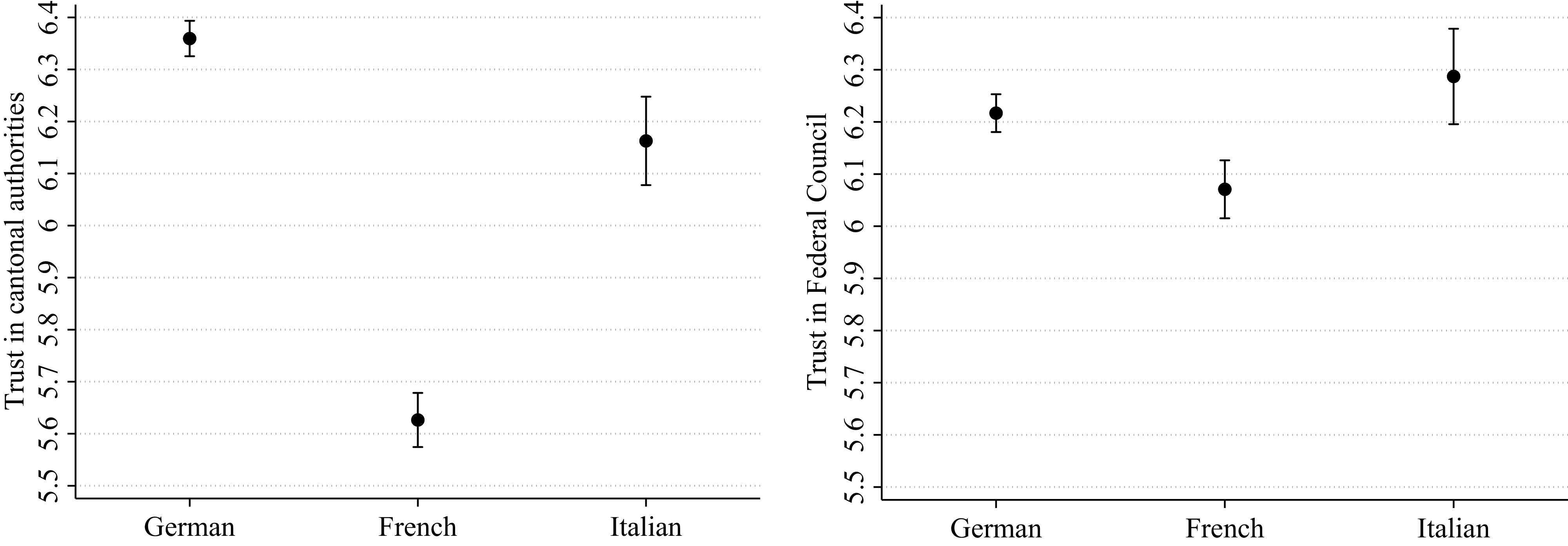
I start by documenting unconditional differences in institutional trust across linguistic groups. The left panel of Figure 1 shows sizeable gaps in trust in cantonal authorities. German-speaking respondents report the highest levels of trust, French-speaking respondents the lowest, with Italian-speaking respondents in between. However, these differences are not straightforward to interpret as cultural differences. The evaluated authority varies across cantons, and language groups are unevenly distributed across these jurisdictions. The observed gap may therefore reflect differences in the cantonal institutions and contexts that respondents evaluate, rather than language-group differences alone.
Average trust in political authorities by language group.
Notes: This figure displays the average unadjusted level of trust in cantonal authorities (left panel) and in the Federal Council (right panel) across language groups in Switzerland, with 95% confidence intervals.

To put these differences into perspective, the right panel compares the same language groups in terms of trust in the Federal Council. This provides a useful descriptive benchmark because the Federal Council is a shared national institution and can be viewed as the national counterpart to cantonal authorities. The comparison does not provide a direct test of culture against institutions because cultural orientations may affect trust in national and cantonal authorities differently. Still, if language groups differed in a general propensity to trust political institutions, similar differences should also be visible for the Federal Council. Comparing the two panels therefore helps assess whether the pronounced language-group differences are specific to cantonal authorities or extend to a common national institution.
The right panel shows that language-group differences in trust in the Federal Council are markedly smaller than those observed for cantonal authorities, with Italian-speaking respondents even reporting slightly higher trust than German speakers.Footnote 4 This pattern suggests that the gaps in cantonal trust are unlikely to reflect only general differences in institutional trust across language groups. The much smaller differences observed for a common national institution are instead consistent with the interpretation that the cantonal context being evaluated plays an important role. At the same time, this does not rule out that cultural attitudes matter for specific institutional evaluations.
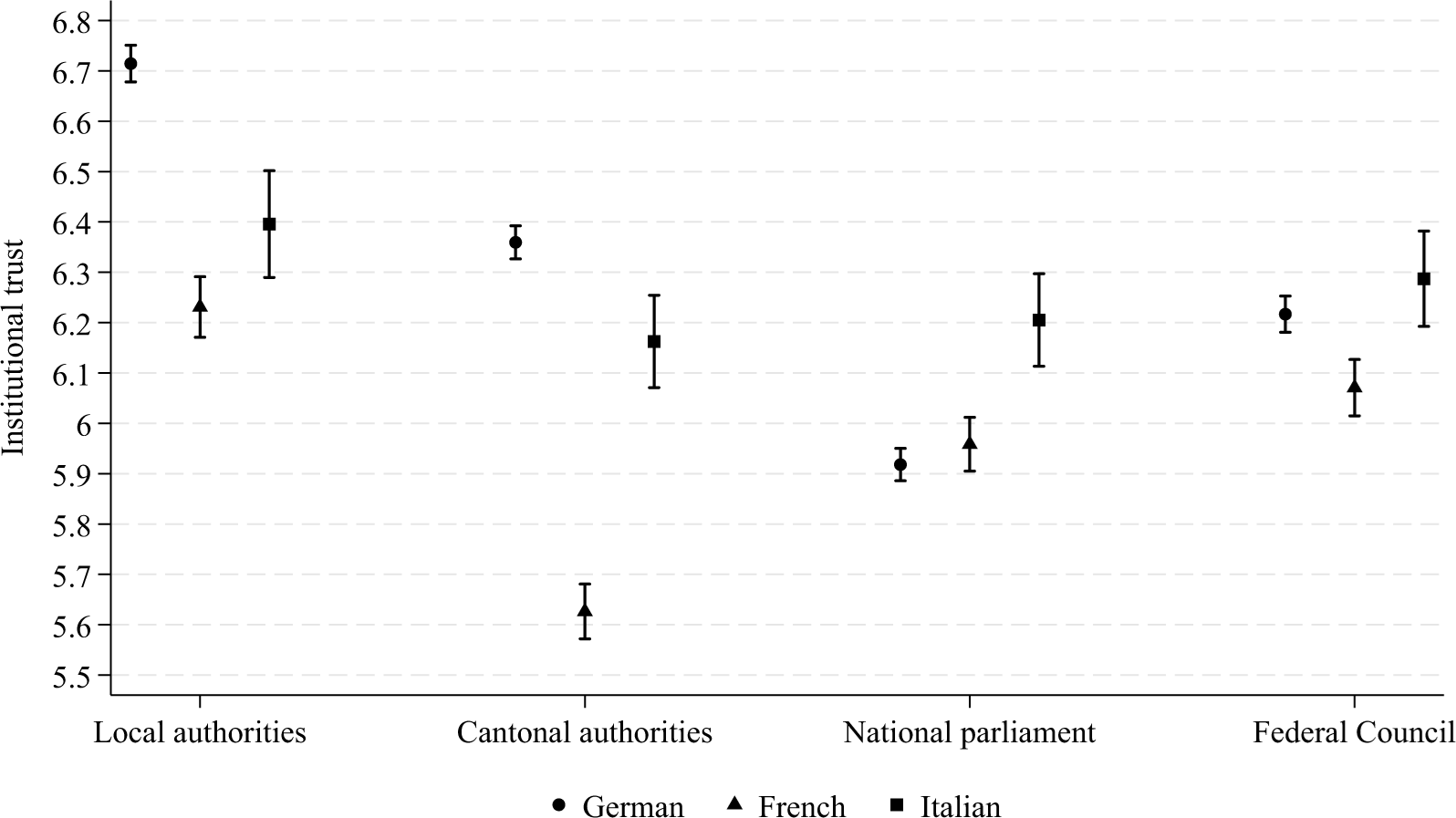
Appendix Figure A1 extends this descriptive comparison to trust in local authorities and the national parliament. The figure shows that language-group patterns are not uniform across institutions. The pattern for local authorities resembles the one for cantonal authorities, although the German–French gap is smaller. By contrast, the pattern for the national parliament differs from both. This reinforces the view that language-group differences in trust are institution-specific and provides little evidence of a general cultural tendency to trust political institutions more or less.
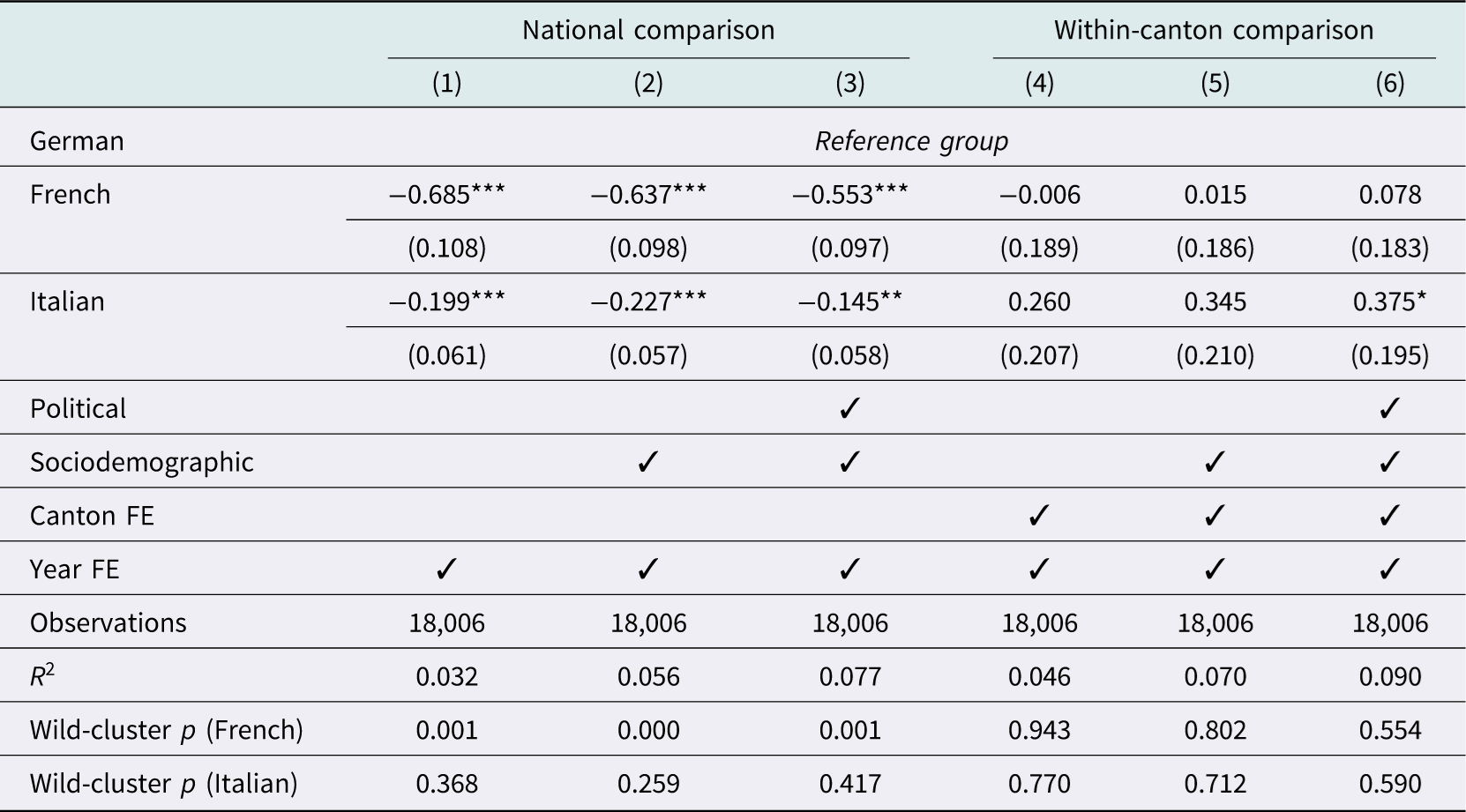
Those findings are in line with the regression results reported in Table 1, which are estimated on the balanced sample.Footnote 5 Columns (1)–(3) compare language groups without canton fixed effects and therefore capture national language-group differences that may reflect both cultural background and systematic differences across the cantonal contexts in which language groups are concentrated. French-speaking respondents report substantially lower trust in cantonal authorities than German speakers across all three specifications. The estimated gap ranges from 0.55 to 0.69 points on the 11-point scale and remains statistically significant when sociodemographic characteristics and political predispositions are included. Italian-speaking respondents also report lower trust than German speakers, with estimated differences of around 0.15 to 0.23 points. However, unlike the French–German gap, the Italian–German difference is not statistically distinguishable from zero under wild-cluster inference in any of these specifications.
Trust in cantonal authorities by language group

Table 1. Long description
The table compares trust in cantonal authorities by language group, with columns for national and within-canton comparisons. It includes rows for German, French, and Italian speakers, with values indicating trust levels and statistical significance. The table also notes the inclusion of political, sociodemographic, and year fixed effects (FE), along with observations and R-squared values. Wild-cluster p-values for French and Italian speakers are provided.
Standard errors are given in parentheses.
*p < 0.10, **p < 0.05, ***p < 0.01.
Notes: The table reports OLS estimates of trust in cantonal authorities by language group, based on the balanced estimation sample. German speakers serve as the reference category. All models include year fixed effects (FE), and standard errors are clustered at the cantonal level. Models (1) and (4) include no additional controls. Models (2) and (5) add sociodemographic controls, and models (3) and (6) additionally include political predispositions. Models (4)–(6) include canton fixed effects. Reported wild-cluster p-values provide additional inference for the French- and Italian-speaking coefficients to account for the small number of canton clusters.
Columns (4)–(6) add canton fixed effects and therefore shift the comparison to respondents from different language groups living within the same canton, holding constant all time-invariant cantonal characteristics. Under this within-canton comparison, the negative French and Italian coefficients observed in the national specifications disappear. The French coefficient is essentially zero, whereas the Italian coefficient turns positive. This pattern is important because it shows that the pooled negative language-group gap is not reproduced within cantons. If anything, the point estimates suggest that Italian-speaking respondents report higher trust than German-speaking respondents living in the same canton. This positive within-canton gap should nevertheless be interpreted cautiously, as inference is sensitive to the limited number of canton clusters. Although one of the positive coefficients is statistically significant at the 10% level using conventional clustered standard errors, the wild-cluster bootstrap p-values reported in the table show that it is no longer statistically distinguishable from zero once the small number of clusters is taken into account.
The control variables, reported in Online Appendix Table E3, show several systematic associations with trust in cantonal authorities. Political interest displays a particularly clear pattern; respondents who are rather uninterested or not interested at all report substantially lower trust than those who are very interested. Trust is also positively associated with age and more right-leaning ideological self-placement, whereas native respondents, divorced respondents, and those without a religious affiliation report lower trust. Female respondents report somewhat higher trust once political predispositions are included. Education is generally positively associated with trust relative to primary schooling, although the magnitude and statistical significance vary across categories, while the positive association with income largely disappears once political predispositions are taken into account. Political knowledge shows only a weak and inconsistent relationship with trust, and municipal population size is not systematically associated with the outcome. Overall, these controls change the estimated language-group differences only modestly and leave the contrast between the national and within-canton estimates largely unchanged.
Beyond the role of observable controls, the interpretation of the within-canton comparison also depends on whether it captures comparable language communities. Because most Swiss cantons are dominated by a single language group, respondents from other language groups living in these cantons may differ systematically from those residing in cantons where their own language group is more strongly represented. They may, for example, have selected into these cantons because of institutional preferences, labour-market opportunities, or other unobserved characteristics. Such selection could contribute to the positive point estimates obtained with canton fixed effects. To reduce this concern, I focus on the officially German–French bilingual cantons of Bern, Fribourg, and Valais, where both language communities are historically established. This provides a more direct comparison of language groups exposed to the same cantonal authority and broader contextual environment, while reducing concerns that the within-canton estimates reflect selective migration into cantons dominated by another language group.
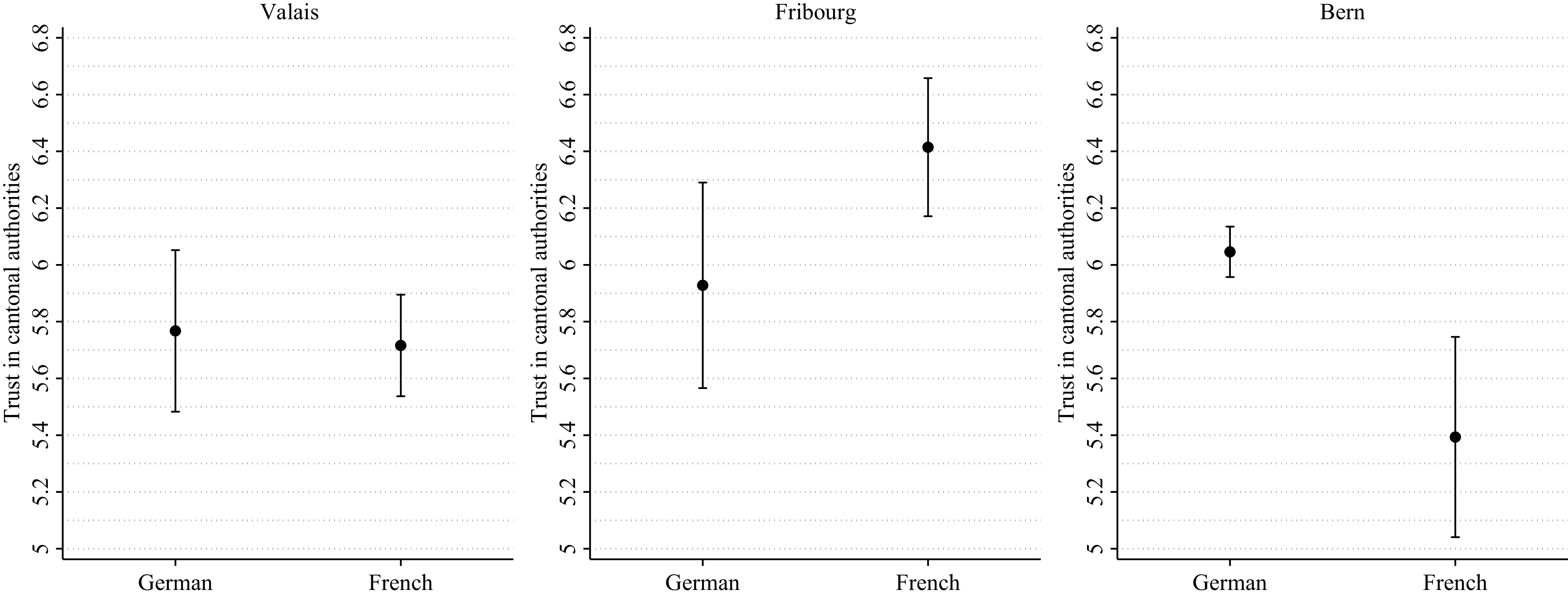
The results from this restricted sample, reported in Figure 2, show that the language-group gradient is not uniform once the cantonal context is held constant. In Valais, German- and French-speaking respondents report very similar levels of trust, with widely overlapping confidence intervals.Footnote 6 In Fribourg, French speakers report higher trust than German speakers, whereas Bern displays the opposite pattern, with French speakers reporting markedly lower trust than German speakers.Footnote 7
Average trust in cantonal authorities by language group in bilingual cantons.
Notes: This figure displays the average unadjusted level of trust in cantonal authorities for German- and French-speaking respondents in the German–French bilingual cantons of Valais, Fribourg, and Bern, with 95% confidence intervals.

This pattern is consistent with an explanation based on linguistic minority status rather than a general cultural difference between German- and French-speaking respondents. In both Fribourg and Bern, the lower-trust group is the linguistic minority: German speakers in Fribourg and French speakers in Bern. The relative size of the gaps points in the same direction. The gap is larger in Bern, where French speakers constitute only around 10 per cent of the cantonal population, than in Fribourg, where the German-speaking minority accounts for roughly 30 per cent.Footnote 8
A plausible explanation is that smaller linguistic minorities experience weaker descriptive representation (Gay, Reference Gay2002), lower perceived responsiveness (Minta and Sinclair-Chapman, Reference Minta and Sinclair-Chapman2013), or greater administrative distance (Riccucci et al., Reference Riccucci, Van Ryzin and Lavena2014) from cantonal authorities, which may contribute to lower trust in those authorities. The case of Moutier illustrates how such tensions can become politically salient; the French-speaking municipality voted to leave the canton of Bern and join the predominantly French-speaking canton of Jura, with the transfer taking effect in 2026. Although this case is not representative of French-speaking Bern as a whole, it highlights how questions of cantonal affiliation and representation can matter for linguistic communities. More generally, the observed trust gaps may therefore be related to how language groups are positioned within particular cantonal contexts.
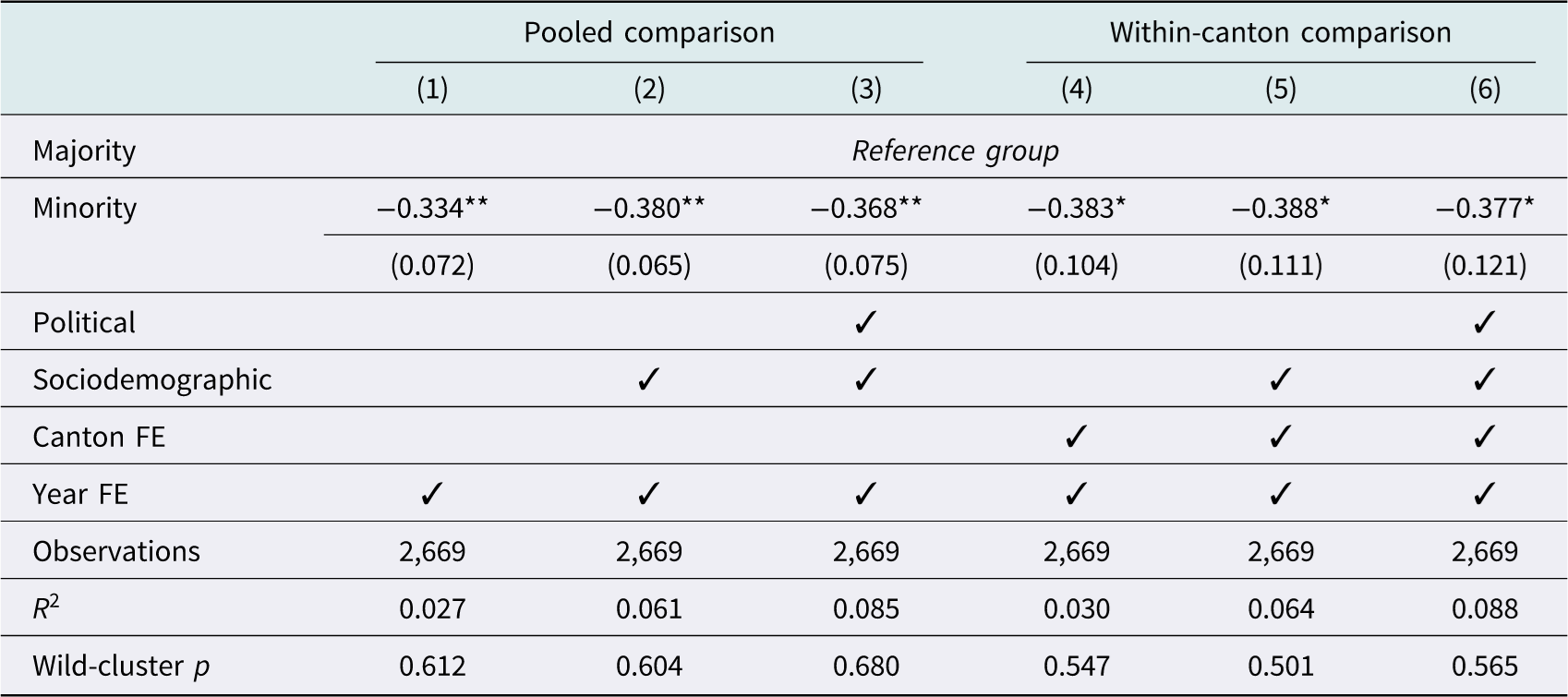
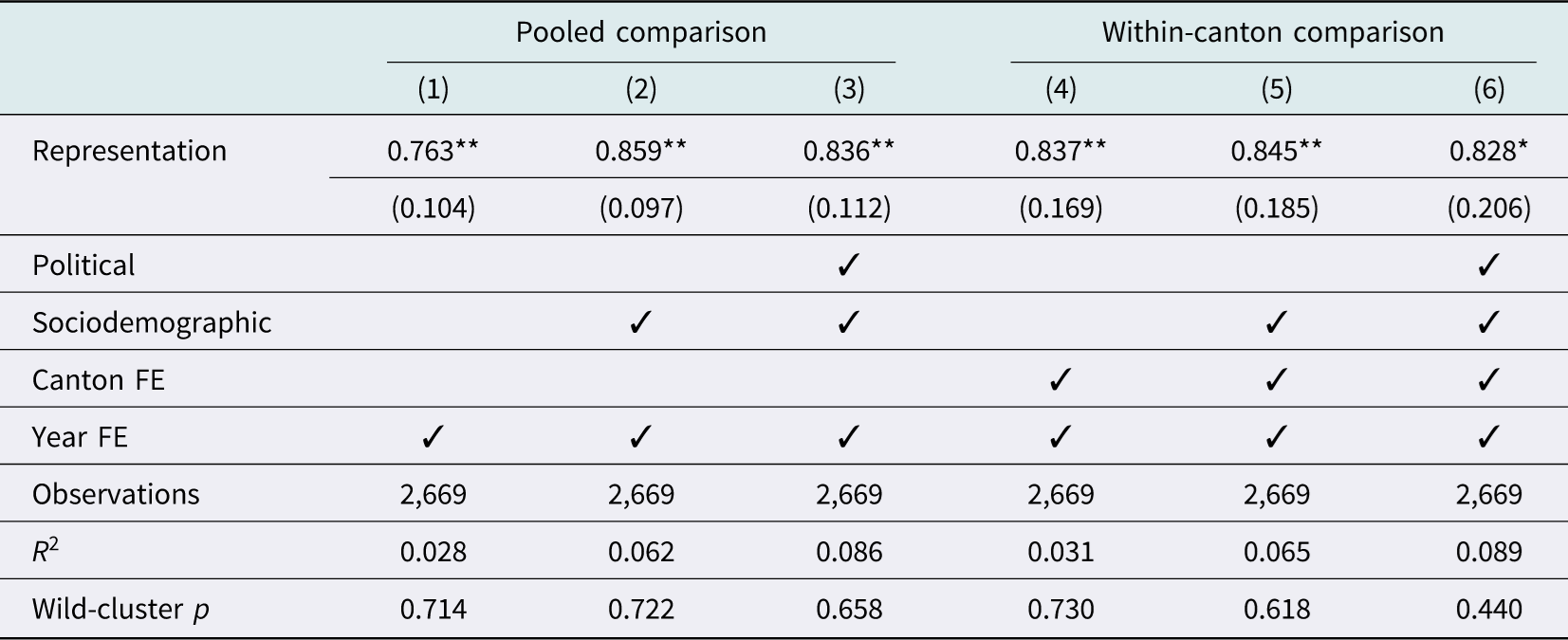
To examine these mechanisms more directly, I introduce two additional measures. First, respondents are classified as belonging to a linguistic minority when their language group constitutes the smaller of the two language communities within the canton. Second, political representation is measured as the share of cantonal government members coming from the respondent’s language region. Minority status is consistently associated with lower trust in cantonal authorities (Appendix Table A3), whereas greater descriptive representation is associated with higher trust (Appendix Table A4). Both associations are statistically significant using conventional clustered standard errors and remain similar in magnitude across specifications. However, the coefficients are not statistically distinguishable from zero under wild-cluster inference. Taken together, these results are consistent with the view that language-group differences in trust reflect groups’ position and representation within the canton rather than culture as proxied by language alone.
Institutional context and institutional trust
The results so far suggest that the language gap in trust in cantonal authorities is closely related to systematic differences between cantons. Although the gap is sizeable in pooled comparisons, it largely disappears once canton fixed effects are included. This does not identify which cantonal characteristics matter because fixed effects absorb the full bundle of stable canton-level differences, including institutions and other persistent contextual features. The finding therefore points to the importance of between-canton variation but does not by itself reveal its source.
To move beyond this aggregate canton-level adjustment, I examine one specific institutional feature that is theoretically relevant and varies meaningfully across cantons: direct-democratic participation rights. These rights differ substantially in their accessibility across cantons and may be particularly relevant for institutional trust because they provide citizens with formal opportunities to influence political decision-making. Initiatives and referenda allow citizens to propose policy changes or challenge political decisions, potentially bringing policy more closely into line with citizens’ preferences. Participation rights may also matter through the political process itself, as meaningful opportunities for voice can signal procedural fairness. Consistent with these arguments, previous research in Switzerland links more accessible direct-democratic rights to higher trust in the authorities directly subject to them (Bauer and Fatke, Reference Bauer and Fatke2014; Kuhn and Torgler, Reference Kuhn and Torgler2026). Including this measure therefore allows us to examine whether the between-canton component of the language gap is associated with a specific institutional feature rather than only with the broader bundle of stable cantonal differences captured by canton fixed effects.
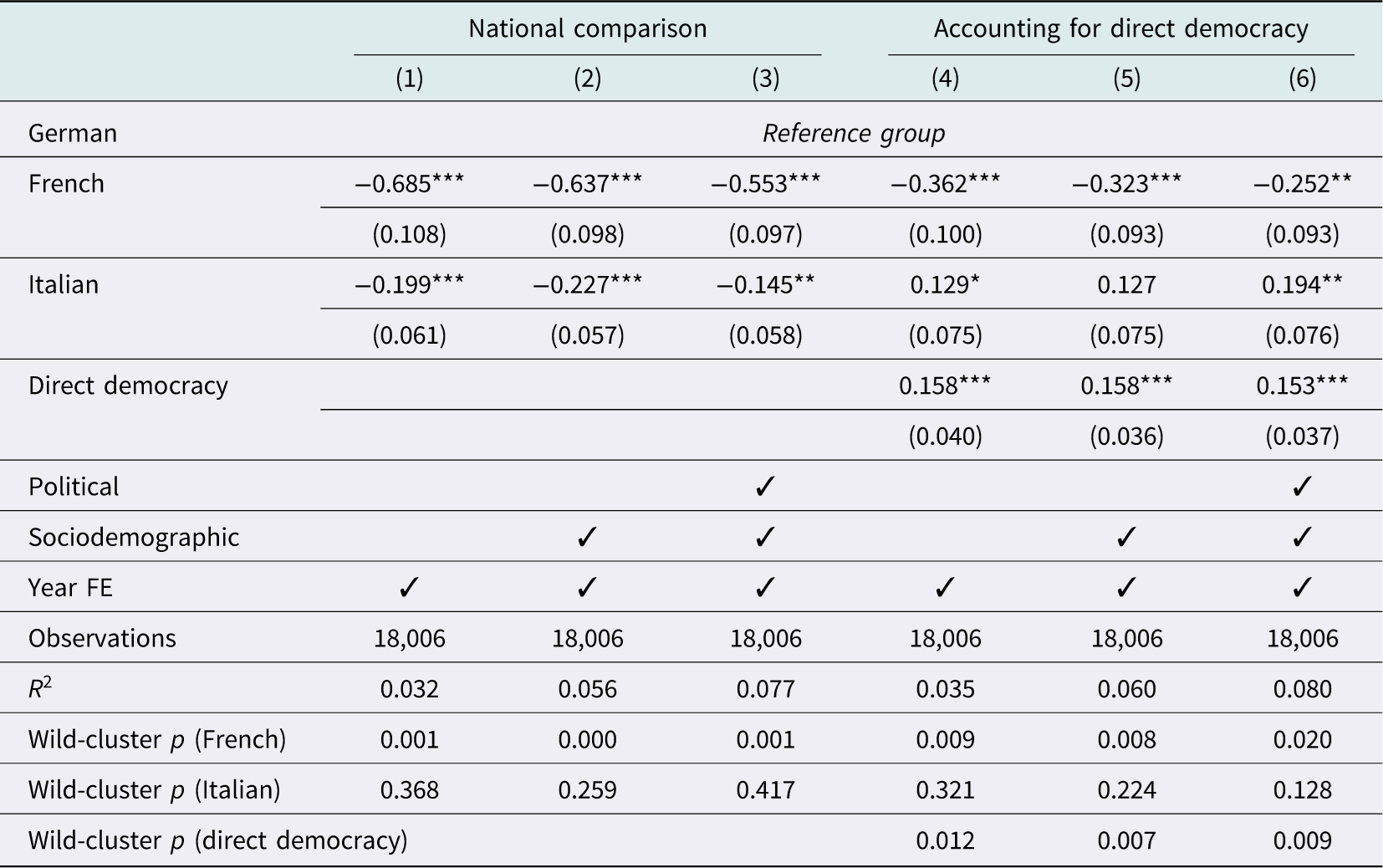
Table 2 shows that the French–German trust gap observed in the national comparison is substantially attenuated once the direct-democracy index is included. Across otherwise identical specifications, the estimated gap declines from 0.55–0.69 to 0.25–0.36 points, corresponding to a reduction of approximately 47% to 54%.
Trust in cantonal authorities by language group, with direct-democratic rights

Table 2. Long description
The table compares trust in cantonal authorities by language group, accounting for direct-democratic rights. It has six columns and seven rows, including a reference group. Column headers are National comparison (1), (2), (3), Accounting for direct democracy (4), (5), (6). Row labels are German, French, Italian, Direct democracy, Political, Sociodemographic, Year FE, Observations, R-squared, Wild-cluster p (French), Wild-cluster p (Italian), Wild-cluster p (direct democracy). Each row contains values and standard errors in parentheses. The table also includes indicators for political, sociodemographic, and year fixed effects, along with observations, R-squared values, and wild-cluster p-values for different groups.
Standard errors are given in parentheses.
*p < 0.10, **p < 0.05, ***p < 0.01.
Notes: The table reports OLS estimates of trust in cantonal authorities by language group, based on the balanced estimation sample. German speakers serve as the reference category. All models include year fixed effects, and standard errors are clustered at the cantonal level. Models (1) and (4) include no additional controls. Models (2) and (5) add sociodemographic controls, and models (3) and (6) additionally include political predispositions. Models (4)–(6) additionally account for differences in the level of direct democracy. Reported wild-cluster p-values provide additional inference for the French- and Italian-speaking coefficients and, in models (4)–(6), for the direct-democracy coefficient, to account for the limited number of canton clusters.
For Italian-speaking respondents, the coefficient changes sign once the direct-democracy index is included. Although the baseline estimates are negative, the coefficients in columns (4)–(6) become positive, ranging from 0.13 to 0.19 points. This pattern is consistent with the lower trust observed in the national comparison being related to the cantonal contexts in which Italian-speaking respondents are concentrated, including differences in direct-democratic institutions. At the same time, the estimates may also reflect selective sorting of respondents across cantons and other unobserved canton-level characteristics. The positive coefficients should therefore not be interpreted as evidence of a robust Italian-language effect, particularly because they are not statistically distinguishable from zero under wild-cluster inference.
The direct-democracy coefficient is positive and stable across specifications. A one-unit increase in the index is associated with approximately 0.16 points higher trust in cantonal authorities. This estimate changes little when sociodemographic and political covariates are added – a pattern in line with previous evidence linking stronger direct-democratic rights to higher institutional trust in Switzerland. At the same time, direct-democratic rights may proxy for other canton-level characteristics that are correlated with both language-region composition and institutional trust. To assess this possibility, I therefore use two additional canton-level contextual variables as benchmarks.
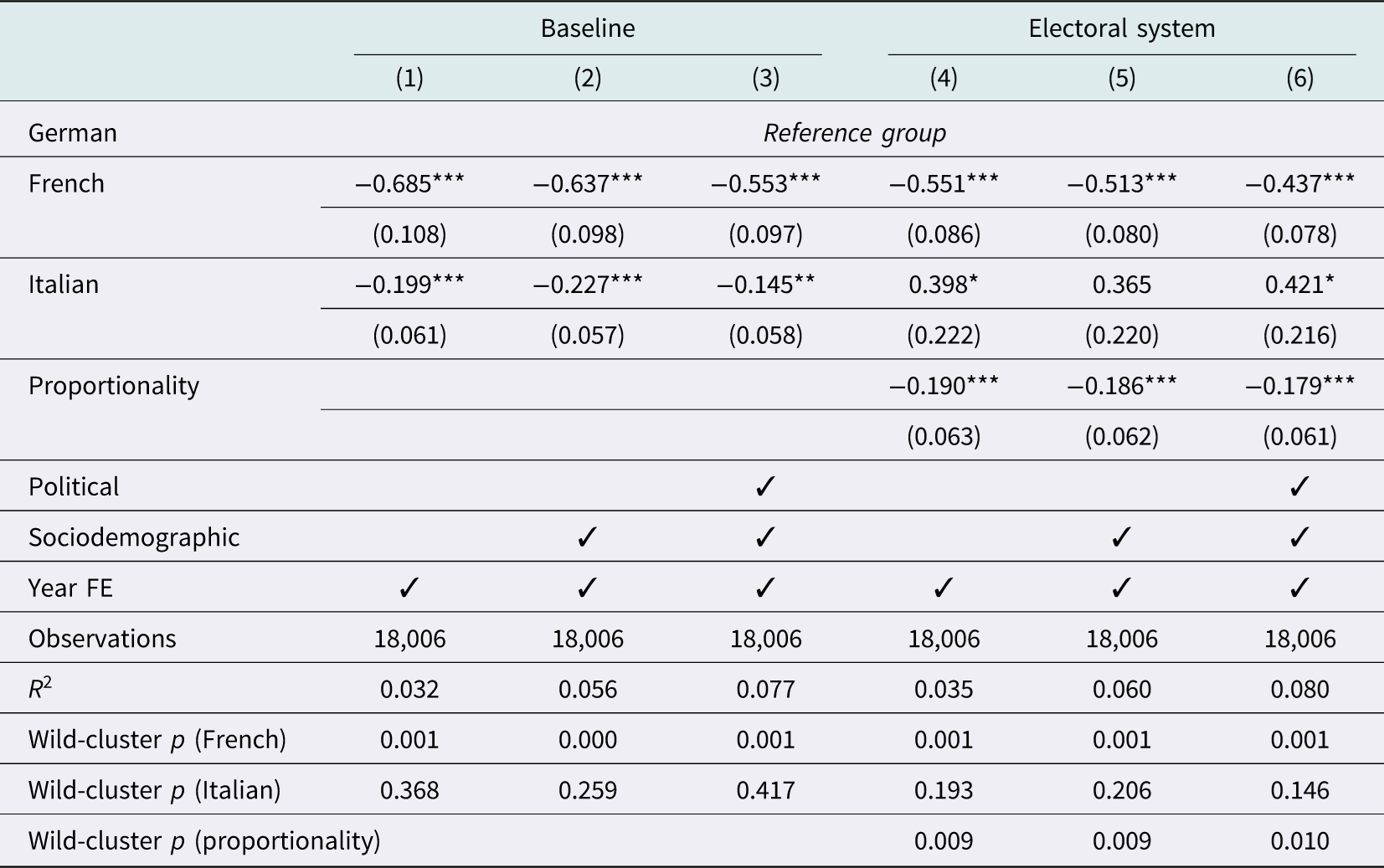
The first benchmark captures the proportionality of cantonal electoral systems. The data are taken from Vatter et al. (Reference Vatter, Arnold, Arens, Vogel, Bühlmann, Schaub, Dlabac, Wirz, Freiburghaus and Della Porta2024), who provide a combined measure of the electoral rules used for cantonal government and parliamentary elections on a scale from zero to six, with higher values indicating more proportional systems. Electoral rules provide a useful institutional benchmark because they shape how political preferences are translated into representation and therefore constitute another potentially relevant dimension of the cantonal context. Appendix Table A5 shows that greater proportionality is associated with lower trust in cantonal authorities. Including the measure also attenuates the French–German trust gap, but substantially less than the direct-democracy index. The Italian coefficient turns positive, although it is not statistically distinguishable from zero under wild-cluster inference.
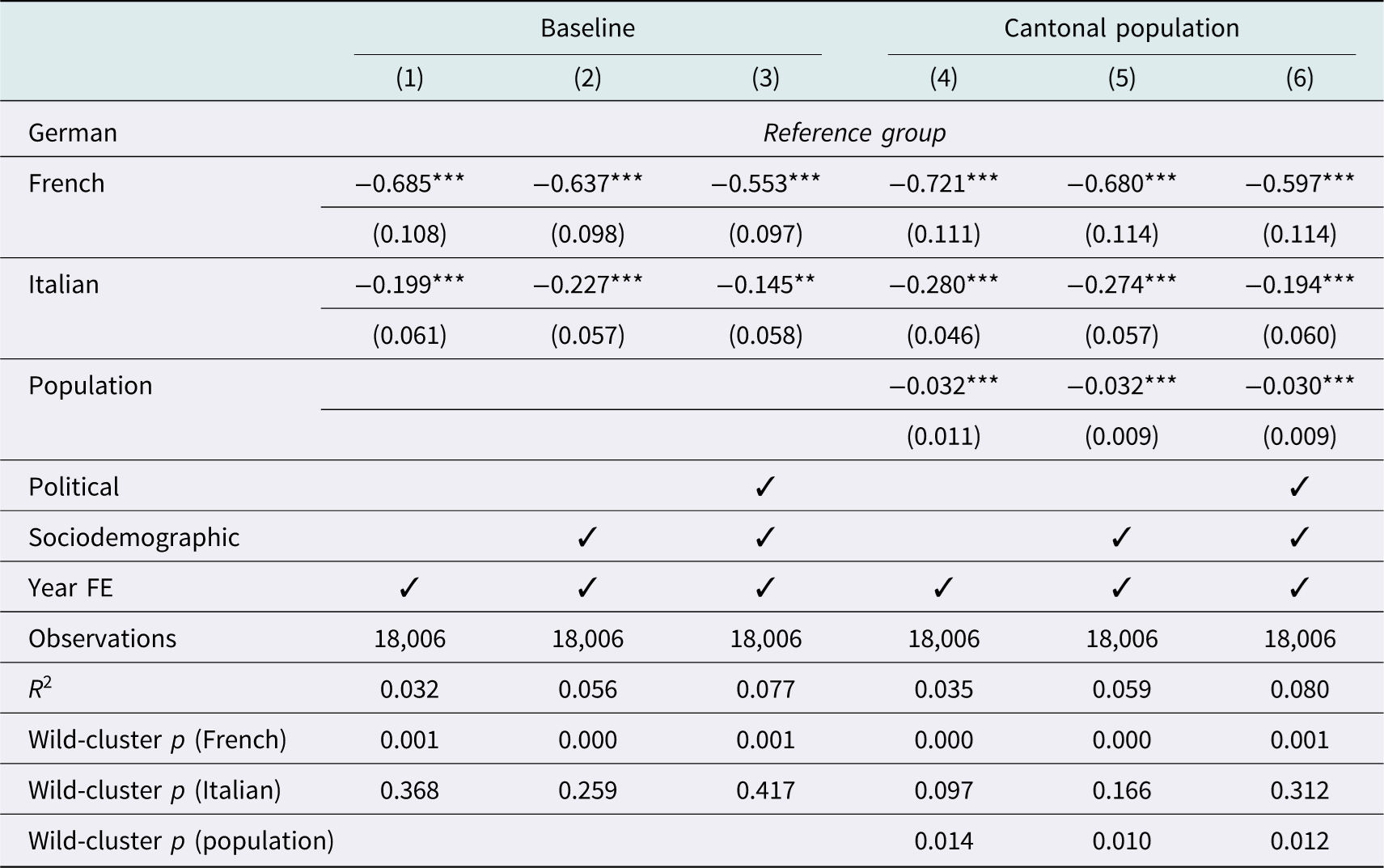
The second benchmark captures cantonal population size, measured in units of 100,000 inhabitants.Footnote 9 Population size may capture several features of the cantonal context that are relevant for institutional trust, including the proximity between citizens and political authorities and opportunities for direct interaction. Population size therefore provides a useful benchmark for assessing whether the attenuation associated with direct democracy reflects broader structural differences across cantons rather than direct-democratic institutions specifically. Appendix Table A6 shows that population size is negatively associated with trust in cantonal authorities, with respondents in more populous cantons reporting lower trust. However, including population does not attenuate the language-group gaps. Instead, the estimated differences become somewhat more negative for both French- and Italian-speaking respondents. This contrasts with the attenuation observed when direct-democratic participation rights are included.
Robustness
The main results are assessed through a series of robustness checks. These examine whether the findings depend on the use of the balanced estimation sample, the linear treatment of the trust scale, or broader trust orientations across political institutions rather than trust in cantonal authorities specifically. Finally, I assess whether the results are robust to using religious affiliation as an alternative observable marker of cultural background.
First, I re-estimate the main specifications using all observations available for each specification rather than restricting all models to the balanced estimation sample. The results, reported in Online Appendix Tables E4 and E6, are very similar to the baseline findings. In the national comparisons, French-speaking respondents report substantially lower trust than German speakers, and the corresponding Italian coefficients are smaller and not robust under wild-cluster inference. Once canton fixed effects are included, the French–German gap again disappears, and the Italian coefficients become positive, although neither language-group difference is statistically distinguishable from zero under wild-cluster inference. Likewise, including direct-democratic participation rights substantially attenuates the French–German gap, whereas the direct-democracy coefficient remains positive and statistically significant. The main results are therefore not driven by restricting the analysis to a common balanced sample.
Second, I account for the ordinal nature of the dependent variable by re-estimating the main models using ordered probit regressions. Online Appendix Tables E5 and E7 reproduce the same qualitative pattern. The French–German difference is negative in the national specifications but essentially disappears once canton fixed effects are included. Similarly, accounting for direct-democratic participation rights substantially reduces the French coefficient, whereas the direct-democracy coefficient remains positive. The Italian coefficients again change sign when either canton fixed effects or direct democracy are introduced, but inference remains sensitive to the limited number of canton clusters. Thus, treating the 0–10 trust scale as cardinal rather than ordinal does not drive the substantive conclusions.
Third, I examine whether the language-group patterns are specific to trust in cantonal authorities or instead reflect broader differences in political trust across language groups. Online Appendix Table E8 therefore adds respondents’ trust in other political institutions to otherwise comparable specifications. Including these measures modestly reduces the negative French–German difference in the national comparison and further attenuates it in the direct-democracy specification. The within-canton coefficients remain positive, and the Italian coefficients show the same general pattern as in the main analysis. Notably, the positive association between direct-democratic participation rights and trust in cantonal authorities remains stable when trust in other institutions is included. Because cultural groups may differ in a general propensity to trust political institutions rather than only in their evaluations of specific institutions, these variables may themselves capture part of the cultural variation of interest. I therefore regard specifications controlling for trust in other institutions as a complementary robustness check that distinguishes institution-specific evaluations from a more general propensity to trust, rather than as preferred baseline models.
As a final check, I replace language group with religious affiliation as an alternative observable cultural marker. This check is not intended to replace language as the main proxy for culture, but to assess whether a similar trust gap appears when culture is proxied by another historically relevant cleavage available in the data. It is informative because Protestant and Catholic citizens are both substantially represented within several cantons, allowing us to compare two historically relevant groups within the same cantonal context. For example, in Vaud, 28.9% of residents are Protestant and 31.1% are Catholic; in Zürich, the corresponding shares are 33.9% and 27.9%; and in Graubünden, 35.4% and 44.3%.Footnote 10 This broad pattern is also reflected in the survey data used in this analysis, as shown in Appendix Table A1. The use of religious affiliation is further supported by previous research that relies on the Catholic–Protestant distinction to study culturally rooted differences within Switzerland. Volonté (Reference Volonté2015) uses religious affiliation, alongside language, as a proxy for culture in an analysis of corporate governance, whereas Basten and Betz (Reference Basten and Betz2013) use historical variation between Reformed Protestantism and Catholicism to study the role for individual and political preferences.
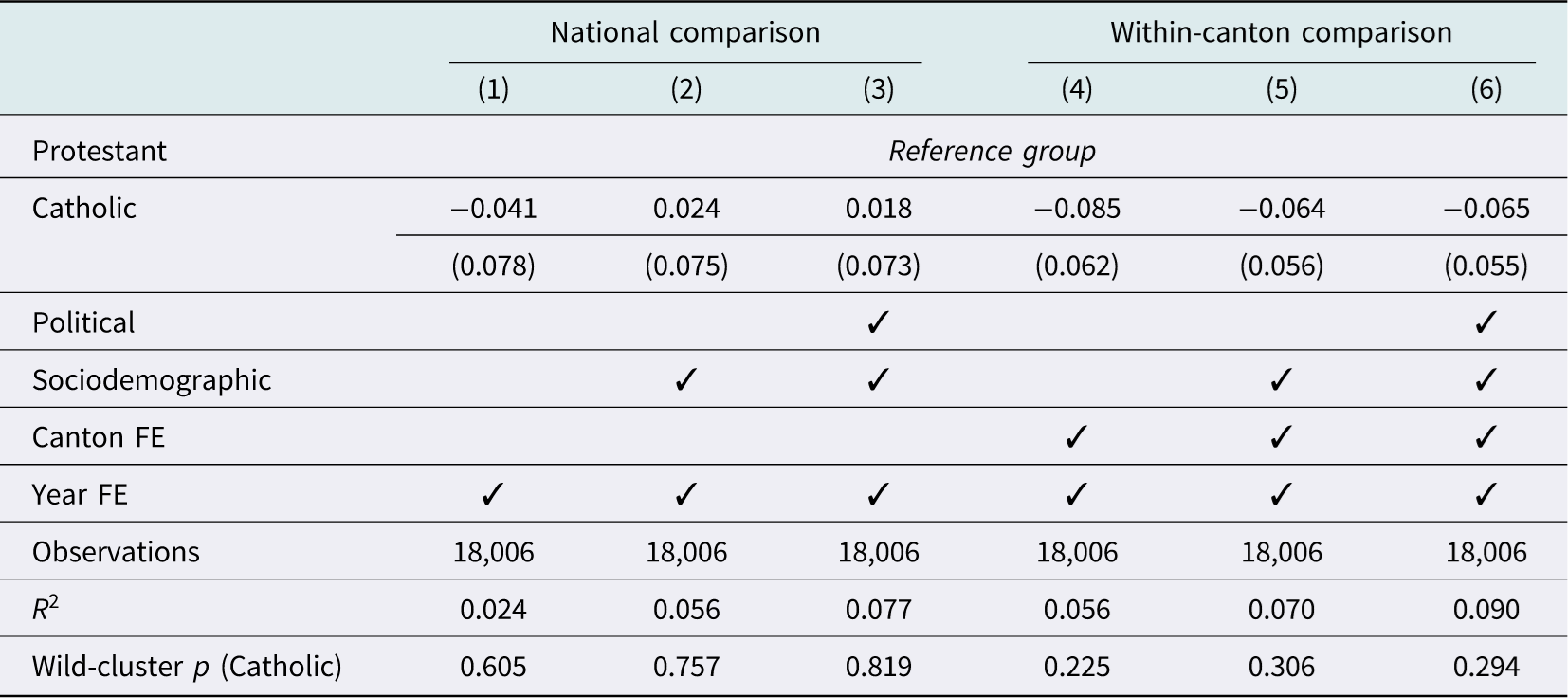
Appendix Table A7 shows no systematic Catholic–Protestant difference in trust in cantonal authorities. Across all specifications, the Catholic coefficient is small and statistically insignificant, both in national comparisons and once canton fixed effects are included. This does not rule out other cultural cleavages, including regional cultural boundaries that cannot be observed in the data. However, the absence of a systematic trust difference along this second, historically salient cultural dimension provides additional evidence that cultural background, at least as captured by the observable proxies available here, is not consistently associated with trust in cantonal authorities. This is consistent with the overall interpretation that the pronounced language-group gap is closely tied to cantonal context rather than to cultural background.
Discussion
The findings suggest that observed language-group differences in institutional trust are closely tied to the cantonal contexts in which linguistic groups are embedded. In national comparisons, French-speaking respondents report significantly lower trust in cantonal authorities than German-speaking respondents. Taken at face value, such a difference could be interpreted as evidence of culturally rooted orientations towards political institutions. However, the broader set of results points to a more contextual interpretation. The language-group differences largely disappear once respondents are compared within the same canton, vary across bilingual cantons and across the political institutions being evaluated, are substantially attenuated when direct-democratic participation rights are taken into account, and are not reproduced when religious affiliation is used as an alternative cultural marker. Taken together, these findings make an explanation based on stable, context-invariant cultural differences less convincing.
The distinction between national and within-canton comparisons is central to this interpretation because national comparisons combine potential cultural differences with systematic variation in the cantonal authorities and contexts that respondents evaluate. Comparing respondents within the same canton reduces this contextual variation by holding stable canton-specific factors constant. The attenuation of the language-group differences in these comparisons therefore suggests that the pronounced national gap is largely associated with between-canton variation rather than with differences that persist among language groups exposed to the same cantonal context. More generally, this highlights the difficulty of distinguishing cultural differences from contextual differences when cultural groups are unevenly distributed across institutional environments.
The bilingual-canton analysis provides some indication of how these contextual differences may matter. The direction of the French–German trust gap varies across Bern, Fribourg, and Valais, and in both Bern and Fribourg the lower-trust group is the linguistic minority. Consistent with this pattern, minority status is associated with lower trust, whereas greater representation of the respondent’s language region in the cantonal government is associated with higher trust. These findings are compatible with several mechanisms. Minority status may be associated with weaker descriptive representation, lower perceived responsiveness, or greater distance from political authorities. Greater representation may, in turn, strengthen the perception that a group’s interests are present in political decision-making. The present data cannot distinguish among these mechanisms, and the corresponding estimates are imprecise under wild-cluster inference. They nevertheless point towards group position within the institutional setting as a potentially relevant dimension of trust.
Direct-democratic participation rights suggest a related but distinct channel. More accessible participation rights are positively associated with trust in cantonal authorities and substantially attenuate the French–German trust gap. By giving citizens opportunities to challenge political decisions, propose policy changes, and participate directly in decision-making, such institutions may affect both the alignment of policy with citizens’ preferences and perceptions of the fairness of the political process. In this sense, participation may be relevant not only because of the policies it produces but also because opportunities for voice can shape how citizens experience political authority. The fact that electoral-system proportionality attenuates the French–German gap much less, whereas cantonal population size does not attenuate it at all, provides some indication that the direct-democracy result is not simply a mechanical consequence of adding any canton-level characteristic. At the same time, these comparisons do not establish a causal role for direct-democratic institutions, which may still proxy for other features of the cantonal context.
These findings also speak to the debate over cultural and institutional explanations of political trust. A notable feature of the results is that neither of the two observable cultural markers used in the analysis produces a stable trust gradient once contextual differences are taken into account. The negative language-group differences observed nationally are not reproduced within cantons, and Catholic and Protestant respondents show no systematic difference in trust either nationally or within cantons. This makes an explanation based on stable, context-invariant cultural orientations less convincing. At the same time, these results should not be taken to imply that culture is irrelevant. Language and religion capture only particular dimensions of cultural background, and interview language is necessarily an imperfect proxy for the values, beliefs, and experiences acquired through socialization. Moreover, culture and institutions need not be fully independent. Historically rooted cultural norms may influence the development and persistence of institutions, while those institutions may in turn shape the cultural attitudes and expectations through which citizens evaluate public authority. The contribution of the analysis is therefore not to identify a clean causal separation between culture and institutions, but to show that observed differences between cultural groups need not primarily reflect enduring group-specific orientations.
Taken together, the minority-status, representation, and direct-democracy results point to a common institutional theme: how citizens and groups are positioned within political institutions and what opportunities they have for voice and representation. In culturally or linguistically divided settings, differences in trust may therefore depend not only on group membership itself, but also on whether groups are represented in political decision-making and whether citizens have meaningful opportunities to influence it. The negative association of institutional trust with minority status, the positive association with representation, and the positive association with direct-democratic participation rights are all consistent with this interpretation, although the data do not establish these relationships causally.
The scope of these findings extends beyond Switzerland and, more importantly, beyond multilingual political systems. Switzerland provides a particularly useful setting because linguistic groups are unevenly distributed across cantonal environments, making it possible to examine how observed group differences in trust change once these contextual differences are taken into account. The broader insight, however, does not depend on language itself. What matters is that social groups may be systematically exposed to different political and institutional environments or occupy different positions within the same institutions. Even in relatively culturally homogeneous societies, groups may differ in the authorities they encounter, their representation within them, or their opportunities for political participation. The specific Swiss combination of linguistic diversity, federalism, and direct democracy is therefore particular to this case, although the underlying insight is more general; observed differences in institutional trust may reflect the contexts in which groups experience public authority rather than enduring group-specific orientations alone. Accounting for these contextual differences is consequently important before interpreting trust gaps as evidence of cultural differences.
Conclusions
I use Switzerland’s linguistic and institutional diversity to examine whether apparent cultural differences in institutional trust persist once the cantonal contexts in which linguistic groups are embedded are taken into account. In national comparisons, French-speaking respondents report lower trust in cantonal authorities than German-speaking respondents. Yet this difference weakens sharply once respondents are compared within the same canton. The language-group pattern also varies across the institutions being evaluated and is not reproduced when religious affiliation is used as an alternative cultural marker. Evidence from German–French bilingual cantons further suggests that language-group differences depend on groups’ position within specific cantonal contexts rather than reflecting a uniform cultural divide. Taken together, the results indicate that the prominent national language gradient in trust is primarily a between-canton phenomenon.
I then examine whether one specific institutional feature is associated with this between-canton variation. Once cantonal direct-democratic participation rights are taken into account, the French–German trust gap is substantially attenuated, while the direct-democracy coefficient itself is positive and stable across specifications. This pattern is consistent with the idea that opportunities for political participation and voice may be related to how citizens evaluate cantonal authorities. These results should not be interpreted as causal effects of direct democracy, as the index may also capture other persistent canton-level characteristics. They nevertheless indicate that the national language-group gap is closely related to concrete features of the cantonal institutional environment rather than only to language-group membership itself.
The broader implication is that institutional trust should not be understood simply as an exogenous cultural trait carried by groups across contexts. Instead, observed group differences may reflect the institutional environments in which citizens are embedded, their position and representation within those institutions, and the opportunities they have for political participation and voice. This does not imply that culture is irrelevant or that culture and institutions can be cleanly separated. It does, however, caution against interpreting observed differences between groups as cultural differences without accounting for the contexts in which those groups are embedded.
Supplementary material
The supplementary material for this article can be found at: https://doi.org/10.1017/S1744137426100940.
Declaration of generative AI and AI-assisted technologies in the manuscript preparation process
During the preparation of this work, the author used ChatGPT (OpenAI) to assist with coding, proofreading, and language editing. After using this tool, the author reviewed and edited the content as needed and takes full responsibility for the content of the published article.
Appendix
Average institutional trust by language group.
Notes: The figure displays average levels of trust in local authorities, cantonal authorities, the national parliament, and the Federal Council by language group. Trust is measured on an 11-point scale ranging from 0, no trust at all, to 10, complete trust. Markers indicate group means and vertical bars indicate 95% confidence intervals.

Canton-level descriptive statistics of key variables

Table A1. Long description
The table presents descriptive statistics of key variables for various cantons. It includes columns for Trust in cantonal authorities, Direct democracy, percentages of German, French, Italian speakers, and percentages of Protestant and Catholic populations. The table has 26 rows and 8 columns. Each row represents a canton with its corresponding statistics. Notable trends include high trust in cantonal authorities in cantons like UR and AI, and varying percentages of language and religious groups across cantons.
Notes: Trust in cantonal authorities and the direct-democracy index are reported as canton-level averages. Language and religious groups are reported as percentages of all respondents within each canton. Abbreviations refer to official two-letter canton codes: AG (Aargau), AI (Appenzell Innerrhoden), AR (Appenzell Ausserrhoden), BE (Bern), BL (Basel-Landschaft), BS (Basel-Stadt), FR (Fribourg), GE (Genève), GL (Glarus), GR (Graubünden), JU (Jura), LU (Luzern), NE (Neuchâtel), NW (Nidwalden), OW (Obwalden), SG (St. Gallen), SH (Schaffhausen), SO (Solothurn), SZ (Schwyz), TG (Thurgau), TI (Ticino), UR (Uri), VD (Vaud), VS (Valais), ZG (Zug), and ZH (Zürich).
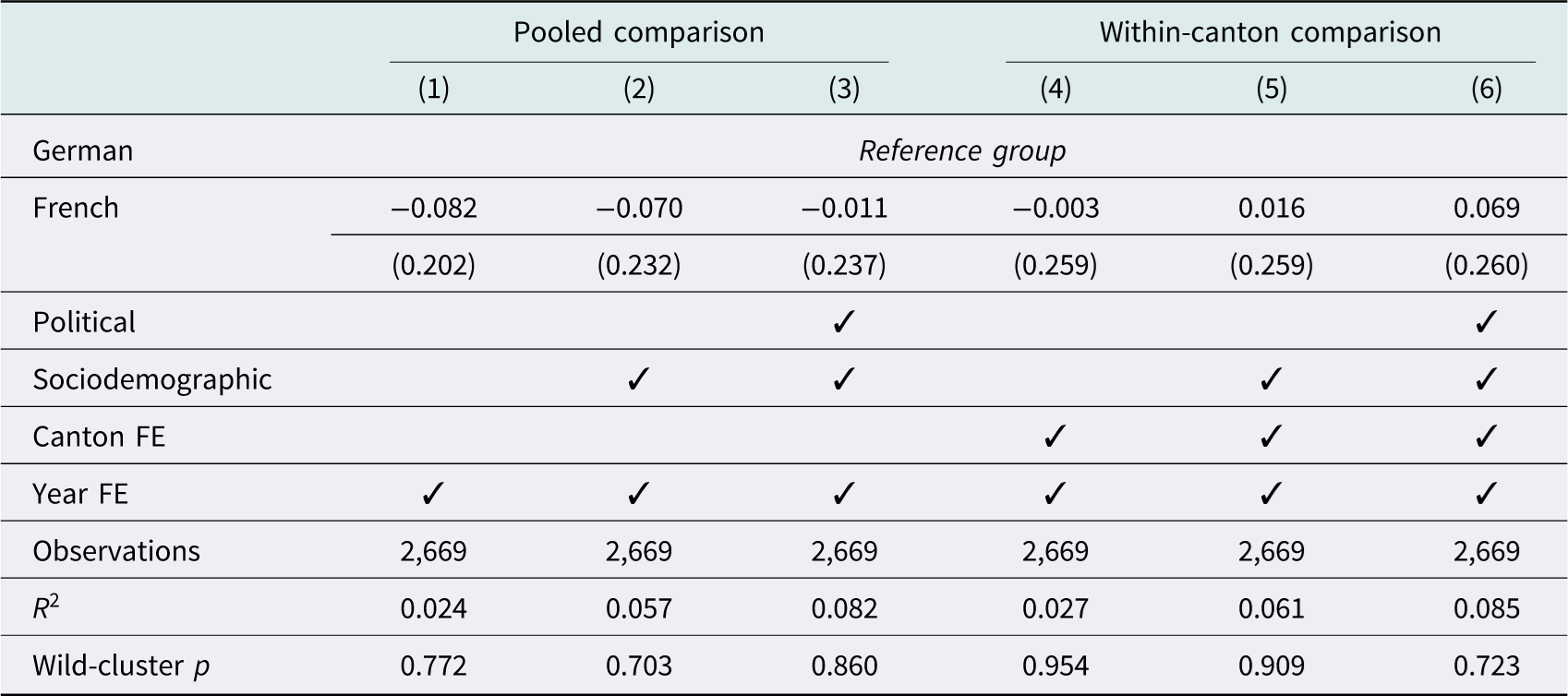
Trust in cantonal authorities by language group within bilingual cantons

Table A2. Long description
The table compares trust in cantonal authorities by language group within bilingual cantons. It has six columns and eleven rows. The columns are labeled Pooled comparison (1), Pooled comparison (2), Pooled comparison (3), Within-canton comparison (4), Within-canton comparison (5), and Within-canton comparison (6). The rows are labeled German, French, Political, Sociodemographic, Canton FE, Year FE, Observations, R2, and Wild-cluster p. The German group serves as the reference group. The French group has values -0.082, -0.070, -0.011, -0.003, 0.016, and 0.069 with standard errors in parentheses. The table includes observations of 2,669 for each column, R2 values ranging from 0.024 to 0.085, and wild-cluster p-values ranging from 0.772 to 0.954. The table also indicates the inclusion of political, sociodemographic controls, canton fixed effects, and year fixed effects.
Standard errors are given in parentheses.
Notes: The table reports OLS estimates of trust in cantonal authorities by language group, based on the balanced estimation sample, restricted to bilingual cantons. German speakers serve as the reference category. All models include year fixed effects, and standard errors are clustered at the cantonal level. Models (1) and (4) include no additional controls. Models (2) and (5) add sociodemographic controls, and models (3) and (6) additionally include political predispositions. Models (4)–(6) include canton fixed effects. Reported wild-cluster p-values provide additional inference for the French-speaking coefficient to account for the small number of canton clusters.
Trust in cantonal authorities by minority status within bilingual cantons

Table A3. Long description
The table has six columns and ten rows. Column headers are Pooled comparison (1), Pooled comparison (2), Pooled comparison (3), Within-canton comparison (4), Within-canton comparison (5), and Within-canton comparison (6). Row labels are Majority, Minority, Political, Sociodemographic, Canton FE, Year FE, Observations, R2, and Wild-cluster p. Row 1: Majority, Reference group. Row 2: Minority, -0.334 (0.072), -0.380 (0.065), -0.368 (0.075), -0.383 (0.104), -0.388 (0.111), -0.377 (0.121). Row 3: Political, blank, checkmark, checkmark, blank, checkmark, checkmark. Row 4: Sociodemographic, checkmark, checkmark, checkmark, checkmark, checkmark, checkmark. Row 5: Canton FE, blank, blank, blank, checkmark, checkmark, checkmark. Row 6: Year FE, checkmark, checkmark, checkmark, checkmark, checkmark, checkmark. Row 7: Observations, 2,669, 2,669, 2,669, 2,669, 2,669, 2,669. Row 8: R2, 0.027, 0.061, 0.085, 0.030, 0.064, 0.088. Row 9: Wild-cluster p, 0.612, 0.604, 0.680, 0.547, 0.501, 0.565.
Standard errors are given in parentheses.
*p < 0.10, **p < 0.05.
Notes: The table reports OLS estimates of trust in cantonal authorities by linguistic minority status, based on the balanced estimation sample, restricted to bilingual cantons. Majority-group respondents serve as the reference category. All models include year fixed effects and language-group controls, and standard errors are clustered at the cantonal level. Models (1) and (4) include no additional controls. Models (2) and (5) add sociodemographic controls, and models (3) and (6) additionally include political predispositions. Models (4)–(6) include canton fixed effects. Reported wild-cluster p-values provide additional inference for the minority-status coefficient to account for the small number of canton clusters.
Trust in cantonal authorities by representation within bilingual cantons

Table A4. Long description
The table presents OLS estimates of trust in cantonal authorities by the representation of respondents’ language group in the cantonal government, based on a balanced estimation sample, restricted to bilingual cantons. It includes six columns for pooled comparison and within-canton comparison, each with different models and controls. Row 1: Representation, 0.763, 0.859, 0.836, 0.837, 0.845, 0.828. Row 2: Standard errors, (0.104), (0.097), (0.112), (0.169), (0.185), (0.206). Row 3: Political, blank, checkmark, blank, blank, checkmark. Row 4: Sociodemographic, blank, checkmark, checkmark, blank, checkmark, checkmark. Row 5: Canton FE, blank, blank, blank, checkmark, checkmark, checkmark. Row 6: Year FE, checkmark, checkmark, checkmark, checkmark, checkmark, checkmark. Row 7: Observations, 2,669, 2,669, 2,669, 2,669, 2,669, 2,669. Row 8: R-squared, 0.028, 0.062, 0.086, 0.031, 0.065, 0.089. Row 9: Wild-cluster p, 0.714, 0.722, 0.658, 0.730, 0.618, 0.440. The table includes notes on the models and controls used, and standard errors are clustered at the cantonal level.
Standard errors are given in parentheses.
*p < 0.10, **p < 0.05.
Notes: The table reports OLS estimates of trust in cantonal authorities by the representation of respondents’ language group in the cantonal government, based on the balanced estimation sample, restricted to bilingual cantons. All models include year fixed effects and language-group controls, and standard errors are clustered at the cantonal level. Models (1) and (4) include no additional controls. Models (2) and (5) add sociodemographic controls, and models (3) and (6) additionally include political predispositions. Models (4)–(6) include canton fixed effects. Reported wild-cluster p-values provide additional inference for the representation coefficient to account for the small number of canton clusters.
Trust in cantonal authorities by language group, with electoral system

Table A5. Long description
The table has six columns and eight rows, including headers. The columns are labeled Baseline (1), Baseline (2), Baseline (3), Electoral system (4), Electoral system (5), and Electoral system (6). The rows are labeled German, French, Italian, Proportionality, Political, Sociodemographic, Year FE, Observations, R-squared, Wild-cluster p (French), Wild-cluster p (Italian), and Wild-cluster p (proportionality). The table reports OLS estimates of trust in cantonal authorities by language group, with German speakers as the reference category. Each cell contains numerical values with standard errors in parentheses. The table includes models with and without additional controls and accounts for the proportionality of the cantonal electoral system. Wild-cluster p-values provide additional inference for the coefficients.
Standard errors are given in parentheses.
*p < 0.10, **p < 0.05, ***p < 0.01.
Notes: The table reports OLS estimates of trust in cantonal authorities by language group, based on the balanced estimation sample. German speakers serve as the reference category. All models include year fixed effects, and standard errors are clustered at the cantonal level. Models (1) and (4) include no additional controls. Models (2) and (5) add sociodemographic controls, and models (3) and (6) additionally include political predispositions. Models (4)–(6) additionally account for the proportionality of the cantonal electoral system. Reported wild-cluster p-values provide additional inference for the French- and Italian-speaking coefficients and, in models (4)–(6), for the proportionality coefficient, to account for the limited number of canton clusters.
Trust in cantonal authorities by language group, with population size

Table A6. Long description
The table has six columns and eight rows, including headers. The columns are labeled Baseline (1), Baseline (2), Baseline (3), Cantonal population (4), Cantonal population (5), and Cantonal population (6). The rows are labeled German, French, Italian, Population, Political, Sociodemographic, Year FE, Observations, R2, Wild-cluster p (French), Wild-cluster p (Italian), and Wild-cluster p (population). The table reports OLS estimates of trust in cantonal authorities by language group, with German speakers as the reference category. Each cell contains numerical values and standard errors in parentheses. The table includes models with and without additional controls and accounts for cantonal population size in some models. Wild-cluster p-values are provided for additional inference.
Standard errors are given in parentheses.
**p < 0.05, ***p < 0.01.
Notes: The table reports OLS estimates of trust in cantonal authorities by language group, based on the balanced estimation sample. German speakers serve as the reference category. All models include year fixed effects, and standard errors are clustered at the cantonal level. Models (1) and (4) include no additional controls. Models (2) and (5) add sociodemographic controls, and models (3) and (6) additionally include political predispositions. Models (4)–(6) additionally account for cantonal population size. Reported wild-cluster p-values provide additional inference for the French- and Italian-speaking coefficients and, in models (4)–(6), for the population coefficient, to account for the limited number of canton clusters.
Trust in cantonal authorities by religious affiliation

Table A7. Long description
The table compares trust in cantonal authorities by religious affiliation, focusing on national and within-canton comparisons. It has six columns labeled (1) to (6) and several rows with different variables. The rows include Protestant, Catholic, Political, Sociodemographic, Canton FE, Year FE, Observations, R-squared, and Wild-cluster p (Catholic). The Protestant group serves as the reference. The Catholic row shows various coefficients and standard errors. The table includes observations for 18,006 entries and different R-squared values for each model. Wild-cluster p-values for the Catholic coefficient are also provided.
Standard errors are given in parentheses.
Notes: The table reports OLS estimates of trust in cantonal authorities by religious affiliation, based on the balanced estimation sample. Protestants serve as the reference category. All models include year fixed effects, with standard errors clustered at the cantonal level. Models (1) and (4) include no additional controls. Models (2) and (5) add sociodemographic controls, and models (3) and (6) additionally include political predispositions. Models (4)–(6) include canton fixed effects. Reported wild-cluster p-values provide additional inference for the Catholic coefficient to account for the small number of canton clusters.



 Open access

