Social democracy is in a state of flux and transition. The electoral fortunes of many of the mainstream social democratic and labour parties that comprise the social democratic party family are poor. In countries including France, Germany, Italy, the UK, the Netherlands and Australia the main centre-left party has long been out of office. The future of the social democratic project is unclear, and the spectre of ‘pasokification’ – the end of a social democratic party – haunts the mainstream centre left (Benedetto et al. Reference Benedetto, Hix and Mastrorocco2020). Yet, amidst the debates about the prospects of social democracy, there is a lack of clarity regarding how centre-left parties are positioning themselves in the competitive policy spaces of their respective party systems. Descriptors such as ‘social democratic’, ‘progressive’, ‘third way’ or ‘centre-left’ are often employed, but with a lack of analytical precision. This research note makes a clear contribution to our understanding of the changing policy direction of this significant family of parties, many of which remain key fixtures of many party systems.
The article proceeds as follows. First, the current debates about the overall changing policy profile and trajectory of social democracy are outlined – and then linked to Adam Przeworski's (Reference Przeworski and Glyn2001) notion of ‘waves’. Second, we examine the gaps and omissions in some of the most recent mappings of social democracy, focusing on Hans Keman's (Reference Keman2017) comparative work. Third, we outline the methodology and approach of our research using the Manifesto Research on Political Representation (MARPOR) data set to map policy changes of the centre-left political parties. Finally, we discuss our findings and outline how the ‘third way’ no longer adequately captures the current policy profiles of the family of the centre left. We then examine the issues this may pose for the changing government–opposition dynamics in increasingly fragmented party systems.
Four waves of social democracy
How do we best understand and categorize the policy profiles and characteristics of the family of social democratic and labour parties? These questions are nothing new for scholars of the centre left, but in the aftermath of a range of recent developments, from the Corbyn leadership of British Labour, the rise of populism, the challenge of climate breakdown and the COVID-19 outbreak, these long-standing questions have taken on fresh impetus.
A useful way to understand a party family is through ‘stylized’ accounts or models which seek to aggregate and distil the key elements of complex political phenomena (Bailey Reference Bailey2009). In more recent times, there have arguably been three main stylized approaches to understanding the centre left, each of which gives clues to the changing policy profile of social democracy. We broadly categorize these three approaches as the ‘death’, ‘crisis’ and ‘transition’ of social democracy, and we explore each in turn before setting out our analysis.
Emblematic of the first approach is Ashley Lavelle's (Reference Lavelle2008) view that social democracy is, indeed, dead. He is not the only writer to chime the death knell of the centre left – or variations of this frame (see also Gray Reference Gray1996; Hamilton Reference Hamilton2006; Judt Reference Judt2009; Ryner Reference Ryner2010). The key aim of these studies is to understand the impact of the ‘third way’ or ‘new social democracy‘ upon the social democratic tradition (Bailey Reference Bailey2009; Fitzpatrick Reference Fitzpatrick2003; Gamble and Wright Reference Gamble and Wright1999; Giddens Reference Giddens1998). Lavelle's (Reference Lavelle2008) view is that social democracy is a specific, historically rooted phenomenon, characterized by three key commitments: wealth redistribution, government intervention (in the face of market failure) and social protection (via the welfare state). For Lavelle, the advent of the ‘third way’, with incarnations such as New Labour and Die Neue Mitte, saw an abandonment of the ‘traditional’ goals of social democracy, as it ultimately embraced neoliberalism. For there to be a renewal of social democracy, the main task, according to Tony Judt (Reference Judt2009), is to explore what in the policy profile of the family party of the centre left should be jettisoned and what should be embraced.
A second approach conceives of social democracy in a state of ‘crisis’ or responding to a crisis (Bailey et al. Reference Bailey2014; Keating and McCrone Reference Keating and McCrone2013; Manwaring and Kennedy Reference Manwaring and Kennedy2017; Martell Reference Martell2013, Pontusson Reference Pontusson1992; Ryner Reference Ryner1999; Scharpf Reference Scharpf1991). This approach is often reacting to the (poor) electoral performance of the centre left. Examples abound of such electoral woes and include the UK, the Netherlands and France. For Michael Keating and David McCrone (Reference Keating and McCrone2013), the meaning of social democracy is now more contested and, for many parties established in the 19th century, there is an ongoing struggle to deal with more contemporary issues, such as financial neoliberalism and climate change. Several scholars further identify country-specific crises (Geyer et al. Reference Geyer1999; Huber and Stephens Reference Huber and Stephens1998; Koelble Reference Koelble1991; Laycock and Erickson Reference Laycock and Erickson2015; Oudenampsen Reference Oudenampsen2020; Pontusson Reference Pontusson1992). Often the focus of these studies is to explore the policy options or changes centre-left parties seek to make to deal with specific economic or social crises.
A third approach is to understand social democracy as undergoing a process of ‘transformation’ (Berman Reference Berman2006; Kitschelt Reference Kitschelt1994; Moschonas Reference Moschonas2002; Mudge Reference Mudge2011; Sassoon Reference Sassoon2013). In different ways, those adopting this approach argue that social democracy has faced new electoral and other threats, and had to respond accordingly to – for Herbert Kitschelt – the rise of left libertarian values. David Bailey (Reference Bailey2009) characterizes the most recent shift as one from ‘traditional’ social democracy to the ‘new’ social democracy. In effect, and similarly to Lavelle, Bailey catalogues a shift to a third way politics. As explored below, in many of these accounts, the focus has not moved beyond the ‘third way’ transformation.
We can link these three different approaches to understanding change and continuity across social democratic parties by considering them in the context of historical periodizations or ‘waves’. In one of the most insightful contributions, Przeworski (Reference Przeworski and Glyn2001) offered a stylized trajectory of socialism and social democracy. In this account, there are four waves of social democracy: revolution, revisionism, remedialism and a speculative fourth wave – resignation. These waves are historically located and strongly overlap with many of the key landmark studies of social democracy (e.g. Berman Reference Berman2006; Keman Reference Keman2017; Pierson Reference Pierson2001; Sassoon Reference Sassoon2013). For Przeworski, the last two waves are key in that, in ‘hard times’ (the 1970s and 1980s), the project of social democracy seemed to have narrowed to mostly offering remedial strategies to protect workers and the most vulnerable, rather than seeking to build a new political economy. By the ‘third way’ turn, Przeworski hints at the despair that the social democratic project might be exhausted and has now resigned itself to operating within neoliberal and globalized settings. What remains far from clear is if the social democratic party family's current policy profile is best described as ‘resigned’.
All three (and, it should be stressed, overlapping) approaches outlined above shed important insights about the changing policy dynamics of social democracy. There are, however, significant limitations. If social democracy is in ‘crisis’, it seems to have been going on for quite some time. Fritz Scharpf (Reference Scharpf1991), for example, catalogued the crisis of the late 1980s. Forty years on, then, is ‘crisis’ still a useful descriptor for this ideological tradition and its main political agents? Moreover, if social democracy is ‘dead’, following Lavelle (Reference Lavelle2008), how do we understand the apparent reappearance or resurgence of social democracy? For example, as of 2020, there are centre-left-led governments in Sweden, Spain, New Zealand and, notably, Portugal. If these parties are not social democratic, how can we best understand and characterize their policy agenda and profile? Finally, if the parties are in ‘transition’, then how have their ideological and policy agendas changed?
We align our research primarily with the ‘transition’ approach to understanding social democracy, as we seek to map out change and transition in policy salience and positioning across the party family. More specifically, we aim to test whether the parties are still ‘resigned’, or locked in, to an embrace of the ‘new’ social democracy (Bailey Reference Bailey2009; Gamble and Wright Reference Gamble and Wright1999). While there is broad consensus that many of the social democratic parties adopted third way policy positions through the 1980s and 1990s (e.g. Bonoli and Powell Reference Bonoli and Powell2002; Mudge Reference Mudge2018; Volkens Reference Volkens, Bonoli and Powell2004), it is unclear whether the third way has become engrained, abandoned or modified. Is Przeworski's fourth wave of ‘resignation’ the final destination for the centre left, or is there still potential for the reinvigoration of the social democratic project? We address this specific gap in scholarly knowledge.
Mapping of the centre left
Despite the voluminous literature on centre-left politics and parties, there are strikingly few systematic comparative policy mappings of social democracy. More commonly, there are case-study-driven examinations (e.g. Arndt Reference Arndt2013; Manwaring and Kennedy Reference Manwaring and Kennedy2017; Merkel et al. Reference Merkel2008; Schulman Reference Schulman2015), or there are studies that, while comparative in scope, tend to focus on one or more policy areas (Bale et al. Reference Bale2010; Klitgaard Reference Klitgaard2007), or studies which focus more specifically on determinants of electoral behaviour and the centre left (Abou-Chadi and Wagner Reference Abou-Chadi and Wagner2020; Benedetto et al. Reference Benedetto, Hix and Mastrorocco2020; Maravall Reference Maravall2016). Clearly, these studies shift forward our knowledge of the state and policy direction of social democracy, but a limitation is that they can be piecemeal or ‘talk past each other’.
There have been very few recent comparative mapping projects of social democracy (Keman Reference Keman2017; Maravall Reference Maravall2016; Volkens Reference Volkens, Bonoli and Powell2004).Footnote 1 Andrea Volkens's (Reference Volkens, Bonoli and Powell2004) is the path-breaking study in our view, as she employs the MARPOR data set to offer what was then the most quantitative systematic mapping of policy change across the social democratic party family. What was particularly notable in Volkens's work – as we outline below – is that she developed a ‘third way’ index to demonstrate that, by and large, the social democratic party family had embraced this agenda across its policy portfolio. Volkens's study filled a clear gap in the literature at the time, and complemented other substantive research. A key driver for our research is to explore how, if at all, the parties have shifted their policy positions since Volkens's benchmark study.
The most recent mapping exercise of the family of the centre left was conducted by Keman (Reference Keman2017). While there are clear merits and strengths of his analysis, we find a number of significant issues with Keman's analysis of social democracy. First, while the volume was published in 2017, and we anticipate an inevitable time-lag in publishing research, much of the data used by Keman only uses data from the MARPOR data set up to 2005 (e.g. Keman Reference Keman2017: 59–60, 152–153).Footnote 2 The problem here is that Keman's (Reference Keman2017) exercise does not capture significant events, notably the global financial crisis of 2008–9 and heightened public concern over climate change, likely to prompt significant shifts in social democratic policy profiles. For such a recently published volume, it is a time-limited and historical study rather than necessarily a contemporary snapshot of the social democratic party family.
Second, we identify some shortcomings in Keman's methodological approach. Keman makes significant inferences about social democratic parties from findings produced by a range of indices comprising MARPOR variables. The validity of these inferences thus rests in the operationalization of the indices. Most problematic, and most relevant for our analysis, is Keman's (Reference Keman2017: 190) operationalization of the ‘third way’. Keman measures third way positions using variables PER: 402 (market incentives), 403 (market regulation), 411 (technology and infrastructure) and 506 (education expansion). Even accounting for Keman's main concerns of welfare and social investment, this is a remarkably narrow understanding of the third way, particularly as Keman uses the measure to draw far wider conclusions about social democratic parties (e.g. around party positioning, strategies and goals).Footnote 3 In theorizing the third way, Keman (Reference Keman2017: 171–174) notes the central role of administrative efficiency, internationalism, ecology, social justice and equity for underprivileged groups, but these are not measured. Each of these matters not only has direct implications for the nature of social democracy (and for changing party accounts of the role of the state), but is also represented among the MARPOR variables and should be included in measuring the salience of third way approaches.
In sum, we find limitations in both these accounts; most notably we do not have clear data about the current policy profile of the family of centre-left parties. Moreover, it is not clear how steeped in the third way these parties have become since Volkens’s Reference Volkens, Bonoli and Powell2004 study, and how social democracy may have adapted to significant national and world events of the past 15 years.
Manifesto research and methodology
Following Volkens (Reference Volkens, Bonoli and Powell2004) and Keman (Reference Keman2017), we employ the latest MARPOR data set, the longest-running data set in political science (Laver and Budge Reference Laver and Budge1992; Volkens et al. Reference Volkens2019). Here, political party manifestos are parsed by human coders into ‘quasi-sentences’ constituting individual policy statements, which are then categorized into one of 56 distinct policy issue variables. The MARPOR data set rests on the salience view of electoral politics (Budge et al. Reference Budge2001). Manifestos are understood to be one of the most comprehensive statements of a political party's agenda that the party presents at each election (Dolezal et al. Reference Dolezal2018). The salience view suggests that parties compete against each other by prioritizing certain policy agendas at each election. For our purposes, we can get a clear longitudinal snapshot of the range of policies centre-left parties present at elections (Laver Reference Laver2001). For the sake of brevity, we only outline the main changes and continuities in the policy profiles of social democratic parties.
We employ the MARPOR data set in two ways. First, for spatial purposes to get an aggregate picture of the social democratic party family. Second, to focus on and measure salience and positioning in specific policy areas. We focus our analysis on the main social democratic and labour political parties across 21 countries. We include the traditional ‘homes’ of social democracy, such as the Nordic countries, as well as parties from Western and Southern Europe. We also incorporate parties from the Anglosphere, taking in Australia, New Zealand and Canada. These Anglosphere parties each hold important stories to tell about the changing fortunes of the centre left but, as Chris Pierson (Reference Pierson2001) rightly points out, are often misunderstood, and neglected in many Eurocentric analyses of the centre left. We exclude the Eastern European social democratic parties (and also the left parties in South America), as they have distinctive policy profiles quite apart from those in Western democracies.
There is widespread debate about the use of the MARPOR data set, especially the left/right (RILE) index scores which construct an overall ‘left’ or ‘right’ score for the parties (e.g. Benoit and Laver Reference Benoit and Laver2007; Franzmann and Kaiser Reference Franzmann and Kaiser2006; Gemenis Reference Gemenis2013; McDonald and Budge Reference McDonald and Budge2014; Volkens Reference Volkens2007). First, we note that any statistical approach is likely to have some inherent limitations, but argue that the MARPOR data has been widely used to shed key insights. Moreover, we use the data here to demonstrate change in policy salience across the social democratic party family, but in doing so, following Keman (Reference Keman2017), note the wide diversity of policy positions and salience across the party family. Further, by locating policy change within regional and ideological proximity groupings (Scandinavian, ‘labour parties’, etc.), we can present a broad picture of flux in the social democratic party family, while respecting broad differences.
Policy change and the centre left
In our analysis of the family of centre-left parties, we focus first on some of the main aggregate changes, before then focusing in more detail on changing policy profiles of the centre left. A long-standing index used in the MARPOR data set is the RILE index, which scores the parties spatially on a left–right spectrum ranging from −100 (left) to +100 (right) (Budge and Meyer Reference Budge, Meyer and Volkens2013). Thus, the more negative the overall score, the more ‘left wing’ the party is – with strong salience for policy areas like regulating the market, expanding the welfare state, and so on. Conversely, the more positive the overall score, the more right wing a party is, likely emphasizing policies promoting the free market, economic orthodoxy and traditional morality, among others.
There are several ways to ‘get at’ the relative positioning of parties. We employ the MARPOR's RILE index for four main reasons. First, it affords data over a wider time scale than alternative means of measuring party positioning. Second, the composite nature of the index, comprising a static 26 issue variables, allows standardized comparison between cases and across time.Footnote 4 Third, being based on policy manifestos and similar documents, the index provides a snapshot of how parties position themselves at a crucial point in time: election campaigns. Fourth, it allows comparison between our findings and those of the wealth of literature employing MARPOR data.
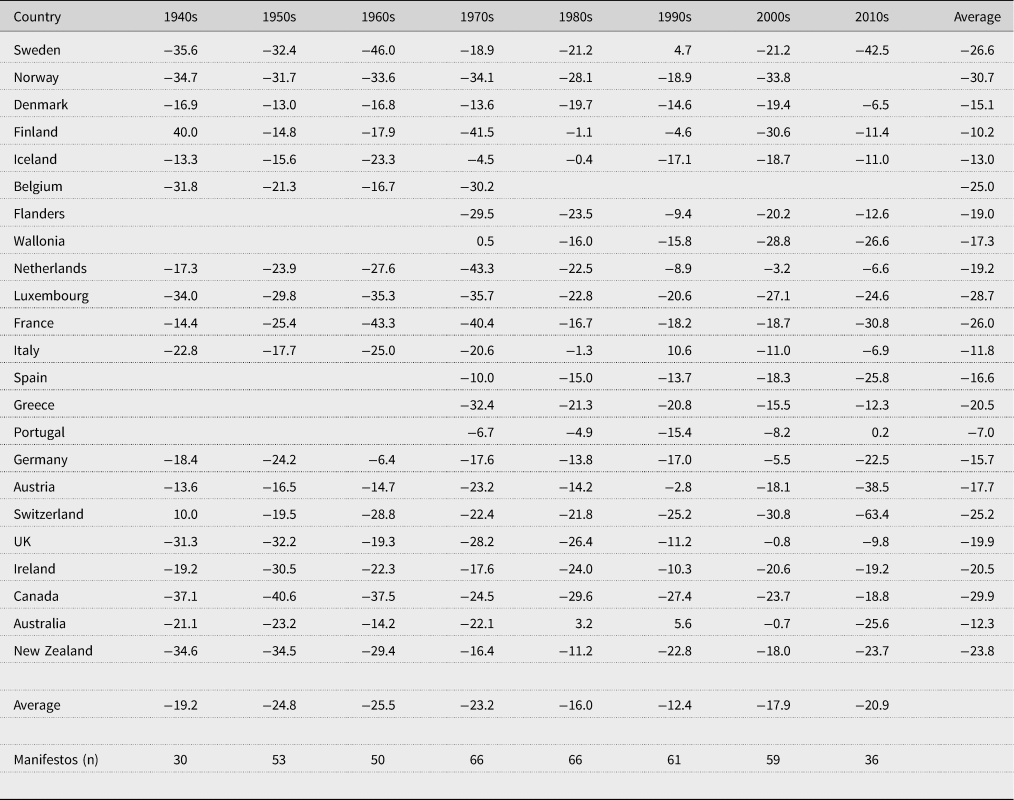
It is important to note that our findings about the left and right positioning of parties are restricted to policy positioning at election time only; they do not take into consideration factors that might shape voter or party elite impressions of the ideological locations of parties (Dalton and McAllister Reference Dalton and McAllister2015), such as party leadership or reputations. The RILE index encompasses significant economic and social policy issues still structuring much of party competition across Western democracies, and therefore best allows us to direct conclusions about the ideological and policy development of the social democratic party family. In Table 1, we outline the RILE scores for our cases.
Mean Left–Right (RILE index) Scores by Decade, Social Democratic Parties (1940s–2010s)

The results suggest several striking findings. First, following Keman (Reference Keman2017), we can note and agree that on this metric there is a significant diversity across the social democratic party family. Social democrats, clearly, ‘do’ social democracy by preferencing different policy areas, at different times. It is notable that some centre-left parties are generally more left-leaning than some of their counterparts. Australia, for example, is generally one of the more right-wing parties on this index, although there is a body of literature which suggests that non-Nordic variants of social democracy can be mischaracterized (e.g. Castles and Mitchell Reference Castles, Mitchell and Castles1993; Pierson Reference Pierson2001). Second, we can see that particularly in the 1940s and 1950s some of the more significant left scores are coded in this era, especially in cases like Sweden. Third, and relatedly, in many cases we can see a strong shift to the right by the 1990s and 2000s. Finally, and most crucially, if we focus on the period from the 1990s – arguably the heyday of the third way era – we can see a significant period of change. On this metric, most centre-left parties have become more left wing in recent years.
If we compare 1990 RILE scores with 2010 scores, then 13 cases moved more left (e.g. Sweden, Belgium, France, Germany, Australia), in four cases there was no striking change (Norway, the UK, Canada, New Zealand), and in five cases, the parties had moved more rightwards (e.g. Denmark, Netherlands, Portugal). In fact, given that the data set does not include recent elections in the UK and Portugal (and some parties such as the New Democratic Party in Canada did not shift right), we would say that this arguably under-estimates the overall shift to the left.
The Sozialdemokratische Partei Deutschlands (SPD) in Germany is a good example of the overall shift. In the 2000s, its overall profile was relatively centrist (−5.5), and in the 2010s its average RILE score was a significant (−22.5). The only decade where the SPD had a more ‘left-wing’ score was in the 1950s. Though, if the headline finding is that the parties have shifted to the ‘left’, it invites the question of whether the parties are ‘left’ in the same way as they were in an earlier epoch. We return to this more granular question in the subsequent section of this research note.
For now, a second aggregate measure for gauging policy change is to compare policy distance between each social democratic party and its main competitor to the right on the ideological spectrum. The main competitor here is defined as the rival party to the right receiving the highest share of votes at each election. The policy distance between social democratic parties and their competitors is an indicator of the extent of ideological polarization in party systems. Over time, patterns in such distance identify centrifugal or centripetal system tendencies, with ensuing consequences for electoral choice, formation of government and political stability (Sartori Reference Sartori1976). Some scholarly research has suggested a convergence between the centre left and centre right, which dovetails with Otto Kirchheimer's argument that these parties had become ‘catch-all’ (see Krouwel Reference Krouwel2003 for an overview). In Figure 1, we calculate the distance between social democratic and competitor parties by decade averages.
Average Left–Right Positions – Social Democratic Parties (SDPs) and Right-Wing Parties (RWPs) (1940–2010s, 21 Countries)
Note: Scores are the average RILE score per decade for each party category.

The data in Figure 1 suggest that the policy distance between the two sets of party families was at its strongest in the immediate period after World War II. Additionally, on this measure, the centre left remains markedly and historically to the ‘left’ of the centre right. At the aggregate level since the 1960s, the distance between the two sets of parties has remained relatively stable. The left–right divide continues to shape party competition in many systems. Yet we can also see clear evidence of change. Both sets of parties moved to the right by the 1990s. Moreover, since that period, both sets of parties have moved back towards the left. Indeed, the average aggregate policy position of centre-right parties is at its most centrist since the 1960s.
These findings link to Bo Rothstein and Sven Steinmo's (Reference Rothstein, Steinmo, Keating and McCrone2013) dismissal of the ‘crisis’ of social democracy. Their argument is that, to a large degree, social democrats have ‘won’ the argument (if not office), and that much of the social democratic settlement (especially an inclusive welfare state) has been adopted by the right, despite the dominance of neoliberal ideas.
Examining the country-level data (see Online Appendix B), in tandem with a general leftwards shift of both centre-left and centre-right parties we observe nascent growth in policy distance between the two party groupings. In 12 of our 22 cases, left–right policy distance has increased from the 1990s to the 2010s. Among those eight cases where social democratic and centre-right parties have significantly converged, it is only in six that social democrats have contributed to convergence, and in just three of those (Greece, Portugal, Canada) where social democrats have contributed more to convergence than their right-wing competitors.
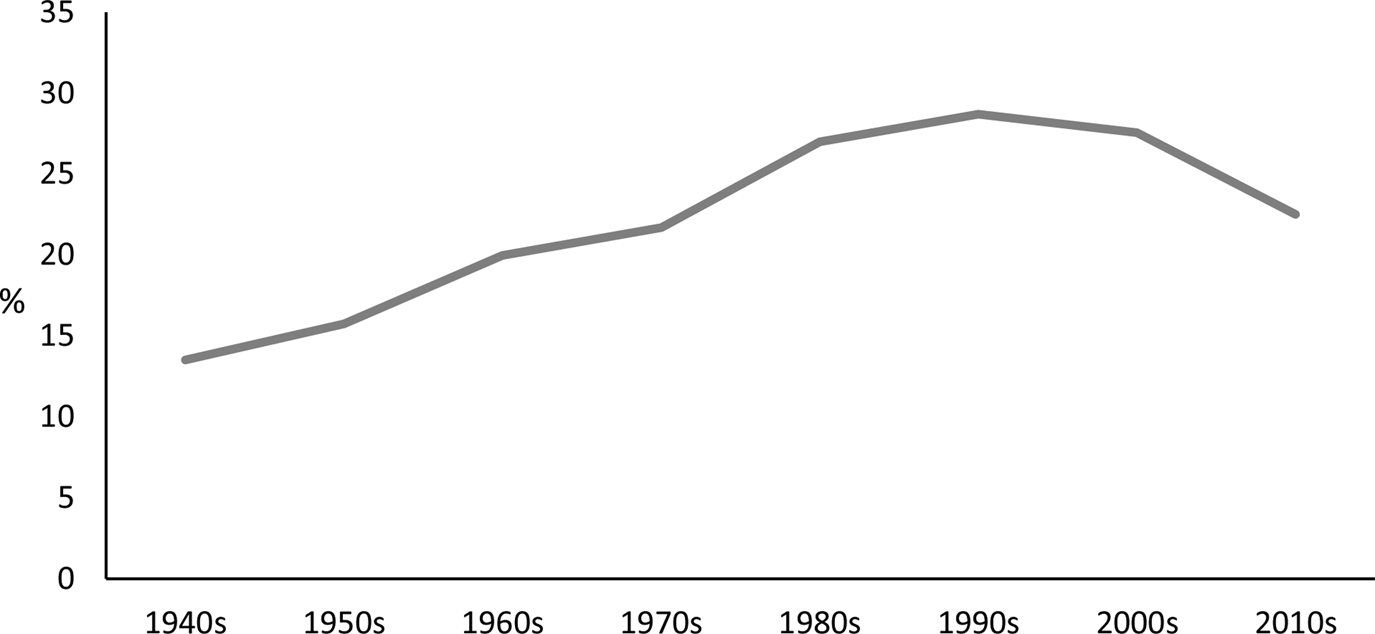
Continuing at this aggregate level, we now turn to a third measure of policy change – the ‘third way’ index. Using MARPOR categories, Volkens (Reference Volkens, Bonoli and Powell2004) constructed a proxy index for gauging how far social democratic parties had adopted ‘third way’ positions in their manifestos (see also Mudge Reference Mudge2018). Volkens's index operationalizes the third way primarily as it is expressed by Anthony Giddens (Reference Giddens1998). The third way index therefore captures where social democratic parties give salience to policy issues including decentralization, a preference for technology and investment (as a key economic tool), environmental protection and a shift to policies reflecting social liberal ideas and focusing on social groups other than class. We modify Volkens's index, enhancing its applicability to non-European social democratic parties.Footnote 5 The aggregate findings are charted in Figure 2. In including issue variables such as those covering environmental protection or favourable mentions of women and minority groups, we are concerned more with salience in party manifestos, rather than qualitative meaning. Indeed, the third way arguably ‘appropriated’ the rhetoric of (shallow) environmentalism and attempted to appeal to women as a social group in a way stripped of commitment to feminism (Curran Reference Curran2001; McRobbie Reference McRobbie2000). Nevertheless, even if third way commitment to these issues was somewhat superficial, their (changing) presence in social democratic manifestos itself gives insight to party developments in the third way ‘era’.
Third Way Index: Social Democratic Parties (1940s–2010s, 21 Countries)
Note: The third way index is cumulative and represents the proportion of manifestos dedicated to third way issues, averaged across the party family for each decade.

In her 2004 analysis, Volkens found a clear shift to the third way by the social democratic party family. Social democrats in the 1940s and 1950s placed very little emphasis in their manifestos on these sorts of issues, and we can see all the hallmarks of a ‘traditional’ social democratic approach. However, from the 1960s onwards, we see a growing embrace of these policy stances, reaching a peak in the 1990s – the epitome of the Blair/Schröder years. What is striking is that the ‘third way’ shift was not as dramatic a break as some critics would have it – it does not suddenly appear as a quick, radical break. It was arguably an incremental development, reflecting a range of sociological, institutional and structural changes.
However, what is critical for our analysis is that, since the 1990s peak years of the third way, the parties have been dramatically shifting away from the third way politics. If Bailey (Reference Bailey2009) characterized a shift from ‘traditional’ to ‘new’ social democracy – with which we broadly concur – then we argue that it is no longer accurate to describe the parties as third way, or with policy agendas fully embedded in the ‘new’ social democracy. If anything, on this metric, in the 2010s, social democrats show about as much preference for the third way policy issues as their forebears did in the 1970s.
Of all the trends based on manifesto data, this is one of the clearest we see across the social democratic party family. At the country level, we compare 1990s and 2010s third way scores for each case (see Online Appendix C for full results table). Our findings suggest that 17 social democratic parties reduced their third way policy appeals – in several cases (Germany, Spain, Switzerland, New Zealand) by more than 15 percentage points. In five cases, social democrats became more third way, but only in Australia and Ireland did third way appeals increase by more than 5 percentage points. These data confirm other research which shows that third way adoption varied a good deal across the party family, both in intensity and in timing (Green-Pedersen and van Kersbergen Reference Green-Pedersen and van Kersbergen2002). Some parties were early adopters (Austria, Belgium), while some (Denmark, Italy) were late adopters. It is important to note that many of the parties might not have called it the ‘third way’ (Bonoli and Powell Reference Bonoli and Powell2002). Nonetheless, there was a growing salience for these policy areas in their manifestos.
If we sum up the main trends and changes from the aggregate data, we can make some broad generalizations about policy change across the social democratic party family. First, it is clear that, since the heyday of the 1990s, the parties are preferencing more left policy positions. This might seem intuitive in some cases, such as with the Corbyn era in the UK, or the left turn taken by Benoît Hamon after the breakaway effect of Emmanuel Macron's En Marche! in France. Yet, the trend occurs across the board. Second, not only have social democratic parties shifted left, but so too have the centre right – at least to some extent. Further, in relation to the policy distance between the two sets of parties, there is also evidence of a (albeit mild) growing divergence between the two sets of parties. Third, and most importantly, the majority of the centre-left political parties we survey can no longer be considered ‘third way’. This is no longer a useful descriptor of the type and range of policies to which social democratic parties give preference in their manifestos.
As flagged earlier, these results invite a new set of questions. If the parties are again becoming more ‘left wing’, is this the same sort of left as we saw in the 1970s and earlier? Relatedly, if the parties are no longer third way, how can we best understand their political agendas? Is there, then, a new, ‘new social democracy’?
What's ‘left’ about the left?
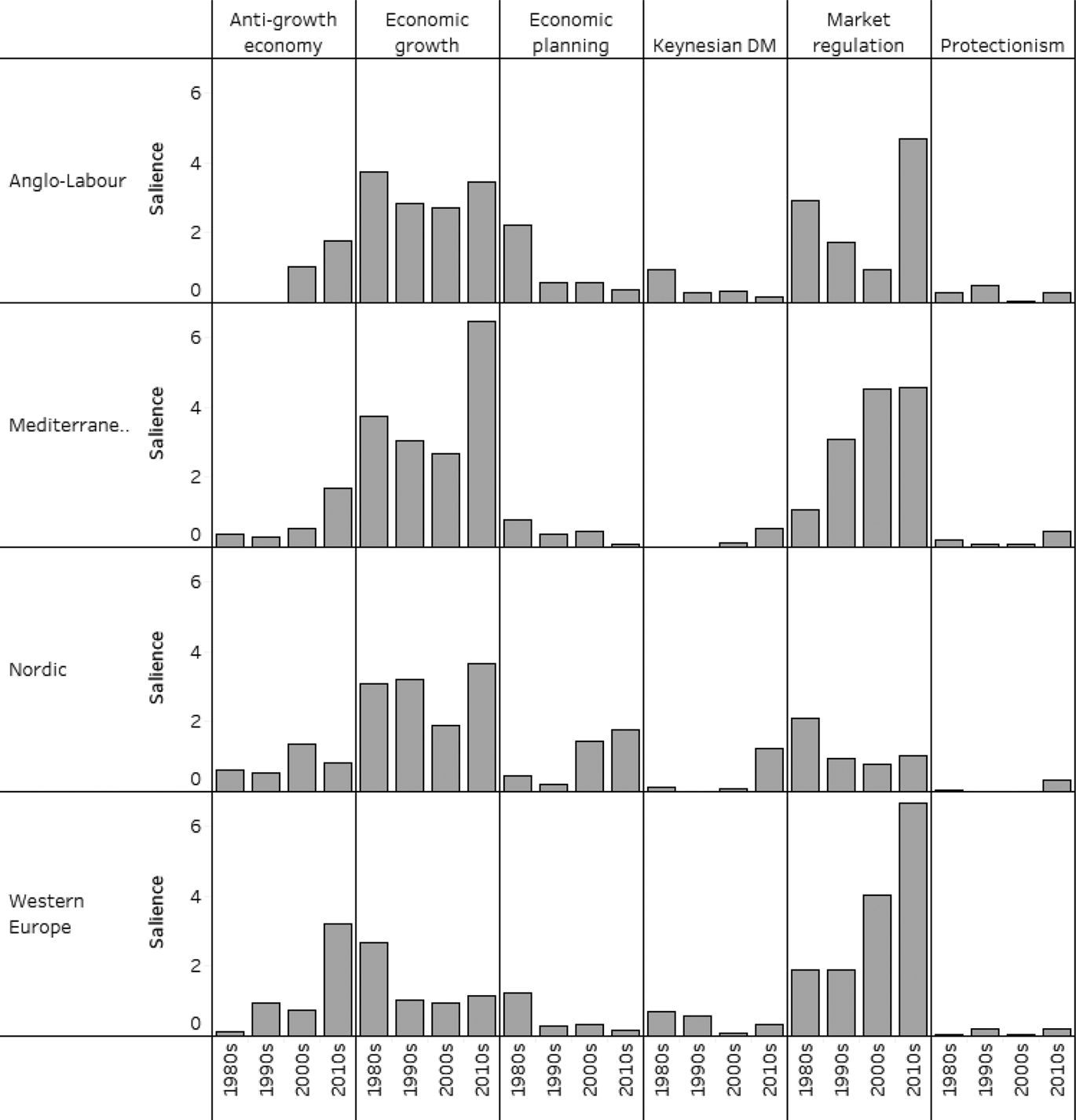
In this section we map in more granular detail the extent and nature of the policy change across the social democratic party family. We narrow our focus to a smaller number of variables, and also a shorter temporal window. In Figure 3, we outline the policy salience for several key policy areas for social democrats: support for economic growth, Keynesianism, protectionism, economic planning, market regulation and ‘anti-growth’ strategies. We focus on each decade from the 1980s, in order to capture the degree of change since the advent of neoliberalism. We also group parties by region, as despite significant intra-regional differences, this enables us to read the data more clearly. We also group the ‘labour’ parties (Australia, New Zealand and the UK) together as they share a common institutional framework which makes comparison stronger.
Social Democratic Parties’ Support for Economic Policies (1980s–2010s)

The results confirm some striking alterations in the changing political economic profile of social democratic parties. First, we can identify what seems to be driving the leftward shift of the parties – a rediscovery of tools to regulate the market. With perhaps the exception of the Nordics, by the 2010s, this remains the dominant economic policy preference for social democrats. However, we see some evidence of the Nordics taking a different path – as they show an increasing preference for forms of Keynesianism and economic planning, which their sister parties are not embracing. After the third way heyday, we also see some, albeit small, embrace of protectionist economic policies. We find it interesting that Keynesianism, at least as expressed in the manifestos, remains a relatively small part of the ‘new’ social democratic policy armoury, despite the importance of stimulus spending and counter-cyclical budgeting to many countries’ responses to the prolonged effects of the global financial crisis. This might reflect both a weakness in the use of the MARPOR data, or more likely, that social democrats tend not to campaign with Keynesian agendas, but are willing to use them in moments of economic downturn if afforded the chance to be in office.Footnote 6 We would also argue that since the 1980s, following the work of Scott Brenton (Reference Brenton2016) and Scott Brenton and Jon Pierre (Reference Brenton and Pierre2017), social democratic parties have been under both institutional pressures (via mechanisms such as the EU's growth and stability pact), but also under ideational pressures to marginalize former Keynesian tools and focus on the ‘politics of budget surplus’. Yet, overall, following the global financial crisis, we see the centre left (re-)advocating mechanisms to civilize capitalism.
Second, with the exception of a number of the Western European parties, we see also a strong emphasis on championing economic growth. As a group this policy setting remains the most salient in the 2010s compared with every other previous decade. Thus, while in other respects, social democratic parties have regained motivation to curb some of the vagaries and inequalities of liberal capitalism, there is nonetheless a strengthened push for economic development – arguably to fuel the expansion of the welfare state and related spending programmes (Brenton Reference Brenton2016). Another interpretation, however, is that the shadow of the third way still looms large, disciplining and structuring even the recent leftward movements of social democrats.
Third, and what arguably makes the left turn far more distinctive, is that social democrats are increasingly putting an emphasis on ‘anti-growth’ strategies (such as ‘sustainable development’, well-being and what also might be broadly grouped as postcapitalist strategies). The overall salience of these policies in the manifestos is nearly eight times greater than we find in the 1980s, albeit from a low base. So somewhat paradoxically, social democrats are championing traditional economic growth, in effect to fuel productivity and jobs for workers, but alongside this shift towards the ‘new’ politics. We make three, tentative, observations here. One, these might not necessarily be opposing strategies, as centre-left parties seek to pursue economic growth, but growth with an emphasis on potential green technologies and industries. Two, the parties have tilted to the ‘anti-growth’ agenda, but not fully embraced it. This seems to reflect a hybrid approach, with in-built contradictory impulses – arguably reflecting different factional ‘pulls’ in the party structures. Three, it appears to reflect the centre left's ongoing strategic and electoral dilemma in trying to pacify its mixed supporter base and to aggregate the interests of, especially, middle-class professionals, and workers from traditional manufacturing areas.
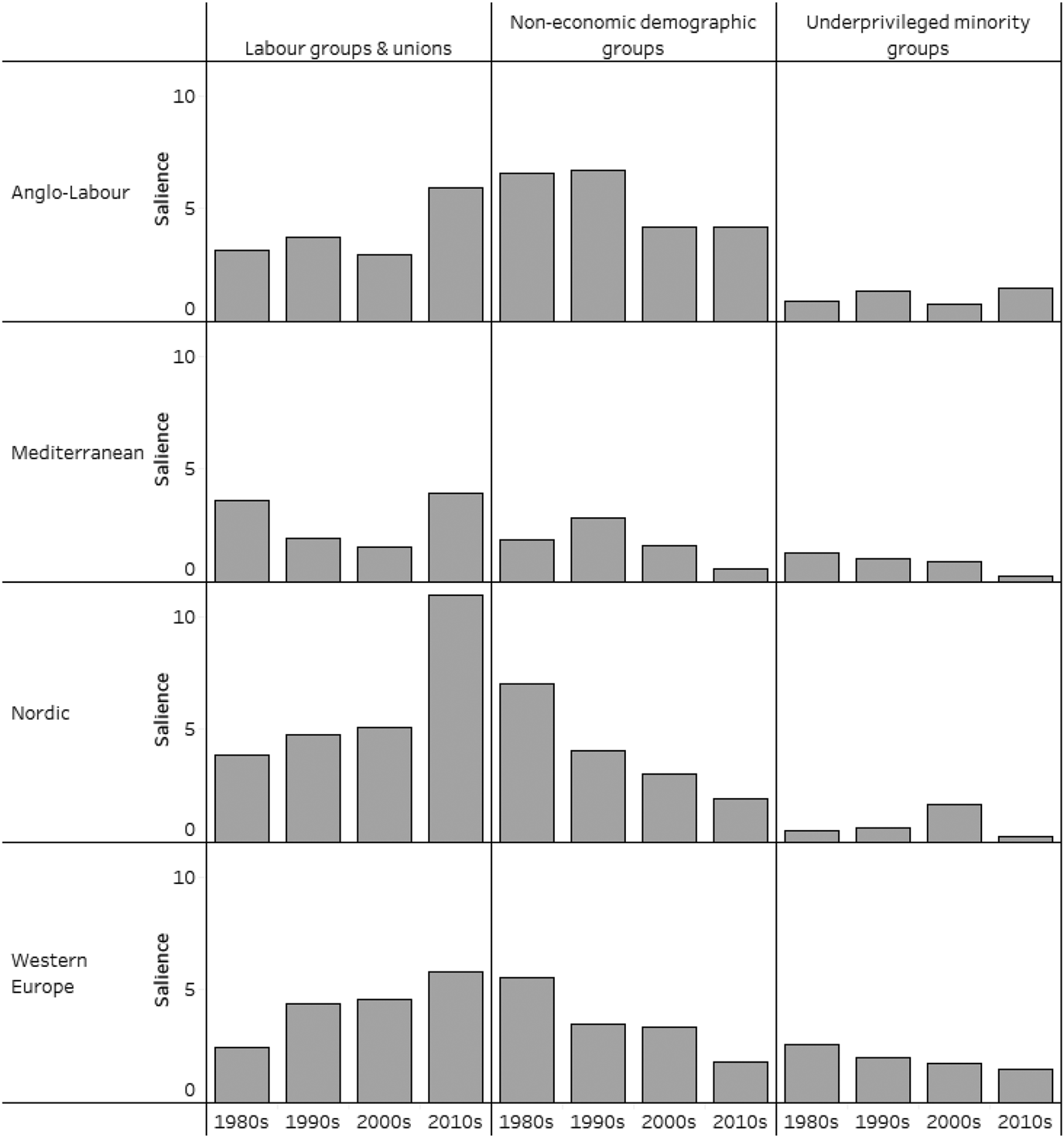
Brevity means that we cannot outline the full suite of policy changes or positions for the social democratic party family. From here, we now focus on the extent to which social democratic parties, in their election manifestos, express support for specific social groups (see Figure 4). Given the changing sociological make-up of, and shifting values within, many of the countries under study, measuring patterns of policy change and continuity across these social policy areas neatly captures how social democrats are responding to issues such as those relating to ‘identity politics’. We focus on support for three main groups captured in the MARPOR data: labour groups (trade unions), underprivileged groups and what are described as non-economic demographic groups (e.g. ‘women’, ethnic minority groups, LGBTIQ and so on).Footnote 7
Social Democratic Support for Social Groups

As a whole, we can see some striking patterns of change in social democratic policy emphases. What is clearly also contributing to the leftward shift of social democratic parties is a (re-)discovery of support for trade unions and related labour groups. This is doubly striking, given declining union density across many countries. Taking Australia as an example, union density was nearly 50% of the workforce in the 1980s, but by the late 2010s was just under 15% (there are, of course, exceptions, with high and stable levels in many Nordic countries) (Scheuer Reference Scheuer2011). The data suggest some caution, however, on any claim that social democrats have shifted back to the left in this regard, since support for labour groups is higher now than it ever was across the past four decades.
If the centre left are shifting further left, then one surprising area where this is not evident is regarding support for the poorest and most economically vulnerable groups. From the 1980s to the 2000s, this was a relatively small part of their manifestos, and broadly consistent in each region/grouping. However, by the 2010s, with the exception of the Anglo-labour group, it is an even smaller part of their overall support for specific social groups. Here, we might suggest that the long-standing neoliberal derision of welfare recipients is taking its toll on social democrats. Social democrats’ strategy, by and large, has been to focus on jobs and workers, and related compensatory measures, rather than directly reducing poverty per se. In one sense, this is not new, as Jonas Pontussen (Reference Pontusson and Cronin2011: 98) argues, contra Gøsta Esping-Andersen (Reference Esping-Andersen1985), that the project of social democracy is essentially labour-market entry focused, rather than the pursuit of decommodification.
Perhaps most interesting are the changing levels of salience for non-economic demographic groups. To some extent, we might see this as proxy for wider debates about ‘identity politics’. By this, we take it to mean that, in increasingly pluralistic and diverse societies, many non-class-based social groups make claims for greater inclusion and equality. For some, the appeal of ‘identity politics’ is a dead end for social democrats as it privileges specific group rights over universalism (Rothstein Reference Rothstein2011). There is an ongoing tension between social democrats’ ‘old’ class politics, and balancing or supplanting these with the ‘new’ identity politics. Carol Johnson (Reference Johnson2019), in her study on the Australian Labor Party, outlines these challenges posed by the expanding notion of equality.
For our purposes, we chart the salience of policies relating to these groups. Broadly, manifesto support for non-economic demographic groups has decreased steadily over each decade since the 1980s. We do note some regional differences; for example, the Mediterranean social democrats never embraced this policy agenda like their counterparts, perhaps a function of more socially conservative societies. The German SPD, however, is a good example of the general trend, with a relatively strong score of 1.5 in the 1990s, but with a score of 0 for the 2010s. In some senses, then, social democrats are returning to their pre-third-way roots, but as indicated above, they are also shifting into new policy areas.
Discussion and conclusion
What, then, is the meaning of modern social democracy? How can we best characterize the changing policy profile of the family of centre-left political parties?
Before we proceed, it is worth highlighting some caveats with the data and analysis outlined here. First, social democracy, as many have pointed out, is a multi-dimensional phenomenon. Generalizing is particularly fraught as it tends to obscure how centre-left parties have found innovative local solutions to long-standing issues within the capitalist market economy. There are both inter- and intra-regional differences. Second, there is a distinction between social democracy as an ideology and centre-left parties as political actors (Kitschelt Reference Kitschelt1994). While we place social democratic parties at the centre of our analysis as the traditional main carriers of this ideological tradition, left critics in particular argue that the parties have ‘betrayed’ the tradition (Lavelle Reference Lavelle2008). In sum, changes in the policy profile of centre-left parties do not tell us everything about ongoing changes in the wider ideological tradition. Third, the manifesto data are incredibly rich, robust and help us make meaningful comparisons. Yet they cannot measure policy outputs or government performance and, crucially, struggle to capture context. So, we temper the wider claims we might make from our data analysis. That said, most of these caveats apply to many of the existing accounts of social democracy. We can ‘get at’ a political phenomenon in many ways, and we employ just one approach.
Caveats aside, to recap. First, it is no longer accurate to describe social democratic parties as ‘third way’. Almost all of them have shed this over-arching policy approach, although there are exceptions. This is not to say that many are not still wrestling with third way legacies. For the French Parti Socialiste, the Mitterrand years and infamous 1983 U-turn still set the context for wider debates about the future of the French left. In Australia, the Hawke–Keating years and the attendant privatization and financial deregulation still influence current policy debates, including the loss of the 2019 federal election. Despite Ed Miliband arguing that the era of ‘New Labour is over’, the contested legacy of the Blair–Brown years continues to shape debates about the future of the British Labour Party, even in the post-Corbyn era. Third way policies might well be decreasing in the parties’ manifestos, but they still influence the ongoing identity ‘crisis’ of the centre left.
Second, generally speaking, social democratic parties have recently shifted leftwards. Interestingly, this movement has largely been matched by their centre-right political opponents as well, keeping the left–right distance between these two party groupings relatively stable. Across a range of policy areas, the centre-left family are giving much greater salience to critical indicators of a broadly left-wing agenda. The shift towards greater tools to regulate the market reflects perhaps a growing frustration with the globalized market economy – an issue that populist parties have exploited. In other areas, we also see labour and social democratic parties re-embracing some of the traditional policy areas of social democracy – especially support for trade unions. This is a somewhat surprising finding, given the overall debates about declining union density and influence.
Third, the parties are shifting to the left, and since Volkens's (Reference Volkens, Bonoli and Powell2004) study it is not quite the same ‘left’ that characterized the parties in the 1970s, or even in their earlier incarnations. Indeed, on support for trade unions, it might well be that social democrats are over-compensating in their appeals to support for unions as they rediscover their left credentials. But more significantly, the parties are clearly embracing ‘new’ political agendas. The parties have steadily (if unevenly) placed a focus on environmentalism over the past decades. Strikingly, what was totally absent from the earliest forms of the parties’ manifestos is a flirtation and growing interest in ‘anti-growth’ policy areas. The parties are far from ‘postcapitalist’, but these ideas are weaving their way into their overall policy agenda.
Does this then all amount to a new ‘wave’ of social democracy? If we adopt and define stylized versions of ideologies to enable us to chart macro changes, rather than essentialize complex and varied phenomena, then framing change through ‘waves’ can be a useful heuristic. As noted above, Przeworski claimed the existence of three main waves: revolution (the early efforts by social democrats to overthrow and replace capitalism), revisionism (the Marxist break from revolution) and remedialism (the post-1970 efforts to mitigate rather than substantially change capitalism). Przeworski speculated, in the beginning of the third way era, on the existence of a new wave of ‘resignation’, with social democrats capitulating to capitalism.
At the risk of over-extending Przeworski's four ‘R's, do the policy changes outlined here constitute a new, fifth wave? If the electoral fortunes of the centre left are to improve, then perhaps they hint at a new phase – ‘reinvigoration’. However, if the structural electoral decline continues, and the centre left lose the ‘battle of ideas’, then perhaps this might instead be a ‘relapse’. It is of course too early to say with any certainty whether the electoral performance of social democratic parties will recover from the troughs witnessed over the past two decades. It is clear, however, that a post-third-way era is emerging for much of the social democratic party family. In this emerging policy agenda, there are ongoing (and new) competing dilemmas, especially between the renewed push for economic growth and anti-growth strategies. Social democratic parties also appear uncertain as to how (and whether) to emphasize issues of underprivileged and minority groups amid the popularity of far-right parties (or centre-right parties acceding to far-right policy positions). Conversely, centre-left parties are rediscovering means by which to restrain unfettered capitalism, and it is here we find the strongest indication that social democracy may have escaped from a wave of resignation.
Finally, we link our research findings to their potential implications for the COVID-19 outbreak in 2020. We offer three broad scenarios. First, the COVID-19 outbreak could well assist the centre left and its left shift might prove timely; not least in the widespread use of fiscal spending and stimulus to support the economy and vulnerable workers, along with a rediscovery of the value of welfare regimes (e.g. Johnson Reference Johnson2020; Vampa Reference Vampa2020). COVID-19 might then amplify ‘reinvigoration’. Yet, conversely, it may do very little to assist the centre left. In many cases, centre-right governments might well be electorally rewarded (Australia, UK, Germany) for using, in effect, ‘social democratic’ tools to tackle the crisis. Why would voters reward the left, if the right manages to contain the crisis using these same tools? Moreover, the centre left was brutally exposed after the global financial crisis in that it lacked a coherent response to growing government debt – and has not recovered from the period of austerity in many places. In this view, despite its left turn, it may return to ‘resignation’. A third scenario might well be that once the highpoint of the crisis passes – perhaps by 2021–2, more long-term structural trends resume, and a politics of ‘business as usual’ kicks in. In this scenario, COVID-19 may have little mid- to long-term impact on the trajectory of the centre left.
Supplementary material
To view the supplementary material for this article, please go to: https://doi.org/10.1017/gov.2020.33
Acknowledgements
The authors would like to thank the three anonymous reviewers for their insightful feedback. Any errors, of course, remain those of the authors. Thanks too to colleagues at Government and Opposition for support and assistance in the production of this research note.