Introduction
Normal balance in humans relies on integrating and interpreting peripheral vestibular, visual, auditory and proprioceptive sensory inputs.Reference Rogind, Lykkegaard, Bliddal and Danneskiold-Samsoe1, Reference Kanegaonkar, Amin and Clarke2 An upright stance requires maintaining the body's centre of gravity above a relatively small base of support.Reference Era, Sainio, Koskinen, Haavisto, Vaara and Aromaa3 An oscillating movement about a vertical axis is induced by muscular contractions of the lower extremities, trunk and neck, resulting in continuous body sway.Reference Rogind, Lykkegaard, Bliddal and Danneskiold-Samsoe1
Several studies have quantified the magnitude of postural sway and described the relative contribution of the sensory inputs involved in balance.Reference Kanegaonkar, Amin and Clarke2–Reference Hansson, Beckman and Hakansson7 However, these studies have used complex devices, such as force plates or computerised dynamic posturography.Reference Rogind, Lykkegaard, Bliddal and Danneskiold-Samsoe1, Reference Era, Sainio, Koskinen, Haavisto, Vaara and Aromaa3–Reference Kogler, Lindfors, Odkvist and Ledin5, Reference Hansson, Beckman and Hakansson7–Reference Tanaka, Kojima, Takeda, Ino and Ifukube11 In recent years, a number of applications that exploit the inherent gyroscopes and accelerometers present in smart phones have been developed.Reference Lane, Miluzzo, Hong, Peebles, Choudhury and Campbell12 This study aimed to evaluate the contributions of different sensory inputs to postural sway in normal adults using the D+R Balance application and iPhone.
Materials and methods
Normal adults aged between 18 and 45 years (13 males and 37 females) and free of musculoskeletal, neurological, visual and vestibular pathologies were invited to participate in this study. Patients with a history of dizziness or vertigo symptoms were excluded. Informed verbal consent was obtained from all participants. Ethics committee approval was not deemed necessary.
Experimental set–up
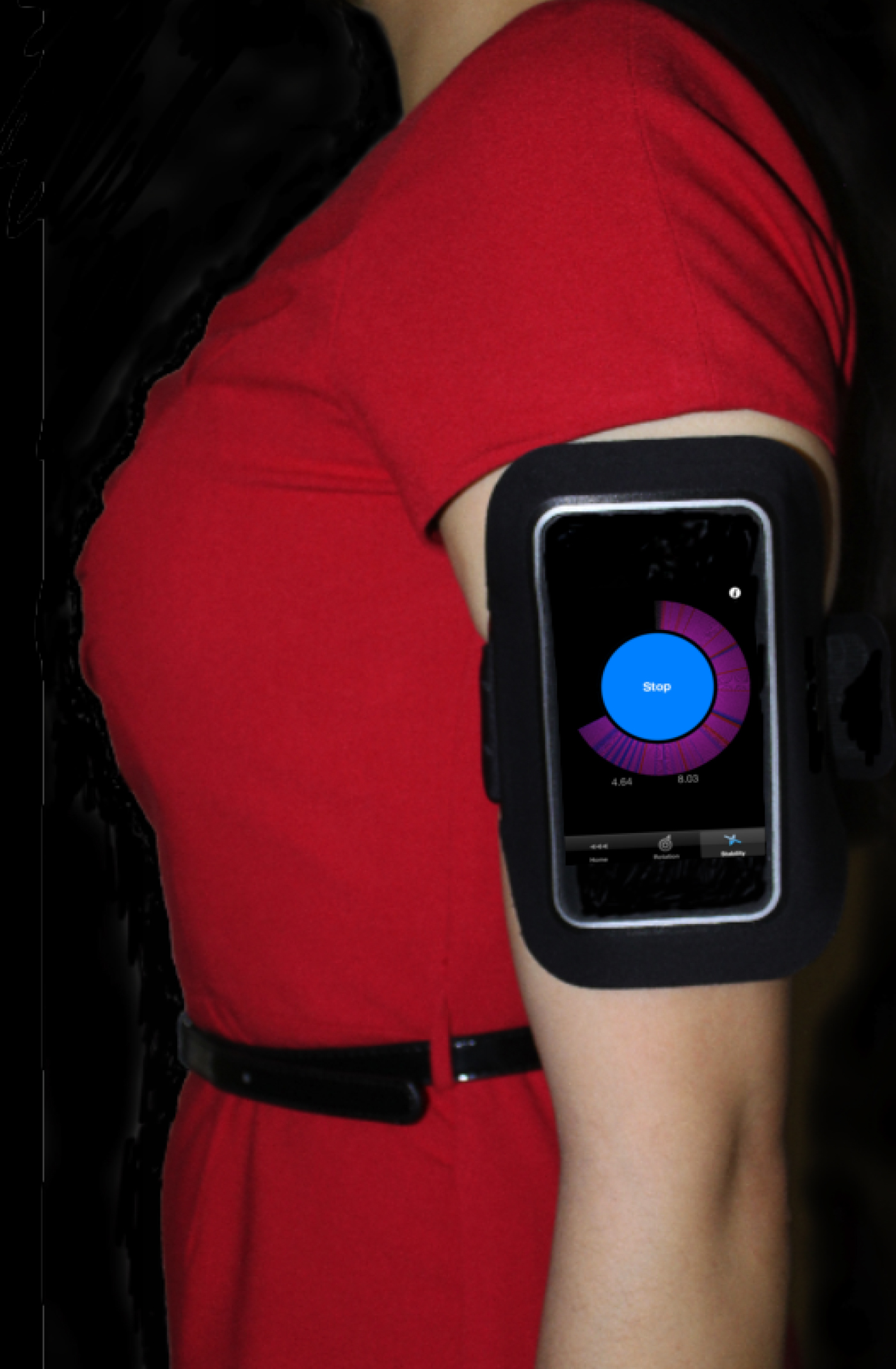
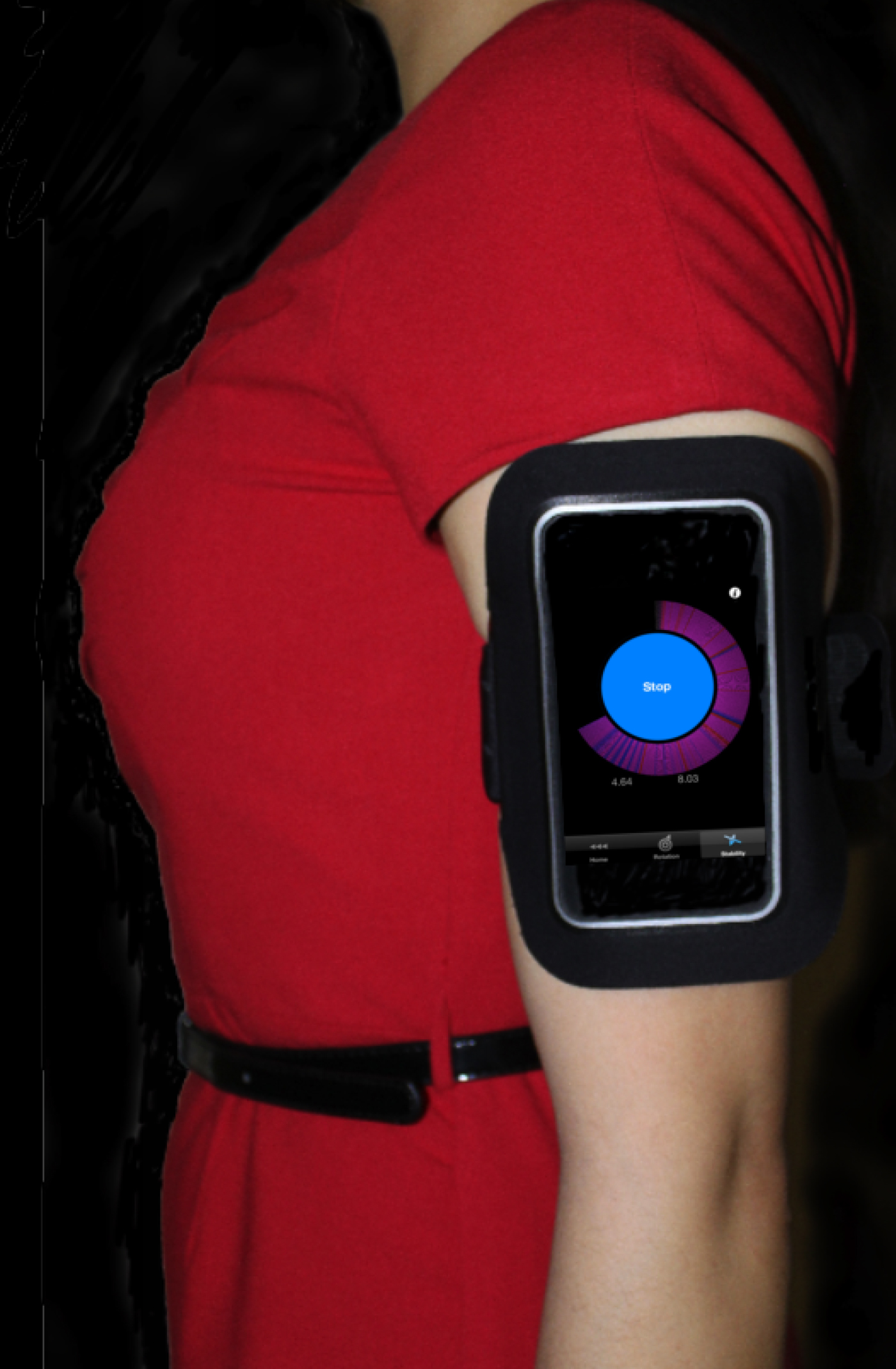
The iPhone was inserted into an Incase™ Sports Armband Pro and strapped to the participant's left upper arm (Figure 1). Output data (Kanegaonkar, or ‘K’ value) were taken directly from the D+R Balance application. Each dataset represents an area of an ellipse with two standard deviations in the anteroposterior and lateral planes about a mean point, taken over a period of 30 seconds.
Photograph showing an iPhone strapped to a participant's left upper arm.
Experimental procedures
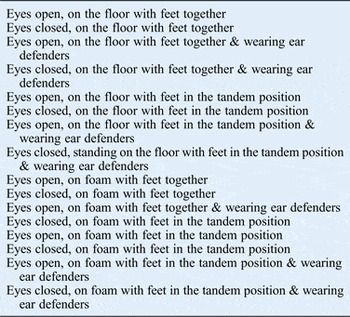
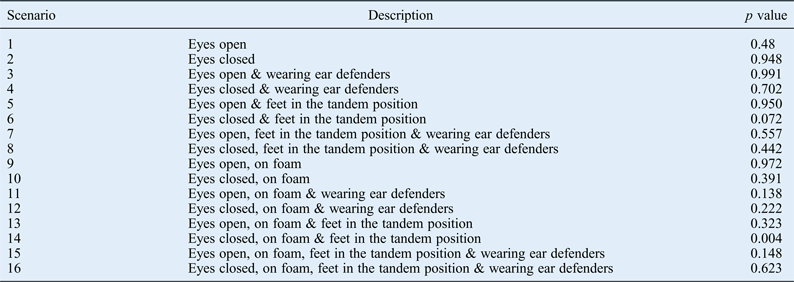
Participants were asked to stand upright with their arms by their sides. Postural sway was initially assessed in a soundproofed room in 1 of the 16 standing test conditions (see Table I) and subsequently in a normal clinic room of similar dimensions to the soundproofed room.
Standing scenarios

Data were entered into a Microsoft Excel spreadsheet, and environments and conditions were compared using paired t-tests. Statistical significance was set at a p value of less than 0.05.
Results
Normal room
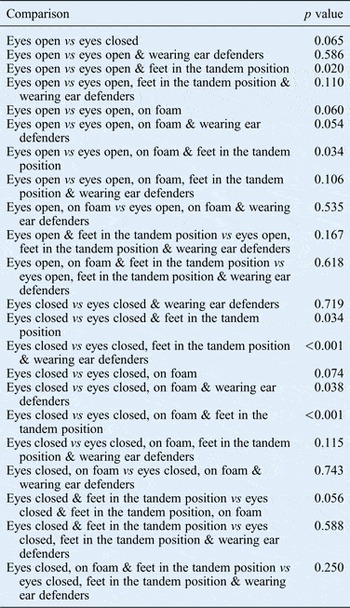
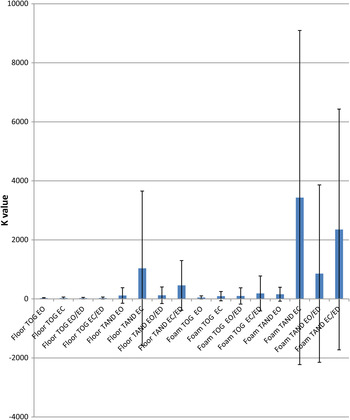
A significant increase in postural sway measurements was found for those standing with their eyes open and feet in the ‘tandem’ position (i.e. with the toes of one foot touching the heel of the other) on the floor (p = 0.020) on foam (p = 0.034) vs those with their eyes open, with feet together on the floor in the normal room. Compared with standing on the floor with eyes closed and feet together, participants showed a significant increase in sway under the following conditions: standing on the floor with eyes closed and feet in the tandem position (p = 0.034) whilst wearing ear defenders (p < 0.001); standing on foam with eyes closed and wearing ear defenders (p = 0.038); and standing on foam with feet in the tandem position and eyes closed (p < 0.001; Table II and Figure 2).
Graph showing mean Kanegaonkar (‘K’) values for different standing variables in a normal clinic room, expressed as mean ± standard deviation. EC = eyes closed; EO = eyes open; NR = normal room; SPR = soundproof room; TAN = feet in the tandem position; TOG = feet together

Normal room: comparisons of postural sway

Soundproofed room
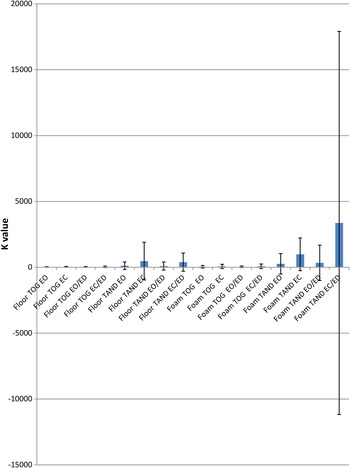
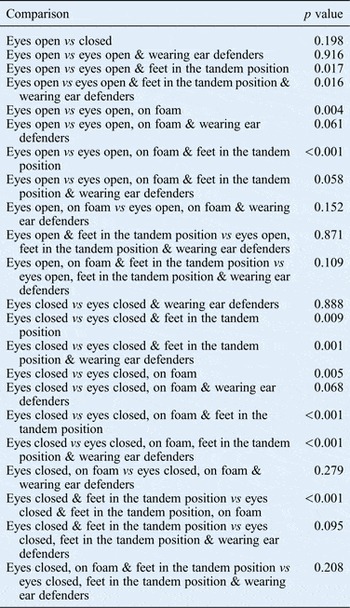
Table III and Figure 3 show the results of comparing postural sway under different conditions in the soundproofed room. Compared with participants with their eyes open and standing with feet together on the floor, a significant increase in postural sway was noted for those with their eyes open, with feet in the tandem position (p = 0.017) and wearing ear defenders (p = 0.016); and those with their eyes open and standing on foam (p = 0.004), with their feet in the tandem position (p < 0.001).
Graph showing mean Kanegaonkar (‘K’) values for different standing variables in a soundproofed room, expressed as mean ± standard deviation. EC = eyes closed; EO = eyes open; NR = normal room; SPR = soundproof room; TAN = feet in the tandem position; TOG = feet together

Soundproofed room; comparisons of postural sway

Compared with standing with their eyes closed and feet together on the floor, there was significantly more sway when participants had their eyes closed, feet in the tandem position (p = 0.009) and were wearing ear defenders (p = 0.001); were on foam with their eyes closed (p = 0.005); and had their eyes closed and were standing on foam with their feet in the tandem position (p < 0.001) and wearing ear defenders (p < 0.001). In addition, there was significant increase in sway in participants standing with their eyes closed and feet in the tandem position on foam vs on a hard floor (p < 0.001).
Soundproofed vs normal room
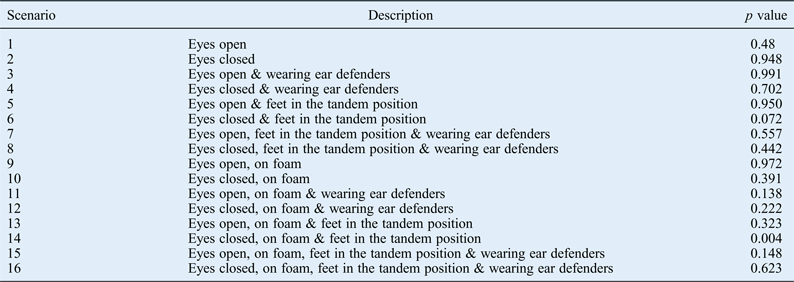
There was a general trend towards increased sway in most standing test scenarios conducted in the soundproofed room compared with the normal room (Table IV). However, the difference was statistically significant only for participants with their eyes closed and feet in the tandem position (p = 0.004).
Comparison of postural sway in a normal vs a soundproofed room
Discussion
Normal balance function relies on sensory information from the visual, peripheral vestibular, auditory and somatosensory systems. This study was performed to confirm the contribution of recognised sensory pathways involved in balance by means of a body-worn smart phone and a specialist preloaded application.
A number of studies have demonstrated an increase in postural sway when sight of the surroundings is denied,Reference Era, Sainio, Koskinen, Haavisto, Vaara and Aromaa3–Reference Hansson, Beckman and Hakansson7 with changes in both central and peripheral vision affecting postural stabilisation.Reference Uchiyama and Demura13 These reports were confirmed in this study: the relative importance of vision was most pronounced when comparing different standing surfaces and acoustic environments. This study also found that body sway increased significantly when standing on a foam surface compared with a hard surface, in agreement with previous reports.Reference Adamo, Pociask and Goldberg4, Reference Patel, Fransson, Lush, Petersen, Magnusson and Johansson14–Reference Stambolieva and Angov16
As previously demonstrated, auditory cues contribute to the maintenance of postural control, with more sway occurring in the soundproofed room than in the normal room.Reference Kanegaonkar, Amin and Clarke2, Reference Era and Heikkinen10 The presence or absence of ear defenders had no effect on postural sway; it may be that those participants familiar with wearing headphones or ear defenders upgrade the relative importance of other sensory cues. Other studies have shown that moving auditory fields can increase postural sway,Reference Soames and Raper17 more notably in elderly people.Reference Tanaka, Kojima, Takeda, Ino and Ifukube11 In addition, auditory biofeedback has been suggested to reduce body sway in individuals with bilateral vestibular loss.Reference Dozza, Wall, Peterka, Chiari and Horak18 The degree to which auditory biofeedback compensates for absent sensory cues correlates positively with the extent of sensory loss.Reference Tanaka, Kojima, Takeda, Ino and Ifukube11
Several methods have been used to assess postural sway, with varying success. In 1887, Hinsdale graphically recorded sway by attaching smoke paper to the top of the participant's head and placing the participant under a marker to measure movements inscribed onto paper.Reference Hinsdale19 Helbrandt et al. devised a footplate capable of measuring foot pressure.Reference Kelso and Hellebrandt9 This method was further developed by adding an accelerometer mounted onto a belt at the waist.Reference Stevens and Tomlinson20 The Nintendo Wii® balance board exploits a similar principle and has recently been demonstrated to be of potential use in a clinical setting.Reference Kanegaonkar, Amin and Clarke2
Our results suggest that the D+R Balance application also provides a simple and relatively inexpensive tool to accurately quantify postural sway. However, unlike the Wii gaming console and other established methods, the smart phone is a freely portable device that readily allowed sway to be compared in different environments and on different surfaces. The results of this study are consistent with those of a similar study performed using the Wii platform.Reference Kanegaonkar, Amin and Clarke2 However, it was not possible to make a direct comparison between the D+R Balance application and a posturography system because of the difficulty in transferring the latter to the semi-anechoic room used in this study.
• Postural sway is regulated by vision, proprioception, auditory information and the peripheral vestibular system
• Sway can be assessed by the Romberg test or quantified by force plate or dynamic posturography
• Smartphones can respond to movement and tilt
• A novel iPhone application (D+R Balance) is a possible method of quantifying sway
• This application may provide an alternative to current dynamic posturography systems
Dynamic posturography has previously been used to assess participants at a potential risk of falls (a significant cause of morbidity and mortality).Reference Tseng, Stanhope and Morton21 However, the D+R Balance application may provide a simple, inexpensive and reliable alternative. Additional research is planned to assess sway in those individuals subjected to experimental visual, auditory and proprioceptive challenges, and in real-life environments. These findings will be compared with data obtained using a posturography system.
Conclusion
The results of this study suggest that the D+R Balance application may provide a simple, inexpensive and reliable method to assess postural sway. It offers a mobile alternative to current force plate and dynamic posturography systems. Further research is required to assess this tool in individuals with vestibular pathology and in those at risk of falls.