Introduction
Cervix carcinoma is one of the most frequently occurring cancer entities in northern Thailand. The report of Kamnerdsupaphon et al.Reference Kamnerdsupaphon, Srisukho, Sumitsawan, Lorvidhaya and Sukthomya 1 revealed age-standardized incidence rates in 2005 of 22·7 per 100,000 inhabitants and there were 234 new cases of cervix cancer diagnosed.
Radical radiotherapy generally includes whole pelvic radiotherapy (WPRT) and brachytherapy (BT). WPRT (45–50·4 Gy) aims to reduce the gross tumour and control the microscopic disease in the pelvic area, whereas BT is used to boost the dose to the local lesion up to 75–90 Gy. Respecting the principles of inverse-square law, BT delivers very high doses to the primary target (close to radioisotope), whereas it deposits substantially less dose to the surrounding organs at risk (OARs). Although the use of 2D planning can achieve good tumour outcomes and acceptable toxicities, many studies reported the results of conventional versus image-guided brachytherapy (IGBT) planning approaching different technical solutions. All reports showed that IGBT improved the target coverage and spared the dose of organs at risk (OARs) when it was compared with 2D planning.Reference De Brabandere, Mousa, Nulens, Swinnen and Van Limbergen 2 – Reference Zwahlen, Jezioranski and Chan 4
With the emerging of Groupe Européen de Curiethérapie—European Society for Therapeutic Radiology and Oncology (GEC-ESTRO) recommendations, the developed volume-based concept seems to be associated with an improvement of BT for the treatment of cervical cancer.Reference Haie-Meder, Pötter and Van Limbergen 5 , Reference Pötter, Haie-Meder and Van Limbergen 6 Based on these developed volume-based concepts the subsequent performed clinical studies showed promising results in terms of disease control and toxicity profiles.Reference Pötter, Dimopoulos and Georg 7 , Reference Tan, Coles, Hart and Tait 8
In our department, volume-based BT was implemented as a research joint project until 2008. Initially, our group reported preliminary and intermediate-term results of using IGBT in our treated and analysed study patient cohorts.Reference Tharavichitkul, Mayurasakorn and Lorvidhaya 9 – Reference Tharavichitkul, Chakrabandhu and Wanwilairat 12 The follow-up programme for these patients was maintained on long-term and offered to all patients.
Thus, we performed this study to report long-term results and toxicity profiles of a combined WPRT and IGBT for determining optimal treatment of cervical carcinoma in modern radiotherapy.
Material and Methods
From 2008 to 2014, 52 patients with carcinoma of cervix uteri were included and treated. All patients were classified IIB-IIIB by International Federation of Gynecology and Obstetrics clinical staging, were at least 18 years old and had a good performance status. Patients with severe co-morbidity, emergency conditions (e.g., bleeding), pregnancy, previous irradiation or allergy of chemotherapy were excluded from the study. Consent forms were signed by each patient before enrolment.
WPRT
All patients received WPRT of 45–50·4 Gy in 23–28 fractions with conventional technique, 3D conformal radiotherapy (3D-CRT) or intensity-modulated radiation therapy (IMRT). In total, 32 patients (61·5%) received 3D-CRT. The doses of targets and OARs were calculated into equivalent dose of 2 Gy (EQD2) using the linear-quadratic models and assuming α/β ratio=10 for tumour and α/β ratio=3 for OARs.Reference Bentzen and Joiner 13
Concurrent chemo-radiation
Concurrent chemo-radiation with weekly cisplatin 40 mg/m2 for a maximum of five cycles was given to patients with an indication of combined radio-chemotherapy with sufficient kidney and bone marrow function. The dose of chemotherapy was modified according to a weekly assessment of creatinine clearance before each applied dose. Chemotherapy was interrupted when creatinine clearance was <40 mL/minute and considered to be stopped when creatinine clearance was <30 mL/minute.
IGBT
Four fractions of intracavitary BT were designed for all patients. First BT application was assigned to be performed after the 4th week of EBRT. Intracavitary applicators were used. A Foley’s catheter was inserted into the bladder and inflated with 7 cc of diluted contrast media. A normal saline solution (50 cc) plus 10 cc of contrast media was added into the bladder to identify bladder volume before computed tomographic (CT) imaging. The vagina was packed with gauze to increase the distance between the radiation source and the rectum/bladder. EBRT was interrupted for each day of HDR BT insertion. After application, a pelvic CT or magnetic resonance imaging (MRI) scan were performed from the iliac crest to the ischial tuberosity to obtain appropriate images with the patients in a supine treatment position and legs relaxed on the table. The slice thickness of images was 5 mm without an inter-slice gap. After the imaging was performed, images were checked by the radiation oncologist and then transported to the planning system. For BT planning, we used PLATO™ or ONCENTRA™ (after June 2014) in the entire contouring and planning process. Patients were then transferred to the BT treatment room and adjusted to the same position as in the imaging devices.
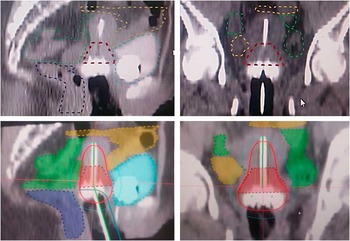
High-risk clinical target volume (HR-CTV), intermediate-risk clinical target volume and OARs (bladder, rectum and sigmoid colon) were contoured according to GEC-ESTRO recommendations and the CT-standardized Contour Guidelines.Reference Haie-Meder, Pötter and Van Limbergen 5 , Reference Viswanathan, Dimopoulos, Kirisits, Berger and Pötter 14 Figure 1 shows contours and dose distributions for IGBT.
Computed tomographic images in coronal and sagittal views showed high-risk clinical target volume (red), bladder (light blue), rectum (dark blue), sigmoid (green) and bowels (yellow) with dose distributions with 7 Gy in red colour.

For HR-CTV, the D90 (minimum dose covering 90% of target volume) of HR-CTV in all patients was carefully planned to be at least 6·5–7 Gy per fractions. In terms of OARs, the D2cc (representing the minimum doses calculated at the most irradiated 2 cc volumes) of the bladder, rectum and sigmoid colon were recorded. The total doses at HR-CTV and OARs were calculated into EQD2 using the linear-quadratic model and assuming α/β ratio=10 for tumour and α/β=3 for OAR.Reference Bentzen and Joiner 13
The EQD2 of WPRT and IGBT were added to evaluate the optimised plan with regard to the dose-volume histogram (DVH) constraints corresponding to a prescribed dose of at least 80 Gy10 to D90 of HR-CTV. For the OARs, total dose constraints for bladder, rectum and sigmoid colon were evaluated in terms of D2cc.
Evaluation
During treatment, patients visited the physician to evaluate the toxicities according to the National Cancer Institute; Common Terminology Criteria of adverse event (CTCAE) version 3·0. The World Health Organization criteria were used to evaluate the disease status. After treatment finished, the follow-up programme schedule was performed by vaginal examination every 3 months in the first 3 years after treatment completion. During the 4th–5th year, the follow-up appointment was every 6 months and then annually after the 5th year. Late toxicities were evaluated according to the Radiation Therapy Oncology Group/European Organization of Research and Treatment of Cancer late toxicity criteria.
Statistical analysis
All statistical analyses were evaluated by SPSS version 22·0. The parameters of age, stage, histology, primary tumour size at diagnosis, technique and dose distributions were calculated by descriptive analysis. The Kaplan–Meier method and log-rank tests were used to evaluate local control, disease-free survival, metastasis-free survival and overall survival rates.
Results
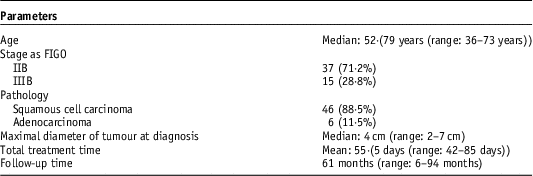
At median follow-up time of 61 months, one patient died from non-cancer cause 6 months after treatment was completed. In all, 11 patients developed distant metastasis and one of those was diagnosed with a local recurrence after 6 months of treatment which was confirmed by biopsy. The mean age was 52 years. In total, 37 patients (71%) had stage IIB and 46 of the analysed patients (88·5%) presented with squamous cell carcinoma (Table 1).
Patients’ characteristics and total treatment time

Abbreviations: FIGO, The International Federation of Gynecology and Obstetrics.
Treatment results
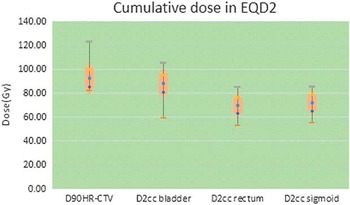
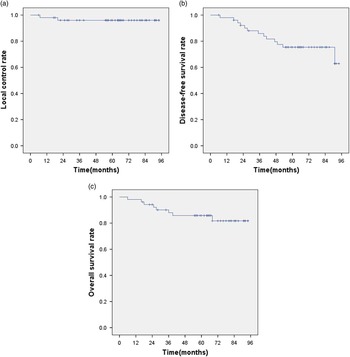
All patients in the present study reached a cumulative dose EQD2 Gy >80 Gy. The mean cumulative dose±standard deviation in EQD2 to the HR-CTV, bladder, rectum and sigmoid colon were 92·4±7·5, 87·9±7·3, 69·6±6·8 and 72±7 Gy, respectively (Figure 2). Local recurrence and distant metastasis were observed in two and 13 patients, respectively. Seven of 13 patients with metastases were metastases to lymph nodes. Eight patients died during follow-up period. The 5-year local control, disease-free survival and overall survival rates were 96·2, 75 and 84·6% respectively (Figure 3).
Box-plot graph showed the dose parameters of high-risk clinical target volume, bladder, rectum and sigmoid. Abbreviations: EQD2, equivalent dose of 2 Gy; Gy, Grey; OARs, organs at risk; D90, dose at 90% of referring volume; D2cc, dose at 2% at refereed volume; min, minimum dose; max, maximum dose.

Kaplan–Meier curves of 5-year local control (a), disease-free survival (b) and overall survival (c)

Toxicity profiles
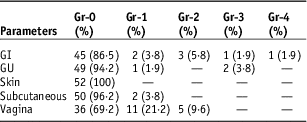
The most common toxicities were mainly grade 1–2 gastrointestinal (29 patients) and grade 1–2 genitourinary toxicities (23 patients). Due to concurrent chemo-radiation, 18 patients (34·6%) and 14 patients (26·9%) had grade 1–2 leucopenia and grade 1–2 anaemia, respectively. Concerning late toxicity, four patients (7·6%) developed grade 3–4 gastrointestinal and genitourinary toxicities during the follow-up period. In total, 16 patients developed grade 1–2 vaginal obstructions. No complication-related death was registered in all patients (Table 2).
Late toxicity profiles

Abbreviations: GI, gastrointestinal; GU, genitourinary; Gr, grade.
Discussion
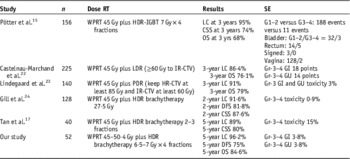
Our results supported using IGBT to treat patient with the promising results of IGBT for the treatment of locally advanced cervical cancer. Our treatment results and toxicity profiles related to previously published studies (Table 3). The mean cumulative dose to the D90 of HR-CTV in our study was 92·4 Gy corresponding to the studies of Pötter et al. (93 Gy), and Lindegaard et al. (91 Gy).Reference Pötter, Georg and Dimopoulos 15 , Reference Lindegaard, Tanderup, Nielsen, Haack and Gelineck 16 The local control rate was >90% in our study and had the same tendency of treatment results in other studies. All of two local recurrences developed in stage IIB and the cumulative dose in EQD2 were >87 Gy (87·3 and 93·8 Gy). Interestingly, metastases were the major factor of failure in our series. In total, 13 patients (25%) failed distantly. For the OARs, the mean cumulative dose to the D2cc of the bladder was 87·9 Gy related to the study of Pötter et al. (86 Gy) and De Brabandere et al. (85 Gy).Reference De Brabandere, Mousa, Nulens, Swinnen and Van Limbergen 2 , Reference Pötter, Georg and Dimopoulos 15 However, the mean cumulative dose to the D2cc of rectum (69·6 Gy) and sigmoid colon (72·0 Gy) were higher in comparison with previously published studies.Reference De Brabandere, Mousa, Nulens, Swinnen and Van Limbergen 2 , Reference Pötter, Georg and Dimopoulos 15 – Reference Tan, Diane Whitney and Coles 17 Keeping the rectal dose to be <65 Gy will be our further aim, according to the study of Tharavichitkul et al.Reference Tharavichitkul, Meungwong and Chitapanarux 18 Although the cumulative dose to the rectum and sigmoid colon were higher, only four patients (7·6%) developed grade 3–4 GI and GU toxicity in our study.
Literature reports on image-guided brachytherapy (IGBT) for cervical cancer

Abbreviations: WPRT, whole pelvic radiotherapy; HR-CTV, high-risk clinical target volume; IR-CTV, intermediate-risk clinical target volume; IGBT, Image-guided brachytherapy; HDR, high dose rate; LDR, low dose rate; PDR, pulsed dose rate; GI, gastrointestinal; GU, genitourinary; LC, local control; CSS, cancer-specific survival; OS, overall survival; yrs, year; pts, patient; DFS, disease-free survival.
Thus, our study showed excellent results of IGBT for cervical cancer in terms of treatment results and toxicities. However, our study is mostly CT-based planning because this is suitable for our infrastructure. On the same floor, our CT simulator situated close to the theatre and loading room so our patients were transferred within short distance. To perform MRI, we have to transfer patients to the first floor in another division which caused time consuming.Reference Tharavichitkul, Sivasomboon and Wanwilairat 10 Although CT yielded poorer image quality than MRI,Reference Viswanathan, Dimopoulos, Kirisits, Berger and Pötter 14 , Reference Eskander, Scanderbeg, Saenz, Brown and Yashar 19 , Reference Krishnatry, Patel, Singh, Sharma, Oinam and Shukla 20 CT-based planning allowed us to improve dose distributions and caused good treatment results and toxicity profiles. According to long-term results of CT-based IGBT, It could be another choice in case of MRI approaches is difficult.Reference Tan, Diane Whitney and Coles 17
Conclusion
IGBT for cervical cancers showed very promising results in long-term results and toxicity profiles. The successful implementation of IGBT depends on manpower, installed equipment, department infrastructure, workload and possibilities of cooperation.Reference Galalae, Tharavichitkul and Wanwilairat 21 To improve the quality of CT-based planning, carefully per-vaginal examination and assistant imaging (pre-BT MRI or ultrasound) may be helpful. The further development of recommendations from GEC-ESTRO in CT-based plan is also needed because CT-based planning is easier accessible in most radiation oncology units.
Acknowledgements
The author offers many thanks to the staff of the Division of Radiation Oncology, Faculty of Medicine, Chiang Mai University for supporting this study.
Conflicts of Interest
None.
Financial support
This work was supported by the Research Unit, Faculty of Medicine, Chiang Mai University.