Confronted with high migration outflows, a number of developing nations have seen in the financial manna of remittances a way out of their economic deadlock. A recent estimate evaluates total flows remitted in 2007 above 318 billion dollars, of which developing nations captured around 75 percent.Footnote 2 These sizeable figures have attracted the attention of growing numbers of researchers, policymakers, and international organizations, and triggered an avalanche of publications on the topic. The literature tries to answer two central questions: What is the socioeconomic impact of remittances in emigration countries and how to channel remittances toward productive investment and development projects?
In this context, one important line of research has investigated the relationship between migrants' transfers and financial markets. Paola Giuliano and Marta Ruiz-Arranz analyze how remittances can substitute for a lack of financial development in the developing countries with borrowing difficulties. The upshot is a positive impact on economic growth.Footnote 3 But high levels of remittances may also have negative effects, if they allow receiving nations to accumulate excessive debt burdens by giving them access to international financing.Footnote 4 Nonetheless, such risk seems limited, while the positive effect of remittances in preventing financial crises has been underlined by Matteo Bugamelli and Francesco Paternò, who show that high levels of remittances reduce the risk of current account reversals in emerging markets.Footnote 5
Although intriguing, this line of research is still limited, as if an invisible border existed between the literature on international migration and remittances on the one side, and the literature on financial markets on the other side. This barrier really needs to be surmounted, if only because of the mounting role of developing countries in both international financial and labor markets. Our article takes a major step in that direction by studying the role of remittances in the adjustment process.
We focus on two common definitions of financial trouble: sudden stops and current account reversals. Although the recent process of financial globalization has brought about a new surge of financial instability, globalization and volatility are not new.Footnote 6 Indeed, the pre-1914 world reached levels of financial market integration only recovered after the 1970s. What is striking about this earlier period of globalization is that financial crises remained constrained, despite the high level of capital mobility. One explanation for this puzzling difference lies in the existence of the gold standard: the adoption of credible convertibility rules fostered the stability of the system and allowed to weather financial whirlwinds not only in core countries, but also along the periphery. However, the recent literature on the determinants of pre-1914 financial stability do not find any evidence of the link between financial disturbances and the exchange rate regime.Footnote 7 Therefore, the explanation for the relative international stability during the gold standard era has to be sought elsewhere, and perhaps it is to be found in the role of remittances.
Mass migration before World War I gave rise to a huge reallocation of population on the international scale. Millions of European workers migrated to the New World in search of better opportunities for themselves, but also for the relatives they left behind. International migration was therefore accompanied by considerable financial flows between countries.Footnote 8 It is likely that these flows helped to prevent balance of payments disturbances in the recipient countries along the European periphery, by compensating for these emerging markets' lack of access to international financing and by providing a stable source of current account credits. We expect that these mechanisms would be especially relevant for peripheral nations under the gold standard, as they were prevented from using the exchange rate as an adjustment instrument to external disturbances.
REMITTANCES BEFORE WORLD WAR I: WHAT DO WE KNOW?
While research on remittances has flourished in the last few years, in particular in connection with their impact on the development of Third World countries, there are few studies of remittances before World War I. Even the abundant literature on mass migration during this period barely mentions transfers of money from migrant workers to their families. This may give the impression that remittances are a relatively new phenomenon fostered by the emergence of efficient and reliable technologies. Yet migrants' sending money home is hardly new. On the contrary, an important part of today's money transfer business has its origin in the impressive wave of labor flows that occurred before World War I.
The world before 1914 was a period of unparalleled international labor mobility. Just between 1870 and 1913 more than 45 million Europeans left their homeland in search of better opportunities in the New World. Fleeing from unpromising living conditions in overpopulated areas, European workers were attracted by fertile lands in the new territories or by high industrial wages. Technical progress in transport and communication contributed to boosting the process by lowering distances and costs.Footnote 9 Most migrants were young, low-skilled males, who left not only with the hope of becoming rich, but also with the intent of helping their family.Footnote 10 Remittances were part of a collective strategy that consisted in sending one or several members of the family abroad so that they could support those left behind.Footnote 11
Transfer Channels
A significant share of remittances sent to Europe during the nineteenth century was the result of “invisible” operations. Many migrants used informal channels to transfer their savings. Banknotes were sent through registered or even ordinary mail, despite the risk of loss or theft.Footnote 12 Emigrants also frequently resorted to the “family and friends network,” entrusting envelopes full of money to acquaintances that traveled to the country of origin. Finally, owing to the fact that transitory flows and return migration were frequent before World War I, many migrants carried their savings with them. In that case, migrants used not only “pocket” remittances, that is, cash, but also bank drafts, since it was a safer way to carry money.
As the number of migrants and the need for sending money home increased, official channels expanded. Money orders and bank drafts represented an easy and inexpensive method that guaranteed that families would receive the money relatively fast. These were denominated in local currencies, and also in the main international currencies such as pounds, francs, and dollars.Footnote 13 Exchange rates played a significant role at the time of sending remittances home. Migrants, who aimed at maximizing the amount of money received by the family in local currency, often waited for the most favorable exchange rates before sending money.Footnote 14 Maria Eugénia Mata describes the existence of a “triangular flow of remittances” between Rio de Janeiro, London, and Lisbon, allowing migrants to take advantage of the best opportunities in terms of cross exchange rates.Footnote 15 The choice of instrument also depended on the country of destination. For instance, Italian migrants in the United States used essentially money orders, while those in South America preferred bank drafts.Footnote 16
In order to meet the growing demand of migrant workers, a structured network of financial intermediaries developed in both sides of the Atlantic. The Western Union Corporation, originally a telegraph company, introduced its money transfer business in 1871, just in time for the take-off of the mass migration phenomenon. Shipping companies also offered the same service, taking advantage of their activity to serve as intermediaries between migrants and their families.Footnote 17 Mail companies were another significant actor in the remittance business through the means of international mail orders.Footnote 18 In the specific case of the United Kingdom, their position was reinforced with the creation in 1881 of postal orders, which allowed for a cheap and safe way of transferring small amounts of money. Inspired by the success of this system, the British authorities extended it in 1904 to the British dependencies overseas, by establishing the Imperial Postal Order Service.Footnote 19
Nevertheless, banks began to capture a larger share of the market. José Ramón García López describes the process through which mercantile houses and exchange agencies converted into banking corporations, at the same time that they dramatically increased the number of branches, both in immigration countries (mainly Argentina, Cuba, and Mexico) and in Spain.Footnote 20 Migration and remittances also gave rise to ethnically oriented banks, since migrants tended to trust financial institutions managed by fellow countrymen. The Emigrant Industrial Savings Bank, founded in 1850, offered its services to the Irish community settled in New York, and many Italo-American banks were set up in the United States, the most important among them being the Bank of Italy in San Francisco, which had a large Italian community.Footnote 21 Remittances also contributed to the density and restructuring of the Italian financial system, particularly in the countryside. In 1901 the Italian government tried to regulate emigration by steering remittances towards the modernized banking network in order to protect Italian migrants against shady intermediaries and also to use remittances as leverage to finance investment projects.Footnote 22
Data on Remittances
Several authors have attempted to estimate series of remittances for the prewar period. Obviously, these estimations are far from being perfect for a number of reasons. First of all, it is hard to evaluate “invisible” remittances that followed informal channels such as “pocket” and “envelope” transfers. It is also necessary to make assumptions that are inevitably open to discussion. For instance, most estimates are based on the number of emigrants, but not all migrants sent money home, either because they traveled with their families, or because they had no family to support. And it would be better to base the calculations not on the flow of emigrants (as is usually done), but on the stock. But, it is usually difficult to estimate this stock, especially if censuses in immigration countries were too far apart. An estimate requires knowledge of return flows and of death rates too, which are not easily available. Finally, there is still the question of determining the amount of money sent by each emigrant on a yearly basis. Clearly, not all migrants sent the same amounts and, with the passing of time, the propensity to transfer remittances decreased.
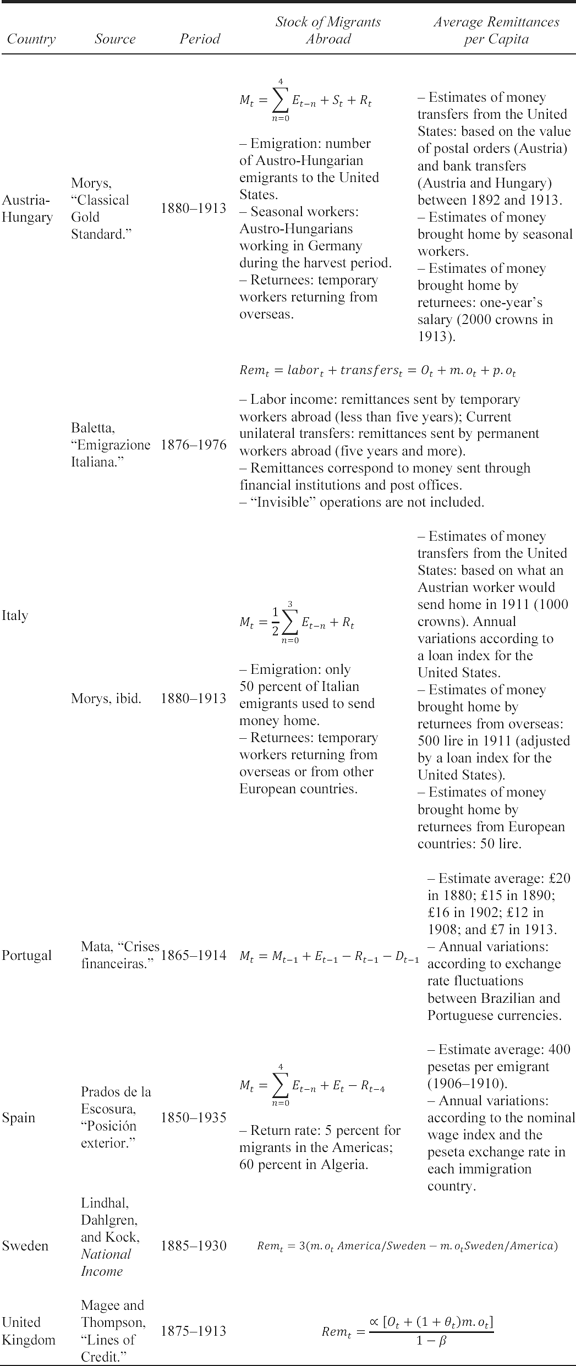
Despite these difficulties, we have chosen the best available series for our estimates. We followed Matthias Morys for Austria-Hungary and Italy; Mata for Portugal; Leandro Prados de la Escosura for Spain; and Erik Lindhal, Einar Dahlgren, and Karin Kock for Sweden.Footnote 23Table 1 summarizes the estimation methods for the remittances series we used.
Morys reworks the Austro-Hungarian and Italian balances of payments, an important part of which were remittances. For Austria-Hungary, he considers three remittance channels. The first is the money sent home by migrants either through banks or post offices. Since more than 90 percent of Austro-Hungarian migrants headed for the United States, this component focuses on transfers from America. The second channel is “pocket” remittances, that is, money that temporary migrants brought with them when returning home. The third is the money carried by seasonal workers in neighboring countries. Due to the large quantity
COMPARATIVE ESTIMATION METHODS

Notes:
Mt = stock of emigrants abroad on year t; Et = emigrants; St = seasonal migrants; Rt = returnees; Dt = deaths of emigrants abroad; Remt = remittances; m.ot = money orders; p.ot = postal orders; Ot = recorded remittances passing through financial intermediaries; θ t = ratio of p.ot to m.ot; α t = share of non-commercial remittances out of the total; and β = share of unreported remittances out of total.
of Austro-Hungarians working in Germany during the harvest period, this channel was very significant.Footnote 24
The value of postal orders is known for Austria between 1892 and 1913 (remittances before 1892 are considered insignificant), but not for Hungary. Morys assumes that after five years, either migrants went back home or settled definitely—and stopped sending remittances. He therefore combines statistics on the number of Austrian immigrants in the United States every year and over the past five years to estimate the average amount of remittances sent each year through the postal services. He extrapolates from the number of Hungarian immigrants in the United States to derive remittances to Hungary. With regard to bank transfers, there is data for both Austria and Hungary starting in 1892. Since the amount of transferred money was likely to be more important than for postal money orders, Morys also includes an estimate for this component of remittances between 1880 and 1891 by extrapolating backward. As for the money brought home by returning migrants, it seems that Austro-Hungarians that migrated to the United States came back home with the equivalent of one-year's wage, or roughly 2000 krone. Using data on return migration, Morys then estimates the yearly value of “pocket” remittances. Finally, he includes estimations provided by Franz Bartsch on the money carried by seasonal workers in Germany.
Although there are other estimates available for Italian remittances (in particular, Francesco Balletta), we again rely on Morys.Footnote 25 As in the case of Austria-Hungary, his calculations include remittances sent by immigrants in the Americas, “pocket” remittances from migrants returning from overseas, and money sent by Italian migrants in other European countries. Because return rates were around 50 percent for Italian migrants in the Americas, and because those who decided to permanently settle did not send remittances after their fourth year abroad, Morys first estimates the number of Italian migrants sending money home each year. He then applies to Italy the average annual amount sent back by Austrian migrants, in effect assuming that Italians and Austrians sent home roughly the same per capita amount. As for return migrants from the Americas, Morys takes an average value of 500 lire per migrant in 1911 and builds up his series by multiplying this value by a loan index for the United States (the main Italian immigration country). Finally, Morys considers that the rate of return for intra-European migration is around 75 percent of the total number of the Italians who migrated to other European countries and that each return migrant carried 50 lire. The sum of these three categories of remittances gives the series for Italy.
Mata reconstructs the Portuguese balance of payments between 1865 and 1914 and supplies estimates of remittances that Portuguese migrants sent to their homeland. The stock of Portuguese citizens in Brazil, the main receiving country, is taken from Herbert Klein.Footnote 26 It is calculated by taking into account the annual volume of emigration and immigration, as well as the death rate among immigrants. Several Portuguese economists provided different estimations of per capita remittances before World War I.Footnote 27 Based on this information, Mata considers an average level of remittances of approximately 20 pounds in the 1880s, 15 pounds in the 1890s, 16 pounds in 1902, 12 pounds in 1907-1911, and 7 pounds before the war. The values for intervening years were interpolated on the basis of Brazilian business cycles and exchange rate fluctuations. The series of Portuguese remittances is then built by multiplying average remittances per emigrant by the estimates of the number of Portuguese living abroad.
For Spain, Prados de la Escosura provides a series of remittances between 1850 and 1935. Based on emigration data from Blanca Sánchez Alonso, he assumes that migrants sent money home only during the first five years, and that thereafter they had either already returned home or had decided to stay and so stopped sending money back home.Footnote 28 Following Matthew Simon, Prados de la Escosura gives a double-weight to the last year of every five-year period.Footnote 29 With these assumptions, he calculates the potential number of migrants sending money home and multiplies it by the estimated annual average of money transferred, which is taken from Garcia López.
Lindhal, Dahlgren, and Kock provide the only estimates of remittances for Sweden. Unlike previous authors, who calculate gross flows, their estimations for Sweden are net. They take into account not only remittances from the United States (the main destination country of Swedish emigrants before World War I), but also the money Swedes sent to America. In order to offset the lack of information about “invisible” remittances, Lindhal, Dahlgren, and Kock multiply by three the difference between the money orders sent by immigrants in the United States and those sent from Sweden. This method was used to construct contemporary balance of payment series.
Remittances in Perspective
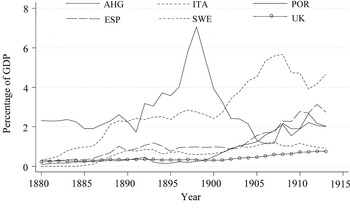
Figure 1 illustrates remittances as a share of GDP between 1880 and 1913 for six European countries—the five countries we will be concentrating on and the United Kingdom. On average, Italy registered the highest levels of remittances (2.8 percent), followed by Portugal
REMITTANCES AS A SHARE OF GDP, 1880-1913

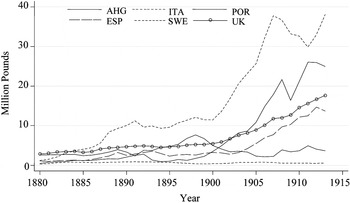
(2.7 percent), Spain (1.2 percent), Austria-Hungary and Sweden (both with 0.8 percent), and the United Kingdom (0.4 percent).Footnote 30 Only Portugal recorded levels of remittances above 2 percent of GDP at the beginning of the period. Portugal was also the country that reached the highest level of remittances as a share of GDP (7.1 percent) in 1898, although reverting thereafter to more modest values. This pattern is due to economic and political difficulties in Brazil (the main destination of Portuguese emigration) during the late 1880s and early 1890s. Portuguese emigrants reacted by amassing significant sums in expectation of the improvement of the Brazilian exchange rate from 1898 onwards. The evolution of remittances in the other countries was more regular, even though the presence of cycles is obvious. Sweden is the only exception, with remittances never exceeding 1.2 percent of GDP. If we instead look at remittances expressed in sterling (Figure 2), Italy dominated from early on, later joined by Austria-Hungary.
Among the determinants of the flow of remittances, the single most important is the per capita amount sent by nationals abroad in foreign currency. Analysis of covariance shows that, on average, per capita
REMITTANCES IN MILLION POUNDS, 1880-1913

values explain 68 percent of the variation in total remittances, while the changes in the stock of nationals abroad accounts for the remaining 32 percent. Also, exchange rate fluctuations, although important over short periods, had a small impact on the overall variation of remittances received by emigration countries. Furthermore, individual amounts sent home were highly procyclical with respect to the main destination countries.Footnote 31
Clearly, remittances were important before World War I. Migrant money trickled down to the most remote parts of the continent and increased local consumption and savings.Footnote 32 Remittances also fostered the emigration process itself, since they were partly used to finance the voyage of new migrants.Footnote 33 This created a self-reinforcing cycle of emigration, remittances, and living conditions.Footnote 34 But did remittances also support the balance of payments adjustment during the classical gold standard period?
LABOR MOBILITY, REMITTANCES, AND THE BALANCE OF PAYMENTS ADJUSTMENT UNDER THE GOLD STANDARD
The classical theory of optimum currency areas emphasizes that a fixed exchange rate regime may require a high level of labor mobility to offset the loss of exchange rate flexibility.Footnote 35 David Khoudour-Castéras shows that there was a trade-off, during the gold standard period, between labor mobility and nominal exchange rate fluctuations in the current account adjustment.Footnote 36 While countries that opted for a fixed exchange rate strategy experienced a strong correlation between the variations in the emigration rate and the current account, countries with flexible exchange rates relied less on the migration channel, since exchange rate fluctuations helped to reduce current account imbalances.
The role of remittances in the adjustment process has been suggested by several authors, both in the past and more recently. At the turn of the century, Friedrich Fellner and Bartsch underlined the weight of emigrants' savings in Austria-Hungary's balance of payments, with Bartsch noting that: “The transfer home of emigrants' savings has greatly increased and become one of the main assets in the balance of payments of the monarchy.”Footnote 37 Reflecting on the prewar Portuguese balance of payments, Oliveira Salazar, the future Portuguese dictator, emphasized the impact of remittances on exchange rate variations: “Given that remittances are the largest source of foreign assets in Portuguese markets to make payments abroad, they have over time been the most important influence on the upswings and downswings of our exchange rate.”Footnote 38 More recently, Stefano Fenoaltea and Gino Massulo have pointed to the contribution remittances made to the Italian current account and have shown that migrant money helped ease the burden of adjustment.Footnote 39
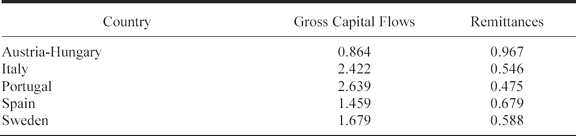
VOLATILITY OF CAPITAL FLOWS AND REMITTANCES
Note:
Values are coefficients of variation.
Sources:
See the text.
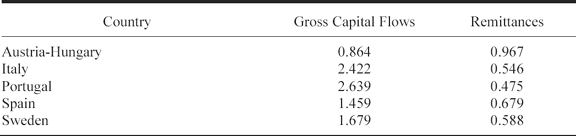
We can confirm these assertions with our series of remittances. As Table 2 shows, the volatility of gross capital flows was higher than that of remittances, except in Austria-Hungary. In Italy and Portugal, for instance, gross capital flows were, respectively, 4.4 and 5.6 times more volatile than remittances.Footnote 40
Such stability can be explained by the fact that migrants felt that they were responsible for their relatives left behind. Therefore, they tended to regularly transfer money. Yet the contribution of remittances to development was threatened by economic shocks, since migrants' transfers were strongly correlated with business cycles in recipient countries.Footnote 41 In this context, the case of Portugal is the most remarkable. When the Brazilian economy went through a crisis between the late 1880s and early 1890s, Portuguese emigrants stopped sending money to their homeland. But the Portuguese economy relied so much on remittances that monetary authorities were forced to abandon the gold standard.Footnote 42
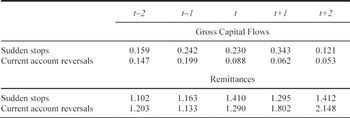
The contribution of remittances to external adjustment is even more striking when we compare the behavior of capital flows and remittances during balance of payments disturbances. Table 3 shows the average value of gross capital flows and remittances one and two years before, during, and one and two years after disturbances (sudden stops or current account reversals).Footnote 43 Whereas gross capital flows tended to
REMITTANCES AND CAPITAL FLOWS DURING BALANCE OF PAYMENTS DISTURBANCES

Note:
Unweighted average values in percentage of GDP.
Sources:
See the text.
decrease following balance of payments disturbances, remittances followed a rising path. The explanation probably lies in the fact that foreign capital has a high propensity to flee financial instability. Remittances, by contrast, follow a countercyclical pattern: when the country of origin faces an economic shock, migrants are inclined to send more money to their family in order to offset the situation. This probably explains the significant increase in remittances that accompanied balance of payment disturbances and suggests that migrants' transfers, which also represented a higher value of GDP than other foreign capital inflows, played a significant role in the external adjustment of small open economies before World War I.
FINANCIAL CRISES AND BALANCE OF PAYMENTS DISTURBANCES
Michael Bordo et al. define financial crises as “episodes of financial market volatility marked by significant problems of illiquidity and insolvency among financial market participants and/or by official intervention to contain such consequences.”Footnote 44 The literature identifies several types of financial perturbations: banking crises, debt crises, currency crises, sudden stops, and current account reversals.Footnote 45 Comparing the periods 1880-1913 and 1980-2004, Bordo shows that the frequency of sudden stops and current account reversals, among a sample of nations in each year, was higher during the first period (7.0 and 6.1 percent, respectively) than during the second (6.5 and 4.9 percent, respectively).Footnote 46 Banking, currency, and debt crises, by contrast, were more frequent during the period 1980-2004 than before 1914. We will therefore focus on sudden stops and current account reversals.
Sudden stops were present before 1914 and affected a wide range of countries, irrespective of their income level or financial development.Footnote 47 They tended to occur simultaneously in different countries, as if domestic conditions might not be the driving cause, and clustered around three main periods: 1874-1880, the early 1890s, and 1906-1908. Southern European countries, in particular, seemed to follow a synchronous pattern. The exchange rate regime was not a determining factor for the frequency or the duration of sudden stops. In other words, belonging to the gold standard did not protect a country against such events. In fact, the only common determinant of sudden stops before World War I seems to have been the occurrence of interest rate hikes in the core countries. Beyond their significance for financial markets, sudden stops had a strong impact in terms of growth rates, mostly because they came with large interest rate upswings. Bordo, and Bordo, Alberto Cavallo, and Christopher Meissner show that the average output loss caused by sudden stops was around 4 percent, or even worse when associated with financial crises.Footnote 48 In Europe, Italy was one of the countries that suffered the most damage from sudden stops, which were followed not only by a fall in the growth rate, but also by banking crises (1891 and 1893) and even a currency crisis (1889).
Current account reversals are considered to be a problem insofar as they imply a rapid decline in consumption levels and hence a slowdown in the economic activity. Nevertheless, drastic changes in the current account position do not always bring about disruptive effects. If the reversal is the result of a sharp increase in investment, then the result can be an improvement in output. In that sense, current account reversals are more common, and often more disruptive, in countries with persistent deficits, low levels of reserves, and unfavorable terms of trade.Footnote 49 Comparing the gold standard era (1880-1914), the interwar period (1919-1939), the Bretton Woods years (1945-1970), and the post-Bretton Woods period (1972-1997), Adalet and Eichengreen find that the frequency and magnitude of reversals were smaller before World War I than during any other period.Footnote 50 Nevertheless, the difference relative to Bretton Woods is not large, which seems to confirm the stabilizing influence of fixed exchange rate regimes in general, and the gold standard in particular. It is noteworthy however that, unlike the gold standard, Bretton Woods was an era of low capital mobility, which constrained current account imbalances. Finally, even though there was a negative impact of current account reversals in terms of growth during the gold standard era, this impact was significantly smaller than during the other periods. Müge Adalet and Barry Eichengreen interpret the lower cost of reversals as consistent with the higher level of wage and price flexibility before World War I.
To sum up, recent studies emphasize that the gold standard period was marked by financial crises, sudden stops, and current account reversals, but the relative frequency of such calamities changed in later periods. Above all, the costs in terms of average output loss were lower during the gold standard period than in the last thirty or so years.Footnote 51 One might obviously conclude that the gold standard protected member countries from misfortune. However, neither Adalet and Eichengreen nor Luís Catão was able to find any significant impact of the exchange rate regime in their regressions. In other words, all countries appear to have been affected by—or more precisely protected against—current account reversals and sudden stops in the same way, no matter whether they were on the gold standard or not. This begs the question why financial and balance of payments disturbances were not more frequent. As Adalet and Eichengreen put it: “The smooth operation of the classical gold standard remains to be explained.”Footnote 52
EMPIRICAL MODEL
To identify the relevance of remittances for current account adjustment, especially among countries on gold, we now focus on the determinants of financial crises. In particular, we bring remittances into models of financial crises.Footnote 53 We start with a standard empirical specification in the literature on financial crises and adopt standard definitions of what financial crises are. We follow Catão's concept of sudden stop as a drop in capital flows of more than 2 standard deviations (or larger than 3 percent of GDP) of the deviations of capital flows from their linear trend over a period shorter than four years.Footnote 54 Sudden stops are usually defined with respect to net capital inflows, but the irregular availability of capital account information before 1914 may require the use of the definition in gross flows, especially in larger country samples. We directly used Catão's dating of sudden stops (gross and net) for all countries except Austria-Hungary. There we applied Catão's definition to Morys's capital account statistics as well as to the available estimates of gross capital inflows into the Danube monarchy.Footnote 55 Contrary to Catão, in estimating capital inflows into Austria-Hungary, we included not only British capital calls (from Irving Stone), but also German capital exports, as the latter were ten times the size of the former in our period of study.Footnote 56
For the definition of current account reversals, we follow Gian Maria Milesi-Ferretti and Assaf Razin in identifying a reversal episode when three criteria are met: (1) an average fall of at least 2 percent of GDP from the three preceding years to the three succeeding years after the reversal; (2) a maximum current account deficit in the later three years no larger than the minimum deficit in the earlier three years; and (3) a reduction in the three-years average deficit by, at least, a third.Footnote 57 Since we are interested in relating current account reversals to a component of the current account (emigrants' remittances), we used data on the trade account to date the reversals.
Because of the nature of our hypothesis, we run our model for the five “peripheral” economies for which we have information on remittances: Austria-Hungary, Italy, Portugal, Spain, and Sweden. The United Kingdom is excluded, both because it was a core country in the gold standard, and because remittances weighed very lightly in the structure of its current account.Footnote 58 Even though our sample is constituted by a relatively small number of countries, one should note that these five nations constitute a representative portrait of European emigration in this period. Based on Imre Ferenczi and Walter Willcox's figures, they produced 58 percent of European emigration in the period 1880-1913, and 84 percent of the total from peripheral nations.Footnote 59
DATING OF BALANCE OF PAYMENTS DISTURBANCES

Sources:
See the text.
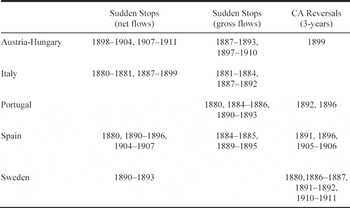
Table 4 summarizes the balance of payments disturbances that struck these nations. The country that faced longer sudden stops of net capital inflows was Italy (15 years), followed by Austria-Hungary (12 years). Portugal did not register any sudden stop, measured in net flows, during the period. As for sudden stops of gross flows, Austria-Hungary was the most affected with 21 years, while Sweden did not have any sudden stop. Current account reversals were more evenly distributed: two years for Portugal, six for Sweden, four for Spain, and one for Austria-Hungary. Italy did not register any current account reversal in our sample. Also notice the clustering of events in time for both concepts—sudden stops and current account reversals.
The covariates of our model include seven groups of variables. The first group captures the size of macro imbalances via the current account deficit (in pounds sterling) and the real exchange rate against sterling. The second group measures external exposure, using central bank net reserves, the government debt service payable in gold, and the trade openness of the economy, all as percentages of GDP. The third group is per capita GDP, as is usual in the literature. The fourth includes indicators of monetary and fiscal probity, namely, the participation in the gold standard, domestic banknote circulation in pounds sterling per capita, and the ratio of government debt service to revenue.Footnote 60 The fifth controls for external exogenous developments: the international level of interest rates (proxied by the rate on British consols) and the growth rate in the leading economy, again the United Kingdom. The sixth takes into account political disturbances, while the last group is composed of our measures of emigrants' remittances. We use both the size of remittances in percentage of GDP and its interaction with the participation in the gold standard. The gold standard being the typical hard peg of the period, we use the latter covariate as a test of the argument that remittances were especially important for countries that had to weather financial crises along the periphery. The sources for the variables are listed in the Appendix.
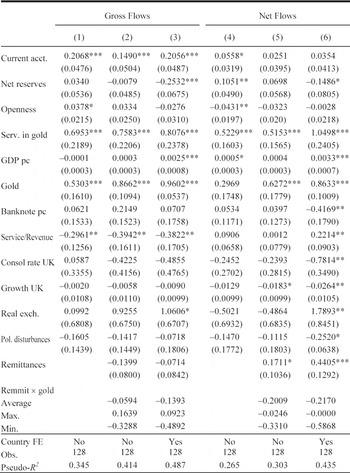
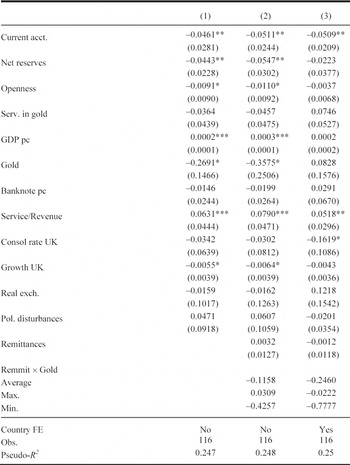
Tables 5 and 6 list the results from probit regressions for the probability of the three definitions of financial crises used in this study. Given the small number of countries, these are pooled OLS regressions.Footnote 61 We also tried panel methods, but the panel-level variance component was always insignificant. To prevent endogeneity problems, all independent variables are lagged. In each case, we provide three sets of results: without the information on remittances, with the two remittances variables, and with country fixed effects. The estimates listed are the marginal effects of each independent variable on the probability of each definition of financial crisis.
For the determinants of sudden stops, we could not include all countries in the sample because Portugal did not experience a sudden stop of net capital inflows, while Sweden had no stop of gross flows. We find that both definitions of sudden stops are more likely the higher the currency mismatch of government external debt, in other words, the higher the difference between debt service in gold and net external reserves. The coefficients on debt service in gold are significant and positive in both specifications 3 and 6, while net reserves enter the same models with negative and significant coefficients. The positive and significant coefficient on domestic GDP seems puzzling, although it may be the case that lagged GDP proxies here for periods of growth financed by unsustainable foreign capital inflows leading to crises.Footnote 62 The gold standard variable also has a positive and significant value, which would appear to confirm the findings elsewhere in the literature
PROBIT ESTIMATES (MARGINAL EFFECTS) OF SUDDEN STOPS

* = Significant at the 10 percent level.
** = Significant at the 5 percent level.
*** = Significant at the 1 percent level.
Notes:
Estimated marginal effects on the probability of success. For categorical values, estimate represents the impact on the probability of changing the covariate from 0 to 1. Robust standard errors in parenthesis. See the text for descriptive statistics of the interaction term Remmit × gold.
PROBIT ESTIMATES (MARGINAL EFFECTS) OF CURRENT ACCOUNT REVERSALS

* = Significant at the 10 percent level.
** = Significant at the 5 percent level.
*** = Significant at the 1 percent level.
Notes:
Estimated marginal effects on the probability of success. For categorical values, estimate represents the impact on the probability of changing the covariate from 0 to 1. Robust standard errors in parenthesis. See the text for descriptive statistics of the interaction term Remmit × gold.
that the choice of monetary regime cannot stave off sudden stops.Footnote 63 Nevertheless, we do not want to impute too much meaning to this coefficient because of the well-known fact that in models with interaction terms, the level and significance of the lower-order coefficients do not usually provide valid inferences.Footnote 64 In particular, the presence of the interaction term means that the coefficient on the gold standard dummy should be interpreted conditional on zero remittances. In other words, the positive value of the gold standard coefficient is an estimate of the effect valid only for countries that received no remittances (hardly the case in this sample).
External shocks are especially significant in the regressions for net capital flows. Yet, the negative coefficient on the British consol rate is hard to reconcile with casual intuition about the negative impact of exogenous interest hikes. A negative sign of the United Kingdom growth rate is in agreement with the literature on financial crises. Macroeconomic imbalances are also relevant. In particular, real appreciation against the leading country (the United Kingdom) duly increases the probability of a subsequent stop in capital inflows. Notice, however, that the current account surplus exhibits persistence in the regression for sudden stops (gross), contrary to what might be expected from peripheral nations.Footnote 65 Given the length of sudden stops (six years on average in the sample), this may just reflect the time required for the current account to respond to capital account shocks. Domestic policy is significant but not always in the expected direction. For instance, banknote circulation has the wrong sign in the regression for net flows. Political disturbances have a counterintuitive sign, although the rarity of such events in this sample (only 10 years in 170 possible) probably does not allow for a good identification of their impact.
The introduction of the remittances variables has a significant impact on the adjustment of the models, as can be seen by the improvement in the pseudo-R 2 of models 2 against 1, and 5 against 4. This variable included both in levels and interacted with participation in the gold standard to test for a differential impact of access to emigrant money, depending on the exchange rate regime. Remittances in levels are almost everywhere insignificant, which fits our expectation that remittances were not as relevant for floating countries that had other adjustment mechanisms, namely depreciation.Footnote 66 By contrast, we need to interpret the interaction terms carefully. As Chunrong Ai and Edward Norton have noted, the coefficient of the linear interaction term does not give the correct marginal effect in nonlinear models. Moreover, the correct interaction effect depends on the covariates and, hence, varies across observations.Footnote 67 To see this, let yi be the probability of a financial disturbance on year i. In a probit model:

where Φ is the normal distribution function. β12 is the coefficient of the usual linear interaction term, with marginal effect β12Φ'(•), but the correct interaction between variables x 1 and x 2 is given by:

For this reason, we list three summary statistics of the distribution of interaction effects—average, maximum and minimum. Despite the variation across observations, the interaction terms are unambiguously negative, except in the regression for gross flows, where some of the terms are positive. The economic significance of these results can be gauged by comparing them to statistics on the prevalence of financial disturbances before World War I. According to Catão's chronology, the incidence of sudden stops among 16 nations between 1870 and 1913 was in order of 22 percent of the country-year pairs.Footnote 68 In Adalet and Eichengreen's sample of 19 peripheral and core nations, the probability of current account reversals is 12.2 percent (1880-1913).Footnote 69 For both definitions of financial disturbance, the estimated marginal effect of emigrants' remittances in our model is remarkably close to these probabilities. Of course, the comparison is not exact because we estimate here conditional probabilities, whereas these authors' figures are unconditional. Furthermore, these authors include core nations in their samples, which arguably downplay the average exposure to financial disturbances. Nonetheless, the size of our estimates is highly significant from an economic point of view, as a 1 percent GDP increase in remittances reduces the probability of financial disturbances in our sample by between 60 percent and almost 100 percent of the corresponding probability in Catão's sample.
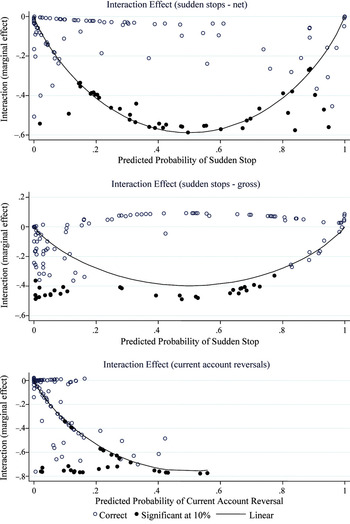
A different way to grasp the importance of these results is to plot the interaction effects against the estimated probabilities of financial disturbance for each observation. The first two panels of Figure 3 depict the values of the interaction effects for the two definitions of sudden stops.Footnote 70
Although many individual interaction terms follow closely the incorrect linear marginal effect β12Ф' (represented by the solid line in each panel), there is sufficient variation in the distribution of the correct interaction terms to confirm how misleading the linear terms are. Notwithstanding, if we concentrate only on the correct terms that are statistically significant (dark circles), most of them either conform to the linear model (on or close to the concave line), or are concentrated in the extremes of the estimated probabilities of sudden stop.Footnote 71 Thus, remittances were more important in preventing sudden stops (in net terms) in countries under gold with high ex ante probabilities of sudden stops. Using gross flows, however, there is some concentration of significant terms at low probabilities of sudden stops.
As is immediately evident from the pseudo-R 2, the quality of adjustment for the regressions of current account reversals is lower than for sudden stops. Nevertheless, all coefficients now have the expected sign, except for the positive association between GDP and incidence of reversals. Consistent with Milesi-Ferretti and Razin, and Adalet and Eichengreen, we find positive marginal effects from fiscal imbalance (service/revenue) and slower growth at the core.Footnote 72 Unlike the models for sudden stops, the coefficient on the gold standard is positive but insignificant, except in the model without country fixed effects.Footnote 73 The current account exhibits a predictable negative sign. Finally, in seeming agreement with our hypothesis, remittances have a significantly negative impact on the probability of reversals only for countries on gold. This assertion is again confirmed by the last panel of Figure 3 that exhibits a configuration similar to that of sudden stops (gross), namely a concentration of significant interaction terms at low probabilities of reversal.
CORRECT INTERACTION TERMS BETWEEN REMITTANCES AND GOLD (marginal effects)

Robustness Checks
We checked the stability of our results against five different exercises. First, we reestimated our models using a linear probability specification. The qualitative nature of the results does not change relative to the probits, but the estimates of the interaction coefficients are significantly larger in absolute value than the average individual terms of Tables 5 and 6. Depending on the specification, the linear interaction terms were between 3 and 6 times larger, placing them closer to the maximum than to the average of the individual terms in the nonlinear models. Nevertheless, we do not wish to emphasize these results given the known problems of LPM regressions.
Second, we explored the alternative of running separate regressions for countries and off gold. The size and significance of the coefficient on remittances behaved here also according to expectation, namely the level of remittances is only significant (and negative) in the regressions on gold.
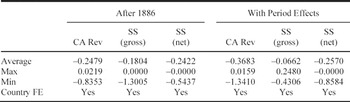
Third, following Bugamelli and Paternò, we checked whether remittances were only significant above a minimum threshold level.Footnote 74 The authors suggested that in the contemporary case, the effects of remittances are especially felt above a minimum of 3 percent of GDP. In our sample, most countries only reach this threshold in the first decade of the twentieth century, which limits the possibility to test this hypothesis given the few degrees of freedom left. Nevertheless, even for a lower threshold, as 1 percent of GDP, we obtain a significant increase in the point estimates of the coefficients of interest. The unweighted average of remittances in our sample reaches 1 percent of GDP in 1887. Restricting the time period to 1887-1913, the average marginal effect of the interaction term between the level of remittances and gold slightly increases in absolute value to −0.248 in the regression for current account reversals, and to −0.180 and −0.242 in the regressions for sudden stops of gross and net flows, respectively (see Table 7).Footnote 75
INTERACTION TERMS (MARGINAL EFFECTS) AFTER ROBUSTNESS CHECKS

Notes:
CA Rev - current account reversals, SS - sudden stops, defined in terms of net or gross capital flows. Values are estimated marginal effects on probability of success in models with country fixed effects.
Sources:
See the text for descriptive statistics of the interaction term Remmit × gold.
Even though we included measures for international exogenous conditions (interest rate and growth in leading economy), it is possible that our results are biased by the omission of common factors that drove either or both types of financial crises. The literature on financial crises documents the clustering of sudden stops and current account reversals in time.Footnote 76 We therefore introduced period controls to account for general swings in international capital flows, which could introduce an element of contagion in the disturbances experienced by the countries in our sample. We followed the dating by Michael Clemens and Jeffrey Williamson of waves of British capital exports as a proxy for global investment cycles.Footnote 77 Five such periods are included in our sample period: 1878-1885, 1886-1893, 1894-1901, 1902-1906, and 1907-1913. We also considered only the downswing phases of these waves. In both cases, the tenor of the results is essentially unchanged, especially when only controlling for general downswings. Table 7 lists the summary statistics of the interaction terms with period controls. Although there is a reduction in the average absolute value of the marginal effects in the case of sudden stops (gross), the size of the interaction terms is still very significant in economic terms.Footnote 78
Finally, we also tested the stability of the results to the exclusion of individual countries from the sample. We find that the coefficients of interest (level and interaction of remittances) are not generally robust to the exclusion of individual countries. This, however, is not entirely unexpected because of the small number of countries and, consequently, the limited variation in their participation in the gold standard. For instance, omitting Sweden (classified as being on gold in all years of our sample) reduces considerably the chances of identifying the marginal impact of remittances precisely through gold membership. The same can be said from the omission of Spain, the only country outside the golden club throughout the period. Still consistent with our interpretation is the fact that the country with least impact on the results is Italy, which spent almost equal number of years within and outside the system.
The solution to the country sensitivity of our results naturally requires adding more countries to our sample. Nevertheless, the nature of the question we ask in this article limits the class of countries which can be included both because of the difficulty in obtaining historical series of remittances and because of the connection between international labor mobility and currency pegs which we study here. Among the peripheral nations who joined the gold standard, we are not so much interested in countries of immigration. The main destinations of European migrations in the New World or in Oceania regularly paid a substantial flow of remittances which could hardly have helped the stability of their external position.Footnote 79 This leaves as candidates for future inclusion other countries in the European periphery—Denmark, Norway, Finland, Greece, Serbia, Romania, Russia, and maybe Turkey—as well as countries that were either not among the main destinations of migratory flows, such as Japan, or countries that were important sources of migrants themselves, such as China. Unfortunately, for many of these countries the necessary data are severely limited.
CONCLUSION
This article has established the importance of emigrants' remittances in the context of the late-nineteenth-century wave of mass migration. It is the first article to do so using historical data. Not surprisingly, given the scale of international labor movements before 1914, we conclude that remittances had a remarkable impact in the economy of emigration countries. This importance can be measured from a number of perspectives, in particular the impact on domestic growth, and on domestic and international financial stability. We focus mainly on financial stability, even though there is suggestive evidence of the direct effect of remittances on household behavior and general savings patterns. It is reasonable to expect that such easing of financial constraints could boost savings levels or increase consumption. A predominant rise in consumption levels corresponds in this case to a pathology similar to the renowned “Dutch disease.” A promising avenue for research would be to investigate which effect dominated and how the ordering of the effects depended on specific structures or policies in recipient countries. One cannot emphasize too much the importance of the results for contemporary policy challenges in developing economies.
Equally challenging and relevant are the financial implications of a regular flow of remittances for the stability of the external account of developing and emerging nations. The evidence compiled in this article confirms patterns observed in recent years. Remittances are less volatile and frequently more important than other foreign capital inflows received by countries with significant rates of emigration. Another opportunity for research consists in clarifying the relation between capital flows and remittances. One hypothesis claims that larger remittances can substitute for insufficient access to foreign capital and consequent credit constraints. Another view sees foreign capital following remittances, which are interpreted in the market as stable collateral for investment in a developing nation. Authors forwarding this view caution about a possible moral hazard problem, in the sense that remittances may lead to overlending to developing nations. A rough test of these competing views consists of calculating the correlation between remittances and private capital inflows, which is expected to be negative in the first scenario and positive in the second. Contrary to Claudia Buch, Anja Kuckulenz, and Marie-Hélene Le Manchec, who find a positive and significant correlation between remittances and private capital flows after 1970, the equivalent measure in our sample is negative (-0.30) and also significant.Footnote 80 This suggests that remittances and foreign capital flows were substitutes before 1914, and that remittances were instrumental in relieving credit constraints to developing nations.
The final contribution of this article, and its main claim, is to show that remittances had a direct impact on financial stability by reducing the probability of financial crises, as measured by two common concepts in the literature—sudden stops and current account reversals. By extending standard empirical models of determinants of these events, we showed that the level of remittances significantly reduced the likelihood of financial disturbances. That was particularly so for countries in the gold standard periphery, which had to submit to the strictures of a hard peg without the benefits of stabilizing capital flows that the currencies of core countries enjoyed.Footnote 81 Part of the “mystery” of financial stability during the gold standard may therefore derive from remittances. More generally, our results also speak to the broad debate over merits of international financial integration. Even if access to international capital is liable to submit the domestic economy to the costs of international financial shocks, the example of remittances suggests that financial openness can be sustained if sufficient buffer mechanisms exist to limit the incidence of disturbances to a tolerable level. Contrary to more pessimistic authors, we find that the preponderance of evidence favors the view that emerging economies have more to gain from the international allocation of capital than they have to lose from the associated financial turbulence.Footnote 82
Clearly, historical remittances raise many significant questions, and the answers have direct implications for modern policy in developing economies. Our purpose here was to start drawing useful lessons from a historical period when it would not be disputed that international labor movements reached a height still unsurpassed today.
Data Appendix
Current Account
Morys, “Classical Gold Standard,” for Austria-Hungary and Italy; Prados de la Escosura, “Posición exterior,” for Spain; Lindhal, Dahlgren, and Kock, National Income, for Sweden; and Mitchell, International Historic Statistics, for Portugal.
Openness
Trade statistics from Mitchell, ibid., and nominal GDP data from Flandreau and Zumer, Making of Global Finance.
GDP per Capita and U.K. Growth Rate
In 1990 U.S. dollars, purchasing power parity (PPP) from Clemens and Williamson, “Wealth Bias.”
Real Exchange Rate
Nominal exchange rates and price levels from Flandreau and Zumer, ibid. The variable was normalized as an index with value 1 for 1913.
Central Bank Net Reserves, Debt Service In Gold, Years On Gold, Banknote Circulation per Capita, Debt Service/Revenue, and Political Disturbances
Flandreau and Zumer, ibid.