Throughout Chinese history, stories of filial children, especially those who made sacrifices for their parents, have served as classic examples of moral behaviour. Filial piety (xiao 孝), which developed in the framework of Confucianism, has been highly valued as a core virtue of family life and has served as a key standard of moral conduct in China. When discussing filial behaviour, Confucius commented in the Classic of Filial Piety: “In serving his parents, a filial son reveres them in daily life; he makes them happy while he nourishes them; he takes anxious care of them in sickness; he shows great sorrow over their death; and he sacrifices to them with solemnity.”Footnote 1 This statement highlights the fundamental principles of filial behaviour – serving parents with respect and appreciation, providing care and financial support when they are alive, and practising ancestor worship after their deaths.
Because of higher expectations on sons of filial practice, filial piety was defined as a male virtue in traditional Chinese society.Footnote 2 Confucian ethics and patrilineal tradition obliged sons to take on the responsibility of offering material support and physical care to their parents, arranging their funerals and practising ancestor worship after their deaths.Footnote 3 In contrast, upon marriage a daughter joined her husband's patriline and was no longer considered a formal member of her natal family. A daughter's separation from her parents on marriage was vividly expressed by the Chinese saying, “married daughter, splashed water” (jia chuqu de nüer, po chuqu de shui 嫁出去的女儿, 泼出去的水).Footnote 4 Consequently, she was not expected to make a contribution to her natal family and her filial obligation was transferred to her parents-in-law.Footnote 5
In contemporary China, the long-standing practice of filial piety is still highly desired, especially in rural areas where the majority of elderly peasants do not enjoy a state-sponsored retirement pension. Moreover, the Chinese state has further promoted and reinforced the practice of family support through implementing laws that stipulate the legal obligations of adult children to their parents in need.Footnote 6 Despite the cultural significance and financial necessity of filial support, recent scholarship has revealed a decline in “traditional” filial practices and in sons' devotion to the welfare of their parents because of a weakening of parental power and an increase in self-interest amongst the younger generation under the effects of China's burgeoning market economy.Footnote 7 Meanwhile, some studies have documented the existence of an intimate bond between a daughter and her natal parents in post-revolutionary China.Footnote 8 Other studies have even revealed that some daughters shoulder the main filial responsibility and have become the primary caregivers of and/or financial providers to their elderly parents.Footnote 9
In this article, I examine the filial practices of sons and daughters in contemporary rural north-eastern China to explore the changing gendered character of filiality within a transformed socio-economic environment. The now common designation of daughters as more filial is vividly expressed by a well-known Chinese saying: “A daughter is like a little quilted vest to warm her parents' hearts” (guinü shi diema de tiexin xiaomian'ao 闺女是爹妈的贴心小棉袄). The suggestion that daughters are more filial is supported by my fieldwork data; however, the specific dimensions and characteristics of daughters' filial behaviour are not simply a feminized version of traditional expectations of filiality. Instead, elderly parents have modified traditional expectations to encompass a desire for an emotional bond, as well as respect and practical support from adult children, particularly their daughters. As discussed below, elderly villagers whom I interviewed conceptualized filial practice in both material and emotional terms, and particularly expressed an increasing desire for an emotional bond with their adult children.
The data collected for this article are based on my 17 months of fieldwork in Lijia village (Lijiacun 李家村),Footnote 10 a rural community in north-eastern China, over the course of four field trips, conducted in 2002, 2004, 2005 and 2006–07. The field methods for this project combined long-term participant observation, a household survey, a survey of 248 couples of reproductive age,Footnote 11 and open-ended interviews with over 160 Lijia residents, including 34 elderly parents with married sons and daughters.
Lijia village, with a population of 822 in 2006, is a surname village in Liaoning province in north-eastern China. Residents engage in maize cultivation and household sideline production, such as raising cows and selling vegetables. The burgeoning market economy has also created non-agricultural employment opportunities for villagers, such as temporary jobs at construction sites and at a brick kiln outside the village as well as at ceramic factories in a recently established economic development zone in the county area.Footnote 12 In addition to taking local jobs, some Lijia residents have migrated to the cities for temporary employment. The majority of villagers start to take non-agricultural jobs as early as their mid-teens, after they finish junior high school. After marriage, almost all men take non-agricultural jobs, except for those with severe health issues. A large number of married women, when they are able to obtain childcare from relatives, also take temporary jobs. The majority of Lijia residents retire from working by their late 60s or early 70s, when their physical condition does not allow them to engage in labour-intensive work.
In Lijia village, there has been a concurrent shift of post-marital residence from patrilocal to neolocal among newly-wed couples. A new bride typically moved to the groom's village after marriage. Now, however, instead of living with the groom's parents, new couples are forming separate households. According to a household survey I conducted in 2006, among 40 couples who married between 1997 and 2006, 31 couples (77.5 per cent) resided either in a separate house or in a separate room in the groom's parents' house, and kept separate finances.
Transformation of the Gendered Practice of Filial Piety
Based on my open-ended interviews with 34 elderly parents with married sons and daughters in Lijia village in 2004, the standards of filial piety can be placed into three categories.Footnote 13 Of the elderly parents, 22 prioritized keeping parents in mind (dianji 惦记) and/or visiting parents frequently (chang huijia kankan 常回家看看), which I categorize as “expressing intimate care to parents.” Additionally, 20 of my informants emphasized not making parents upset (bure laoren shengqi 不惹老人生气), not criticizing parents (buchi'er laoren 不斥儿老人) and/or not physically or verbally abusing parents (budani bumani 不打你不骂你), which I categorize as “showing respect to parents.” Finally, 12 elderly parents mentioned offering support (yanghuo laoren 养活老人), providing food (gei fan chi 给饭吃), helping with physical work (bang ganhuo 帮干活) and/or offering money (gei qian hua 给钱花), which I categorize as “providing financial and physical support to parents.”
Although these standards were not gender specific, elderly couples were more likely to associate filiality with daughters. Among the 34 elderly parents whom I interviewed, 18 (52.9 per cent) believed that daughters were more filial. According to these informants, daughters were warm-hearted (xinchang re 心肠热) and were considerate of their parents' material and emotional needs. Four (11.8 per cent) stated that sons were more filial but did not deny daughters' filiality, and the remaining 12 (35.3 per cent) acknowledged that sons could be as filial as daughters, but only if they could gain the support of their wives. Younger couples had similar views. The results of a survey that I conducted with all 248 couples of reproductive age in Lijia village and a neighbouring village demonstrate that, although the majority did not associate filial piety with gender, 27 per cent believed that daughters were more filial, as opposed to only 3 per cent who believed that sons demonstrated greater filiality. They emphasized respect for parents, offering sufficient material support and showing intimate care to parents. My informants often expressed their appreciation for daughters, using the popular metaphor of a daughter as a little quilted vest, a traditional cotton garment made by women in north-eastern China for family members. Just like a little quilted vest that offers warmth in cold winter, a daughter shares an emotional bond with and provides intimate care for her parents, making her close to their hearts.
Expressing intimate care to parents
As expressed by elderly parents, filial children should always keep their parents in mind and provide intimate care for them. Caring children regularly check with their parents concerning their well-being, share delicious food with them, buy items that they need and, most importantly, visit them frequently. Of the elderly parents whom I interviewed, 17 emphasized frequent visits as an important aspect of filial practice. As discussed below, because of a shift of post-marital residence from patrilocal to neolocal, elderly parents put more emphasis on frequent visits from their married children as a way to show intimate care. Some expressed this expectation using the title of a popular Chinese song, “Visit home frequently.” The song portrays a married couple returning to their parents' home with their child and with gifts. It was first sung on a national spring festival gala on television in 1999 and soon gained popularity throughout China. When answering my question about the definition of filial practice, a 79-year-old woman stated: “As it is expressed in the song, it is not important how much money our children give us. We are happy if they can visit us frequently. It is the best way to show that they really care about us.” Married children, both daughters and sons, were expected to visit their parents and offer gifts on certain occasions, such as a parent's birthday and holidays. At other times, the frequency of children's visits depended on their sense of responsibility to their parents, their emotional bond with them and the distance from their homes to the parents' home.
My interviews with elderly parents with both married sons and daughters revealed that most married sons lived in Lijia village but did not visit their parents as frequently as did daughters who lived in Lijia village. When I mentioned that many of these sons and daughters finished work late in the evening and might not have time for a visit, most of my informants responded that, if children kept their parents in mind, they would visit frequently or would simply make a phone call to make sure that their parents were doing well. Elderly parents complained that, when sons did visit, they were not likely to express concern for their parents. One 55-year-old woman told me of her disappointment with the lack of expression of intimate care by her son, stating: “A couple of weeks ago, my leg hurt and everybody in my family knew about it. My son shares a house with me. But he never asked about my leg after he came back from work in the evening.”
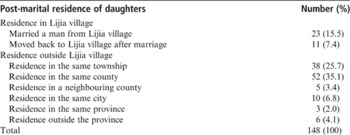
In contrast, the majority of the elderly parents whom I interviewed stated that daughters usually visited their parents whenever they had the opportunity. Daughters' frequent visits were made easier by most marriages being within the local township. As indicated in Table 1, 34 Lijia daughters (23 per cent) resided in their natal village, either through marrying a man from their own village or by moving back after marriage.Footnote 14 Interviews with parents of some of these daughters revealed that their daughters visited them on a daily basis. The 95 daughters (64 per cent) who moved into their husbands' village, in the same township, in the same county or in a neighbouring county, usually lived within half-an-hour's bus ride to Lijia village. The proximity and the convenience of local transport facilitated frequent visits. Frequent visits by married daughters has become a significant aspect of daughters' filial practice, compared to traditional China when visiting natal parents was subject to the approval of a woman's husband and parents-in-law and was constrained by the distance from her home to her parents' home and a lack of convenient transport.
Post-Marital Residence of Married Daughters from Lijia Village, 2006

Note: The age range of respondents in this survey was 19 to 55.
According to the elderly parents whom I interviewed, when daughters visited, they were more likely to express intimate care for their natal parents. Some told me that their daughters would visit with food, such as dumplings, that they had prepared. Some mentioned that their daughters helped with household chores. Others enjoyed chatting with their daughters, who shared stories of their lives and comforted their parents when they were upset.
Daughters' expressions of intimate care can be exemplified by the visit of Zhang Xiaohua 张小华 to her parents. On a hot summer day in 2007, I was conducting an interview with an elderly couple in their late 70s when their youngest daughter Xiaohua visited them after she finished work at a garment factory. Xiaohua brought her parents ice cream bars so they could cool off from the heat. They enjoyed a lively conversation, with Xiaohua telling her parents interesting stories about what happened in the factory. They exchanged comments, told jokes and shared laughter. Upon her departure, Xiaohua took her mother's comforter cover with her to wash at home, as it was difficult for her mother to wash large pieces of laundry by hand. After Xiaohua left, the elderly couple contentedly commented: “Daughters are indeed close to your heart (tiexin 贴心).”
Showing respect to parents
Respect for parents is still considered a significant aspect of filial practice by elderly parents in Lijia village. According to these elderly parents, respectful behaviour includes not arguing with parents and being considerate during daily interactions, such as serving parents meals before sons or daughters serve themselves. Many elderly parents lamented a lack of respect from their children. Such feelings were the result of an increase in verbal abuse and physical violence from children, especially sons and daughters-in-law. Tensions often arose when parents had conflicts with a daughter-in-law, such as a daughter-in-law being impolite, not doing her share of household chores or, in the worst case, verbal and physical abuse. My interviews with these 34 elderly parents revealed that 23 had engaged in at least one intense verbal confrontation with their son or daughter-in-law. Disappointed and even outraged, some of my informants have ironically expressed that they would consider their children filial if their sons and/or daughters-in-law did not physically or verbally abuse them (buda buma jiushi xiao 不打不骂就是孝). Although there were a few cases of a daughter showing disrespect to her natal parents, extreme cases of unfilial behaviour in Lijia village almost always came from sons and daughters-in-law.
The tragic story of Chen Guizhi 陈桂芝 and her husband Li Hongtian 李洪田, a couple in their 50s in Lijia village, demonstrates intergenerational conflict between an elderly and a young couple, in this case a daughter-in-law. After the daughter-in-law married Guizhi's son in 2004 and moved in with them, she and Guizhi did not get along. The tension reached a peak one day when the daughter-in-law expressed strong resentment that Guizhi did not open the gate for her when she came home with several cows that she had herded. The conflict was further fuelled when the daughter-in-law's mother, who lived in Lijia village, came and supported her daughter in a physical confrontation with Guizhi, resulting in minor injuries to Guizhi. Immediately following the fight, the daughter-in-law declared that the elderly couple had to move out right away. Otherwise, she would ask for a divorce from their son. To maintain their son's marriage, which they had funded through years of hard work, the elderly couple moved out at 10.30 p.m. and temporarily stayed with one of Guizhi's brothers.
When I talked to Guizhi in 2007, she and her husband were living in a small shabby room next to a livestock room in a brick kiln, where they worked during the day. She told me about her attempts to have a daughter during the late 1970s when China's birth-control campaign was tightened.Footnote 15 Several times, she had to hide in relatives' houses in neighbouring villages to avoid the detection of her pregnancy by birth-control personnel. To her great disappointment, she ended up with four sons. For the following 20 years, she and her husband worked exceedingly hard to provide all their sons with wedding expenses. When they finally helped the youngest son with his wedding expenses and renovated their house to share it with the young couple, they did not receive any return for their efforts; instead, they ended up homeless. With deep regret and sadness, Guizhi said: “I always wanted a daughter because a daughter is closer to your heart. I do not have the luck. If I had a daughter, my life would be much better!”
Although the case of Chen Guizhi and Li Hongtian is not typical in Lijia village, almost all the elderly parents I interviewed told me the story to express their disappointment with and anger over the loss of respect of the young generation. They condemned the extremely disrespectful behaviour of the daughter-in-law and the cowardice of the son. Some of them also mentioned that, if the elderly couple had a daughter, they would certainly receive support or at least emotional comfort, from a daughter.
Offering financial support and physical care
In addition to showing an intimate bond and respect to parents, adult children in Lijia village were expected to offer sufficient financial support and physical care for parents in need. After elderly parents retire from work, it becomes the responsibility of adult children to provide them with meals and medical care.Footnote 16 Filial children will go beyond the necessities of basic living and give their parents the resources that will result in better living conditions, including money for coal in the winter or pocket money for playing cards for entertainment. When elderly parents need physical care, usually during the later stage of life, filial children take good care of them, including cooking meals, washing clothes and keeping them company.
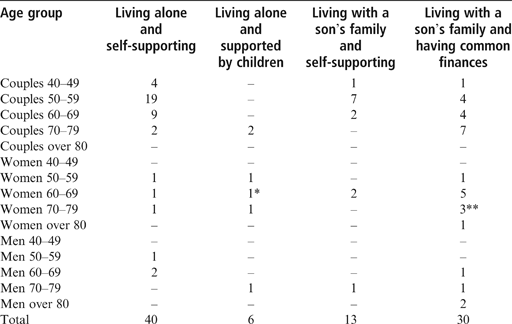
Parents generally do not have financial needs until they reach old age. As indicated in Table 2, 53 of the 89 couples and widowed or divorced parents were financially self-sufficient. Among the remaining 36 families, the elderly parents in 11 families made a financial contribution to the family of a son or a daughter, and those in 25 families were no longer engaged in physical labour due to old age. However, it would not be correct to say that they were completely financially supported by their children. In Lijia village, all residents are allocated family contracted land averaging 3.7 mu per person. Elderly parents have the option of leasing their land for income. For example, in 2006, income for two people from renting out the land was 1,110 yuanFootnote 17 on average, which provided money for basic food purchases. In most of the families, the child who provided meals for his or her elderly parents also farmed the parents' land, without paying them. The elderly parents whom I interviewed were well aware of the trade-off of land for support and expressed a strong sense of entitlement to support from their children.
Living Arrangements and Sources of Support of the Elderly in Lijia Village, 2006
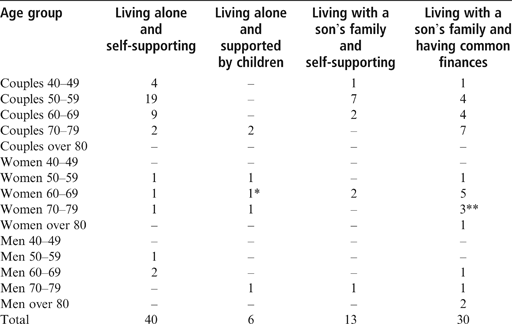
Notes: *This elderly woman was supported by a daughter and a son-in-law. **One of the elderly women was supported by a daughter and a son-in-law.
For some elderly parents with severe health issues, such as diabetes and cancer, medical care became an extra expense for their children. Payment for medical treatment was usually provided either by the child with whom the elderly parent was living or was shared by all children. During my interviews with these elderly parents I was told that, if medical treatment for a parent cost a large amount of money, the cost was usually shared by all children, including daughters.
Although elderly parents felt entitled to be supported by their children, especially those who farmed their land, adult children generally disagreed on their shared responsibilities. When there was more than one son in a family, sons were likely to bargain with each other over their responsibilities and their share of their parents' property.Footnote 18 Disappointed and even outraged, some elderly parents have even resorted to lawsuits against their unfilial sons.
During my fieldwork, I was told of several cases of an elderly parent seeking a ruling from the court for sufficient support from his or her sons and daughters-in-law. In one case, an elderly widow, Zhang Shuzhen 张淑珍, had five sons who refused to provide support for her after they could not reach agreement on an equal share of their responsibilities and a fair division of her house. The youngest daughter-in-law, with whom Shuzhen was living, made Shuzhen's situation even worse by frequently verbally abusing her and even smashing a window in Shuzhen's room for leaving the responsibility of her care to her and her husband. Shuzhen had no choice but to file a lawsuit against her five sons. As a result, her sons had to take turns offering meals to their elderly mother. When I interviewed Shuzhen in 2007, she sadly commented that, even though she was offered enough food, her relationship with her five sons and daughters-in-law had worsened because the lawsuit had made her children a target of public criticism and thus had hurt their feelings.
In contrast, when their economic conditions allowed them to, daughters usually offered financial support. Some daughters shared with their brothers the financial responsibility for their natal parents. When sons have neglected or abandoned their filial duty, most married daughters have shouldered the responsibility. Some elderly parents whom I interviewed told me that their daughters always contributed more than did their sons towards their medical care and food provision. Daughters were also more likely to help their parents with practical work, such as domestic chores and physical care.
I was frequently told the story of Li Yulan 李玉兰, a filial adopted daughter and a model of filial children in Lijia village, who consistently provided her adoptive parents with care. When Yulan was three months old, her biological parents decided to divorce and, as a result, sent her for adoption. Yulan was always a filial daughter to her adoptive parents, even after she learned about her adoption. When she started to earn a salary at the age of 19, by working as a village health practitioner in Lijia village, she always bought her adoptive parents their favourite foods and good clothes. After her marriage, although she had the opportunity to live in the county seat, where her husband was from, Yulan chose to live with her adoptive parents so that she could take care of them on a daily basis.
Yulan's adoptive father died of tracheitis in 1990 and, coincidently, on the very same day her biological father also died.Footnote 19 Although she was expected to attend her biological father's funeral, Yulan decided to stay to arrange a funeral for her adoptive father. Five years later, her adoptive mother suffered a cerebral haemorrhage. Yulan tried all means available to save her mother's life, including desperately kowtowing on the floor, a traditional way to pray, until her forehead was swollen. Miraculously, her mother survived. Later when her mother's illness became more severe and required intensive care, including cleaning up her excrement, Yulan fulfilled her obligation as a caring daughter until her mother's death.
Villagers in Lijia highly praised Yulan for her extraordinary self-sacrifice and dedication to performing filial piety. When comparing the filial practice of sons and daughters, they often mentioned Yulan's story and commented that “even an adopted daughter is more filial than most sons.”
Sociocultural Underpinnings of the Transformation of the Gendered Practice of Filial Piety
The transformation of the gendered practice of filial piety and the changing perception of daughters as more filial present a significant and fundamental shift in intergenerational relations and patrilineal traditions in China. An in-depth examination of this transition suggests three major factors that contribute to the change: reinterpreted intergenerational relations resulting from a decline in parental power; women's emerging filial practice with their natal parents, which is derived from women's recently obtained decision-making power in marriage and greater economic leverage; and a shift of post-marital residence and an increased desire of the elderly for an emotional bond with their children.
Reinterpreted intergenerational relations and the practice of filial piety
A decrease in sons' filial practice is closely associated with the decline in parental power in rural China, which began after 1949 and increased under collectivization when communes replaced traditional family-based farming. Patriarchal control was further weakened after the introduction of the market economy in the early 1980s, when values associated with a market economy significantly challenged the traditional value of filial piety. A series of policies initiated by the Chinese government since the 1950s, such as the abolition of arranged marriage and the banning of ancestor worship, has also shaken traditional patriarchal practice.Footnote 20
When patriarchal authority is shaken, intergenerational relations have to be renegotiated and reinterpreted.Footnote 21 For the young generation, unconditional filial devotion has been replaced by a sense of intergenerational reciprocity: a child's filiality has to be earned through the parents fulfilling their role as loving providers for the child's education and career development as well as, most importantly, financing a wedding. Failure to provide a decent wedding for a son would result in complaints from him. During my fieldwork in Lijia village, I was frequently told stories of several bachelors, well past the best age for marriage, expressing discontent and even violent behaviour towards their parents for failing to finance a marriage for them.Footnote 22 Parental obligation does not stop with a son's wedding. A good relationship with married sons and daughters-in-law needs to be cultivated and maintained with appropriate help when young couples are in need, such as for childcare and household chores.
Under such a reinterpreted intergenerational relation, young married women tend to expect and take for granted high bride wealth and continuous assistance from their parents-in-law. When a daughter-in-law is not provided with appropriate bride wealth or believes that her parents-in-law do not offer her enough help, she is reluctant to assist her husband in fulfilling his filial obligations. Dissatisfaction with her parents-in-law often results in disrespectful behaviour and, ultimately, a negative influence on her husband's potentially filial attitude towards his parents.
Meanwhile, these young women have little expectation of a high dowry from their own parents, although most parents, when their financial situation allows, try to offer their daughter a decent dowry.Footnote 23 Further, many parents play an important role in helping a daughter's family, such as lending them money and babysitting their grandchildren, even though traditionally they have not been expected to make a contribution to a daughter's family. Their help is usually interpreted as parents' intimate bond with a daughter, and their help is always greatly appreciated by their daughters and sons-in-law. Consequently, there are few conflicts between a married daughter and her natal parents in regard to parental obligations. A harmonious relationship with her parents facilitates her filial practice towards them.
Women's empowerment in marriage and their increased filial practice
While a decline in parental power has weakened the institutionalized practice of old-age support by sons, women's emerging empowerment in marriage has increased the decision-making leverage of married daughters to practise filial piety with their natal parents. The empowerment of women in marriage is closely associated with their increasing economic contribution.Footnote 24 While many men in Lijia village have engaged in temporary employment in the local county or in the neighbouring cities, women have taken over most of the farm work. Many women have also taken up non-agricultural jobs, including working full-time in garment factories, the brick kiln or restaurants in the county seat. The money they bring home has become an important source of family income. Because the cost of living has increased significantly in recent years, it has become nearly impossible for an average family to live a comfortable life based solely on the husband's income. Therefore, men value their wives' economic contribution as well as their work at home. During an interview, a man in his mid-40s frankly confessed: “I went to the city to work in a factory last year. My wife did all the farm work at home. After we calculated our income, I was surprised to find that she made more money by farming than I did by working in the factory. She is truly a capable and hard worker.”
Women's income-earning power has enabled them to use family resources for their natal parents. They can offer their parents money or gifts as well as participate in reciprocity with their natal relatives. Women's decision-making power in regard to performing filiality is especially important when their male siblings are unable or refuse to offer financial support for their parents. When daughters have the capability, most of them take on the responsibility of their parents.
The second contributing factor to women's empowerment is men's disadvantaged position in spouse selection and women's right to initiate a divorce. The patrilineal tradition of a groom's family financing a wedding is still prevalent in rural China.Footnote 25 In 2006, the average amount of bride wealth in Lijia village was 30,000 yuan. This did not include a newly renovated house, gifts to the bride such as jewellery and clothes, furniture, electric devices, and costs of an engagement reception and a wedding banquet. On average, the total cost for financing a son's marriage was about 100,000 yuan. It typically took a couple ten years of hard work to earn the money for their son's wedding.
While the unequal obligation of financing a marriage puts a man at a disadvantage, women's rights to initiate a divorce, implemented in 1950 under the Marriage Law and reinforced in its subsequent revisions, have improved their status in a marriage.Footnote 26 As divorce has become more tolerated in the village, some women have refused to put up with an undesirable marriage and have taken the initiative to file for divorce. Men are usually reluctant to initiate a divorce because they would lose the bride wealth that they had paid and would have to finance their second marriage if they chose to remarry. Since the late 1980s there have been 13 divorce cases in Lijia village, all of which were initiated by women.
Married men whom I interviewed recognized women's emerging empowerment and some quoted a modified version of Chairman Mao's famous slogan of gender equity, “Women can hold up more than half the sky” (nüren neng ding duo banbiantian 女人能顶多半边天). The recognition of women's increased status has had a direct influence on men's filial practice. Some married men told me that they would like to fulfil their filial obligation to their parents, but would compromise, to maintain marital harmony, if it caused a problem for their wives. This phenomenon is exemplified by the story of Zhang Yongcheng 张永城, a 37-year-old man in Lijia village. In 2004, Yongcheng's wife decided to celebrate her father's birthday with a gift of 100 yuan, but Yongcheng proposed to offer 50 yuan instead. His wife argued: “My parents raised me for over 20 years. Now I am married to you and bore children for your family. My parents got nothing for raising me. Why should it be a problem to give them just 100 yuan!” His wife's remarks rendered him speechless, and he reluctantly agreed to the amount of money on which she had decided.
During my interviews with young married men, they frequently mentioned their active efforts to gain favour from their parents-in-law in order to please their wives. Almost all the men whom I interviewed admitted that they offered money and gifts to their parents-in-law on a birthday and Chinese New Year. Some also shared the responsibility of paying for their medical care and many helped with farm work, house construction and family events. In some cases, young married men even competed with each other to win favour from their parents-in-law.
In 2006, I was invited to the wedding of a young couple in Lijia village. While enjoying a joyful ceremony with a large turnout of guests, I was surprised to find that one of the groom's two brothers-in-law had invited ten friends to the wedding. This behaviour made the other brother-in-law very upset. When I talked to one of the groom's relatives, a 27-year-old married man, he explained that the brother-in-law brought his friends to the wedding to please his parents-in-law because a large attendance indicated their popularity. More importantly, all of his friends came with decent gifts of money for his parents-in-law. The other brother-in-law was jealous and upset because he had just lost the rivalry for favour from his parents-in-law.
This emerging practice of married men favouring their parents-in-law in order to please their wives was severely criticized by many elderly people whom I interviewed. Some even coined a saying that had become popular in Lijia village by 2006 and was frequently cited during my interviews: “Marrying in a daughter-in-law is equal to marrying off a son” (qu ge xifu guo chuqu ge erzi 娶个媳妇过出去个儿子). In these cases, China's long-standing tradition of a married woman contributing to her husband's filial practice has been reversed to a man helping his wife to practise filial piety to her parents.
A shift in post-marital residence and the desire of the elderly for an emotional bond
The expectation for an emotional bond from children has become a significant aspect of filial practice in contemporary China. As mentioned above, a decline in parental power and an increase in intergenerational conflicts have made a child's intimate care extremely precious. Moreover, a shift of post-marital residence from patrilocal to neolocal has left many elderly people with an empty nest and a feeling of loneliness.Footnote 27 As shown in Table 2, 46 elderly parents (51.7 per cent) lived alone. My interviews with these parents reveal that they especially had a desire for frequent visits from and a close bond with their children.
Meanwhile, the shift of post-marital residence has relieved married women from the daily responsibility of care-taking of their parents-in-law. They have the opportunity to decide to whom they want to perform filiality, and they are more willing to follow their hearts and show their attachment to their parents. Children's filial practice is often motivated by a sense of guilt and gratitude towards parents.Footnote 28 A 38-year-old woman told me: “During the years when I went to school, my mother got up early every morning to cook me breakfast. Whenever I recall this, I cannot help but feel like doing something for my mother to pay back everything she has done for me.”
People in Lijia village have attributed their daughters' consideration to a socially constructed notion of women, by nature, being more caring and more likely to express their feelings. Women are also naturally more sensitive (xinxi 心细) to parents' practical and emotional needs. When a conflict arises between an elderly couple and their married sons and daughters-in-law, a daughter is a valuable source of comfort and support. A daughter's ability to communicate with her parents and to show them intimate care satisfies the expectations of elderly parents for emotional consideration from their children.
Sons, on the contrary, are considered by nature insensitive (xincu 心粗) and less likely to show emotional intimacy to their parents. The majority of men whom I interviewed shared the same view. Some claimed that they wanted to show intimacy to their parents but felt shy about expressing their emotions for fear of leaving people with the impression that they were woman-like. One of my male informants explained that he did not talk to his parents as much as a daughter would because he was the breadwinner of his family and should show his strong side in front of his parents. He said, “I will appear a weak person if I talk with my parents about my frustrations and worries.”
Conclusions
The transformation of the gendered practice of filial piety is having a significant impact on patrilineal tradition and the Confucian ethic in China. Such a transformation is the result of a decline in parental power and the rise of individual self-interest on the part of the younger generation at a time when changing market relations are eroding practices and expectations of sons' and daughters-in-law's filial devotion. Moreover, women's emerging empowerment in marriage and employment has enabled them to make decisions to be filial towards their parents in ways that “tradition” did not permit. Finally, elderly parents have an increased desire for an emotional bond with their adult children, and women's socially constructed role as more considerate and expressive satisfies the expectations of elderly parents.
The transformed gendered practice of filial piety has a great impact on many peasant couples' view about daughters. Some parents have embraced a singleton-daughter (one-child, a daughter) rather than take advantage of the modified birth-control policy that allows them to have a second child if their first child is a girl. In the long run, this transformation will have significant social implications in rural China, including an increase in the value placed on daughters and a decrease in the preference for sons.