INTRODUCTION
Genetic diversity is one of the most important natural properties for commercially interesting species, because it can influence the species’ adaptive capacity to environmental change, and loss of genetic variation is destructive to domestication of cultured stocks (Spielman et al., Reference Spielman, Brook and Frankham2004; Koljonen et al., Reference Koljonen, Gross and Koskiniemi2015). Limited effective population size and the effects of artificial selection on hatchery progeny may lead to population genetic drift, which will cause offspring to differentiate from broodstock (An et al., Reference An, Cho, Kim, Son, Park, Myeong and An2014b). Monitoring population genetic diversity and genetic structure, therefore, has become a key aspect and long-term mission for the success of commercial breeding programmes (An et al., Reference An, Cho, Kim, Son, Myeong and An2014a).
Seven-band grouper, H. septemfasciatus (Thunberg, 1793), belongs to the family Serranidae, and is distributed in the waters of Korea, Japan and China (Heemstra & Randall, Reference Heemstra and Randall1993). It is a sedentary, reef-associated species and lives in shallow waters (5–30 m) (An et al., Reference An, Cho, Kim, Son, Myeong and An2014a). Seven-band grouper is a fast growing and commercially valuable marine fish, with a greater tolerance to cold water temperature than most other grouper species, and is considered as a potential species for marine fish cage culture and sea ranching in the temperate seas of North-east Asia (Liu et al., Reference Liu, Zhuang, Meng, Lei and Yang2010; Koh et al., Reference Koh, Yokoi, Tsuji, Tsuchihashi and Ohta2010; An et al., Reference An, Cho, Kim, Son, Myeong and An2014a). However, a stable and efficient artificial breeding technique of seven-band grouper has not been established fully, owing to some aspects of their reproductive biology such as extended maturation age for males, failure to spawn spontaneously under captivity, and the fragility of newly hatched larvae (Liu et al., Reference Liu, Zhuang, Meng, Lei and Yang2010; An et al., Reference An, Cho, Kim, Son, Myeong and An2014a). Seven-band grouper is a protogynous hermaphrodite fish, beginning life as a female before becoming a male. Currently, almost all of seven-band grouper hatcheries maintain wild-caught sources of H. septemfasciatus as broodstock for artificial reproduction (Kime et al., Reference Kime, Van Look, McAllister, Huyskens, Rurangwa and Ollevier2001; An et al., Reference An, Cho, Kim, Son, Myeong and An2014a). The limited male broodstock (given the extended maturation age) may limit the genetic diversity in breeding programmes (An et al., Reference An, Cho, Kim, Son, Park, Myeong and An2014b). The genetic variability among broodstocks may be lost during artificial propagation. In order to avoid the detrimental loss of genetic variation in cultured stocks, regular monitoring of population genetic diversity and genetic structure for H. septemfasciatus is necessary.
A number of ecological studies have been carried out to detect genetic variability of wild and hatchery populations of H. septemfasciatus (An et al., Reference An, Cho, Kim, Son, Myeong and An2014a, Reference An, Cho, Kim, Son, Park, Myeong and Anb). These genetic studies revealed reduced genetic variability in hatchery populations compared with wild populations, based on microsatellite analyses. Significant population genetic differentiation was also examined among the hatchery population in South Korea (An et al., Reference An, Cho, Kim, Son, Myeong and An2014a, Reference An, Cho, Kim, Son, Park, Myeong and Anbb). Until now, no research has estimated the genetic variability of broodstock and offspring from Japan. In this study, we used fluorescent-AFLP markers to investigate the genetic diversity and population genetic structure of broodstocks and offspring from Japan and Korea. Such information will provide a useful genetic basis for future planning of sustainable culture and management of H. septemfasciatus in fisheries.
MATERIALS AND METHODS
Sample collection
Samples were collected from two broodstock and one offspring populations: broodstock (broodstock I: Japan, 32°45′N 129°50′E, broodstock II: Korea, 33°21′N 126°28′E), offspring (Rizhao) from May 2014 to September 2014 (Table 1). Six individuals of Epinehelus moara were sampled from Guangzhou as an outgroup. All individuals were identified based on morphological characteristics, and a piece of fin-clip tissue was obtained from each individual and preserved in 95% ethanol or directly extracted from frozen samples.
Polymorphism data of bands generated by AFLP primer combinations for H. septemfasciatus.

Genomic DNA extraction and fluorescent-AFLP method
Genomic DNA was isolated from the fin-clip tissue by proteinase K (Invitrogen) digestion followed by a standard phenol–chloroform extraction method (Ausubel et al., Reference Ausubel, Brent, Kingston, Moore, Seidman, Smith and Struhl1995). Procedures of AFLP were essentially based on Vos et al. (Reference Vos, Hogers, Bleeker, Reijans, Van De Lee, Hornes, Frijters, Pot, Peleman, Kuiper and Zabeau1995) and Wang et al. (Reference Wang, Wang, Lin, Qiu and Ben2002). About 100 ng genomic DNA was digested with 1 unit of EcoR I and Mse I (New England Biolabs Inc., UK) at 37°C for 6 h. Double-stranded adapters were ligated to the restriction fragments at 20°C overnight after adding 1 µl 10 × ligation buffer, 5 pmol EcoR I adapter (EcoR I-1/EcoR I-2; Table 1), 50 pmol Mse I adapter (MseI-1/MseI-2; Table 2), 0.3 unit of T4 DNA ligase (Takara Bio Inc., China) with a final volume of 10 µl. Pre-amplification PCR was conducted using Takara Thermocycler with a pair of primers containing a single selective nucleotide. Amplification was performed at an annealing temperature of 53°C for 30 s. The 20 µl PCR product mixture was diluted 10-fold with distilled water and used as templates for the subsequent selective PCR amplification. The primer EcoR I was the FAM fluorescent marker (FAM-E-AAC, FAM-E-ACA, FAM-E-ACC) (Table 1). The selective amplifications were carried out in 20 µl PCR reaction volume containing 1 µl productions of pre-amplifications, 1 × PCR reaction buffer, 150 µm of each dNTP, 30 ng of each selective primer, and 0.5 unit of Taq DNA polymerase on a gradient thermocycler with a touchdown cycling profile of 9 cycles of 30 s at 94°C, 30 s at 65°C (−1°C at each cycle), and 30 s at 72°C followed by the cycling profile of 28 cycles of 30 s at 94°C, 30 s at 56°C and 1 min at 72°C. The final step was a prolonged extension of 7 min at 72°C. Two microlitres of selective-amplification product was separated by electrophoresis in a 4% denaturing polyacrylamide gel at 50 W (maximum to 3000 V) for 2.4 h in ABI Prism 377 DNA Sequencer (Applied Biosystems, USA). The electrophoresis pattern was collected automatically. Sequences of AFLP adapters and primers are listed in Table 1.
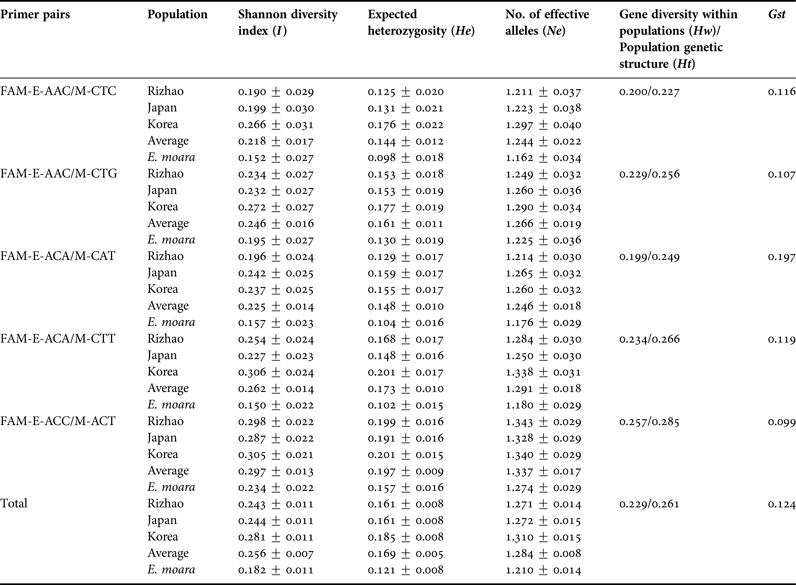
Parameters of genetic diversity for three populations of H. septemfasciatus.

DATA ANALYSIS
AFLP typing analysis and data processing
PCR products were electrophoresed on an ABI 3730xl Genetic Analyzer (Applied Biosystems) which were genotyped by Shanghai Sunny Biotechnology Co., Ltd, using the internal size standard LIZ 500 (Applied Biosystems) and scored using the GENESCAN3.1 software (Applied Biosystems).
Genetic diversity and population structure
Clear and unambiguous fragment sizes in length ranging from 70 to 1000 bp were considered as usable. AFLP fragment sizes were scored for presence (1) or absent (0) by visual inspection, and transformed into 0/1 binary character matrix. The following genetic diversity parameters were determined: (1) the number of polymorphic bands and the percentage of polymorphic bands; (2) the effective number of alleles per loci (Ne); (3) expected heterozygosity (H); (4) Shannon's information index (I); (5) Nei's genetic distances, which were evaluated by GenALEx 6.501 (Peakall & Smouse, Reference Peakall and Smouse2006). The parameters of gene diversity within populations (Hw) and population genetic structure (Ht) were calculated by AFLPsurv (Vekemans et al., Reference Vekemans, Beauwens, Lemaire and Roldan-Ruiz2002).
Genetic differentiation between population pairs was evaluated by fixation indices F st and Nei's genetic distance using ARLEQUIN (Excoffier & Lischer, Reference Excoffier and Lischer2010) and GenALEx 6.501 (Peakall & Smouse, Reference Peakall and Smouse2006) software. When multiple comparisons were performed, P values were adjusted using the sequential Bonferroni procedure (Rice, Reference Rice1989). Analysis of molecular variance (AMOVA) (Excoffier et al., Reference Excoffier, Smouse and Quattro1992) was employed to further examine hierarchical population structure as well as the geographic pattern of population subdivision (Excoffier et al., Reference Excoffier, Smouse and Quattro1992). Clustering based on a Bayesian model was used to evaluate genetic structures of the seven-band grouper populations with the software package STRUCTURE in its extended version 2.3.3 (Pritchard et al., Reference Pritchard, Stephens and Donnelly2000). The admixture model and independent allelic frequencies were employed to analyse the data set without prior population information. The length of the burn-in period and number of MCMC repeats after burn-in were set to 25,000 and 100,000, respectively. These steps were used to determine the ancestry value, which estimated the proportion of an individual's genome that originated from a given genetic group. The algorithm was run 10 times for each K value, from 1 to 4.
RESULTS
Polymorphic data of different AFLP primers
A total of 602 bands were checked for 62 individuals from two broodstock and one offspring populations by five pairs of selective primers. Four hundred and twenty-two polymorphic sites were detected and 70.10% of them were polymorphic (Table 1). A maximum of 129 polymorphic bands was amplified by the FAM-E-ACC/M-ACT primer pair, and a minimum of 52 polymorphic bands was amplified by the FAM-E-AAC/M-CTC primer pair. The average polymorphic sites for the five pairs of primers were 84.4, ranging from 52 to 129 (Table 1). The percentages of polymorphic sites were 55.50% (N broodstock I = 308) and 63.12% (N broodstock II = 356) in the two broodstocks and 52.88% (N offspring = 294) in the offspring, respectively. The same primer pair revealed different polymorphism in broodstock and offspring populations for H. septemfasciatus. Two hundred and thirteen polymorphic sites were checked for E. moara and 74.74% of them were polymorphic (Table 1). Every population has its own special bands, and the special bands were 1 and 11 for broodstock I (Japan) and broodstock II (Korea) populations and 8 for the offspring population, respectively (Table 1). The special bands compared with H. septemfasciatus for E. moara were 317.
Genetic diversity and population structure
The average number of effective alleles for the three populations was 1.284 ± 0.008 and the average value of broodstock II (Korea) (Ne = 1.310 ± 0.015) was higher than those of broodstock I (Japan) (Ne = 1.272 ± 0.015) and offspring (Ne = 1.271 ± 0.014). Similar trends were also detected in the expected heterozygosity (He broodstock II = 0.185 ± 0.008, He broodstock I = 0.161 ± 0.008, He offspring = 0.161 ± 0.008) and Shannon diversity index (I broodstock II = 0.281 ± 0.011, I broodstock I = 0.244 ± 0.011, I offspring = 0.243 ± 0.011). The whole values of expected heterozygosity and Shannon genetic diversity of H. septemfasciatus were 0.169 ± 0.005 and 0.256 ± 0.007, respectively. The parameter of genetic diversity within population (Hw) was 0.229 in the three populations (Table 2). Although the different primer pairs revealed different genetic diversity in the two broodstock and one offspring populations, the trend showed the genetic diversity of broodstock II (Korea) was higher than those of broodstock I (Japan) and offspring (Table 2).
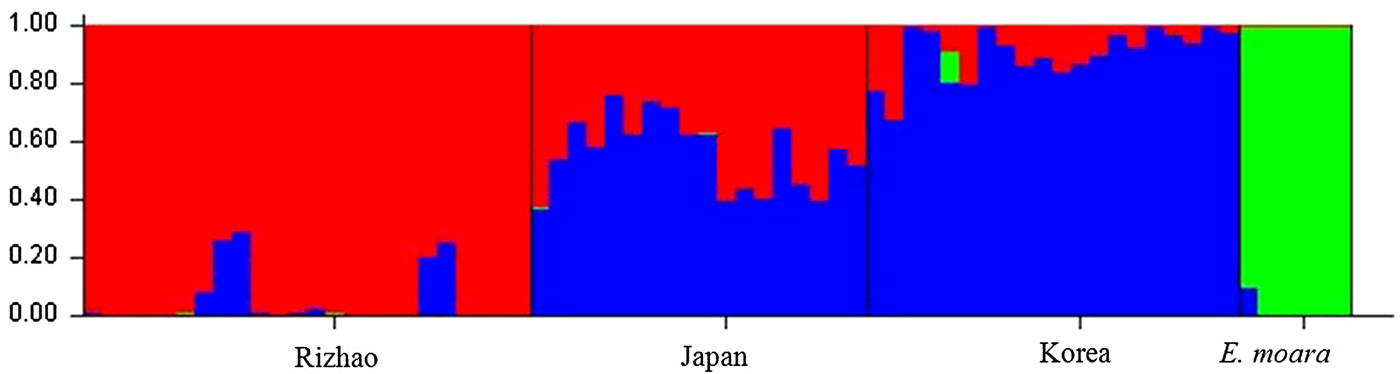
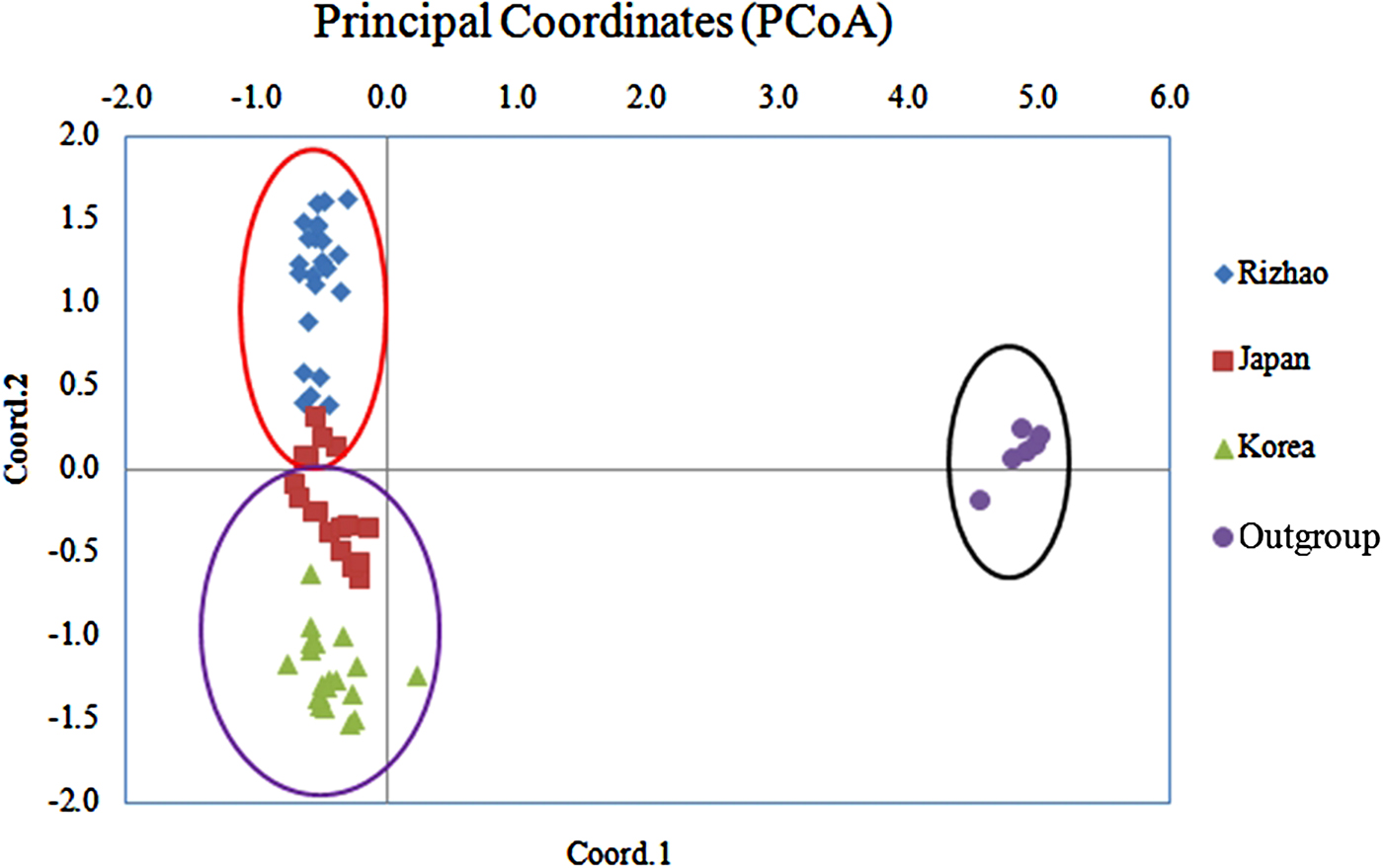
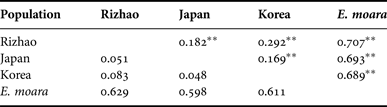
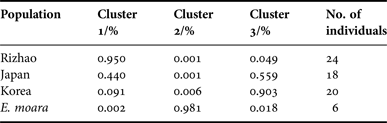
The parameters of genetic structure analyses showed significant genetic differentiation existed among the three populations of H. septemfasciatus (Table 2). The AMOVA also revealed 22.37% of genetic variation among populations (Table 3). Though different primer pairs revealed different degrees of genetic variation, the genetic differentiation parameters showed the same trends and the average values were 0.261, 0.124 and 0.214 based on Ht, Gst and F st (Table 2, Table 4). All primer pairs showed that more than 15.83% genetic variation happened among the three populations. F st and Nei's genetic distance analyses showed high levels of genetic differentiation between broodstock and offspring populations; the largest value was between broodstock II (Korea) and offspring (F st = 0.292, P < 0.01, D = 0.083), whereas the lowest value was between broodstock I (Japan) and broodstock II (Korea) (F st = 0.169, P < 0.01, D = 0.048) (Table 4). STRUCTURE results showed a clear maximum for ΔK at K = 3, in which all individuals were classified into three different clusters (Figure 1). Cluster 1 and Cluster 3 composed of three parts [Cluster 1: (F offspring = 95.0%, F broodstock I = 44.0%, F broodstock II = 9.1%), Cluster 3: (F offspring = 4.9%, F broodstock I = 55.9%, F broodstock II = 90.3%)], respectively. The individuals of E. moara as outgroup formed the independent Cluster 2 (Table 5). This result was also supported by the Principal Coordinates Analysis (PCoA), which showed three stocks detected in the examined populations (Figure 2).
Clustering of three populations for H. septemfasciatus. Each individual is shown as a vertical line divided into segments representing the estimated membership proportion in the three ancestral genetic clusters inferred from STRUCTURE.

Principal Coordinates Analysis (PCoA) of three populations of H. septemfasciatus.

AMOVA of three populations of H. septemfasciatus.

Nei's genetic distance (below diagonal) and pairwise F st (above diagonal) among populations of H. septemfasciatus.

**P < 0.01.
The distribution of individuals of three populations in two genetic groups inferred by STRUCTURE.

DISCUSSION
In this study, two stocks were detected for H. septemfasciatus in the two broodstocks and one offspring populations by STRUCTURE statistics and PCoA analyses (Figures 1 & 2). F st, AMOVA and STRUCTURE statistics indicated that the offspring was significantly divergent from the two broodstock populations in which broodstock I (Japan) and broodstock II (Korea) exhibited high differences in the contributions to the offspring (Table 4, Figure 1). This differentiation in the two broodstock and one offspring populations was possibly due to the low number of founding individuals in the hatcheries, possibly indicating the effect of genetic drift, which has been well documented in other fish species (Sekino et al., Reference Sekino, Hara and Taniguchi2002).
Characterization of population genetic diversity of H. septemfasciatus
The percentage of polymorphic sites was 70.10% for H. septemfasciatus, which was higher than other fish species based on general AFLP markers (18.6–55.8%) (Mickett et al., Reference Mickett, Morton, Feng, Li, Simmons, Cao, Dunham and Liu2003; Liu et al., Reference Liu, Dong, Wang, Zhu and Wu2005; Li et al., Reference Li, Xu, Lou, Wang, Xin, Mao and Zhan2012). Genetic variability in the two broodstock and one offspring populations (P = 70.10%, I = 0.256, H e = 0.169, N e = 1.284) was lower than previously found in wild populations of other rock reef fish species (P = 98.73%, I = 0.288, H e = 0.189, N e = 1.319) based on fluorescent-AFLP markers with similar paired primers, revealing a reduction in genetic variability in the examined populations for H. septemfasciatus (Xiao et al., Reference Xiao, Li, Ren, Ma, Wang, Xiao and Xu2016). The genetic variations in wild-caught broodstock I from Japan was lower than that of wild-caught broodstock II from Korea.
Conservation of genetic diversity is important for the long-term objective for marine species (Falk & Holsinger, Reference Falk and Holsinger1991). Although many studies have found significant reductions in genetic diversity of offspring compared with broodstock, no significant difference was detected between broodstock I and offspring in this study (Reily et al., Reference Reily, Elliott, Grewe, Clabby, Powell and Ward1999; An et al., Reference An, Byun, Kim, Lee and Myeong2011a, Reference An, Hong, Kim and Myeongb). High levels of genetic diversity in wild populations of fish can be related to large effective population size, environmental heterogeneity, life history traits and genetic divergence (Nei, Reference Nei1987; Xiao et al., Reference Xiao, Li, Ren, Ma, Wang, Xiao and Xu2016). The value of heterozygosity derived from significant geographic difference for Mugil cephalus in coastal waters of China was higher than that in Florida based on AFLP analysis (Campton & Mahmoudi, Reference Campton and Mahmoudi1991; Liu et al., Reference Liu, Lun, Zhang and Yang2009). Given the small population size of broodstock, in addition to the protogynous hermaphrodite characteristics of H. septemfasciatus, the offspring may have experienced a founder effect with significant reductions in genetic diversity, compared with the broodstock population. Herein, we believe that significant heterozygosity may exist in the offspring of H. septemfasciatus to maintain high level of genetic diversity.
Population genetic structure and genetic composition
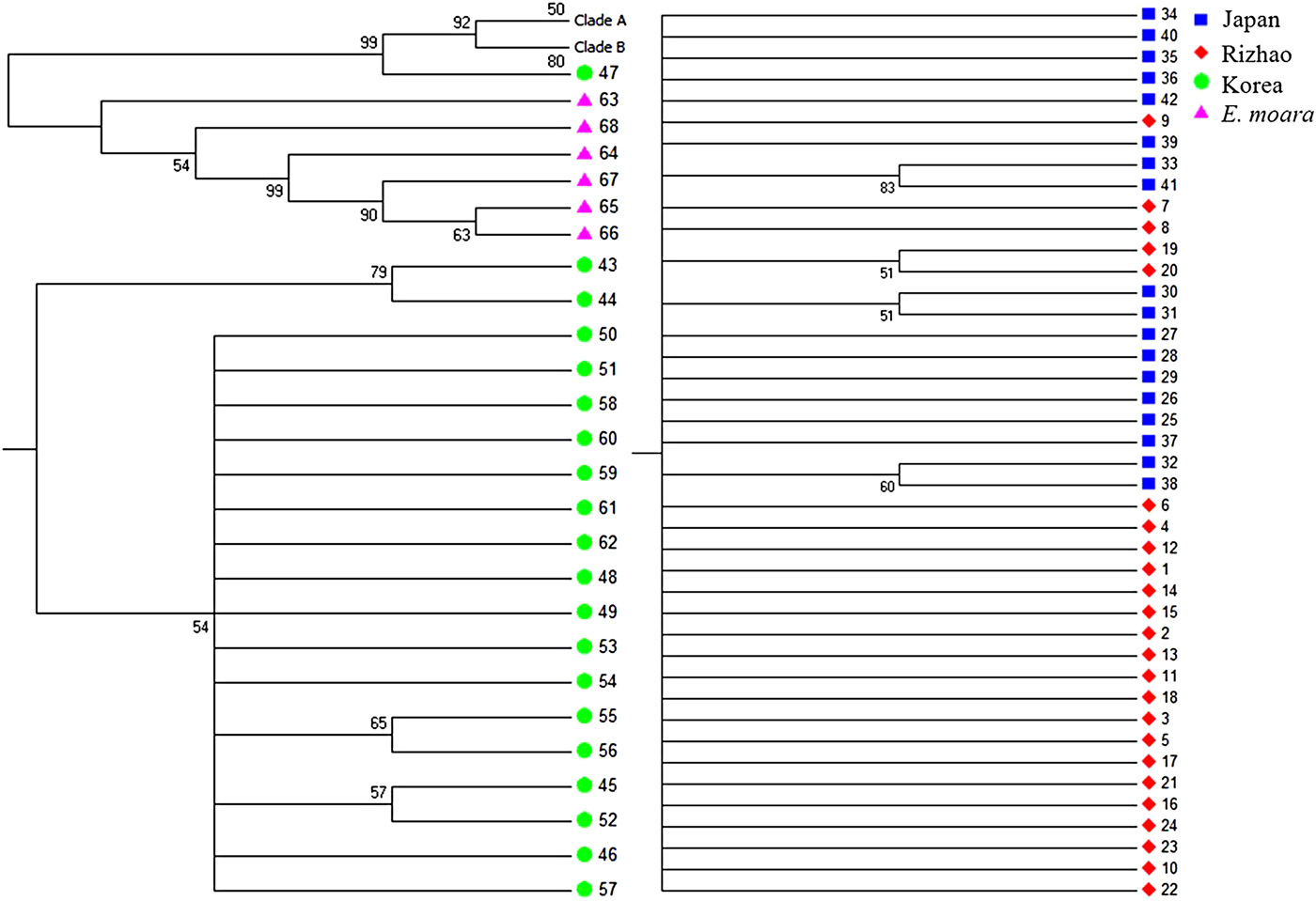
AMOVA, F st, STRUCTURE, PCoA and UPGMA tree analyses revealed significant genetic differentiation between wild-caught broodstock I from Japan and wild-caught broodstock II from Korea. These results also indicated that the hatchery progeny of H. septemfasciatus was a compounded population. Most of the two broodstocks (F broodstock I = 55.9%, F broodstock II = 90.3%) made very limited contributions to the offspring (F offspring = 4.9%) (Figure 3). The pattern of genetic differentiation was always derived from the limited effective population size of broodstock (An et al., Reference An, Cho, Kim, Son, Myeong and An2014a, Reference An, Cho, Kim, Son, Park, Myeong and Anb). Hence, genetic drift has probably played an important role in causing offspring to differentiate from broodstock (An et al., Reference An, Cho, Kim, Son, Myeong and An2014a). Individuals of offspring in this study originated from two broodstocks, which maintained a relatively high level of genetic diversity compared with broodstock I. Although this study was limited by the small population size, our results showed broodstock with different genetic backgrounds could make contributions to the maintenance of genetic diversity for compounded offspring. Maintenance of genetic variation within hatchery stocks requires that effective broodstock management practices be carried out. Large effective population size of broodstock from different backgrounds should be maintained to ensure adult reproductive success (Amos et al., Reference Amos, Wilmer, Fullard, Burg, Croxall, Bloch and Coulson2001). In relation to the management of hatcheries, the geographic sources of different broodstocks should be labelled to avoid inbreeding (An et al., Reference An, Cho, Kim, Son, Myeong and An2014a, Reference An, Cho, Kim, Son, Park, Myeong and Anb). Hence, continued genetic monitoring of bloodstock is necessary for hatchery progeny (An et al., Reference An, Cho, Kim, Son, Myeong and An2014a, Reference An, Cho, Kim, Son, Park, Myeong and Anb).
UPGMA tree of individuals of H. septemfasciatus based on Nei's genetic distance.

Evaluating population genetic diversity and structure can be a vital tool for managing and maintaining a productive fishery (Seeb et al., Reference Seeb, Seeb and Polovina1990). Severe population-size declines can also result in the loss of genetic diversity (Glenn et al., Reference Glenn, Stephan and Braun1999). These results also indicate that genetic drift has exerted negative effects on the reproductive capacity of the stock, which may have resulted in significant genetic differentiation between broodstock and offspring populations. Our data will be important to ensure the success of ongoing breeding and stock enhancement programmes. Thus, careful broodstock monitoring and management will be necessary to ensure the success of artificial seed production (An et al., Reference An, Cho, Kim, Son, Myeong and An2014a, Reference An, Cho, Kim, Son, Park, Myeong and Anb). Our data provide a useful genetic basis for future planning of sustainable culture and management of H. septemfasciatus in fisheries.
FINANCIAL SUPPORT
This work was supported by the National Natural Science Fund (41506170, 41276166, 31672672), Qingdao National Laboratory for Marine Science and Technology (2015ASKJ02, 2015ASKJ02-03-03), International Advanced Agricultural Science and Technology Plan (2014-Z49), Shandong Province agricultural seed project (2014–2017), the STS (No. KFJ-EW-STS-060-STS), the Key Laboratory of East China Sea & Oceanic Fishery Resources Exploitation and Utilization, Ministry of Agriculture, P. R. China, the Guangdong Provincial Key Laboratory of Fishery Ecology and Environment (LFE-2015-8) and Technology Foundation for Selected Overseas Chinese Scholar, Ministry of Personnel of China (2013.01), the North Jiangsu Science and technology development plan (BN2014107).