The Keynote Article examined research situated at the interface of bilingualism and specific language impairment (SLI) primarily to evaluate theories of SLI and secondarily for clinical considerations. The purpose was not to argue for one theoretical perspective over another, but instead to demonstrate how they both need some refinements and extensions to account for data from bilingual children. The breadth and depth of the Commentaries on this Keynote Article were impressive, and common themes emerged across many of them. This response article is organized into sections according to these themes. I hope that the review and synthesis in each section reveals how this collection of contributions has moved us forward in our understanding of the interface between bilingual development and SLI. The final section of this article includes more longitudinal data from English second language (L2) children to explore ideas arising from the discussion of cross-linguistic transfer, cognitive processes, and age effects.
BRIDGING THE REPRESENTATION VERSUS PROCESSING DIVIDE
In their Commentaries, Vainikka and Young-Scholten, Chiat, Håkansson, and Peets and Bialystok discuss alternative theoretical frameworks for understanding the underlying linguistic configurations and language development in SLI, L2, or both. The contribution of Peets and Bialystok is highlighted here because they offer a framework from cognitive psychology that could be useful for bridging the divide between representational and domain-specific deficit theories and processing and domain-general deficit theories of SLI.
Following Craik and Bialystok (Reference Craik and Bialystok2006), Peets and Bialystok propose that cognitive systems can be conceptualized as consisting of both crystallized and fluid intelligence. In the case of language, an example of crystallized intelligence would be linguistic representation: phonological, lexical, and morpohsyntactic knowledge that is mainly domain specific. Examples of fluid intelligence would be domain-general control processes that “coordinate, plan, monitor, and execute all complex cognitive activities” (Peets and Bialystok Commentary), of which language activities are a part. Working memory, both verbal and nonverbal, would be additional fluid cognitive mechanisms relevant to building and using linguistic representation. Both representation and processing systems can be shaped through maturation and environmental experiences, and shaped separately, as fluid mechanisms are more likely to decline with age. But crucially, representations and control processes interact to codetermine development. For example, “working memory selects aspects of existing representations to act as a kind of internal context to support relevant processing operations” (Craik & Bialystok, Reference Craik and Bialystok2006, p. 132).
This framework is especially relevant to explanatory theories of SLI in the separate but intertwined nature of representation and processing. If my interpretation is correct, according to this framework, deficits arising from disruptions in neurological development could be present in representational systems or in fluid mechanisms, but are unlikely to remain isolated to the domain of origin in their impact on the development and use of language. Much of the theoretical debate on the nature of the deficits underlying the condition of SLI has focused on whether these deficits are located either in domain-general processing mechanisms or domain-specific representations. Peets and Bialystok's comments raise the issue of whether this polarized approach is sensible. Deficits in control and working memory processes could be a source of deficits in representations, and in turn, representational deficits could impact how control and working memory processes function, reducing the ability to completely disassociate their impact as development progresses. Therefore, a comprehensive understanding of the nature of SLI requires research focusing on linguistic representations and cognitive processing mechanisms, and the maturational and environmental factors that influence both.
EXTENDED OPTIONAL INFINITIVES (EOIs) AND CROSS-LINGUISTIC RESEARCH
Many commentators focused on the EOI profile and, in so doing, collectively raised concerns about the “universality” of finite grammatical morphology as a clinical marker of SLI, and whether maturational models are valid if the EOI profile is not universal (see Commentaries by Chiat, de Jong, Ellis Weismer & Kaushanskaya, Kohnert & Ebert, Leonard, and Rothweiler). In response to these concerns, I review and comment on the information brought forward by my colleagues about the extent to which the (E)OI profile is present in some other languages and discuss how consideration of maturational components to growth is not tied directly to the presence or absence of the EOI profile in a given language.
In the Keynote Article, I wrote “Some version of an (E)OI profile extends to numerous other languages, including French . . .” This statement was based largely on Paradis and Crago (Reference Paradis and Crago2001), who reviewed cross-linguistic research on the acquisition of finite verb morphology using a liberal definition of “nonfinite” and found that optional infinitives emerged as an error form in the typical and impaired acquisition of many languages surveyed, in particular, in English and other Germanic languages. Rothweiler discusses how subject–verb agreement appears to be a main source of errors in German SLI, both in monolinguals and bilinguals, but she notes that because finiteness refers to the combination of tense and agreement, German could be described as displaying some version of the EOI profile. De Jong comments on how the EOI stage in Dutch SLI is not as prominent as it is in English; however, the basic insight of certain parallels between typically developing (TD) children and children with SLI is apparent in the acquisition of finiteness in Dutch. Leonard also raises the issue of how prominent an EOI profile might be across Germanic languages in comparing the use of finite verb morphology in English, Swedish, and German. Chiat points out that even in English, not all nonfinite morphemes are equally easy to acquire; for example, possessive [-s] is in between plural [-s] and third singular [-s] in difficulty for children with SLI, and thus, the finite–nonfinite dichotomy might not be as clear cut as is assumed in the EOI profile. Taken together, these comments reveal that the acquisition of finite verb morphology tends to be affected by SLI in Germanic languages, but exact parallels across these languages is not in evidence.
Paradis and colleagues’ research on French SLI shows that direct object clitics are possibly more affected than finite verb morphology, although both can be considered potential clinical markers in this language (Paradis, Reference Paradis2004; Paradis, Reference Paradis2007a; Paradis & Crago, Reference Paradis and Crago2001; Paradis, Crago, & Genesee, Reference Paradis, Crago and Genesee2005/2006; Paradis, Crago, Genesee, & Rice, Reference Paradis, Crago, Genesee and Rice2003). A comparison across data from two Paradis et al. studies (Reference Paradis, Crago, Genesee and Rice2003, Reference Paradis, Crago and Genesee2005/2006) reveals a lower percentage of correct scores for direct object clitics than finite verb morphology in French for both bilinguals and monolinguals with SLI. These findings are in line with other research on both European and Canadian French, which are cited in Paradis and colleagues’ articles. Therefore, although a version of the EOI profile might be present in French, this does not mean that finite verb morphology is an exclusive, or even the most prominent, source of errors in French SLI. However, Ellis Weismer and Kaushanskaya cite Thordardottir and Namazi (Reference Thordardottir and Namazi2007) as counterevidence to the claim that errors with grammatical morphology can be considered characteristic of French SLI. Thordardottir and Namazi (Reference Thordardottir and Namazi2007) examined 45-month-old preschool children with a mean length of utterance (MLU) in words of 2.02 (p. 702). Paradis and Crago (Reference Paradis and Crago2001), Paradis (Reference Paradis2004), and Paradis et al. (Reference Paradis, Crago, Genesee and Rice2003, Reference Paradis, Crago and Genesee2005/2006) examined 7-year-old monolingual and bilingual children with MLUs in words of 3.98 and 3.56, respectively (Paradis et al., Reference Paradis, Crago and Genesee2005/2006, p. 45). Because omissions of auxiliary verbs in the periphrastic passé composé and futur proche constructions are the main source of finite morpheme omission, and because French is not a null subject language, children must produce utterances of three to four words regularly to even be expected to have some productive command of these morphemes, and in turn, to have sufficient contexts within utterances for omitting these morphemes. The same argument can be made for direct object clitic pronouns, which appear in utterances consisting minimally of subject, verb, and object constituents. For example, utterances like il a mang-é (he ate), il a mang-é une pomme (he ate an apple), and il l'a mang-é (he ate it) all consist of three to five words or four to six morphemes. Therefore, Thordardottir and Namazi's (Reference Thordardottir and Namazi2007) study is not directly relevant to the EOI profile in French, but instead is relevant to understanding the characteristics of language delay (LD) or impairment in very young French speakers more generally (which is much needed for clinical practice in Canada).
Turning to other languages, Leonard cites research on Cantonese showing aspect markers to be difficult for children with SLI acquiring this language (see also Leonard, Reference Leonard, Bishop and Leonard2000, for SLI in other languages). Rothweiler mentions case marking to be a source of difficulty in Turkish SLI. Armon-Lotem's research reveals that very specific deficits in verb morphology can be found in Hebrew SLI, namely, use of the feminine plural. In addition, Hebrew-speaking children with SLI have particular difficulties in acquiring prepositions. Ellis Weismer and Kaushanskaya review additional research pointing to the variety of clinical markers found in SLI cross-linguistically. Thus, although grammatical morphology tends to be affected in SLI, the particular morphemes vary across languages, with finite verb morphology being affected in some languages.
Kohnert and Ebert question the assertion that morphosyntax is always affected in SLI across languages. Two sources of evidence used to support their position are data in Thordardottir (Reference Thordardottir2008) and the typological properties of isolating languages. Neither of these sources of evidence is unequivocal. First, Thordardottir (Reference Thordardottir2008) is a study based on naturalistic speech data from children with SLI who speak Icelandic compared to those who speak English. Children in both groups were 9 years old, and thus were beyond the age for errors with grammatical morphology in naturalistic speech to be numerous, even in English (cf. Rice Commentary). In addition, Conti-Ramsden points out that a few errors with a certain structure at a young age could signal typical development; whereas a few errors with the same structure at an older age, even adolescence, could be a clear sign of impairment. Second, East Asian languages typologically categorized as isolating are not languages that lack grammatical morphology. Grammatical morphology in languages is not restricted to inflections, that is, bound morphemes. For example, unbound morphemes such as, auxiliary verbs, articles, and prepositions, are all grammatical morphology in English, which is also frequently categorized as isolating. Neither Cantonese nor Mandarin marks the feature tense grammatically, but both have rich sets of nominal classifier and verb aspect morphemes (Lin, Reference Lin2001; Matthews & Yip, Reference Matthews and Yip1994). Vietnamese also has a set of nominal classifier morphemes, as well as auxiliary verbs that mark tense and aspect separately (Nguyen, Reference Nguyen1997). As mentioned above, research on Cantonese SLI shows that deficits with grammatical morphology are apparent in this isolating language. Therefore, in my view, the assertion that morphosytnax is prominently affected in SLI is supported by much cross-linguistic research. Nevertheless, it is important to appreciate the more general point in Kohnert and Ebert's Commentary about how different components of linguistic representation and processing beyond morphosyntax are affected by SLI, and how what is affected most prominently can shift with age (see also Conti-Ramsden Commentary).
Turning to the EOI profile and maturational models, it is crucial to distinguish between an approach to documenting the growth patterns of linguistic representations and a particular morphological construct being documented, that is, finite verb morphology. As Ellis Weismer and Kaushanskaya suggest, the cross-linguistic differences in what aspect of morphosyntax is most affected in SLI are compatible with the assumptions of limited processing capacity theories. This is because the interaction of domain-general cognitive processes with different linguistic input would likely result in different error profiles in morphosyntactic representation and use. However, it seems to me that the maturational approach of Rice and colleagues is also compatible with cross-linguistic differences in which morphosyntactic structures are most profoundly affected by SLI. Rice (Reference Rice, Rice and Warren2004) assumes a configuration of linguistic representation that has separable elements, the computational system (morphosyntax) being one of them. (Internal differentiation within domain-specific representational systems like language is also expected in the Craik & Bialystok, Reference Craik and Bialystok2006, framework.) Rice (Reference Rice, Rice and Warren2004) also assumes that asynchrony between linguistic elements in development is possible under the condition of SLI. However, the potential for developmental asynchrony of some aspect of the computational system is distinct from an assumption that a specific morphological construct must always be affected in SLI across languages. In her Commentary, Rice writes “This is a developmental maturational model, one that hypothesizes underlying neurocognitive mechanisms that set the conditions for language acquisition, conditions that must accommodate environmental influences such as the languages to which a child is exposed.” One could assume that both the potential for asynchronous development in growth of linguistic representations, and the interaction of deficient cognitive processes with the input, conspire to determine which morphosyntactic structure emerges as a clinical marker in a given language. Growth models like those developed in the work of Rice and colleagues revealing a disruption within delay profile for finiteness in English could be applied to other profoundly affected structures in other languages, and in so doing, bring a deeper understanding of cross-linguistic differences in impaired morphosyntactic development.
“TWO OF A KIND?” RECONSIDERED
In the Keynote Article, the primary motivation for invoking the EOI profile was to review research on similarities and differences between monolingual SLI and TD L2 acquisition of English and French. Evidence for differences between SLI and TD L2 are important to uncover for both theoretical and clinical reasons. In English, one key difference between TD L2 acquisition and monolingual first language (L1) acquisition, with and without SLI, is the precocious acquisition of BE, and in the Keynote Article, some possible explanations for this phenomenon were discussed. Vainikka and Young-Scholten note that the easier acquisition of unbound versus bound morphology is also widely attested in adult L2 acquisition, and they put forward the interesting suggestion that literacy might play a role in this distinct L2 phenomenon. Chiat puts forward an explanation couched in the mapping model for precocious BE acquisition. She suggests that because L2 children are older, they have semantic categorization advantages over younger L1 children; thus, temporal reference would be easier for them to grasp. In addition, their phonological mapping skills would be less challenged by the more salient BE forms than by inflections. Therefore, BE forms would be mapped earlier than inflections to a semantic category of tense in L2; whereas in L1, where semantic and phonological mapping skills might emerge more in tandem, so would BE and inflectional morphemes. Both these explanations for precocious BE acquisition are complementary to those discussed in the original article, and furthermore, both draw on the greater neurocognitive maturity of L2 children compared to their L1 peers. We return to the role of neurocognitive maturity in the section on growth models and age effects in acquisition.
Other commentators discuss more evidence for differences between TD L2 and monolingual SLI, indicating that they are not two of a kind. As mentioned above, Hebrew-speaking children with SLI make errors with feminine plural verb agreement and with prepositions, but TD English–Hebrew and Russian–Hebrew sequential bilingual children make few errors with these morphemes after they have had 2 years of exposure to Hebrew (see Armon-Lotem Commentary). Differences between TD L2 and SLI language use that emerge early on in L2 development are important for the identification of impaired populations in a multilingual setting. Similarly, de Jong points out that typical SLI errors are not entirely identical to typical L2 errors in Dutch. For example, subject–verb agreement errors are more common in Dutch SLI, whereas errors with determiners and gender are more characteristic of Dutch L2. Kohnert and Ebert review research by Kohnert and colleagues examining processing and accuracy on linguistic and nonlinguistic tasks performed by TD bilinguals, TD monolinguals, and monolinguals with primary language impairment (PLI, their preferred term). This set of studies addresses the two of kind question from a cross-domain perspective. Kohnert and Windsor (Reference Kohnert and Windsor2004) found overlap in some aspects of lexical processing between TD bilinguals and monolinguals with PLI; but other studies found that on nonlinguistic processing tasks, greater separation between TD bilinguals and monolinguals with PLI was evident. This research suggests that nonlinguistic processing might be an important source of information to be used in assessment in multilingual contexts.
CROSS-LINGUISTIC TRANSFER: HELP AND HINDRANCE
In considering possible compensatory mechanisms in bilinguals that enable more efficient acquisition than their reduced input would suggest, interdependence between their languages generally, and cross-linguistic transfer for morphosyntax in particular, was briefly mentioned in the Keynote Article. Brief mention notwithstanding, the potential of transfer from the L1 to facilitate or inhibit L2 acquisition seemed to pique the interest of Armon-Lotem, de Jong, Gathercole, Hulk and Unsworth, Leonard, and Rothweiler.
Armon-Lotem argues that the more accurate use of Hebrew prepositions by English–Hebrew bilinguals compared to Russian–Hebrew bilinguals signals the facilitative effect of transferring the prepositional category from English to Hebrew. In addition, she found that bilingual children with SLI make more commission errors with prepositions in Hebrew than their monolingual counterparts with SLI who are more likely to omit them. Commission errors could be attributed to English L1 influence in the sense of awareness that a prepositional position needs to be filled. De Jong proposes that bilingual children's Turkish L1 might facilitate their acquisition of subject–verb agreement in their Dutch L2, but conversely, the absence of a determiner system and grammatical gender in Turkish might inhibit their acquisition of these constructs in their Dutch L2. Hence, Turkish–Dutch bilinguals with SLI display more profound difficulties with determiners and gender than with subject–verb agreement. Hulk and Unsworth also note that data from simultaneous bilinguals acquiring a Romance language along with Dutch points to the Romance language facilitating the acquisition of gender in definite determiners in Dutch.
Leonard brings up several examples of different language combinations and predicts how influence from one language to the other could in some cases help the acquisition of that language and in other cases hinder it. He argues that a delay profile between bilinguals and monolinguals with SLI might be more evident in cases where transfer would have a hindering effect. For example, Leonard hypothesizes that the acquisition of the progressive aspect marker -ing and tense marking morphemes in the English of Cantonese–English bilinguals with SLI might be hindered by cross-linguistic transfer. This hypothesis is explored with longitudinal data in the final section of this article, and the data suggest it could be on the right track. Leonard also speculates on whether differences in the L2 acquisition of BE would emerge as a function of L1 background. Zdorenko and Paradis (Reference Zdorenko and Paradis2009) found that in TD sequential bilinguals, faster acquisition of BE auxiliaries was observed in Spanish L1 children; Spanish has a comparable morphological construct to English BE (Mackenzie, Reference Mackenzie2001). Leonard's hypotheses on language combinations and cross-linguistic transfer could be extended to the acquisition of object clitic pronouns in Romance–English bilinguals. Paradis (Reference Paradis2007a) and Paradis et al. (Reference Paradis, Crago and Genesee2005/2006) discuss the greater morphosyntactic and morphophonological complexity of object pronouns in French versus English to explain their protracted acquisition in French SLI. In these studies, even though the bilingual children with SLI made significantly more errors with object pronouns in French than in English, their accuracy with object pronouns was significantly higher than their French monolingual peers with SLI (Paradis et al., Reference Paradis, Crago and Genesee2005/2006). Paradis et al. (Reference Paradis, Crago and Genesee2005/2006) put forward the possibility that the influence of English could have facilitated the bilingual children's acquisition of French. Paradis and colleagues also considered severity differences between the affected monolinguals and bilinguals as a possible explanation (another factor Leonard discusses in his Commentary); however, severity differences seemed unlikely because the same groups participated in the Paradis et al. (Reference Paradis, Crago, Genesee and Rice2003) study and showed equivalent abilities with finiteness marking in French.
There is evidence for cross-linguistic transfer playing a role in bilingual development with and without SLI, but I believe that we need to guard against overinterpretation of the role of this factor. First, L1 transfer has not always been found to predict the development of L2 grammatical morphology in children (Blom, Reference Blom, Haznedar and Gavruseva2008; Dulay & Burt, Reference Dulay and Burt1974; Paradis, Reference Paradis2005, Paradis, Rice, Crago, & Marquis, Reference Paradis, Rice, Crago and Marquis2008). Researchers need to consider carefully what is actually transferring in order to consider an L2 morphosyntactic structure to be a potential candidate for L1 influence. Second, it is important to consider the length of time L1 transfer might be a significant factor in child L2 acquisition. Zdorenko and Paradis (Reference Zdorenko and Paradis2008, Reference Zdorenko and Paradis2009) and Unsworth (Reference Unsworth2005) found L1 transfer to be evident mainly at the early stages of L2 acquisition. Therefore, inhibitory L1 influence might not be a credible explanation for the protracted acquisition of a structure when bilinguals have had over 3 years of exposure to the L2. Third, it is important to situate cross-linguistic transfer among other factors that contribute to individual differences in patterns and rates of bilingual acquisition. Hulk and Unsworth discuss environmental factors concerning quantity and quality of Dutch input among immigrant communities in The Netherlands. Such factors could contribute more to the acquisition success or failure of children in these kinds of nonintegrated and disadvantaged social contexts than internal factors like L1 transfer, in particular, after children have passed the early stages of L2 acquisition. These cautions aside, it is clearly worthwhile to consider the effects of cross-linguistic transfer in bilingual acquisition with SLI. One particular question worth pursuing would be whether bilingual children with SLI are more dependent on cross-linguistic transfer than TD bilingual children, and whether inhibitory L1 influence extends for a longer period time than in TD bilingual children.
“DOUBLE DELAY” RECONSIDERED
In the Keynote Article, I argued that most studies of bilingual children with SLI have not found evidence for cumulative effects in that these children are not necessarily severely delayed compared to monolinguals with SLI. Armon-Lotem presents more evidence against the double delay/cumulative effects hypothesis from early sequential English–Hebrew bilinguals. Rothweiler also discusses research showing that Turkish–German early sequential bilinguals with SLI can catch up to their monolingual German peers with SLI for subject–verb agreement. Vainikka and Young Scholten mention a case study of a boy with a neurodevelopmental syndrome affecting motor skills and hearing, which would impact on the ability to make speech sounds and receive sufficient input. And yet, this boy was an early trilingual with minor delays in language. In contrast, Pearson comments on the slope of the bilingual SLI group in figure 4 in the Keynote Article. Interpreting slopes in cross-sectional data is tricky, but nevertheless, she notes that it looks like the bilingual SLI trajectory will not intersect with the bilingual TD trajectory over time. Thus, perhaps there is evidence for cumulative effects on this morphological measure in Dutch. However, notice that the monolingual SLI slope in figure 4 is also rather flat, and might not intersect over time with the monolingual TD trajectory either. Hence, it appears a low asymptote might be the ultimate outcome on this measure for both these SLI groups. It would be interesting to see whether SLI versus TD comparisons show a larger effect size for the bilinguals than the monolinguals when children have reached asymptote on this measure.
In the Keynote Article, I hypothesized that the lack of consistent cumulative effects for bilingual SLI could be a result of cognitive compensatory mechanisms, which Armon-Lotem, Pearson, and Peets and Bialystok comment on. Peets and Bialystok deconstruct where strengths and weaknesses could lie in L2 learners, proficient bilinguals, and children with SLI. They support the proposition that if SLI arises from deficits in cognitive processes like working memory and executive functions, then bilingualism might offset these deficits somewhat because bilingualism enhances these cognitive processes. If the offset effects are compensatory, then bilinguals with SLI could show equivalency to monolinguals with SLI in linguistic outcomes, or “no additional disadvantage” (see Peets & Bialystok Commentary). Although, it is important to bear in mind that bilingual proficiency matters, and L2 learners in the initial stages might not show cognitive enhancement effects.
Gathercole presents an intriguing gradient model of cumulative effects in her figure 3 that builds on the effect size metric proposed in the Keynote Article. In this model, factors like L1 transfer and relative complexity of a target structure interact such that cumulative effects, or a difference in effect size, would only be expected in bilingual SLI for exceptionally complex L2 structures for which no facilitation from the L1 is possible. Gathercole also shows evidence for the impact of environmental factors that vary within bilinguals, like home language use, which ought to be considered as well in the prediction of cumulative effects in bilingual SLI (see also Hulk & Unsworth Commentary). A combination of structure complexity, L1 background, and input quantity and quality might explain the extraordinary difficulties faced by Turkish–Dutch bilinguals with SLI when acquiring gender in the Dutch determiner phrase, as documented in Orgassa and Weerman (Reference Orgassa and Weerman2008).
Conti-Ramsden, Kohnert and Ebert, and Ellis Weismer and Kaushanskaya question the logical entailment of cumulative effects from the combination of limited processing capacities and dual language learning. The original formulation of the logic was based on the work of Leonard and colleagues (Leonard, Reference Leonard1998; Leonard et al., Reference Leonard, Ellis Weismer, Miller, Francis, Tomblin and Kail2007) and is recapitulated here: if limited processing capacity = reduced intake requiring more input for acquisition, and bilingual exposure = reduced input, then limited processing capacity (SLI) + bilingual exposure = even less intake than limited processing capacity + monolingual exposure. I do not believe this initial logic to be flawed. However, empirical evidence and arguments brought forward in the Keynote Article and in the Commentaries (including those of Conti-Ramsden, Ellis Weismer & Kaushanskaya, and Kohnert & Ebert) indicate that the impact of the reduced input in bilingual exposure, and how this relates to intake, needs to be reconceptualized from the initial logic. In other words, there seems to be evidence that linguistic and cognitive compensatory mechanisms prevent the reduced input of bilinguals with SLI to be translated into dramatically reduced intake, and to cumulative effects, in most circumstances.
GROWTH MODELS AND AGE EFFECTS IN ACQUISITION
In the Keynote Article, the extent to which maturational models could account for parallel patterns in morphosyntactic acquisition between L1 and L2 was queried. Rice presents comparative growth models for simultaneous and sequential bilinguals, with and without SLI, that incorporate the consequences of older age of acquisition onset. The trajectories given for simultaneous bilinguals are essentially parallel to those for monolinguals, for both TD and SLI, reflecting findings from research reviewed in the Keynote Article. However, those for TD sequential bilinguals are different in both onset time and acceleration, where maturation in neurocognitive mechanisms confers advantages for older onset learners. The overall shape of the trajectory remains the same, and the outcomes for TD L2 are expected to be similar to those of TD monolinguals and simultaneous bilinguals. By contrast, sequential bilinguals with SLI, whose exposure onset is late and whose acceleration is depressed when compared to their unaffected bilingual peers, achieve lower outcomes in the same 2-year time frame as the TD sequential bilinguals.
Citing the well-known Johnson and Newport (Reference Johnson and Newport1989) study of critical period effects in L2 acquisition, Rice expects that changes in language learning mechanisms emerge around age 7. Critical periods are typically interpreted as referring to onset of exposure to the L2; however, Rice considers the interaction of age and mastery, rather than age and onset of exposure, in her contribution. Bringing together research from L1 with SLI and L2 with SLI, Rice proposes that if a morphosyntactic structure is not mastered by age 7 years, 6 months (7;6), there is a risk of leveling off before mastery, in other words, incomplete acquisition, because of maturational changes. Rothweiler (Reference Rothweiler2009, and Commentary) also discusses the age of acquisition onset in bilinguals with SLI and potential critical period effects.
Rice's proposal raises some interesting questions: Is older age of onset better or worse for acquiring a L2? Are TD L2 learner outcomes identical to TD L1, or do they also show age effects or incomplete acquisition, as Rice proposes is a possibility for L2 with SLI? According to Craik and Bialystok (Reference Craik and Bialystok2006), fluid cognitive processes of control and memory increase in efficacy across the childhood years, which is consistent with the assumption that older child learners are faster and with the notion that “older is better.” By contrast, in addition to Johnson and Newport (Reference Johnson and Newport1989), there is converging evidence for differential outcomes in morphosyntactic and phonological ultimate attainment between monolinguals and L2 learners whose exposure to the L2 began at 6 to 8 years old, or perhaps even earlier (for reviews, see Meisel, Reference Meisel2009; Paradis, Reference Paradis, Hoff and Shatz2007b). Age effects in ultimate attainment suggest that “younger is better” for L2 acquisition. Pearson cites research showing that it takes bilinguals a long time to achieve monolingual norms of performance on measures of academic linguistic skills, and she also raises the possibility that bilingual outcomes for some aspects of language might level off lower than those of monolinguals. Jia and Fuse's (Reference Jia and Fuse2007) 5-year longitudinal study of English L2 children's acquisition of grammatical morphemes showed that some children did not reach over 90% accuracy with finite verb morphemes even though they had begun to acquire English before or at 6 to 8 years old. As shown in the Keynote Article, the TD L2 children in Paradis (Reference Paradis, Gavruseva and Haznedar2008) were not at ceiling at 7 years old because their mean proportion correct score on the tense composite measure was 0.82 at the end of the study (34 months of exposure). If maturational limitations on ultimate attainment are in affect at this age, even the TD L2 children in this study would be at risk of leveling off before mastery of finite verb morphology, although most likely at a higher level than L2 children with SLI. In sum, maturation of neurocognitive mechanisms might come along with both advantages and disadvantages. Delayed age of onset can produce steeper growth, but at the same time can also produce incomplete acquisition, depending on how delayed the onset, and how fast the growth.
Jia and Fuse (Reference Jia and Fuse2007) discuss how age effects on ultimate attainment in child L2 acquisition might be better predicted by environmental than maturational factors, namely, contact with native-speaker input. Similarly, Hulk and Unsworth's Commentary indicates that incomplete acquisition in child Dutch L2 learners could be attributed to input factors within ethnic communities. Gathercole presents research showing that input variations within bilinguals and complexity of the target structure can impact ultimate attainment. In the spirit of Peets and Bialystok's framework, we can hypothesize that both maturational and environmental factors contribute to age effects in acquisition. Therefore, we can revise the statement made above as follows: delayed age of onset can produce steeper growth but can simultaneously also produce incomplete acquisition, depending on how delayed the onset age, how fast the growth, and how much input is accessible and necessary to acquire a target structure.
ADDITIONAL CLINICAL PERSPECTIVES
The main clinical issue discussed in the Keynote Article was overidentification of SLI in bilingual children. In particular, research has shown that TD bilingual children can perform below age expectations on tests normed with monolinguals. Armon-Lotem brings forward similar research that found two-thirds of a group of Russian–Hebrew and Russian–German sequential bilinguals scored below the norms on tests in their L2, even after 2 to 3 years of exposure. Pearson highlights the need for bilingual assessment norms based on her research with Spanish–English speakers in the United States. Gathercole notes that interaction between a bilingual's languages ought to be considered in designing and interpreting tests. Developing bilingual norms for monolingual tests might not be sufficient, in her view, because it is possible that bilinguals could use cognate knowledge or transferred grammatical structures to perform on a test in the other language. Therefore, their abilities in one language in isolation might not emerge from the test. However, I wonder if it is necessary to know what their ability in isolation is if such interactions are present in how bilinguals always use their two languages.
Håkansson suggests that developmental models, where children are compared with themselves at earlier stages, would be superior for assessment with bilingual children. Hadley and Holt (Reference Hadley and Holt2006) make similar arguments for the use of growth models with monolingual children. Chiat mentions the movement in the field toward assessment tasks that measure learning potential or cognitive capacities rather than accumulated linguistic knowledge, and how this could enhance accuracy in assessment with bilingual children. Kohnert and Ebert describe a research program aimed at finding an optimal combination of linguistic and nonlinguistic processing tasks to identify language impairment in diverse learners. Dynamic assessment, with a test–teach–retest design, also shows promise as an assessment strategy focused on measuring learning capacity (e.g., Peña et al., Reference Peña, Gillam, Malek, Ruiz-Felter, Resendiz and Fiestas2006). These are all interesting developments that could function to circumvent the bias of using tests of accumulated linguistic knowledge normed with monolinguals when assessing bilingual learners. However, one should bear in mind that assessment is always based on comparison, whether it is a one-time measure of accumulated knowledge or processing abilities, individual growth on a measure of accumulated knowledge or processing abilities over time, or measuring growth from Time 1 to Time 2 after a teaching treatment. In other words, the following question needs to be asked, regardless of the assessment task or strategy: “What score/how much growth is sufficient to consider a child in the typically developing range on this measure?” Growth patterns could be different for bilinguals and monolinguals, and bilinguals could perform differently from monolinguals even on processing tasks, unless tasks are truly nonlinguistic in all respects, and at the same time, measure cognitive processes where bilinguals would not be expected to show superior performance to monolinguals (cf. Peets & Bialystok Commentary). Therefore, new techniques of assessing children's linguistic and cognitive abilities may well be more insightful, but they might need to come along with the development of bilingual, in addition to, monolingual norms.
MORE LONGITUDINAL DATA FROM L2 CHILDREN: CROSS-LINGUISTIC TRANSFER, CONTROL PROCESSES, AND AGE EFFECTS
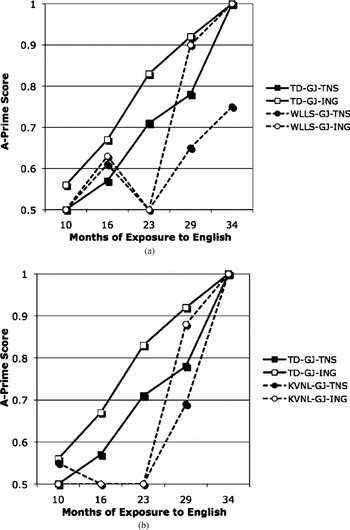
More longitudinal data from the same cohort of children as those in figures 1 and 2 in the Keynote Article (from Paradis, Reference Paradis2005, Reference Paradis, Gavruseva and Haznedar2008; and Paradis et al., Reference Paradis, Rice, Crago and Marquis2008) are discussed in this section. The data presented here in Figures 1 and 2 come from English L2 children with an average age of 5;2 at the outset and 7;3 at the final round of the study. The observations were taken every 6 months, from an average of 10 months exposure to English at the beginning, and an average of 34 months exposure to English at the end. Children have either Cantonese or Spanish as their L1, and the two case studies are one child with LD, KVNL, and one child with SLI, WLLS; both are Cantonese speakers. These data are presented to explore some of the ideas emerging from the foregoing discussion concerning cross-linguistic transfer, control processes, age effects, and their theoretical and clinical implications.
Mean A′ scores for grammaticality judgments of tense omission (GJ-TNS) and progressive -ing omission (GJ-ING) over time for TD L2 children with Spanish (SPAN) and Cantonese (CAN) as L1s.

Mean A′ scores for grammaticality judgments of tense omission (GJ-TNS) and progressive -ing omission (GJ-ING) over time for Cantonese L1–English L2 TD children and the Cantonese L1–English L2 child with (a) SLI (WLLS) and (b) LD (KVNL).

Children whose L1s mark grammatical tense, for example, Spanish, might have an advantage over children whose L1s do not mark tense, for example, Chinese languages, in acquiring English tense morphemes. However, as mentioned above, Paradis (Reference Paradis2005) and Paradis et al. (Reference Paradis, Rice, Crago and Marquis2008) did not find evidence of L1 influence on TD L2 children's accuracy rates with tense morphemes, calculated in composite scores. The analyses from Paradis (Reference Paradis2005) and Paradis et al. (Reference Paradis, Rice, Crago and Marquis2008) were conducted with a group of 24 TD children from 10 different L1 backgrounds at the first round of data collection. It is possible that the potential effects of L1 influence might have been masked by the variety of L1s, or the large variance in individual scores at Round 1, or both. Therefore, L1 influence on the acquisition of tense would still be worth examining in longitudinal data, comparing just the Spanish L1 and Cantonese L1 children. As mentioned above, Leonard predicts that the progressive -ing could also be more difficult for English L2 children whose L1 is Cantonese because aspect morphemes are optional in that language, and because research indicates that aspect morphemes are good candidates for clinical markers in Cantonese SLI. In contrast, L2 children with Spanish as their L1 might be facilitated in their acquisition of -ing since progressive aspect in the present tense is marked in Spanish (Mackenzie, Reference Mackenzie2001). Thus, it is possible that for the acquisition of both tense morphemes and progressive -ing, Spanish L1 children have an advantage over their Cantonese-speaking peers. For Cantonese–English L2 children with SLI, it could be expected that both tense morphemes and progressive -ing would be even more difficult to acquire than for their TD peers.
The language measures in Figures 1 and 2 here are A′ scores from the grammaticality judgment probe on the Test of Early Grammatical Impairment (Rice & Wexler, Reference Rice and Wexler2001). For this probe, children are asked to judge if two robots’ utterances are “said right” or “not so good.” In some cases, the robots make tense morpheme omission errors, for example, “he running away” or “now the bear want a drink,” and progressive -ing omission errors, for example, “he is smile.” The A′ scores from two groups of TD L2 children are given in Figure 1, one with three Cantonese L1 children, and one with three Spanish L1 children. The three Cantonese speakers were included in the Chinese group in figures 1 and 2 in the Keynote Article. Because the group means have just three scores contributing to them, these data can only be viewed as suggestive of possible trends in L2 acquisition. Figure 1 here shows that for both L1 groups, judgments of tense omission are less accurate than judgments of -ing omission over time, parallel to the performance of monolinguals with these probes (Rice & Wexler, Reference Rice and Wexler2001). Nevertheless, the Cantonese L1 children's scores lag behind those of the Spanish L1 children for both tense and -ing, pointing to the possibility that cross-linguistic transfer was affecting acquisition rate, even though the overall sequence of acquisition was intact. In other words, Cantonese speakers did not have equal difficulties with judging tense morpheme and -ing omissions, but there still appeared to be some L1 effects on their acquisition. Regarding the timeframe of cross-linguistic transfer, both groups reached ceiling in their scores for both morphemes at Round 5, or at an average of 34 months of exposure. Thus, L1-based differences were mainly in evidence from 10 to 29 months of exposure, or up to 2.5 years of experience with the L2.
Figure 2a and b is parallel in format to figure 1a and b in the Keynote Article. The TD mean A′ scores for judging tense omission and -ing omission are those from three Cantonese children in Figure 1 and are placed in Figure 2 for comparison purposes. Figure 2a shows the trajectories in grammaticality judgments for tense morpheme and -ing omission from WLLS, the L2 child with SLI. Similar to the production data in figure 1a in the Keynote Article, WLLS's scores at Rounds 1 and 2 are close to those of the TD children, but by Round 3 at 23 months exposure, he is lagging behind the TD children. At Round 5 at 34 months, WLLS catches up for -ing, but not for the tense morphemes. In contrast to the tense and nontense composite scores in figure 1a in the Keynote, WLLS's scores for tense morphemes and -ing are very similar until Round 4 at 29 months of exposure, when accuracy in judgments for -ing dramatically increases. KVNL, the child with LD, also shows a conflation of scores for tense and -ing judgments until Round 4 at 29 months of exposure, when -ing jumps ahead and is close to the TD mean (Figure 2b). KVNL catches up to the TD peers clearly for both tense and -ing by Round 5 at 34 months. These data suggest that the nontense composite score in production (figure 1, Keynote Article) might have masked some intermorpheme differences. They also suggests that equivalent problems with well-formedness judgments of both tense and -ing omission are present in L2 learners with SLI/LD whose L1 is Cantonese, supporting the prediction made by Leonard. Furthermore, this pattern of fairly equal and low accuracy with both tense and -ing contrasts with the pattern found for SLI acquisition in English monolinguals, and with that of TD L2 acquisition, regardless of L1 background (Figure 1). Taken together, data from WLLS and KVNL in figure 1 in the Keynote Article and Figure 2 here suggest that (a) clinical markers in the L1 can influence analogous structures in the L2 in the initial stages of L2 acquisition, and (b) clinical markers in English are the same whether English is being acquired as a L1 or L2. However, longitudinal data from Spanish L1 children with SLI, and more children generally, are needed to fully understand if these trends are indeed robust.
The L2 children's outcomes for grammaticality judgments of tense morpheme omission in Figures 1 and 2 here are different from those for tense morpheme production in figure 1 in the Keynote Article. Recall that the mean score at 34 months exposure for the TD L2 group for tense in production was 0.82, and just 44.4% of the children met the age-expected native-speaker criterion for this measure (Paradis, Reference Paradis, Gavruseva and Haznedar2008; Paradis Keynote). In contrast, all the TD L2 children and KVNL reached the criterion score for judgments of tense morpheme omission by the end of the study. Only the L2 child with SLI, WLLS, did not reach criterion for judgments of tense omission; however, his final score of 0.75 is nearly identical to the mean of 0.76 found for native-speaker children with SLI the same age (Rice & Wexler, Reference Rice and Wexler2001, p. 65), indicating that he managed to catch up to monolinguals with SLI in both grammaticality judgments and in production of tense morphemes. Paradis (in press) also found a discrepancy between French–English bilingual children's accuracy with tense in production and their well-formedness judgments of tense omission on the Test of Early Grammatical Impairment. Chondrogianni and Marinis (Reference Chondrogianni and Marinis2009, Reference Chondrogianni and Marinis2010) found similar discrepant abilities in production and processing, where Turkish L1–English L2 children showed superior sensitivity to ungrammatical omission of inflectional morphemes in on-line processing than accuracy in producing the same morphemes. Following Bialystok (Reference Bialystok2007), Paradis (in press) argued that the discrepancy in performance could be explained by the superior control functioning in bilinguals favoring grammaticality judgment tasks and the competition cost in speech production processes faced by bilinguals disfavoring accuracy in production. If this explanation is on the right track, then the data here and in Paradis (in press) and Chondrogianni and Marinis (Reference Chondrogianni and Marinis2009, Reference Chondrogianni and Marinis2010) offer evidence of how the unique configuration of control processes in bilinguals could influence their language use, and in so doing, influence the demonstration of their linguistic knowledge.
This discrepancy between being able to accurately produce a morpheme in one's own speech, and to judge when its presence or absence is correct in the speech of others, is also relevant to the consideration of age effects in acquisition. In the Growth Models and Age Effects in Acquisition Section, the possibility that sequential bilingual children never reach the same asymptote for accuracy in production as monolinguals was brought up, and maturational changes in language learning mechanisms in middle childhood was entertained as an explanation. This explanation needs some rethinking in light of evidence that TD bilingual children, both simultaneous and sequential, appear to have more knowledge of the correct use of morphology than they display in production. It is possible that for the acquisition of grammatical morphology, age effects for TD L2 children might reside more in fluid cognitive processes than in linguistic representation. It is also possible that apparent age effects in the acquisition of grammatical morphology are actually bilingualism effects, as they might not be isolated to sequential bilingual children.
Finally, let us consider the clinical implications of these longitudinal data. First, the potential for cross-linguistic transfer suggests that this factor needs to be considered as a source of individual differences in the early stages of L2 acquisition, and therefore, considered in the interpretation of performance on tests measuring morphosyntactic knowledge. In clinical practice, this could entail investigating whether a particular morphological construct that is probed on a test is present in the L1 of an L2 child, and unfortunately not all clinicians would have the resources to obtain this information. However, differentiation between TD L2 children and L2 children with SLI, based on their L2 abilities, might be limited in the early stages of acquisition anyway (cf. Armon-Lotem Commentary; Paradis, Reference Paradis, Gavruseva and Haznedar2008). The developmental point at which L1 influence is diminishing as a source of individual differences might coincide with the developmental point where accurate identification of impairment in the L2 is starting to become reliable. Therefore, the impact of cross-linguistic transfer on assessment practices might be small, although future research is necessary to know for certain. A second clinical implication comes from the discrepancy between performance with tense morphemes in production and in well-formedness judgments. This could be considered a profile effect of bilinguals, as discussed in the Keynote Article. Consideration of the weakness all bilingual children might show on measures of morphological correctness is something to bear in mind when choosing and designing assessment measures for bilingual children. Tasks like well-formedness judgments might provide a more accurate measure of bilingual children's morphosyntactic knowledge in a language than production tasks.