It is fitting to measure Perestroika's impact through the contents of the leading political science association journals. The original Perestroika manifesto railed at the American Political Science Review (APSR), and many subsequent Perestroika protests condemned the skewed contents of the APSR, the American Journal of Political Science (AJPS), and the Journal of Politics. Large national and regional associations publish and pay for these journals. The position of Perestroika has been that their contents should represent the many types of research that political scientists are doing, which was not the case when the movement began.
David Pion-Berlin and Dan Cleary classified articles in the APSR over the period of 1991 to 2000 into four categories: statistics, formal and mathematical modeling, philosophy and theory, and qualitative empirical research. Statistics accounted for 53% of all articles, formal modeling for 21%, philosophy/theory for 25%, and qualitative empirical research for 1%. Of the 425 articles, five embodied qualitative empirical methodology without statistics (Pion-Berlin and Cleary Reference Pion-Berlin, Cleary and Monroe2005).
I conducted a similar survey of AJPS, tracking its contents by pairs of years going back to 1960. In the most recent two-year stretch of 2000–01, statistics accounted for 71.7% of all articles, modeling 18.6%, philosophy 7.1%, and qualitative empirical research 2.6% (Kasza Reference Kasza and Monroe2005).
Since these surveys were conducted, strenuous efforts have been made to re-legitimize qualitative methods. These efforts include the publication of books,Footnote 1 the founding of a qualitative methods section in the APSA, the expansion of the Consortium on Qualitative Research Methods, and the spread of qualitative methods courses in graduate programs. All of these efforts tout the advantages of qualitative methods such as case studies, interviews, focus groups, comparative history, participant observation, and interpretivism. What has been their impact on the association journals?
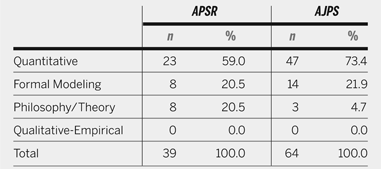
I examined articles appearing in the most recent four issues (a year's worth) of AJPS and APSR, classifying them under the same rubrics used in the earlier surveys. I defined quantitative articles as those analyzing empirical, numerical datasets with techniques such as regression. This category also includes experimental research projects, which invariably present their findings in statistical form. I defined formal modeling articles as studies that employ deductive reasoning to develop models that are ordinarily elaborated in mathematical notation. When articles combined quantitative and formal methods, I categorized them according to which method seemed to receive the most emphasis. Articles in the philosophy/theory category include classical studies (Plato, Rousseau), as well as articles exploring topics such as democratic theory or political culture without examining empirical cases or using formal models. Finally, qualitative-empirical research employs the types of qualitative methods listed in the previous paragraph to examine empirical subjects without using statistical techniques. Results are shown in table 1. As can be seen, the publication of qualitative research in these journals has decreased since the onset of Perestroika.
Types of Articles Published in APSR (May 2009–Feb 2010) and AJPS (July 2009–April 2010)

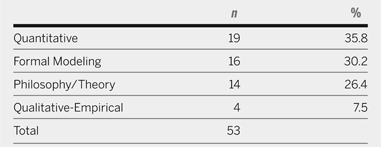
The editorship of Lee Sigelman at the APSR was reputed to be more open to qualitative methods than previous regimes, so I also examined a year's worth of articles processed toward the end of his term.Footnote 2 The results are shown in table 2.Footnote 3
Types of Articles Published in APSR (February–November 2007)

Evidently, the scholarly orientation of an editor matters in the decision to publish, and perhaps also in the decision of scholars to submit manuscripts for publication. Under Sigelman, the number of qualitative articles in APSR increased, if only modestly.
From the vantage of qualitative scholars, the challenge was to institutionalize and expand the more pluralistic bent of the APSR under Sigelman. The introduction of a multiple editorship after he stepped down seemed like a good way to achieve this. It is silly to pretend that any of us is equally sympathetic with all methods or competent to pass judgment on all forms of research. If a collective editorship includes people who are committed to qualitative methods and capable of selecting appropriate readers for qualitative research, then a qualitative contributor might request that one of those editors oversee his or her manuscript. There could be no better guarantee of even-handedness in the editing of a journal. As a case in point, Professor Kirstie McClure, a theorist, oversees APSR submissions in the philosophy/theory field, and that field is well represented in the journal's pages. I cannot judge the intentions of the current editors, but judging from results, qualitative empirical research has not found a similarly sympathetic and competent representative among the APSR's lead editors.
The standard response from the editors of journals like the APSR, AJPS, and JOP is that qualitative scholars simply do not submit manuscripts to them. But given that the first two journals are publishing virtually no qualitative empirical research, is it unreasonable for qualitative scholars to assume that these journals are biased against their work? Suppose that for a 12-month period, the APSR did not publish a single article containing a regression coefficient. Wouldn't quantitative scholars invariably conclude that their work was not getting a fair hearing?
A collective editorship will not solve the problem of methodological bias unless two or three of the editors are dyed-in-the-wool qualitative researchers. By this, I mean people who have never published anything containing an r 2 or an equation loaded with Greek letters, people whose epistemological principles and scholarly experience and contacts lie solidly in the realm of qualitative methods. Nothing less will produce a level playing field for qualitative scholarship.
How is it that so many years of protest have produced such negligible results? Political action, not sound arguments, governs the academy, and qualitative scholars have been out-politicked. When it comes to reforming the discipline, too many seem to confuse discourse with tangible accomplishments. Perestroika has indeed made a more open discourse about methodology possible, but its adherents have not pushed long or hard enough to effect institutional change. In October 2008, a former editor of one of the journals examined in this article sent a confidential e-mail to me and one other Perestroika activist. In this letter, he expressed deep concern that the search committee for a new editorial team at AJPS was made up entirely of scholars doing quantitative research and formal modeling. While acknowledging the scholarly credentials of the committee's members, he stated that “the composition of the committee seems to me to be sending a pretty clear message,” and he urged us “to kick up a bit of a fuss.” My response to him was that “We in Perestroika (or what's left of it) must share the blame, because the truth is that we're not well organized enough to offer an alternative editorial team anyway…. I could take over the advisory function myself and the editorship would probably end up in the same hands.” When the editorship of a major journal opens up, hard scientists band together and present a viable proposal for assuming the task. Qualitative scholars do not. So guess who ends up editing our journals?
The fairest means of effecting change in the major journals would be to make their funding optional for members of the national and regional associations. Instead of these bodies channeling part of their members' dues to the association journals automatically, each member would have to check a box on the membership application indicating whether or not he or she wanted to contribute to that cause. There is no democracy in the regular selection of officers in political science associations, but this would at least give the members some voice in regulating what are purportedly their journals. Let the market reveal what the majority of political scientists think of these publications. Then, those of us who object to the discriminatory editorial policies of these journals would have the opportunity to demonstrate that these journals do not reflect our understanding of the discipline. If the people running these journals today really believe that their contents represent the best that political science has to offer, they should have nothing to fear from the judgment of their colleagues. Or are today's editors self-consciously imposing what they know to be a one-sided view of political scholarship on the rest of us?