

Over the past 25 years, second language acquisition (SLA) studies have extensively examined the effects of integrating form-focused instruction (FFI) into meaning-oriented classrooms as “a set of psycholinguistically motivated pedagogic options” (Ellis, Reference Ellis2001, p. 12) in the contexts of grammar teaching. They found that FFI can positively impact learners’ developing system of second language (L2) morphosyntax not only at a controlled level but also at a spontaneous level (Norris & Ortega, Reference Norris and Ortega2000; Spada & Tomita, Reference Spada and Tomita2010). Although it is often assumed that the empirical findings of L2 grammar studies may be applicable to all types of language features, such as L2 lexis (e.g., Schmitt, Reference Schmitt2008) and L2 pragmatics (e.g., Rose & Kasper, Reference Rose and Kasper2002), it is surprising that little attention has been given to FFI research in the domain of L2 phonetic development. Building on the FFI research framework in the field of instructed SLA, the current study examines in depth which combination of FFI techniques, FFI with or without corrective feedback (CF), can most benefit the development of phonetic aspects of L2 speech perception and production. We provided a range of pedagogical activities designed to elicit learners’ noticing and practice of the target sounds (but without any explicit instruction) in simulated classroom settings.
L2 SPEECH LEARNING
Theoretical issues
Recently, speech researchers have proposed that L2 speech learning is subject to patterns of sound and word recognition that are similar to those of first language (L1) phonetic acquisition (Best & Tyler, Reference Best, Tyler, Bohn and Munro2007; Bundgaard-Nielsen, Best, & Tyler, Reference Bundgaard-Nielsen, Best and Tyler2011a, Reference Bundgaard-Nielsen, Best and Tyler2011b; Walley, Reference Walley, Bohn and Munro2007). That is, L2 learners initially use computational strategies to detect prosodic patterns of language and then start recognizing words in the earliest stages of their vocabulary learning (i.e., lexically driven L2 speech learning). Their representation of sounds, therefore, is based on lexical items that they have fully or partially acquired, subject to the influence of various lexical factors such as text frequency, subjective familiarity, and neighborhood density (Bradlow & Pisoni, Reference Bradlow and Pisoni1999; Imai, Walley, & Flege, Reference Imai, Walley and Flege2005; Trofimovich, Collins, Cardoso, White, & Horst, Reference Trofimovich, Collins, Cardoso, White and Horst2012).
As their vocabulary size increases, however, L2 learners are forced to engage in more fine-grained phoneme discrimination and identification in order to accurately comprehend and produce a large lexicon containing many phonetically similar words such as minimal pairs. Ultimately, while they are sensitive primarily to word-sized units of L2 speech information, they concurrently become more capable of detecting new sounds in L2 input at a phonetic level (i.e., phonetically driven L2 speech learning). This phonetic-level restructuring, in particular, leads learners to create new phonetic categories and to generalize newly acquired phonetic knowledge from familiar to unfamiliar lexical contexts (Flege, Frieda, Walley, & Randazza, Reference Flege, Frieda, Walley and Randazza1998). Finally, major L2 speech theories assume that phonetic categories have a perceptual basis and L2 learners access them at various processing levels. This suggests that perception of new L2 sounds activates relevant sensorimotor skills and leads to production ability (i.e., a perception-first view; Flege, Reference Flege and Strange1995, Reference Flege, Meyer and Schiller2003; Kuhl, Reference Kuhl2000) and change appears first at a controlled and later at a spontaneous level (i.e., a variationist view; Major, Reference Major, Edwards and Zampini2008; Rau, Chang, & Tarone, Reference Rau, Chang and Tarone2009).
English /ɹ/
One well-researched yet still controversial topic in adult L2 speech learning is the acquisition of word-initial /ɹ/ by native speakers of Japanese (for a review, see Bradlow, Reference Bradlow, Hansen and Zampini2008). From an acoustic point of view, American English /ɹ/ can be characterized along multiple dimensions, such as (a) third formant (F3), (b) second formant (F2), (c) first formant (F1), and (d) transitional duration of F1 and F3. A clear delimitation of /ɹ/ from the other approximant sounds in the English phonetic system requires, in particular, a severe dip in F3 as its reliable acoustic correlate (F3 = 1300–1950 Hz; Espy-Wilson, Boyce, Jackson, Narayanan, & Alwan, Reference Espy-Wilson, Boyce, Jackson, Narayanan and Alwan2000). Despite a variety of articulatory configurations for the sound (e.g., retroflexed and bunched /ɹ/), key articulatory features include constrictions in the labial, palatal, and pharyngeal regions of the vocal tract and a front cavity resonance behind the sublingual space, which is highly related to low F3 values (Espy-Wilson et al., Reference Espy-Wilson, Boyce, Jackson, Narayanan and Alwan2000).
The Japanese phonetic system includes neither /ɹ/ nor /l/, and Japanese learners tend to perceptually substitute the nearest L1 counterpart (Japanese tap /ɾ/) for both of these phonemes, thus neutralizing the contrast (Guion, Flege, Ahahane-Yamada, & Pruitt, Reference Guion, Flege, Ahahane-Yamada and Pruitt2000). Japanese learners resort to two interlanguage strategies instead of developing the new phonetic representation of F3 and relevant articulatory configurations. First, Japanese learners tend to overly depend on F2 frequencies to discriminate /ɹ/ from /l/ (Iverson et al., Reference Iverson, Kuhl, Akahane-Yamada, Diesch, Tohkura and Kettermann2003) and produce /ɹ/ with lower F2 (tongue retraction, /w/-like production; Saito & Brajot, in press). Second, Japanese learners also overly rely on durational cues rather than spectral cues (Iverson, Hazan, & Bannister, Reference Iverson, Hazan and Bannister2005). Although the transition duration of English /ɹ/ (50–100 ms) is generally longer than that of Japanese tap /ɾ/ (5–20 ms), it has a wide range of natural variation (e.g., some /ɹ/ tokens can be as short as Japanese tap) and it is not necessarily a significant acoustic correlate of /ɹ/ (Flege, Takagi, & Mann, Reference Flege and Strange1995).
In sum, if Japanese learners are overly reliant on F2 distributions and temporal dimensions at the expense of variation in F3 (Saito & Brajot, in press), the following framework for acquiring /ɹ/ may be proposed: (a) a move away from (though not necessarily a complete abandonment of) “default strategy” of F2 and duration dependency; (b) attention to new acoustic information (F3 variance: 2400–3000 Hz for Japanese tap /ɾ/ → 1600–1900 Hz for English /ɹ/); and (c) associated shift in orolingual articulation (i.e., labial, palatal, and pharyngeal constriction). In conjunction with the interlanguage development of /ɹ/, this study examines in depth whether and to what degree FFI can help L2 learners to expedite the development and restructuring of the multiple acoustic properties of their representations of /ɹ/ (i.e., F3, F2, F1, and transition duration) as well as enhance various levels of their processing abilities of /ɹ/ (i.e., perception → controlled production → spontaneous production).
Pedagogical issues
From a pedagogical perspective, developing effective and efficient approaches to helping adult L2 learners reach comprehensible pronunciation and listening skills is an especially timely and important initiative. Although foreign accents are normal aspects of L2 speech production for adult L2 learners (Flege, Munro, & MacKay, Reference Flege, Munro and MacKay1995) and accents are essential to maintaining English users’ sense of identity in the context of global communication (Jenkins, Reference Jenkins2000; cf. Derwing & Munro, Reference Derwing and Munro2005), heavy accents may in some cases prevent even those with precise grammar from attaining successful comprehensibility in their L2 interaction (Isaacs & Trofimovich, Reference Isaacs and Trofimovich2012). Advanced listening skills play a key role in accessing aural L2 input available not only during actual L2 interaction but also via a variety of network media such as TV and the Internet (Vandergrift, Reference Vandergrift2007), and extracting linguistic information from intake is hypothesized to be a first crucial step in SLA (Gass, Reference Gass1997; VanPatten, Reference VanPatten2004).
As Celce-Murcia, Brinton, Goodwin, and Griner (Reference Celce-Murcia, Brinton, Goodwin and Griner2010) and Levis (Reference Levis2005) have pointed out, however, the teaching of pronunciation in L2 classrooms has been largely ignored over the past 20 years by the proponents of communicative language teaching. As a result, much pronunciation teaching is “still heavily influenced by commonsense intuitive notions” (Derwing & Munro, Reference Derwing and Munro2005, p. 380). Pronunciation teaching has been notorious for its overdependence on decontextualized practice, such as mechanical drills and repetition, reminiscent of the audiolingual teaching methods of several decades ago (Trofimovich & Gatbonton, Reference Trofimovich and Gatbonton2006). Previous intervention studies have indicated that the pedagogical potential of such focus-on-formS is limited to improvement only at a controlled level (see Saito, Reference Saito2012, for research synthesis on 15 quasi-experimental studies published since 1990).
Furthermore, despite increasing research attention to the role of successful segmental perception in word recognition (Best & Tyler, Reference Best, Tyler, Bohn and Munro2007; Bundgaard-Nielsen et al., Reference Bundgaard-Nielsen, Best and Tyler2011a, Reference Bundgaard-Nielsen, Best and Tyler2011b; Cutler & Boersma, Reference Cutler, Broersma, Hardcastle and Beck2005) and its ultimate impact on holistic L2 comprehension (Stæhr, Reference Stæhr2009), relevant findings have been restricted to the effects of laboratory training methods. During the training, L2 learners are intensively exposed to minimally paired stimuli such as “rock”–“lock” produced by a number of native-speaking talkers (i.e., high variability phonetic training; for a review, see Thomson, Reference Thomson2012). The results of the previous studies have indicated that even adult L2 learners can alter their perception performance (e.g., Iverson et al., Reference Iverson, Hazan and Bannister2005; Logan, Lively, & Pisoni, Reference Logan, Lively and Pisoni1992) and transfer a gain to production levels (e.g., Bradlow, Pisoni, Akahane-Yamada, & Tohkura, Reference Bradlow, Pisoni, Akahane-Yamada and Tohkura1997). The pedagogical implications of these studies remain unclear, arguably because L2 learners listened to only a small number of phonetic targets and the length of instruction, in some cases, lasted for many hours (e.g., 15–22.5 hr in Bradlow et al., Reference Bradlow, Pisoni, Akahane-Yamada and Tohkura1997). As a result, no single pronunciation or listening teaching study has ever been included in previous meta-analysis studies in the field of instructed SLA, because of the lack of sufficient discussion as to type of instruction (e.g., focus-on-form vs. focus-on-formS) and outcome measures (e.g., controlled vs. free constructed responses; Norris & Ortega, Reference Norris and Ortega2000; Spada & Tomita, Reference Spada and Tomita2010).
FFI IN SLA
FFI is defined as “any pedagogical effort which is used to draw the learners’ attention to language form either implicitly or explicitly” (Spada, Reference Spada1997, p. 73). Different from traditional grammar translation methods that introduce forms in a decontextualized manner, FFI is hypothesized to be most effective when implemented in content-based and communicative language classrooms in which conveying a meaningful message is a priority (Spada, Reference Spada2011). Communicative focus on form in this way helps L2 learners to develop their “form–meaning mappings” (Doughty, Reference Doughty, Long and Doughty2003; VanPatten, Reference VanPatten2004) and promotes a gradual transition from effortful to automatic use of rules (DeKeyser, Reference DeKeyser2007; Lyster, Reference Lyster2007). Specifically, Lyster and Ranta (Lyster, Reference Lyster2007; Ranta & Lyster, Reference Lyster2007) proposed a pedagogical sequence of FFI corresponding to differential levels of students’ interlanguage development: noticing → awareness → practice.
In FFI, teachers should design a range of preplanned tasks to promote learners’ noticing of a target language feature in L2 input especially at the initial stage of interlanguage development (the noticing phase) and then guide learners’ analysis of the target feature with some degree of elaboration (the awareness phase). Among effective FFI activities identified by researchers, those tested in this study include (a) structured input (i.e., learners are required to process linguistic form in input for meaning without being pressured to produce output; VanPatten, Reference VanPatten2004), (b) typographically enhanced input (i.e., target structures are highlighted by means of emphatic stress or visual changes such as italics to induce learners to notice the forms in oral and written L2 input; Han, Park, & Combs, Reference Han, Park and Combs2008), and (c) focused tasks (i.e., learners are required to produce linguistically accurate output to successfully complete meaning-oriented tasks; Ellis, Reference Ellis2006). Finally, after learners successfully restructure and develop interlanguage representations, they are ready to be pushed to repetitively practice the target feature in production in communicatively authentic contexts (the practice phase). At this stage, provision of output-prompting CF in a seemingly less planned fashion during online interaction could be a very effective technique.
With a general absence of research specifically investigating the pedagogical capabilities of FFI in L2 speech learning, Saito and Lyster (Reference Saito and Lyster2012) took a first step toward testing the amenability of FFI techniques to teaching new sounds in conjunction with the production of /ɹ/ by Japanese learners. The results showed that providing CF (i.e., recasts) in response to learners’ mispronunciation during FFI treatment played an important role in changing their L2 pronunciation performance. The relative importance of CF was attributed to its dual pedagogical function: pronunciation-focused recasts provided students with pronunciation models while, at the same time, eliciting self-modified output.
Yet, that study had several methodological limitations. Furthermore, it resulted in more questions that future research needs to answer to obtain a better understanding of the relationship among FFI, CF, and L2 phonetic development. First, one could argue that such FFI effectiveness might be solely limited to production levels, arguably because adult L2 learners can sometimes carefully monitor their pronunciation forms without developing much perceptual awareness of the new sounds (Sheldon & Strange, Reference Sheldon and Strange1982). Thus, the precursor study has yet to answer whether FFI can simultaneously impact both the perception and the production domains (more similar to naturalistic L2 phonetic development; Flege, Reference Flege, Meyer and Schiller2003) or if it simply reinforces learners’ monitoring skills on their correct pronunciation forms of new sounds, regardless of the present state of their perceptual representations (Sheldon & Strange, Reference Sheldon and Strange1982).
Second, the precursor study mainly measured the pedagogical potential of FFI only in the context of trained lexical items that appeared during instruction. It remains unclear to what extent learners can generalize their gain to novel lexical contexts beyond instructional materials (i.e., a transition from vocabulary to sound learning).
Third, all participating students in the precursor study had been residing in an English-speaking country (Canada) with much individual difference in their proficiency profiles: their length of residence (LOR) widely ranged from 1 month to 13 years (M = 15.5 months, SD = 31.8 months). Although the study found significant gains for the FFI and CF treatment, such results could have been confounded with the total amount and frequency of the participants' L2 use outside of the classroom in an English as a second language (ESL) setting. To isolate and reexamine the pure effects of FFI and CF on L2 speech learning, the study needs to be replicated, especially in conjunction with learners with homogeneous proficiency levels (e.g., LOR < 1 year) living in an English as a foreign language (EFL) environment, where they would be expected to have little exposure to spoken English outside of the classroom (for a similar discussion on the differential effectiveness of phonetic training in ESL vs. EFL settings, see Lively, Pisoni, Yamada, Tohkura, & Yamada, Reference Lively, Pisoni, Yamada, Tohkura and Yamada1994).
RESEARCH QUESTIONS AND HYPOTHESES
The current study was designed to examine which combination of FFI techniques (FFI with or without CF) impact the three different levels of L2 phonetic development of /ɹ/ by Japanese learners: perception, controlled production, spontaneous production. It also aimed to investigate whether learners generalize the effects of FFI from trained to untrained lexical contexts, which might in turn provide evidence for their functional use of the lexical- and phonetic-level representational systems in a complementary fashion. The study's research questions and hypotheses are thus formulated as follows:
1. To what degree is FFI-only facilitative of L2 speech perception and production development of /ɹ/?
Following Ranta and Lyster's (Reference Ranta, Lyster and DeKeyser2007) FFI model, FFI-only in this study is defined as providing a great deal of positive evidence of /ɹ/ through preplanned noticing and awareness activities, which included structured input, typographically enhanced input, and focused tasks. It was predicted that such training without any further intervention on the part of the teacher, such as the provision of CF, would predispose the learners especially at the initial stage of interlanguage development to notice and practice /ɹ/ in a receptive manner. Because L2 pronunciation development requires not only learners’ accurate perceptions of speech properties in L2 input (i.e., the cognitive phase) but also their actual usage of articulators to produce correct sounds (i.e., the physical domain; Flege, Reference Flege, Meyer and Schiller2003), FFI-only might be insufficient to trigger learners’ robust pronunciation improvement. It may be the case that some improvement would appear only at the perceptual level (i.e., perception precedes production; Flege, Reference Flege and Strange1995, Reference Flege, Meyer and Schiller2003) or, at best, may be transferred to the controlled-speech domain (Bradlow et al., Reference Bradlow, Pisoni, Akahane-Yamada and Tohkura1997).
2. To what degree does adding CF to FFI increase the size of instructional gain?
With respect to the efficacy of CF, previous descriptive research has generally shown that L2 learners tend to notice teachers’ CF on their pronunciation errors and thus produce a great deal of modified output in various classroom settings (e.g., Sheen, Reference Sheen2006). Thus, the learners receiving CF during FFI are predicted to have more self-correction opportunities and occasion to proceduralize their productive use of the newly acquired phonetic knowledge while comparing their nontarget pronunciation with the teacher's model pronunciation in contexts of interaction. Such communicative output practice is hypothesized to promote automatization of the L2 system (Trofimovich & Gatbonton, Reference Trofimovich and Gatbonton2006). Thus, learners will demonstrate gains not only at the perceptual level but also in both controlled and spontaneous production domains.
METHOD
Design
This study took place at a private language institute in Osaka, Japan, which granted access to its students, classrooms, and teachers for research purposes. After completing pretests, all students in the experimental groups received four 1-hr English communication lessons over 2 weeks in which a range of FFI activities were embedded to encourage students to notice and practice the target pronunciation features of /ɹ/ (but without any explicit instruction) during meaningful discourse. For the FFI + CF group, instructors consistently provided CF on the mispronunciation of /ɹ/, while the FFI-only group did not receive any CF. Students in the control group received comparable communicative language instruction in terms of duration and content but with no focus on phonetic form. The author observed the instruction from the back of the classroom to ensure consistency of treatments. All classes were videorecorded. Two weeks after the end of the lessons, all students completed posttests and participated in a final interview.
Participants
The participants in this study consisted of 49 Japanese learners of English, 2 experienced native-speaking (NS) teachers, and 10 NS baseline talkers.
Students
For recruitment purposes, the author advertised the English conversation lessons in the language institute, in postsecondary educational institutions in the area of the research site, and on several social networking websites. Interested participants contacted the author and made appointments for their initial interviews and pretests. Of the 54 students who initially participated in this study, 5 failed to see the project through to completion for various personal reasons. The total number of students used in the final analyses was 49 (age: M = 30.5 years, SD = 10.1 years).
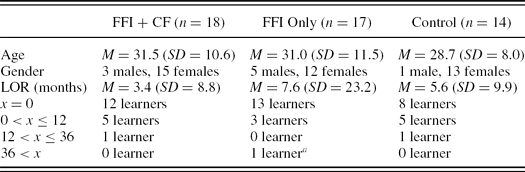
According to a preliminary language background questionnaire, although all learners had studied English formally for 6 years from Grades 7 to 12, typically through grammar translation methods, they reported that they had few opportunities to speak English, except for a few hours of conversation classes either at the university or at language institutes. In addition, 33 of the 49 learners had never been abroad. Mean LOR in an English-speaking environment was 7.9 months (SD = 21.4 months). Students were randomly assigned to nine classes of six students each, and then each of the classes was assigned to one of three groups, with each group consisting of three classes. The three groups were the FFI + CF group (three classes, n = 17), the FFI-only group (three classes, n = 18), and the control group (three classes, n = 14). The production (but not perception) data of the FFI + CF group and the control group were partially reported in another study (Saito, Reference Saito2013). In this study, however, the same production data was reanalyzed via new statistical and acoustic analyses in comparison with the FFI-only group (the main focus of this study is to examine the differential effectiveness of FFI with or without CF). Table 1 provides the details of the 49 learners according to three groups.
Participant information by group

Note: FFI, form-focused instruction; LOR, length of residence.
aThis learner reported 8 years LOR.
Instructors
Two experienced NS instructors (one male from California and one female from Ontario) who worked at the language institute participated in this study in the role of teacher. Whereas the first instructor taught one FFI + CF group and one FFI-only group, the second instructor taught two FFI + CF groups, two FFI-only groups, and three control groups.
NS baselines
Ten NS talkers (5 males, 5 females) participated by taking the same perception and production tests. They were undergraduate and graduate students at an English-speaking university in Montreal, Canada (age: M = 21.5 years, SD = 1.6 years). Their performance served as baseline data for comparison purposes.
FFI treatment
Target words
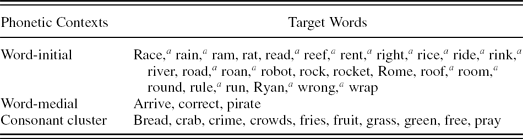
In total, the target sound of /ɹ/ was embedded in 39 minimally paired words (including near minimally paired words; see Table 2) that frequently appeared in various FFI activities. All of these words were italicized and highlighted in red so that the learners might notice the target words in meaning-oriented lessons and become aware of the target feature of /ɹ/ at a lexical level (i.e., typographically enhanced input; Han et al., Reference Han, Park and Combs2008).
39 target words included in the instructional treatment
aThe 16 words included in the pre-/posttests.
Instructional treatment
The main purpose of the meaning-oriented lessons was to teach English argumentative skills, which entailed logical thinking, negotiation and debating, and public speaking abilities. To successfully complete each task, the learners were to accurately perceive and pronounce a few target words that were minimally paired with /l/. Among these activities were argument critique, English debating, argument creation, and public speaking.
1. Argument critique: The students were given a set of logically problematic passages such as “Ryan was able to drive his car well in the rain yesterday. So, he can drive his car in the snow without any problems” and taught how to find and critique these problems (i.e., analogy problem: “driving in the rain” ≠ “driving in the snow”).
2. Debating: With critique techniques that they had learned, the students debated several topics such as “Running inside is better than running outside” and “Is it good to have a rainy day?”
3. Argument creation and public speaking: After learning how to use a logical sequence (i.e., Introduction → Evidence → Objection → Defense → Conclusion), the students were paired to develop their own arguments and make a public speech in front of their class with good control of eye contact and a loud, clear voice. Topics used in this activity included “Is reading comic books good for children?” and “Is a sense of ‘rat race’ among students harmful (e.g., tests and entrance examinations)?”
In addition to the main activities introduced above, three activities were used as “warm-up” games where students had to distinguish the target feature of English /ɹ/ from the Japanese tap /ɾ/ in perception and production to win the game. The instructors spent approximately 15 min on the games at the beginning of each lesson.
1. English karuta: Thirty-six cards were placed on a table. Each card represented one lexical item and had a relevant picture with the first letter of the word. When the teachers read a list of the words, the students tried to find and pick up the appropriate card as soon as possible. To get as many cards as possible, the students had to pay attention to the perceptual difference between /ɹ/ and /l/.
2. English card game: Each card had two identical sentences except one minimally paired word (e.g., “I found a beautiful leaf” vs. “I found a beautiful reef”), and the students in pairs took turns reading the sentences; the partner had to guess which sentence was read. To obtain several cards, the students had to differentiate their productions of the English /r–l/ contrast (there were 36 cards in total); the purpose of this activity was to promote their awareness of their production of English /ɹ/–/l/ contrast but not their perceptual abilities (note that both students were Japanese learners of English).
3. Guessing game: Each card had one vocabulary item written in standard orthography on the right-hand corner of the card. One learner would paraphrase the word, and the other would guess the vocabulary item his or her partner was trying to describe.
CF procedure
For the FFI + CF group, the instructors consistently provided CF in the form of recasts in response to learners’ mispronunciation or unclear pronunciation of /ɹ/ in the target words during the FFI treatment. Specifically, they were asked to recast only individual words that had been mispronounced and to use a falling intonation when doing so (i.e., pronunciation-focused recasts). Such recast techniques were categorized as “partial recasts” and have been considered to be the most perceptually salient type of recast (Sheen, Reference Sheen2006).
To examine the relationship between recasts and self-modified output, the author carefully watched 12 hr of videotaped FFI + CF lessons (3 FFI + CF classes × 4 hr) and checked the number of times the teachers provided recasts and to what degree they elicited students’ repetition. Because of the relative difficulty of accurately determining how successfully learners repaired their pronunciation errors during meaning-oriented classroom discourse (likely filled with unwanted noise), the author (a NS of Japanese) made a form of dichotomous coding on whether students made clear efforts to approximate English /ɹ/ (i.e., repair) or simply continued to substitute the Japanese tap /ɾ/ (i.e., needs repair). For a similar judgment procedure on Japanese learners’ /ɹ/ production in conversational speech and its rationale, see Riney, Ota, and Takata (Reference Riney, Takada and Ota2000). Three examples of the recast–repair sequence are as follows:
(1) For repair (argument creation)
S: It might be better to let children read /ɾid/* comic books.
T: Read /ɹid/ ← RECAST
S: Read / ɹid/ comic books especially with adult guidance. ← REPAIR
(2) Needs repair (English debate)
S: We should avoid a wrong /ɾɔŋ/* sentence . . .
T: Wrong / /ɹɔŋ /. ← RECAST
S: Wrong /ɾɔŋ/ sentence. ← NEEDS REPAIR
(3) No repair (English debate)
S: If it rains /ɾeɪnz/*, we can . . .
T: Rains /ɹeɪnz/. ← RECAST
S: Yes. ← NO REPAIR
Control group
The 14 learners in the control group received the same instruction on English argumentative skills as the other groups but without any FFI component on /ɹ/. All target words in the instructional materials were replaced with comparable words (“rain” → “typhoon,” “run” → “jog”). For the warm-up games, they did other communicative activities with no emphasis on pronunciation or listening practice.
Teacher training
The researcher provided the instructors with 4 hr of training sessions over 2 days before the intervention commenced. They were given a package of instructional materials with a list of the target words and then they were told the content and purpose of each activity as well as the way they were to provide CF following students’ pronunciation errors.
MEASURES
The effects of FFI on L2 phonetic development were examined by means of a perception test, a controlled production test, and a spontaneous production test, including both trained and untrained lexical items. The testing sessions were individually conducted before and after instruction in a quiet room at the language institute. To avoid too much focus on form, especially in the spontaneous production task, the pre- and posttests were conducted in the following order: the spontaneous production task → the controlled production task → the perception task.
Perception tests
The two-alternative forced-choice identification task was used to measure the learners’ perception performance of /ɹ/.
Materials
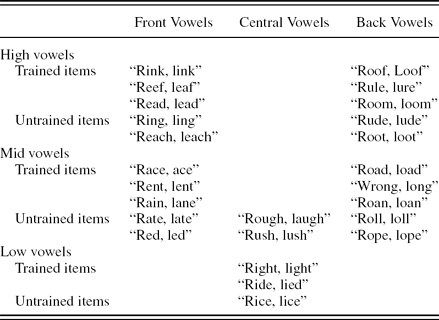
The test consisted of 70 test items containing 25 minimally paired words beginning with word-initial /ɹ/ or /l/ (“rain” vs. “lane”) together with 10 other minimally paired words serving as distracters (e.g., “think” vs. “sink”). The minimally paired target words (n = 50) contrasted word-initial /ɹ/ and /l/ in three phonetic contexts: 20 consonant–vowel–consonant (CVC) singletons with front vowels, 10 CVC singletons with central vowels, and 20 CVC singletons with back vowels (see Table 3).
50 tokens in the perception tests in relation to following vowel conditions
Three types of listening materials were prepared: Version A spoken by one male NS and one female NS of northeastern American English; Version B spoken by the male NS instructor; and Version C by the female NS instructor. All stimuli were recorded by means of a Roland-05 Wave recorder in a quiet room at an English-speaking university in Montreal (Version A) or at the language institute (Versions B and C). The tokens were digitized at a 44.1 kHz sampling rate and normalized for peak intensity by means of speech analysis software, Praat (Boersma & Weenik, Reference Boersma and Weenik2011).
Procedures
All test items were presented orthographically, and Japanese learners responded to all speech stimuli using an answer sheet. Several of the words were uncommon ones (e.g., lure and lope), and so the learners were told that all items were real minimally paired words (and near minimally paired ones) and were asked to focus on the contrasting sounds (e.g., /ɹ/–/l/, /θ/–/s/, /v/–/b/) rather than on lexical meaning. The assumption underlying the perception task was that, if the Japanese learners altered their L1-related perception patterns (i.e., sensitivity to F2 variation and transition duration) and started discriminating nonnative phonetically relevant acoustic parameters (i.e., sensitivity to F3 variation), they could successfully perceive /ɹ/ in the following manner: identifying the sound with low F3 as /ɹ/ and discriminating the sound with high F3 as /l/ (i.e., not /ɹ/).
Version A was used for all participants at both the pre- and posttest sessions to measure any change in the perception level resulting from instruction. The participants also listened to Versions B or C at posttest sessions to see whether their instructional gain was restricted by training contexts (their teacher's voice).
Production test
The two production tests (word reading and timed picture description) were designed to measure the learners’ pronunciation performance of /ɹ/ at two different levels of processing (controlled- vs. spontaneous-speech levels). Their speech tokens were recorded by means of Roland-05 Wave recorder, at a 44.1 kHz sampling rate and a 16-bit resolution with a unidirectional microphone (DM-20SL).
Controlled production
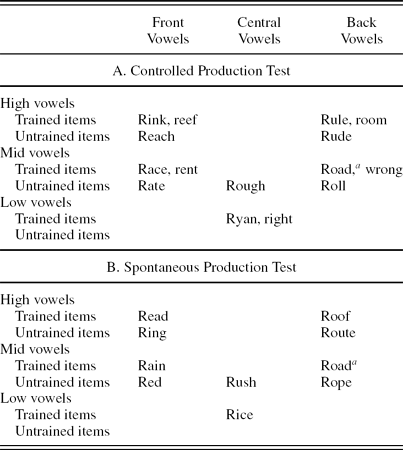
To elicit controlled production of /ɹ/, the learners read a list of 40 words, of which 15 were target words. The test tokens were CVC singletons except “Ryan” (CVVC), including six tokens with front vowels, three tokens with central vowels, and six tokens with back vowels. According to Vocabulary Profiler (Cobb, Reference Cobb2011), these tokens, except “Ryan” and “rink,” fell within the first 2,000 word families (the test items are relatively high-frequency words). These 15 words included 10 trained lexical items and five untrained lexical items. The test tokens are identified in Table 4.
25 tokens in the controlled and spontaneous production tests in relation to the following vowel conditions
a“Road” was tested twice both in the controlled and spontaneous production tests.
Spontaneous production
As a reliable way to measure spontaneous production abilities of certain linguistic features, SLA researchers have emphasized the importance of eliciting learners’ use of language for some communicative purpose (i.e., they are required to pay equal attention to grammatical, phonetic, lexical, and pragmatic aspects of language; Spada & Tomita, Reference Spada and Tomita2010) and under time pressure (i.e., they are not given much planning time to access their explicit knowledge; Ellis, Reference Ellis2005). Among such cognitively demanding tasks is a picture description task wherein learners are guided to use certain linguistic structures with written or oral prompts while describing pictures; this task has been widely used in previous instructed SLA research (for a summary, see Ellis, Reference Ellis2002). In L2 phonology, it has been found that the picture description task induces more segmental errors and fluency problems than controlled production tests such as word and sentence reading tasks (Derwing, Rossiter, Munro, & Thomson, Reference Derwing, Rossiter, Munro and Thomson2004; Lin, Reference Lin2003; Rau et al., Reference Rau, Chang and Tarone2009). To elicit spontaneous production of /ɹ/ by Japanese learners, a timed picture description task was adapted in this study as follows.
Sixteen pictures including 6 distracters were prepared, 10 of which were designed to lead the learners to pronounce one target word including word-initial /ɹ/. These tokens were CVC singletons, including four tokens with front vowels, two tokens with central vowels, and four tokens with back vowels (five trained items + five untrained items). According to Vocabulary Profiler (Cobb, Reference Cobb2011), the target lexical items fell within the first 2,000 word families, except “route” (which was included in the academic word list). These words are listed in Table 4. Subsequently, the learners were asked to describe pictures one after another under communicative pressure:
1. Learners were given 10 s to memorize a list of four key words.
2. Right after the list was taken away, the learners were asked to describe two pictures in a row without any planning time by using two key words for each picture; one of them was a target word including /ɹ/ at a word-initial position.
3. After describing the pictures, they moved on to the next four key words for another set of two pictures.
Acoustic analysis
In accordance with the acoustic analysis performed for natural speech tokens of word-initial /ɹ/ established by Flege (Flege, Takagi, et al., Reference Flege and Strange1995), F3, F2, F1, and the transition duration of all speech tokens were measured through linear predictive coding spectra by means of Praat (Boersma & Weenik, Reference Boersma and Weenik2011). The beginning of word-initial English /ɹ/ was first identified via both the spectrographic representations and wave forms of the speech tokens in conjunction with the onset of the energy for all three formants. The cursor was put at this point to measure F3, F2, and F1 in Hertz. With respect to /ɹ/ embedded in continuous speech (i.e., the spontaneous production tokens), the severe dip in F3 (local peak) was carefully identified, given that English /ɹ/ exhibits relatively low F3 values compared to other vowel and consonant sounds in the English phonetic system. Finally, transition duration was measured by dragging a cursor from the beginning point of F1 transition to the endpoint of the F1 or F3 transition (Hattori & Iverson, Reference Hattori and Iverson2009).
Normalization
Given that spectral information (i.e., F3, F2, and F1 values) significantly varies due to anatomical differences in individual vocal tract length, raw acoustic values were adjusted in the following normalization procedure (for a more detailed account of this procedure, see Lee, Guion, & Harada, Reference Lee, Guion and Harada2006; Yang, Reference Yang1996). A mean F3 value of /æ/ elicited from 10 monosyllabic words in the controlled production test (i.e., fan, tap, map, bat, mad, cap, bag, lab, cat, and dad) was calculated for each participant (N = 49 Japanese learners + 10 NS baseline speakers). One female English speaker was randomly selected as a reference, and her mean F3 value (i.e., 2897 Hz) was divided by those of the other participants to provide their own k factors. Then, all formant values (F3, F2, and F1) of /ɹ/ for each participant were multiplied by the individual respective k factor. Finally, all raw values in Hertz were converted to Bark to reduce the nonlinear relationship between the formant frequencies and the corresponding perceived semivowel quality (more similar to human perception of /ɹ/).
Teacher evaluation
To examine the extent to which the students’ improvement resulting from instruction could be perceptible, the two instructors rated the quality of each student's /ɹ/ on the first and last day of lessons (the male NS teacher A for one FFI-only and one FFI + CF class; the female NS teacher for two FFI-only classes, two FFI + CF classes, three control classes). This decision reflects L2 classroom practice: teachers not only deliver instruction but also provide adequate assessments on their students’ performance at regular intervals to guide and motivate them toward continued L2 development inside and outside the classroom.
A descriptor of a 9-point scale was adapted and modified from Flege, Takagi, et al.'s (Reference Flege and Strange1995) 6-point scale, and the rating criteria were explained as follows: 1 (very good /ɹ/) → 2 (good /ɹ/) → 3 (probably /ɹ/) → 4 (possibly /ɹ/) → 5 (neutral exemplars, neither /ɹ/ nor /l/) → 6 (possibly /l/) → 7 (probably /l/) → 8 (good /l/) → 9 (very good /l/). To enhance the validity of teacher evaluation, we asked the instructors to not only assess each of their students as objectively as possible but also practice the current listening procedure prior to their actual teaching assignment, by listening to and evaluating the total number of 50 /ɹ/ tokens randomly selected from the data pool of the precursor study (Saito & Lyster, Reference Saito2012) whereby 65 Japanese learners read singletons including word-initial /ɹ/ via word and sentence reading and picture description tasks.
RESULTS OF PERCEPTION TESTS
To avoid ceiling effects, the four learners (n = 1 from FFI-only, n = 1 from FFI + CF, and n = 2 from control) whose listening scores were more than 90% at pretests (x ≥ 45 out of 50 points) were eliminated from the final analyses. For all following inferential statistical analyses, an alpha level was set at a p < .05 level. The Cohen d was also calculated to measure the magnitude of instructional effectiveness between two contrast groups of means.Footnote 1
Initial performance
The 45 learners in the experimental and control groups took Version A (spoken by untrained male and female talkers) at pretests and scored 63.4% (31.70 points out of 50 items) on average. A one-way analysis of variance (ANOVA) did not yield any significant group difference among the three groups at pretests, F (2, 42) = 2.493, p = .095. The 10 NSs completed test Versions A, B, and C to ascertain the construct validity of the listening stimuli. They demonstrated perfect scores for all test materials (M = 50 points).
Pre- and posttest performance
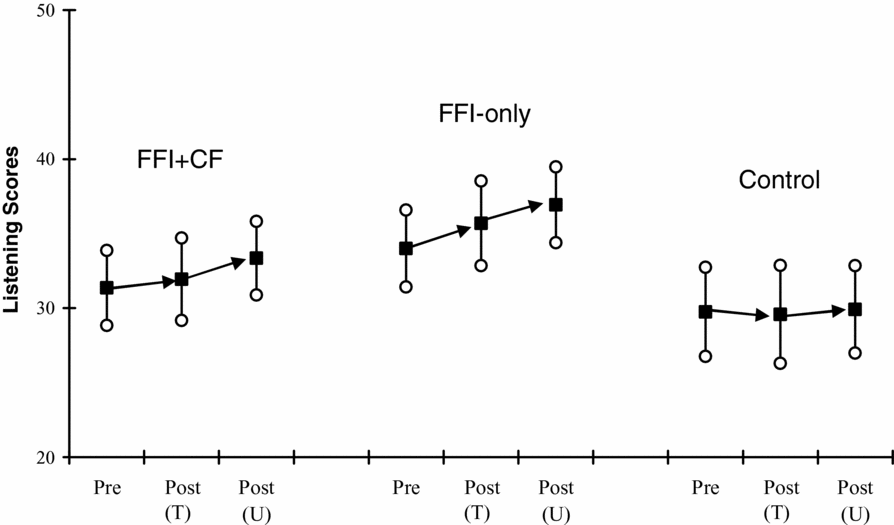
The learners took not only Version A but also Version B or C (spoken by their instructors) at posttests. Their raw listening scores are plotted in Figure 1. According to the inferential statistics described below, the FFI-only group significantly outperformed the controls, while the FFI + CF did not.
The 95% confidence intervals and mean values of the learners’ pre-/posttest scores. Post (T) denotes their performance of materials spoken by their instructors. Post (U) denotes their performance of materials spoken by untrained talkers.
Analyses of covariance (ANCOVAs) were conducted on their posttest listening scores yielded by both Version A and Versions B or C to investigate any group difference resulting from instruction at the time of posttests, with their initial perception abilities of /ɹ/ (measured via Version A at pretests) as a covariate. Whereas the ANCOVA did not yield a significant group difference in the case of a trained talker (Version B or C), F (2, 41) = 1.764, p = .184, it revealed a significant effect for group in the case of an untrained talker voice (Version A), F (2, 41) = 3.801, p = .031. Bonferroni post hoc comparisons, performed on adjusted means, found a significant difference between the FFI-only group (M = 35.59 points) and the control group (M = 31.25 points). The effect size analysis revealed a medium effect size for FFI only (d = 0.87).
To further examine the influence of lexical contexts on these gains, ANCOVAs were conducted separately on learners’ posttest performance on Version A according to trained lexical items and untrained lexical items. In sum, the FFI-only group significantly improved their perceptual abilities of /ɹ/, especially in untrained lexical items produced by untrained talkers.
For trained items, the ANCOVAs yielded marginally significant effects for group, F (2, 41) = 3.227, p = .050. Bonferroni post hoc comparisons found a significant difference between the FFI-only group (M = 21.42 out of 30 points) and the control group (M = 19.07 points) with medium effects (d = 0.71). For untrained items, the ANCOVAs revealed a significant group effect, F (2, 41) = 3.370, p = .004. The post hoc comparisons showed that the FFI-only group (M = 14.49 out of 20 points) outperformed the control group (M = 11.80 points) with large effects (d = 1.08).
RESULTS OF PRODUCTION TESTS
Given the pattern of distinct formant distributions between /ɹ/ and Japanese tap /ɾ/ discussed earlier (Hattori & Iverson, Reference Hattori and Iverson2009; Saito & Brajot, in press), the following benchmark (Japanese tap /ɾ/ → English /ɹ/) was used to interpret the acoustic results:
• F3: 14.10–15.70 Bark (2400–3000 Hz) → 11.40–12.60 Bark (1600–1900 Hz)
• F2: 11.80–13.20 Bark (1700–2100 Hz) → 7.90–11.00 Bark (900–1500 Hz)
• Transition duration: 5–20 ms → 50–100 ms
In the following analyses, compared to the Japanese tap, the degree of reduction in F3 (the primary cue) is considered a valid index of “extent of acquisition,” and the degree of change in F1, F2, and transition duration (the minor cues) are an index of “use of the interlanguage strategy.”
Initial performance
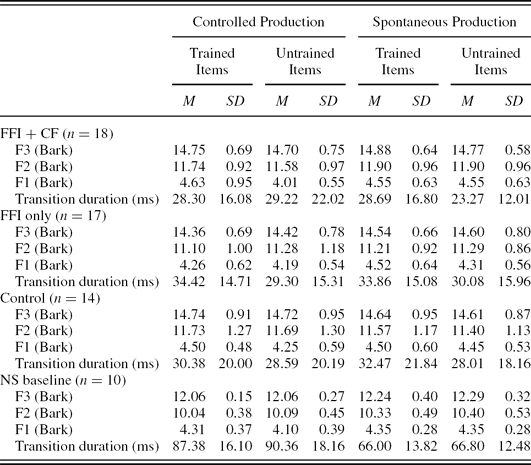
The descriptive results of the acoustic values are summarized in Table 5. According to the inferential statistics described below, the Japanese learners in this study tended to substitute the Japanese tap for English /ɹ/ at the beginning of the project.
Summary of acoustic values at pretests
Note: FFI, form-focused instruction; CF, corrective feedback; NS, native speaker.
We first examine how the three Japanese groups (control, FFI-only, and FFI + CF) produced /ɹ/ under various levels of processing (controlled vs. spontaneous) and lexical contexts (trained vs. untrained items), compared to a native English-speaking group (NS baseline). Their four acoustic values of /ɹ/ (F3, F2, F1, and transition duration) were separately submitted to three-way ANOVAs with one between-group factor (four groups) and two repeated factors (2 task conditions [controlled, spontaneous] × 2 lexical conditions [trained, untrained lexes]). Main effects of group were found for F3, F (3, 55) = 49.107, p < .001; F2, F (3, 55) = 7.88, p < .001; and transition duration, F (3, 55) = 30.98, p < .001. The results of Bonferroni post hoc comparisons showed that the Japanese learners’ /ɹ/ production at posttests was significantly different from the NS baseline, across various lexical and task conditions, with respect to higher F3 (14.40–14.70 Bark), higher F2 (11.10–11.90 Bark) and a shorter transition duration (25–35 ms; p < .001).
Pre- and posttest performance
Primary Cue (F3)
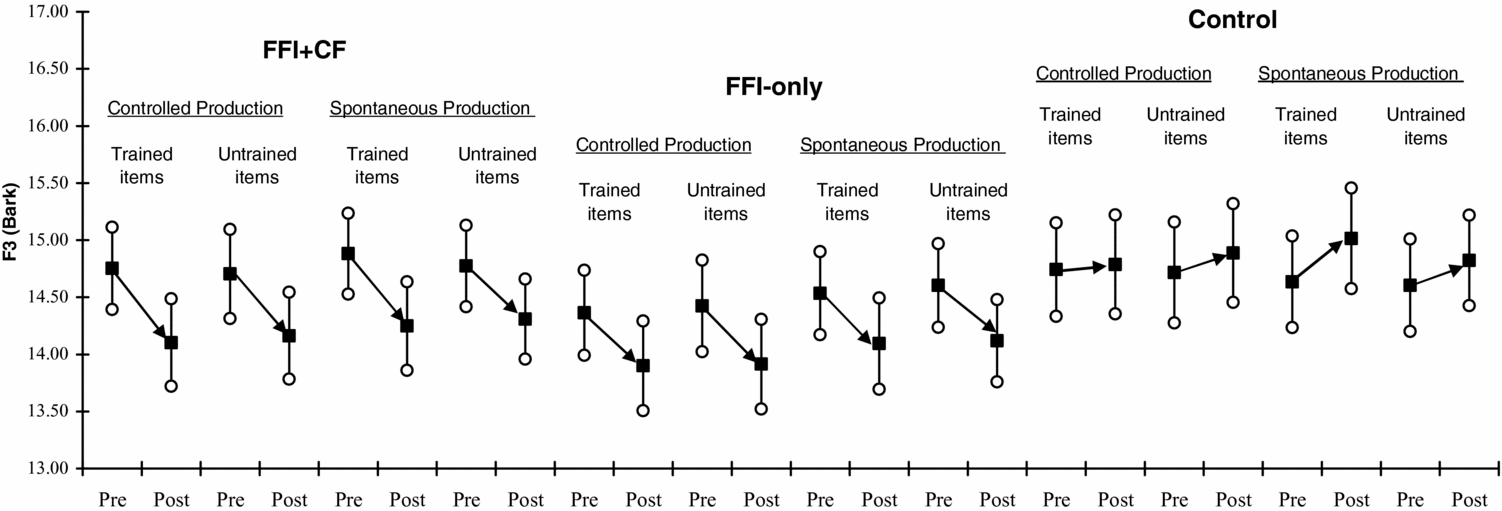
The descriptive results of F3 values are plotted in Figure 2. A visual inspection of the figure indicates that both the FFI-only and the FFI + CF groups generally reduced F3 values from the range of the Japanese tap (F3 > 14.10 Bark) to English /ɹ/ (F3 < 14.10 Bark) in all lexical and task conditions. However, their posttest performance (F3 = 13.50–14.50 Bark) was still substantially different from the range of the NS baseline (F3 = 12.00–12.30 Bark).
The 95% confidence intervals and mean values of the third formant (F3; Bark) in Group × Task × Lexical contexts. Both the form-focused instruction and corrective feedback (FFI + CF) and the FFI-only groups outperformed the control group at all contexts.
To measure the impact of instruction on the acquisition of F3, the F3 values were submitted to a four-way ANOVA with one between-group factor (3 groups [FFI + CF, FFI-only, and Control]) and three repeated factors (2 task conditions [controlled, spontaneous] × 2 lexical conditions [trained, untrained lexes] × 2 time conditions [pretests, posttests]). The results showed a significant Group × Time interaction effect, F (2, 46) = 10.489, p < .001. According to Bonferroni pairwise comparisons, both the FFI + CF and the FFI-only groups produced significantly lower F3 values (more targetlike exemplars of /ɹ/) than did the control group at posttests (p = .042, d = 0.88 for FFI + CF, and p = .006, d = 1.08 for FFI only).
Secondary cues (F2, F1, and transition duration)
To investigate how FFI influenced the use of the interlanguage strategy (change in F2, F1, and transition duration), the following subsections present the results of descriptive and inferential statics for each acoustic dimension.
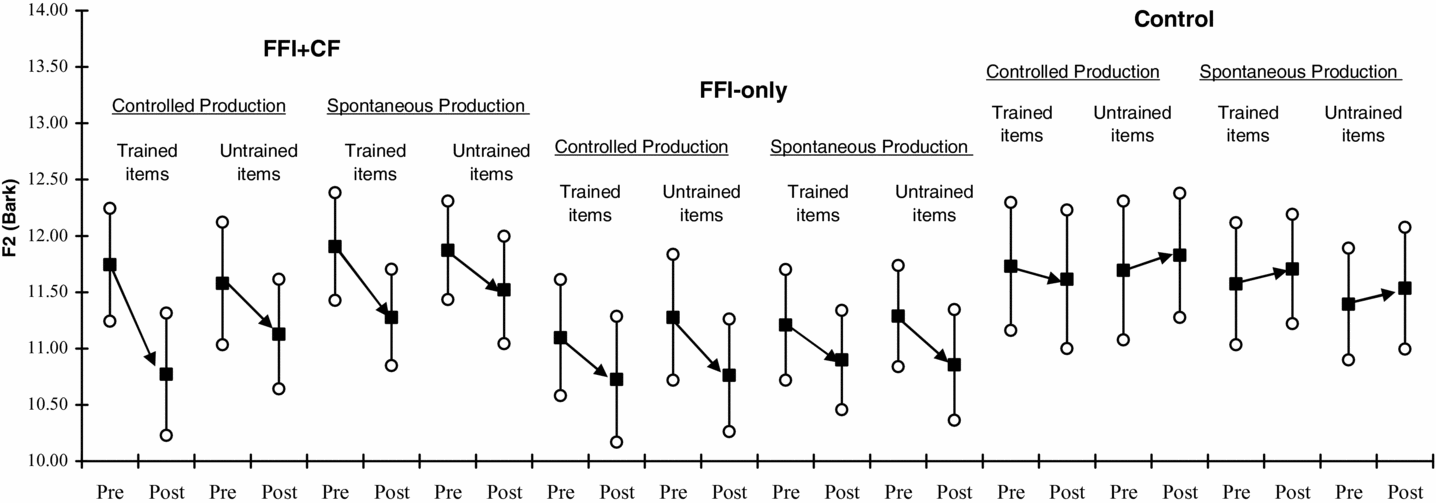
• F2: The descriptive results of F2 values are plotted in Figure 3. Inspection of the figure reveals that the experimental groups equally reduced F2 values (i.e., producing /ɹ/ with more tongue retraction). Given the range of NS baseline in Table 5 (F2 = 10.00–10.40 Bark), the figure suggests that FFI led the learners to reach the range of NS baseline across various lexical and task contexts.
A four-way ANOVA (Group × Task × Lexis × Time) yielded a significant interaction effect of group and time, F (2, 46) = 5.428, p = .008. Bonferroni pairwise comparisons showed that the FFI + CF and the FFI-only groups outperformed the control group at posttests with significantly lower F2 (p = .006, d = 0.46 for FFI + CF, and p = .030, d = 0.83 for FFI only).
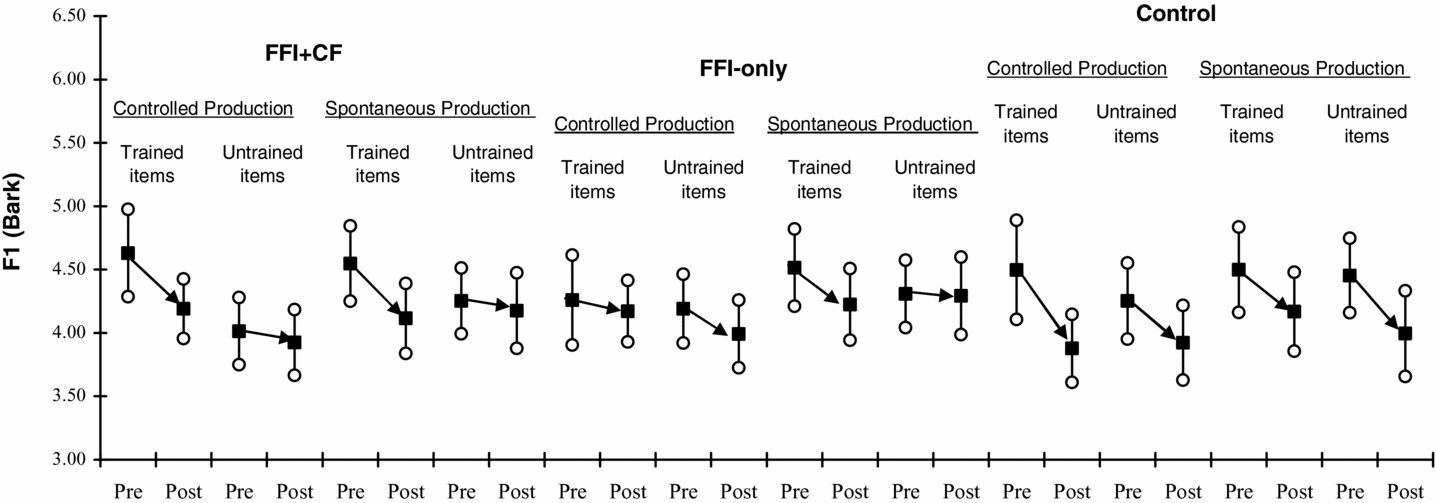
• F1: The descriptive results of F3 values are visually plotted in Figure 4. Although the F1 range does not differ between the Japanese tap and English /ɹ/ (F1 = 600–900 Hz; Hattori & Iverson, Reference Hattori and Iverson2009) and thus the Japanese learners do not need to modify F1 to produce /ɹ/, a visual inspection of the figure shows that all Japanese learners generally reduced F1 (i.e., producing /ɹ/ with higher tongue positions).
A four-way ANOVA (Group × Task × Lexis × Time) yielded only a significant main effect of time, F (1, 46) = 26.123, p < .001. That is, all Japanese learners produced /ɹ/ with lower F1 values at posttests than at pretests (M = 4.37 Bark → 4.09 Bark) with small effects (d = 0.46).
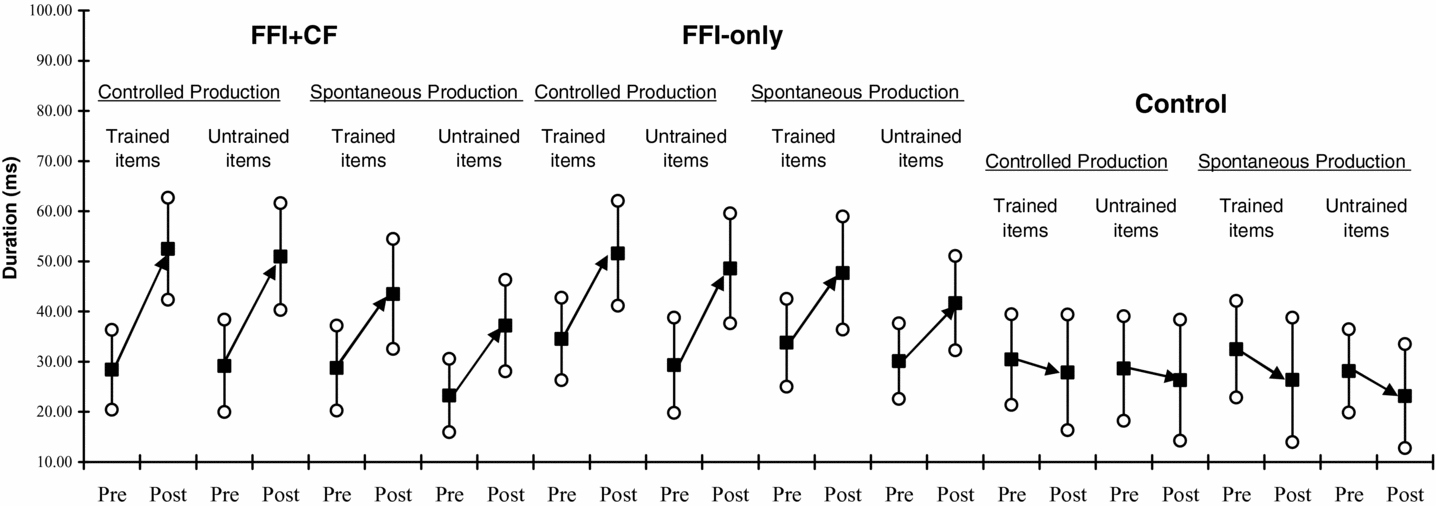
• Transition duration: The descriptive results of transition duration are plotted in Figure 5. Inspection of the figure indicates that the Japanese learners in the experimental groups tended to lengthen the duration of /ɹ/ from 30 ms (close to the Japanese tap: 5–20 ms) to 50 ms (close to English /ɹ/: 50–100 ms). Given the range of the NS baseline in Table 5 (60–90 ms), the figure suggests that FFI led the learners to reach nativelike temporal aspects of English /ɹ/.
A four-way ANOVA (Group × Task × Lexis × Time) found a significant interaction effect of group and time, F (2, 46) = 8.675, p = .001. According to Bonferroni post hoc comparisons, both of the experimental groups (FFI + CF and FFI-only) produced /ɹ/ with significantly longer transition durations than the control group at posttests (p = .013, d = 0.96 for FFI + CF, and p = .008, d = 1.12 for FFI only).
The 95% confidence intervals and mean values of the second formant (F2; Bark) in Group × Task × Lexical contexts. Both the form-focused instruction and corrective feedback (FFI + CF) and the FFI-only groups outperformed the control group at all contexts.
The 95% confidence intervals and mean values of the first formant (F1; Bark) in Group × Task × Lexical contexts. All groups had equally lowered F1 values after instruction.
The 95% confidence intervals and mean values of transition duration (ms) in Group × Task × Lexical contexts. Both of form-focused instruction and corrective feedback (FFI + CF) and the FFI-only groups outperformed the control group at all contexts.
Teacher evaluation
Validity
The rating of the subset of /ɹ/ tokens (n = 50) demonstrated a high correlation between the two instructors, r (49) = 0.855, p < .001, without significant difference between their actual rating scores, F (1, 98) = 0.516, p = .474. Because their judgment patterns were highly comparable, their scores were combined.
Pre- and posttest performance
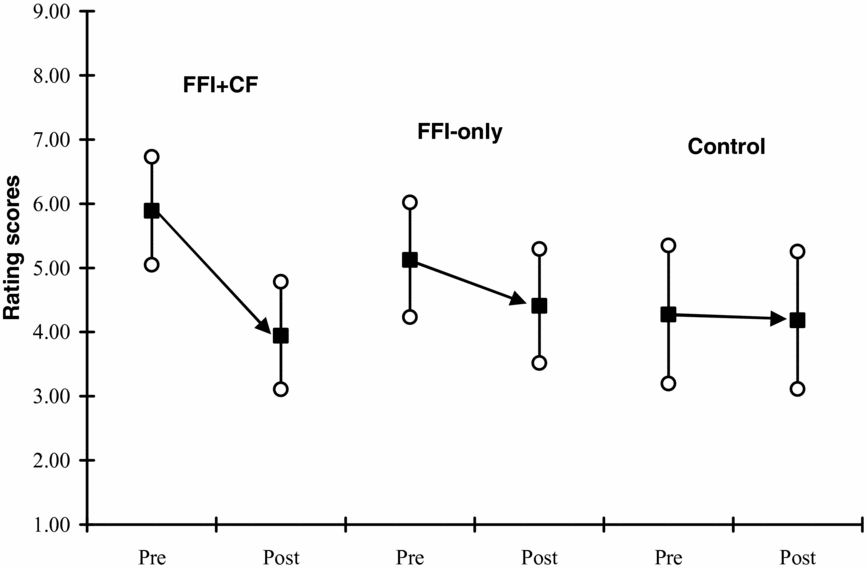
The instructors’ 9-point rating scores (1 = very good /ɹ/, 9 = very good /l/) were plotted in Figure 6. According to two-way ANOVA (Group × Time), the results yielded a significant interaction effect, F (2, 46) = 14.206, p < .001. Bonferroni post hoc comparisons showed that, although both teachers generally judged their students’ /ɹ/ production on Day 1 as “neutral exemplars” (M = 5.10), a significant improvement over time was found for the FFI + CF group (M = 5.89 → 3.94, p < .001, d = 1.00) over the FFI-only group (M = 5.12 → 4.41, p = .005, d = 0.39).
The 95% confidence intervals and mean values of teacher evaluation in Group × Task contexts. Both the form-focused instruction and corrective feedback (FFI + CF) and the FFI-only groups showed a significant improvement over time.
Recast–repair analyses
Eighteen learners in the FFI + CF group received 579 recasts and repeated 474 of them, yielding a relatively high repetition rate (81.2%). On average, each learner in the FFI + CF group received 32.17 recasts (M = 8.0 per lesson). In line with the previous descriptive studies (e.g., Sheen, Reference Sheen2006), the results showed that the learners likely noticed the instructors’ corrective intention of pronunciation-focused recasts, and they were thus pushed to process a great number of enhanced output opportunities during FFI activities (i.e., repetition of recasts). With respect to the quality of repetition, however, the students successfully repaired only 59 out of 579 recasts, with a relatively low repair rate (10.2%). Although many of the participating students repeated the teachers’ recasts, they actually did so simply by substituting the Japanese tap /ɾ/, instead of making a clear effort to approximate English /ɹ/.
DISCUSSION
The main goal of the current study was to investigate how two types of FFI, FFI with and without CF, could promote the acquisition of /ɹ/ by Japanese learners in EFL settings. FFI effectiveness was assessed via three outcome measures (perception, controlled production, and spontaneous production) and also according to two lexical contexts (trained and untrained items). According to the pre- and posttest scores, the learners in the FFI + CF and FFI-only groups revealed slightly different patterns in instructional gains. These results of this study will be further discussed below in conjunction with previous findings in the field of instructed SLA and L2 phonology in an interdisciplinary manner.
Effects of FFI
Unlike decontextualized pronunciation drills and intensive laboratory perception training methods, this study aimed to test a combination of communicative input and output activities (FFI) in L2 segmental learning. With respect to the perception measures, the results showed that the FFI-only group outperformed the control group at the time of posttests, with instructional gains particularly apparent in the context of the novel lexical items spoken by the untrained talkers. The amount of improvement resulting from 4 hr of FFI (5.9% gain) could be considered as medium to large, and comparable to other intensive lab training studies (e.g., Logan et al., Reference Logan, Lively and Pisoni1992, for 8% gain after 10 hr of training). With respect to the production measures, the results of the acoustic analyses showed that the FFI-only group not only enhanced their use of an interlanguage strategy (F2 reduction for tongue retraction and increase in transition duration for lengthening the phoneme) but also developed new articulatory configurations for English /ɹ/ (i.e., F3 reduction for labial, palatal, and pharyngeal constrictions) to approximate a more nativelike production of English /ɹ/. The learners could also generalize the instructional gain from trained to untrained lexical contexts as well as from controlled to spontaneous speech contexts. This suggests that these learners developed a robust phonetic category of /ɹ/ with various levels of processing abilities. Similar to the acoustic data, the two NS instructors perceived their students’ general improvement from neutral to intelligible exemplars of /ɹ/ between the first and last day of the lessons. As expected earlier, the efficacy of FFI on the development of L2 speech perception and production could be due to several factors.
First, FFI could successfully draw L2 learners’ selective attention toward phonetic form, while maintaining their primary focus on meaning. Different from focus-on-formS interventions, repetitive practice of language under communicatively authentic contexts is believed to encourage students to appropriately transfer what they have learned in classrooms to the world outside of the classrooms (Lyster, Reference Lyster2007; Trofimovich & Gatbonton, Reference Trofimovich and Gatbonton2006). Second, teacher talk in such meaning-oriented classrooms could provide optimal linguistic input to facilitate L2 phonetic development, such as higher pitch, simplified prosody, and vowel and consonant hyperarticulation. Many speech researchers have claimed that the acoustic enhancements could be the best way for adult L2 learners to circumvent L1 interference effects and increase their awareness of new sounds (see Kuhl, Reference Kuhl2000, p. 11855). Iverson et al. (Reference Iverson, Hazan and Bannister2005) found that exposing Japanese learners to synthetically exaggerated speech stimuli, with F3 and F2 variation maximized and duration lengthened, helped them improve their perception abilities of the nonnative /ɹ/–/l/ contrast (see also McCandliss, Fiez, Protopapas, Conway, & McClelland, Reference McCandliss, Fiez, Protopapas, Conway and McClelland2002).
Third, the importance of social interaction may play a crucial role in successful L2 speech learning processes. In early bilingual literature, it has been well documented that speech learning tends to occur preferentially for signals from a live person rather than those from televised or audio-only presentations. For instance, Kuhl, Tsao, and Liu (Reference Kuhl, Tsao and Liu2003) found that English infants who interacted with four native Mandarin caretakers for approximately 6 hr demonstrated remarkable L2 perception learning for Mandarin phonetic contracts, although the infants who listened to the same speech stimuli but via televised or audio-only presentation failed to do so. As Kuhl (Reference Kuhl2007) argued, “social interaction might be effective because it involves other humans, or because features inherent in social settings, such as interactivity and contingency, are critical for learning” (p. 115, emphasis original). In the adult bilingual literature, this study investigated in depth the effectiveness of social interaction on speech learning processes by adopting a FFI research framework into pronunciation and listening teaching contexts. Our results provided empirical evidence that processing new sounds through online interaction with teachers could be facilitative of various aspects of L2 phonetic development even within a limited amount of instructional treatment (i.e., 4 hr).
Adding CF to FFI
As we confirmed the effectiveness of FFI itself on the development of speech perception and production of /ɹ/, we now turn our discussion to the issue of whether and to what degree adding CF to FFI could further increase (or decrease) the size of the gain. In our research design, CF was operationalized as pronunciation-focused recasts (teachers recasted students’ mispronunciation of /ɹ/ during FFI activities), and it served as production enhancements in light of the relatively high rate of repetition (students perceived almost all recasts as corrections and they repeated the teacher's model pronunciation). Similar to the precursor study (Saito & Lyster, Reference Saito2012), the FFI + CF group showed significant improvement in their production abilities of /ɹ/. However, they did not show any significant gain in the perception measures. That is, the findings in this study suggest that FFI itself can sufficiently promote the acquisition of /ɹ/, but the acquisitional value of CF in L2 speech learning remains unclear. These unexpected findings (i.e., FFI only = FFI + CF) need to be carefully discussed along with the various possible interpretations.
The findings in the current study shed light on the role of learners’ interlanguage proficiency levels in recast effectiveness. In L2 morphosyntax development, previous research has consistently shown that recasts facilitate acquisition when learners have a sufficient amount of knowledge for target forms but not when learners are considered at lower stages of development. Based on the well-established developmental sequence of English question formation, Mackey and Philp (Reference Mackey and Philp1998) found that recasts positively influenced learners who were developmentally ready to acquire the target feature (Stage 3) but not those who lacked developmental readiness (Stage 2; see also Ammar & Spada, Reference Ammar and Spada2006, for the acquisition of possessive determiners). In their review of L2 recast research, Nicholas, Lightbown, and Spada (Reference Nicholas, Lightbown and Spada2001) pointed out, “Recasts can be effective if the learner has already begun to use a particular linguistic feature and is in a position to choose between linguistic alternatives” (p. 752). These findings in turn indicate that recasts help advanced learners consolidate their already acquired knowledge rather than helping beginner learners acquire completely new knowledge.
It is important that the analyses of the pre- and posttest performance showed that most of the learners in this study substituted the Japanese tap /ɾ/ for English /ɹ/ both in perception and in production. Furthermore, the post hoc analysis demonstrated that despite their high noticing and awareness of teachers’ recasts during FFI lessons (i.e., 81.2% of repetition rate), many learners in the FFI + CF group continued to use the Japanese tap /ɾ/ to repeat received recasts (i.e., 10.2% of repair rate). This suggests that the participating students had yet to develop or establish any robust mental representations of /ɹ/ at the onset of the project, and thus such beginner learners were unlikely to benefit from CF treatment, arguably because they lacked the phonetic knowledge (i.e., how to repair their mispronunciation of /ɹ/) necessary to process pronunciation-focused recasts.
Another crucial index of interphonology proficiency is the amount of L2 experience (usually measured as LOR in a target language country). Previous studies have shown that the first few months of intensive exposure to the L2 tend to make a great impact on the developing L2 phonetic system (for a review, see Piske, MacKay, & Flege, Reference Piske, MacKay and Flege2001). Although the learners in this study did report some prior experience in L2 (LOR: M = 3.4 months for FFI + CF, M = 7.6 months for FFI only),Footnote 2 most of them (33 out of 49 learners: see Table 1) had never been abroad and they were in EFL settings with only minimal use of English in classroom settings at the time of the project (a few hours per week). Recent psycholinguistic SLA studies have shown that adult SLA in foreign classroom settings without many opportunities to use language for meaning does not necessarily promote the integration of explicit knowledge into their mental representational system (e.g., Jian, Reference Jiang2007).
Taken together, it is possible that these learners, with little or no integrated phonetic knowledge in their L2 developing system, could be developmentally “unready” to benefit from recasts and concomitant opportunities for output practice. As a sequence for L2 phonetic development, many researchers have claimed that phonetic categories are based in perception, which in turn indicates that, once L2 learners hear perceptual aspects of new segmental sounds and dissimilate them from L1 counterparts, they start internalizing their newly acquired phonetic knowledge as mental representations (Flege, Reference Flege and Strange1995, Reference Flege, Meyer and Schiller2003; Kuhl, Reference Kuhl2000). In this respect, the beginner should be encouraged to notice and practice the target feature of /ɹ/ only through FFI in a receptive mode without much pressure for modified output (recast treatment).
Similarly, the importance of the input-driven view of SLA (receptive learning without much pressure for production) especially for the early stage of interlanguage development has also been extensively discussed in the domain of L2 morphosyntax studies (for review, Gass, Reference Gass1997). For example, VanPatten (Reference VanPatten2004) maintains that L2 learners first need to extract morphosyntactic information from L2 lexical input in a receptive mode. This is believed to be a first step toward enhancing the quality of the L2 developing system, which is responsible for their performance in output at a later stage of SLA processes (i.e., a comprehension-first view). Following his theoretical model of SLA, VanPatten and his colleagues conducted a series of empirical studies, providing some evidence that beginning L2 learners who received only input-based practice in the form of processing instruction without any pressure to actually produce L2 output improved not only their comprehension abilities but also their production abilities (e.g., VanPatten, Reference VanPatten2004; VanPatten & Cardierno, Reference VanPatten and Cardierno1993).
The question is then when should pronunciation-focused recasts as production enhancements be introduced to facilitate L2 speech learning? Given that many SLA researchers have argued that the primary pedagogical function of CF (production enhancement) is to automatize the retrieval of existing knowledge (Lyster, Reference Lyster2007; Nicholas et al., Reference Nicholas, Lightbown and Spada2001), we suggest ensuring that L2 learners have already established their increasing awareness toward a new sound to some degree in order to make the best use of subsequent recast treatment during FFI activities.
As a pedagogic means to increase less-advanced learners’ attention to phonetic form, it would be intriguing to provide explicit phonetic information at the beginning of FFI lessons. In Saito's (2013a, 2013b) experiment, for example, teachers exaggerated their pronunciation of /ɹ/ and provided explanation on the relevant articulatory configurations (i.e., labial, palatal, and pharyngeal constrictions). In this way, the teachers were able to help their students decode and create new perceptual categories for L2 segmentals from ambient language input, as well as activate the correct use of articulators to pronounce these sounds under little communicative pressure before they moved on to practicing FFI activities. As a result, those receiving explicit phonetic information were able to make a substantially large change on the primary acoustic property of their English /ɹ/ production (i.e., F3; Saito, Reference Saito2013), and their improvement was perceptible to human listeners as well as apparent in the perception domain (Saito, in press).
Another remedial strategy could be the adoption of different types of CF, such as metalinguistic correction (i.e., teachers providing explicit information while at the same time reformulating students’ linguistic errors during FFI lessons). In L2 morphosyntactic development, for example, Sheen (Reference Sheen and Mackey2007) found that metalinguistic correction significantly facilitated the acquisition of English articles by adult ESL learners, although recasts alone did not. In this vein, future studies are needed to examine how we can further enhance the magnitude of recast effectiveness by including other mediating FFI techniques (e.g., explicit phonetic information and metalinguistic correction).
LIMITATIONS
Given that the current study took an exploratory approach to examining the effects of FFI on L2 speech learning, certain shortcomings must be acknowledged with an eye toward future replication. First, although the two-alternative forced-choice identification task was the only perception measure in this study, the instructional benefits on L2 perception need to be scrutinized via a range of perception tests in experimental phonetics, such as identification and discrimination tasks with the synthetic F2 × F3 continua (Iverson et al., Reference Iverson, Kuhl, Akahane-Yamada, Diesch, Tohkura and Kettermann2003), in noisy conditions (Munro, Reference Munro1998), and with reaction time instruments (Lively et al., Reference Lively, Pisoni, Yamada, Tohkura and Yamada1994). Second, given that previous studies showed that L2 segmental perception is subject to frequency and familiarity of test words (Flege, Takagi, & Mann, Reference Flege, Takagi and Mann1996), future studies should carefully control this variable to investigate in depth the FFI effectiveness on L2 perception development. Third, L2 production development was measured based on acoustic analyses and teacher evaluation. Whereas the teachers’ judgment could be considered as reliable in conjunction with their accumulated teaching experience in EFL classrooms, their evaluation could also easily become lenient or biased because of their actual interaction with the students. Although the experimental groups reached the nativelike range for minor cues (F2, F1, and transition duration) after receiving FFI, we need to acknowledge that the impact of FFI on developing the new phonetic representation (F3) was still not substantial (their posttest performance of F3 [13.50–14.50 Bark] was still considerably different from the nativelike range of English /ɹ/ [12.00–12.30 Bark]). Future research could implement human rating sessions to see how such changes in F3, F2, F1, and transition duration can ultimately impact the perception of naïve listeners who have little familiarity with Japanese-accented English (cf. Saito, in press).
CONCLUSION
Building on the instructed FFI research framework, this study examined in depth how two types of FFI (FFI with or without CF) can facilitate the acquisition of /ɹ/ by adult Japanese learners and help them improve three different levels of L2 performance (perception → controlled production → spontaneous production) across two lexical contexts (trained and untrained items). The results showed communicative focus on form via FFI can be facilitative of the development of L2 speech perception and production of /ɹ/. The FFI effectiveness could be because L2 learners are to repetitively practice phonetic forms through social interaction with their teachers under communicatively authentic conditions. Although the learners in this study showed high levels of noticing, the provision of CF as a form of recasts did not appear to be effective for acquisition, arguably because recasts help L2 learners increase control over their existing knowledge rather than acquire completely new knowledge. The EFL Japanese learners in this study had minimal opportunities to use English on a daily basis and had yet to have much phonetic knowledge of the target sound /ɹ/ at the time of the project. Thus, the results in turn suggest that these beginners need to focus more on noticing the perceptual aspects of new sounds in a receptive mode in order to start establishing relevant phonetic representations of the sounds before processing production enhancements, such as pronunciation-focused recasts. To further examine the role of learners’ levels of representation and processing abilities in CF effectiveness, we therefore make a strong call for more instructed L2 speech research of this kind, specifically research which recruits a range of L2 learners with different proficiency profiles. Such future studies will as a result shed some light on when and how recasts can help, in particular with respect to how advanced and intermediate learners (or those who receive explicit information before or during FFI lessons) can enhance their perceptive and productive performance of new L2 sounds.
ACKNOWLEDGMENTS
This study was funded by the Government of Canada Post-Doctoral Research Fellowship. I gratefully acknowledge insightful comments from Murray Munro, Roy Lyster, Tracey Derwing, Helen Fraser, and three anonymous Applied Psycholinguistics reviewers on earlier versions of the manuscript. Finally, I extend my gratitude and appreciation to the administration staff, teachers, and students at ECC Foreign Language Institute, especially Noriaki Okamura, Yukio Nagato, and Anna-Marie Staniewski.