Introduction
Mild traumatic brain injury (mTBI) has become an increasingly high-profile battle injury. Work by the US Defense and Veterans Brain Injury Center suggests that 59% of injured US soldiers returning from Iraq or Afghanistan who are being treated at the Walter Reed Medical Center suffered a TBI while in combat (Okie, Reference Okie2005).
mTBI is defined as ‘an acute brain injury resulting from mechanical energy to the head from external physical forces’ (Holm et al. Reference Holm, Cassidy, Carroll and Borg2005). Criteria for clinical identification include confusion or disorientation, loss of consciousness lasting less than 30 min or post-traumatic amnesia lasting less than 24 h (Holm et al. Reference Holm, Cassidy, Carroll and Borg2005), and its symptoms include: headache, dizziness, fatigue, memory loss, nausea, tinnitus, visual disturbance, loss of concentration and irritability. Such symptoms are, however, also common in the general population and cannot be considered as pathognomonic per se.
The issue is further complicated by difficulties in collecting reliable indicators of exposure. Recording data in-theatre for what is by definition mild head injury will always pose problems in an operational environment. But reliance on retrospective recall might also prove unsatisfactory, given the well-known problems of recall bias in symptomatic populations (Wessely et al. Reference Wessely, Unwin, Hotopf, Hull, Ismail, Nicolaou and David2003).
Monitoring mild head injury in operational theatres is also problematic since many, if not most, are not referred to the main clinical centres, not least because of the considerable risks involved in transport as, for example, in Afghanistan. Furthermore, many personnel in both the US and UK Armed Forces have already sustained such injuries before any such contemporaneous monitoring was contemplated. In the absence of systematic and accurate data recording in-theatre, the US Department of Defense and Veterans Affairs is therefore implementing new post-deployment population screening procedures for mTBI (Department of Veterans Affairs and Veterans Health Administration, 2007).
Using data from a large, randomly selected cohort of UK military personnel (Hotopf et al. Reference Hotopf, Hull, Fear, Browne, Horn, Iversen, Jones, Murphy, Bland, Earnshaw, Greenberg, Hacker Hughes, Tate, Dandeker, Rona and Wessely2006), we have examined the prevalence of symptoms thought to be a consequence of mTBI among service personnel deployed to Iraq. The association with in-theatre experiences and post-deployment health outcomes has also been explored.
Method
Study sample
Full details of the study and responders can be found in Hotopf et al. (Reference Hotopf, Hull, Fear, Browne, Horn, Iversen, Jones, Murphy, Bland, Earnshaw, Greenberg, Hacker Hughes, Tate, Dandeker, Rona and Wessely2006). In brief, the study was the first phase of a cohort study of UK Armed Forces personnel serving at the time of the Iraq War (Operation TELIC, the UK military codename for the current operation in Iraq) in March 2003. In total, 4722 regular and reserve personnel who were deployed on TELIC 1 (the war-fighting phase) and 5550 regular and reserve personnel who were not deployed to Iraq at that time (referred to as ‘Era’) completed a questionnaire (post-deployment, between June 2004 and March 2006) on their military and deployment experiences, life-style factors and health outcomes (see below). TELIC 1 was defined, for the purposes of this study, as 18 January to 28 April 2003. However, as data were collected on other TELIC deployments, we have been able to examine those deployed to later phases of this continuing operation (see analytical sample for more details). Reserve personnel were over-sampled [2:1 (reserves:regulars)].
The response rate after three mailings and intensive follow-up was 59% (n=10 272). The main reason for non-response was inability to contact personnel (Hotopf et al. Reference Hotopf, Hull, Fear, Browne, Horn, Iversen, Jones, Murphy, Bland, Earnshaw, Greenberg, Hacker Hughes, Tate, Dandeker, Rona and Wessely2006; Iversen et al. Reference Iversen, Liddell, Fear, Hotopf and Wessely2006). No evidence was found of any response bias by health outcome and no difference in the prevalence of medical downgrading (being fit for operational deployment) by responder status (Tate et al. Reference Tate, Jones, Hull, Fear, Rona, Wessely and Hotopf2007).
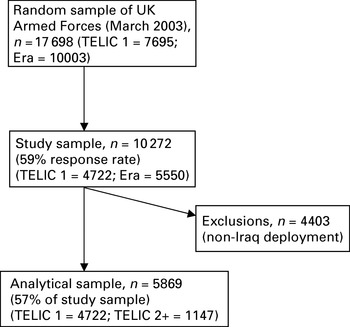
The analyses reported here are based on data from regular and reserve service personnel with any deployment experience in Iraq (see Fig. 1 for details); 5869 personnel (4928 regulars and 941 reservists), thus excluding 4403 (out of 10 272) personnel (43%) who had not deployed to Iraq at the time of questionnaire completion.
Summary of overall study sample and sample used for analysis. TELIC, UK military codename for the current operation in Iraq; Era, personnel not deployed to Iraq.

Data collection
Data covering a wide range of factors were collected by a self-completion questionnaire. For the purposes of these analyses, the following variables were considered.
Post-concussional syndrome (PCS) symptoms and severity: data were collected on the presence and, if present, the severity (mild, moderate or severe) of 53 common symptoms (e.g. headache, sore throat, joint stiffness, stomach bloating). For the current analysis we made a post hoc selection of seven symptoms: headache, dizziness, irritability or outbursts of anger, double vision, ringing in the ears, loss of concentration and forgetfulness. These were chosen because they reflect the concept of PCS (World Health Organization, 1992), and include five of the seven symptoms found to differentiate between mTBI and control groups at 1 month post-head injury (Kashluba et al. Reference Kashluba, Casey and Paniak2006). They also include all the symptoms used by Hoge and colleagues in their analysis of data collected in US combat infantry on return from Iraq (Hoge et al. Reference Hoge, McGurk, Thomas, Cox, Engel and Castro2008) and reflect the symptoms included in the US Military Acute Concussion Evaluation (MACE) questionnaire. Data were collected on nausea and vomiting but this was felt to be an immediate, not long-term, symptom of mTBI. No data were collected on balance problems as this symptom was considered to be covered by dizziness. Finally, we could not include in the analysis data on fatigue, since this was measured using a separate 11-item questionnaire (Chalder et al. Reference Chalder, Berelowitz, Pawlikowska and Watts1993).
Using these seven symptoms, two markers of PCS were generated: ‘PCS symptoms’ (a variable indicating the presence of at least one or more stated symptom: none, 1–2, 3+) and ‘PCS symptom severity’ (a variable indicating the presence of one or more of the stated symptoms at either a moderate or severe level of severity: none, 1–2, 3+).
Deployment experiences: key deployment experiences included self-reported exposure to a blast which potentially could lead to an mTBI injury. Responses to two questions were combined to form this variable: ‘during Op TELIC did you come under mortar, Scud missile or artillery fire’; and, ‘during Op TELIC did you experience a landmine strike?’ We also selected two other exposures that are associated with active duty deployment, but not mTBI. We assessed potential exposure to depleted uranium (based on participants responding positively to inhaling depleted uranium dust, handling depleted uranium ordnance or inspecting/entering vehicles destroyed by depleted uranium munitions) and aiding wounded personnel. Using these data, a four-category variable was generated: no in-theatre experiences; blast exposure only; exposure to depleted uranium and/or aiding the wounded; all three exposures.
Health outcomes
The health outcomes included:
• Heavy drinking: measured by the World Health Organization's Alcohol Use Disorders Identification Test (AUDIT) score (Babor et al. Reference Babor, Higgins-Biddle, Saunders and Monteiro2001). Heavy drinkers have been defined as those having an AUDIT score of 16 or more (Fear et al. Reference Fear, Iversen, Meltzer, Workman, Hull, Greenberg, Barker, Browne, Earnshaw, Horn, Jones, Murphy, Rona, Hotopf and Wessely2007).
• Symptoms of common mental disorder: measured by the General Health Questionnaire (GHQ)-12 (Goldberg & Williams, Reference Goldberg and Williams1988; Goldberg et al. Reference Goldberg, Gater, Sartorius, Ustun, Piccinelli, Gureje and Rutter1997). The defined cut-off value was a score of four or above.
• Symptoms of post-traumatic stress disorder (PTSD): measured by the 17-item National Center for PTSD checklist (Blanchard et al. Reference Blanchard, Jones-Alexander, Buckley and Forneris1996). The defined cut-off value was a score of 50 or more.
• General well-being: assessed using the general health perception question of the 36-item Short Form Health Survey (Ware & Sherbourne, Reference Ware and Sherbourne1992; McHorney et al. Reference McHorney, Ware and Raczek1993).
Confounding factors
The following variables were examined for their role as confounders in these analyses: age at completion of questionnaire (in years), sex, rank, service [i.e. Naval Service (including the Royal Marines), Army, Royal Air Force], role in theatre, engagement type (i.e. regular or reserve), marital status and educational status.
Statistical analyses
To examine the distribution of PCS symptoms and PCS symptom severity, a range of sociodemographic and military factors were investigated; numbers, percentages, χ2 statistics, degrees of freedom and two-sided p values are presented. Odds ratios and 95% confidence intervals were calculated using univariable and multivariable logistic regression (Breslow & Day, Reference Breslow and Day1980). Analyses were repeated separately for PCS symptoms and PCS symptom severity. Sampling weights were included in all analyses due to the over-sampling of reserve personnel (Hotopf et al. Reference Hotopf, Hull, Fear, Browne, Horn, Iversen, Jones, Murphy, Bland, Earnshaw, Greenberg, Hacker Hughes, Tate, Dandeker, Rona and Wessely2006). All analyses were performed using the Stata statistical software package (version 10.0; StataCorp LP, College Station, TX, USA) and statistical significance was defined as p<0.05.
Results
PCS: demographics
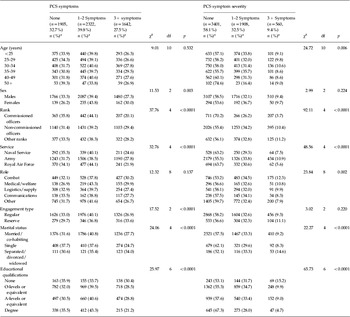
Of our sample 67% had at least one symptom of PCS, and 42% of our sample had at least one moderate/severe symptom (Table 1). Analysis of the demographics of those with and without symptoms revealed that PCS symptoms were more common in women, those in the Army, reservists and non-commissioned officers and other ranks. Associations were also apparent with marital and educational status. Those under 50 years of age, those in the Army, non-commissioned officers and other ranks and those having a combat role in theatre were more likely to endorse having at least one moderate/severe PCS symptom. Associations were also evident with marital and educational status.
Demographic characteristics of those with PCS symptoms

PCS, Post-concussional syndrome; df, degrees of freedom.
a Weighted to take account of over-sampling of reserve personnel. Row percentages are presented.
PCS: associations with in-theatre experiences
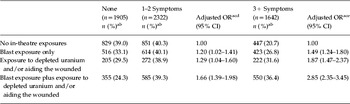
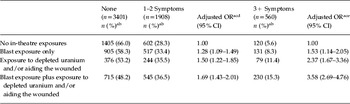
Examination of in-theatre experiences showed that 52% (n=3043), 24% (n=1422) and 21% (n=1214) of the sample were exposed to blasts, aided the wounded and were exposed to depleted uranium respectively. All in-theatre exposures examined were associated with PCS symptoms and symptom severity, with the strongest associations being observed for exposure to depleted uranium (data not shown). These analyses were then repeated comparing those with no in-theatre exposures (n=2127, 37.1%) with those with only blast exposure (n=1553, 26.5%), those with exposure to depleted uranium and/or aiding the wounded (n=699; 11.5%) and those with all three exposures (n=1490, 24.9%) (Tables 2 and 3). These analyses show that the associations with PCS symptoms and PCS symptom severity are strongest for those with all three exposures and that exposure to depleted uranium and/or aiding the wounded is more strongly associated with PCS than blast exposure only.
In-theatre experiences associated with PCS symptoms

PCS, Post-concussional syndrome; OR, odds ratio; CI, confidence interval.
a Weighted to take account of over-sampling of reserve personnel.
b Row percentages are presented.
c Adjusted for sex, rank, service, engagement type, marital and educational status.
d 1–2 Symptoms versus none.
e 3+ Symptoms versus none.
In-theatre experiences associated with PCS symptom severity

PCS, Post-concussional syndrome; OR, odds ratio; CI, confidence interval.
a Weighted to take account of over-sampling of reserve personnel.
b Row percentages are presented.
c Adjusted for age, service, role, rank, engagement type, marital and educational status.
d 1–2 Symptoms versus none.
e 3+ Symptoms versus none.
These analyses were then repeated including time between exiting from theatre and return of questionnaire and phase of deployment (TELIC 1 versus TELIC 2+) as additional confounders. The reporting of symptoms was not associated with time between exit and questionnaire completion or with phase of deployment and thus the inclusion of these factors in the analytical model had minimal effect on the associations observed (unpublished results available from the authors).
PCS: associations with other health outcomes
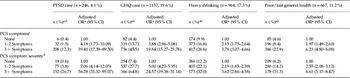
Table 4 shows that all other health outcomes examined are associated with PCS symptoms, with the strongest associations being apparent for being a PTSD case or GHQ case. These analyses were repeated with the inclusion of blast exposure as an additional confounder; this had no noticeable effect on the associations reported in Table 4 (data available from the authors).
PCS symptoms and their association with other health outcomes

PCS, Post-concussional syndrome; PTSD, post-traumatic stress disorder; GHQ, General Health Questionnaire; OR, odds ratio; CI, confidence interval.
a Weighted to take account of over-sampling of reserve personnel.
b Row percentages are presented.
c Adjusted for sex, service, rank, engagement type, marital and educational status.
d Adjusted for age, service, role, rank, engagement type, marital and educational status.
Discussion
This is the first analysis undertaken to assess the prevalence of PCS-associated symptoms in UK Armed Forces personnel deployed to Iraq. These analyses are based on seven symptoms used in all the current definitions of PCS, and were undertaken to determine the usefulness of using these symptoms to define mTBI retrospectively as would happen in any post-deployment screening programme.
Principal findings
PCS symptoms were indeed associated with self-reported exposure to blast whilst in a combat zone. However, the exact same symptom constellation was also associated with other in-theatre exposures such as potential exposure to depleted uranium and aiding the wounded. There is no mechanism by which these non-blast exposures could be associated with mTBI and hence PCS. Strong associations were also apparent between having PCS symptoms and other health outcomes, in particular being a PTSD or GHQ case, as found by Hoge and colleagues in US combat infantry (Hoge et al. Reference Hoge, McGurk, Thomas, Cox, Engel and Castro2008). But most problematic for the alleged link between mTBI and PCS was that the PCS symptom complex was also associated with other factors that are not customarily associated with mTBI.
Implications
Our results suggest that PCS symptoms per se are not specifically related to head injury but also relate to a number of non-clinical factors and potentially distressing exposures which have no plausible link to head injury. We also found that those with PCS symptoms were highly likely to report psychological distress. This raises the issue of whether PCS symptoms are part of the complex expression of psychological distress.
One of the most consistent findings in psychiatric epidemiology is the association between physical and psychological symptoms – the more one has of one, the more one has of the other (Simon et al. Reference Simon, Von Korff, Piccinelli, Fullerton and Ormel1999). It is also well established that anxiety and depressive disorders are common in patients who present to primary care with unexplained symptoms (Wessely et al. Reference Wessely, Chalder, Hirsch, Wallace and Wright1996). This is of relevance to our finding that those who were GHQ cases were more likely to report PCS symptoms. A similar link has been found with PTSD (Hoge et al. Reference Hoge, Terhakopian, Castro, Messer and Engel2007; Schneiderman et al. Reference Schneiderman, Braver and Kang2008). Our results indicate an even stronger relationship between PCS symptoms and PTSD caseness. Thus, these findings suggest that PCS symptoms are often an expression of psychological distress.
This suggestion is supported by our finding that PCS symptoms are associated with factors which have no link to head injury (e.g. being in a relationship) and potentially traumatic exposures which do not cause any physical damage (e.g. seeing dead bodies). Once again, we believe that these findings reinforce our suggestion that, in general, PCS symptoms are a non-specific indicator of distress.
Strengths and limitations
This study is the largest ever conducted within the UK Armed Forces, the sample being representative of all three services, and the first to look at PCS and its associations with mTBI and other exposures. Our response rate of 59% is comparable with that achieved by other population-based studies, especially of populations dominated by young men. We have already presented data suggesting that participation was limited due to our difficulty in finding people and participant inertia (Iversen et al. Reference Iversen, Liddell, Fear, Hotopf and Wessely2006). There was no evidence of any response bias by health outcome or medical downgrading status (being fit for operational deployment) (Tate et al. Reference Tate, Jones, Hull, Fear, Rona, Wessely and Hotopf2007).
The study relies on self-reported information, which is vulnerable to response bias in military personnel (Wessely et al. Reference Wessely, Unwin, Hotopf, Hull, Ismail, Nicolaou and David2003) as indeed elsewhere. However, the study was not set up to examine the role of in-theatre exposures including mTBI on subsequent PCS symptoms, and at the time of data collection we did not anticipate the emergence of mTBI as a ‘signature injury’ of the Iraq deployment. The questions on in-theatre exposures and events were embedded within a section on deployment experiences whilst in Iraq and the ‘outcome’ questions were taken from a broad list of self-reported symptoms. Therefore, it is unlikely that any participant would have made the link between the two, thereby minimising the effects of response bias.
To define current PCS symptoms, we selected symptoms that are used in all the contemporary formulations of PCS, as well as the MACE checklist, which is routinely used by US military personnel. The MACE is of course designed to be used contemporaneously in theatre to define mTBI, but also includes a PCS symptom checklist.
Conclusions
PCS symptoms are common and we know that some are related to head injury including mTBI. However, this study shows that there are dangers in overstating this relationship, and overlooking the myriad of associations between the same symptom complex and many other risk factors and/or exposures. In particular what we highlight are the problems of retrospective assessments of mTBI, a feature of the current US screening programme and what would happen if current calls for similar procedures be implemented in the UK.
It is possible that technical advances in brain imaging and assessment procedures may allow finer distinctions to be drawn as well as adding to the knowledge of potential mechanisms. But as we have argued elsewhere (Jones et al. Reference Jones, Fear and Wessely2007), the experiences of the First and Second World Wars suggest that distinguishing between the effects of physical and psychological trauma is always going to be problematic.
Acknowledgements
We thank the UK Ministry of Defence for their cooperation; in particular we thank the Defence Analytical Services Agency, the Veterans Policy Unit, the Armed Forces Personnel Administration Agency and the Defence Medical Services Department. We also thank our colleagues within the King's Centre for Military Health Research (KCMHR) and the Academic Centre for Defence Mental Health (ACDMH) for their role in this study.
All work was carried out within ACDMH/KCMHR, King's College London.
The study was funded by the UK Ministry of Defence (MoD contract no. R&T/1/0078). The authors' work was independent of the funders, and we disclosed the paper to the Ministry of Defence at the point we submitted it for publication. S.W. is partially funded by the South London and Maudsley NHS Foundation Trust/Institute of Psychiatry National Institute of Health Research Biomedical Research Centre.
The study received approval from the Ministry of Defence (Navy) personnel research ethics committee and the King's College Hospital local research ethics committee.
Declaration of Interest
N. T. F. and E. J. are supported by grants from the UK Ministry of Defence. M. G. and T. H. are full-time active service medical officers who have collaborated with the authors on this piece of work. N. G. is a full-time active service medical officer who has been seconded to the ACDMH, although paid from Ministry of Defence funds they were not directed in any way by the Ministry of Defence in relation to this publication. S. W. is Honorary Civilian Consultant Advisor to the British Army.