Introduction
Iconicity in sign language lexicons is high, where there is a nonarbitrary relationship between form and sense. Over time, the referents of these lexical items might fall out of use, such as for reasons of technological or environmental change, resulting in a misalignment of form and sense. That misalignment might be tolerated or might lead to variants with (sub)lexical changes that correct the misalignment.
With some lexical items, however, we find a misalignment of form and sense over time due to cultural shifts. If this misalignment is regrettable in that it has particular importance to deaf individuals, it is very likely to be corrected, moving us from an inappropriate form to an appropriate form.Footnote 1 Often corrections due to cultural shifts involve taboo topics or terms, and, thus, the corrections might be open to an analysis as euphemisms—a mistake, as we argue below.
In the next section, we give a background on studies of offensive language and euphemism. In the third section we give a brief overview of the only study we know of on euphemisms in sign languages. In the fourth section, we discuss the notion of correction, distinguishing it both from euphemisms and politically correct language, and we examine two types of controversial lexical corrections in American Sign Language (ASL) that make use of the same linguistic mechanisms that euphemism makes use of. In the final section, we conclude that corrections of this type must be recognized in order to have a fuller understanding of lexical change not just in sign languages, but in language in general.
Background
The present discussion calls for an initial caveat. While taboo terms are generally recognized by those within a given culture, there can be disagreement as to whether a term is offensive or merely blunt (Burridge Reference Burridge2012:66). This caveat holds for sign languages as well (Sze, Wei, & Wong Reference Sze, Wei and Leung Wong2017:194ff), and for change motivated by a need for correction. We urge readers to keep that caveat in mind, as we plow ahead using the sensibilities of our deaf consultants as guides.
Offensive language
Interest in offensive language, typically taboo terms, has flowered in the past two decades and promises to continue doing so (Allan Reference Allan2018). Several studies examine taboo usage from a historical perspective (Hughes Reference Hughes2015) and/or a sociolinguistic perspective, including the role of taboo in reinforcing culture (Van Oudenhoven et al. Reference Van Oudenhoven, de Raad, Askevis-Leherpeux, Boski, Brunborg, Carmona, Barelds, Hill, Mlacic, Motti, Rammstedt and Woods2008), differences in usage by typical sociolinguistic factors (Pilotti, Almand, Mahamane, & Martinez Reference Pilotti, Almand, Mahamane and Martinez2012), general utility (Culpeper Reference Culpeper2011), and the anonymity of those using taboo on the internet (Dynel Reference Dynel2012). Much work examines insights that taboo language offers about linguistic structure (Postma Reference Postma, Hoeksema, Rullmann, Sánchez-Valencia and van der Wouden2001).
Studies of offensive language in sign languages, however, are few. Some examine what taboo terms tell us about morphophonology (Mirus, Fisher, & Napoli Reference Mirus, Fisher and Napoli2012) and syntax (Napoli, Fisher, & Mirus Reference Napoli, Fisher; and Mirus2013).
Loos, Cramer, & Napoli (Reference Loos, Cramer and Napoli2020) study the linguistic sources that make a sign taboo in German Sign Language (Deutsche Gebärdensprache, DGS), where most of their examples concern sex-related terms: explicitness and detail of graphic information heighten offensiveness, as does pejorative facial expression.
Unsurprisingly, many taboo terms in spoken languages have counterparts in sign languages, including those dealing with death and illness, sexuality, bodily effluents, and religion. However, some taboo terms observed in sign languages do not have counterparts in spoken languages (Fisher, Mirus, & Napoli Reference Fisher, Mirus, Napoli and Allan2018), due to a range of experiences common to deaf people that are not shared by hearing people (for example, one can insult a deaf person by using the sign think-like-hearing-person)—making the existence of deaf culture, in its myriad and changing forms, undeniable and of intense importance to deaf communities (Leigh, Andrews, & Harris Reference Leigh, Andrews; and Harris2016, among many others).
Euphemism
Alongside studies of taboo terms in spoken languages are studies of euphemism (Allan & Burridge Reference Allan and Burridge1991). Some studies look at how euphemisms change over time (Linfoot-Ham Reference Linfoot-Ham2005), while others examine the range of linguistic mechanisms employed in euphemisms (McGlone, Beck, & Pfiester Reference McGlone, Beck; and Pfiester2006). Like taboo, euphemism is defined relative to context (Gómez Reference Gómez2009).
A common means of avoiding taboo terms while still getting across taboo ideas is circumlocution (calling a toilet ‘a restroom’, or saying someone was ‘satisfied’ rather than had an orgasm). This occurs in sign languages, as well; in ASL restroom occurs side-by-side with toilet.Footnote 2
Some circumlocutions are not words, but simply sounds, as in Where is the ehum? (Warren Reference Warren1992). In ASL a comparable circumlocution might involve somewhat less emblematic nonmanual articulations, such as head tilted back, close-lipped smile, blinks, upward gaze, or a combination.
Sometimes circumlocutions involve metaphors, such as passed on or simply passed for ‘die’. Sign languages likewise use metaphors, such as absent/gone for ‘die’, which can occur alone but is frequently used in a compound (or, perhaps, a lexicalized phrase; see Liddell & Johnson Reference Liddell and Johnson1986) such as that meaning ‘widow’: husband^remove/gone.Footnote 3
At least one way of reducing offensiveness in taboo expressions in spoken languages does not occur in sign languages: reducing articulation via shortenings, including clippings (such as Jeez for Jesus). Since sign languages are generally monosyllabic (Sandler Reference Sandler, Davis and Zajdó2008), the opportunity for clippings is limited.
Another euphemism strategy is to disguise taboo expressions by using written conventions. In spoken languages, this is done via acronyms (SNAFU for ‘situation normal all fucked up’) and abbreviations (Why don't you just F-off now?). Sign languages, likewise, appropriate writing via initialization (B-S for ‘bullshit’; B-handshape in bitch, bastard), which typically does not, however, reduce offensiveness. Additionally, sign languages appropriate writing via fingerspelling, which can be an effective euphemistic strategy (Sze, Wei, & Wong Reference Sze, Wei and Leung Wong2017; hereafter SWW). For example, in ASL s-l-u-tFootnote 4 can be a euphemistic option to the lexical sign slut. Still, some signs are always fingerspelled, and those of them that are offensive are not mitigated with respect to offensiveness simply because they are articulated via fingerspelling. An example is d-o-u-c-h-e-b-a-g, a powerful slur. Initialization and fingerspelling are instances of influence from another language, given that most deaf people read and write in the text of the ambient spoken language, rather than in a sign-writing system. So when fingerspelling is used as a euphemistic strategy, it can be compared to introducing foreign vocabulary in spoken euphemism (think of the pardon Excuse my French). In fact, code-switching can be a way of softening the effect of breaking taboos; in Kuwait, speakers (especially women) sometimes switch from Arabic to English to complain, since complaining is taboo behavior (Mahsain Reference Mahsain2014:153). Similar to this strategy is the use of baby words, such as poo-poo, and baby signs such as pinching the nose to indicate excrement in place of the sign shit.
Finally, euphemisms can involve phonetic changes. Spoken languages often do this by replacing sounds (shoot for shit; gosh for god). Sign languages can do this as well; in ASL shit is articulated with the thumb of the dominant hand moving out of what can be seen as the bottom of an enclosure formed by the nondominant hand, while a less offensive variant that could be glossed as ‘shoot’ or ‘oh, shit’ has the thumb going into the top of that enclosure. We discuss additional examples of phonetic changes in euphemism in sign languages in the next section.
Sex-related signs and euphemism
Early mentions of euphemism in sign languages are few. Those include studies that note variation in signs regarding sexual activities or sex-related body parts, attributing some of that variation to euphemism (Woodward Reference Woodward1979; Colville & Stewart Reference Colville and Steward1988).
Pyers (Reference Pyers2006) notes that indexical pointing signs are frequent for some body parts (eyes, nose), but pointing to the genitals would be impolite, hence the existence of lexical signs for genitalia. Pointing directs the eyes, and looking toward someone's genitals is rude in most situations. This is a subtle kind of euphemism, one that might not have a counterpart in spoken languages—the euphemism of avoiding leading the addressee toward inappropriate behavior.
Sutton-Spence & Woll (Reference Sutton-Spence and Woll1999) list taboos, insults, and euphemisms in British Sign Language and suggest that euphemism can be achieved via reducing visual explicitness, including changing the location of a sign.
SWW set the groundwork for broad studies of euphemism in sign languages. They look at Hong Kong Sign Language (HKSL), Jakarta Sign Language (JakSL), Sri Lankan Sign Language (SLSL), and Japanese Sign Language (JSL) to determine whether euphemisms in sex-related signs are geared toward lowering the visual iconicity of the sign as suggested by Sutton-Spence & Woll (Reference Sutton-Spence and Woll1999).
They find many euphemisms regarding sex, sexual activities, and intimate body parts in these four sign languages and give frequency information on the types of strategies used in each euphemism. Many examples involve circumlocutions. A fascinating finding is the euphemism strategy of replacing manual phonological parameters with strictly nonmanual articulation. For example, ‘menstruation’ in SLSL can be conveyed via repeated lower-lip biting. This can be done in spoken language, as in, You know she's… where the ‘…’ is filled with a depictive facial gesture indicating a variety of things (such as mental illness). SWW further found that the addition of a nonmanual parameter can make an inoffensive term highly taboo (so nonmanuals can create dysphemisms, a finding Loos, Cramer, & Napoli (Reference Loos, Cramer and Napoli2020) found for DGS).
Of particular interest here is the strategy labelled ‘phonemic modifications’ in SWW's Table 5. They note ten instances of ‘handshape change’ (including for signs that mean ‘clitoris’ in SLSL and ‘testicles’ in JSL and JakSL); fourteen instances of ‘location change’ (including for signs that mean ‘masturbation’ in HKSL, ‘female lubrication’ in HKSL, ‘vagina’ in SLSL, and ‘anus’ in JakSL—the last of which euphemism had additional changes); nine instances of ‘deleting part of a sign’, such as simply dropping the weak hand (as in the sign for ‘intercourse’ in JSL); and three instances of ‘movement change’, but gave no examples.
They conclude that the various methods of forming euphemisms tend to reduce visual iconicity or to avoid visual explicitness entirely. From evidence regarding phonemic modifications in euphemisms, they conclude that ‘iconic handshape and locations can be a crucial source of visual offensiveness’ (Sze, Wei, & Wong Reference Sze, Wei and Leung Wong2017:194).
Corrections
Often changes in culture lead to the original sense of a word no longer being pertinent to the situations in which one would have ordinarily used it. Such situations need not concern taboo. Technological change, for example, often wreaks havoc with lexical sense. For instance, we used to do visual recordings of motion using film. Today most cameras record visual motion digitally, even in commercial movies. Yet we still speak of the ‘film’ industry in English. English tolerates this particular misnomer; accordingly, the sense of film has changed.
Sometimes, however, speakers do not tolerate misnomers. So records were replaced by cassette tapes, which were replaced by CDs, which were replaced by DVDs (and now many are returning to records)—and along the way new lexical items were coined to refer to the new objects. If there are motivations for new lexical items (beyond commercial ones), they are surely not phonological.
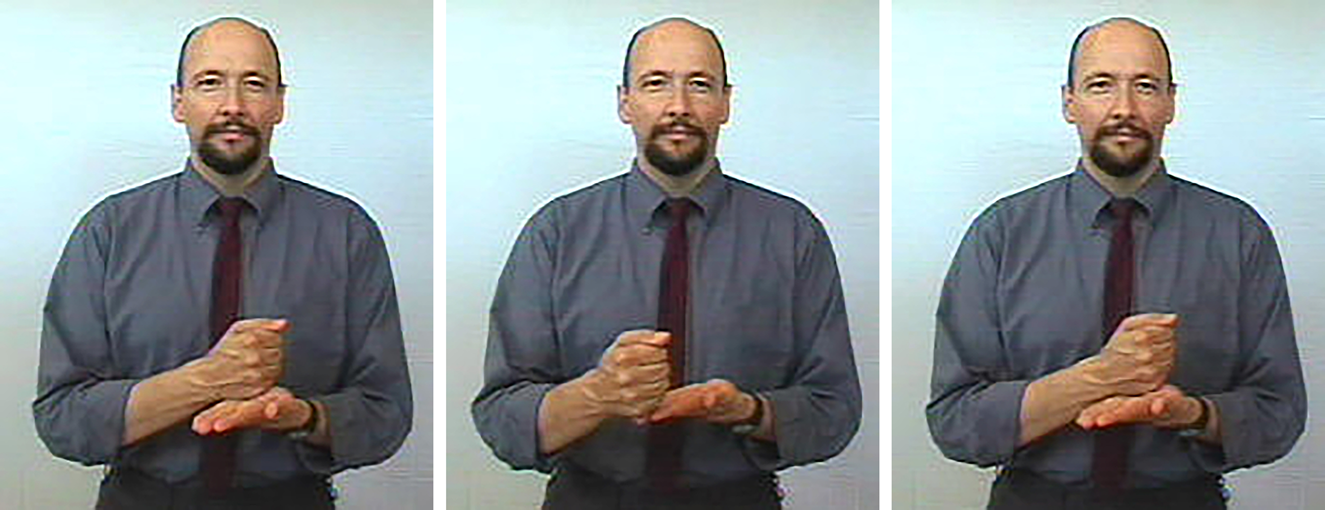
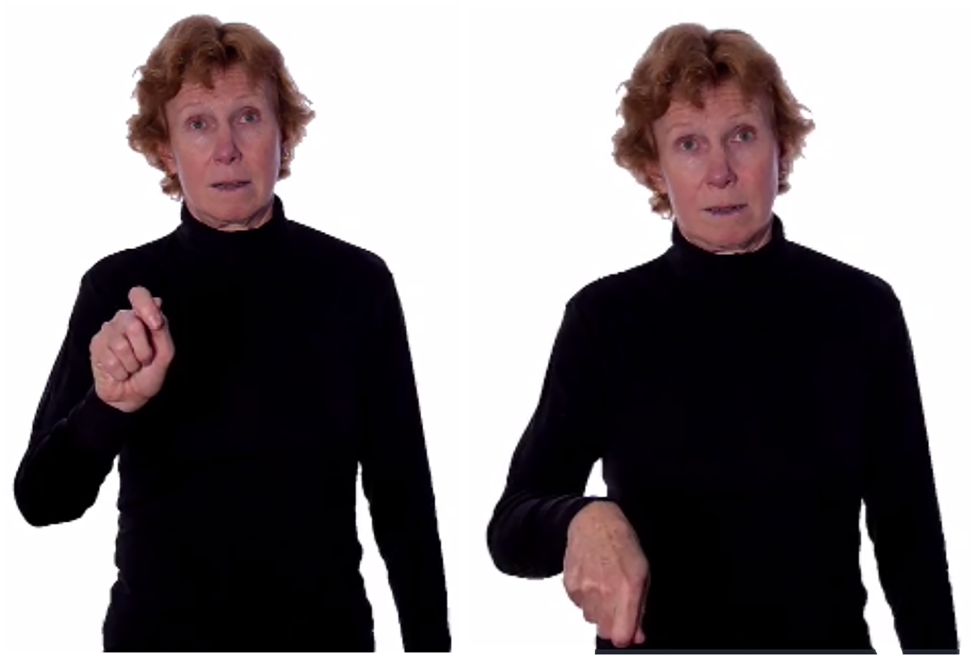
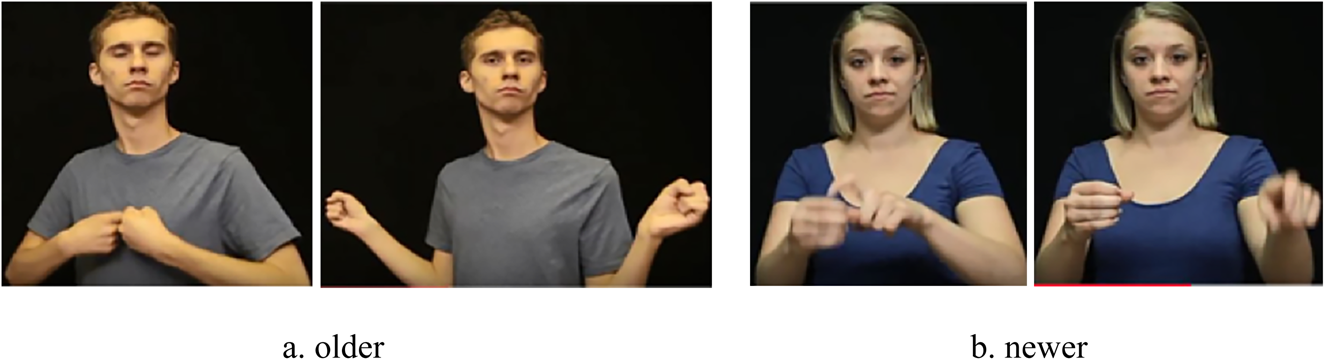
Misnomers arise in sign languages, as well, and frequently, due to the possibility of iconicity; that is, in many signs there is an alignment between form and meaning—and changes in habits can throw that alignment off. For example, compare the older sign use-credit-card in Figure 1Footnote 5 to the newer sign in Figure 2.Footnote 6 The older sign (which can be a noun or verb) is iconic of times when one made an imprint of the credit card by laying it on a machine surface and running part of the machine back and forth over it. The newer sign (which, to our knowledge, is used only as a verb), in contrast, is iconic of swiping the credit card vertically (and there is also a noniconic sign, which is simply c-c).
ASL older sign use-credit-card.

ASL newer sign use-credit-card.

Technology changed, and signers made the lexicon catch up by coining a new sign; they made a correction in the lexicon. But the English word credit card presents no alignment of form and meaning, so differences in the way we use our credit cards do not result in conundrums for speakers.
Not all misalignments in signs are handled with corrections, however. Many ASL signers still use the older sign in Figure 1; in fact, many signers use both older and newer variants of all the signs in this article. That is, corrections are a tendency, not an absolute.
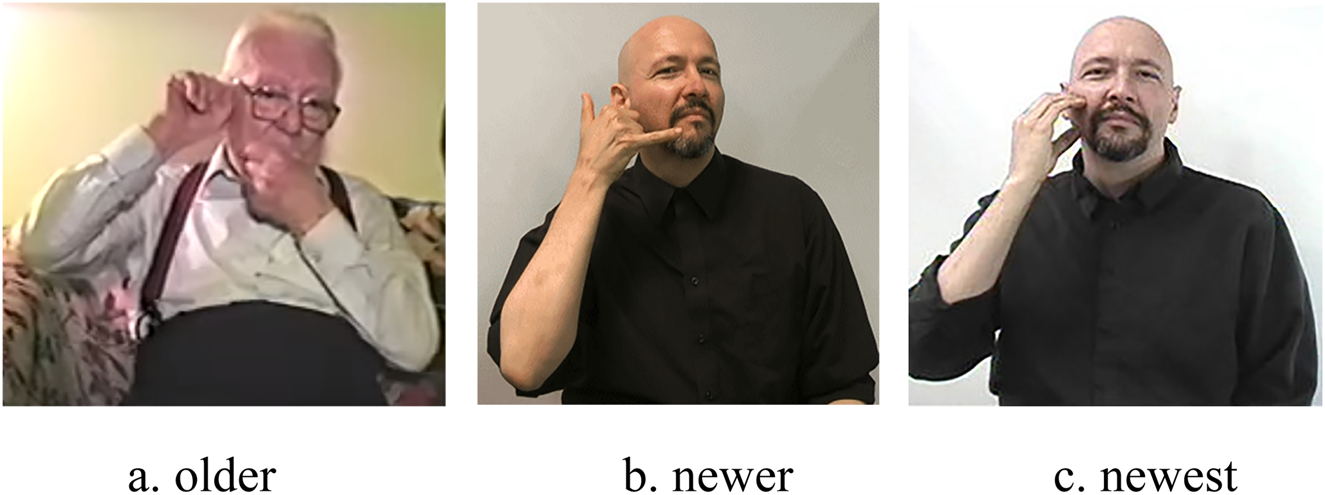
Another comparison between English and ASL makes that point clear. The word telephone has persisted in English since the first telecommunications device of that type, even though the actual device has changed multiple times in form and in how one handles the device. The situation in ASL, however, is different. The older sign telephone in Figure 3aFootnote 7 appears beside the newer sign in Figure 3bFootnote 8, which is used more often (in our experience) than the newest sign in Figure 3c. The sign in Figure 3a is iconic of antiquated telephones that had two parts, one for listening and one for speaking, each held by a hand. Those phones disappeared when dial phones with handsets came in. Accordingly, the older sign was replaced by newer signs. The sign in Figure 3b is iconic of the handset, and this correction introduces a sign that has an appropriate alignment of form and meaning for dial phones. The other newer sign in Figure 3c simply has a C-handshape at the ear—and it refers only to mobile phones not dial phones. Nevertheless, the variant in Figure 3b persists despite the rarity of dial telephones today; in particular, it is used without hesitation to refer to mobile phones.
ASL signs telephone.

So signers have not corrected the misalignment between form and meaning of the sign telephone in Figure 3b. In fact, that sign may be considered by many signers today to have an arbitrary relationship of form to meaning—that is, the misalignment (with respect to cell phones) is no longer visible to them. In support of that possibility, we point out that the sign in Figure 3b is used as an agreeing verb (a verb whose movement parameter is a line from the spatial index of one argument of the verb to the spatial index of another argument of the verb; Pfau, Salzmann, & Steinbach Reference Pfau, Salzmann and Steinbach2018). So it is not locked in position, with the pinky going toward the mouth and the thumb going toward the ear—important contributions to the original iconicity—but, instead, can move about in space. Once the handshape is no longer located on the face, its iconicity (all but) disappears. In fact, signers that use the older form in Figure 3a (including older signers in the Philadelphia area) also can use it as an agreeing verb, in accordance with its lost iconicity.
What makes one misalignment tolerated while another strongly calls for correction, at least among our consultants? Our contention is that misalignments can be tolerated (although need not be) so long as they are not regrettable, where sources of regret are misalignments concerning matters of particular relevance or importance to deaf experience or perception. If tolerable misalignments are maintained, the relationship between form and meaning becomes arbitrary over time (like in spoken languages), and eventually the misalignment is no longer perceived (as with the signs telephone in ASL in Figures 3a,b). With regrettable misalignments, however, the relationship between form and meaning acts as a persistent irritant, assailing signers—hence these misalignments are costly to maintain and tend to be corrected.
Judging what is particularly relevant or important to deaf experience or perception is sometimes easy. For example, the ASL sign call-by-TTY changed over time. The original sign was just like the newer sign for telephone in Figure 3b. It was replaced by the sign in Figure 4aFootnote 9, in which both hands assume the X-handshape and then the dominant hand moves toward the recipient (here we show someone telling the other person to contact them by TTY), clearly iconic of actual and common (at the time) deaf experiences. So the lexical item for the machine that was used by deaf people (TTY) changed to match deaf experiences, while the lexical item for the machine that was not used by deaf people (dial telephone) did not change. The misalignment in the older form of call-by-TTY was regrettable, and called for correction. When relay services and other types of modern alternatives came in, the sign in Figure 4a was appropriated for the newer communication modes. However, over time, many have adopted other signs for these newer modes, including ones that have no iconicity (such as f-t for FaceTime calls) and ones that have an iconicity more aligned with modern experience, such as videophone in Figure 4b.
ASL newer signs for communication via machines.

Other times, however, judging what is particularly relevant or important to deaf experience calls for a more profound understanding of deaf experience, and, since deaf experience varies, can lead to controversy over lexical change.
The judgments we discuss in this article were collected through a qualitative study in casual situations in the Philadelphia and Washington, DC deaf communities. Nine deaf, sighted consultants participated, four men (two gay, two straight) and five women (three gay, two straight), between the ages of twenty-five and fifty. Additionally, a Coda relative of one of the authors was included—male, straight, thirty-years-old. All of his judgments coincided with those of at least two deaf participants. We used Think Aloud Protocol (TAP), a method of gathering data developed to study the problem-solving process (van Someren, Barnard, & Sandberg Reference van Someren, Barnard; and Sandberg1994). TAP has been adapted repeatedly in sign language studies with respect to choices sign language interpreters make (Stone Reference Stone2009), choices mimes and sign language poets make in performances (Sutton-Spence & Boyes Braem Reference Sutton-Spence and Braem2013), and choices deaf signers make in creating and using taboo items (Napoli, Fisher, & Mirus Reference Napoli, Fisher; and Mirus2013). Two of the authors of this article felt comfortable participating actively in the discussions since they are members of those deaf communities (one in each). Their judgments always coincided with those of at least two deaf participants.
Below we offer two common types of regrettable misalignments that have fueled heated discussion among our consultants and on the internet, one type having to do with respect for identities, and often concerning (what have previously been) taboos, and the other type having to do with being true to deaf experiences. In both types of misalignments, the regrettable part is founded on the nature and role of language itself in the lives of deaf people. Thus we take a moment to give a brief overview of relevant points here.
Language is a staggeringly important cognitive activity for human beings. Language allows us to gain information beyond what our somatosensory system can access—that is, beyond what an individual can see, hear, feel, smell, touch, and internally intuit (Hendry & Hsiao Reference Hendry, Hsiao, Squire, Berg, Bloom, Lac, Ghosh and Spitzer2013a,Reference Hendry, Hsiao, Squire, Berg, Bloom, Lac, Ghosh and Spitzerb; but see many others, such as Pleger & Villringer Reference Pleger and Villringer2013). Language is our most reliable way to convey our thoughts to others and to appreciate others’ thoughts, our major means of cooperating with each other, and a crucial player in making friends, falling in love, telling jokes. As Oliver Sacks (Reference Sacks1989:8) wrote, ‘To be defective in language, for a human being, is one of the most desperate of calamities, for it is only through language that we enter fully into our human estate and culture, communicate freely with our fellows’.
Many hearing people might never explicitly consider nor appreciate the fact that they participate in language—it is a given. But most deaf people do. 96% of deaf children are born into hearing families who are, at least initially, unprepared to raise a deaf child (Humphries, Kushalnagar, Mathur, Napoli, Padden, Rathmann, & Smith Reference Humphries, Kushalnagar, Mathur, Napoli, Padden, Rathmann and Smith2012); whether one chooses an oral, a sign, or a bimodal-bilingual path, it takes heroic efforts to ensure the language rights of a deaf child (Humphries, Kushalnagar, Mathur, Napoli, Padden, Rathmann, & Smith Reference Humphries, Kushalnagar, Mathur, Napoli, Padden, Rathmann and Smith2013). Despite great efforts, many deaf people are late language learners (Meier Reference Meier1991, but see many others since) and many deaf people struggle in daily communication because they find themselves interacting in a language not fully accessible to them. Hence, nearly all deaf people are hyper-aware of language itself as a privilege.
It is only in the past sixty years, following the groundbreaking work of William Stokoe (Reference Stokoe1960), that linguists have come to understand that sign languages are bona fide languages (for the impact of Stokoe, see Hochgesang & Miller Reference Hochgesang and Miller2016, among many others). In fact, in 1978 Carol Padden, perhaps the best-known sign language linguist in the world, gave a presentation at the second meeting of the National Symposia on Sign Language Research and Teaching in which she demonstrated the claim that anything could be communicated in a sign language by explaining in ASL the structure of the double helix in a DNA molecule and how to change a car carburetor. She repeated that demonstration at conferences and workshops over the next few years. Linguists, particularly sign language linguists, have gradually conveyed the message that sign languages are real natural human languages to the general public as well as to deaf people themselves (Battison Reference Battison, Emmorey and Lane2013). In 2001, the Linguistic Society of America published a resolution stating explicitly that sign languages are natural human languages, equal cognitive citizens to spoken languages (Perlmutter Reference Perlmutter2001). But the road leading to this understanding has been long and bumpy; as a result, deaf people historically have had a wide range of relationships with and attitudes toward sign languages (Leigh Reference Leigh2009), though in many places today sign language communities express pride in their language (James & Huang Reference James and Huang2006) and embrace sign stories and poetry as bona fide literature (Bauman, Nelson, & Rose Reference Bauman, Nelson; and Rose2006).
This unique situation of the deaf vis-à-vis language is a key player in the determination of whether a misalignment of form and meaning is regrettable, and, hence of whether correction is in order. Many signers are invested in whether their language reflects realities and truths as they know them, witness discussions on websites such as the Facebook group ASL that!, audismfreeamerica.blogspot.com, and others. They debate whether existing signs need modification or replacement and who has the right to make such correction, as well as who has the right to introduce new signs into a deaf community (debate that occurs in many sign communities, such as the Swiss deaf, see Boyes Braem, Groeber, Stocker, & Tissi Reference Boyes Braem, Groeber, Stocker and Tissi2012, and the Facebook group started by Tissi in 2016). They compare sign languages to minority spoken languages (other deaf communities also discuss this comparison; see Monaghan, Schmaling, Nakamura, & Turner Reference Monaghan, Schmaling, Nakamura and Turner2003), and they express alliance with oppressed minorities.
Correction based on recognition of and respect for identity
Language regarding identities, particularly minority identities, is often the subject of controversy in spoken languages, sometimes leading to lexical changes. For example, a number of scholars have studied functional diversity with respect to identity issues and have looked at ways of referring to those identities/groups, sometimes with at least passing attention to euphemism (Muredda Reference Muredda2012; Back, Keys, McMahon, & O'Neill Reference Back, Keys, McMahon and O'Neill2016), where many of the examples that come up involve replacing explicitness with vagueness (such as talking about children with ‘special needs’; see Grondelaers & Geeraerts Reference Grondelaers, Geeraerts, Athanasiadou and Tabakowka1998).
Sometimes politically correct (PC) efforts prevail, that is, language policing and ‘reform’ efforts imposed by outsiders on ‘behalf’ of a community that is in some way oppressed. This can result in a given term falling out of use almost entirely, bringing about the demise of the sense associated with the defunct term (witness certain racial and ethnic slurs). Occasionally sublexical changes are proposed and spread at least among progressive types (witness the common use of latinx on university campuses, where the final x replaces a vowel that held information about gender in Romance languages but was just a sublexical part without associated meaning in the English borrowing).
But not always. Galvin (Reference Galvin2003:155) points out that PC language often fails in resisting oppressive identifications because ‘if the concepts behind the words remain unchanged, then the new words end up being just as negative in their connotations’. Halmari (Reference Halmari2011) is also revelatory, suggesting that sometimes non-PC wording then becomes oppressive, leading to the desire for further euphemisms or lexical innovations. We return to these positions in our conclusion.
Thus, in spoken language communities lexical items can change based on a perceived need by some to avoid usages that cast aspersions on (minority) identities or that are somehow exclusive.
When we turn to sign languages, we sometimes find iconic signs that identify groups, where the graphics zero in on a visually identifiable characteristic of members of the group. That characteristic, however, might not be how the particular group views itself nor how it wants others to view it. Empathy with that group can lead outsiders to understand that the label seems reductionist and is in need of correction. That is, signers can perceive a misalignment of form with meaning. The concern here is less one of trying to avoid offense and more one of trying to correct a sign based on an identification that does not ring true. Correction often takes the form of modifying the phonology to obliterate the misalignment, and it does it in very much the same ways that euphemism does, as we see below.
Many examples of correction regarding identity concern minority groups, where something about the group at least touches on traditional ideas of taboo. People with disabilities or serious illnesses are included here, as are those with sexual behaviors other than straight and monogamous.
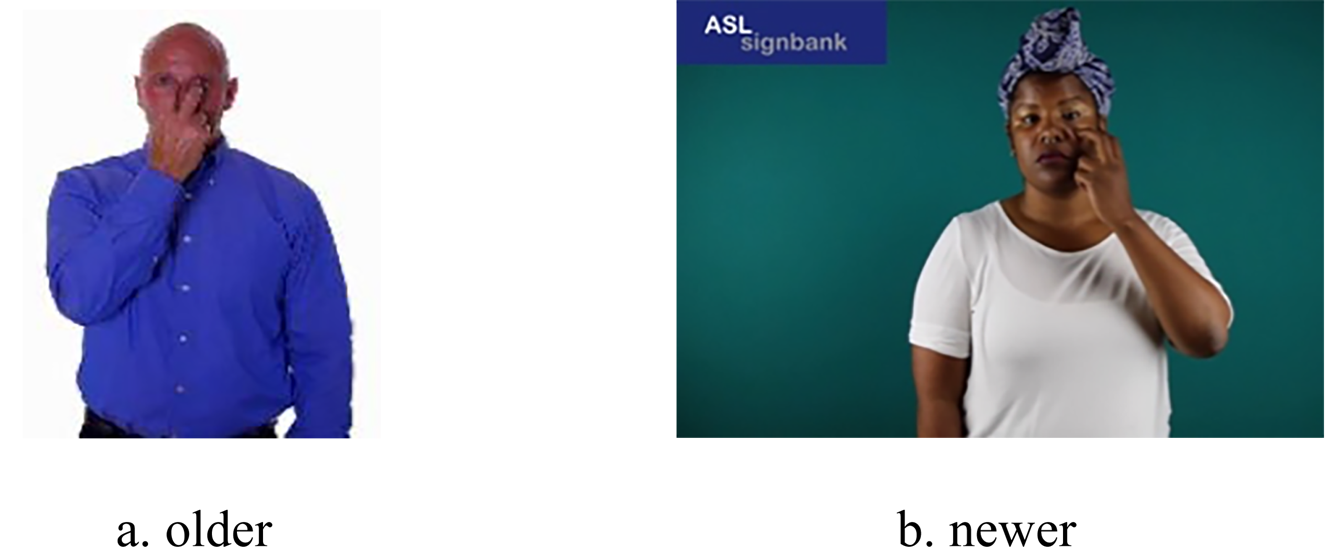
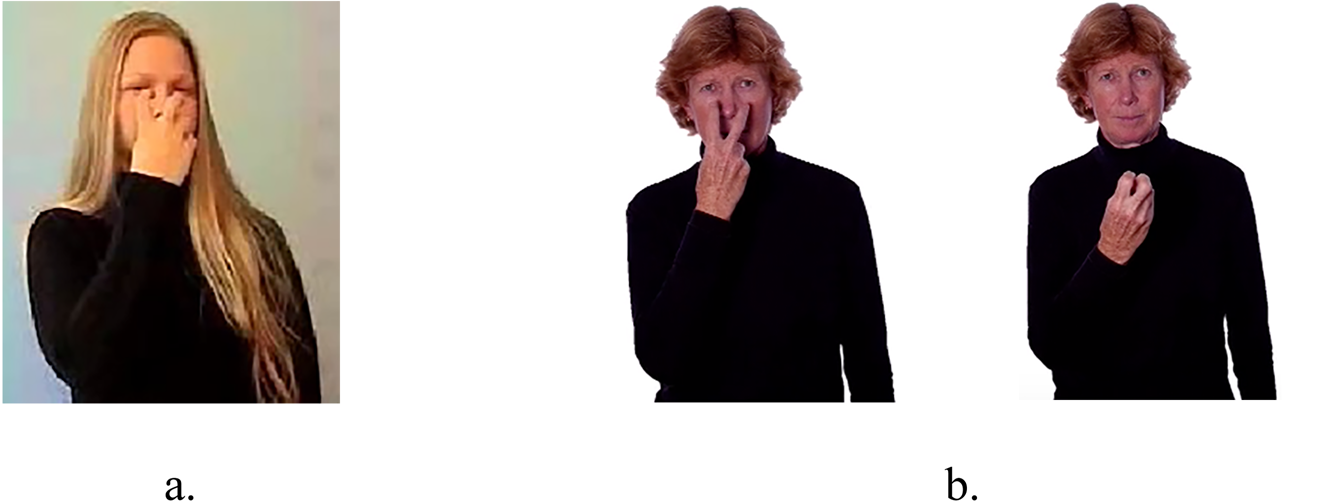
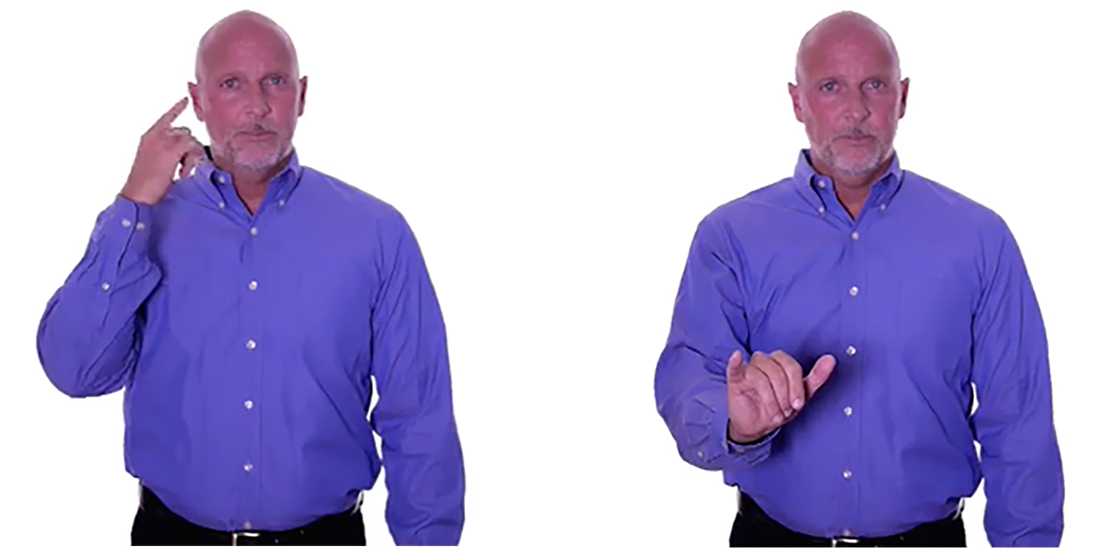
For example, the older sign blind in ASL in Figure 5a moves the bent-V-handshape directly toward the eyes (a location that many signs involving vision share in many sign languages; Börstell & Őstling Reference Börstell and Őstling2017), while one newer variant of the sign blind in Figure 5bFootnote 10 moves that handshape toward the ipsilateral cheek below the eye, and another new variant of the sign blind moves the handshape toward a much lower point on the face (so the fingers touch on either side of the bottom of the nose, as in the version on handspeak.com). Vision is alluded to in the V-handshape itself (indicating two eyes), but the location correction to the cheek or to the sides of the bottom of the nose adds an arbitrariness, in line with the perception that blindness, as an identity, involves more than simply lack of sight.
ASL signs blind.

One might object to the analysis of the change in Figure 5 as a correction. After all, location variation can be conditioned by phonological as well as sociological factors (Lucas, Bayley, Rose, & Wulf Reference Lucas, Bayley, Rose and Wulf2002). And a likely phonological account presents itself: the shift in location in Figure 5 could be an example of the diachronic tendency to move signs from the center to the perimeter of the face (Frishberg Reference Frishberg1975). In fact, the ASL sign see is at the perimeter of the face, not the center, as in Figure 6.
ASL sign see.

If the location change in Figure 5 is phonologically motivated, then no discussion of realistic interpretation of a blind identity should enter here.
In opposition to a phonological account, we compare the change in location in ASL blind to the location of ASL doubt. The handshape in both signs is the same. For some signers, doubt moves the hand away and back immediately in front of the eyes, as in Figure 7a.Footnote 12 For others, doubt moves the hand from below the eyes outward and downward—sometimes curling the fingers more tightly as the hand moves away, as in Figure 7b. Both variations start with the hand central to the face.
Two variants of ASL sign doubt.

These variants of doubt and the older variant of blind (Figure 5a) are phonologically similar, with the major difference between them being that the initial movement in blind is toward the face and the initial movement in doubt is away from the face. But it is only in a newer variant of blind, not in any variant of doubt, that location has shifted from the center of the face to the periphery. Thus, while the lowering of the hand in the variant of blind in handspeak.com might simply be phonological (by the same process that lowers the hand in one newer variant of doubt), the shift to the side of the face in another new variant of blind most probably is not.
Certainly, diachronic change in sign languages is not regular in the way that change in spoken languages is (Moser Reference Moser and Lucas1990). Nevertheless, the contrast between the variants in Figure 7 and the newer form in Figure 5b makes a correction account of the change in blind at least as likely as a phonological account.
We have already noted the frequent use of change of location as a strategy for euphemisms (in the third section above). So one might ask whether the change in Figure 5 is an example of euphemism, not correction. The distinction between correction and euphemism in this instance is both philosophical and psychological. Our consultants tell us that the newer sign in Figure 5 is not considered polite or nice (as euphemisms are), but, rather, sensible and more in line with what we know about the complexity of identities.
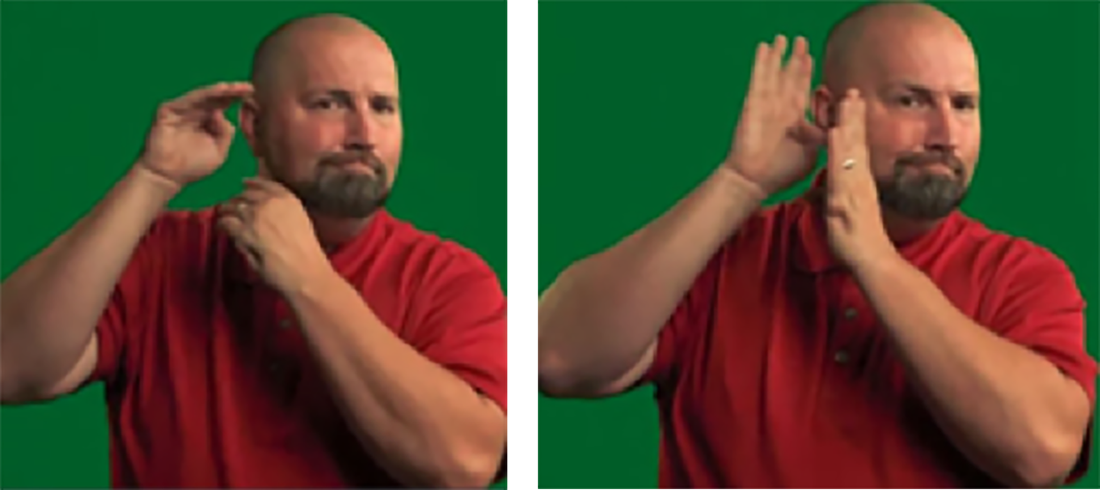
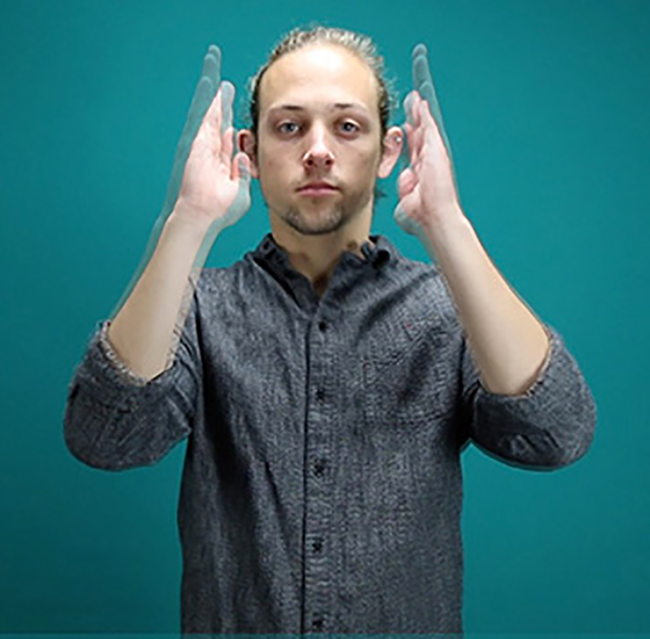
The motivation for the newer sign in Figure 5b might also be political, in the sense of deaf people being political allies to blind people. That is, many deaf people have expressed opposition to being defined by audiological status alone; that definition has led to a devaluation of deaf cultures and lives (Bauman Reference Bauman2008). Our consultants tell us they do not want to be guilty of perpetrating the same sort of harm on blind people via defining them by visual status alone. They recalled for us the common picture of a person putting parallel B-handshapes above and below the ear and then beside the ear—that is, putting the ear in a box, which is a sign indicating focus on audiological status only, at the expense of understanding the whole person (see Humphries Reference Humphries1975, explicated at length in Bauman Reference Bauman2004)—shown in Figure 8.Footnote 13
ASL sign for seeing audiological status as the focal point of deaf identity.

We propose that correction is a way of setting the story straight, making the story more true to one's knowledge—whether with regard to a changing technology, experience, or sensibility. Rather than continuing with a range of lexical items that were coined without empathy, often by an out-group or oppressor for whom the older lexical items might be somewhat self-serving, people can choose to change the lexicon to show empathy and greater understanding, and to reflect their own understandings of the world.
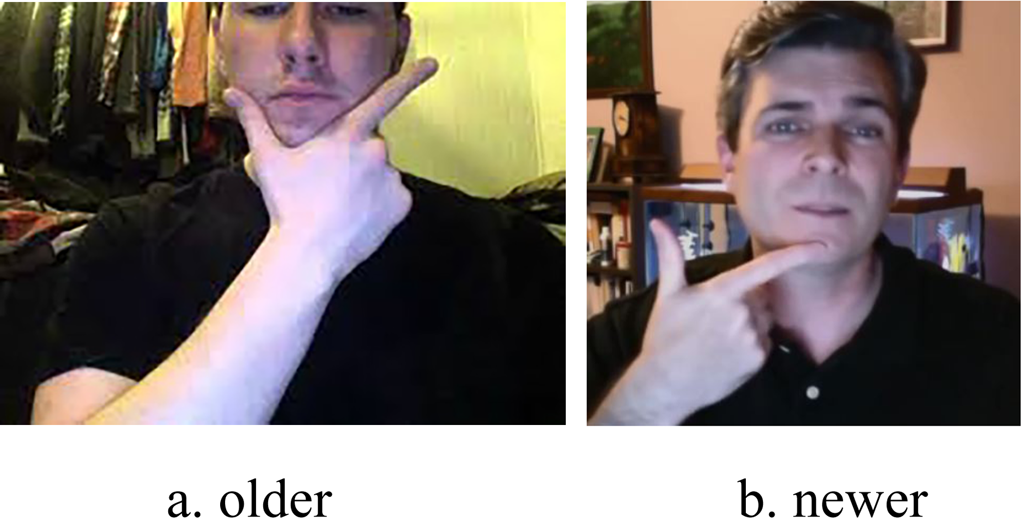
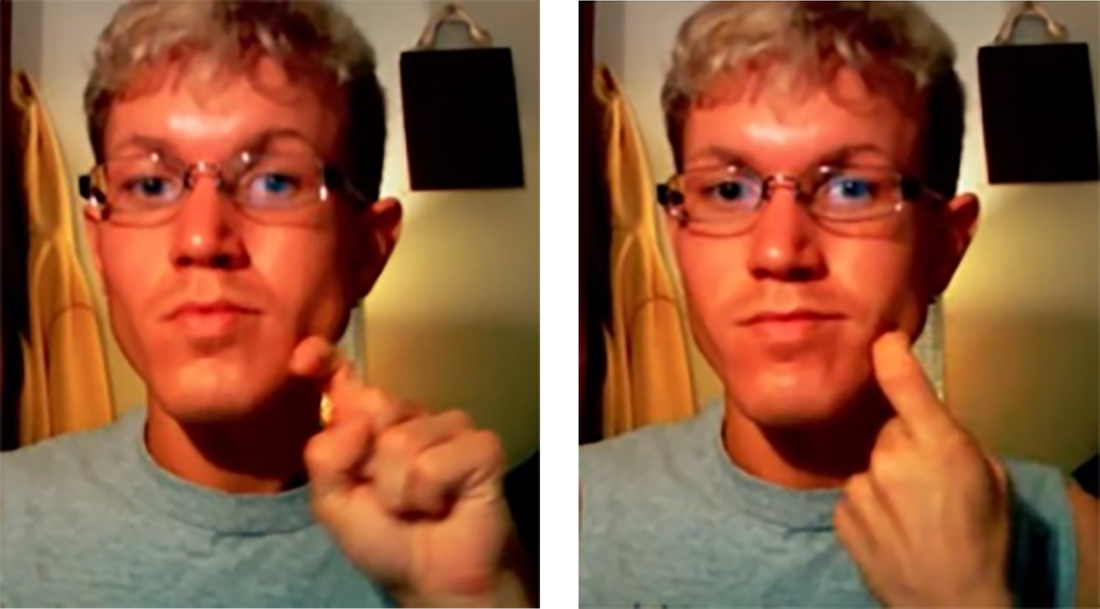
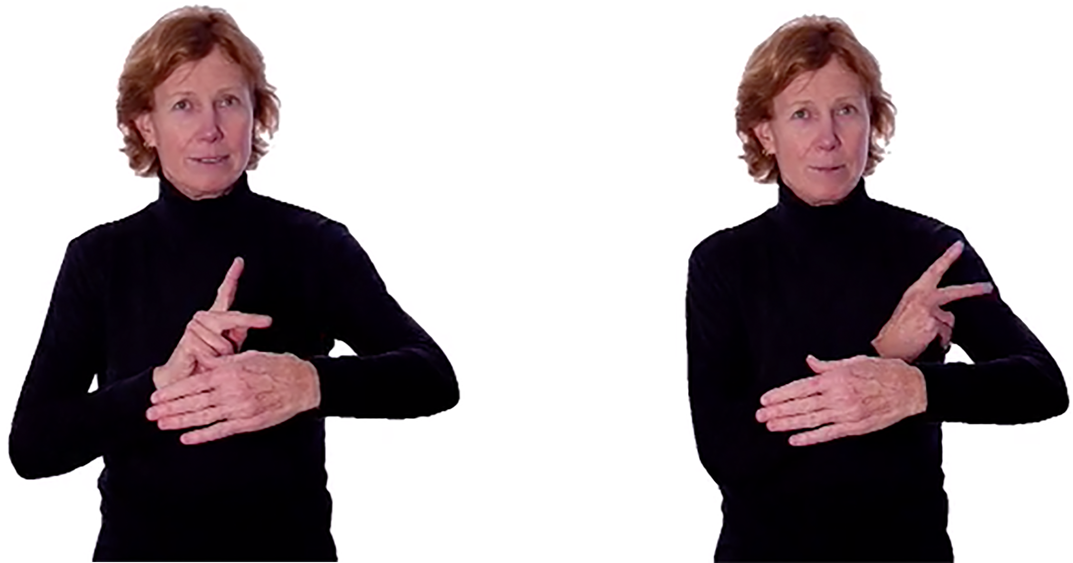
Another example regarding identity of a minority group is variation for the ASL sign lesbian. Kleinfeld & Warner (Reference Kleinfeld, Warner and Lucas1996) note four variants for this sign. In two of them, which, to our knowledge and experience and according to our consultants, are older variants, the web between thumb and index finger of the L-handshape makes contact with the chin. In the other two variants, the tip of the index finger makes contact with either the area under the contralateral corner of the mouth or with the chin. Figure 9 shows an older and a newer variant.Footnote 14
ASL sign lesbian.

It could well be that the sign lesbian was originally arbitrary—where the L-handshape is an initialization and the contact point was random. However, folk etymologies have grown up around it, attributing iconicity, and these etymologies appear to have a kind of ‘collective reality’ in sign languages just as they have in spoken languages (Rundblad & Kronenfeld Reference Rundblad, Kronenfeld, Coleman and Kay2000). One of our consultants volunteered the explicit interpretation of the older form as having the L-handshape representing spread legs, so bringing that L below the mouth is iconic of oral sex. Others saw that L as iconic of genitals (consistent with the fact that two L-handshapes come together in the sign vagina, as the signer in Figure 9b says). In fact, some signers play with the older variant in a mocking way by sticking out the tongue and flicking it. Nyle DiMarco (DiMarco & Man Reference DiMarco and Man2018) does not explain why the older sign is a no-no, but he asserts it is, and that the respectful way to sign ‘lesbian’ is the newer form. Our consultants agree. We propose that the change in point of contact may be a correction in perception of identity; a lesbian identity concerns more than engaging in a sexual act.
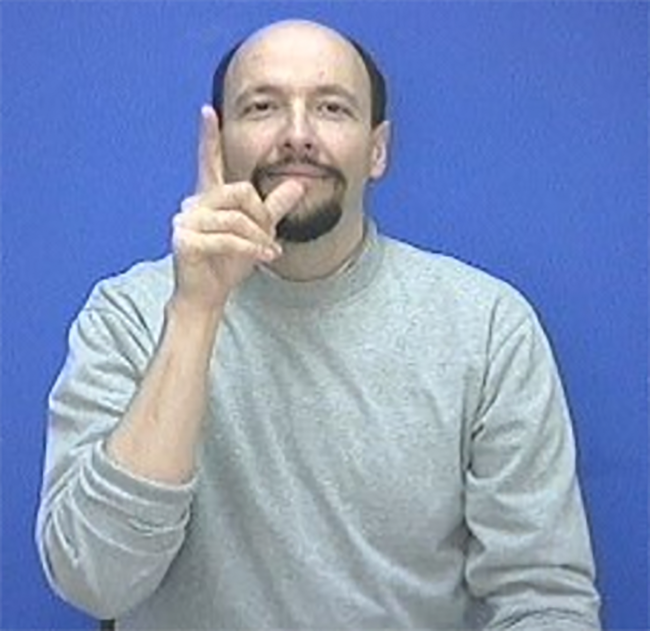
Again, we consider the possibility that the variation might not be a correction, but, instead, be due to the phonological tendency to move signs away from the center of the face (which, here, is an effect of changing the point of contact from web between thumb and index finger to tip of the index finger). In response, we offer first the fact that our consultants as well as web sources (such as Greene Reference Greene2011) indicate that the newer form is preferred because the older form reveals a lack of understanding of sexuality and gender today. Second, the tendency to move away from the center of the face does not appear to apply to signs made on the chin. For example, bitch, breakfast, finland, jewish, lunch, dinner, prefer, sweet, wrong—all of these ASL signs are made on the chin but none have variants off to one side. And notice that lunch in Figure 10Footnote 15 uses the L-handshape just like lesbian does, though the orientation is different (the palm faces contralateral), which leads to a different contact (the thumb tip touches the chin). So we have a near minimal pair here. A purely phonological account based on the tendency to move away from the center of the face, then, is suspect.
ASL sign lunch.

An anonymous reviewer of this article suggested considering a different phonological account, one based on change in point of contact. However, while there are, indeed, few signs in ASL in which the web of the dominant hand moves to make contact with some other body location (as in butterfly or bracelet), we know of no tendency to change point of contact from web to any other part of the hand, nor do we know of claims in the literature to that effect. But if there were such a tendency, again it looks like it does not apply to signs made on the chin, since some signers make contact of that web (plus the sides of the thumb and index finger continuous to it) in at least two other signs located on the chin in ASL, both using the O-handshape changing to the S-handshape: orange and old.
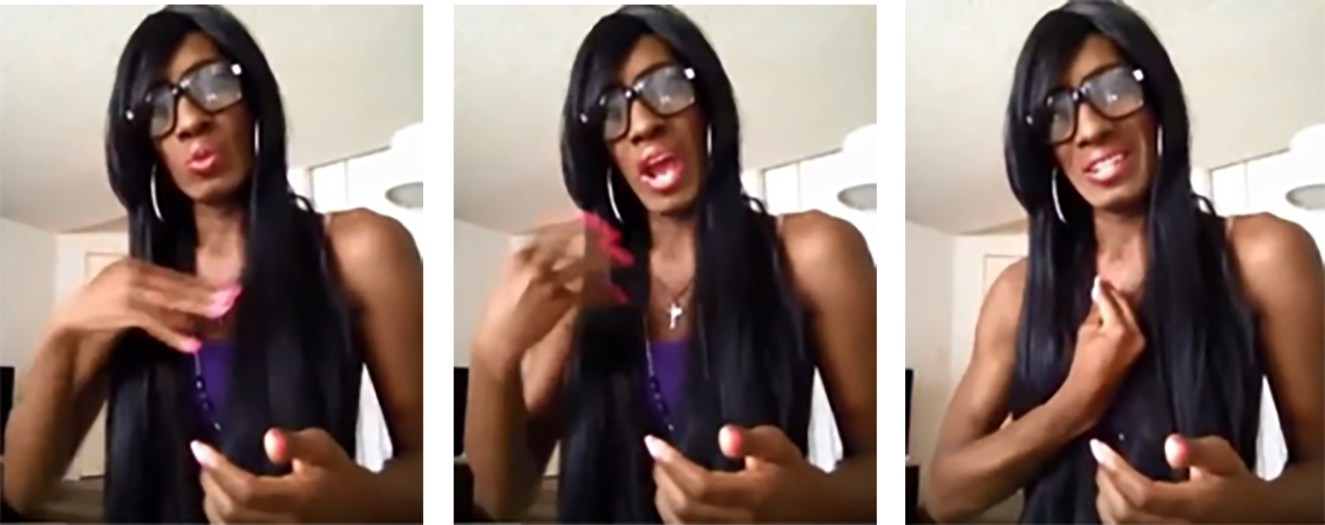
A third example of correction based on recognition of and respect for identity involves a lexical substitution. Here, both the older sign and the newer sign rely on a sign-internal change in the phonological parameter of orientation. The original sign for transsexual had the X-handshape contact the ipsilateral cheek, palm oriented away from the signer, then the radioulnar joint articulated, rotating the forearm so that the palm was oriented toward the signer, as in Figure 11.Footnote 16
ASL sign transsexual.

For many, this sign has been replaced by one better glossed as transgender: the 5-handshape, with palm toward the signer, touches the chest while it closes to a flat-O-handshape and then the hand rises and comes back down with radioulnar movement changing the palm orientation, as shown in Figure 12.Footnote 17
ASL sign transgender.

DiMarco & Man (Reference DiMarco and Man2018) offer a folk history; Man claims that the sign beautiful has been moved from the face to the chest, in accord with recognition that a transgendered person is claiming internal beauty. Shannon (Reference Shannon2017), instead, sees the newer sign as iconic of taking what is inside the chest—one's inner identity—and moving it up and out, so others can see it. Either interpretation is coherent with this sign being a correction; that is, the new sign embraces the idea that transgendered people make a change not limited to nor defined by their sexuality alone.
A fourth example of correction involving identity again replaces a sign, where this time the articulatory characteristics of the newer sign have nothing in common with those of the older sign. An older sign for come-out in Figure 13a mimics opening a coat, as though to expose yourself; a newer sign in Figure 13bFootnote 18 has the X-handshape unhook and move ‘out of’ the nondominant hand. The older version is taken by some to be insulting to gay people because it can bring to mind exposing ones genitalia (Kleinfeld & Warner Reference Kleinfeld, Warner and Lucas1996:17); it reduces the process to something crude and laughable (although many deaf people in the LGBTQ community still use it without hesitation or insult, as multiple videos on youtube.com attest, almost certainly not associating it with exposure of genitalia). The newer term recognizes the act as a detachment, one of our consultants even suggesting it might be a metaphor for getting off the ‘vehicle’ that was carrying you along till this point (particularly if the nondominant hand assumes a C-handshape—as in DiMarco & Man Reference DiMarco and Man2018).
ASL signs come-out.

Other examples involving identities are discussed in Shannon (Reference Shannon2017), who explicitly states that he is not comfortable with signs that are incorrect about sexual identities. For example, he eschews signs for ‘bisexual’ based on a binary choice as oversimplified. And he abhors a sign for ‘bisexual’ that iconically (to his view) indicates that a person has more than one biological sex (the sign that is like the sign sex, but substitutes a bent-V-handshape in place of the usual X-handshape). When he encounters a sense for which no accurate iconic possibility occurs to him, he prefers to simply fingerspell. And he makes an appeal to his viewers to send him new signs they know for ‘gender’ that avoid any hint of a binary choice.
Correction based on deaf experiences
Often expressions in a sign language are different from comparably used expressions in the ambient spoken language in a way appropriate to deaf experiences. These expressions need not concern taboo. For example, ASL pay-attention in Figure 14Footnote 19 is iconic of directing visual attention; the two flat-B-handshapes move forward like blinders.
ASL sign pay-attention.

Other times, however, a sign expression stems from an expression in the ambient spoken language that has little to do with deaf experiences. For example, signers of ASL use the expression sound + like in Figure 15 when expressing something like Sounds like you're unhappy.
ASL sign sound + like.

This kind of example is common (compare to sound + good for ‘sound good’), and, generally, our consultants and signers we have observed do not seem to give evidence of noticing the inappropriateness of the fixed phrase borrowed from English. That may well be due to the very nature of it being a fixed phrase; fixed phrases are understood holistically, not componentially.
By contrast, there are instances in which the inappropriateness is seen as problematic. An example is ASL listen. There are at least two forms. One literally means ‘pay attention to audible information’—and is articulated at the ear, as in Figure 16.Footnote 20 It is often used to mean ‘receive information generally’, despite the iconicity of ear reception.
ASL sign listen or older sign for receive-information/perceive.

A newer variant means, instead, ‘receive information’ or ‘perceive’ (via any perception) and is articulated on the cheek under the eye, often with the nondominant hand also articulating, but in neutral space, as in Figure 17.Footnote 21
ASL newer sign listen/perceive.

The change from the older to the newer form is from a location incongruous with deaf experiences, in Figure 16, to a location congruent with deaf experiences, in Figure 17: a correction. Note that the change of location moves from the periphery of the face more toward the center, the opposite direction of the phonological tendency we referred to earlier—so this change is highly unlikely to be purely phonological.
Another example of a correction based on appropriateness to deaf experiences concerns the ASL sign poetry. The older sign differs from the sign music only by handshape; music uses the flat-B-handshape and poetry uses the P-handshape, shown in Figure 18. The dominant hand swings back and forth above the nondominant forearm. The older sign, then, draws a parallel between music and poetry that might well not be congruous with deaf experiences.
ASL older sign poetry.

The newer sign in Figure 19Footnote 22 does not change any phonological parameters of the older sign. Instead, the newer sign is a lexical substitution. The hand moves up the chest and turns over (via radioulnar movement) and then moves forward and down. The handshape changes from S-handshape to 5-handshape. The iconicity is of taking something from inside oneself and pulling it up and out to offer to the addressee. Peter Cook and Kenny Lerner (Flying Words Project 2008) in the poem ‘Poetry’ explicitly explain that poetry is a relationship between the poet's heart and the outside. The newer sign's articulation is far more appropriate to its sense with respect to deaf experience than the older sign's, thus this substitution is a correction.
ASL newer sign poetry.

The examples here may bring to mind discussions of language colonialism or linguistic imperialism (Mühlhäusler Reference Mühlhäusler2002)—where the spoken language is that of the powerful culture, and its adoption across cultures within a country has led to debates over whether such adoption is a destructive imposition (for example, Phillipson Reference Phillipson1992, Reference Phillipson2010 versus Davies Reference Davies1996 and Widdowson Reference Widdowson, Cooper, Shohamy and Walters2001). Additionally, it may bring to mind issues of linguistic hegemony, where the spreading use of one language increases and maintains the power (political, cultural, etc.) of those who use it (Anderman & Rogers Reference Anderman and Rogers2005). It is not our intention to add fuel to those fires, however. In true language-colonialism and linguistic-hegemony situations lexical items from the powerful language (here, spoken English) replace lexical items in the less powerful language (here, ASL). That is not what happened in the lexical items discussed in this article; we did not have replacement of earlier lexical items in ASL. Instead, lexical items based somehow on English (such as the calque sound + like or placing the sign for ‘poetry’ in the same lexical family as the sign for ‘music’) simply appeared in ASL and were used without attention to their inappropriateness to deaf experiences and sensibility.
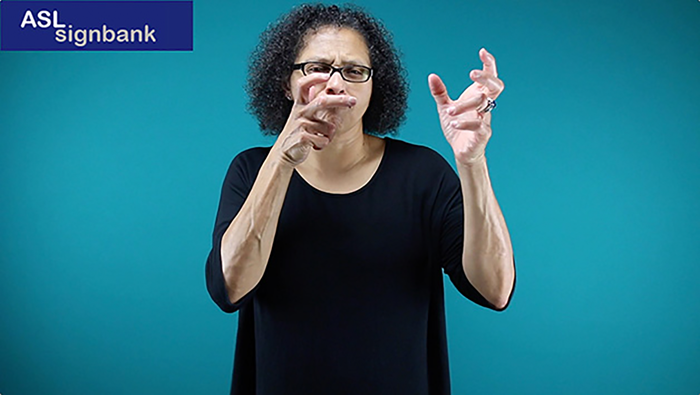
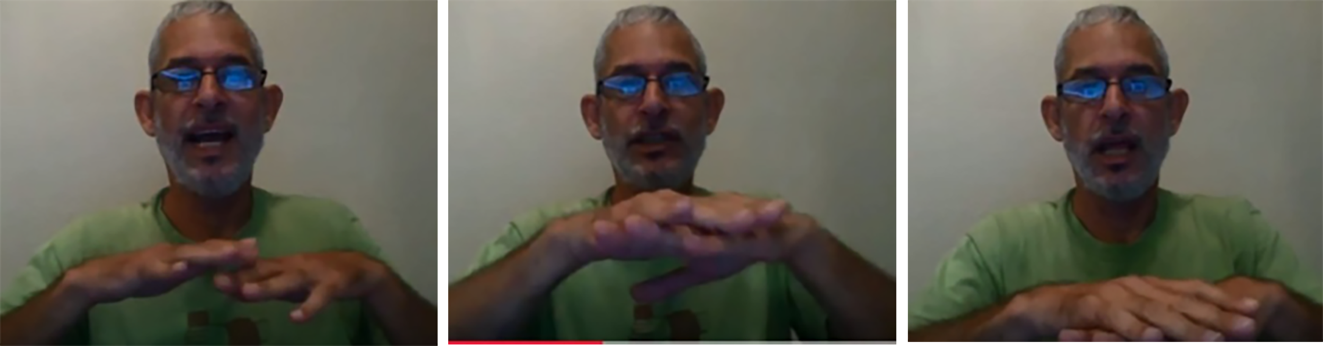
In fact, we find corrections regarding congruity with deaf experiences in signs that have nothing to do with English or any spoken language. Instead, these signs are originally coined by deaf communities and are partially changed or replaced entirely as experiences of deaf people change. For example, in Figure 20Footnote 23 we see one older variant of the sign intersectionality. The hands come together (fingers wiggling) until one is on top of the other and then they settle downward and stop with a hold, iconic of overlapping identities.
ASL older sign intersectionality.

There are a number of newer variants on the internet, so perhaps a favored one has yet to be settled on. One newer variant that some of our consultants adopt can be found on the website handspeak.com.Footnote 24 Here the two hands start with fingers interlaced and they move together, iconic of linked identities that act together (despite the fact that they are sometimes in opposition) without suggestion of any one being a base upon which other identities are overlaid. None of the sign variants for intersectionality was imposed by or somehow derived from speech; but correction is happening all the same, as knowledge about intersectionality grows among deaf communities.
Conclusion
When the relationship between form and sense is nonarbitrary, the possibility arises that a lexical item's articulation can become inappropriate. If that inappropriateness is a misalignment of a linguistic community's knowledge of how self and the world works, then (sub)lexical change might occur to bring about a realignment. Additionally, if the inappropriateness is offensive (as with some identity terms), the pressure to realign might be harder to ignore.
This realignment differs from euphemism in that its goal is not to avoid referring directly to some taboo topic; thus realignment is not a matter of any kind of circumlocution or phonetic change that disguises the taboo topic, making it more polite. It also differs from PC in that its primary goal is not to police the language, banning terms with negative associations that may be unjust (such as casting aspersions on a given group), although it may, in fact, have some of the same results. Rather, the goal of such realignment is to ensure that a lexical item be compatible with the sensibilities and experiences of the linguistic community. Thus the variant of lesbian that changes the point of contact to the tip of the index finger, for example, still means ‘lesbian’ (and not some circumlocution like ‘woman who likes other women’) and still will have negative associations attributed to it by those who disapprove of lesbianism. But it does not identify lesbians by the act of cunnilingus; it is neither reductionist nor crude (although ideas of what is ‘crude’ vary, particularly between spoken language and sign language in the US; see Mirus et al. Reference Mirus, Fisher and Napoli2012). We conclude that the notion of correction must be added to discussions of language change, and that notion may be particularly helpful in understanding changes in lexical items concerning matters that deal with sensitive areas, such as taboo or areas in which notions of social justice are pertinent.
Further, the study here suggests that metalinguistic awareness and activity can be an important component of cognitive, social, and cultural change. The changing of attitudes does not happen solely inside isolated individual minds. Rather, people's linguistically mediated interactions help them collectively shape improved attitudes and understandings. A corrected sign can help spread those improvements by equipping others in the community to more effectively articulate their own experiences and understanding. The new sign provides a more effective linguistic instrument, one less likely to undercut the improved understanding. Change in linguistic form is never the whole story and, as Halmari's (Reference Halmari2011) and others’ work shows, any simplistic ‘always substitute X for Y’ approach is woefully inadequate for effecting social change (and may indeed backfire). But our study suggests that active engagement around language issues can be a crucial part of supporting and promoting shifts in dominant ideas and sociocultural realities within linguistic communities.
Our study concerns correction in sign languages as used by deaf communities; as such, we have mentioned spoken languages only briefly. This is natural, since nonarbitrary relationships between form and sense arise more frequently in sign than spoken languages. However, when we look outside the Indo-European family, we find a variety of types of iconicity, including not just onomatopoeia, but associations between particular phonemes and senses (Hinton, Nichols, & Ohala Reference Hinton, Nichols and Ohala2006; Haynie, Bowern, & LaPalombara Reference Haynie, Bowern and LaPalombara2014) and sound-meaning mappings dealing with ‘sensory, motor and affective experiences as well as aspects of the spatio-temporal unfolding of an event’ (Vigliocco, Perniss, & Vinson Reference Vigliocco, Perniss and Vinson2014:3). We therefore might expect to find lexical corrections among spoken languages with higher frequency of iconicity, such as the languages of Japan, Korea, Southeast Asia, sub-Saharan Africa, the Balto-Finnic group, the Australian Aborigines, and the indigenous peoples of South America (Perniss, Thompson, & Vigliocco Reference Perniss, Thompson and Vigliocco2010). Examination of such languages could raise new questions and considerations. For example, if the motivations for (sub)lexical correction presented here are on the right track, we would expect languages that have been suppressed or oppressed to show even more propensity toward corrections.
Still, deaf communities might be extreme regarding (sub)lexical correction, given the special status of language acquisition among deaf people. It may well be that pressure for correction is greater when the lexical item is at odds with perceptions of realities and truths that deaf individuals and communities hold dear.