In the language of liturgical drama, the Officium Stellae is the liturgical representation of the visit by the Magi to the infant Jesus on the feast of the Epiphany. This representation was first noted in modern scholarship by Charles Magnin in his Sorbonne lectures of 1834–5. Textual editions for several settings were published by Édelstand du Méril in 1849, while critical analyses of the texts along with additional exemplars were offered in 1905 by Heinrich Anz and in 1979 by Norbert King. These earlier studies focused on the texts of the known settings with little reference to the melodies that were preserved for many. Nausica Morandi's reappraisal of this repertory is thus most welcome, as she is the first to consider the melodies, the notation and, to some extent, the liturgical contexts for a repertory that has grown by her count to fifty surviving exemplars. More significantly, she offers musical transcriptions for most sources preserving musical notation, whether pitch is evident or not.
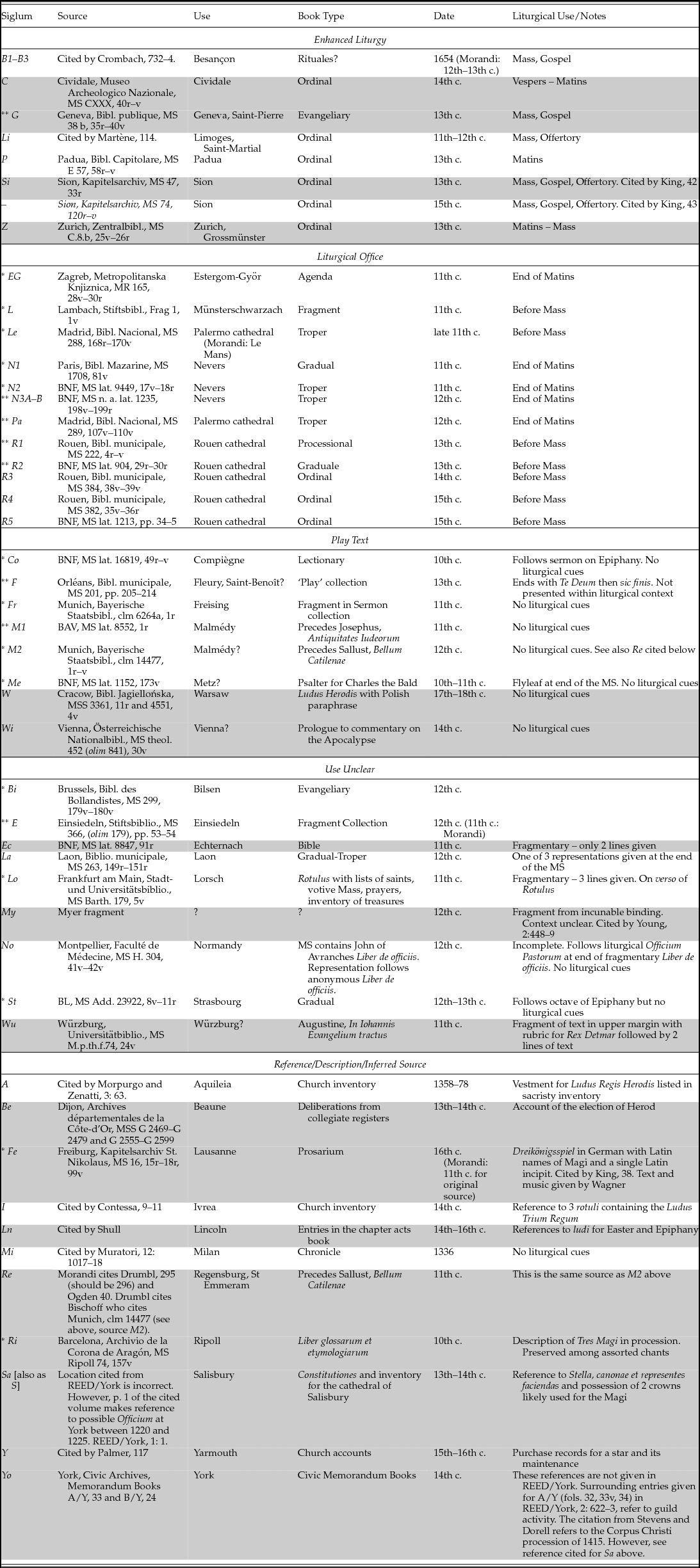
The book begins with an introduction, a bibliography and a list of manuscript and other witnesses arranged in alphabetical order according to sigla modelled on those originally proposed by Anz in 1905 (see Table 1). Chapter 1 offers an overview for the study of the Officium Stellae, including discussions of the terms used to identify the office, its chronology and distribution, its manuscript and documentary sources, its relation to the liturgy of Epiphany and Christmas, and the biblical, apocryphal and classical sources for its texts. Chapter 2 examines the manuscript tradition of the sources in greater detail, including tables that list the manuscript and printed sources along with their chronological and geographical distribution. Included also are comparative analyses of the texts, melodies and rubrics. Morandi treats the Officium Stellae here as a singular entity – all settings are seen as ‘liturgical dramas’, as dramatic interpolations into the liturgy, no matter what the evidence for their individual liturgical associations might show. This is the case in the analyses of both the textual and the musical structures, where the discussions of texts, rubrics, melody, mode and melodic organisation focus on how these advance the dramatic aspects of the individual settings.
Morandi Witnesses for the Officium Stellae

* Unheighted neumes
** Pitch notation
Shaded: New in Morandi
Italic: Not in Morandi
Anz Heinrich Anz, Die lateinischen Magierspiele (Leipzig, 1905).
Bischoff Bernhard Bischoff, ‘Regensburger Beiträge zur mittelalterlichen Dramatik und Ikonographie’, Mittelalterliche Studien: Ausgewählte Aufsätze zur Schriftkunde und Literaturgeschichte, 3 vols. (Stuttgart, 1966–81), 2:156–65.
Bolingbroke Leonard G. Bolingbroke, ‘Pre-Elizabethan Plays and Players in Norfolk’, Norfolk Archeology 11 (1892), 332–52.
Contessa Carlo Contessa, Un inventario del secolo XIV ed alcune spigolature per la storia della Biblioteca Capitolare di Ivrea (Turin, 1909).
Crombach Hermann Crombach, Primitae Gentium (Cologne, 1654).
Du Méril Édelstand du Méril, Origines latines du théâtre moderne (Paris, 1849).
Drumbl Johann Drumbl, Quem Quaeritis: Teatro Sacro dell'Alto Medioevo (Rome, 1981).
King Norbert King, Mittelalterliche Dreikönigsspiele (Freiburg, 1979).
Magnin Charles Magnin, Notes to Sorbonne lectures, Journal géneral de l'Instruction publique (Dec. 1834–Mar. 1836).
Martène Edmond Martène, Tractatus de antiqua ecclesiae disciplina in divinis officiis celebrandis (Lyon, 1706).
Morpurgo and Zenatti S. Morpurgo and A. Zenatti (eds.), Archivio storico per Trieste, l'Istria e il Trentino, 4 vols. (Rome, 1881–95).
Muratori Ludovico Antonio Muratori, Rerum Italicarum scriptores, 25 vols. (Milan, 1723–38).
Ogden Dunbar Ogden, The Staging of Drama in the Medieval Church (Newark, DE, 2002).
Palmer Charles Palmer, The History of Great Yarmouth, Designed as a Continuation of Manship's History of that Town (London, 1856).
REED/York Alexandra F. Johnston and Margaret Rogerson, Records of Early English Drama: York, 2 vols. (Toronto, 1979).
Shull Virginia Shull, ‘Clerical Drama in Lincoln Cathedral’, PMLA 52 (1937), 946–66.
Stevens and Dorell Martin Stevens and Margaret Dorell, ‘The “Ordo Paginarum” Gathering of the York “A/Y” Memorandum Book’, Modern Philology 72 (1974), 45–59.
Wagner Peter Wagner, ‘Das Dreikönigspiel zu Freiburg in der Schweiz’, Freiburger Geschichtsblätter 10 (1903), 77–101.
Young Karl Young, Drama of the Medieval Church, 2 vols. (Oxford, 1933).
Chapters 3–5 offer transcriptions of the texts and melodies of those sources where such information is provided. Chapter 3 provides textual transcriptions for most of the sources, excluding several found only as archival references. Most of the editions are given in block format, with both rubrics and sung texts printed continuously without regard to textual, poetic or dramatic divisions. The Warsaw text (W), though, is formatted as is typical in modern editions, with individual rubrics and sung texts given on separate lines.
Chapter 4 focuses on technical issues in the digital recapturing of the musical and textual details in poorly preserved sources and offers transcriptions both for those musical sources that do not provide pitch information and for those that include neumes on lines. The discussion here is frustratingly light. Morandi discusses the particular problems presented by several sources as well as some of the general approaches taken to bring missing features to light and to render them for the following transcriptions. However, aside from listing the software she used to assist in the digital recapturing along with some of the techniques she used to aid in the recovery, her discussion is more tantalising than illustrative. As one who works in this area, I would like to have seen more detail on how the processes she used were effected. In the transcriptions, Morandi follows two formatting schemes. Those sources preserving pitch information follow the layout given in the manuscripts, with a few adjustments to account for the rubrics that are not provided. These include the editions for Einsiedeln (E), Fleury (F), Malmédy (M1), Nevers (N3A–N3B) and Palermo (Pa). The unheighted setting from Münsterschwarzach (L) also appears to follow its manuscript layout. The transcriptions for the other unheighted sources, however, adopt the block format used in most of the text editions in the preceding chapter.
Chapter 5 then offers musical transcriptions for all sources where pitch information is given. For those sources not given in Chapter 4, Morandi offers two transcriptions: one in square notation and the other in modern stemless notation. Square notation is provided for the settings from Geneva (G) and Rouen (R1 and R2), and, like those provided for the pitched sources in Chapter 4, these transcriptions follow the layout of their presentation within the manuscripts. The remaining transcriptions follow the block format used elsewhere. Thus, all pitched sources are given twice, with one version following the manuscript layout and the other not.
In each of her several sweeps through the repertory, Morandi presents the settings in alphabetical order according to their sigla. This systematic approach to presenting the sources offers some convenience by allowing easy access to discussions of particular aspects of the individual settings throughout the volume (textual, musical, liturgical, etc.). However, this method also masks the distinctions that exist among different categories of sources. In Table 1, I have divided Morandi's sources into five groups that illustrate some of these distinctions.
Of the fifty sources cited, only twenty-two are copied within a liturgical context, and of these, nine might be better described as ‘enhanced liturgy’. The Cividale source (C), for example, describes an electio regis during First Vespers and the participation of the king during Matins with no additional movement towards what might today be seen as dramatic action. A thirteenth-century evangeliary from Geneva (G) distributes the passages from the Gospel of St Matthew (2:1–11) among three clerics in the persons of the Magi, and a similar arrangement is given in the settings from Besançon (B1–B3). A lost manuscript from Saint-Martial in Limoges (Li) involves the clerics as Magi in the offering for the Mass, while that in a thirteenth-century ordinal from Zurich (Z) employs them as Magi throughout the morning services.
Just thirteen of the fifty settings meet the criteria for what most would consider to be liturgical dramas, as independent ceremonies celebrated within defined liturgical contexts. Just over half are from churches where Norman/Angevin customs held sway: five from the cathedral of Rouen (R1–R5) and two from Palermo in Norman Sicily (Le and Pa). Four additional settings stem from the cathedral in Nevers (N1, N2 and N3A–B), while those remaining stem from further afield (Münsterschwarzach [L] and Estergom-Györ [EG]). Like other similar rites (Visitatio Sepulchri and Officium Pastorum), these are celebrated either at the conclusion of Matins or prior to the Mass.
Eight settings offer no evidence of a liturgical association, and these appear to be closer to what we would today see as plays than ritual observance. These include the most extended treatments of the encounter of the Magi with the Holy Family and with Herod and his attendants. The earliest settings (Co and Fr) are included in sermon collections. The Fleury setting (F) is found within a collection of plays that is itself attached to a collection of sermons for Lent. Other locations are evident as well. The two settings assigned by Morandi to Malmédy (M1 and M2) are included in manuscripts containing the Antiquitates Iudeaorum of Josephus and the Bellum Catilenae of Sallust, respectively, while the setting from Metz (Me) is given as a flyleaf at the end of the Psalter of Charles the Bald.
Nine settings offer too little information to determine their intent. Several are fragmentary, offering only two or three lines from what could be an Officium Stellae or a more ambitious non-liturgical representation (Ec, Lo and Wu). Others may have been intended for liturgical use, but their presentations within their respective manuscripts do not allow a definitive determination. A final grouping of sources consists of descriptions of and possible references to representations that no longer survive in written form. Most are from account books or inventories from church or civic archives and appear to concern larger non-liturgical representations rather than liturgical rites.
Morandi claims to offer thirteen previously uncited sources among those she presents (p. xiv, n. 13). These are given with grey background in the table. Some were cited in studies not devoted to liturgical drama or to the Officium Stellae particularly, while others were found by Morandi herself. Her most important contribution in this regard is her rediscovery of the Vienna manuscript (Wi), cited originally by Du Méril in 1849 as MS 941 in the Bibliothèque de Vienne, but lost to later scholars (now Vienna, Österreichische Nationalbibliothek, MS theol. 452 (olim 841)). While she includes the Myer fragment (My) among the newly discovered sources in her list, this entry is likely an error, as she notes Young's prior citation and edition later in her discussion (pp. 86–7). Two of the previously uncited sources, however, were previously given by King, whose work Morandi appears not to know. These include the Sion manuscript (Si) and the macaronic source from Frieburg (Fe), for which Morandi provides neither text nor music (although both text and music are given by Wagner).
This otherwise valuable contribution is marred by several factual and typographical errors. Some errors result from insufficient tracking of information in secondary sources. For example, Morandi cites Du Méril to support her assertion that the Limoges source reported by Martène (Li) was destroyed by fire in 1768 (p. 77). Du Méril's reference, though, was to a lost manuscript from St Blasius that included a Dreikönigsspiel performed at local courts (Du Méril, p. 151, n. 1). Elsewhere, she describes a performance of the Officium at Yarmouth drawn from a description given by Bolingbroke (1892, pp. 334–5) (p. 115). Bolingbroke's description, though, is a misreading of a footnote from the earlier citation by Palmer (1856) (p. 117), who offered a generic description of the Officium Stellae rather than a specific description of the Yarmouth representation. For the Regensburg source (R), Morandi drew from notices by Johann Drumbl and Dunbar Ogden (p. 107). Drumbl's reference, though, was from Bernhard Bischoff, who cites this as Munich, Bayerische Staatsbibliothek, c.l.m. 14477 (Bischoff, 156, n. 3), which Morandi had previously assigned to Malmédy (M2). For the Salisbury source (S or Sa), Morandi cites a reference from the York volumes of the Records of Early English Drama (p. 108). However, there is no such reference on the page indicated (REED/York, I, p. 113). The cited volume does make reference, though, to a possible Officium at York from 1220 to 1225 (see REED/York, I, p. 1). The citations Morandi gives for York (Yo, p. 116), on the other hand, I was unable to find. She cites references from two civic account books, but these references are not among those given in REED/York. Nor are they found in the Stevens/Dorell edition of the Ordo Paginarum that she cites as her source for this entry. Indeed, surrounding entries given for York account book A/Y in REED/York refer to guild activity (see REED/York, II, pp. 622–3), while the references in the Ordo Paginarum are to the Corpus Christi procession of 1415.
Other issues are evident as well. It was probably the block format used in the text editions that masked for both author and proofreader the two lines omitted from the first and third stanzas of Nos respectu gratie (RH 12241) in the settings from Besançon (B1–B3, p. 303). There are also a number of proofreading anomalies. Space does not permit an exhaustive list, so I offer a few examples here. The manuscript number given for Morandi's sources N3A and N3B should be ‘nouv. acq. lat. 1235’ and not ‘lat. 1235’ (pp. xxix, 90, 332, 396 and 436). The reference to O quam dignis should be RH 13496 rather than 12496 (p. 77, n. 60), while that for Novae genitura should be RH 12329 rather than 12635 (p. 118, n. 108). The siglum for the Salisbury source is given variously as S (pp. xiv, n. 13, xxx, 119, 129 138 and 154) and Sa (pp. 4, 33 and 198). The manuscript number for the Vienna manuscript (Wi) is given as MS 552 in the list of witnesses (p. xxx) but as MS 442 elsewhere. In addition, a number of references given in the notes do not point to the correct locations. The citation from Dunbar Ogden mentioned above with respect to the Regensburg source, for example, is misplaced. On the page referenced (Ogden, p. 40), Ogden describes a fifteenth-century Visitatio Sepulchri from Regensburg and not the Officium Stellae.
These issues notwithstanding, Nausica Morandi has provided an invaluable resource that can offer us a deeper understanding of the Officium Stellae should we be willing to make the effort. While one may quibble over her choices for organisation, presentation and formatting, Morandi's provision of the complete textual and musical information for these sources makes possible investigations into aspects of these settings well beyond those that prompted and guided her presentation. The Officium Stellae is the one office among those labelled ‘liturgical drama’ that really does not seem to fit. Morandi's study, and her editions in particular, offer the resources needed to allow future scholars to better understand the nature and history of this most peculiar office and its place both within and without the liturgy.