1. Introduction
This article reviews research in the field of language teaching and learning published in New Zealand over the period 2013–2017, following on from a similar earlier review by Ker, Adams, and Skyrme (Reference Ker, Adams and Skyrme2013). While the teaching and learning of the dominant language, English, as a first language are excluded, the review is concerned with themes ranging from maintenance of New Zealand's official and community languages, to the teaching within schools of languages additional to the language of instruction, and issues for those learning English as an additional language (EAL). The intention is to provide more prominence and a wider audience for research which an international audience may be unaware of.
In order to make sense of the research surveyed, the article begins with an overview of the current language landscape in New Zealand. It then introduces the major sources from which the surveyed studies have been drawn, before proceeding to the review itself. The review is divided into broad categories relating to the languages in focus – the official languages, te reo Māori and NZSL, community and additional languages, and the dominant language, English.
2. The language landscape of New Zealand: an overview
High levels of immigration to New Zealand over recent decades have resulted in superdiversity (e.g. RSNZ, 2013; Chen, Reference Chen2015). The 2013 Census showed that 25% of the population was born overseas. Of these overseas-born migrants, the largest sub-groups originated from Asia (particularly China, India and the Philippines), the UK and Ireland, the Pacific Islands, continental Europe, as well as the Middle East and Africa (Hawke et al., Reference Hawke, Bedford, Kukutai, McKinnon, Olssen and Spoonley2014). The diversity is most apparent in Auckland, where 39% of the population was born overseas and 23% claim Asian ethnicity. Auckland also has the largest population of people of Pacific Island origin in New Zealand (Stats, Reference Stats2014a). Ethnic diversity brings linguistic diversity, noticeable in the range of languages now spoken alongside English (160 languages according to RSNZ, 2013, p. 1).
Paradoxically, linguistic diversity has not translated into a higher value being accorded to the learning or speaking of languages other than English. Harvey (Reference Harvey2013b) suggests, in fact, that ‘New Zealand's public monolingualism in English is further entrenched’ (p. 1). Census statistics bear this out: just 20% of the population was recorded in the 2013 Census as speaking more than one language (Stats, Reference Stats2014a). Furthermore, the numbers of students learning languages additional to the language of instruction (henceforth, ‘additional languages’) in high school and university are diminishing. The tension between New Zealand's endemic monolingualism and its increasing cultural diversity has renewed debate about the need for a national language policy.
Earlier work on a language policy by Waite (Reference Waite1992) did not lead to government action but support has re-emerged strongly in some quarters during the period under review. This was prompted by Languages in Aotearoa New Zealand, a statement paper prepared by experts in the field brought together by the Royal Society of New Zealand (RSNZ, 2013). It was followed by articles in leading outlets for applied linguistics research (East, Reference East2013b; Harvey, Reference Harvey2013b), a conference hosted by the Office of Ethnic Communities in 2015 (Lotu-Iiga, Reference Lotu-Iiga2015), a 2016 visit by Joseph Lo Bianco, major architect of Australia's language policy, and the launching of Ngā Reo o Tāmaki Makaurau/Auckland Languages Strategy (Tāmaki Makaurau Auckland Languages Strategy Working Group, 2015).
Some of the key issues raised in the Royal Society paper are reflected in this article, in particular, the position of New Zealand's official languages, te reo Māori and NZSL, access to English, consideration of the many languages used by the people of New Zealand, language capability in a highly diverse society, and the ability of research to examine language practice in society (RSNZ, 2013).
2.1 The official languages
As official languages, te reo Māori and New Zealand Sign Language (NZSL) occupy a special position in New Zealand. The official status, and, in the case of te reo Māori, its indigeneity and the 1840 Treaty of Waitangi between Māori and the British Crown, the founding document of New Zealand, are touchstones for the Māori and Deaf communities in requesting government attention and support. At the same time, both official languages are endangered, with shrinking pools of users (Stats, Reference Stats2014a). Efforts to maintain or revitalise them are focusing more than ever on the role of families (Bright, Barnes, & Hutchings, Reference Bright, Barnes and Hutchings2013; McKee & Smiler, Reference McKee, Smiler, Macalister and Mirvahedi2017).
2.1.1 Te reo Māori
The linguistic dominance of English, widely enforced through the education system and systematic undervaluing of things Māori by the mainstream (Stewart, Reference Stewart2014) through policies of assimilation and integration, has left the demographics of the language in a parlous state and undermined intergenerational transmission and acquisition through social interaction (Winitana, Reference Winitana2011; Olsen-Reeder, Hutchings, & Higgins, Reference Olsen-Reeder, Hutchings and Higgins2017). According to the 2013 Census, the proportion of Māori who can converse in the language has declined from 25% in 1996 to 21.3% in 2013 (Stats, Reference Stats2014b). However, in a parallel 2013 face-to-face nationwide survey of 5,000 Māori, just 11% of Māori respondents said they could speak te reo Māori very well or well (Stats, Reference Stats2014b).
This demographic decline has called forth sustained grassroots initiatives to revitalise the learning and teaching of the Māori language, now stretching over five decades. These initiatives include notably the creation of ‘language nests’ (kohanga reo), or early childhood Māori immersion programmes, which significantly raised the proportion of Māori children able to speak the language (Winitana, Reference Winitana2011) and the emergence of schools and tertiary institutions governed and run by Māori with the aim of maintaining and promoting their own culture and language. The Māori language was recognised as the first official language of the country in 1987.
Māori-medium education, and the curricula underpinning it, are now well-established, and the role of the formal education system in revitalisation efforts remains crucial. The period under review coincides with the implementation of the government's Māori education strategy Ka Hikitia – Accelerating Success 2013–2017 Footnote 1 (Ministry of Education, 2013a). The strategy was based on twin foundations of quality provision and family involvement and set targets for substantially increasing the number of proficient speakers of te reo Māori. In addition, a new Māori Language Act (2016) commits the government to work in partnership with Māori on revitalisation.
2.1.2 NZSL
Likewise, Census 2013 revealed users of NZSL had declined by 16% to 20,235 (0.5% of the population) from 2006, the year it became an official language (Stats, Reference Stats2014a). McKee (Reference McKee2017) found that it met the criterion for being a ‘threatened’ language, namely because ‘the language is used for face-to-face communication within all generations, but it is losing users’ (Bickford, Lewis, & Simons, Reference Bickford, Lewis and Simons2015, p. 4, cited in McKee, Reference McKee2017, p. 353). Since 2006, the language has been documented online, first through the production of a dictionary (McKee, Reference McKee2011), and then the publication of a reference grammar (McKee, Reference McKee2015). More recently, funding has been provided to enable learners to teach themselves online (www.learnnzsl.nz). In spite of its official status and greater social visibility, as described in the review below, a combination of factors makes NZSL vulnerable.
2.2 Community languages
The maintenance and provision of community languages is a focus of the Royal Society of New Zealand paper (RSNZ, 2013). Significant immigration from the Pacific Islands means that many young New Zealanders grow up with languages such as Samoan, Cook Island Māori or Tongan as part of their heritage. However, rates of attrition of Pacific heritage languages are among the highest of all community languages spoken in New Zealand (Ministry of Social Development, 2010), and provision of bilingual education is fragmented and under-funded. In some cases, for example, the Cook Islands, Niue and Tokelau, this is especially critical, because the large majority of people originating from these countries actually live in New Zealand (Walrond, Reference Walrond2015).
The Ministry of Education's Pasifika Education Plan 2013–2017 sets targets such as increasing the number of centres offering immersion in a Pasifika language for 50% or more of class time (Ministry of Education, 2013b). The number of schools offering classes in Pacific languages and cultures, either as an immersion option (43 mainly primary schools) or as a subject option (62 mostly secondary schools) has increased steadily in recent years (Education Counts, 2017).
More recent large-scale migration from East and South Asia, particularly China, the Philippines, India and Korea, combined with refugee intakes from Africa and the Middle East, has led to the existence of many other language communities, particularly in the larger cities. Support for the learning of their languages from pre-school to tertiary, within formal institutions and in community settings, can be found in some quarters, but these languages have less salience in the discourse about language learning than te reo Māori, English and NZSL – and fewer resources (de Bres, Reference de Bres2015). There has been little sense of government obligation to support them.
2.3 Additional languages
As indicated already, monolingualism remains endemic in New Zealand. Nevertheless, the learning and teaching of additional languages is an established part of the school curriculum. Alongside te reo Māori and sometimes Samoan, languages as various as French, German, Spanish, Japanese and Chinese are offered by many schools, from the upper years of primary school (sometimes earlier) and throughout secondary school. In addition, adult learners may have access to polytechnic, university and evening class courses as well as online learning.
Since the designation of Learning Languages as one of eight official learning areas in the revised curriculum introduced by the Ministry of Education (MoE) in 2007, there has been progress in the provision of language teaching in primary and intermediate schools. However, although the Ministry expects schools to provide opportunities for students in Years 7 to 10 (11+ to 14+ years of age) to learn at least one language in addition to English, governments have shied away from making language learning compulsory. Research reported in the review section discusses possible reasons for declining numbers of enrolments in the learning of additional languages over the period under study.
2.4 Access to English language
One of the key concerns in RSNZ (2013) was ‘Access to English for the whole community’ (p. 1). Groups for whom this is significant include former refugees, migrants and international students.
The period of this review, 2013–2017, covers the ongoing international refugee crisis, to which the New Zealand government responded by increasing the intake of refugees. By 2020, the annual quota accepted through the United Nations High Commissioner for Refugees will double to 1,500. Support services to promote successful settlement, which include English-language provision, will also increase (Ardern & Lees-Galloway, Reference Ardern and Lees-Galloway2018). General migration to New Zealand has also increased. Not all migrants are English-language learners (ELLs), but China and the Philippines are among the top source countries for permanent residence approval (MBIE, 2018). The numbers of international students coming to New Zealand have also grown (MBIE, 2018) and they continue to be a significant cohort in tertiary institutions and secondary schools.
The compulsory education system is the most significant source of opportunities for young people to learn English. Migrant and refugee students attend school under the same conditions as New Zealand citizens, and schools receive government funding to provide additional support for those with high English-language needs. At tertiary level, universities generally offer pre-degree English courses and make some, though often limited, provision for EAL students at degree level. Public polytechnics, private tertiary institutions and community providers staffed by both professional and volunteer teachers supplement English-language provision for adults. For most permanent residents, this is provided under the same conditions of partial fee payment as for domestic students. For former refugees, there is some free English-language provision, generally closely allied to ongoing education or employment.
3. Rationale for selections of publications
Before we move from the brief overview of the language situation in New Zealand above to the review of research below, this section indicates how we have located the research reviewed, and the criteria for our searches.
Beyond the broad issue of relevance to the field of the learning and teaching of languages, the selection criteria for the inclusion of articles are that the research has been at least partly undertaken, and is published, in New Zealand, and that thematic links with other studies indicate areas of common interest. Unpublished theses and first language learning in the dominant language are excluded.
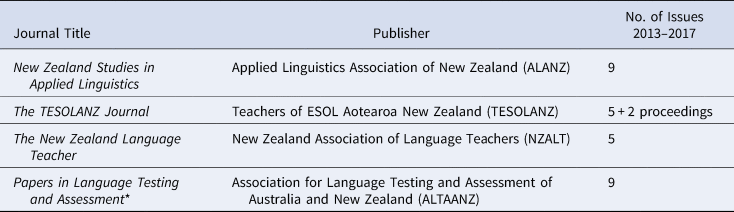
Much of the research carried out in New Zealand is published internationally as high-impact journals are favoured by the official process which regularly evaluates academics' research profiles. Nevertheless, the local audience remains important. The major channels that we have identified are the peer-reviewed journals issued by organisations with an applied linguistics focus (see Table 1).
Journals with an applied linguistics focus

* Although not exclusively New Zealand-based, we have searched it for New Zealand authors to enable their work to find a wider audience.
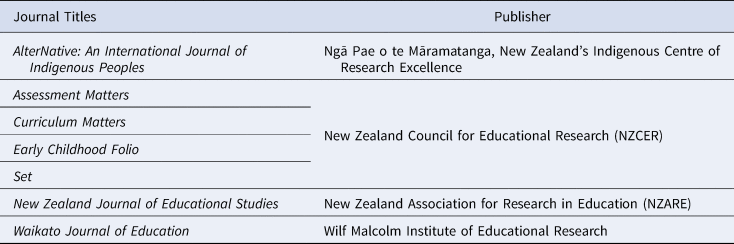
We have also searched journals with a more general educational ambit published by independent research centres, government educational agencies or universities for relevant articles. These are included in Table 2.
Journals with a more general education focus in which articles with an applied linguistics focus have been located

Most books on language learning and teaching in New Zealand are published by international publishers. Nevertheless, seven books published with a more local audience in mind were located which contained at least one chapter with an applied linguistics focus: Higgins, Rewi, and Olsen-Reeder (Reference Higgins, Rewi and Olsen-Reeder2014), Hoskins and Jones (Reference Hoskins and Jones2017) in the field of te reo Māori; McKee (Reference McKee2015) on NZSL; Ogino, Shino, and Nesbitt (Reference Ogino, Shino and Nesbitt2016b) on teaching Japanese; Podmore, Hedges, Keegan, and Harvey (Reference Podmore, Hedges, Keegan and Harvey2016) on multilingual early childhood education centres; and two more general volumes, East and May (Reference East and May2013) and Morgan (Reference Morgan2015). One exception was made for the book chapter McKee and Smiler (Reference McKee, Smiler, Macalister and Mirvahedi2017), which was published internationally, in order to ensure at least a minimum of coverage of New Zealand research published on NZSL.
We have also made a wide search of relevant educational, governmental and non-governmental organisations’ websites, and where we have located commissioned research which met our criteria, in particular, links with themes from the selected academic articles, we have included it. The sites include New Zealand MoE, the Education Review Office, the Office of Ethnic Communities and English Language Partners New Zealand.
A trend away from publishing conference proceedings is apparent. Those of the CLESOL Conference, New Zealand's major biennial conference for community languages and English for speakers of other languages (ESOL), and an important outlet for New Zealand-based researchers, have been the main proceedings source for this article: one set published online, and two published as special issues of The TESOLANZ Journal (see Table 1).
4. Review: research into New Zealand's official languages, 2013–2017
Our review uses selected studies to expand on themes established in the overview. They survey research into the two official languages, te reo Māori and NZSL (Section 4), before moving on to community and other additional languages (Sections 5 and 6). The focus will then move to teaching in a multilingual society at each level of the education system (Section 7), followed by issues related to the teaching and learning of EAL (Sections 8.1–8.7). The review will conclude by examining research into language acquisition and use in the wider community (Section 8.8).
4.1 Using, learning and teaching te reo Māori
Research into the use, learning and teaching of te reo Māori has grown noticeably in volume and variety since the last country survey was published. Much of this is conducted within a Kaupapa Māori framework (Hoskins & Jones, Reference Hoskins and Jones2017), which envisions Māori overcoming the colonial legacy and ‘thriving as Māori’ (Durie, Reference Durie, Hoskins and Jones2017, p. 2). This research is carried out within the context of a Māori world view, in accordance with Māori values (Hoskins & Jones, Reference Hoskins and Jones2017).
4.1.1 Language use and transmission
Giving a general overview of language use, Hutchings et al. (Reference Hutchings, Higgins, Bright, Keane, Olsen-Reeder, Hunia and Kearns2017) report on a large-scale study commissioned by Te Taura Whiri i te Reo Māori, the government agency mandated to ‘promote the use of Māori as a living language’ (Te Taura Whiri i te Reo Māori, n.d.) to investigate the health of the language, and factors which were helpful or detrimental for language learning, maintenance and regeneration. More than 665 adults and children were interviewed about their use and learning of the language. In each community, factors leading to increased or decreased active use were identified.
The findings of this survey were cautiously optimistic. Factors contributing to increased use included the existence or establishment of te reo Māori domains, where the language was normally or exclusively used. Family and tribal strategies, Māori-medium education at all levels, radio stations, succession plans to train younger people in Māori protocol, adult language courses and language champions were also found to have contributed to normalisation of the use of the language.
4.1.2 Language maintenance through the education system
Looking more specifically at Māori-medium schools, ‘where all, or some, of their students are taught curriculum subjects in the Māori language for at least 51 percent of the time’ (Education Counts, 2018), research has included historical perspectives. For example, Tocker (Reference Tocker2015) conducted interviews with some of the founders of the first kura kaupapa Māori-medium school to explore its philosophy and the struggle to set it up. Most were parents who had seen their children's use of the Māori language and cultural understanding flourish in pre-school kohanga reo and were determined to see this continue in their schooling. As well as setting up the first Māori-medium school outside the public education system, they fought what they saw as tokenism and monocultural thinking on the part of the government to achieve the recognition of kura kaupapa Māori as an integral part of a reformed public system.
Current issues are also included in the literature. One of these is transition. At each transition point in the education system, for example, between pre-school and primary school, large numbers of children move out of Māori-medium education into English-medium schools (Bright et al., Reference Bright, Barnes and Hutchings2013; Hill, Reference Hill2015). MoE data indicate significant drop-offs at the beginning of both primary and secondary school, as well as a gradual decline throughout the compulsory education system (Education Counts, 2015). In 2015, only 12% and 5% of Māori students respectively attended Māori-medium primary and secondary schools, compared with 21% in early childhood education. The largest cohort learning by immersion was three-year-olds.
Hill (Reference Hill2015) looked more closely at this issue, tracking five graduates of Māori-medium primary schools during the first three years of their English-medium secondary schooling. He found their overall progress was positive, but that some struggled with aspects of academic English use, and needed more support in their new school environment to develop their Māori proficiency.
Stewart (Reference Stewart2014) elucidates this lack of support within the mainstream. She notes that in spite of the obligation set out in the government's Māori language strategy for all primary school teachers (in both English- and Māori-medium schools) to teach te reo Māori, the language has suffered through the perception by many non-Māori of te reo Māori as inferior to English. She believes this attitude is now giving way to a joint determination to revitalise the language and describes ways for teachers to enrich their current teaching, which in many cases is currently ‘poor or detrimental’ (p. 5). These include informing themselves about the historical and cultural background of the language, using the wealth of existing learning resources and creating resources of their own, as well as engaging with the local Māori community by bringing Māori speakers into the classroom and taking students out to a local marae (centre of Māori community life).
Another issue that arises in the literature reviewed with regard to learning te reo Māori in English-medium schools is whether the cultural dimension is adequately incorporated. Lourie (Reference Lourie2013) studied curriculum documents, and concluded that for Māori students studying the language, a clear connection was made between learning te reo Māori and their cultural identity as Māori, but that a similar connection was not made for non-Māori students. She attributes this in turn to the unresolved question of whether te reo Māori is a national language or a cultural treasure belonging to those of Māori ethnicity, but advocates that use by non-Māori needs to be included as an explicit part of the revitalisation strategy for the language.
4.1.3 Curriculum implementation
Teachers’ role in the implementation of the New Zealand curriculum in its Māori form, Te Marautanga o Aotearoa, in immersion and bilingual programmes, has been the subject of research in the period covered in this review. A survey of teachers in Māori immersion programmes (Education Counts, 2013) showed the majority of respondents were implementing the Māori version of the curriculum and its supporting specifications, but that there was still some variability, and a perceived need for further professional development. Using case studies, online surveys and interviews, Hōhepa, Hāwera, Tamatea, and Heaton (Reference Hōhepa, Hāwera, Tamatea and Heaton2014) evaluated Māori-medium initial teacher-education programmes with a focus on equipping and retaining students for teaching in Māori-medium contexts. They found that curriculum implementation and assessment were the tasks teacher trainees felt least prepared for.
One major assessment project relevant to the learning of Māori (Edmonds, Roberts, Keegan, Houia, & Dale, Reference Edmonds, Roberts, Keegan, Houia and Dale2013) entailed the production of oral language proficiency progressions for Year 1–8 students. These were empirically derived in a multi-stage, inductive process of identifying indicators of different levels of proficiency. The researchers used a five-point scale to specify levels of performance in oral production, grammar, vocabulary, discourse, sociolinguistic competence and cognition.
Two articles dealing with one school subject, mathematics, illustrate some of the challenges involved in Māori-medium curriculum development. Hāwera and Taylor (Reference Hāwera and Taylor2013, Reference Hāwera and Taylor2014) reported on collaboration between researchers and a Year 7–8 teacher in investigating the teaching and learning of transformational geometry in te reo Māori. Their 2013 article focused on the insights which arose from the collaboration, and their 2014 article concentrated on the perspective of the students. The geometry tasks, which the students generally found helpful to their mathematical understanding, used Māori decorative designs as a reference point for learning about symmetry. Relevant features were then embedded in a discussion focusing on their significance and how they were constructed.
4.1.4 Digital technologies
Digital resources for learning te reo Māori abound, and the literature reviewed indicates that they are increasingly important for curriculum implementation. A survey of Māori-medium schools (Murphy & Reid, Reference Murphy and Reid2016) found that online Māori resources such as the dictionary Te Aka (Moorfield, Reference Moorfieldn.d.) were accessed by all schools, that over 90% of them actively purchased digital devices, and that 65% had an ICT strategic plan. However, children attending Māori-medium schools were significantly less likely than their non-Māori counterparts to have a computer at home.
Keegan, Mato, and Ruru (Reference Keegan, Mato and Ruru2015) and Mato, Keegan, and Naera (Reference Mato, Keegan and Naera2016) were interested in whether digital communication technology could potentially widen the use of te reo Māori by creating further domains for its use and, if so, what triggers could stimulate this. Keegan et al. (2015) found the use of Māori-language tweets to be increasing, with peaks coinciding with particular events. Mato et al. (Reference Mato, Keegan and Naera2016) conducted a survey of users of a Māori-language interface developed by one smartphone provider which highlighted some of the difficulties in simply translating instructions and functions into a minority language.
Although the predominance of English and the relatively small numbers of fluent speakers work against intergenerational transmission, the surveyed literature documents determined and innovative efforts to maintain and revitalise te reo Māori.
4.2 NZSL
Like te reo Māori, NZSL was found to be under threat from demographic factors reducing the number of users and from the complexities of intergenerational transmission (McKee & Smiler, Reference McKee, Smiler, Macalister and Mirvahedi2017). McKee (Reference McKee2015) examined the impact which the recognition of NZSL as an official language in 2006 has had on its vitality. She concluded that the expectations raised in the deaf community by official recognition for better planning and resourcing had only partly been fulfilled, and that in light of the reducing numbers of users, this ran the risk of being ‘too little and too late’ (McKee, Reference McKee2015, p. 493). As is the case for te reo Māori, there are both optimistic and pessimistic views of the future for NZSL among its users.
McKee and Smiler (Reference McKee, Smiler, Macalister and Mirvahedi2017) examined the effects of family language policy at macro-, meso- and micro-levels, drawing on the experiences of ten individual families. The authors found that the availability of cochlear implants and the desire of hearing parents to pass on their own linguistic identity to their deaf children, combined with limited support for deaf children in acquiring the language, had resulted in a steep decline, especially in the numbers of younger users of NZSL. They noted that more recently, government policy has provided more support for NZSL acquisition in education, including early childhood education, but that the impact of these changes was yet to be measured.
Among measures to boost vitality has been the development and testing of the website Learn NZSL (www.learnnzsl.nz). Alexander, Vale, and McKee (Reference Alexander, Vale and McKee2017) reported on its development and the experience of users. While online learning provided flexible access, the lack of contact with a teacher or other learners led to a high dropout rate. The authors concluded by discussing ways of motivating students, including creating a virtual community among learners, supplying feedback on learning, or gamifying aspects of the learning.
5. Review: community languages in a multilingual society, 2013–2017
The issue of maintaining intergenerational transmission arises for community languages as it has for te reo Māori and NZSL. King and Cunningham (Reference King and Cunningham2017) attempted to estimate the rates of intergenerational transmission of te reo Māori and Samoan. They found that in spite of the rapid attrition the language was experiencing among the New Zealand Samoan community, the rate of intergenerational transmission for Samoan in the main Samoan population centre, Auckland, was still significantly higher than for te reo Māori.
Investigating family language policy as a factor in intergenerational transmission, Revis (Reference Revis2016) compared how parents and children in two refugee communities living in New Zealand, Colombians and Ethiopians, negotiated which language to use at home, English or first language (L1). She distinguished between explicit and laissez-faire policies of language management, finding that the Ethiopian parents tended to adopt an explicit policy of using only Amharic in the home. By contrast, the Colombian parents, who had been in New Zealand for a shorter time and were thus focused on learning English themselves, exhibited a more laissez-faire approach, allowing the use of both Colombian and English.
Going beyond the home, the professional development of community language teachers is receiving increased attention. As noted in ACE Aotearoa (2017), a wide variety of languages is taught, often by people who, although they may have trained as teachers in their own country, do not know much about prevailing language teaching practices in New Zealand. Bao, Zhang, and Dixon (Reference Bao, Zhang and Dixon2016) provided an illustration of this in their case study of a Chinese teacher (the first author) whose prior teaching embodied a traditional teacher-centred approach using a textbook to teach grammar, but who needed to make a major shift when she began teaching Chinese in New Zealand. Bringing together influences from both contexts, she listed the beliefs that evolved in her new context, including the need to use authentic scenarios, attention to learners’ L1s, teaching grammar communicatively and adapting teacher roles.
In summary, community languages in New Zealand face strong competition from English and rely on family transmission or on teachers with varying levels of training and awareness of the local context, and little direct government support.
6. Review: additional languages, 2013–2017
Much of the research described in this section focuses on the decline in the numbers of language learners and how it can and is being reversed. An additional prominent theme is developing intercultural competence within the context of language learning.
6.1 Declining numbers
Several studies documented the decline in numbers of learners of additional languages. McLauchlan (Reference McLauchlan2015/2016) noted ‘ominous’ signs that the pragmatism governing subject choice as students move through the education system is decreasing overall numbers in language classes, with a correspondingly detrimental effect on the capacity of schools and tertiary institutions to offer languages. McLauchlan found that between 2002 and 2012, the numbers of students learning French, Japanese, German and Latin at secondary school reduced by rates of 7%, 35.7%, 34.1% and 50.1%, respectively. Although the numbers learning Chinese, Spanish and te reo Māori increased, this was not sufficient to make up the difference. Overall, excluding te reo Māori and Pacific languages, there was a 14% decline between 2005 and 2015 in the numbers of secondary school students enrolled to study a second language (L2) (NZALT & Asia New Zealand Foundation, 2016).
As McLauchlan notes, as numbers of students decrease, there is a danger that the capacity to provide instruction in additional languages declines with them. Echoing this, Ward and East (Reference Ward and East2016), drawing on interviews with principals and lead language teachers in four schools (n = 7) and an online teacher survey (n = 112), reported that the factors influencing schools as they made decisions about additional languages programmes included quality of teaching staff; timetabling and curriculum constraints; lack of status for language learning; and lack of compulsion to take a language.
East and Tolosa (Reference East, Tolosa and Morgan2015) examined pragmatism regarding language learning (judgments based on the perceived ‘usefulness’ languages have for work prospects, travel etc.). They traced the impact of the so-called ‘STEM revolution’ on the New Zealand school system. The authors observed that the current international focus on STEM subjects (science, technology, engineering and mathematics) to boost international competitiveness appears to be lowering the status of languages, thereby threatening the recruitment and retention of language students who, especially in the final years of secondary schooling, are often forced to choose between STEM subjects and others. Ogino, Nesbitt, and Shino (Reference Ogino, Nesbitt, Shino, Ogino, Shino and Nesbitt2016a) observed a decline of 48% in tertiary level enrolments in Japanese between 2005 and 2015. In addition, Ashton and Shino (Reference Ashton, Shino, Ogino, Shino and Nesbitt2016) found a strong move from studying Japanese as a major to studying it as a minor, alongside ‘career’ subjects.
The status of additional languages in the curriculum has also been weakened by the myth that everyone speaks English (East & Tolosa, Reference East, Tolosa and Morgan2015), leading to the assumption that languages other than English are essentially irrelevant for employment purposes. This view has been challenged by others who see language learning as integral to the global competitiveness STEM subjects are supposed to boost. East and Tolosa presented a case study of a Christchurch secondary school which, while adopting the status of a ‘STEM school’, has embraced all existing subjects and advocated an integrated, cross-curricular approach to STEM. They warned that in a fluid curricular environment, the future of language learning will rely on re-invention which moves away from teacher-fronted instruction as the paradigm to adopting innovations such as those described in Section 6.2.
6.2 Retention of learners
In response to declining numbers, motivation and retention have emerged as key themes. At secondary level, the interviews Scheffer-Cosslet and Kitchen (Reference Scheffer-Cosslett and Kitchen2013) carried out with students of German supported their contention that motivation is complex and multidimensional. The ability of students to imagine themselves using German for authentic communication with native speakers was identified as a crucial motivating factor, most commonly among those with previous experience of living in a country where multilingualism was the norm.
Payne, Howard, and Ogino (Reference Payne, Howard and Ogino2017) investigated whether secondary New Zealand students of Japanese were motivated by Japanese popular culture (specifically manga, graphic novels, and anime, animated films), as indicated in international literature. The study found that while a significant minority of the 178 students surveyed identified anime in particular as a motivational factor, the majority did not actually watch it. Those who did noticed educational benefits, and the authors concluded that anime could motivate students and aid their learning. In a more practical vein, Kennedy (Reference Kennedy2016) explores the merits of competing systems for teaching Chinese characters.
At tertiary level, the volume edited by Ogino, Shino, and Nesbitt (Reference Ogino, Shino and Nesbitt2016b) demonstrated ways that new thinking can stimulate student interest in a language traditionally taught in quite a formal way. In their introduction, Ogino, Nesbitt, and Shino (Reference Ogino, Nesbitt, Shino, Ogino, Shino and Nesbitt2016a) asserted that models and policies need to ‘be radically re-engineered’ (p. 19), if the decline in enrolments is to be reversed. They suggested both administrative changes, such as collaboration with government and non-government organisations, and the creation of learning pathways. They recommended moving from traditional teacher-fronted classrooms to much more innovative and egalitarian settings.
Other contributions to the same volume expanded on new forms of authentic engagement with the language. Kawai and Gallagher (Reference Kawai, Gallagher, Ogino, Shino and Nesbitt2016) studied how 150-hour work placements in schools or companies where Japanese was used helped students majoring in Japanese to develop autonomy. Nishimura and Umeda (Reference Nishimura, Umeda, Ogino, Shino and Nesbitt2016) ran visitor sessions, where native Japanese speakers learning English at the university visited their class of pre-intermediate learners of Japanese. An analysis of transcripts of the conversations showed how students benefited from the opportunities for practice and authentic communication the visitors offered. Minagawa (Reference Minagawa, Ogino, Shino and Nesbitt2016) also used transcripts, this time of a television drama, to enable students of Japanese linguistics to study language variation, register and politeness, as well as extralinguistic behaviour.
In a comprehensive departure from traditional approaches, Kawai, Waller, and Nesbitt (Reference Kawai, Waller, Nesbitt, Ogino, Shino and Nesbitt2016) integrated project-based language learning into two non-sequential, mixed-level classes, and found that the benefits far outweighed the drawbacks of giving up textbook-based instruction. Finally, Tabata-Sandom (Reference Tabata-Sandom, Ogino, Shino and Nesbitt2016) explored how extensive reading can be used to complement the traditional focus on accuracy-based intensive reading, thereby supporting fluency development.
6.3 Building intercultural communicative competence as part of language learning
The increasingly multicultural nature of New Zealand communities makes it desirable for New Zealand children to acquire intercultural competence early, and it is highlighted in the official New Zealand Curriculum as a component of the Learning Languages strand; as students ‘compare and contrast different beliefs and cultural practices, including their own, they understand more about themselves and become more understanding of others' (MoE, 2017b). The studies reported in this section concern teachers’ intercultural communicative competence. Student competence appears to be under-researched by comparison.
Howard, Biebricher, Tolosa, Scott, and East (Reference Howard, Biebricher, Tolosa, Scott and East2016) reported on the varied beliefs and practices of five teachers of Year 7–8 students, as part of an MoE project to support intercultural capability in intermediate schools. The participating teachers were not language specialists, though they had received relevant professional development. The researchers found their subjects’ understanding of the principles of intercultural communicative competence varied widely. While there was a consensus that language learning needed to be interactive and communicative, their treatment of culture in the classroom was based more on transmission of information and viewed as separate from language. The exception to this was a teacher of te reo Māori, for whom language and the world view it expresses were inextricably linked. The researchers saw this as a reference point for other teachers in building intercultural competence.
Two further studies on incorporating principles of intercultural competence at primary-school level found teachers’ understandings were under-developed. Howard, Scott, and East (Reference Howard, Scott and East2015) observed classes. In the lessons they witnessed, featuring both language and culture on the topic of birthday celebrations, the teacher and students began to reflect on the meaning of cultural differences, though this was inadequately developed. Oranje and Feryok's study (Reference Oranje and Feryok2013) related to the attention given by teachers to the home cultures of their students. They also found that evidence of intercultural awareness was limited, and, in the case of the specialist ESOL teacher, specifically avoided: teaching culture was ‘wasting time’ when ‘really they need to know the language so they can relate to the teacher and to their peers’ (p. 12).
With more encouraging results, at secondary level, Conway and Richards (Reference Conway and Richards2016, section 3) surveyed language teachers regarding how they made their teaching culturally responsive, in particular by acknowledging the cultural identity of their students and the language knowledge and experience they brought with them into the classroom. The survey brought to light a diverse range of practices used to create learner-centred classrooms in which the cultural and linguistic identity and resources of the students were explicitly drawn upon ‘with a focus on interaction and communication’.
East (Reference East2013a) examined how to build the intercultural communicative competence of language teachers through in-country professional development – in this case, a two-week government-funded Language and Culture Immersion Experience for secondary school teachers of French. Despite the brevity of the course, the participants found their understanding of French language and culture improved significantly, and they felt better placed to raise awareness of cultural differences among their students.
7. Review: teaching for a multilingual society, 2013–2017
This section looks at research examining teachers’ practices in response to students from multilingual origins, now common in New Zealand. There are studies at each level of the education system, beginning with early childhood.
7.1 Early childhood education (ECE)
The research reveals that many ECE centres are multilingual sites. Reflecting international trends, studies reviewed here focused less on fixing supposed deficits in English and more on valuing and building on the languages and multilingual skills children bring with them.
An example of this focus is an edited volume produced through collaboration between researchers from the University of Auckland and teacher-researchers from four Auckland ECE centres (Podmore et al., Reference Podmore, Hedges, Keegan and Harvey2016). These included a Māori- and a Samoan-medium centre, and two English-medium centres with students representative of the linguistically superdiverse Auckland population. Based on questionnaires and focus groups for staff and parents, observations and video-clips, and teacher-student interviews, the study sought to document the languages spoken in centres, the learning experiences of the children, and the outcomes valued by parents, teachers and children. Here, the focus was on additive bilingualism, envisaging English as adding to the language repertoire of the children, rather than replacing the heritage language. The primary research interest was therefore in how home languages and the funds of knowledge students arrived with might be used to promote age-appropriate learning.
The authors found a range of practices in response to the plurilingual settings. For example, in the Samoan immersion centre, English was spoken only in specially designated areas (Tapusoa, Podmore, Tuafuti, Taouma, & Crichton, Reference Tapusoa, Podmore, Tuafuti, Taouma, Crichton, Podmore, Hedges, Keegan and Harvey2016). In the Māori centre, particular periods of the day were devoted to culturally appropriate use of te reo Māori (Castle, Young, Liley, Keegan, & Popata, Reference Castle, Young, Liley, Keegan, Popata, Podmore, Hedges, Keegan and Harvey2016); and in the English-medium centres, different languages were present on the walls, and greeting and departing times were moments of high use of the home languages (Anandh, Harvey, Hedges, Lotomau, & Subhani, Reference Anandh, Harvey, Hedges, Lotomau, Subhani, Podmore, Hedges, Keegan and Harvey2016; Hartley et al. Reference Hartley, Rogers, Smith, Lovatt, Harvey, Hedges, Podmore, Hedges, Keegan and Harvey2016). The study indicates values promoted by the curriculum – empowerment, relationships, family, community and holistic development (MoE, 2017a) – but also reveals culturally specific values reflecting the language and culture of each centre. Involvement in the research project raised staff members’ awareness of the linguistic richness of their charges and new practices were developed in each centre. These were particularly salient in the English-medium centres, and included a deeper co-operation with the families and a growth of the metalinguistic awareness of both monolingual and bilingual children.
Acknowledging that the project had shown ‘how multiple languages can be fostered intentionally in planned and systematic ways’ (Harvey, Hedges, Podmore, & Keegan, Reference Harvey, Hedges, Podmore, Keegan, Podmore, Hedges, Keegan and Harvey2016, p. 118), the researchers concluded that teachers need the professional knowledge to recognise the value of these approaches. This is underscored in a report by the Education Review Office (ERO, 2017) based on data drawn from 167 ECE centres and 104 schools, which focused on the development of oral language in early years (in both English and other home languages). It found ‘very few services where teachers had a clear and shared understanding of expectations for children's oral language learning and development’ (p. 19), and, among other recommendations, suggests encouraging use of the home language and appointing staff who share home languages with some of the children.
Two studies have used narrative approaches to investigate the experiences of such multilingual teachers in ECE. N. Harvey (Reference Harvey2013a) recorded the ‘principled practices’ (p. 19) of five teachers known to use home languages in their work. The teachers noted positive benefits, including helping students and their families to feel safe, supporting language maintenance, and building on learning from children's early L1 experience. On the other hand, Arndt (Reference Arndt2014) pointed out that within the climate of apparent celebration of the diversity of children and their families, teachers from non-local origins can struggle to have their differences appreciated and to avoid pressures to homogeneity.
7.2 Primary schools
Like ECE teachers, their primary school counterparts often have limited preparation for the language needs of their students. The focus of research in primary schools over this period shares with that in the previous section an interest in teacher knowledge and awareness, but is concerned with the learning of English, with little attention to home languages.
Berry and Kitchen (Reference Berry and Kitchen2014), also interested in oral language as part of learning, analysed recorded interactions including ELLs, their native English-speaking peers and the teacher in the first author's own classroom. They concluded that the teacher's reflection and flexible intervention is key to optimising opportunities for learners to benefit from interactive work. Newton and Jeurisson's (Reference Newton and Jeurissen2013) small case study showed how portfolios of work done by students in ESOL withdrawal classes could help enhance awareness by mainstream teachers of their ELLs’ language needs, and help students see connections with their other classes.
7.3 Secondary schools
Students of diverse language backgrounds featuring in the ECE and primary research reviewed here appear to be mainly the children of migrant families. At secondary level another important cohort is present, namely international students. ERO (2013) indicates that immediately prior to the period in review, there were nearly 8,500 international students enrolled in New Zealand secondary schools.
Three of the articles about this level (Kitchen, Reference Kitchen2013; McCarthy, Reference McCarthy2016a, Reference McCarthy2016b) are concerned with relationships between ELLs and their peers. Kitchen explored how Korean migrant students who had primary schooling in New Zealand experienced the transition to secondary school. They often felt a loss of confidence and connectedness, as they were sometimes excluded from groups that had earlier accepted them as full members. In this vacuum, some gravitated towards newly arrived Korean international students and adopted Korean modes of behaviour. Kitchen observed that this could work against aspirations parents expressed for their children's integration into New Zealand society and workplaces.
McCarthy's research into refugee-background Nepali students in a provincial secondary school also included the relationships that can affect adolescents’ educational progress. McCarthy (Reference McCarthy2016b) identified the trajectory of friendship networks made possible by changing language proficiency and strategic choice within both first and new culture environments. Prioritising friendships that helped reinforce their Nepalese identity meant their progress in English was not as rapid as expected, but enabled them to balance both influences. The focus of McCarthy (Reference McCarthy2016a) was on the methodological insights gleaned in researching this potentially vulnerable group of adolescents from her perspective as a teacher turned researcher. She noted the value of well-established relationships with the students, their families and communities, a combination of focus groups and one-to-one interviews, and strategies for encouraging relaxed discussion.
7.4 Tertiary learning
At tertiary level, two projects looked at EAL students engaged in university study. Lee's (Reference Lee2017c) study of ten students during their first semester in a New Zealand university examined how in making sense of academic demands they called on brokers, both peer and non-peer, outside classes. A shared language was often key to peer brokering, but they also sought out students who had superior knowledge of the course or the academic culture, even where there was no shared L1. In a further article, Lee (Reference Lee2017b) reflected on cross-linguistics issues she had faced in that study in interviewing students with whom she did not herself share an L1.
At doctoral study level, Reinders, Cho, and Lewis (Reference Reinders, Cho and Lewis2013) considered the affordances provided by online interactions between one supervisor and four Ph.D. students, all advanced L2 speakers of English. The study examined written feedback, noting the importance of affect and its potentially greater demands in computer-mediated encounters. The supervisor was found to be attentive to the relationships, making extensive use of politeness strategies, and giving rationales for suggestions made. Comments on language mistakes, however, were conveyed more baldly.
8. Review: learning, teaching and using EAL, 2013–2017
This section reports on studies investigating aspects of the teaching and learning of EAL in educational institutions, covering issues pertaining to the curriculum, what is taught and how it is taught, and to teachers themselves. Finally, it looks at how ELLs fare in the wider community.
8.1 Curricular issues
A number of studies have given an overview of curricular issues at tertiary level, and the responsiveness to different needs. They cover a community-based course for refugee-background learners with low levels of L1 education (Potgieter, Reference Potgieter2016), general English courses for both migrant and international students (Andrew, Reference Andrew2016a), English for academic purposes (EAP) courses (Bruce, Reference Bruce2017) and courses delivered overseas by a New Zealand institution (Otto, Reference Otto2013, Reference Otto2016).
Potgieter's (Reference Potgieter2016) action research project to promote adult learners’ critical awareness of their learning was undertaken in a class for former refugees grappling with English and literacy at an early level, with a bilingual tutor able to support some of the learners with translation. She introduced new tasks, each of which had an important element of peer learning. Potgieter found that this aspect and ongoing self-assessment activities may ‘rais[e] learners’ critical awareness of learning at this level’ (p. 55).
Andrew (Reference Andrew2016a) discussed critical pedagogy, by which teachers and students unpack normalised language use to recognise issues of power imbalance. He provided three examples of praxis in English classes for adults which required students to engage with the community. Student tasks included a community volunteer placement, an ethnographic exploration of diversity, and a portfolio reporting on authentic listening opportunities. In each, a built-in reflective process allowed the participants to deepen their understanding of the community and of themselves as language users within it.
Bruce (Reference Bruce2017) noted the rising demand for specialised EAP courses in New Zealand and elsewhere as international and migrant students seek access to study. He asserted that EAP requires a specialised understanding, but that teachers typically enter EAP teaching without specialist preparation. Bruce calls for inclusion of this area in teacher-education courses and for New Zealand conferences and symposia to develop the field.
The focus of two studies by Otto (Reference Otto2013, Reference Otto2016) was appropriate processes for designing ‘place-based’ courses to be delivered in collaboration by a New Zealand educational institution and an offshore partner. Key contributors to the success of two blended learning programmes delivered in Malaysia were ‘dialogues and conversations with all the stakeholders’ (Otto Reference Otto2016, p. 41) and training provided by the New Zealand institution for local staff facilitating face-to-face sessions which took account of the local context.
8.2 Assessment issues
A general movement towards standardised national qualifications for government-funded education intensified interest in the assessment of ELLs over the period. Read (Reference Read2014) raised some general concerns about assessment, discussing concepts of consistency, fairness and validity in relation to assessed writing in two large-scale standardised tests (IELTS and TOEFL), and one standards-based assessment task from the New Zealand Qualifications Authority Framework for secondary students. These examples highlighted the complexity and importance of striving for these three qualities.
Fairness to ELLs in the administration of tests designed for native speakers was raised in several studies at different levels. As Darr (Reference Darr2014) explains, mathematics tasks are contextualised to relate them to real-world processes, but the language and contexts used may not be familiar to ELLs, as confirmed in Jourdain and Varta Sharma's (Reference Jourdain and Varta Sharma2016) literature review of the linguistic challenges posed by the study of mathematics. Tung and Kitchen (Reference Tung and Kitchen2014) examined the impact on a single 12-year-old refugee-background learner of a mathematics test widely used in primary schools to help teachers establish each student's learning needs. They found that some instructions and vocabulary, both general and technical, were not understood by their subject. Consequently, such tests may under-represent the achievements of ELLs, leading to inappropriate decisions about their needs.
Luxton (Reference Luxton2013) reported on the development of a diagnostic reading test for ELLs in secondary schools to provide a fairer alternative to existing tests designed for native speakers. Lane (Reference Lane2014) addressed this issue at tertiary level in an MoE report on an assessment tool in mandatory use in all government-funded adult education for literacy and numeracy. The report tentatively concluded that the literacy skills of ELLs were appropriately assessed. However, numeracy test data was less clear, and ELLs were noted to take longer to complete assessments than other learners.
In another study with implications for fairness, Wu and Erlam (Reference Wu and Erlam2016) investigated the impact of time limits in tests of L2 writing. They administered two tests, one timed and one untimed, to a group of adult ELLs. An innovative aspect was the adjustment of the time limit for individuals proportionate to the rate of writing achieved under the untimed condition. There was evidence that a trade-off sometimes occurred in attention to aspects of the writing when time was limited, but there were individual differences as to which aspects were affected.
Others have reported on new test development. Read (Reference Read2016) provided an account of the development by the New Zealand Qualifications Authority of the New Zealand Certificate in English Language (NZCEL), a standardised national qualification. He discussed the complexities of benchmarking with international qualifications and frameworks such as the Common European Framework of Reference and the IELTS examination, and meeting equivalence standards with other New Zealand measures. Hiser (Reference Hiser2013) was also concerned with benchmarking, and gave an account of research probing the relationship between a placement test developed within her university and IELTS bands awarded to the same students. Results suggested ‘the real possibility of developing placement tests for specific programmes which reflect the international norms of professionally standardised English-language tests’ (p. 1).
Assessment of speaking has been a cross-cutting theme during the survey period (refer to Section 4.1.3). In the case of additional languages, East (Reference East2014) and Erlam (Reference Erlam2015) investigated a National Certificate of Educational Achievement standard introduced in secondary schools in 2010 to align assessment better with the curriculum through the use of unscripted peer interaction in the target language. Erlam emphasised its potential to provide valuable washback. For example, she found the interactions showed instances of developing fluency and peer support. East's survey of 152 language teachers similarly elicited favourable comments about the authenticity and washback of the new standard. However, time and technical issues left some teachers unwilling to use it.
8.3 Vocabulary
Vocabulary size and the lexical demands of study have been of particular interest in vocabulary studies in the period.
Omidian, Beliaeva, Todd, and Siyanova-Chanturia (Reference Omidian, Beliaeva, Todd and Siyanova-Chanturia2017) compared the use of single and multi-word items of academic language in a corpus of L2 English essays in a New Zealand secondary school with essays from the Louvain Corpus of Native English Essays (though see Nesi, Matheson, and Basturkmen, Reference Nesi, Matheson and Basturkmen2017, below for the comparability of such sources). Native-speaker adolescent writers used significantly more varied academic vocabulary, though there was a much higher degree of similarity in use of multi-word items. Luxton, Fry, and Coxhead (Reference Luxton, Fry and Coxhead2017) go beyond measuring to supporting academic vocabulary development. They worked with ESOL and disciplinary teachers in 35 secondary schools, raising their awareness of vocabulary issues and sharing principles of ESOL, vocabulary learning and general education. Although there were no control groups, given the teaching-as-inquiry approach taken, the study found that ‘students, especially English-language learners, could make rapid strides in learning academic vocabulary with appropriate support’ (p. 20).
Parkinson et al. (Reference Parkinson, Coxhead, Demecheleer, Mackay, Matautia, McLaughlin and Tu'amoheloa2017) reported on a large-scale project, ‘Language in the Trades’, to investigate language demands and teaching practices, develop resources, including bilingual materials, and support language development in four trades areas. They found teaching texts were ‘lexically as demanding as university-level academic texts’ (p. 10) and recommended ways of addressing this. Coxhead, Demecheleer, and McLaughlin (Reference Coxhead, Demecheleer and McLaughlin2016) focused on one of the trades, carpentry, identifying a high number of new lexical items and ‘heavy reliance on oral language in the classroom and on the building site’ (p. 38) as key learning challenges.
8.4 Teaching and learning literacies
Work under this heading is divided into literacy at university level and the emerging literacy of adult students with limited prior education.
Reflective of Bruce's (Reference Bruce2017) comment about the growth of EAP, several studies have shown an interest in how demands at tertiary level have been met. Wette (Reference Wette2013), concerned at the lack of research into classroom practices, investigated those of seven experienced, qualified and highly regarded teachers of academic writing. She was particularly interested in the use of product- or process-orientations towards writing instruction. She found the two were blended in lessons that were genre-based but also included writing process and sentence-level grammar and vocabulary. Teachers were, though, concerned to go beyond language support to develop student capabilities for future disciplinary study. This was also the guiding principle for a course on academic writing described by Andrew and Romova (Reference Andrew and Romova2014), where students produced a portfolio of writing based on analysing and creating text types linked to their future study disciplines. They noted that the students were thus able to develop imagined future identities as successful communicators within those disciplines. One further article focused on products – academic assignments – rather than instructional procedures. Nesi et al. (Reference Nesi, Matheson and Basturkmen2017) compared features of undergraduate student writing from British, US and New Zealand corpora. The comparison reveals that of the three, the New Zealand examples were the most formal linguistically, which may have implications for student mobility and the applicability of EAP materials across educational environments.
Two articles by Field address the effectiveness of approaches to teaching reading to adults with low-level literacy in English, some with minimal L1 literacy, an area that has not been widely researched. In both studies, she found that elements of student autonomy were attainable. Field (Reference Field2017b) received positive student feedback on a scaffolded ‘balanced’ approach to teaching reading, including computer-mediated and co-constructed texts recording the class's shared experiences. The other study (Field, Reference Field2017a) surveyed students about an extensive reading intervention providing a daily period of silent reading of easily understandable texts to promote fluency. Growing autonomy, enjoyment and positive reading habits were indicated. Although neither study had control groups, Field highlights the importance of reading that is varied, interesting and relevant to the readers and within students’ current competency.
8.5 Listening
Two studies reported on programmes to enhance students’ listening by providing a programme of out-of-class activities: Roe (Reference Roe2013) through a choice of pre-selected e-listening texts, and Andrew (Reference Andrew2016b) through self-selected listening, including both CALL semi-authentic texts and real-life face-to-face encounters. In both studies, students produced a reflective record of their listening and reported on their use of strategies. Andrew pointed out that this reflection led them into metacognitive domains and enhanced their awareness of their agency as their listening improved. Roe noted that learner autonomy was enhanced. In both cases, most students found the programme provided skills they transferred into other important areas of language use.
8.6 Teacher cognition
In Sections 8.6 and 8.7, the focus turns specifically to teacher cognition.
Noting the responsibility mainstream teachers have for supporting ELLs in their content classes, two small surveys investigated their knowledge in this regard. Edwards and Easto (Reference Edwards and Easto2013) studied early-career primary teachers, and Edwards (Reference Edwards2014) researched secondary teachers of English, Science, Mathematics or Social Science, subjects for which MoE resources for supporting ELLs have been developed. The studies indicated a low level of knowledge of ELL needs and little time to provide support. This is of some concern considering the conclusions of Edwards (Reference Edwards2016), which examined MoE materials designed to assist mainstream teachers in supporting ELLs. The analysis found that the demands of grammatical and metalinguistic knowledge they make would render them difficult for some New Zealand-educated teachers to access, since the education system lacks a strong tradition of grammar instruction.
Two studies have investigated the cognition of ESOL teachers at tertiary level. Field and Vane (Reference Field and Vane2017) investigated teachers’ perceptions and promotion of learner autonomy, focusing particularly on students with low levels of literacy. Participants were far less likely to perceive this group as autonomous compared with those of higher proficiency, but accepted responsibility for fostering autonomy in all groups through targeted scaffolding. Tan's (Reference Tan2017) study of teachers’ attitudes to the use of L1 took place in an English-language centre where signs exhorted students to speak ‘English only’. However, the participant teachers subverted this where classroom use of L1 supported other objectives, such as the learning of course content. Tension arose where the presence of a dominant group of co-nationals or students with low English proficiency led to particularly high L1 use.
8.7 Teacher education and professional development
There has been research interest in three widely used tools for teacher development, namely reflection, observation and reading, as well as investigations of the experiences of non-native English speakers studying language teaching in New Zealand.
Conway and Denny (Reference Conway and Denny2013) conducted a follow-up study of a Master's-level course where experienced language teachers participated in a reflective practice project. Participants indicated this had enhanced their ability to learn from reflection, particularly from course activities with a dialogic element, such as post-observation discussion with tutors and peers. Haultain (Reference Haultain2013) was also concerned with depth of reflection in teacher education, and with the power of photo-elicitation to support it. Her teacher-education students were invited to supplement their reflective journals with self-taken photos relevant to their language-learning experience component. She found this led to a ‘depth of comment … and … unexpected detail’ resulting in excellent essays with ‘increased depth of critical reflection’ (p. 7).
Another process widely used for in-service teacher development, observations, was the subject of Naik, Hodges, and Kirk's (Reference Naik, Hodges and Kirk2017) small-scale project investigating the use of a four-step framework (collaboration, observation, teacher reflection, extension: CORE), designed to increase the agency of the observed teacher through building on collaboration established at the outset. The study found that CORE encouraged greater experimentation, lasting change, and less stress about the observation process.
Kitchen, Gray, and Jeurissen (Reference Kitchen, Gray and Jeurissen2015) were interested in the professional reading that practising primary school teachers enrolled on an in-service Teaching English to speakers of other languages qualification did prior to and during their study. Their study found the frequency was ‘beneficial but low’ (p. 63), but that motivation and participation jumped where relevance to their own practice was identified, especially after enrolment on the course.
Hartley et al. (Reference Hartley, Rogers, Smith, Lovatt, Harvey, Hedges, Podmore, Hedges, Keegan and Harvey2016) described the use of two evaluation tools for language teachers participating in a year-long in-service training programme to assess their use of core practices seen as promoting student success. The tools consisted of a portfolio collecting evidence of principle and strategy use, and a template for evaluating practice in relation to interactive and meaningful use of the target language by both teachers and students. She evaluated the reliability and validity of the tools and used a case study to illustrate their effectiveness.
Two studies invited non-native English-speaking students to provide retroflection on their study for English-teaching qualifications in English-speaking universities. In both, students generally valued the courses, with some caveats. Li and Tin (Reference Li and Tin2013) found a gap in expectations of opportunities for teaching practice. Erlam (Reference Erlam2014), following up graduates of a Malaysian government-sponsored programme to educate English teachers in New Zealand, found that on return to their high-structure transmission-focused education system, they encountered severe limitations on their ability to implement student-centred approaches advocated in the course. Both studies underline the importance of New Zealand-based educators having a well-developed understanding of the contexts their students will teach in.
8.8 Language learning and use in wider contexts
Some research over the period has been interested in community affordances for English learning, and in issues of language use in New Zealand.
8.8.1 Learning English in the community
English Language Partners, a community organisation reaching over 7,000 learners nationally (English Language Partners, 2017), commissioned two research reports into its impact over the period. Alkema (Reference Alkema2015) investigated the pathways that learners take as a result of participating in its various programmes, including community-based group learning and the Home Tutor service provided one-to-one by trained volunteers. This latter service was the focus of Thomas (Reference Thomas2017). While English language is key to the organisation's purpose and was highlighted by interviewees in both studies, they also identified gains in other areas, such as employment, inclusion and wellbeing. Home tutors ‘are not only teachers, they also act as conduits, connectors and circuit-breakers’ (Alkema, Reference Alkema2015, p. 15). Tutors, too, highly valued the connections with new communities and derived wellbeing from the experience.
Three other studies used interviews and observations with migrants and former refugees to uncover their language practices, looking at issues such as agency, identity and belonging. Kaur (Reference Kaur2015) interviewed a former refugee Syrian woman, using a framework of literacy as a social practice. She observed rich encounters within the family where engagement with digital literacies involved multiple languages and media as well as discussion among household members. In community encounters, her subject demonstrated agency that included volunteering at the local school and mosque.
In another study, Ishii (Reference Ishii2017) undertook an ethnographic study of a former refugee in his sixth year of settlement regarding his ‘efforts to learn English, his conflicts with others, and his sense of identity’ (p. 12). Early ambitions to acquire high proficiency in English were thwarted, leading to a narrowing of his sights to what was particularly important for him (e.g. the vocabulary of politics). He accepted a more translanguaging usage, in communities largely involving other migrants. An increasing sense of isolation within the local community eventually led him to emigrate. A partial sense of exclusion is reflected too in Lee's (Reference Lee2017a) study of six Asian women migrants highlighting the difficulty they had in shedding perceptions of them as ‘language learners’, in spite of their length of time and achievements in New Zealand. The constant requirement to prove their credentials as English speakers had a negative impact on their sense of self-worth and belonging, which they were sometimes able to overcome through other displays of skill.
8.8.2 Language use in the community
The interrelationship of employability and language dominates studies on language use in the community, exploring both the impact of English proficiency and the value accorded to knowledge of other languages. Pilott (Reference Pilott2016) surveyed employers to discover which features of non-standard pronunciation of English were a barrier to appointment. Of the factors considered, segmentals, prosody and fluency all proved to be important, but the lack of fluency proved the strongest impediment. The focus of Kuśmierczyk's (Reference Kuśmierczyk2013) study of employment interviews was extralinguistic aspects, including ‘gesture, gaze, space and objects’ (p. 59), and how paying attention to them, and taking appropriate actions, can improve success. Riddiford (Reference Riddiford2017) sought a practical outcome in developing a research-based EAL resource to support skilled migrants meeting the challenges of a job interview.
Erlam and Pimentel Hellier (Reference Erlam and Pimentel Hellier2016) and Erlam and Yan (Reference Erlam and Yan2017) reported on demand for other languages within the Auckland market. They found that around 7% of the jobs studied explicitly required this, but their investigations suggested that the actual proportion is probably higher. The languages in greatest demand were Mandarin/Cantonese and te reo Māori. The jobs covered a range of categories, particularly ‘business and administrative support, retail, hospitality, tourism and education’ (Erlam & Yan, p. 21).
Another aspect of integration within the new community, jury service, which any New Zealand permanent resident may be summonsed to, was investigated by Smith (Reference Smith2015). While the ability to understand the trial is a legal obligation for membership of the jury, the suggestion in the initial information that ability to understand a ‘group conversation in English’ (p. 59) is adequate downplays the complexities of the linguistics, pragmatics and culture of a courtroom. The article recommends better, and translated, information and clearer English-language requirements.
9. Conclusion
To conclude, this review indicates that the interests of applied linguistics researchers, as represented in their New Zealand publications over the period 2013–2017, have covered the full range of aspects identified as salient in our opening overview of New Zealand's language landscape. This suggests that the field is dynamic and well-attuned to current issues of importance, such as family-based strategies for language maintenance, innovations which can staunch the decline in the learning of additional languages, and moves to celebrate and draw on linguistic and cultural diversity.
The studies have used methodologies ranging from traditional interview/focus groups (e.g. Tocker, Reference Tocker2015) to more recent approaches such as narrative (e.g. Arndt, Reference Arndt2014). They have also reflected the cultural understandings of the groups being researched (e.g. Hōhepa et al., Reference Hōhepa, Hāwera, Tamatea and Heaton2014; Tapusoa et al., Reference Tapusoa, Podmore, Tuafuti, Taouma, Crichton, Podmore, Hedges, Keegan and Harvey2016). They have addressed perennial difficulties in cross-linguistic research in different ways (e.g. by drawing on the researcher's own linguistic repertoire in Lee, Reference Lee2017b, or using interpreters for focus groups with a common L1 in Field, Reference Field2016). Small-scale studies, of single institutions (e.g. Oranje & Feryok, Reference Oranje and Feryok2013), a small number of subjects (e.g. Harvey, Reference Harvey2013a) or even a single participant (e.g. Ishii, Reference Ishii2017) predominate. While such studies have always been a valuable source of understanding of issues in applied linguistics, especially where they are intensive (e.g. Wette, Reference Wette2013, with 8–12 hours’ observations of each participant), it is heartening, too, to see studies with wider collaborative scope, such as the multi-school teaching-as-inquiry project of Luxton et al. (Reference Luxton, Fry and Coxhead2017), the four different pre-school centres of Podmore et al. (Reference Podmore, Hedges, Keegan and Harvey2016), or the large data sample of te reo Māori and sizeable team of raters used in Edmonds et al. (Reference Edmonds, Roberts, Keegan, Houia and Dale2013).
This review began by highlighting renewed calls for a national language policy, and it will finish by re-visiting this question. The diversity of New Zealand's population and the commensurate needs for language learning, maintenance and revitalisation make a coherent, cogent language policy more essential than ever. The country has reached a critical stage in which a departure from the previously reactive stance of central government is urgently required. This is vital if potential language learners are to be encouraged to take up and continue their language learning to a suitably high level, sufficient teachers trained and community and family initiatives supported and resourced.
There are certainly signs of ongoing interest in strengthening the learning of languages. For example, as reflected in Hutchings et al. (Reference Hutchings, Higgins, Bright, Keane, Olsen-Reeder, Hunia and Kearns2017), a range of initiatives and individual efforts is contributing to renewed intergenerational transmission of te reo Māori, in the context of wider efforts to normalise the use of the language in both public and private domains. Furthermore, recent media reports suggest an upsurge in numbers seeking to learn te reo Māori (see, for example, Hunt, Reference Hunt2017). A private member's bill proposing compulsory L2 teaching in primary schools is currently under consideration by Parliament (RNZ, 2018, news item). The government agency, the Office of Ethnic Communities, is showing signs of action on community languages (Sharon Harvey, p. c., September 2018), and the Auckland Languages Strategy has been updated (Auckland Languages Strategy Working Group, 2018). Monitoring of the impact of these signs of change will no doubt be an important aspect of research reported in the next review of research in New Zealand.
But without a national framework to mandate, coordinate and resource these initiatives there is a danger that their energy will be dissipated. Research into language teaching and learning therefore needs to continue to investigate and to highlight effective practice, especially at the grassroots level. This applies acutely to measures to accommodate the language and settlement needs of increased numbers of refugees, particularly in the light of calls for greater social cohesion in response to the Christchurch mosque killings of March 2019. Related topics of importance are the wider provisions made for ELLs within the mainstream education system, as well as the role of language teachers in nurturing intercultural competence. The significance of the pedagogical affordances of new technologies is increasing with the novel opportunities they offer for all language learning and teaching, but these tools cannot dispense with the need for comprehensive training and professional development for teachers across the whole range of language teaching contexts.
Future research into the learning and teaching of te reo Māori should reinforce the current widespread interest in home and community-based learning, as well as opportunities for all children to learn the language within mainstream schooling. This will require a quantum increase in the ambition of language education, underpinned by research into the benefits of bilingualism for both Māori and non-Māori New Zealanders.
Ambition, underpinned by research – these are the key ingredients for the dynamic and forward-looking policymaking needed to help New Zealand's cultural and linguistic diversity flourish.
Gillian Skyrme is a senior lecturer in linguistics at Massey University. Her research interests include a sociocultural perspective on the experiences of international undergraduate students at university in New Zealand and the responses of academic staff to their presence in classes. She is also part of a collaborative project looking into distance teaching of Chinese. Her articles have appeared in Journal of English for Academic Purposes, Studies in Higher Education and Teaching in Higher Education. She is secretary of the Applied Linguistics Association of New Zealand.
Alastair Ker is a senior language teacher and ASEAN Programmes Academic Director at the English Language Institute, Victoria University of Wellington. His research interests include language acquisition, corpus linguistics and pedagogical grammar. More recently, he has been intensively involved in curriculum design and assessment issues for both ESP for government officials and EAP programmes for postgraduate students around Southeast Asia. He was a co-author of the previous New Zealand country survey in Language Teaching, and has presented and published in New Zealand on a range of topics.