Implications
Better work conditions and productivity gains are two main incentives for keeping farmers at work. We present a method called the QuaeWork for analysing the interactions between the main components of livestock farms, that is, farm management practices, workforce and equipment. Work is assessed on the basis of productivity and flexibility criteria. The aim was to help livestock farmers make reasoned changes and assess the impacts of innovations on their farm work.
Introduction
In Europe, the changes affecting farms (Common Agricultural Policy reforms, open markets, increasing environmental concerns and changing consumer awareness) have made work organization a central concern for both the sector and for farmers themselves (Garcia-Martinez et al., Reference Garcıa-Martınez, Olaizola and Bernuès2009). As the agricultural working population and the number of farms have continued to fall, increasing work productivity has remained the key to farm competitiveness (Ferris et al., Reference Ferris, Frost, Binnie and Patterson2006; Aubron et al., Reference Aubron, Cochet, Brunschwig and Moulin2009). In France, work perceptions are evolving too: farmers are increasingly focused on being free, having holidays or freeing up time to spend on private activities and the family (Dufour and Dedieu, Reference Dufour and Dedieu2010). To provide change management support for farmers, methods need to be developed to analyse the work component by co-integrating two previously segregated approaches – productivity gains and work flexibility.
Envisioning the farm as a business and the livestock farming system as a three-way ‘human input–herd–resources’ triad (Gibon et al., Reference Gibon, Sibbald, Flamant, Lhoste, Revilla, Rubino and Sorensen1999), work is a resource that needs to be optimized as part of a farmer project, targeting maximal economic performance (Bewley et al., Reference Bewley, Palmer and Jackson-Smith2001). Methods (‘Time budget’ and ‘Labour budget’) developed by economists to evaluate work efficiency appeared highly selective, as they were only viably deployable on limited farmer samples. Work efficiency, measured using ratios of various dimensions, for example, livestock units or utilized agricultural area relative to work time (Veysset et al., Reference Veysset, Bebin and Lherm2005), and the criteria produced do not account for all the dimensions inherent to work, such as delegation strategies, management workload peaks or livestock management. As a result, the efficiency debate tends to focus on automation, equipment and buildings, whereas farmers could adjust workforce and livestock management practices (Parsons et al., Reference Parsons, Luloff and Hanson2004). Work organization, as a component of the production process, can be considered as the interactions between livestock management, workforce and equipment facilities (Madelrieux and Dedieu, Reference Madelrieux and Dedieu2008). The ‘Bilan Travail’ method, produced by livestock researchers, puts forward indicators, expressed over the year, such as work durations, work efficiency and room for manoeuvre (Hostiou and Dedieu, Reference Hostiou and Dedieu2009). However, farm work is subject to unpredictable weather and varying workforce availability, which together impose frequent readjustments (Darnhofer et al., Reference Darnhofer, Bellon, Dedieu and Milestad2010). Flexibility, as currently conceptualized in livestock farming system approaches, characterises a system's capacity to adapt to continuous disturbances (Nozières et al., Reference Nozières, Moulin and Dedieu2011). Another approach (the Atelage model) abandons work quantification and opts instead to describe and qualify work flexibility with its various adjustments and time scales, which integrates the other activities, that is, economic or private (Madelrieux et al., Reference Madelrieux, Dedieu, Dobremez and Girard2009).
Previous studies have suggested methods for exploring work productivity on the one hand and work flexibility on the other. However, increased pressure on farms to be competitive and productive together with farmer demand for improved working conditions converge to underline how work productivity and work flexibility need to be co-combined in a single approach. This paper presents a method called QuaeWork (QUAlification and Evaluation of WORK in livestock farms) for analysing the interactions between livestock management, workforce and equipment facilities using productivity and flexibility-based work criteria and the use of this method to analyse how livestock management contributes to work organization on dairy farms. The first section deals with the methodology implemented to set up the QuaeWork method and the methodology used to identify patterns of livestock management to work organization. In the ‘Results’ section, we present the QuaeWork method in itself at the farm scale and patterns of livestock management to work organization on dairy farms. Finally, we discuss the utility of this method for producing knowledge on livestock farming systems and for developing social sustainability indicators.
Material and methods
The methodology for setting up the QuaeWork method
Aims of the QuaeWork method
The QuaeWork method, built on livestock farming systems framework (Gibon et al., Reference Gibon, Sibbald, Flamant, Lhoste, Revilla, Rubino and Sorensen1999), integrates conceptual developments from both the ‘Bilan Travail’ and Atelage approaches (Madelrieux and Dedieu, Reference Madelrieux and Dedieu2008). The ‘Bilan Travail’ method, proposed by livestock researchers, aims at integrating the work dimension into the analysis of how livestock farming systems operate at year-round level (Madelrieux and Dedieu, Reference Madelrieux and Dedieu2008). The goal was to quantify the work linked to herd and land management and to evaluate the time remaining for non-accounted activities (agricultural or other). In the Atelage model, the goals were to describe and qualify a farm's work organization and to identify the reasons underpinning this organization (Madelrieux et al., Reference Madelrieux, Dedieu, Dobremez and Girard2009). Starting from ‘who does what, when and where’, the aim was to identify the forms of interaction between production process, workforce and non-agricultural activities, including holidays, and how these interactions evolve over a full year-long production cycle. On the basis of these two approaches, the aim of the QuaeWork method was to examine work organization over the year through a systemic approach to the farm (Bonneviale et al., Reference Bonneviale, Jussiau and Marshall1989) that integrates interactions between herd and land management practices, workforce (composition and task distribution), equipment facilities and combinations of activities (agricultural and non-agricultural) through the characterization of ‘who does what, when and for how long’. The method takes into account: (i) the variability of task rhythms (routine or seasonal), (ii) the differences between workers involved in farm management and (iii) the evolutions in farmer practices and workforce throughout the yearly calendar. In the QuaeWork method, the assessment of work organization refers to a productivity approach related to ratios (e.g. annual durations divided by farm dimensions like livestock units or hectares of utilized agricultural area, UAA) and a flexibility approach dealing with the system's buffer capacity and the adaptive capacities of the organizational forms (Chia and Marchesnay, Reference Chia and Marchesnay2008). Developed with research and development cooperation, the QuaeWork needs to fit in with the objectives of agricultural advisors and their work rhythms. It must be applicable to diverse and large-scale farmer populations, without requiring long data collection phases. For that, the principle of data collection is inspired by the analytical reconstitution approach to agricultural work over the year (Lacroix and Mollard, Reference Lacroix and Mollard1991). A half-day interview is the targeted duration for collecting data with farmers about both work flexibility and productivity. Another principle is that the method has to enable agricultural advisors to help farmers on their work-related issues, produce a diagnostic analysis and identify consequences of technical or organizational changes on work organization.
An iterative process with farmers and advisors
Method set-up consisted of developing the concepts and producing the documents for interviews, analysis and presentation of findings. Tests were performed in eight livestock farms selected to cover a broad diversity of animal production (dairy, beef, pig and poultry), production structures, combinations of agricultural and non-agricultural activities and workforce composition. The tests formed a part of an iterative process based on surveys conducted with farmers, discussions with different experts (advisors, researchers, development agents) and literature review. The farms were selected with agricultural advisors in two regions of France (the Auvergne and the Pays de la Loire) that differed in terms of soil and climatic characteristics. The Auvergne is an upland region (600 to 1100 m) in central France, whereas the Pays de la Loire is a low-lying plain in western France. These two regions also differed in terms of farm structures and intensification levels.
Each test comprised the following four steps on the eight farms, with an iterative process. First, a survey was led with the farmer using a semi-structured questionnaire to collect information on the farm. Second, for the survey, both the form (outlining the aims, order of questions, how subjects would be approached, vocabulary used) and the content (relevance of questions, more thorough treatment of certain themes, questions added or skipped) were analysed. The agricultural advisors gave their input on how to improve the questionnaire structure and content. This step led us to reword the questionnaire and draw up a guide for future users. In the third step, a data analysis document, in the form of an Excel® spreadsheet, was constructed to facilitate qualitative and quantitative data processing and to store information about the farm. Finally, a document bringing the main results was drawn up and discussed with the farmer in a presentation of the findings. We asked the farmer to give feedback on the clarity and usefulness of this document. After each test, improvements were made to the different steps. All concepts and documents were validated based on the results of the eight tests.
The methodology to identify patterns
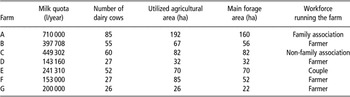
The aim was to identify how livestock management can contribute to work organization on dairy farms. We applied the QuaeWork method to seven dairy cattle farms in Ségala, a small agricultural region of the southern Massif Central in central France. Ségala is a natural landscape region that has a rugged terrain at an average altitude of 650 m (range: 300 to 850 m). Agriculture is prevalent: farmers account for a quarter of the working population, whereas the national average is less than 2.7%. It is also a major dairy production region: milk production density, at 100 000 to 120 000 l/km2, is high compared with other mountainous regions of France. We selected a sample of seven dairy farms characterized by a diverse range of livestock management, workforce compositions and production structures. The main characteristics of the farms are presented in Table 1. The production structures were diversified with a milk quota of 143 160 to 710 000 l, 27 to 85 dairy cows, 26 to 192 ha UAA and 22 to 160 ha of main forage area. Four workforce compositions ran the farms: four individual farmers, one couple, one family association (several members of the family: father and son or siblings) and one non-family association (group of farmers outside the family, in which associates were not all part of the same family).
Main characteristics of the seven dairy farms in Ségala region

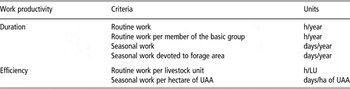
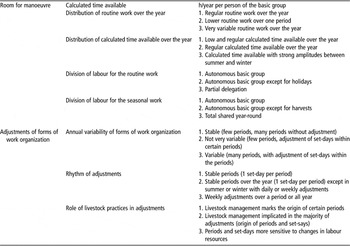
A categorization approach (Girard et al., Reference Girard, Duru, Hazard and Magda2008) was used to identify different patterns representing how livestock management contributes to work organization. Variables expressing work productivity and flexibility (Tables 2 and 3) and livestock practices (milking, winter feeding, spring–summer feeding, diet/feed supplementation and calving intervals) for the sample farms were expressed on linear axes, and the existing modalities were ranked into order (Girard et al., Reference Girard, Bellon, Hubert, Lardon, Moulin and Osty2001). Each farm was characterized by one modality for each variable. To formalize the diversity of the cases, graphic representations amplifying visual cognition were used (Bertin, Reference Bertin1977; Card et al., Reference Card, MacKinlay and Schneiderman1999). A cross-table was created with the farms in columns and the different variables and their modalities in rows. Farms that presented similar visually profiled modalities were pooled into groups. Three groups, defined by the most typical variables, emerged and were characterized under a name underlining the strategy implemented.
Criteria to assess work productivity, and units used

UAA = utilized agricultural area.
Qualitative criteria and classes to assess work flexibility

Results
In this section, we present the QuaeWork method in itself at farm scale (concepts, criteria for assessing work productivity and flexibility and steps to implement it on farms) and then the patterns representing how livestock management contributes to work organization on dairy farms.
The QuaeWork method at farm scale
Concepts
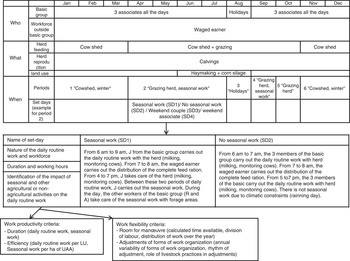
The method is based on the concepts outlined below, and is presented in Figure 1. Two categories of workforce (‘who’) are defined. The basic group comprises workers for whom agricultural work predominates in time and income, such as a farmer, a farming couple or associates. The workforce outside the basic group are workers: (i) who occasionally intervene in farm work (children, mutual help, agricultural company, equipment cooperative, etc.); (ii) who do not share any responsibility for work organization (full-time or temporary wage earners); and (iii) whose income does not depend directly on the farm (retired relatives, spouse working full-time off the farm, etc.). All the workers were also characterized in terms of their skills and/or preferences for different production units (livestock, crops, etc.) in order to provide a better understanding of how the work is distributed and what tasks can be done by different workers.
Concepts and criteria used on the QuaeWork method: example of farm C.

To address work content (‘what’), two types of tasks are defined according to their rhythm and postponability. Routine work has to be done almost every day and can be neither aggregated nor postponed. It covers daily animal care (milking, feeding, etc.), and it is quantified in hours. Seasonal work includes tasks that are easier to postpone and/or aggregate over a given period. It comprises tasks linked to agricultural activities (herd, crops, forage areas, land upkeep) and non-agricultural activities (commercialization, diversification or services), and it is quantified in days. The temporal characteristic of a given task is not set in advance, but is stated for each farm according to how the task is performed.
The method consists of representing forms of work organization at different temporal scales (‘when’) and their combination. The basic scale unit of organization is the day, represented by the concept of a ‘set-day’. A set-day represents a daily work organization framework corresponding to the technical and social division of work (Madelrieux and Dedieu, Reference Madelrieux and Dedieu2008). It is characterized by the routine work, the workforce performing the work and its duration, as well as the relations between routine work and seasonal work (Figure 1). The method also identifies periods, which correspond to a time interval lasting several weeks or months, and that mark certain stability in the daily work organization. A period is defined by the consistency of workforce availability (number of workers, rhythms of work), farm practices and technical events (calving, grazing, harvests, etc.), and the presence or absence of other activities (markets, meetings, off-farm activities, etc.). Three criteria are used to define a change of period (Figure 1): (i) when there is a change in the nature of the routine work (e.g. herd put out to pasture after the cowshed period); (ii) when a member of the basic group no longer intervenes in the same way in routine work (due to holidays, off-farm activities or a radical change in the division of labour between workers); and (iii) when new agricultural or non-agricultural activities re-timetable the presence of workers or induce new routine activities. Each period is composed of one or various set-days, which alternate according to different rhythms (weekly alternation, day by day alternation, etc.; Figure 1). For example, workforce composition can change (children present at weekends, wage earners working 2 days a week, etc.), which leads to a different distribution of routine work among the workers.
Criteria for assessing work organization
The assessment of work organization refers to work productivity and work flexibility. Table 2 presents the criteria for assessing work productivity. These criteria are quantitative. Two criteria quantify routine work in hours per year (‘routine work’ and ‘routine work per member of the basic group’), whereas two other criteria quantify seasonal work in days per year (‘number of days of seasonal work’ and ‘number of days devoted to forage areas’). Two work efficiency criteria are calculated (‘number of hours of routine work per livestock unit’ and ‘number of days of seasonal work per hectare of UAA’). To assess work flexibility, the QuaeWork method produces criteria presented in Table 3. The flexibility approach deals with the buffer capacity of the system and the adaptive capacities of the organizational forms. The buffer capacity of the system is assessed in terms of room for manoeuvre (five criteria), which is represented by (i) the calculated time available (CTA); (ii) the distribution of work over the year; and (iii) the division of labour. The CTA, that is, the time left to the basic group for performing other tasks, is not accounted by the method and is to be kept free. The formula used to calculate the time available (in hours per year) to the baseline farm unit is as follows:

where i represents a period where routine work has a constant duration; Jdi represents the number of days available during period i for performing non-quantified tasks; Jdi =[(number of days in period i − number of Sundays) ×(number of workers in the basic group)]−[number of days spent by the basic group on seasonal work during period i ]; Hdi represents the number of hours available per 8-h-day once all routine work has been completed (during period i ); Hdi = [8−(number of hours of routine work carried out by the basic group/number of workers of the basic group)].
Adaptive capacities are assessed by adjustments of forms of work organization. Three qualitative criteria are used (Table 3). The ‘annual variability of forms of work organization’ characterizes the degree of variability of periods over the year according to the total number of periods and number of set-days per period. The ‘rhythm of adjustment’ defines the modes of alternation of set-days within periods. The ‘role of livestock practices in adjustments’ characterizes how changes in livestock management cause variation in work organization. It corresponds to the number of periods and set-days whose origin is technical (evolution of the livestock production process, effect of climatic hazards on livestock or land management).
A three-step method on farm
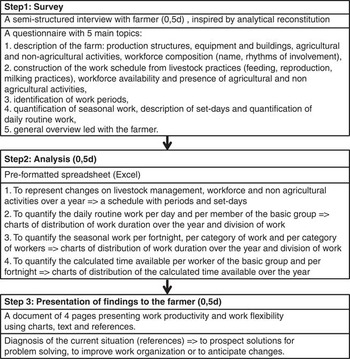
The QuaeWork method was implemented in three steps, taking a total duration of 1.5 days per farm (Figure 2). First, the farmer was interviewed (0.5 day). The questionnaire was divided into five main topics: (i) description of the farm: production structures, equipment and buildings, agricultural and non-agricultural activities, workforce composition (name, rhythms of involvement); (ii) construction of the work schedule based on livestock management practices (feeding, reproduction, milking practices), workforce availability and presence of agricultural and non-agricultural activities; (iii) identification of work periods; (iv) description of set-days and quantification of routine work and seasonal work; and (v) general overview led with the farmer. Second, data were analysed and processed with a pre-formatted Excel spreadsheet (0.5 day). For example, total daily routine work and per member of the basic group were quantified. Graphs are plotted to illustrate the evolution of daily routine work per worker and the evolution in room for manoeuvre over the year. The work periods and set-days are presented in a 12-month timetable (Figure 1). Third, the presentation of findings to the farmer (0.5 day) is based on work productivity and flexibility criteria, work schedule and set-days. It proposes a visual representation (using charts and a schedule) shared mutually by both the farmer and the advisor, which is essential to building an efficient advisory relationship. The aim of this presentation step was to consider prospects and solutions for problem solving, to improve the farmer's work or to anticipate consequences of changes on work organization.
The three steps of the QuaeWork method.

Patterns of livestock management to work organization
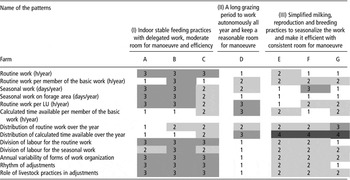
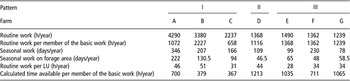
On the basis of the case studies, the method identified three patterns representing how livestock management contributes to work organization on dairy farms. Table 4 shows the results of the analysis, using the work productivity and flexibility criteria. Quantitative criteria are reported in Table 5.
The three patterns of work organization identified from QuaeWork criteria

The numbers in the boxes correspond to the modality taken by the case for each variable (see Table 2). A same color was attributed to a same modality.
Work durations, work efficiency and calculated time available in the seven dairy farms

Indoor stable feeding practices with delegated work, moderate room for manoeuvre and efficiency (pattern I)
Routine work was high (2237 to 4290 h/year) because of large herd sizes (55 to 85 dairy cows; Table 5). However, routine work was less high per person in the basic group, which was composed of several workers or a single person delegating a share of the work to a paid employee. Farmers managed their herd to obtain homogeneous and unvarying routine work over the year (10 to 11 h/day; Supplementary material 1). Dairy cow feed was based on a complete feed ration or was dispensed with free access. With near ‘zero-grazing’ management, the tasks consisted of mucking out, mulching and feeding all year round. The farmers had invested in farming equipment (automatic concentrate dispenser) to facilitate certain tasks with dairy cows. Calvings were spread out over the year for a more even distribution of the work linked to assisting calvings and caring for the calves. There was no particular period set aside for reproduction, and cows were inseminated throughout the year. Seasonal workload was also high, much of this work being devoted to forage areas (94 to 222 days/year) because of the fact that the dairy herd diet relied on stored forage (grass and maize silage, hay). In two cases, the routine work was not very efficient relative to the sample (46 to 51 hours per livestock unit per year) because of manual tasks required for certain batches of animals (heifers and calves), whereas on another farm, routine work was more efficient (31 h/LU per year). The calculated time available was very low (less than 700 h/member of the basic group per year). Farmers had little time to carry out other activities or for their families. Farmers did not manage to achieve autonomy. Throughout the year, high work durations led the basic group to delegate a share of the routine work to paid or unpaid workers. Distribution of the complete feed ration was outsourced to an agricultural equipment cooperative with a driver. Likewise, to manage periods of peak workload in the fields, the basic group delegated a share of the seasonal work to outside workforce (e.g. for harvesting). This pattern of work organization is typified by multiple adjustments, with various periods and several different set-days within those periods implying a higher degree of complexity in the production process or greater workforce availability (Supplementary material 1). The periods and alternations of set-days are because of changes in labour workforce and seasonal work. Thus, in winter, farm organization is constantly adjusted according to the workforce available. The set-days alternated in a weekly rhythm because of the absence of a worker or a member of the basic group (weekends or holidays). During the other periods of the year, alternation between set-days was on a day-to-day basis according to seasonal work priorities (the worker no longer intervened in the routine work, but was reassigned to seasonal work, or only one person in the basic group carried out the routine work) or to demand for free time (weekends or holidays). This pattern corresponds to farmers who apply many adjustments with various forms of work organization.
A long grazing period to work autonomously all year and keep reasonable room for manoeuvre (pattern II)
In this farm, the lone farmer ran a small herd (26 cows) that required a low amount of annual routine work (1368 h/year). Seasonal work amounted to 109 days/year, including 46.5 days for the forage area. Routine work was not very efficient (44 h/LU per year), owing to a very low level of mechanization, with many tasks (e.g. mucking out) carried out manually. Calculated time available was high (1213 h/year). The farmer had chosen to have a simple and relatively stable organization determined by the production process (Supplementary material 2). The only alternations were governed by production process (winter with the herd at the cowshed, summer with the herd out to pasture). There were few periods and only one set-day per period, and the same set-day was repeated throughout the year. The farmer was attempting to remain autonomous on both routine and seasonal work. Routine workload was lower in summer than in winter, as from April to October the cows were grazed and received no stored forage. In spring, herd management practices enabled the basic group to free up enough daily time to carry out seasonal work on the forage area without having to bring in outside workers. Investment in equipment (e.g. barn hay drying) allowed the work, including haymaking, to be more evenly spread over time.
Simplified milking, reproduction and breeding practices to seasonalize work and make it efficient with consistent room for manoeuvre (pattern III)
The total amount of routine work was moderate (1239 to 1900 h/year), but high per person in the basic group (1239 to 1490 h/year), because of farms being run by lone farmers and the work shared with voluntary workers. Seasonal work ranged from moderate to high, at 78 to 230 days of work. Routine work was efficient (28 to 34 h/LU per year). The farmers had invested in equipment (automatic milk dispenser for calves, straw shredder, mixer–recycler, etc.) to reduce the routine work in winter. They also relied on cooperative equipment to ensure efficient seasonal work. Calculated time available was high for two farms (1035 to 1065 h/year), but low in the third (711 h/year) because of the time devoted to seasonal work on crops (seed maize). The farmers did not manage to stay autonomous, but they at least tried to gain autonomy when workload was lighter. During work peaks, they delegated a share of the seasonal work to unpaid help and agricultural cooperatives. Farmers had adopted simplified practices (once-a-day milking, shut-down of the milking parlour, grouped calving) in order to manage their herds. The aim was to seasonalize routine work, cope with work peaks and to free up private time. The distribution of the routine work varied greatly over the year (Supplementary material 3). It was heavier during the cowshed period (autumn to winter) because of time-consuming tasks (mucking out, feeding and care) and grouping calvings over several months, which induced additional tasks for the care of calves and milking. The routine work was reduced from the beginning of spring by allowing the animals to graze. The dairy cows spent little time stabled, thus reducing the time devoted to cleaning out buildings and moving. During the grazing period, the farmers suspended feed dispensing. Milking practices were also modified, with once-a-day milking or shutting down the milking parlour for several weeks. The number of periods was moderate (5 to 6), and set-days alternated during certain periods in a weekly rhythm because of farmer expectations. Livestock management was involved in most adjustments in the forms of work organization (periods, set-days) and at different time scales (period, day). For example, on one farm (E; Supplementary material 3), several set-days during weeks over the winter period alternated mid-week set-days (twice-daily milking) with weekend set-days (once-a-day milking on Sunday) to free up time for the family.
Discussion
Specificities of the QuaeWork method
The QuaeWork method further complements the livestock farming system approach (Gibon et al., Reference Gibon, Sibbald, Flamant, Lhoste, Revilla, Rubino and Sorensen1999) by considering interactions between livestock management, workforce and equipment facilities in addition to the more classic ‘production and performance’ framework and by integrating work objectives – productivity and flexibility – into technical and economic goals. The method considers not only relations among workers (Elad and Houston, Reference Elad and Houston2004) but also interactions between tasks and the workers, who are differentiated according to their involvement in farm work. Equipment facilities are another essential factor for understanding farmers’ organizational choices, as equipment will shape task duration and/or the content of the work to be done (Wagner et al., Reference Wagner, Palmer, Bewley and Jackson-Smith2001; Rotz et al., Reference Rotz, Coiner and Soder2003). In the QuaeWork, equipment facilities are represented by a scale of automation level for herd management and land use. The approach identifies the productive gains of work and the adjustments obtained from the equipment. The method is based on an analysis of the work to be done through interactions between workforce, tasks and equipment facilities at different time scales (year, period, day), whereas most of the previous studies of livestock systems lend priority to the yearly scale (Jouven and Baumont, Reference Jouven and Baumont2008), or sometimes to monthly or weekly scales (Hervé et al., Reference Hervé, Genin and Migueis2002; Vayssières et al., Reference Vayssières, Vigne, Alary and Lecomte2011). Farm changes such as the departure of a retired worker, a son joining the business or diversification of agricultural activities can modify the work organization (who does what, when and how long) on these three temporal scales.
Knowledge produced on the contribution of livestock management to work organization
In the case of family farms, where not only economic efficiency but also life projects are central to farmer expectations (Solano et al., Reference Solano, Leon, Pérez and Herrero2001), the QuaeWork method makes it possible to integrate two approaches: ‘work efficiency’, which characterizes efficiency in terms of resource use, and ‘work organized’, which translates the farmer's projected aim to achieve a certain quality of life (Dedieu and Servière, Reference Dedieu and Servière2011). Research programmes applying the method are currently in progress in countries where family farms are differentiated by the interactions between livestock management, workforce (family or salaried) and level of equipment. In France, applying the QuaeWork method on contrasting dairy farms underlined specific combinations between work productivity and flexibility. For example, pattern-1 farmers organize their work by distributing farm tasks across workers (including wage earners), mechanizing herd feed distribution and rationalizing herd diet, which translates a desire to improve the farm's functional system and technical productivity (Olaizola et al., Reference Olaizola, Chertouh and Manrique2008). Pattern-2 and pattern-3 farmers opt more for simplified milking and feeding practices, which translates a desire to work for other priorities rather than simply productivity. These farmers are looking to free up personal time every day in order to spend time with the family, take weekends off and holidays, or in some cases to be able to complete all the work alone, without outside help (Tipples et al., Reference Tipples, Verwoerd, Bewsell, Dalley and Turner2007).
In developing countries, interactions between livestock management and workforce play an even more important role in meeting the expectations of farmers and their families than in Europe, as mechanization is often non-existent or not an option (McDermott et al., Reference McDermott, Staal, Freeman, Herrero and Van de Steeg2010). Livestock management choices are critical to work organization adjustments. In dairy cattle farms in Amazonian Brazil, where the family workforce cannot hire wage earners, the forage system must adjust to priority tasks. Such adjustments make it possible to simplify herd management tasks and techniques (Hostiou and Dedieu, Reference Hostiou and Dedieu2009). In contrast, when livestock management follows a uniform pattern, such as in some ex-state farms in Vietnam, the QuaeWork method shows that in the largest and most heavily intensified farms, the farmers had lightened their workload by mechanizing routine work tasks (thereby improving work efficiency) and employing permanent wage earners, whereas in the small-scale farms the farmers had adjusted their work flexibility by stopping non-agricultural activities during peak workload periods (Hostiou et al., Reference Hostiou, Pham Duy, Madelrieux, Vu Trong and Dedieu2010). For instance, other situations would need to be studied to support this analysis. There are other contexts where farming sector is closely integrated with standardized practices (e.g. poultry and pig farms). Research tends to focus essentially on work productivity, whereas the farmers themselves are looking for ways to improve their quality of life (Martel et al., Reference Martel, Dourmad and Dedieu2008). The QuaeWork method could be used in these industrial-scale farm settings (pig and poultry) to map and benchmark the livestock farm systems involved. The QuaeWork method also needs to account for biophysical and environmental research in order to better integrate an understanding of work organization. A way forward is to analyse how ecologically intensive systems impact on work productivity and flexibility. Operational tools can also be co-constructed jointly with users (advisors and farmers) using the QuaeWork method (Supplementary material 4).
Criteria for assessing livestock farm work
The QuaeWork suggests criteria for analysing a farm's social sustainability. Social indicators are still rarely taken into account in livestock farm assessments, which are essentially based on technical or environmental criteria (Bockstaller et al., Reference Bockstaller, Guichard, Keichinger, Girardin, Galan and Gaillard2009). Authors have so far proposed indicators on the workloads linked to physical labour (Van Calker et al., Reference Van Calker, Berentsen, de Boer, Giesen and Huirne2007) or on work time linked to livestock farming practices (Gleeson et al., Reference Gleeson, O'Brien and O'Donovan2008). In comparison with other sustainability approaches, the QuaeWork method offers a set of criteria for integrating work organization into farm assessments. It proposes criteria on work productivity (duration and efficiency) and flexibility (room for manoeuvre and adjustments), all of which are commonly tied together in livestock farms (Hervé et al., Reference Hervé, Genin and Migueis2002). Criteria concerning work duration (routine work and seasonal work) and efficiency (routine work per LU) provide useful references for farmers looking to improve work productivity, consolidate the competitiveness of their farm business, cope with the decline in family workforce options (Garcia-Martinez et al., Reference Garcıa-Martınez, Olaizola and Bernuès2009) or diversify their agricultural activities (Reig-Martinez and Picazo-Tadeo, Reference Reig-Martinez and Picazo-Tadeo2004), or even for farmers ready to employ waged labour (Bewley et al., Reference Bewley, Palmer and Jackson-Smith2001). Reference benchmarks therefore need to be created in order to be able to cross-compare different farm set-ups and pinpoint potential levers for change. The QuaeWork method proposes other indicators than the more standard annual work time (Dogliotti et al., Reference Dogliotti, Rossing and van Ittersum2004), (i) by considering changes in work time over the course of the year, in particular, by identifying periods that take into account interactions between routine work, seasonal work and other activities, and (ii) by considering flexibility indicators. However, the criteria are not centred solely on the management of peak workloads: the method highlights changes in work organization, but without assigning resources (workforce, equipment) in advance according to required needs, unlike agronomic approaches (Papy et al., Reference Papy, Attonaty, Laporte and Soler1988). For example, the ‘annual variability of forms of work organization’ criterion makes it possible to qualify the stability or variability of work organization over the course of the year. It highlights the sensitivity of work organization to both internal (retirements, etc.) and external (climatic hazards) events. These criteria are able to qualify the adaptive capacities of livestock farms, which have become a key issue for farm sustainability because of the growing uncertainties involved (Darnhofer et al., Reference Darnhofer, Bellon, Dedieu and Milestad2010; Nozières et al., Reference Nozières, Moulin and Dedieu2011).
Productivity and flexibility criteria are important for making reasoned decisions on livestock farm changes, especially innovations (Riedel et al., Reference Riedel, Casasús and Bernués2007). For this, concrete social sustainability criteria that can be generally used in livestock farms are required. For example, work duration (routine work and seasonal work) and efficiency (routine work per LU) and the room for manoeuvre (calculated time available, division of labour among workers; Dedieu, Reference Dedieu2009) can be relatively easy to measure (a half-day of interview with farmers and a half-day to analyse the data and calculate the criteria).
Conclusion
We have developed a new approach to qualify and assess work organization in livestock farming systems by taking into account two approaches of work organization – productivity and flexibility. The QuaeWork can be used, by advisors and researchers, to analyse the farmer-led trade-offs designed to improve work efficiency in response to sector needs, but at the same time to increase work flexibility in response to unknowns (climatic hazards, uncertainties over labour availability), to meet the increasing demand for free time or combine different farming activities. We suggest social sustainable criteria to assess work productivity and flexibility on livestock farms, which are based on work duration, work efficiency, room for manoeuvre and also adjustments of work organization over the year. We show the utility of the method for producing knowledge on livestock farming systems. Our results highlight different interactions of livestock farmer practices to organize their work on their farm, and different consequences on work efficiency and on room for manoeuvre. Further research is required to take into account other farm work components in the QuaeWork method as mental workload, which should make it possible to assess the full complexity of certain livestock management systems. It should also incorporate other work dimensions that are important in farms, such as farmer knowledge, the construction of the farmer's identity and the meaning given to work with animals. Given the current context of changing patterns of agricultural work marked by bigger farms and shifts in farmers’ attitudes to their work, the ability to integrate different work dimensions in the QuaeWork method, that is, not just productivity and flexibility, will enable better assessments of livestock farming systems to be made, and it should also make it possible to design and build tools that could be properly adapted to farmers, their knowledge and their demands.
Acknowledgements
This work was carried out as part of the TRANS project (Transformations de l’élevage et dynamique des espaces) funded by the French National Research Agency (ANR – agriculture and sustainable development projects). The authors thank the National Livestock Institute and the Milk Recording Services for their collaboration.