Introduction
Ibises are a group of medium- to large-sized, mainly wading birds in the family Threskiornithidae (Aves: Ciconiiformes; see also discussion in Mayr Reference Mayr2002). They are known from all the continents except Antarctica, though one species breeds as far south as Tierra del Fuego (del Hoyo et al. Reference Del Hoyo, Elliott and Sargatal1992, p. 499). The oldest fossil bones (including skull elements) attributed to ibises are those of Rhynchaeites messelensis Wittich, 1898 from the Middle Eocene of Messel, Germany (Peters Reference Peters1983, Mayr Reference Mayr2002). Another supposed member of this group is the Pondaung bird from the late Middle Eocene of Myanmar (formerly Burma) represented solely by an incomplete tibiotarsus (Stidham et al. Reference Stidham, Holroyd, Gunnell, Ciochon, Tsubamoto, Egi and Takai2005, fig. 2). The taxonomic position of Minggangia changgouensis Hou, Reference Hou1982 from the Late Eocene of China (Hou Reference Hou1982) was recently questioned by Stidham et al. (Reference Stidham, Holroyd, Gunnell, Ciochon, Tsubamoto, Egi and Takai2005, p. 183). Here, we present a partial bill from the Eocene La Meseta Formation (Seymour Island, Antarctica) which most closely resembles that of ibises.
The specimen was found by two of the authors (AG and AT) in 1992 in the upper part of the La Meseta Formation on the northern flank of a plateau, c. 500 m north of the airstrip at Marambio Base (64°14′10″S, 56°38′10″W), in unconsolidated grey sands in Telm6, or the uppermost Cucullaea II Allomember (see Marenssi Reference Marenssi, Francis, Pirrie and Crame2006, fig. 5). The presence of penguin and gadiform fish remains (Jerzmańska & Świdnicki Reference Jerzmańska and Świdnicki1992, Jadwiszczak Reference Jadwiszczak2006) in this sequence as well as sedimentary structures (see Marenssi Reference Marenssi, Francis, Pirrie and Crame2006) point to a nearshore, shallow-marine or a strandline environment, and may be correlated with the main sea lowstand at 36 Ma (Marenssi Reference Marenssi, Francis, Pirrie and Crame2006). This record sheds new light on Antarctic avian history. The studied specimen is housed at the Institute of Biology, University of Białystok, Poland; abbreviated IB/P/B.
Systematic palaeontology
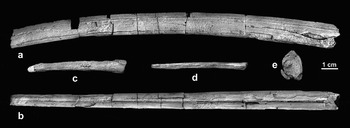
An ibis-like maxillary jaw (IB/P/B-0698) from the Eocene La Meseta Formation of Seymour Island (Antarctica). a, c. left lateral views, b, d. ventral views of the main fragment and tip respectively, e. cross-sectional view of the proximal end of the main fragment. The fossil was coated with ammonium chloride sublimate prior to photography.

Material
Two fragments of the maxillary jaw with partially preserved rhamphotheca, IB/P/B-0698.
Description
Incomplete, markedly decurved maxilla is preserved in two non-contiguous fragments (both distal to nares). Judging from their shape and overall size, the fragments represent more than half of the upper jaw length. The slender, laterally compressed and sharp-pointed tip is elongate and lacks the openings for sensory nerves. The larger fragment, reconstructed from several pieces, is slender, strongly pneumatized and possesses a sharp dorsal edge. Both elements have a conspicuous ventral furrow. The fossilized rhinotheca, best preserved on the larger fragment, is slightly furrowed along its length.
Measurements (in mm)
Smaller fragment: maximum length 59.0; larger fragment: maximum length 196, height at the centre 13.1, width at the centre 9.5.
Occurrence
Seymour Island (Antarctica), La Meseta Formation, Telm6 unit (Late Eocene).
Discussion
The precise taxonomic classification of the specimen IB/P/B-0698 is problematic. It obviously belonged to a large-sized bird. Its dimensions and overall shape resemble those of some threskiornithids, particularly representatives of Threskiornithinae Poche, 1904 (see del Hoyo et al. Reference Del Hoyo, Elliott and Sargatal1992). Although, some scolopacid waders (from the genus Numenius Brisson, 1760) have also markedly crescent-shaped bills, the studied fossil is larger and lacks any sign of flexibility of the upper tip characteristic of these birds. The presented specimen is clearly larger and more strongly decurved than its counterpart in Eocene Rhynchaeites messelensis Wittich, 1898, the sole species in Rhynchaeitinae Mayr, Reference Mayr2002 (see Introduction), and has more elongate tip (as in many Recent ibises). On the other hand, the evident lack of Foveae corpusculorum nervosorum on the bill tip, that are conspicuous and numerous in Recent threskiornithids (Baumel & Witmer Reference Baumel, Witmer and Baumel1993, p. 73), and the laterally compressed tip itself, approach the condition observed in R. messelensis (see Mayr Reference Mayr2002). In Mayr's (2002, p. 510) opinion, the latter feature may suggest foraging on the ground. However, Recent ibises that probe in water or mud (the vast majority of all modern threskiornithids) have generally longer beaks (del Hoyo et al. Reference Del Hoyo, Elliott and Sargatal1992, p. 473), and our specimen seems to be perfectly adapted for such feeding behaviour in shallow delta and/or estuarine environments of the Upper La Meseta Formation (e.g. Marenssi Reference Marenssi, Francis, Pirrie and Crame2006). Alternatively, although Recent ibises generally probe non-visually when feeding in water (del Hoyo et al. Reference Del Hoyo, Elliott and Sargatal1992, p. 478), their Eocene relatives may have preferred other techniques such as pecking or shallow (“visual”) probing. To sum up, it is puzzling that known Eocene threskiornithids with either slightly or strongly decurved bills seem not to have well developed sensory nerves on their tips. On the other hand, the fossil record is scarce, and the fragments described here could have belonged to some previously unknown extinct group.
Assuming correct identification, the specimen presented here could be the oldest fossil record of ibises from the Southern Hemisphere, and the only one known from Antarctica. Furthermore, this is an important addition to the fossil avifauna from the Late Eocene of the La Meseta Formation, so far represented by some ten penguin species (Jadwiszczak Reference Jadwiszczak2006), a ratite bird (Tambussi et al. Reference Tambussi, Noriega, Gaździcki, Tatur, Reguero and Vizcaino1994), a phorusrhacoid (Case et al. Reference Case, Woodburne and Chaney1987), indeterminate procellariiforms and at least two pelagornithid taxa (Bargo & Reguero Reference Bargo, Reguero and Casadio1998, and references therein).
Acknowledgements
The authors want to express their gratitude to Steven D. Emslie, Storrs L. Olson and Stig A. Walsh for valuable comments on the specimen described in this note. Stig A. Walsh is also thanked for checking the English of the manuscript. The comments supplied by the reviewer, Judd A. Case, were also appreciated. Photographs were taken by Grazyna Dziewińska. Our work was supported by the Polish Committee for Scientific Research grant (PBZ-KBN-108/PO4) and logistically by the Instituto Antártico Argentino.