The quality of the administration of justice in many countries has been discussed in depth. In the case of many Latin American countries, scholars have identified the existence of institutional structures and practices where the law does not protect against violence inflicted upon the urban poor. Instead, it seems that the legal system is the protagonist of this same violence (Wacquant, Reference Wacquant2006), either through systematic and uncontrolled use of public force against underprivileged populations (Cano, Reference Cano2010; Silva and Alvarado, Reference Silva and Alvarado2011), or through the violation of procedural rights (Azaola and Bergman, Reference Azaola and Bergman2007; Domingo, Reference Domingo1999; Méndez, O'Donell and Pinheiro, Reference Méndez, O'donell and Pinheiro1999).
Within this context, some authors have subjected public defence systems to critical scrutiny, suggesting that they are part of a process of institutional punishment against urban poverty. As noted by Bergman and Azaola (Reference Bergman and Azaola2003): ‘the differential access to resources such as legal defense … causes that [sic] a large number of poor people get [sic] incarcerated, while a large number of professional criminals remain unpunished’ (pp. 80–81).Footnote 2 Other authors have pointed out that public defence plays a crucial role in reverting this process, as it represents the only instrument through which poor sectors can face the power of the state and respond to the accusations made against them (Ferrandino, Reference Ferrandino and Pásara2004).
Yet, despite ample evidence supporting the aforementioned assertions, the effect of the allocation of a public defender, as opposed to a privately chosen lawyer, on the inmate's perception of the legal process, outcome and justice in a criminal trial has been scarcely explored in Latin America. This paucity of studies may be due to a number of reasons, among which a lack of reliable information systems in the region is probably the most notable (Briceño-León, Reference Briceño-León, Villaveces and Concha-Eastman2008). However, as some authors have acknowledged, elsewhere in Latin America, this situation has recently improved owing to evident efforts toward the development and improvement of legal institutions and their information systems. Indeed, as Rios-Figueroa (Reference Ríos-Figueroa2012) has pointed out, the political transformations that have taken place throughout Latin America during the last three decades have also contributed to the development of systems of information and surveillance, allowing access to a wealth of data and information, and thereby providing a particular context in which it is possible to ‘systematically test existing hypotheses, and numerous theoretical questions and empirical puzzles’ (p. 317), such as how the urban poor access legal defence, or how public lawyers work in practice.
In this paper, we seek to expand the extant knowledge base on this subject by analysing the results of 2,172 semi-structured interviews with sentenced inmates in Mexico City, collected during the 2002–2008 period. By analysing the way in which public lawyers work in Mexico City, we do not intend here to give an exhaustive account of the many implications that the information reported in this paper could have in both theoretical and empirical terms.
It is, however, essential to clarify that this is not a study of procedural justice, in the sense of individual perceptions of the ‘fairness’ of the judicial process. Moreover, this work does not attempt to elucidate the way in which certain social groups perceive, respond to and reflect on their experiences with the legal system (Lind and Tyler, Reference Lind and Tyler1988; Tyler, Reference Tyler1990, Reference Tyler1997; Kitzmann and Emery, Reference Kitzmann and Emery1993; Lind, Reference Lind1994; Solum, Reference Solum2004).
Rather, this study aims to conduct a descriptive analysis of the available information regarding how public legal defence works, how this service is evaluated by the inmates who took part in the interviews, and how the traditional division between public and private services does constitute an important distinction in the way in which criminals interact with, and are processed by, the legal system. Subsequent analysis of the narratives collected allowed us to draw conclusions on the inmates’ perceptions that could have some potential for generalisation to a wider inmate population in other Mexico City correctional facilities.Footnote 3
In this context, our findings suggest that, in the case of Mexico City, when an individual accused of a crime is tried by a public defender, she believes that her chances of receiving a more lenient sentence are improved relative to those she would have if defended by private lawyers. Moreover, in such cases, the accused will usually have a better perception of justice being upheld during the entire legal process.
The remainder of this paper is divided into four sections. In the first section, a brief schematic overview of the recent literature is presented. The review focuses on the studies in which the authors have attempted identify, from an empirical perspective, the differences in the defence types available to those facing court trials, as well as how the defence choice affects the criminal procedure outcomes. In this section, we also discuss the way in which new investigations have incorporated the social factors that affect poorer social strata in the cities. In the second section, the data sources utilised in this study, as well as data collection and analysis methods employed, are presented. The sociodemographic characteristics of the study participants, as well as the most relevant findings yielded by the interviews, are discussed in the third section. The paper closes by drawing some conclusions from this study, which are presented in the fourth section, along with suggestions for future work in this field.
I. Literature review
During the last two decades, crime, inequality and poverty have been recurring topics on the public agendas of many Latin American cities. This growing concern with public order and safety seems to stem from the increase in violent crimes in urban settings. Such unfavourable social dynamics are posited to reflect the way in which the urban poor relate to the judicial system. In the case of Mexico City, a general overview of the literature pertaining to the problem of urban criminal violence has revealed two predominant perspectives on the link between poverty and crime. First, extant studies indicate that crime patterns are likely related to the levels of poverty and unemployment. As a result, poor Mexico City residents are perceived as the main perpetrators of criminal violence (Eckstein, Reference Eckstein1998; Hayner, Reference Hayner1946; Valencia, Reference Valencia1965). The second perspective, however, is based on the premise that the urban poor are treated unfavourably by the judicial system, whereby they appear systematically represented as criminal agents due to their degree of vulnerability in the face of state violence. This discriminatory treatment manifests predominantly as police abuse and a lack of due process (Beltrán and Piccato, Reference Beltrán, Piccato, Kuri and Tamayo2004; Campesi, Reference Campesi2010; Davis, Reference Davis2007; Piccato, Reference Piccato2001; Silva and Alvarado, Reference Silva and Alvarado2011).
Within this context, public defence systems play an important role by assisting the state in providing legal services for those who decide not to or who are not able to hire a private lawyer. As such, public lawyers have been characterised as inefficient, primarily due to the excessive workload and lack of resources faced by them when confronting the representation of marginal sectors. Indeed, since the 1980s, there has been a growing consensus among different socio-legal scholars that private defence is substantially more effective than public defence (Champion, Reference Champion1989). These investigations suggest that the defendants represented by a public defender suffer from substantial judicial and legal disadvantages, relative to those who have sufficient resources to hire a private lawyer (Barak, Reference Barak1975; Hanson, Ostrom and Hewitt, Reference Hanson, Ostrom and Hewitt1992; Stover and Eckart, Reference Stover and Eckart1975).
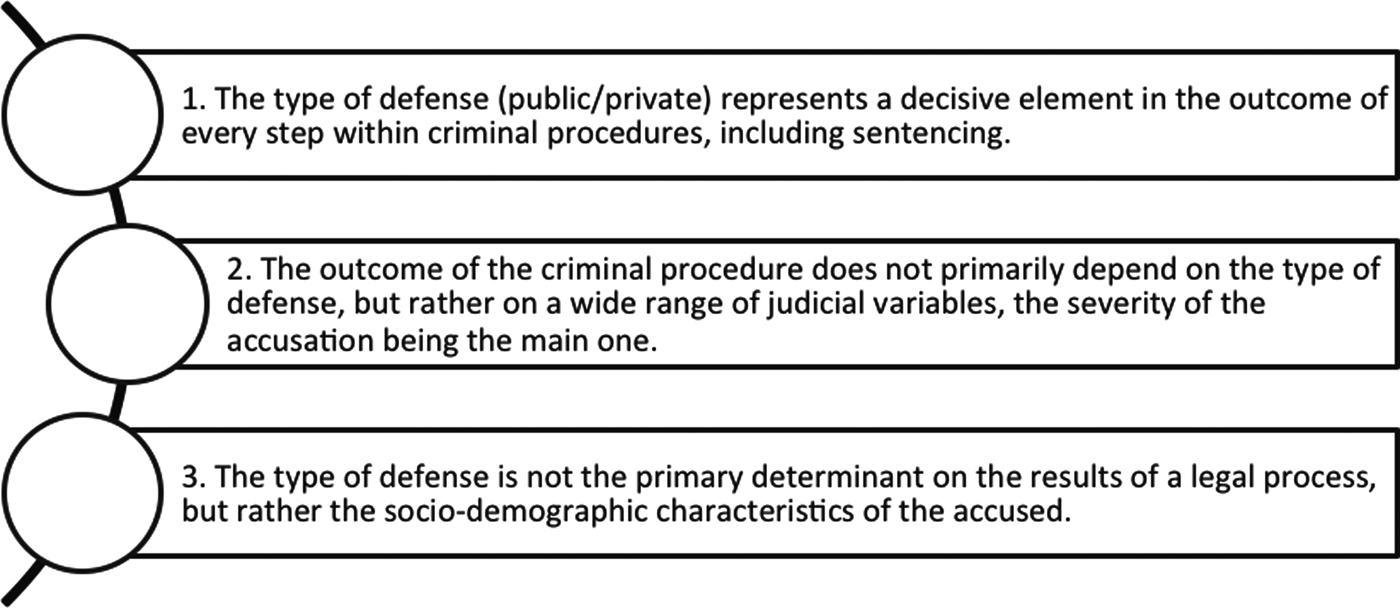
While studies of this nature that have focused on Latin America are scarce, their findings suggest a similar distinction (Bergman and Azaola, Reference Bergman and Azaola2003; Ferrandino, Reference Ferrandino and Pásara2004). These assertions clearly call for a more comprehensive assessment of the efficacy of an institution designated for the defence of the poor. This issue, however, is not new, as it is a topic that has been discussed from various perspectives in many socio-legal investigations. A detailed review of these investigations reveals that most have been conducted following one of the following three approaches (see Figure 1).
Main trends in socio-legal discussion on public defence (source: own elaboration)

On the one hand, it seems that the type of defence (public/private) represents a decisive element in the outcome of every step within criminal procedures, including sentencing. The body of literature that has explored the issue of legal representation of the poor from this perspective suggests that public defence will always be at a disadvantage in achieving a favourable sentence in comparison to private defence. This discrepancy is primarily due to the much larger workload that public defenders are responsible for. They also work in an institutional structure that is weaker relative to its private counterparts (Barak, Reference Barak1975; Comisión de Derechos Humanos del Distrito Federal, 1998; Hanson, Ostrom and Hewitt, Reference Hanson, Ostrom and Hewitt1992; Stover and Eckart, Reference Stover and Eckart1975).
On the other hand, some authors suggest that the outcome of the criminal procedure does not primarily depend on the type of defence, but rather on a wide range of judicial variables, the severity of the accusation being the main one. This premise implies that certain pre-established normative and configurative elements of the expectations that the accused have will have the greatest impact on the outcome of the process (Chiricos and Waldo, Reference Chiricos and Waldo1975; Williams, Reference Williams2002). In other words, these authors share the view that the type and severity of the sentence is primarily driven by the traits of the accused and the accusation itself, rather than the defence type or quality.
Finally, other scholars have established that the type of defence is not the primary determinant on the results of a legal process, but rather the sociodemographic characteristics of the accused, i.e. age, gender and social class (Azaola, Reference Azaola1997; Spohn, Gruhl and Welch, Reference Spohn, Gruhl and Welch1982). According to this stance, the efficacy of public defence is implicitly affected by certain subjective elements that influence the preconceptions held by the judicial system with respect to certain populations. These stereotypes affect the manner in which the accused are processed and judged by the legal system.
While these three lines of investigation are characterised by notable empirical and theoretical differences, they all perceive the accused as passive targets to a series of predetermined policies and strategies whose primary objective is to sentence them and keep them incarcerated. Contrary to this position, in recent years there has been a series of studies that, from different perspectives, have tried to demonstrate that marginal sectors display self-developed strategies in order to deal with the legal structures and classifications that constantly fall upon them.
In the case of Latin American and other developing countries, investigations of this nature start by depicting the urban poor as members of a particular social group whose degrees of organisation and politicisation characterise them as highly strategic individuals who are capable of displaying and mobilising resources. These resources include, but are not limited to, public manifestations, the occupation of buildings and spaces, and the interposition of legal resources to constitutional and international tribunals (Houtzager, Reference Houtzager, Sousa Santos and Rodríguez Garavito2005; Rajagopal, Reference Rajagopal, Sousa Santos and Rodríguez Garavito2005). While these postulates are noteworthy, they have been insufficiently explored in extant studies. Indeed, literature review has revealed a paucity of research that has attempted to explore these characteristics among marginalised urban sectors and their frequent interactions with the law and the judicial system.
At the same time, a wide range of socio-legal studies have been conducted in the US, demonstrating that the low-income population is capable of displaying the means and self-developed strategies that can help reverse or challenge the will and action of judicial authority. According to Ewick and Silbey (Reference Ewick and Silbey1998), these initiatives have operated under the same rules and within the same institutions imposed by the judicial system, as well as in many aspects of daily life, such as a traffic violation or the suspension of a driver's licence.
Studies that have explored the effectiveness of public defenders in the US have also noted that their effectiveness and attitudes towards marginalised populations are also affected by these broader initiatives that have started to affect the attitudes of the latter towards the judicial system and society in general.Footnote 4 For example, Hoffman, Rubin and Shepherd (Reference Hoffman, Rubin and Shepherd2005) suggested that the population ‘uses’, in a strategic way, the services of public defence, particularly in cases that involve individuals on low income, who know the outcome of their verdict in advance. Kritzer (Reference Kritzer2008) described this scenario as follows:
‘If you are a marginally-indigent defendant, and you know not only that you are guilty but there is a very high probability that you will be convicted (for example your crime was captured on videotape), it is not unreasonable to imagine that you will be less inclined to scrape together the money for private counsel than if, for example, you are wrongly accused.’ (p. 901)
Still, it should be emphasised that the statement above does not imply that all criminally prosecuted individuals who are represented by a public lawyer would possess the same possibilities and abilities to turn the majority of public resources in their favour. Nonetheless, it still suggests the presence of a link among urban poverty, the work of public defenders, and the observance (or lack thereof) of a given process.
II. Data and methods
The data for this study were collected via a survey of inmates that took place in three phases, conducted in 2002, 2005 and 2008, by the Center of Investigation and Teachings of Economics (CIDE). The scientific foundation for this method of data gathering was the Survey of Inmates of State Correctional Facilities of the United States Department of Justice Bureau of Justice Statistics. The extant literature on the perceptions of the inmates regarding their treatment within the judicial system is highly diverse. Some studies have focused on exploring inmate prison life (Crank, Reference Crank2010), while others examined the advantages and disadvantages of prison relative to probation (Crouch, Reference Crouch1993). Several authors have also explored correctional officer job competency (Boyd and Grant, Reference Boyd and Grant2005; Cheeseman and Worley, Reference Cheeseman and Worley2006), as well as differences in perceptions of sanction severity as related to the racial background of the inmates (Wood and May, Reference Wood and May2003) and the crimes they committed (Blackburn, Reference Blackburn2006; Fowler, Blackburn, Marquart and Mullings, Reference Fowler, Blackburn, Marquart and Mullings2010; Connor, Reference Connor2009). However, inmates’ perceptions of the criminal process (specifically the legal defence) have rarely been examined. One notable exception is the study conducted by Veneziano and Gill (Reference Veneziano, Veneziano and Gill2001), who sought to elucidate the perceptions of the adult prison inmates on the juvenile justice system. Baker and colleagues' (Reference Baker, Pelfrey, Bedard, Dhungana, Gertz and Golden2013) study on female inmates’ perceptions of the police and courts is also noteworthy, even though neither refers to procedural issues in the justice system.
The extant works underpinning this study, the sampling procedure, the questionnaire design, layout and content, and the processes to be followed during data collection and analysis were all determined by the CIDE (Bergman, Azaola and Magaloni, Reference Bergman, Azaola and Magaloni2006).Footnote 5 The CIDE was also responsible for establishing the study inclusion criteria, as well as the sampling procedure to be followed in order to achieve adequate representation of the penitentiary population of each entity: the prisons, and the urban and rural populations.Footnote 6 Moreover, care was taken to ensure that inmates of both genders were represented proportionally.Footnote 7 More specifically, in order to select the inmates who would be invited to take part in the survey, a list of their names was obtained from relevant entities and was subjected to a random selection process, augmented by systematic jumps. This approach yielded a sample that was representative of the incarcerated population in Mexico City, as well as the State of Mexico.Footnote 8 All study participants were subjected to the same measuring instruments in order to increase study validity, and to ensure the consistency and completeness of the data obtained.Footnote 9 The data yielded by the survey were subsequently analysed, allowing conclusions to be reached regarding the perceptions of the penitential population with respect to the judicial process.
Before proceeding further, it is essential to emphasise that the information presented here pertains exclusively to the penitential population in Mexico City. The study participants voluntarily shared all data utilised in the analysis. However, when interpreting the findings presented later in this paper, it is essential to note that the information conveyed by the inmates was not verified against specific events, or contrasted with official judicial statistics. In addition, during data collation and analysis, no inferences have been made with regard to specific groups of the penitential population. In sum, all findings reflect the participating inmates’ opinions and views.Footnote 10 Conclusions were reached by subjecting the full dataset to frequency analysis, as well as cross-references and calculations of levels of statistical significance, using the statistical software package SPSS.
Some aspects of the information analysed in this work have already been employed by other researchers to describe the general features of the criminal procedure in Mexico City (Bergman et al., Reference Bergman, Azaola and Magaloni2006). These data have also been used to describe the procedural, social and institutional dynamics experienced by inmates of the Metropolitan Area of the Valley of Mexico (Bergman and Azaola, Reference Bergman and Azaola2003). In addition, Vilalta (Reference Vilalta2008) utilised this dataset in order to infer indirect relations and variables associated with the length of sentences and the outcomes of appeals in Mexico. In all of these cases, however, the authors have assumed that public defence is an institution with a clear disadvantage – or with inferior outcomes – compared to its private counterpart, even if these views were not founded in sound empirical evidence.Footnote 11
In sum, to the best of the authors’ knowledge, the current study represents the first investigation focusing exclusively on explicating the relationship among the types of defence, particularly the procedural characteristics (process duration and sentence severity), and the participating inmates’ perceptions of the quality of their defence and the fairness of the judicial process in Mexico. We are also confident that this is the first investigation that has collated all data yielded by the inmate surveys conducted in 2002, 2005 and 2008 by the CIDE. Our investigation is limited to Mexico City and the findings reported here pertain solely to the sample of inmates who took part in the aforementioned surveys. It should also be noted that only the inmates’ perceptions formed the dataset, which was not verified against any other sources or judicial records. While this limitation restricts the potential for generalising the study findings, it also affords a high degree of specificity, allowing us to contrast our findings with the results and inferences expressed in previously mentioned studies. This, in turn, contributes significantly to the furthering of discussions on various socio-legal hypotheses in a context where the usage of empirical information is still incipient. Most importantly, this unique study has helped shed light on the sensitive issue of public defence, on which virtually no systematic evidence exists in the country (even at the institutional level), and even records that are available have not been subjected to any external evaluations or audits.Footnote 12 While this seems a significant omission, it is noteworthy that the private defence system is in no better position in this respect, as it is not subject to any specific regulations or professional bodies that monitor performance, generate information, etc. In certain situations (in particular, prior to the criminal reform of 2008), legal advice of a ‘person of trust’ can still be accepted, indicating that an individual without formal training or a professional licence can represent an accused.Footnote 13
2.1 The effects of the defence on criminal tribunals in Mexico City
In Mexico, the Federal Constitution, Article 20, Section B, Subsection VUI, establishes that any accused person has the right to a proper defence by a lawyer. Yet, despite the criminal procedure reform, which aimed to replace the inquisitorial system by the adversarial one, and was one of the most important changes in the penal system since the establishment of the Constitution of 1917, the rights of the accused to appropriate legal defence have not changed much (the only exception is the prohibition of the use of a ‘person of trust’, which was instated in 2008).Footnote 14 Following from this directive, the public defence system throughout the country is obliged to provide free judicial representation to any individual accused of committing an offence who requests the assistance. The same privilege is afforded to those who have not been assigned a lawyer after the request of a jurisdictional authority (judge or minister). Given that Mexico is a federal republic, each state has its own public defence system.Footnote 15 In the case of Mexico City, the public defence system currently employs 217 lawyers (Mexico City Government, 2004Footnote 16). To obtain representation from the defence counsel, those who require the service must meet the following requirements: (i) manifest that they are not aided by a defence lawyer, (ii) present all information and documents required for the sponsorship or defence on the matter, and (iii) pass a socio-economic assessment in order to prove lack of means (Mexico City Government, 2012).Footnote 17
The stipulations noted above imply that most of the individuals seeking the services of public defence lawyers do so due to insufficient resources to engage private legal representation.Footnote 18 The limited statistics on the matter indicate that, in the period 2008–2010, on average, each year 34,000 individuals met the aforementioned criteria in Mexico City alone (Mexico City Government, 2012). As previously noted, 217 lawyers operate within the Mexico City public defence system, indicating that each public defender has been required to attend an average of 156.68 cases per year. While this seems to be an extensive workload, it is difficult to ascertain the effect of these numbers on the quality of work performed or the outcomes of individual cases. Nonetheless, analysis of survey responses revealed that 62.4 per cent of the interviewees were defended by a public lawyer (N = 1,356), whereas 35.5 per cent obtained representation by a private lawyer (N = 770).Footnote 19
2.2 Profiles and distribution of the interviewees
From the data presented above, it is clear that most inmates who took part in the survey used the services of a public lawyer. With respect to their socio-economic background (which would attest to their income and ability to afford private legal representation), the majority of the accused held temporary, freelance jobs (45.1%) or were self-employed (25%). The remaining participants worked as labourers (14.2%), government workers (6.5%), cattle industry labourers (3.2%), domestic workers (1.4%), tenant farmers (1.3%) and independent workers (1.2%).Footnote 20 When their cases were classified in terms of the crime committed,Footnote 21 a majority of those who received the support of public defenders were accused of theft (56.9%), followed by petty theft (32.9%) and aggravated robbery (24%). A much smaller proportion of inmates committed crimes against public health (drug trafficking), at 11.8%,Footnote 22 while 8% were charged with varying degrees of homicide. The remaining category pertains to crimes related to sexual offences (5.7%), kidnapping (5.2%), homicide (4.3%), injury (2.2%), fraud (1.5%) and illegal possession of a weapon (1.3%). Given that 62.4% of the prisoners received counsel of a defence lawyer, it can be stipulated that the majority of these cases involved some type of theft. When their economic capacity was assessed, the findings revealed that 54% of the inmates who had public defence owned their own homes, while 34.3% rented their accommodation, and 11.7% lived in borrowed dwellings. In comparison, 64.4% of inmates who hired a private defender owned their home, 25.9% rented, and only 9.8% lived in borrowed dwellings.Footnote 23 When these figures were subjected to statistical tests, the results revealed that the differences were statistically significant. The analysis of educational attainment among participating inmates revealed that those who received a public defence were less educated than those who contracted private lawyers. More specifically, among the prisoners who were defended by public lawyers, 7.3% had no education, 30.3% completed only primary school, 26.7% graduated from middle school, 15.6% had a vocational degree, and 13.8% completed a high school or university education. In comparison, among inmates who hired private defence lawyers, a much greater percentage had a high school diploma (20.4%), and a further 15% had a university degree, as compared to 6.3% of the group who contracted public lawyers. Again, statistical analysis of these figures revealed statistically significant differences.Footnote 24
III. Findings
The survey data were carefully analysed with respect to several factors, commencing with the declaration of guilt and the type of representation. The findings revealed that, in 29.4 per cent of the cases where the accused employed a public defender, the inmate pleaded guilty. On the other hand, among those who hired private legal representation, only 20.8 per cent admitted guilt (the difference is statistically significant).Footnote 25 The next relationship explored was that between the inmate's perception of the amount of time spent in the district attorney's office and the type of lawyer.Footnote 26 In this respect, most of the inmates represented by public lawyers felt that they were subject to procedural disadvantages.
According to the available data, the inmates who were defended by a legal aid lawyer spent an average of 2.4 nights (54 hours) in the district attorney's (DA's) office, whereas those who received private judicial guidance spent 2.1 nights (49 hours) on average.Footnote 27 This difference is, albeit small, statistically significant.Footnote 28 However, these findings can also be interpreted as indicating that no advantage can be gained by hiring a private lawyer with respect to the time spent in the DA's office.Footnote 29 This is particularly true given that, by constitutional decree pertaining to Mexican criminal proceedings, the individual cannot spend more than 48 hours in the DA's office.Footnote 30
Next, the information yielded by the surveys was assessed with respect to the duration of the judicial process and the type of lawyer representing the accused during the trial. The analyses revealed that, when a public defender was involved, the average duration of a trial was five months, compared to 6.8 months in case of a private defence. As this difference was statistically significant, it can be inferred that private lawyers devoted more time to the defence of their clients than public lawyers did.Footnote 31
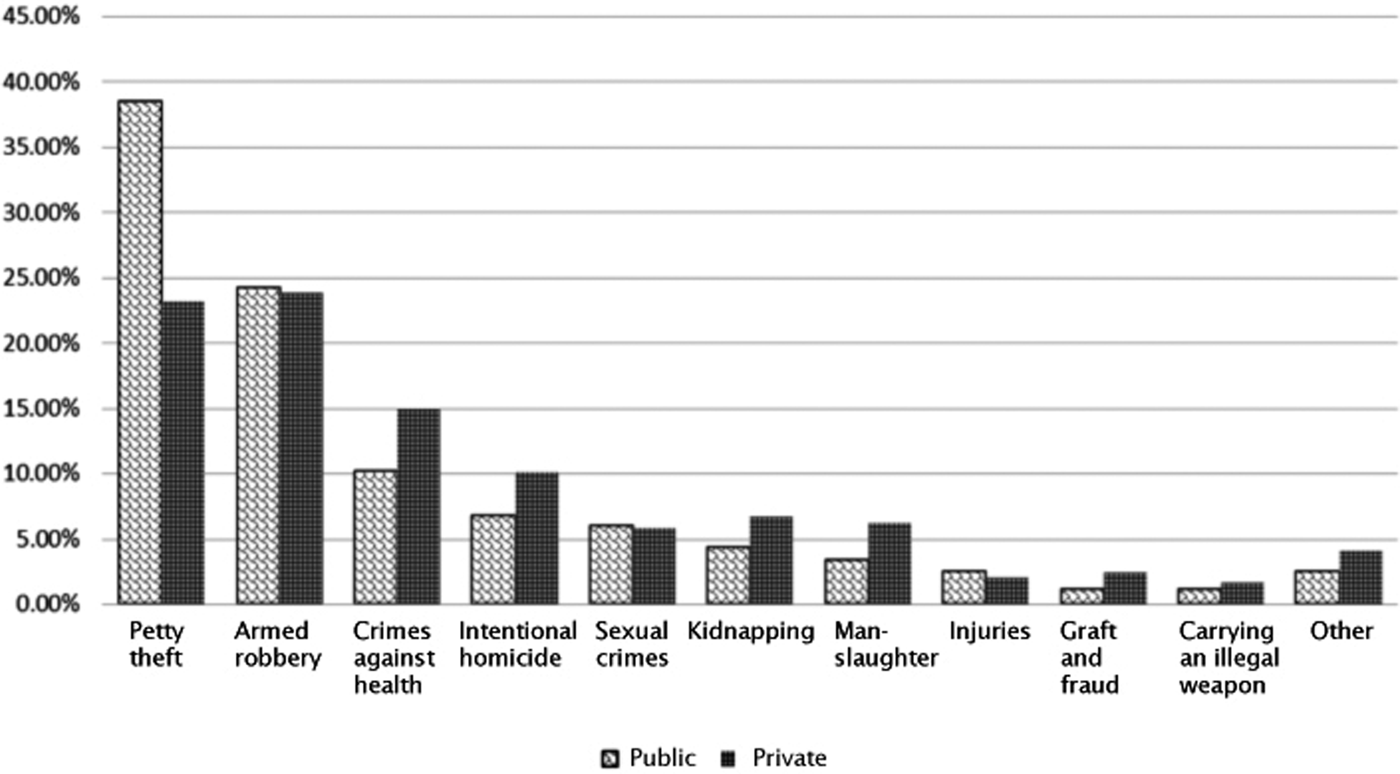
When sentence severity was analysed, the findings revealed a rather surprising outcome, as inmates defended by a public lawyer received more lenient sentences than those who received a private defence, 9.9 and 12.9 years on average, respectively. The difference in sentence duration is, once again, statistically significant.Footnote 32 While this finding is certainly noteworthy, it is difficult to attribute it to any particular factor with certainty. It is possible that public defenders receive less serious cases. Indeed, the available data revealed that 38 per cent of cases handled by the public defence were simple robberies, compared to only 22 per cent that were assigned to private lawyers. If the cases public defenders assisted the inmates with were generally of a less serious nature, it is logical that the sentences would be shorter (see Figure 2). When the data were subjected to analysis that examined links between crime severity and type of lawyer representing the inmate, statistically significant differences were noted between the case-loads of private and public lawyers.
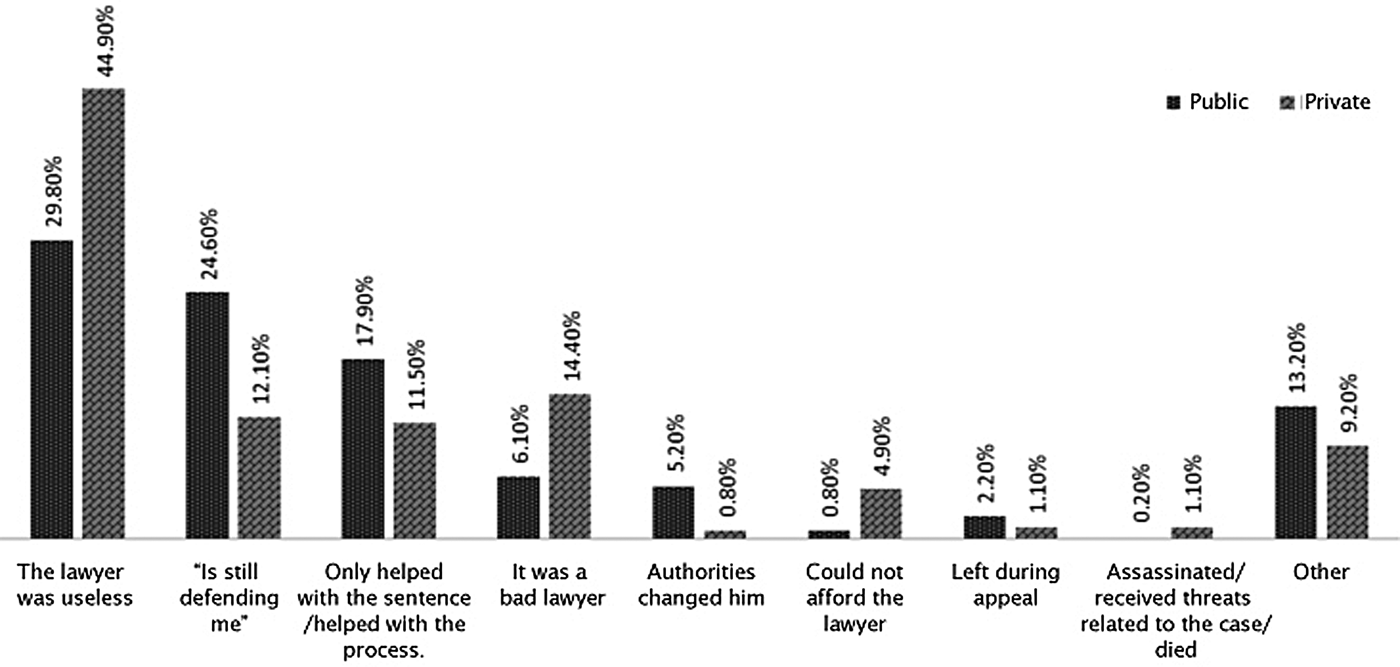
Type of lawyer and reasons to change
However, despite having received less severe sentences than those who had private lawyers, the prisoners who had a public defender evaluated their lawyer more negatively than those with private lawyers did (see Table 1). In fact, more than half of the interviewees claimed that their public defender did absolutely nothing for them.
Type of lawyer and perceived help received

The observed differences in the perception of the work public and private lawyers did for their clients were statistically significant, whereby inmates who hired a public lawyer believed that they received a far less satisfactory defence than those who had a private lawyer. More specifically, this conclusion is based on the results of the mid-range analysis of the Mann–Whitney test, and can be observed in the percentile distribution as well. However, the statistical significance was very low, as the lawyer type explained only 2.2 per cent of the variance in this perception.Footnote 33 Indeed, if these data are excluded from the remaining responses pertaining to the level of satisfaction according to the received representation (see Figure 2), a new relationship emerges – inmates who had public defenders were more satisfied than those who had private lawyers.
The observed relationship is statistically significant, even though only weak support exists for this assertion.Footnote 34 Nonetheless, this correlation can be interpreted to convey that the reasons for hiring a private or public lawyer are statistically different. When the overall satisfaction with the sentence received was analysed, 70.2 per cent of the inmates (regardless of the type of representation) considered it absolutely unfair, 9.3 per cent felt that it was somewhat fair, 12 per cent rated it as quite fair, and only 7.6 per cent of the incarcerated population considered the sentence as very fair (see Table 2).Footnote 35 However, when these views were analysed against the type of representation received, a counter-intuitive relationship emerged once again, as inmates who were defended by public lawyers were, overall, more satisfied with their sentences than those who hired private lawyers.
Type of lawyer and perception on the fairness of the sentence

The observed difference in perception of the sentencing outcome is statistically significant, suggesting that persons who were defended by a public lawyer perceived their sentence as fairer than those who hired a private lawyer (again, this finding emerged from the mid-range analysis of the Mann–Whitney test, and can be mildly observed in the distribution of percentiles as well). However, the statistical significance is very low, given that the type of lawyer explains only 0.6 per cent of the variance in the perceived sentence fairness.Footnote 36
As the findings discussed above suggest, when the quality of public defence in Mexico City was contrasted with that provided by private defence, significant differences in the processes’ duration (whereby trials in which public defenders are involved tend to be briefer), and the sentence severity (inmates defended by public lawyers tend to receive more lenient sentences) were noted. In addition, while very few defendants perceived their sentence as fair, those who had public representation seemed to view their trial outcomes more favourably. Finally, the inmates aided by a state lawyer reported a higher level of satisfaction with their defence than those who received private assistance.
While these findings are certainly noteworthy, and some might be counter-intuitive, the reasons behind them are difficult to establish. However, in the context of this investigation, we consider that there are at least four possible explanations for the perceived success of public defence (with respect to the judicial process and sentence) and the overall inmate satisfaction with the sentence and the performance of the public defender.
3.1 Declaration of guilt of the defendant and litigious activity of the lawyer
As previously noted, 29.4 per cent of the interviewees assisted by public defenders pleaded guilty, in contrast to 20.8 per cent of those who were represented by private lawyers. According to previous studies conducted in Mexico City, declaration of guilt is an element that directly affects the speed of the judicial process (Bergman and Azaola, Reference Bergman and Azaola2003). This may explain the brevity of judicial processes where public defenders intervened, especially if we consider that 89 per cent of the interviewees represented by public defenders were held in custody less than a week after committing the crime (see Table 3).Footnote 37.
Type of lawyer and time elapsed between the crime and detention

In order for the declaration of guilt to have objective effects, especially during the legal process, we consider that the degree of litigiousness of the defender should be taken into consideration.Footnote 38 Consequently, it is important to ascertain whether, during the trial, the lawyer made any attempt to charge or defend any previous declarations by the defendant. When comparing the level of litigiousness of the lawyers, we found that, according to the inmates, private lawyers were more active during the process than public defenders. More specifically, in 75 per cent of cases, private lawyers presented additional evidence, while only 46 per cent of public defenders did. Private defenders also employed a more extensive range of resources and utilised the appeal process more frequently than their public counterparts did. The analysis of the available data indicated that 18 per cent of the public defenders and 50 per cent of the private lawyers appealed the sentence. These data, to an extent, explain the previously noted relationship between the length of the process and the type of defender. Nonetheless, no conclusion can be reached with respect to the more lenient sentences that inmates represented by public defenders received.Footnote 39
3.2 Length of the sentence
The less severe sentences, in terms of both the actual duration and the inmates’ perception of fairness relative to the crime committed, in cases handled by public defenders can be due to the fact that, in general, public defenders tend to represent persons who have been accused of lighter crimes than those who seek the help of private defenders. As shown in Figure 3, public lawyers typically defend individuals accused of lesser crimes, whereas in violent crimes that carry the possibility of a long sentence (kidnapping, crimes against health, etc.), the defender is usually private. Thus, it is possible that this distribution could also explain the sociodemographic characteristics of the accused. Ample studies that have been conducted on the subject have reported a close link between the urban poor and the criminal system in Mexico City. This relationship is revealed in crimes against property, especially burglary and theft (Hayner, Reference Hayner1946; Piccato, Reference Piccato2001; Vilalta, Reference Vilalta2008). In fact, recent investigations point out that most inmates in Mexico City's jails have committed petty theft (Bergman, Reference Bergman2011). Thus, following from the previous analyses, they constitute little more than half of the incarcerated individuals represented by a public lawyer.
Type of lawyer and crime
It was also noted in the preceding discussions that the relationship observed between the type of lawyer and the type of crime committed is statistically significant.Footnote 40 However, given the heterogenic structure of the crimes examined in this study, it is difficult to establish the relevance of this link. Nonetheless, it is important to mention that the correlation demonstrates that crimes committed by those who have private lawyers and those with public representation are statistically different.
3.3 Encounters with the lawyer
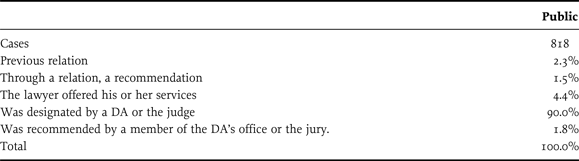
The above analysis was extended to the manner in which the accused contacted their attorneys. As observed in Table 4, in cases in which inmates sought the help of a public defender, the district attorney or the judge of the cases designated the DA in 90 per cent of them. In other words, the accused had no input in the choice of the defender. On the other hand, those who sought the assistance of private lawyers did so of their own accord, and thus had full control of the defence they received.
Type of lawyer and method of assignment
While the assertions made above are difficult to quantify, it is evident that the reasons for choosing a private or public lawyer are statistically different. As noted above, most of the public defenders were designated by a judge or the district attorney, whereas private lawyers were contacted through relations or acquaintances.Footnote 41
3.4 Expenses
Even though, in theory, inmates receive a public defence free of charge, in practice, public lawyers require additional means to carry out their work (i.e. make photocopies, purchase paper for legal documents, etc.). These added expenses are met by the defendant. These irregularities in the service represent another argument that could explain the higher approval rate of those who received public guidance, since their costs are significantly lower when compared to private representation (see Table 5). In cases handled by public defenders, the mean cost was 28,685.4 pesos, compared to 66,875.0 pesos charged by private lawyers.
Type of lawyer and collection of charges

The observed relationship is statistically significant, as expected. However, lawyer type explains only 1 per cent of the variance in the perceived level of service.Footnote 42 It is to be expected that the level of satisfaction with the representation and sentence received would be partially influenced by the expense incurred by the defendant. In other words, if we observe the factors that influence the assessment of services received by public defenders and the fairness of the process, it can be said that a less severe sentence obtained in a shorter time and at a lower cost are the core determinants of a person's opinion of a sentence, regardless of the performance of the defender.
Finally, the survey also revealed that inmates represented by public defendants tend to have a more favourable perception of fairness of both the process and the sentence received. However, if we consider the explored relation in linear terms (whereby lawyer type determines the perception of the sentence), the difference between public and private defence is statistically significant. On the other hand, if we take into consideration that every criminal procedure represents a complex sum of relations, positions, and social and institutional dynamics, the perceived fairness of the process loses relevance when the inmate has no input on the individual who will present the case in court. This is particularly true when the defender designated by an authority has not presented any evidence, and has not used any additional resources or materials. In sum, these results suggest that the manner in which the lawyer is chosen, as well as the lawyer's aptitude (utilisation of resources and/or evidence), can be decisive in determining the perceived justice during the process, regardless of a verdict.
IV. Final remarks
Before drawing conclusions from the discussions presented in the preceding sections, it is essential to reiterate that the data used in the analyses are derived solely from the perceptions of sentenced persons who took part in this investigation. This is pertinent, as no input was sought from those who received a ‘not guilty’ verdict. Thus, it is likely that the findings presented here are biased, as most inmates – by the mere nature of their situation – would not look upon the judicial system favourably. These limitations notwithstanding, this study offers a glimpse into the process from the perspectives of those who are rarely given opportunity to speak out and offer their views regarding the treatment they received. In addition, despite some interesting correlations reported here, no causal extrapolations should be made. Still, these correlations could be further explored in future research. It would be highly beneficial that future studies incorporate qualitative interviews with private and public defenders, as well as an analysis of court records, as this would help to corroborate some of the facts reported here. In addition, by providing a broader perspective of the legal defence of those arrested and prosecuted in Mexico City, it is hoped that the system can be improved.
Despite extensive analyses, it is difficult to respond in a conclusive manner to the issue raised at the beginning of this paper: ‘What impact does the allocation of a public defender, as opposed to a privately chosen lawyer, have on the perception of process, outcome and justice in a criminal trial?’ The results reported in this work revealed that lawyer type plays a role in different contexts and procedural stages. As previously mentioned, it would seem that a lighter sentence obtained in less time and at a lower cost would improve the inmates’ perception of the judicial process, regardless of the defender type and his/her aptitude.
Most importantly, when assessing the level of satisfaction with the defence, it is essential to note that, in most cases, public defenders are assigned to the accused, while those hiring private lawyers work together by recommendation. This has been discussed by Bergman and Azaola (Reference Bergman and Azaola2003), who noted that public defence is an institution which, in co-ordination with the rest of the penal institution, affects the perception of the outcome. These authors go so far as to claim that punishing Mexico City's poorest sectors is the sole purpose of public defence. In this case, the punishment handed out through judicially appointed representation seems guaranteed on paper while, in reality, it (i) abandons the accused at the DA's office, (ii) presents less evidence and (iii) uses fewer resources than private defenders.
However, it can be said that the selection and assignment of lawyers does not always represent a unilateral decision taken by the agents of the judicial system. Empirical evidence indicates that the accused can – in some cases – decide whether to appoint a public or a private lawyer. Though it is important to distinguish between the different stages of the judicial process because the public defenders during the investigation of the Attorney General's Office are not necessarily the same ones during the judicial process itself (each stage has a different public defender).Footnote 43 Evidently, the apparent over-representation of poor defendants by public lawyers makes this a difficult case for generalisation. It is also likely that most individuals defended by public lawyers will not have the opportunity to obtain the favour of a judge or affect the DA's final decision. Still, in other cases, it is probable that the role played by the lawyer within the process will be determined by the defendant's capacity to select a lawyer through their previous experiences with the legal system.
It should, however, be noted that this interpretation applies only to 3.8 per cent of the interviewees who hired a public lawyer, to whom they obtained access by means of an acquaintance or by a previous experience. In the same sense, if we take into consideration that flagrancy and the declaration of guilt are key elements of the decisions taken by the processed to select a lawyer, as suggested by Hoffman et al. (Reference Hoffman, Rubin and Shepherd2005), we can posit that the majority of the work performed by public defenders in Mexico City pertains to persons who have accepted the attributed accusation by the state, which results in the cheapest legal process for the state.
Finally, as an overview born of the consideration of the relations and frequencies previously exhibited, it can be said that the lawyer type, in general, has no effect on the results of criminal procedure in Mexico City. Whether private or public, the performance of the defender will be rather questionable. However, noting that this study was based solely on inmate accounts, it is essential to analyse the relationship between urban poverty, penal justice and public defence further. The judicial process is complex, and its elements and results are as multifarious and diverse as the social reality in which it takes place.