INTRODUCTION
It has been estimated that, in the United States alone, between 100,000 and 200,000 children are sexually molested each year (Gorey & Leslie, Reference Gorey and Leslie1997). These high prevalence rates have fueled research efforts aimed at better understanding the underpinnings of such crimes, with an increasing interest in examining neurobiologic contributions to pedophilia. While one line of research in this general area has focused on identifying prenatal risk factors for the development of paraphilias (Rahman & Symeonides, 2007), another line has utilized neuroimaging and neurocognitive assessments. This latter line of research has linked child molestation to frontal and temporal lobe abnormalities.
The Frontal Lobes
Studies have found that child molesters as a group exhibit frontal lobe anomalies, including structural abnormalities in the frontostriatal gray matter (Schiffer et al., Reference Schiffer, Peschel, Gizewski, Forsting, Leygraf, Schedlowski and Krueger2007) and fronto-occipital and arcuate fasciculi (Cantor et al., Reference Cantor, Kabani, Christensen, Zipursky, Barbaree, Dickey, Klassen, Mikulis, Kuban, Blak, Richards, Hanratty and Blanchard2008); electroencephalogram abnormalities (Flor-Henry et al., Reference Flor-Henry, Lang, Koles and Frenzel1991); lower regional cerebral blood flow (Hendricks et al., Reference Hendricks, Fitzpatrick, Hartmann, Quaife, Stratbucker and Graber1988); decreased glucose metabolism (Cohen et al., Reference Cohen, Nikigforov, Gans, Poznansky, McGeoch and Weaver2002); and poorer performances on measures of executive functions (Flor-Henry, Reference Flor-Henry and Wilson1987; Joyal et al., Reference Joyal, Black and Dassylva2007). Additionally, case studies of men with pedophilic tendencies acquired later in life have shown frontal neuropathology (Burns & Swedlow, Reference Burns and Swedlow2003; Mendez et al., Reference Mendez, Chow, Ringman, Twitchell and Hinkin2000).
These findings are consistent with the evidence that criminal offenders in general demonstrate metabolic (Anckarsater, Reference Anckarsater2006; Birbaumer et al., Reference Birbaumer, Veit, Lotze, Erb, Hermann, Grodd and Flor2005; Maller et al., Reference Maller, Sommer, Wagner, Lange, Taschler, Rader, Schuierer, Klein and Hajak2003; Wright et al., Reference Wright, Nobrega, Langevin and Wortzman1990) and structural abnormalities in the frontal lobes (Brower & Price, Reference Brower and Price2001; Miller, Reference Miller1999), as well as problems in executive abilities, empathy, and perspective taking (Bergeron & Valliant, Reference Bergeron and Valliant2001; Birbaumer et al., Reference Birbaumer, Veit, Lotze, Erb, Hermann, Grodd and Flor2005; Dolan et al., Reference Dolan, Deakin, Roberts and Anderson2002; Gontkovsky & Morgan, 2005; Lapierre et al., Reference Lapierre, Braun and Hodgins1995; Stone & Thompson, Reference Stone and Thompson2001), all representing functions associated with the frontal lobes (Lezak et al., Reference Lezak, Howieson and Loring2004).
The Temporal Lobes
With respect to the temporal lobes, left-hemisphere dysfunction has been suspected (Hucker et al., Reference Hucker, Langevin, Wortzman and Bain1986; Lang, Reference Lang1993), as child molesters have exhibited deficits in semantic knowledge (Langevin et al., Reference Langevin, Wortzman, Wright and Handy1989) and verbal learning (Joyal et al., Reference Joyal, Black and Dassylva2007). However, neuroimaging findings are mixed: Studies have found a lower left–temporal lobe volume (Wright et al., Reference Wright, Nobrega, Langevin and Wortzman1990), lower temporal volume bilaterally (Cantor et al., Reference Cantor, Kabani, Christensen, Zipursky, Barbaree, Dickey, Klassen, Mikulis, Kuban, Blak, Richards, Hanratty and Blanchard2008), smaller amygdala volume bilaterally (Schiltz et al., Reference Schiltz, Witzel, Northoff, Zierhut, Gubka, Fellmann, Kaufmann, Tempelmann, Wiebking and Bogerts2007), and decreased metabolism in the right temporal lobe (Cohen et al., Reference Cohen, Nikigforov, Gans, Poznansky, McGeoch and Weaver2002). Additionally, two case studies of men with pedophilia acquired later in life showed bilateral hippocampal sclerosis and right–temporal lobe hypometabolism (Mendez et al., Reference Mendez, Chow, Ringman, Twitchell and Hinkin2000). Thus, lateralized abnormalities have not been clearly demonstrated. Lateralization notwithstanding, the involvement of the temporal lobe in paraphilias is theoretically plausible, as damage to the temporal-limbic structures (i.e., the amygdala and the hippocampus) has been linked to hypersexuality and other changes in sexual functioning (Baird et al., Reference Baird, Wilson, Bladin, Saling and Reutens2002; Kluver & Bucy, Reference Kluver and Bucy1939; Ozmen et al., Reference Ozmen, Erdogan, Duvenci, Ozyurt and Ozkara2004).
Given the findings of potentially both frontal and temporal lobe abnormalities among child molesters, it has been hypothesized that these men repeatedly offend against children in part because of poor impulse control mediated by weaknesses in frontal lobe functions and in part because of strong sexual attraction toward children presumably mediated by temporal-limbic abnormalities (Bogaert, Reference Bogaert2001; Cohen et al., Reference Cohen, Nikigforov, Gans, Poznansky, McGeoch and Weaver2002; Pallone & Voelbel, Reference Pallone and Voelbel1998; Wright et al., Reference Wright, Nobrega, Langevin and Wortzman1990). Alternatively, it has been argued that because the temporal lobe abnormalities among child molesters are thought to affect primarily the left-hemisphere functions, as is reflected in poorer language skills (Cohen et al., Reference Cohen, Nikigforov, Gans, Poznansky, McGeoch and Weaver2002; Joyal et al., Reference Joyal, Black and Dassylva2007; Langevin et al., Reference Langevin, Wortzman, Wright and Handy1989), it is possible that child molesters’ attraction to children is partly mediated by their inability to relate normally to adults (Marshall et al., Reference Marshall, Seerran and Cortoni2000).
The above assertions have been limited in several ways. First, as is the case with the majority of the research with criminal offenders, studies of child molesters are conducted almost exclusively with those who have been apprehended. Thus, it is not clear whether poor executive functioning predisposes one to commit a crime or whether it simply predisposes one to getting caught (Seto, Reference Seto2008). Second, as pointed out in an excellent comprehensive review by Blanchard et al. (Reference Blanchard, Cantor, Robichaud, Barbaree and Marshall2006), many studies do not find brain or cognitive abnormalities among child molesters at all.
However, Blanchard et al. (Reference Blanchard, Cantor, Robichaud, Barbaree and Marshall2006) argue that both the negative and the positive findings that have been reported are difficult to interpret, as the research in this area has been plagued by poorly defined groups and limited statistical power. Additionally, most studies have not considered the possibility that the “profiles” of strengths and weaknesses they have identified could reflect differential reliability and discriminability of different instruments. Conversely, some studies have employed tests from only one cognitive domain (typically executive) and as such were unable to demonstrate whether observed weaknesses reflect a specific problem with executive functions or a more global cognitive impairment. Given these problems, Blanchard et al. (Reference Blanchard, Cantor, Robichaud, Barbaree and Marshall2006) further argue that “it remains possible that specific cognitive deficits among sexual offenders do, in fact, exist, but that only specific subtypes of sexual offenders exhibit them and that investigations using heterogeneous groups have obscured their detection” (p. 84).
Consistent with the latter assertion, a number of researchers have recently begun to advocate for distinguishing between two distinct types of sex offenders against children (Cohen & Galynker, Reference Cohen and Galynker2002; Guay et al., Reference Guay, Proulx, Cusson and Ouimet1921; Seto, Reference Seto2008): (1) pedophilic child molesters (for whom prepubescent children are the primary target of sexual interest) and (2) nonpedophilic child molesters (who sexually offend against young children even though they are primarily sexually interested in adults).
These two groups of molesters differ quite obviously in their motivations for offending against children: Pedophiles are, by definition, motivated by strong sexual attraction toward children, whereas nonpedophiles appear to offend due to poorly understood nonsexual motives, such as need for control or a desire to eliminate negative emotional states (Mann & Hollin, Reference Mann and Hollin2007). Additionally, pedophiles tend to have more victims (sometimes hundreds) and higher rates of recidivism than nonpedophilic child molesters (Abel & Osborn, Reference Abel and Osborn1992). And finally, the two groups may differ with respect to affective processing, with nonpedophilic child molesters evidencing poorer ability to recognize facial and prosodic affect as compared to pedophiles or nonoffending controls (Suchy et al., in press)Footnote a. However, to our knowledge, no studies have compared the two groups with respect to neurocognitive profiles.
The purpose of the present study was to address some of the weaknesses and controversies in prior research by comparing neurocognitive performances among three clearly defined groups: (1) pedophilic child molesters, (2) nonpedophilic child molesters, and (3) community-dwelling nonoffender controls. These participants were administered a battery of neurocognitive tests that included simultaneously all four neurocognitive domains that have been implicated by prior research, including Executive Functions (EF), Semantic Knowledge (SK), and Auditory and Visual Memory (AM and VM). Additionally, we assessed Processing Speed (PS) and Motor Speed (MS) as two domains that have not been previously implicated but can be associated with neurodevelopmental problems. Each domain was assessed using a composite of three scores, so as to (a) maximize stability of scores and (b) allow assessment of internal consistency reliability. Empirically demonstrating comparable reliabilities in the presently studied sample would allow us to demonstrate that any profiles that might emerge are not an artifact of differential reliability.
METHOD
Participants
Participants were 60 males, including 20 male controls (CNT) recruited from the community and 40 men convicted of having sexually offended against a child less than 13 years of age, recruited from three Utah sex offender residential treatment sites. Sex offenders were divided into two groups: (1) those characterized by a primary sexual interest in prepubescent children (i.e., less than 13 years of age), referred to below as “pedophilic” (PED, n = 20); and (2) those who, despite having offended against a prepubescent child, exhibited a primary sexual interest in adults, referred to as “nonpedophilic” (N-PED, n = 20). Offenders’ pedophilic status was established in three steps, utilizing procedures typically used in this type of research (e.g., Cantor et al., Reference Cantor, Kabani, Christensen, Zipursky, Barbaree, Dickey, Klassen, Mikulis, Kuban, Blak, Richards, Hanratty and Blanchard2008). First, those few child molesters who acknowledged to either their therapist or the study interviewer that they were primarily sexually interested in children were included in the PED group. Second, for those offenders who did not admit to being pedophilic, penile plethysmography (PPG), administered routinely to sex offenders early in treatment, was used for classification. In particular, those offenders evidencing greater arousal to prepubescent (male or female) stimuli than to adult (male or female) stimuli were included in the PED group, while those evidencing greater arousal to the adult than the prepubescent stimuli were included in the N-PED group. Finally, for the few child offenders who did not admit to being pedophiles and for whom valid PPG data were not available, the Screening Scale for Pedophilic Interests (SSPI) (Seto & Lalumiere, Reference Seto and Lalumiere2001; Seto et al., Reference Seto, Harris, Rice and Barbaree2004) was completed. Those scoring 4 or 5 on this five-point scale were considered to be PEDs, while those scoring 0 or 1 were considered to be N-PEDs; those scoring in the intermediate range were not included in the study.
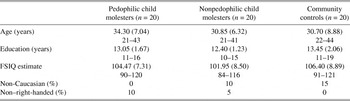
Per self-report, all participants were free of neurologic diseases or serious medical illnesses known to affect the central nervous system. Effort was taken to match controls to offenders’ socioeconomic status using parental education and occupation for this purpose (Hollingshead, Reference Hollingshead1975). However, this proved difficult to accomplish, as the two offender groups themselves differed somewhat on this dimension. Specifically, 80% of PEDs came from lower to upper middle class, as compared to only 55% of N-PEDs and CNTs. Additionally, only 15% of PEDs came from the lower class, as compared to 40% of N-PEDs and CNTs. The remaining demographic characteristics, as well as estimated IQ based on Shipley Institute of Living Scale scores, were comparable across the three groups (all F values <1.8, all p values >.18; see Table 1).
Demographic characteristics of the sample

Note.
Standard deviations (SDs) are presented in parentheses. Ranges are presented beneath each mean (SD) pair. Full Scale Intelligence Quotient (FSIQ) estimate was based on Shipley Institute of Living Scale Wechsler Adult Intelligence Scale—Revised IQ estimate.
Instruments
Assessment of sample characteristics
The SSPI (Seto & Lalumiere, Reference Seto and Lalumiere2001; Seto et al., Reference Seto, Harris, Rice and Barbaree2004). This measure contains four items pertaining to victim characteristics (i.e., victim gender, number of victims, victim age, and relationship to perpetrator) and has been found to correlate with phallometric measures of sexual interest in children (Seto et al., Reference Seto, Harris, Rice and Barbaree2004).
Shipley Institute of Living Scale—Revised (SILS) (Zachary, Reference Zachary1986) The SILS was used to estimate intelligence. It consists of 40 vocabulary and 20 analytical reasoning items and contains normative tables for converting performances into Wechsler Adult Intelligence Scale—Revised Full Scale IQ estimates.
Handedness Questionnaire (Chapman & Chapman, Reference Chapman and Chapman1987).This questionnaire consists of 13 handedness questions.
Health Screen Questionnaire (HQS).HQS was developed for this study and included questions about history of neurologic disorders such as cerebrovascular accident, traumatic brain injury, multiple sclerosis, and epilepsy; history of medical illnesses known to affect cognition, such as diabetes or heart disease; and neurodevelopmental conditions, such as attention-deficit disorder or learning disabilities.
Semantic Knowledge (SK)
Tasks for assessing the SK domain were selected so as not to be confounded by expressive language, which can be confounded by organizational skills and/or executive abilities. In particular, the Information Subtest requires only telegraphic, often single word, responses, and the reading comprehension and vocabulary tests use multiple-choice format.
Wechsler Adult Intelligence Scale, 3rd Edition (WAIS-III): Information Subtest (PsyCor, 1997)
Standard procedures for administration and scoring were followed. The test consists of questions about world facts. Raw score was used as the dependent variable.
Peabody Individual Achievement Test: Reading Comprehension Subtest (Markwardt, Reference Markwardt1997)
Passages of increasing complexity were read to participants. Participants selected one of four drawings that most closely correspond to the content of the presented passage. Ceiling levels were determined according to the manual and thus obtained raw scores were used.
Recognition vocabulary
Recognition vocabularywas assessed using the vocabulary portion of the Shipley Institute of Living Scale (Zachary, Reference Zachary1986). The total raw number of correct words was used.
Executive Functions (EF)
Given that the presumed executive weaknesses among child molesters have been generally referred to as “frontal lobe deficits,” we have specifically selected tests that have been well established both as measures of executive abilities and as measures that are sensitive to frontal lobe pathology (Lezak et al., Reference Lezak, Howieson and Loring2004).
Stroop Color and Word Test (SCWT)
Standard procedures for administration and scoring were followed (Golden & Freshwater, Reference Golden and Freshwater1998). The SCWT consists of a page that contains five columns of color words printed in different color ink. Participants name as many colors as possible in 45 s. The total number of correctly named colors (raw score) was used.
Ruff Figural Fluency Test
Standard procedures for administration and scoring were followed (Ruff, Reference Ruff1988). Patients were presented with five pages, each containing 35 five-dot matrices, and instructed to create, in 1 min, as many different designs as possible by connecting dots within each matrix. The total number (raw score) of unique designs generated by each participant was used.
Behavioral Dyscontrol Scale (BDS)
Standard administration and scoring procedures were followed (Grigsby et al., Reference Grigsby, Kaye and Robbins1992), employing a four-point scoring system (Leahy et al., Reference Leahy, Suchy, Sweet and Lam2003). The BDS comprised nine items, four of which assess motor sequence programming and learning, two go/no-go tasks, and three items of working memory and insight. The BDS is sensitive to frontal lobe injuries (Leahy et al., Reference Leahy, Suchy, Sweet and Lam2003) and correlates highly with traditional measures of executive abilities (Suchy et al., Reference Suchy, Blint and Osmon1997, Reference Suchy, Leahy, Sweet and Lam2003). The total raw score was used.
Auditory and Visual Memory (AM, VM, respectively)
Wechsler Memory Scale 3rd edition: Logical Memory Subtest (PsyCor, 1997)
Standard administration and scoring procedures were followed. The test consists of participants repeating, from memory, two short stories they heard earlier, both immediately and after a 30-min delay. The raw scores for Immediate Recall, Delayed Recall, and Percent Retention were used as variables.
Wechsler Memory Scale 3rd edition: Visual Reproduction Subtest (PsyCor, 1997)
Standard administration and scoring procedures were followed. The test consists of participants drawing a series of abstract figures from memory, both immediately after presentation and after a 30-min delay. The raw scores for Immediate Recall, Delayed Recall, and Percent Retention were used as variables.
Processing Speed (PS) and Motor Speed (MS)
PS and MS were assessed using electronically administered reaction time tasks so as to maximize timing accuracy, as well as to allow separation of the decision time and the movement time aspects of response latencies. Separating decision time from movement time in reaction time tasks is well established in the literature. Decision time has been found to be more heritable (Finkel & McGue, Reference Finkel and McGue2007; Simonen et al., Reference Simonen, Videman, Battie and Gibbons1998) and more sensitive to subtle neurologic insults (Maddocks & Saling, Reference Maddocks and Saling1996) than movement time. Additionally, decision time has been shown to be related to the speed of visualization and perception, as well as performance on Symbol Digit Substitution Test (O’Connor & Burns, Reference O’Connor and Burns2003).
Simple choice reaction time
This task is administered as part of the Behavioral Dyscontrol Scale—electronic version (BDS-EV) battery (Suchy et al., Reference Suchy, Derbidge and Cope2005). Using the BDS-EV response console, participants hold down a “home” button while waiting for stimuli (colored circles) to appear on the computer screen in front of them. They are instructed to respond to stimuli as fast as they can. As soon as a stimulus appears, participants are to let go of the home button and press a button of corresponding color on the response console. Response latencies, measured in milliseconds, are recorded. The speed of letting go of the home button (i.e., the decision time) reflects PS and is relatively unconfounded by fine motor skills. The latency between letting go of the home button and depressing the correct colored button (i.e., the movement time) reflects MS. Median response time across all correct trials was used for analyses.
Complex choice reaction time task
Again using the BDS-EV response console, participants hold down a “home” button while waiting for stimuli (filled or empty circles) to appear on the computer screen in front of them. Depending on the nature of the stimuli, participants either double-tap on the white dome (open circles) or turn the joystick clockwise (filled circles). The speed of letting go of the home button (i.e., the decision time) reflects PS, and the latency between letting go of the home button and executing the correct movement (i.e., the movement time) reflects MS. Median response time across all correct double-tap responses and all correct joystick responses were recorded separately and were used in analyses as separate variables.
Procedures
All data were collected in compliance with the guidelines and regulations of the University of Utah Institutional Review Board (IRB). Participants were recruited using flyers posted in the community (for controls) or at the sex offender treatment centers (for offenders). Participants first underwent standard IRB-approved informed consent procedures and a brief interview, followed by questionnaires and the IQ screen, and then neuropsychological testing. Participants were reimbursed for participation, receiving between $30 and $50 for approximately 3 hr of testing.
RESULTS
Preliminary Analyses
Self-report medical history
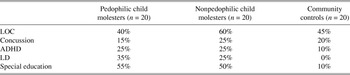
Because sex offenders have been found to exhibit greater than normal rates of brain injuries (Blanchard et al., Reference Blanchard, Christensen, Strong, Cantor, Kuban and Klassen2002, Reference Blanchard, Kuban, Klassen, Dickey, Christensen and Cantor2003) as well as presumed pre- or neonatal perturbations resulting in placements in special education classes (Cantor et al., Reference Cantor, Kuban, Blak, Klassen, Dickey and Blanchard2006), we collected self-report information about potential mild traumatic brain injuriesFootnote b (i.e., loss of consciousness or a diagnosis of a concussion) and potential neurodevelopmental perturbations (i.e., learning disabilities, attention-deficit disorder, and placement in special education classes). The prevalence of these conditions can be found in Table 2. As can be seen, both PEDs and N-PEDs reported learning disabilities and placement in special education classes with a greater frequency than CNTs (Chi Square = 8.13, df = 2, p = .017 and Chi Square = 10.08, df = 2, p = .006, respectively).
Prevalence rates of neurologic vulnerabilities

Note.
Full Scale Intelligence Quotient estimate was based on Shipley Institute of Living Scale Wechsler Adult Intelligence Scale—Revised IQ estimate. Vulnerability score is each participants’ total sum of endorsed vulnerabilities. ADHD, attention-deficit disorder; LD, learning disability; LOC, loss of consciousness.
Generation of composites
As outlined in the Method section, each of the six cognitive domains was based on three scores, so as to maximize score stability, as well as to allow assessment of composite reliabilities within the present sample. This also allowed us to determine whether all six composites were comparable with respect to reliability, as profiles generated by scores with dissimilar reliabilities cannot be meaningfully interpreted.
First, we examined the internal consistencies of composite scores by computing Cronbach’s alpha for each of the six composites. These scores for all six domain composites ranged from .805 to .860, demonstrating adequate, and highly similar, reliabilities.
Next, to generate composites, we conducted six principal component analyses so as to create a single-factor score for each domain. The eigenvalues for all six composites ranged from 2.19 to 2.35. The variance accounted for by each factor score ranged from 72.80% to 78.20%.
Zero-order correlations
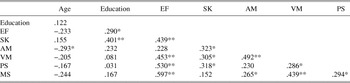
Table 3 presents a correlation matrix among cognitive variables and demographics. As would be expected, most cognitive variables exhibited small to medium correlations. Additionally, education predictably exhibited medium correlation with SK, as well as small correlation with EF. Age exhibited relatively minimal association with most variables, with the exception of a small correlation with AM.
Zero-order correlations among cognitive domains and demographic variables (N = 60)

Note.
AM, Auditory Memory; EF, Executive Functions; MS, Motor Speed; PS, Processing Speed; SK, Semantic Knowledge; VM, Visual Memory. Higher cognitive domain scores reflect better performance.
* p < .05.
** p < .01.
Principal Analyses
Multivariate profile of performance
To examine whether the three groups were characterized by different profiles of scores, we conducted a multivariate analysis of variance using the six domain scores as dependent variables and group (PED vs. N-PED vs. CNT) as the independent variable. The results revealed profile differences [Wilks’ lambda (12,104) = .600, p = .006]. See Figure 1.
The profile of composite factor scores for six cognitive domains for pedophilic child molesters (PED), nonpedophilic child molesters (N-PED), and community controls (CNT). The domains include Executive Functions (EF), Semantic Knowledge (SK), Processing Speed (PS), Motor Speed (MS), Auditory Memory (AM), and Visual Memory (VM). The values on the Y axis are factor scores, with higher scores reflecting better performance.

Univariate differences in performance
Next, we examined whether the groups differed with respect to individual neurocognitive domains by conducting six univariate analyses of variance (ANOVAs), using each of the six domain scores as the dependent variables and group as an independent variable. These analyses showed that the groups differed with respect to EF [F(2,57) = 6.57, p = .003] and PS [F(2,57) = 6.86, p = .002]. There was also a trend for SK [F(2,57) = 2.91, p = .063]. No group differences were found for AM, VM, or MS.
Follow-up analyses revealed that, as expected, both PEDs and N-PEDs performed more poorly than CNTs on EF [least square difference (LSD) p = .001 and .008, respectively] and that PEDs exhibited slower PS than CNTs and N-PEDs (LSD p = .007 and .001, respectively). Additionally, follow-up exploratory analysis of the trend for SK revealed that N-PEDs appeared to perform more poorly than CNTs (LSD p = .019).
Effects of age and education
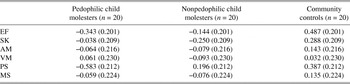
Repeating the above univariate ANOVAs using age and education as covariates yielded highly similar results with respect to EF and PS [F(2,55) = 4.55, p = .015 and F(2,55) = 4.98, p = .005, respectively]. However, the trend for the SK difference was no longer present. Estimated marginal means and standard errors of estimate can be found in Table 4.
Estimated marginal means and standard errors of the mean (in parentheses) for the six assessed domains after accounting for age and education

Note.
Numbers reflect factor scores. Higher values reflect better performance. AM, Auditory Memory; EF, Executive Functions; MS, Motor Speed; PS, Processing Speed; SK, Semantic Knowledge; VM, Visual Memory.
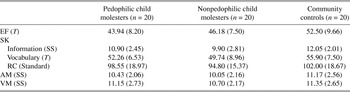
Finally, to facilitate clinical interpretation of the results, Table 5 presents the mean T and scaled scores for the EF, AM, and VM composites. Because the T scores for the SILS vocabulary (which contributes to the SK composite) come from older norms and as such overestimate level of performance, standard scores for tests that contributed to the SK composite are presented individually. Finally, no normative data are available for the PS and MS tasks.
Means T-, scaled, and standard scores for the domains where standardized scores were available

Note.
Standard deviations are presented in parentheses. AM, Auditory Memory; EF, Executive Functions; MS, Motor Speed; PS, Processing Speed; SK, Semantic Knowledge; VM, Visual Memory. SS = Scaled Score, T = T score, Standard = Standard Score.
Supplementary Analyses
Because the child molester groups reported higher rates of LD as compared to CNTs, we wanted to ensure that this particular vulnerability alone could not account for the group differences on cognition. We therefore removed the 12 LD participants from the sample and repeated the analyses, again using the six cognitive composite scores as dependent variables and group as the independent variable. The results remained virtually unchanged despite considerable loss of power, with group differences again emerging on EF [F(2,45) = 3.50, p = .039] and a trend on PS [F(2,45) = 2.90, p = .051].
DISCUSSION
Although some past studies have suggested that child molesters may be characterized by abnormalities in frontal and temporal lobe functions, research in this area has been quite inconsistent, with many methodological limitations. Most notable among the limitations have been failures to (a) examine profiles of performances across several well-defined neurocognitive domains, (b) ensure comparable reliability of employed measures, and (c) differentiate between pedophilic (PED) and nonpedophilic (N-PED) child molesters. The purpose of the present study was to address these weaknesses, with the goal of determining whether child molesters differ neurocognitively from nonoffender controls, as well as whether the two types of child molesters differ from one another.
Our results revealed poorer performances among child molesters in two previously implicated cognitive domains, namely Semantic Knowledge (SK) and Executive Functions (EF). Additionally, weaknesses in the speed of information processing (PS), unconfounded by motor speed, were identified. In contrast, no reliable differences were found for auditory and visual memory or for motor speed. Importantly, whereas EF weaknesses were present for both child molester groups, PS weaknesses emerged only for the PEDs and SK weaknesses only for the N-PEDs. Taken together, these findings, particularly the differences between the two child molester groups, suggest potentially different neurobiologic underpinnings for the two types of child molestation, as well as offer explanations for inconsistencies in past research.
Neurocognitive Differences Among Groups
Consistent with prior research (Cantor et al., Reference Cantor, Kuban, Blak, Klassen, Dickey and Blanchard2006), our study has identified relatively higher rates of self-reported learning disabilities and placements in special education classes among child molesters on the whole. Interestingly, these apparent neurodevelopmental perturbations do not seem to be related to the neurocognitive weaknesses observed in the present study. In other words, EF and PS weaknesses appear to be present among the offenders whether they were identified as LD in childhood or not. It is possible that this lack of association is an artifact of inconsistent diagnostics of LD, as different states, counties, or school districts often follow different explicit, as well as implicit, guidelines for LD diagnosis and student placements.
On the other hand, weaknesses in SK, which have been identified among N-PEDs only, appear to be at least partly mediated by educational achievement, which itself may be mediated by the presence of LD. However, given that LD rates appear comparable between N-PEDs and PEDs, whereas SK weaknesses appear to be specific to N-PEDs, LD alone cannot explain group differences in SK performance. Rather, the N-PEDs’ SK weaknesses and/or potentially lower educational achievement may reflect more general criminal or antisocial tendencies, which have been linked to poorer verbal abilities (Leech et al., Reference Leech, Day, Richardson and Goldschmidt2003; Stattin & Magnussen, Reference Stattin and Magnussen1995).
With respect to slower PS among PEDs, this weakness is somewhat difficult to explain, as PS limitations tend to be related to either lower overall IQ (Sheppard & Vernon, Reference Sheppard and Vernon2008) or an acquired brain injury or degenerative process (Lezak et al., Reference Lezak, Howieson and Loring2004). However, neither of these appears to be more prevalent among PEDs as compared to the other groups. Thus, it cannot be ruled out that the apparent PS weakness simply reflects a cognitive style, rather than a bona fide neurocognitive problem. In other words, PEDs are individuals who, throughout their life, must work to conceal their sexual attraction to children. As a result, they may develop a more deliberate style of responding marked by greater self-monitoring and, consequently, slower performance speed.
Finally, with respect to EF, both PEDs and N-PEDs have exhibited weaknesses, consistent with much research conducted with other types of offenders. It is often assumed that the EF weaknesses among offenders reflect greater impulsivity. However, this assertion is not consistent with the more “deliberate style” of PEDs postulated above. Additionally, while N-PEDs did appear to perform more impulsively in our prior study, this was not the case for PEDs (Suchy et al., in press). Thus, it is possible that different types of offenders may be characterized by somewhat different profiles of strengths and weaknesses among discrete aspects of EF, and this possibility should be examined in future research. The present study focused on assessing EF broadly, and the presently employed EF score reflected a composite of multiple EF processes, including working memory, generative fluency, cognitive flexibility, sustained attention, and response selection and inhibitory control.
Deficits versus Weaknesses
In the present study, despite the reliable EF difference between child molesters and controls, and the tendency of N-PEDs to perform more poorly on SK measures, standard scores reveal that molesters’ performances generally fall in the low-average to average range. Such scores should be considered weaknesses, not impairments. By the same token, one might consider the range of scores that occur in each group. That is, by virtue of exhibiting mean scores in the lower ranges of average, it is likely that a greater proportion of PEDs and N-PEDs will have scores in the borderline, or maybe even impaired, ranges. However, given that clearly the majority of PEDs and N-PEDs are well within normal limits, the interpretation that child molesters offend against children due to poor executive control or poor language skills is not warranted.
Implications for Inconsistencies in Past Research
Given that we found differences between PEDs and N-PEDs, our findings suggest that some inconsistencies in prior research may have been due to heterogeneity of examined samples. Specifically, some prior studies included all sex offenders against children (e.g., Abracen et al., 1991; Hendricks, et al., Reference Hendricks, Fitzpatrick, Hartmann, Quaife, Stratbucker and Graber1988), some included sex offenders who qualified for the diagnosis of pedophilia according to the DSM-IV criteria (e.g., Cohen et al., Reference Cohen, Nikigforov, Gans, Poznansky, McGeoch and Weaver2002), while others employed some other definition altogether (e.g., Cantor et al., Reference Cantor, Kabani, Christensen, Zipursky, Barbaree, Dickey, Klassen, Mikulis, Kuban, Blak, Richards, Hanratty and Blanchard2008). Thus, some studies may have compared only PEDs to controls, some may have compared only N-PEDs to controls, and some a mixture of the two.
Second, some past contradictory findings can probably be explained by the inconsistencies among the control groups employed across studies. In particular, sex offender samples have been compared to other offenders (Hucker et al., Reference Hucker, Langevin, Wortzman and Bain1986), to nonoffending controls (Langevin et al., Reference Langevin, Wortzman, Wright and Handy1989), or to test’s published norms (Stone & Thompson, Reference Stone and Thompson2001). This is particularly relevant with respect to EF, given that much past research has shown poorer EF performances among many different types of criminal offenders. Consequently, studies that compare child molesters to other offenders are not likely to find EF differences overall.
And finally, the present study has shown that SK weaknesses among N-PEDs are at least partly mediated by their educational background (Table 3). In particular, in our sample, despite efforts to match groups on demographic characteristics, N-PEDs were slightly (albeit not significantly) less educated than the other two groups. It is possible that similar problems in matching samples on education have been encountered by other researchers, especially given that some past research suggests that child molesters on the whole tend to have lower IQs (Blanchard et al., Reference Blanchard, Kolla, Cantor, Klassen, Dickey, Kuban and Blak2007). Consequently, slight IQ or educational differences among groups, even if not statistically significant, could cause SK weaknesses to emerge in some studies but not in others. However, as can be seen in Table 4, even after age, education, and neurologic vulnerabilities were accounted for, the SK mean value for the N-PED group still appears somewhat lower than those for the other groups. Thus, it is still possible that in a larger sample, SK weaknesses for N-PEDs would persist even after education and other potential confounds are taken into account.
Limitations
Several aspects of the present study limit interpretation. First, while EF, SK, AM, and VM were based on well-established clinical measures, PS and MS were based on an experimental paradigm and as such could not be compared to norms. For that reason, clinical significance of slower PS cannot be determined.
Second, it is possible that a larger sample might reveal SK weaknesses among N-PEDs.
Third, as is the case in most research with criminal offenders, only those who have been apprehended were used as participants. Thus, it is impossible to know whether child molesters who have not been apprehended also exhibit EF or other cognitive weaknesses. Additionally, a control group that would be composed of criminal offenders who have not engaged in child molestation might help determine whether specific profiles of EF strengths and weaknesses are comparable among different types of apprehended criminals.
And finally, our assessment of neurologic vulnerabilities (e.g., LD, loss of consciousness) is based on self-report, which may not in all cases be accurate.
ACKNOWLEDGMENTS
The study was approved by the University of Utah IRB. This study was funded by the University of Utah Funding Incentive Seed Grant. The authors thank Duanne Bordeaux and the staff of the Center for Family Development, Bonneville Community Correction Center, Fremont Community Correction Center, and Northern Utah Community Correction Center for their support and assistance.