



Psychiatrists are among the largest body of specialists in Europe, Reference Brittlebank, Hermans, Bhugra, Pinto da Costa, Rojnic-Kuzman and Fiorillo1 and several efforts are currently being made in order to enhance the harmonisation of psychiatry training in Europe. Reference Brittlebank, Picker, Krysta, Seker, Riboldi and Hanon2 This harmonisation process may achieve multiple objectives. First, it may enhance patients’ safety and quality of care, strengthening the dissemination of best practices. Reference Fiorillo, Sampogna, Del Vecchio, Luciano, Del Gaudio and De Rosa3 Second, it may improve working conditions and quality of life for its own practitioners, Reference Ryland, da Costa, Baker, Elkholy, Melapi, Santos, Pompili, McIntyre, Fiorillo and Sartorius4 a key target for public health in Europe. 5
To reach these objectives, it is crucial to understand which factors promote the development of technical and interpersonal competencies for psychiatrists in training. Furthermore, as previously hypothesised, Reference Castellini, Tarchi, Cassioli, Ricca, Abbate Daga and Aguglia6 factors challenging this developmental process of professional competencies might be finally responsible for burnout, which is consistently described among mental health professionals, and early career specialists especially. Reference Volpe, Luciano, Palumbo, Sampogna, Del Vecchio and Fiorillo7 More than half of psychiatry residents might have symptoms of burnout, Reference Podlesek, Volpe, Barrett, Ferrari and Kuzman8 with significant impacts on patient outcomes. Reference de Abreu, Ramos, de Castro, Smiderle and dos Santos9
The current literature on the topic was systematically appraised in a recent review, published in 2019. Reference Chan, Chew and Sim10 This review described how specific demographic (i.e. age, gender) and individual factors (i.e. year of residency, greater number of adverse events during life, poor coping strategies) may be associated with an increased risk, alongside work-related stressors (i.e. long working hours, insufficient rest, perceived wage adequacy). Reference Chan, Chew and Sim10 Nonetheless, a high heterogeneity between studies and between individuals has been described. Reference Bykov, Zrazhevskaya, Topka, Peshkin, Dobrovolsky and Isaev11 Therefore, further efforts should be devoted to better explaining contributing factors to burnout development during training, potentially adopting a systemic approach, addressing the interplay between risk factors.
For instance, a recent cross-sectional examination investigated a mediating pathway from early life experiences to burnout in psychiatric and other medical residents. Reference Castellini, Tarchi, Cassioli, Ricca, Abbate Daga and Aguglia6 The authors proposed an explicative model, where childhood trauma and insecure attachment would be associated with low self-mentalising functions (evaluated as a latent factor, being composed of personal emotional competencies and effective coping strategies), which in turn may be associated with the increased risk for burnout during psychiatry residency training.
The conceptual framework of the study initiative had a strong foundation in the mentalisation theory. Reference Fonagy, Gergely, Jurist and Target12 In particular, it integrated attachment theory in a systematic framework, positing that personal factors and interpersonal dynamics are concurrent to the development of trusting relationships between trainers and trainees, enabling learning and sustaining meaningful change at the individual level. Reference Fonagy13
Aims
The present work aimed at characterising protective and risk factors in the development of burnout during psychiatric training, hypothesising that a lower competency in emotion regulation, a lower confidence in interpersonal skills and a greater adoption of maladaptive coping strategies would be associated with a greater longitudinal increase of burnout.
The secondary aim of the study was to examine the specificity of these processes within psychiatric training, comparing longitudinal trajectories of psychiatry residents with that of other medical residents. Moreover, the current work aims to describe which of these factors related to burnout elevation are specific to psychiatry training, and, on the other hand, which are general and may apply to other medical residencies as well.
Finally, to address the dynamic nature of mentalising during training, we further investigated the concurrent development of emotional competencies and burnout dimensions. We hypothesised that personal and interpersonal competencies would be positively reinforcing each other during training, and that reductions in emotional difficulties during training would predict lower concurrent elevations in burnout dimensions.
Method
This is a multicentric, longitudinal study, derived by a nationwide initiative with the aim of characterising which mechanisms facilitate the successful development of occupational skills within psychiatry training. Twenty-nine Italian universities participated in the study: the Universities of Bari, Bologna, Brescia, Cagliari, Napoli Vanvitelli, Catania, Catanzaro, Chieti-Pescara, Cattolica del Sacro Cuore, Ferrara, Firenze, Foggia, Genova, Milano Statale, Milano Bicocca, Modena e Reggio Emilia, Padova, Parma, Perugia, Piemonte Orientale, Pisa, Politecnica delle Marche, Roma Sapienza, Roma Tor Vergata, Sassari, Siena, Torino, Udine-Trieste and Verona. As a reference, the Ministry of Education, in Italy, in 2025, financed 36 training programmes for psychiatry, of which 29 (80.55%) are here included. No region with active training programmes lacked representation within the sample. A cross-sectional examination of responses collected in 2023 has already been reported. Reference Castellini, Tarchi, Cassioli, Ricca, Abbate Daga and Aguglia6 Each year, for up to 5 years (or up to study completion, scheduled for December 2027), subsequent cohorts of medical residents will be enrolled, and previous cohorts receive personal invited to complete follow-up procedures.
Procedures and data collection
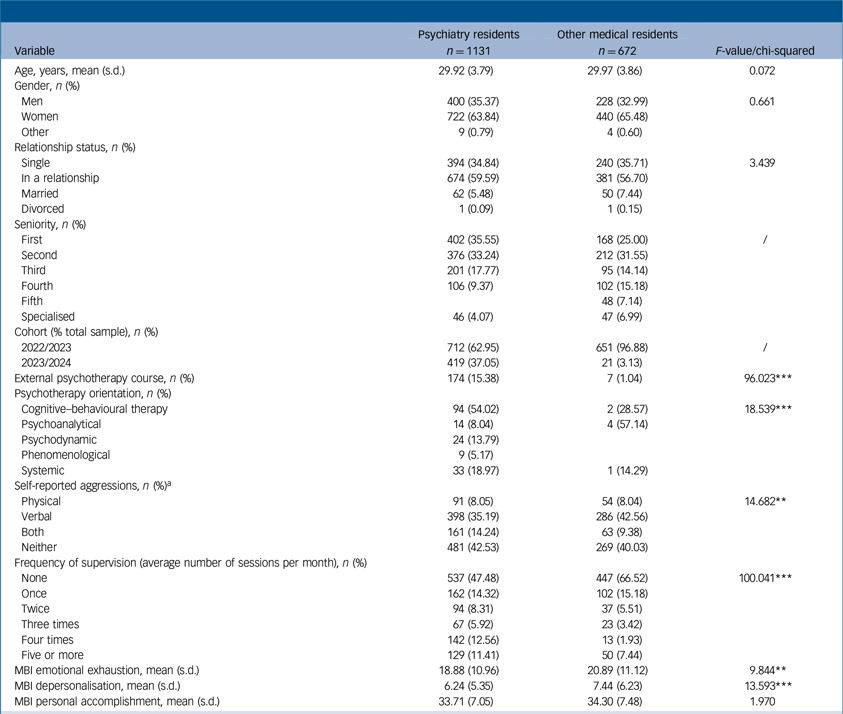
Participants were enrolled in the study according to the following inclusion criteria: (a) age above 18 years old and less than 50 years old, (b) knowledge of Italian language, (c) approval of the informed consent, (d) being enrolled in one of the participating institutions and (e) being a medical resident. In each institution medical residents were contacted by a senior medical doctor and, after the application of inclusion criteria by in person interview, a personal (yet anonymous) link to an online questionnaire was shared. Reference Harris, Taylor, Thielke, Payne, Gonzalez and Conde14 See Table 1 for further details on participation and retention rates.
Sample descriptives

MBI, Maslach Burnout Inventory.
Statistical significance between continuous variables given by analysis of covariance, age adjusted. ‘/’ indicates statistical significance not computed due to expected differences given by study design. Differences between categorical variables tested by chi-squared tests.
a. Assessed through multiple choice question, the participant could select one of the four options reported in the table, question: ‘Since you began your specialist training, have you been the victim of physical or verbal aggression during your professional practice?’.
*p < 0.05, **p < 0.01, ***p < 0.001.
The following domains were assessed within all participants, through self-administered online questionnaires:
-
(a) Attachment style, which could influence mentalisation skills, Reference Castellini, Tarchi, Cassioli, Ricca, Abbate Daga and Aguglia6 was evaluated by means of the Experiences in Close Relationships (ECR), Reference Brugnera, Zarbo, Farina, Picardi, Greco and Coco15 Higher scores indicate more insecure attachment.
-
(b) The Difficulties in Emotion Regulation Scale (DERS) Reference Giromini, Velotti, de Campora, Bonalume and Cesare Zavattini16 was used to appraise emotion regulation skills. Higher scores indicate worse emotion regulation skills.
-
(c) The Interpersonal Competence Questionnaire (ICQ) Reference Giromini, de Campora, Brusadelli, Zennaro, Zavattini and Lang17 was adopted to quantitatively estimate interpersonal competencies. Higher scores represent better interpersonal competencies.
-
(d) The Coping Orientation to Problems Experienced (COPE) to appraise individual coping strategies. Reference Sica, Magni, Ghisi, Altoé, Sighinolfi and Chiri18 Higher scores indicate the degree of adoption of each specific coping strategy.
-
(e) The Childhood Trauma Questionnaire (CTQ), for exposure to early trauma during childhood. Reference Sacchi, Vieno and Simonelli19 Greater score indicates higher exposure to childhood adverse experiences.
-
(f) The Maslach Burnout Inventory - Human Services Survey for Medical Personnel (MBI), to assess burnout symptoms as the main outcome measure of the current study. Reference Sirigatti, Stefanile, Maslach and Jackson20 The instrument considers burnout along three dimensions: emotional exhaustion, depersonalisation and personal accomplishment. Higher scores represent worse symptomatology for emotional exhaustion and depersonalisation, while a higher score in personal accomplishment is conceptualised as protective. Reference Sirigatti, Stefanile, Maslach and Jackson20
In line with the earlier cross-sectional report from this research initiative, a latent factor representing mentalisation was previously tested and supported both at the empirical Reference Castellini, Tarchi, Cassioli, Ricca, Abbate Daga and Aguglia6 and conceptual level, Reference Fonagy13 with attachment style, emotion regulation strategies and coping skills loading coherently onto the same construct. In the present longitudinal analyses, these domains were therefore operationalised as components of mentalisation skills. This conceptualisation draws from previous theoretical frameworks for mentalisation skills, in which self-regulatory and interpersonal regulatory capacities arise from the integration of affective, cognitive and relational processes.
All participants also reported their age, gender, year of residency, whether they were also enrolled in an external psychotherapy course (and if yes, which orientation: the participant could select one of the options reported in Table 1), as well as whether they were exposed to aggressions during training (assessed through multiple choice question, the participant could select one of the four options reported in Table 1) and whether they participated in clinical supervisions (assessed through multiple choice question, with all option reported in Table 1).
The study protocol was approved by the ethics committee of the coordinating centre (University of Florence) on August 2021, later amended on March 2022 (reference CEAVC 20381 OSS). Written informed consent was obtained from all participants.
Statistical procedures
Potential differences between centres for MBI dimensions (emotional exhaustion, depersonalisation, personal accomplishment) were tested by analysis of variance (ANOVA). Between-groups comparisons for continuous variables were tested with analysis of covariance (ANCOVA), with the group as a categorical variable, after age adjustment. Between groups comparisons for categorical variables were tested by chi-squared tests. To test the hypothesis that participants who completed follow-up assessments may exhibit different characteristics than those who did not (i.e. attrition bias), Student t-tests were performed to detect potential group differences in age and psychometric domains. No significant difference was observed (see Supplementary Materials eResults 1 available at https://doi.org/10.1192/bjp.2026.10582).
Longitudinal trajectories of burnout were estimated with longitudinal mixed models, with a random intercept for each participant, and a random slope per site of enrolment. The dependent variable was represented by MBI dimensions (emotional exhaustion, depersonalisation, personal accomplishment), the independent variable by time. To test whether psychiatry training might exhibit specific effects, not fully explainable by general medical residency/training alone, the interaction term of time by group was also estimated (psychiatry resident versus other medical residents).
Then, to investigate the processes related to potential specific effects of psychiatry training, the predictive value of personal/occupational characteristics for differences between baseline and follow-up in burnout dimensions was assessed. The dependent variable was represented by MBI dimensions (emotional exhaustion, depersonalisation, personal accomplishment), the independent variable by time and by psychometric (DERS, COPE, ICQ) or occupational characteristics (being a victim of aggression, participating in clinical supervisions). The following interaction terms were estimated: time effect by moderating variable, time by group (psychiatry resident versus other medical residents), group by moderating variable.
To restrict the number of hypotheses tested, only results where an overall time effect for burnout dimensions was observed were investigated. Moreover, only models where a moderation effect for a psychometric (DERS, ICQ, COPE) or occupational variable (being a victim of aggression, participating in clinical supervisions) was significant were investigated for further investigation of group effects.
To address the dynamic nature of mentalising during psychiatry training, the correlation between longitudinal differences in emotional regulation and interpersonal skills was investigated. This analysis was carried out estimating age-adjusted linear regression coefficients between variations in time for emotion regulation skills (DERS total score) and interpersonal competencies (ICQ), with the working hypothesis of a negative association between these two longitudinal trends. The same analysis was carried out between coping strategies (COPE) and interpersonal competencies (ICQ), with the working hypothesis of a positive association between these two longitudinal trends; and between coping strategies (COPE) and emotion regulation skills (DERS total score), with the working hypothesis of a positive association between adaptive coping and higher emotion regulation competencies. As avoidance as a coping strategy is currently conceptualised as maladaptive, negative associations between longitudinal trends of COPE Avoidance and ICQ dimensions, and positive associations between COPE Avoidance and DERS total score, were hypothesised.
To investigate the hypothesis that reductions in emotional difficulties during training would predict lower concurrent elevations in burnout dimensions, a bivariate latent change model was tested. In brief, latent change models assess the complex longitudinal relationship between different variables levering a Structural Equation Modelling (SEM) framework of analysis. With bivariate latent change models, it is possible to assess the longitudinal change of a variable from one time point to the next. With this setting and by entering two different domains with their variations over time in the same model (bivariate latent change model), repeated-measures analyses can be carried out taking into account different effects simultaneously: the constant variation over time (which corresponds to the intercept of the latent change), the longitudinal variation proportional to the previous time point (proportional or autoregressive effect), the longitudinal variation proportional to the previous time point of the other domain (cross-lagged effect) and the longitudinal variation proportional to the variation in the other domain. Statistical analyses using the SEM framework were conducted on the entire sample without distinguishing between psychiatric residents and other medical residents. This approach was chosen because the hypothesised model did not posit any distinction between groups in the regression coefficients. See Supplementary Materials eMethods 1 for further details.
All analyses were performed in R 4.3.3 for Windows, 21 using nlme for estimating longitudinal mixed models, Reference Pinheiro, Bates, DebRoy and Sarkar22 lmerTest to employ Satterthwaite’s method, Reference Kuznetsova, Brockhoff and Christensen23 and lavaan for modelling the bivariate latent change model. Reference Rosseel24
Results
Descriptive statistics
A total of 1803 individuals completed all assessments for the study initiative (1131 residents in psychiatry, 672 other residents). Other medical residents were enrolled in surgical specialties (general surgery: 123, 18.30%; gynaecology and obstetrics: 56, 8.33%; total 179, 26.63%); anaesthesiology (208, 30.95%); emergency medicine (82, 12.20%); internal medicine (203, 30.21%; total non-surgical residents 493, 73.36%). The rationale for this selection was to limit the potential heterogeneity within other medical residents, as well as to include residency programmes with no formal curricular psychiatry training, to reach a better representation of psychiatry-specific dynamics. Indeed, although in Italy psychiatry specialty training lasts 4 years, all other specialties in the current sample are programmed on a 5-year basis. Psychiatry residents were more likely to be enrolled in an external psychotherapy course, as well as to report aggressions during training and to engage with clinical supervisions in comparison to other medical residents (Table 1). At baseline, psychiatry residents reported less emotional exhaustion and depersonalisation, but not higher personal accomplishment (Table 1). No significant difference for burnout was observed between centres at baseline (emotional exhaustion: p = 0.821; depersonalisation: p = 0.444; personal accopmlishment: p = 0.381).
Longitudinal results, specific processes during psychiatry training
A total of 754 medical residents completed follow-up procedures (520 psychiatry residents – 73.03% response rate, 234 other medical residents, 35.94% response rate – of which 176 (75.21%) enrolled in medical specialties and 58 (24.78%) enrolled in surgical specialties) (see Supplementary Material eResults 2 for a graphical illustration of retention rates). All residents exhibited a significant elevation in burnout at follow-up evaluations. Emotional exhaustion (time effect β = 1.135, p = 0.045) and depersonalisation were significantly elevated across the whole cohort (time effect β = 0.543, p = 0.048), whereas no significant time effect was observed for personal accomplishment (time effect β = 0.389, p = 0.297). The increase in emotional exhaustion and depersonalisation was highest between the first and second year, less pronounced between the second and third year of residency, and not significant thereafter. Personal accomplishment did not exhibit significant trends of change also when comparing different years of enrolment.
Among occupational and sociodemographic factors, only attending clinical supervision showed an association with diverging longitudinal trends of burnout (emotional exhaustion, paired t-test, cohort exposed to at least one supervision per month: mean difference 1.032, p = 0.144; cohort exposed to no supervision: mean difference 1.447, p = 0.016; generalised linear model with the random effect of the subject and the estimate for the contrast between the two cohorts: β = −1.748, p = 0.041). Contrasts with higher frequencies were not significantly associated with different outcomes.
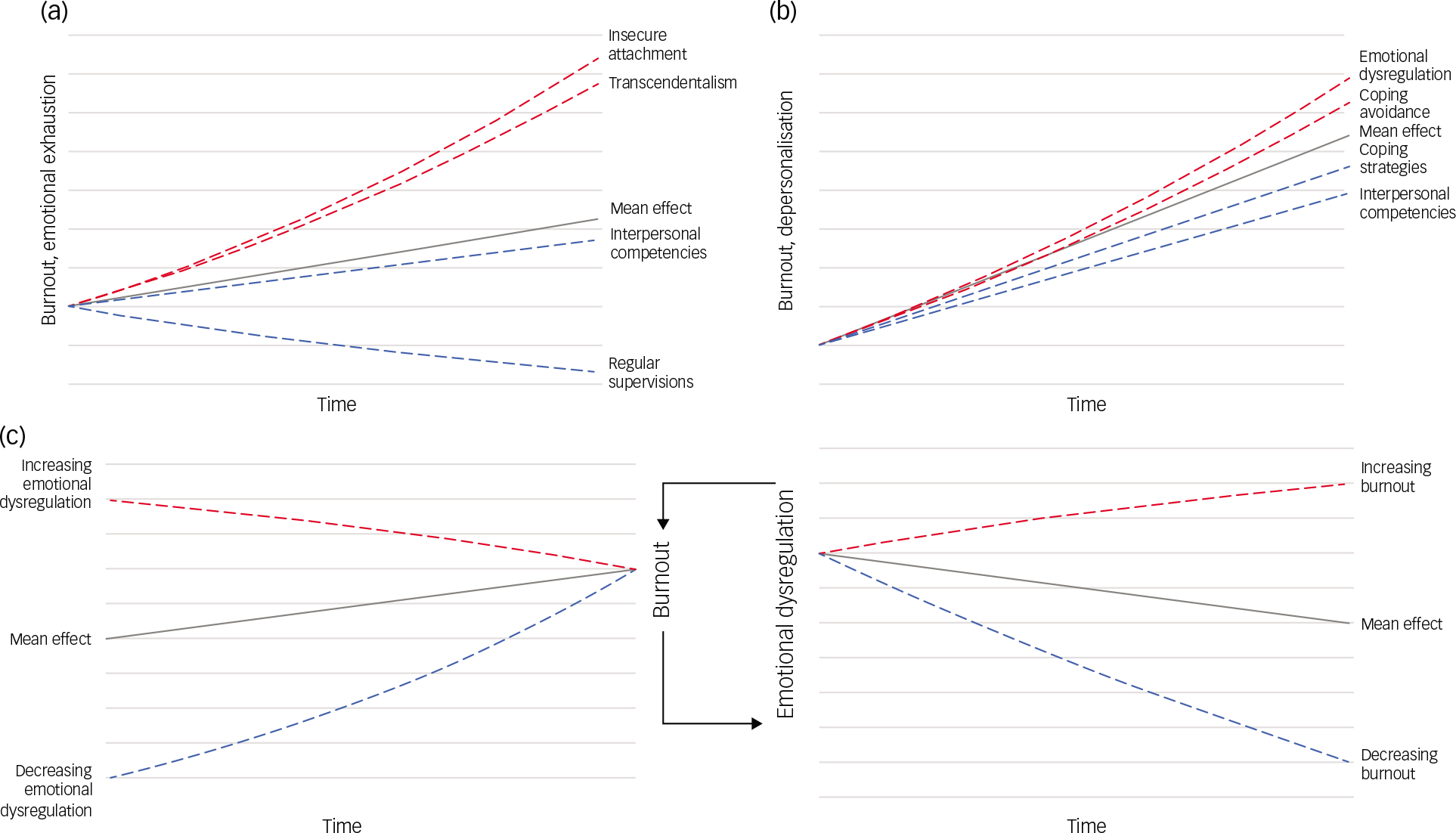
In order to explore which factors were associated with this aggravation in burnout, further longitudinal linear models were employed, assessing the effect of moderating variables (see Fig. 1 for a graphical summary of results). Moreover, the potential diverging effect of training pathways was assessed (group effect, contrasting psychiatry residents with other medical residents).
Graphical summary of results. All results are illustrated by computing model-based predicted values over time from the estimated beta coefficients, with trajectories plotted on a unitary (standardised) scale using a common baseline to facilitate comparability across effects and panels. All trajectories depict the effects associated with higher scores in the respective domains. When multiple domains were found as significant within a single construct, only the one with the highest effect was visually depicted. Time progresses from left to right in all panels. In (c), time is displayed in opposite directions for the two constructs – burnout and emotional dysregulation – to visually highlight the reciprocal (bivariate) nature of their longitudinal association. (a) Trajectories of burnout dimension ‘emotional exhaustion’ over time, illustrating risk and protective factors. Insecure attachment (attachment avoidance, attachment anxiety) and transcendentalism (red dashed lines) are associated with steeper increases in emotional exhaustion relative to the mean effect (solid grey line), whereas interpersonal competencies and regular supervision (blue dashed lines) attenuate emotional exhaustion over time. Illustrated risk and protective factors are evaluated among all residents. Psychiatry residents reported an increased protective effect of adaptive coping strategies (lower transcendentalism) and interpersonal competencies (initiation, disclosure) on emotional exhaustion increases compared to other medical residents, whereas they also reported attenuated aggravating effects of insecure attachment. (b) Trajectories of burnout dimension ‘depersonalisation’ over time, illustrating risk and protective factors. Emotional dysregulation (non-acceptance, goal direction, awareness) and avoidance as a coping strategy (red dashed lines) are associated with steeper increases in depersonalisation compared with the mean effect (solid grey line), whereas adaptive coping strategies (social support, positive attitude) and interpersonal competencies (initiation, negative assertion, disclosure; blue dashed lines) exert protective effects, attenuating depersonalisation trajectories over time. Illustrated risk and protective factors are evaluated among all residents. Psychiatry residents reported an increased protective effect of adaptive coping strategies (social support, positive attitude), interpersonal competencies (initiation, disclosure, conflict management) and an attenuated aggravating effect of emotional dysregulation (goal direction, awareness) on emotional exhaustion increases compared to other medical residents. (c) Bidirectional dynamic between burnout and emotional dysregulation across time. The left panel depicts burnout trajectories under conditions of concurrent increasing versus decreasing emotional dysregulation over time, whereas the right panel illustrates emotional dysregulation trajectories under concurrent increasing versus decreasing burnout over time. Together, these trajectories highlight reciprocal reinforcement processes, whereby increasing emotional dysregulation exacerbates burnout and, conversely, improvements in one domain are associated with reductions in the other.

Emotional exhaustion
Greater longitudinal increase in emotional exhaustion was associated with attachment insecurity (avoidance: β = 1.828, p = 0.044; anxiety: β = 1.391, p = 0.045), transcendentalism as a coping strategy (β = 1.543, p = 0.005) and lower interpersonal competencies (initiation: β = −0.240, p = 0.037; disclosure: β = −0.111, p = 0.045). Psychiatry residents showed lower longitudinal increase in emotional exhaustion as compared to other medical residents (group by time interaction, β = −5.342, p = 0.047), and less effect of insecure attachment or transcendentalism on its variation (group by moderator by time interaction; avoidance: β = −3.361, p = 0.043; anxiety: β = −1.375, p = 0.048; transcendentalism: β = −0.688, p = 0.001). On the other side psychiatry residents reported increased protective effect of interpersonal competences on emotional exhaustion increases (group by moderator by time interaction; initiation: β = 0.257, p = 0.039; disclosure: β = 0.286, p = 0.036), as compared to other medical residents.
Depersonalisation
A greater longitudinal increase in depersonalisation was associated with emotional dysregulation (non-acceptance: β = 0.272, p < 0.001; goal-direction: β = 0.195, p = 0.014; awareness: β = 0.191, p = 0.048), avoidance as a coping strategy (β = 0.158, p = 0.047), lower reliance on social support (β = −0.148, p = 0.044), a lower positive attitude (β = −0.266, p = 0.017) and lower interpersonal competencies (initiation: β = −0.249, p = 0.033; negative assertion: β = −0.270, p = 0.049; disclosure: β = −0.137, p = 0.045; conflict management: β = −0.275, p = 0.041). Psychiatry residents showed lower longitudinal increase in depersonalisation as compared to other medical residents (group by time interaction, β = −3.149, p = 0.015), and less effect of emotional dysregulation on its variation (group by time moderator by time interaction: goal direction: β = −0.259, p = 0.036; awareness: β = −0.181, p = 0.032). On the other hand, psychiatric residents reported increased protective effect of effective coping strategies (group by moderator by time interaction; social support: β = 0.234, p = 0.018; positive attitude: β = 0.389, p < 0.001) and interpersonal competences on depersonalisation increases (initiation: β = 0.267, p = 0.047; disclosure: β = 0.316, p = 0.042; conflict management: β = 0.298, p = 0.039), as compared to other medical residents.
Concurrent development of personal and interpersonal mentalising skills in psychiatry training
To address the dynamic nature of mentalising during psychiatry training, the concurrent development of personal and interpersonal mentalising skills was investigated. Higher interpersonal competencies were consistently observed among those individuals that reduced their emotional regulation difficulties during psychiatry training (Table 2). However, a higher development of negative assertion skills was consistently observed as positively correlated with emotion regulation difficulties (Table 2). Individuals that reduced their emotion regulation difficulties during psychiatry training also reported a higher reliance on adaptive coping strategies, and a lower reliance on avoidance as a coping mechanism (Table 2).
Associations between longitudinal trends

DERS, Difficulties in Emotion Regulation Scale; ICQ, Interpersonal Competence Questionnaire; COPE, Coping Orientation to Problems Experienced.
Longitudinal delta calculated as T1 – T0. COPE Avoidance posited as a maladaptive coping regulation strategy. Only psychiatry residents included here. Dependent variable by column, independent variable by row. Age-adjusted standardised betas reported here.
*p < 0.05, ***p < 0.001.
On the other hand, greater interpersonal competencies were associated with increased adaptive coping strategies (Table 2). However, negative assertion was also observed as exhibiting a divergent trend in comparison to other interpersonal skills, being consistently observed as negatively correlated with an effective adoption of adaptive coping strategies (Table 2).
Concurrent development of emotional competencies and burnout in residency training
Concurrent developments of emotional competencies and burnout were empirically explored in all medical residents (including both psychiatry and other medical residents). The proposed model showed excellent model–data fit indices (χ2 = 0.720, comparative fit index 1.000, Tucker–Lewis index 1.018, root mean square error of approximation (RMSEA) 0.001, p-value of close fit ≤ 0.05, p = 0.988, standardised root mean square residual 0.013). All variations of this model were tested using nested model comparisons (Supplementary Materials eResults 3). Conversely, all initially hypothesised effects significantly improved the model and were therefore retained (Supplementary Materials eResults 3).
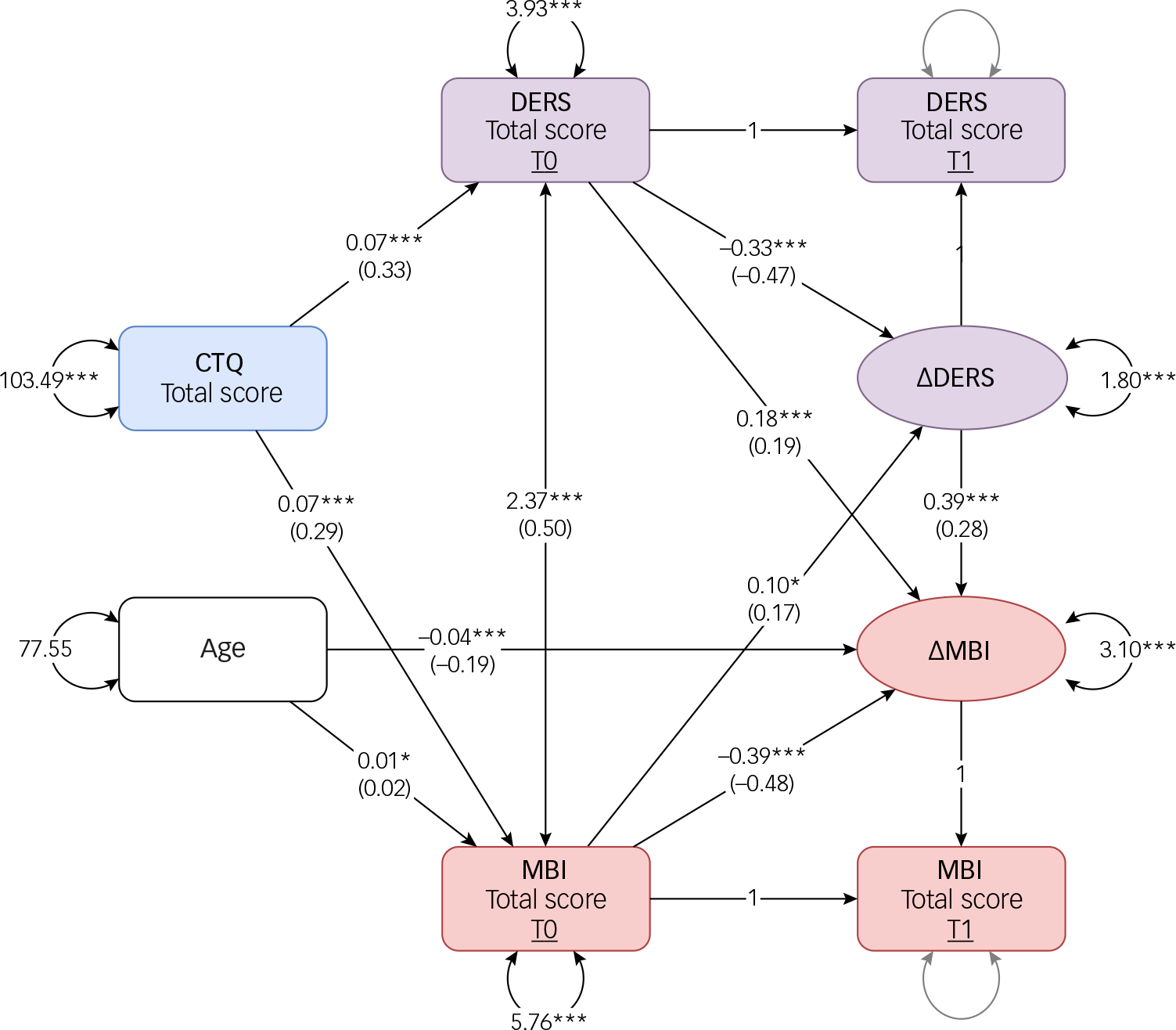
Both emotion regulation difficulties (β = 0.069, p < 0.001) and burnout dimensions (β = 0.071, p < 0.001) were confirmed as under the influence of early adverse childhood experiences. As hypothesised, a reduction of emotional regulation difficulties during training predicted a lower elevation in burnout dimensions (β = 0.386, p < 0.001). Reductions in burnout dimensions at follow-up significantly depended on an amelioration of emotion regulation difficulties (Fig. 2), whereas a covariation between the two was not supported by the model (95% confidence interval of Akaike information criterion difference between the original model and the alternative model: −4.932 to −2.917; Bayesian information criterion difference estimate: −15.092 to −13.077).
Bivariate latent change model. A reduction of emotional regulation difficulties (Difficulties in Emotion Regulation Scale (DERS)) during training predicted a lower elevation in burnout scores (Maslach Burnout Inventory (MBI), β = 0.386, p < 0.001). Both emotion regulation difficulties (DERS: β = 0.069, p < 0.001) and burnout scores (MBI: β = 0.071, p < 0.001) were under the influence of early adverse childhood experiences (Childhood Trauma Questionnaire (CTQ)). Rectangles represent observed variables. Circles represent latent variables. Regression effects and loadings are illustrated as single-headed arrows, labelled with their unstandardised and standardised (in parentheses) coefficients. Variances constrained to zero are illustrated as grey arrows, whereas effects constrained to one are labelled as ‘1’. Double-headed arrows represent variances and covariances. *p < 0.05, **p < 0.01, ***p < 0.001.

Discussion
To date, this study represents the first nationwide, multicentre initiative aimed at promoting an empirically grounded model for the evaluation of psychiatric training processes, employing a longitudinal controlled study design. According to the main results of the present study, across all residents, emotional exhaustion and depersonalisation were found to increase during the first and second years, potentially stabilising thereafter. Furthermore, increasing burnout across years was found to be predicted by higher scores in insecure attachment, emotional dysregulation and maladaptive coping, as well as lower scores in interpersonal skills. Attending at least one supervision per month was found to be protective against higher burnout scores across time. Improvements in emotional regulation were also found to be potentially protective against burnout. Additionally, psychiatry residents reported a higher protective effect of interpersonal competencies and adaptive coping strategies against burnout development.
The observed divergence between psychiatry and other medical specialties deserves particular attention. Psychiatry residents consistently showed lower longitudinal increases in emotional exhaustion and depersonalisation, together with a stronger protective effect of interpersonal competencies and adaptive coping strategies. Several mechanisms may account for this pattern. First, psychiatry training programmes often place greater emphasis on reflective practice, supervision and the development of mentalising skills: either directly, through structured training programmes, or indirectly, by enhancing residents’ ability to integrate emotional and interpersonal challenges encountered in clinical work through repeated exposure. Reference Fonagy and Bateman25 Second, the pedagogical culture within psychiatry may implicitly promote awareness of personal vulnerabilities and relational dynamics, Reference Salgado and von Doellinger26 thereby fostering more adaptive responses to occupational stressors. By contrast, residents in other specialties may be exposed to higher procedural or organisational demands with fewer structured relational resources, thus facing a more pronounced mismatch between job demands and mentalising-related protective factors. These differences suggest that the interpersonal and reflective components embedded in psychiatric training may confer a unique resilience advantage, highlighting the relevance of mentalisation-informed educational strategies across medical training pathways.
The greater burnout increase during first years of training in general, across both psychiatry and other medical residents, may also be interpreted in light of the job demands–resources model of burnout, Reference Demerouti, Bakker, Nachreiner and Schaufeli27 which posits that the highest increase in burnout may be observed in relation to a mismatch between work demands and personal competencies. For this reason, the highest increase can be observed within the first year of residency training, when most residents transit from a previous status of student trainee to an active role in patient management. This transition phase has been explored by previous studies, which highlighted how the transition to an active role in clinical environments posits remarkable challenges to junior medical residents. Reference Boni, Paiva, de Oliveira, Lucchetti, Fregnani and Paiva28,Reference Brennan, Corrigan, Allard, Archer, Barnes and Bleakley29
Among occupational and demographic factors, only attending at least one supervision per month was associated with diverging burnout development across time. This result may be interpreted considering the impact of role models and clinical mentors on shaping expectations by attending staff, Reference Paice, Heard and Moss30 the potential for clinical mentors to increase self-efficacy by carefully balancing occupational challenges in light of personal competencies, Reference Tarchi, Castellini, Ricca, Khalaf and Abi-Habib31 as well as the potential of clinical mentors to offer mentalising advice on doctor–patient relationships by promoting reflective functioning in psychiatry residents. Reference Tohme and Kolev32 Moreover, this result may be better appreciated considering that mentalising may be conceptualised not solely as an individual skill, but rather a social process, embedded within a network of relationships required to sustain it. Reference Fonagy13,Reference Bevington, Fuggle, Batman and Fonagy33
Higher attachment insecurity, lower competencies in emotional regulation and lower interpersonal competencies at the beginning of the training programme were associated with a higher increase in burnout across time. These results confirm the conceptual framework previously developed by our working group – namely that insecure attachment, lower emotional regulation and lower interpersonal competencies may be general risk factors for the development of burnout. Reference Castellini, Tarchi, Cassioli, Ricca, Abbate Daga and Aguglia6
Longitudinal trends of personal and interpersonal components of mentalising were correlated with each other in psychiatry residents. In particular, individuals with a successful acquisition of emotional regulation competencies during psychiatry training were observed as consistently exhibiting a successful acquisition of interpersonal competencies as well. Reference Klinkosz, Iskra and Artymiak34,Reference Parker, Summerfeldt, Walmsley, O’Byrne, Dave and Crane35 According to mentalisation theory, Reference Fonagy, Gergely, Jurist and Target12,Reference Bateman and Fonagy36,Reference Fonagy, Campbell and Luyten37 a successful acquisition of effective coping and emotional regulation strategies may be associated with the successful acquisition of effective interpersonal competencies. As previously commented by Fonagy, Reference Fonagy13 because of the specific nature of psychiatry care, lower mentalising skills may increase job demands in doctor–patient relationships, further highlighting how the relationship between job demands and personal resources is often complicated within psychiatry training. Reference Fonagy13
To better address dynamic relationships in the longitudinal development of emotional competencies and burnout dimensions, Reference Fonagy13 a bivariate latent change model was thus developed. According to the model, improvements in emotion regulation abilities predicted lower burnout scores across time, and this dynamic interaction was influenced by the exposure to childhood adversities. Overall, this analysis suggests a directional relationship between emotional competencies and burnout, contextualising early-life experiences as vulnerability factors for resilience and adaptation in training programmes.
Implications for research
Future studies may be interested in better describing which specific dyadic factors are associated with protective effects against burnout, as well as enhanced professional development. Reference You and Kealy-Bateman38 Concurrently, future research may be interested in achieving better temporal resolution, as yearly follow-ups may not be sufficient to capture rapid fluctuations in emotional competencies or burnout, particularly when residents face critical clinical challenges such as consequences of patient suicide. Reference Whitmore, Cook and Salg39 Future studies may also attempt to replicate findings in other countries or expand the investigation across several countries. Moreover, future endeavours may examine clinical supervisions at a more granular level (such as frequency, duration and supervisory style) to identify the most protective supervision models. Future research may also aim to reach a more granular level of definition for exploring systemic components to both stress and resilience factors, Reference Fonagy13 within and outside training sites – assessing workload, organisational culture and availability of support systems (i.e. social support, mentorship programmes) as either mitigating or promoting the risk of developing burnout in medical residents.
Implications for practice
Considering attachment and mentalisation theory, we suggest that current results carry relevant implications, suggesting that a meaningful relationship with a supervisor may serve as a ‘secure base’ fostering both professional development and emotional resilience during residency training. Effective supervision may encourage psychiatry residents to process challenging clinical or personal experiences, helping them to make sense of complex emotional interactions with both peers and patients. Reference Tohme and Kolev32 The implications for psychiatry training are clear: structured, meaningful supervision should be an integral part of residency training programmes, ensuring that residents receive not just technical guidance, but also emotional support, supported by meaningful professional relationships with their supervisors. This approach is advisable not only to enhance clinical competence, but also to safeguard mental health at large, reducing burnout risk and promoting long-term well-being in future psychiatrists.
Limitations
Although the study reached most training centres in Italy, the study sample may not be representative of the overall population, especially for other medical residents, which were less extensively enrolled in the present study and for which drop-out rates were higher. Given the non-significant difference between participants completing follow-up procedures and participants with no response at follow-up (i.e. attrition bias), non-completed questionnaires were not imputed or weighted, so as to better balance type 1 and type 2 statistical errors. Sociocultural factors may play a role in burnout development, and different countries may adopt different training programmes across specialties. Moreover, although no significant difference was here observed between follow-up responders and drop-out, selection and attrition biases may not be fully excluded. Finally, although adopting a longitudinal controlled design, the present study may not prove causality or completely assess the direction of causality for observed effects.
In conclusion, the present study provided a characterisation of protective and risk factors in the development of burnout during psychiatry training, confirming that lower mentalisation functions (including emotion regulation skills, interpersonal competencies and coping strategies) are associated with increasing emotional exhaustion and depersonalisation over time. Emotional regulation skills and interpersonal competencies influence each other during training, and improvements in emotional regulation skills are associated with a reduction in burnout. This process of emotional development can be challenged by the exposure to adverse childhood experiences, but it may also be promoted by regular clinical supervisions during training.
Supplementary material
The supplementary material is available online at https://doi.org/10.1192/bjp.2026.10582
Data availability
In accordance with privacy regulations, records of registered data can be shared upon reasonable request to the corresponding author. Analytic code adopted to execute formal analyses can be shared upon reasonable request to the corresponding author.
Acknowledgements
The authors would like to dedicate this work to the memory of Professor Arianna Goracci (University of Siena, Italy). In particular, the authors would like this work to be a reminder of her contribution to the art and practice of psychiatry, as well as her dedication to the development and improvement of psychiatry training. The authors would also like to thank the Training in Psychiatry Working Group: Dr Chiara Arcidiacono, Dr Diego Bernini, Dr Sara Bianchi, Dr Concetta Bronte, Dr Alessandra Palma Buongiorno, Dr Carlotta Brandi, Dr Lorenza Cadei, Dr Victor Attilio Campagna, Dr Lorenzo Casati, Dr Dario Conti, Dr Ettore D’Onofrio, Dr Francesco Finatti, Dr Federica Folesani, Dr Serena Limonta, Dr Niccolò Mancini, Dr Christian Nasti, Dr Giorgia Porceddu, Dr Irene Calzavara Pinton, Dr Francesco Possanzini, Dr Fabio Quartaroli, Dr Stefano Roberti, Dr Sophia Russotto, Dr Lucia Tretola and Dr Chiara Villani.
Author contributions
G. Castellini and V.R. contributed to study conceptualisation, methodology, formal analysis, investigation, resources, supervision and project administration, and writing the original draft of the manuscript. L.T. contributed to study conceptualisation, investigation, methodology, formal analysis, investigation, data curation and visualisation, and writing the original draft of the manuscript. E.C. contributed to study conceptualisation, methodology, formal analysis, investigation, data curation and visualisation, and writing the original draft of the manuscript. G.A.-D. contributed to study conceptualisation, investigation and project administration, and reviewing and editing the manuscript. A.A., U.A., A.R.A., S.B., G.B., C.C., G. Carrà, P.D.F., C.D.P., G.D.L., M.D.V., S.F., C.G., M.L., G. Martinotti, M.M., G. Menculini, M.G.N., A.N., F.P., M.P., G.R., M.S.S., F.S., G. Sampogna, G. Sani, G. Serafini, S.T., A.V., C.V. and U.V. contributed to study conceptualisation, investigation and project administration, and reviewing and editing the manuscript. B.D.R. and the Training in Psychiatry Working Group contributed to study conceptualisation, investigation and data curation, and reviewing and editing the manuscript. A.F. contributed to study conceptualisation, methodology, investigation, resources, supervision and project administration; and reviewing and editing the manuscript.
Funding
This research received no specific grant from any funding agency in the public, commercial or not-for-profit sectors.
Declaration of interest
None.




eLetters
No eLetters have been published for this article.