When the going gets weird, the weird turn pro.Footnote 1
Introduction
‘The Gang of Baba Ladla, Alias the Gang of the Bald, Dresses as Women and Wears Burqas to Throw Grenades.’Footnote 2 ‘Breaking News: In the Local Constituency Number 2 of Niyazi Chowk, in Lyari, the Dead of the Piracha Graveyard Have Cast Their Votes.’Footnote 3 ‘Liaqatabad Post Office: Firing at a Rickshaw. Its Driver Riddled with Bullets.’Footnote 4 ‘The Group of Baba Ladla Has Entered Baghdadi: The Noise of Explosions Echoed until Sefi Lane and Aath Chowk.’Footnote 5 ‘The Black Sheep amongst the Police Should Stop Taking Pakhtun Entrepreneurs for Money-making Machines.’Footnote 6 ‘In Galli [Lane] Number 7, off Usman Brohi Street, in Chakiwara, near Singo Lane, 45 Year-old Rihana and 50-year Old Bilqis Were Wounded by Bullets during a Shooting.’Footnote 7 ‘Shiraz Comrade's Challenge: “Rauf Baloch, the End of Your Life is Near. If You Want to Save Your Own Life, Pack Your Things and Leave! You Came to Lyari via an Indian Conspiracy to Kill the Baloch. Rauf Baloch, You Can Run as Much as You Want, but I Will Kill You”.’Footnote 8
These headlines offer a glimpse of what could be found on the front page of the Urdu daily Janbaz (literally ‘the one who puts his life on the line’, namely the fearless) in 2014–15. At that time, the newspaper was at the peak of its popularity in Karachi, especially in the inner-city area of Lyari, which was then faced with a gang war and deadly police and paramilitary operations. Every morning, tens of thousands of inhabitants of the area, including gangsters and policemen, began their day by consulting Janbaz to count the ‘wickets’ that had fallen the previous day—an expression borrowed from cricket and popularized by the newspaper to designate victims of violence. The colourful and often outrageous language used in the paper, which drew from the Urdu slang spoken in the streets of Lyari as well as from the scathing repartee of the cops and thugs of Bollywood, added a touch of masala (spice) to this essential reading. In dhabas and hotels (popular restaurants), hairdressing salons, and local schools, Janbaz fuelled heated conversations. And, as the neighbourhood awakened, small groups of daily-wage labourers, idle youths, and men on motorbikes driving their children to school gathered around the displays in front of the main outlets to consult the headlines and the photographs of the latest victims. By avoiding the mohallas (localities) singled out in the edition of the day, these passers-by would participate in their quarantine and unwittingly facilitate the manoeuvres of the ‘gangwar’, as the inhabitants of Lyari designate criminals associated with the local gangs, which specialize in the protection of gambling dens, extortion, drug dealing, and kidnappings for ransom of merchants and transporters particularly in Karachi's Old City.
Frequently described in terms of ‘addiction’ (chaska), the attachment of Janbaz’s readers to the newspaper owes much to its status as an instrument of social navigation in an unstable environment, rendered partially illegible by the complex and volatile relations between criminal groups, political parties, and state institutions. The contribution of Janbaz in this field, however, is far from univocal. While the newspaper helps its readers regain control over a fluid environment, it simultaneously fuels their sense of insecurity. By participating in a general economy of suspicion, Janbaz is the site of a ‘reality test’Footnote 9 that is renewed daily. In this respect, the newspaper is at once the reflection and the precarious place of settlement of one of those ‘crises of evidences’ discussed by Michel de Certeau—those moments of disruption in which entire populations ‘are no longer sure about “obvious facts” that, though not susceptible of proof, were previously taken for granted by a social order and an organisation of values’.Footnote 10 Our main interest, here, is with the everyday processes of verification undertaken by residents in response to this crisis of intelligibility. In this exploration, we pay attention to the textual and visual content of the newspaper while drawing from informal conversations with approximately 50 readers, as well as from a dozen interviews with members of Janbaz’s editorial team, newspaper vendors, and figures from Karachi's popular press. The material is primarily analysed in the light of two theoretical corpuses: the phenomenology of civil wars and the anthropology of fakes. This includes discussing the possible contributions of this literature to the study of authentication and falsification procedures specific to situations of ‘internecine warfare’. To avoid any confusion, let us state at the outset that we are inscribing ourselves in a Goffmanian perspective in which this notion does not so much refer to a particular type of armed conflict but rather to a questioning of the everyday instilling suspicion at the heart of the familiar.
Internecine warfare and the implosion of the everyday
Rather than through their patterns of conflict, this article engages with situations of internecine warfare through their disruption of individual and collective routines. We thus argue that these situations of protracted civil strife are characterized by their ability to cause those experiencing them to question the transitivity of everyday life—that is, its capacity to be taken for granted, to flow without any need for explication.Footnote 11 Much of this uncertainty has to do with the very nature of situations of chronic civil strife as conflicts within the polis, setting neighbour against neighbour, and sibling against sibling.Footnote 12 As the distinction between friend and foe tends to blur, no one can remain quite sure about their social relations, while events, persons, places, or objects whose status seemed hitherto undeniable become less predictable. The usual gets tainted with suspicion and objects of daily use are no longer an element of the social landscape, but become potential threats—a random bicycle parked near a crowded market could be hiding a bomb, a woman wearing a shuttlecock burqa could be in fact a suicide bomber ready to strike, while a seemingly innocuous water tank could be an instrument of mass poisoning.
This illegibility of the social and the general economy of suspicion that it sustains may predate and precipitate open hostilities, as anxieties about impostors and infiltrators feed into conspiracy theories aiming to restore ontological certainty, possibly through violence, to a troubled world.Footnote 13 This obsession with facticity is only reinforced in situations of open confrontation: situations of internecine warfare are conducive to various forms of deception, which make the separation of facts and fakes a major problem in everyday life—or what's left of it.
Questioning the taken-for-granted
This crisis of evidence makes it impossible to suspend judgement on things and beings and simply continue to take them as they are. In phenomenological terms, this questioning of the taken-for-granted disrupts individual ‘conducts’—these pragmatic and cognitive activities related to habits, tradition, or affectivity, which are performed without thinking in everyday life (which distinguishes them from predetermined actions). For Schütz, ‘attention to life’ is the basic regulative principle of cognitive activities, especially in that it ‘defines the realm of our world which is relevant to us’, which in turn determines ‘the form and content of our stream of thought’.Footnote 14 Like Schütz, Goffman suggests that, in ‘normal’ situations, individuals only need to be momentarily on alert (say, when they cross a street) while interacting with others or circulating across social and physical space. In such situations, the immediate environment can safely remain unattended. This is not the case in situations of chronic civil strife, when suspicion is extended to seemingly familiar objects, places, or people, with a significant increase in levels of alarm as a result. During such times, the individual's Umwelt—‘the sphere around the individual within which … potential sources of alarm are found’—tends to shift from a place ‘where easy control is maintained’ to one where ‘he is fully involved in self-preserving action’.Footnote 15 For Goffman, episodes of internecine warfare are paradigmatic of these situations, where every individual's Umwelt ‘becomes hot for him’.Footnote 16 Even if he only makes passing references to these extreme situations for the sake of his arguments on more normal configurations, Goffman's insights in this field deserve to be rediscovered. They converge, in particular, with the preoccupations of the anthropologists of danger when they suggest that acting in a threatening world is to engage in interpretive acts, to pass judgements on things and living beings, and generally to commit to a certain line of action—that of chronic alertness.Footnote 17
To date, only a few works have engaged with situations of internecine warfare in the light of phenomenology and Goffmanian sociology. Chief among them are K. Borell's study of the disruptions of everyday life in BeirutFootnote 18 and T. Koloma Beck's work on the Angolan civil war.Footnote 19 In his exploration of the impact of terrorism on daily life, Borell draws on Goffman's and Schütz's writings—especially on the latter's ‘systems of relevance’Footnote 20—to show how individuals and groups develop new frameworks of interpretation under threat of terrorism. He is particularly attentive to the process through which suspicion was extended to a whole range of familiar objects and inspired new corporeal routines—that is, ‘new ways of seeing, hearing and reacting’.Footnote 21 In this increasingly uncertain environment, the residents of Beirut ‘redefined the risks in their daily Umwelt and … took a number of precautions accordingly’.Footnote 22
Teresa Beck's monograph on the Angolan conflict, for its part, draws simultaneously on phenomenological and pragmatist philosophies. It argues that most studies of internecine warfare tend to privilege events, spaces, periods, and agents of the conflict, to the detriment of the lived experiences of those involved and affected. Beck proceeds to analyse ‘the expansion of civil war into the sphere of everyday life’, through ‘the (re)production and transformation of habitualized forms of conduct as well as of the transitive flow of the consciousness’. On the basis of extensive interviews with civilians affected by the conflict between government and Uniao Nacional para a Independência Total de Angola (UNITA) troops, she demonstrates that these populations proceeded to a series of behavioural adaptations that took into account the spatial and temporal patterns of military activities—which presupposed some degree of predictability in these activities.Footnote 23
Both of these works suggest that, in the course of time, the disruptions of everyday life caused by internecine warfare tend to be mitigated by new systems of relevance, drawing on a new stock of personal experiences as much as on intersubjectivity. As will become clear in the following pages, the perspective adopted here is slightly different, and we are more sceptical about the possibilities for a normalization of this kind of conflict, which would allow the restoration of transitivity in a new ‘ordinary’ world, only more violent and unpredictable. From our point of view, the routinization of violence, in Karachi as in other societies confronted with situations of chronic civil strife, should not be mistaken for a habituation of conflict by local populations. As Henrik Vigh emphasizes in his study of soldiering in Guinea-Bissau, situations of prolonged political turmoil see the disappearance of habits and their replacement by more flexible routines that ‘rather than being imponderable sets of actions and interpretation, are constantly evaluated and related to new movements of the socio-political environment’.Footnote 24 As we will see further in greater detail, in the most violence-prone localities of Karachi, such as in Lyari, the management of ‘ordinary’ violence by local residents has been challenged by the continuous transformation of this violence in the course of the conflict. While it is important to remember that violence is never determining the entirety of the experience of any population living under conflict,Footnote 25 practices of adaptation seem better captured through the idea of ‘getting by’Footnote 26 or ‘coping in’Footnote 27 rather than through the more stabilized concept of habituation.
Counterfeit realities
If situations of chronic civil strife question the taken-for-granted, this is not merely because they come with new physical threats, making individuals vulnerable to ‘moments of stress’, ‘when acquired competence breaks down and the individual is thrown back momentarily on inadequate mastery’.Footnote 28 The economy of suspicion characteristic of these situations also builds upon a peculiar problem of facticity, as the lines between friend and foe, facts and fakes, or the legal and the illegal tend to blur. Some of these uncertainties—such as those concerning the shape and intentions of the enemy—predate and inform episodes of open confrontation. Others emerge in the course of the conflict and contribute to its reproduction. These are not formal conflicts duly sanctioned by international law. Rather, these are inchoate episodes of unrest whose qualification is itself a source of conflict. In this grey zone of armed conflict, much of the protagonists’ violence is either unlawful (in the case of state terror against civilian populations) or illegitimate (in the case of irregular armed groups’ coercive tactics/military operations). As a result, situations of internecine warfare nurture a specific economy of secrecy. Much of the mimetic and counterfeiting practices characteristic of these situations are inspired by the attempts of irregular armed groups to legitimize their use of violence and, in the opposite direction, by the temptation of state forces to unbound themselves and go irregular. Both movements introduce specific problems of legibility for civilian populations, while sustaining various conspiracy theories about the role of the state and its relations with irregular armed groups.
In such situations, the problem of facticity goes well beyond the (il)legibility of the political realm, however. When neither living beings nor the material world can be trusted, both epistemological and ontological uncertainty ensues.Footnote 29 What is at stake, here, is not merely where to look, in a shape-shifting, threatening environment, but what to believe, in a world of potential deceivers, imitators, and fakes. In this multilevel assault on the taken-for-granted, it is not only human and non-human agents whose credentials come into question, but their representations as well. The conflict over value and truth infusing these crisis situations is also a conflict over the authenticity and significations of the images that they produce. And, while the flow of images associated with contemporary conflicts has been examined with a critical eye by generations of commentators—from the critiques of the ‘society of the spectacle’ to Susan Sontag's attempts to moralize the representation of the suffering of others—we find these accounts unsatisfactory, if only because they tend to neglect the social life of these images beyond the blasé audiences of the Global North, especially within war-torn societies themselves.
In her earlier works on Sikh militancy,Footnote 30 Veena Das was one of the first social scientists to make a connection between ethnic/sectarian violence and ‘the trope of deception, fake identity, and betrayal’.Footnote 31 Similarly, Arjun Appadurai noted that most contemporary conflicts using the idiom of ethnicity or religion are ‘shot through with the language of the impostor, the secret agent, and the counterfeit person’.Footnote 32 More recently, Nils Bubandt has studied the political career of fake letters in early 2000s Indonesia, which resembled instructions for a campaign of ethnic cleansing against the local religious majority. The conspiracy theories propped up in these letters resonated with an anxious imagination of the body politic and the state, where the latter was constantly suspected to hatch conspiracies through agent provocateurs. Various clues contained in these letters hinted at state involvement and inscribed them in a political universe where the state itself was seen as illegible and inauthentic. ‘At once authoritative and widely suspected of being fakes’, these letters were therefore ‘circulating evidence of the seemingly counterfeit nature of state authority itself’.Footnote 33 For all the peculiarities of the Pakistani case in this regard, we will see that it resonates with some of the dynamics uncovered by Bubandt, especially as far as the illegible and suspicious nature of state authority is concerned—a key component of the lingering ‘crisis’ upsetting the residents of Lyari, Karachi's battle-scarred inner-city.
While drawing inspiration from this literature, we also point at some of its limits. We suggest, in particular, that the anthropology of fakes all too often replicates and amplifies the crisis mode through which vernacular accounts of the ‘politics of illusion’Footnote 34 tend to be framed. In most academic works reflecting upon the imbedding of deception into the social and political fabric, the proliferation of impostors, counterfeit objects, forged documents, or false information is often reduced to a source of anxiety and chronic suspicion. It is seen as fuelling moral ambiguity and making legitimate political or economic actors largely indiscernible from their shadier extensions, leading to a general crisis of value and representation.Footnote 35 Without entirely denying this dark side of ‘counterfeit modernities’,Footnote 36 we argue that crises of value forms and ‘truth-value’Footnote 37 can also be socially productive. Besides, we insist upon the myriad ways people have to inhabit the twilight zone of the un/truth, including by enjoying being taken for a ride once in a while.
Gang wars and disruptions of the everyday in Lyari
Lyari and its underworld
Often dubbed by its residents the ‘mother of Karachi’ (Karachi ki maan), Lyari, which comprises several neighbourhoods, is one of the oldest areas of the city—a city founded in 1729 by Hindu merchants (banyas) from interior Sindh, who were attracted by its natural port. Despite its geographic centrality—Lyari is located near the port, but also near the financial district and the administrative centre of Karachi—this degraded inner-city area is characterized by its marginality. Demographically, the area, which is estimated to contain over 1 million residents, stands out from a city where almost half of the population is thought to be Mohajir (Urdu-speakers tracing their roots to North India and the Deccan).Footnote 38 Although Lyari includes a few pockets of Urdu-speakers (which are concentrated on the western corner of the neighbourhood, in Agra Taj and Bihar Colonies), it retains the largest concentration of ‘indigenous’ populations in the city, which, in the context of Karachi, generally refers to Baloch and Sindhi communities. While the Baloch may no longer be in a majority in the area, they remain the largest ethnic group, with self-declared Balochi-speakers constituting around 25 per cent of Lyari's total population,Footnote 39 which was estimated at 662,816 by the 2017 Census.Footnote 40 This Baloch population, as well as the smaller Kutchi community, which migrated from the Kutch region of what is now Indian Gujarat, have been supporting the Pakistan People's Party (PPP) from the early 1970s onwards; this also distinguishes Lyari in a city otherwise dominated by the Muttahida Qaumi Movement (MQM), which draws the bulk of its supporters from Urdu-speaking communities. Finally, Lyari suffers from economic marginalization: it has been bearing the brunt of the restrictions to Pakistani immigration enforced by the Gulf countries at the beginning of the 1990s as well as of successive neo-liberal reforms. These reforms have led to a lowering of customs duties and higher competition from imported manufactured goods and a rise in electricity tariffs, which hurt many small family-based businesses in the area. Furthermore, the downsizing of public companies has led to the closure of many ‘departments’ and the sports teams financed by public banks and companies, and to the abolition of the ‘son quota’, which guaranteed a public job to the children of public servants after their father's retirement, especially within the Karachi Port Trust—both sectors in which a significant number of Lyari's male residents were employed. In recent years, Lyari's economy has also been disintegrating from the economy of the Old City, to which it was closely linked until then, following a rise in extortion on the part of Lyari's gangsters. Many traders from the wholesale markets of the Old City have been relocating their activities to other parts of the city, adding to the already dire economic situation of the area.
Lyari's underworld emerged during the 1960s and was reputed to have provided muscle to various politicians including the Haroon family and, later on, the Bhuttos/Zardaris. Under the regime of Pervez Musharraf (1999–2008), a second generation of gangsters emerged, whose rivalries plunged the neighbourhood into violence of unprecedented intensity. This ‘gang war’ opposed two rival groups, which were fighting for control of Lyari's main criminal markets: heroin trafficking (which developed during the 1980s in the wake of Afghan Jihad), gambling dens (a lucrative market since the ban imposed on gambling by Z. A. Bhutto in 1977), and protection rackets targeting transporters as well as wholesale traders from Lyari and the surrounding bazaars of the Old City. The rivalry between the gang of Arshad Pappu and that of Abdul Rehman, alias Rehman Dakait (Rehman ‘the Bandit’), also had political overtones. It amounted to a proxy war between the PPP and the MQM, which confronted each other through respective gangs. In 2008, Rehman managed to prevail upon his rivals and brought together the majority of the Lyari gangs under the banner of an organization claiming to work for the pacification and economic development of the neighbourhood: the Peoples Aman Committee (People's Committee for Peace—PAC). Drawing on this new authority and the unofficial support of Benazir Bhutto, Rehman imposed his idea of pax traficana. He prohibited the sale of retail drugs on the streets, banned aerial firing during wedding celebrations, and was even rumoured to chop off the hands of petty thieves. This criminal order and the predictability it restored in social relations were, however, challenged by the disappearance of Rehman, who died under suspicious circumstances during a police operation in 2009.
The de-typification of criminal violence
Lyariites are not the only residents of Karachi who have been living and working under a regime of ‘ordered disorder’ since the late 1980s.Footnote 41 The social and geographical expanse of this violent configuration implies that, throughout the city, violence has been partially routinized through ‘systems of relevance’ taking stock of the spatial and temporal patterns of violence. These have been essential for Karachiites to navigate their volatile city, as it provided them with a framework to determine which places, objects, or people required attention and which ones were ‘safely disattendable’.Footnote 42 As we suggested earlier, in every situation of internecine warfare, such systems of relevance are essential to ‘the capacity to stop noticing, or at least stop noticing all the time’.Footnote 43 In Goffmanian terms, this has made it possible for Karachiites’ Umwelten to ‘cool down’. It has instated an order of priorities in the ‘hermeneutic of danger’—this ability to divine a frightening city and anticipate potential threats through the decryption of visuals signs, sounds, and more elusive moods and humours.Footnote 44 In the terminology of Schütz, one can speak of a typification of danger, through a phenomenon of ‘interpretative relevance’ bringing even the most unusual events into a stock of generic facts and experiences.Footnote 45
As we already suggested, however, these adjustments to situations of chronic civil strife rarely reach the stage of full-blown habituation. This is where we depart from those phenomenological studies of civil war, which, like T. Koloma Beck's, suggest that war situations can be ‘normalized’ through ‘adaptive processes’.Footnote 46 On the contrary, we believe it is necessary to refrain from this analytical leap forward, so as to give its due share to the versatility and the chronic uncertainty characteristic of these situations, which tend to compromise the rebuilding of the everyday, as well as the sense of mastery of individual actors over their disorderly environment.
This is exemplified by the sense of insecurity that emerged among the residents of Lyari from 2011 onwards. Even if their recollections of the past may have been tainted by current anxieties, our respondents often emphasized that, until then, the ‘situation’ remained amenable to a process of normalization. As one of them told us in 2012, ‘The gang war of the 2000s was not such a big deal. Living in Lyari, I got used to these things. When incidents of firing happened, it was ok … it was just everyday matter.’ When we met Ahmed, this young Pakhtun and his family had just shifted from Lyari to resettle in a residential area at the south of Karachi, after selling their house for well below the market price. For this middle-class family—Ahmed himself worked for a private TV channel—life in Lyari had become unbearable. In 2011, local gangs started adding rocket-propelled grenade launchers (RPGs) in their arsenal, with devastating consequences for bystanders:
I remember that near my house, last year, a clash happened between rival gangs. … When clashes started [between this gang and a rival one], these guys climbed on the fifth or sixth floor of a nearby apartment building and shot rockets from there. Sometimes, they went astray. Once, a rocket hit a PMT [electric transformer] and the whole area was plunged into darkness for almost ten days. … Another time, they hit someone's house and three people were killed.Footnote 47
A new stage in the conflict was crossed with the proliferation of awans—homemade grenades that during this period became an essential part of the arsenal of Lyari's gangs. Erving Goffman was the first to draw attention to the (de)structuring impact of military technologies on everyday behaviour. As he points out in his ‘sniper problem’, the presence of shooters equipped with telescopic sighting rifles is destabilizing not only because of the one-off danger they represent, but also because they require each and everyone to extend her Umwelt permanently.Footnote 48 The appearance of grenade launchers in Lyari, for its part, called into question the safety zones that local residents had succeeded in carving out on the margins of the conflict and upon which their practices of ‘bracketing’ depended.Footnote 49 Beyond the damage they caused to the already fragile infrastructures of the neighbourhood, these ammunitions and their vectors violated the domestic sanctuary. While Lyariites, until then, could find a certain sense of security in the private sphere, these projectiles falling from the sky shattered these certainties.
To these violations of the domestic sanctuary linked to the transformations of the technologies of warfare, one must add the crisis of dispute solving mechanisms, which hitherto offered a means of dealing with ‘troublemakers’. As a social worker from the Dorai fishing community explained to us in 2013:
These days, when there is an incident of firing, people of this locality tend to go home and lock themselves in, for their own sake. In the past, whenever some people started creating trouble, everyone used to get out, and tried to solve the matter. They tried to identify the culprits and the nature of the issue, before chasing the troublemakers away. If a grave injustice (zulm) or a theft was committed by someone, he would be exposed to a scolding, maybe a beating, or he would be tied up to a pole normally used for horses, and people would pour tar over him and throw eggs at him. That was the custom. But today the situation is such that if someone comes across a group of troublemakers, he avoids getting involved, heads home and shuts the door.Footnote 50
The feeling of growing insecurity among the populations of Lyari between 2011 and 2013 was largely due to the increasingly indiscriminate nature of gang violence. During this period, Lyari was not spared the spiral of partisan and ethnic violence that engulfed Karachi as a whole. In Karachi at large, the typicalityFootnote 51 of ordinary violence showed its limits around this time, due to an escalation of criminal violence, in parallel with its increasingly unpredictable and indiscriminate character. It is not necessary to dwell on the details of these transformations, which have already been analysed elsewhere.Footnote 52 Suffice to say that Lyari was not spared by this new cycle of violence.
In 2011, the conflict in Lyari took an ethnic turn, with clashes taking place between the PAC and the Kutchi Rabta Committee, which led to deliberate attacks against civilian populations associated with each warring faction. The multi-ethnic and multireligious character of Lyari's society continued to be the pride of its inhabitants, but this pluralism was put to the test by the violence taking place during this time. This uncertainty was repeated in 2013 following a split within the PAC between those groups that supported its head, Uzair Baloch, and those who aligned with one of the top gang commanders, Baba Ladla. Clashes erupted for several months between rival factions, with residents often unaware as to which side their own locality's commander was on and which neighbourhoods within Lyari they could safely visit. As the behaviour of gangsters became more and more erratic, and tensions between communities grew, one's own locality appeared increasingly indecipherable for Lyari's residents. As a social worker involved in one of the oldest non-governmental organizations in the area told us in 2012, ‘a strange environment has developed in our city, making it akin to a foreign country’.Footnote 53 The new circumstances that were imposed on residents of Lyari during this period resulted in one of those ‘strange’ experiences mentioned by Schütz, which are ‘not subsumable under the stock of knowledge at hand or inconsistent with it’ and which force us to revise our former beliefs.Footnote 54 It is in this context—that of a crisis of the ‘systems of relevance’—that Janbaz became a key instrument of social navigation in Lyari.
Janbaz: a reality-testing instrument of social navigation
Janbaz was founded in 1999 and belongs to a small media group, Kayanat Publications, which includes three television channels and two other newspapers. Like most newspapers of Karachi, it comes out in the morning. Because of its peculiar ‘mizaaj’ (flavour), however, it is registered in the category of ‘eveningers’—a category used for newspapers that resemble tabloids and that are focused mainly on sensationalized stories related to crime and violence. Janbaz was the first newspaper in this category to be printed in colour, with photos of dead bodies covered in blood featured almost daily on the front page. These photos are often colour-treated in order to enhance the images, with the red of the blood made brighter for effect. Some readers credit Janbaz’s popularity with the fact that it was one of the few newspapers that was available in colour for such a low price—only Rs 5, which is a far lower price than most other newspapers.
While precise numbers are unavailable in terms of Janbaz’s circulation, journalists and those working in the newspaper industry estimate it to be between 15,000 and 25,000 copies daily, with the numbers fluctuating considerably depending on the security ‘situation’ (haalaat)—they can triple or even quadruple on the days of particularly intense clashes between gangs. The number of actual readers is even more difficult to estimate, as the newspaper is often shared between several people and read out loud to those who are not literate, particularly the older generation. Furthermore, several people read the front page at the newsstand without actually purchasing the paper, making the actual influence of the newspaper even more difficult to quantify. Newspaper vendors in the area reported that more than half of their sales were of Janbaz alone as compared to combined sales of the various other papers they sold, and hence their business was largely dependent on this newspaper. Because of its popularity, there are several newspapers available that follow a similar format but, at the time of writing, none had emerged as a serious competitor. Whatever its flaws, residents of Lyari have developed a special relationship with ‘their’ newspaper—a relationship that is captured vividly by the term jaanu (literally ‘my life’, namely my darling) used ironically by one of its readers to refer to the paper.
This popularity reflects the fact that most of the stories featured in the newspaper are about events taking place within Lyari. However, it also maintains varying levels of popularity in other parts of the city, particularly those areas that are home to large Baloch or Sindhi populations and those in which the PAC was previously active. In fact, the popularity of Janbaz was often directly linked to the growth of gangs in the area. Saeed, who worked for Janbaz in its earlier years, recounted how the newspaper shifted from reporting mostly on terrorism to focusing on gang-related stories in the early 2000s, partially in response to reader demands. As violence between rival gangs grew, the newspaper also shifted its focus to these groups. Many of the people interviewed argued that the two phenomena—the increasing power of the gangs and the rising popularity of Janbaz—were mutually reinforcing. The readership of the newspaper, hence, not only reflected an attachment to Lyari as a place, but was also linked to those people who were directly affected by the activities and violence associated with the gangs. In this way, Janbaz served to create a kind of ‘imagined community’, in Benedict Anderson's sense,Footnote 55 amongst a particular group of people in Karachi. This imagination is related to ethnicity, but also to a sense of attachment to Lyari as a place and a shared condition of living in a situation of chronic uncertainty.
The newspaper follows an original business model: it does not publish advertising, but receives money from various ‘parties’—a term that refers to public figures providing regular quotes published as such in the newspaper. Some of this money ends up in the newspaper's coffers, but members of the editorial team also acknowledge that they receive money directly, especially via mobile phone applications such as Easypaisa. Among these ‘parties’ are local notables, politicians, as well as criminals, with Lyari's gangsters being both important contributors and loyal readers of the newspaper. The editorial staff of the newspaper only consists of about ten people, mostly Baloch and Pakhtuns from Lyari and the surrounding areas (notably Keamari, the dock district). As a member of this team, the 60-something photojournalist Rizwan told us: ‘We have no reporters for general topics. We have a crime reporter, an editor, and for the rest there is the phone.’Footnote 56 Most of the ‘reporting’ is done by three photojournalists, whose job essentially consists of covering public events (such as conferences, award ceremonies, cultural events, inaugurations) for a fee. The rest of the time, these ‘photojournalists’ tend to be in the morgues of the city's major hospitals to photograph victims of police or criminal violence as they arrive. One of these photographers specializes in these grisly snapshots, which earned him the nickname ‘Morchary’ (morgue). We shall return later to the place of these images in the newspaper. At this point, suffice to say that the production of these images is partly outsourced to readers in the same way as the ‘statements’ (bayaan) that constitute most of the written content of the paper.
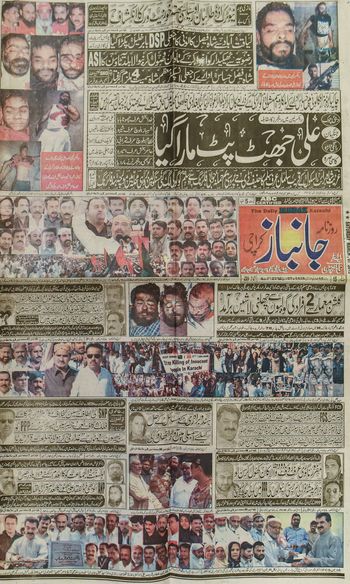
Janbaz contains only four pages and follows a very specific template (see Figure 1). The upper part of the front page is where the ‘masala’ (spice) is. It is devoted to the most sensational news and to photographs of dead bodies (which are sometimes accompanied by ‘memory photos’ of the gangsters, in more or less warlike poses). The lower part of the front page essentially consists of declarations of public figures and reports on public events and collective actions (protest demonstrations, in particular). The back cover contains other press releases from smaller figures, as well as briefs on local politics. On the inside pages is an editorial, generally devoted to Karachi's dysfunctions and its state of permanent ‘crisis’, as well as details of the headlines and of public events. The testimonies of the readers interviewed suggest that these internal pages are much less read.
Janbaz, 7 March 2015. Among the news of the day, the death of gangster Ali Jhat Pat, a ‘commander’ of the Baba Ladla gang, whose body and a ‘souvenir photo’ occupy the top-right corner of the front page. Source: photograph by L. Gayer.

Janbaz allows its readers to monitor the ‘situation’ of the neighbourhood and other localities of Karachi with social and economic ties to Lyari. It provides detailed information on the presence and progression of the gangs, the location of the most recent attacks (and therefore of the most volatile areas), the number of ‘wickets’ that fell the previous day, and the identity of the victims. For these reasons, Janbaz has become an indispensable tool of social navigation for the people of Lyari, which leads many readers to describe their relationship with the daily as a form of ‘addiction’. A hairdresser interviewed in March 2015 spoke of the state of ‘tension’ that would seize his store when the newspaper was not delivered for one reason or another. Janbaz seems to have filled the gap opened by the crisis of the ‘hermeneutics of danger’ mentioned above, at a time when the latter was showing its limits in an increasingly violent and unpredictable configuration. This is what a local poet, A. R. Ghumnaan, suggested: ‘This is a psychic paper’ (najoomi akhbar), which he facetiously compared to Nostradamus.Footnote 57 In a more Goffmanian language, we can see in this medium a monitoring device for an insecure world where self-preservation requires a proactive investment on the part of everyone.Footnote 58
And yet, the readers of Janbaz rarely take the information published in ‘their’ paper at face value. The local anchoring of the newspaper implies that, one day or another, every reader will discover some sort of discrepancy between the observable reality and the ‘facts’ reported in the newspaper. According to a grocer based in the locality of Chakiwara whose shop was full of old newspapers, ‘when an incident occurs in our neighbourhood [elaqah, a term referring to a circumscribed space of acquaintanceship] and different facts are reported in the newspaper, the lie becomes flagrant’. For the majority of readers, these ‘lies’ are essentially due to the sensationalist nature of the newspaper. In a complete reversal of situationist theses, which argued that the emergence of the society of the spectacle somewhat mechanically induced a fragmentation and apathy of mass-media users, the search for the sensational (what the readers of Janbaz refer to as the overuse of ‘spice’) is here conducive to a more socially connected public. Far from inducing ‘passive acceptance’ or contributing to the rise of ‘solitary crowds’, as the situationists would have it,Footnote 59 the putting-on-show of local news has been nurturing scepticism among readers and has been encouraging them to do their own fact-checking. It is therefore common for them to discuss the news in the public places where the newspaper circulates, or to call relatives residing in the localities mentioned in the edition of the day to verify what they have read. The inability to decide a priori on the veracity of the news published in Janbaz is a cause of intense coordination with one's entourage, friends, family, and even with strangers. These verification procedures help to recreate social ties and strengthen the sense of belonging to the same community, which is already sustained by the focus of the paper on local news. If Janbaz has contributed to the expansion of the Umwelten of its readers, it is as much by its revelations as by its approximations. While this comes as a disclaimer to situationist critiques of the ‘society of the spectacle’, this is also an important caveat to the anthropology of fakes briefly discussed above, which tends to suggest that falsity is self-reproducing in our counterfeit modernities, ‘in an infinite regress’.Footnote 60 On the contrary, the contested nature of the information circulated by Janbaz has been inciting Lyariites to pool local knowledge so as to produce trustworthy accounts of the ‘situation’ (haalaat), however contingent and elusive this pursuit of reliable and actionable information may be.
Faces of death: ‘forensic’ photography and the establishment of truth in Janbaz
While there is widespread scepticism about the information and declarations published in the newspaper, images of corpses are generally perceived as more truthful—even if readers are aware that the blood of those pictured tends to be clumsily colour-enhanced for effect. Each full-colour photograph is accompanied by a caption indicating the name of the deceased, the location, and the cause of death. Most of the victims are residents of Lyari but, if no one is killed in the area on a given day, pictures of people murdered in other parts of the city will be published. The crudeness of these images has been subject to much criticism, especially from Janbaz’s more educated readers. Even the middle-aged photographer ‘Morchary’ says he avoids bringing the newspaper home, to spare his children the gory images, which he himself has often provided.
At the same time, many readers of Janbaz ascribe these images with a peculiar power to establish proof in a context of ontological and epistemological uncertainty characteristic of protracted crisis situations, where friends and enemies often become indecipherable and where even the categories of interpretation of one's world and social relations come into doubt.Footnote 61 The power of authentication assigned to photography by Janbaz readers—its alleged truth effect—is not devoid of ambiguities, however. Rather than to ethical or aesthetic issues, these are related to the equivocal relations between market forces and the production of truth. On the one hand, the media's quest for profit is perceived by the readers of Janbaz as an incentive to lies and exaggerations. But, at the same time, commercial success remains perceived as the best certificate of authenticity. This is what a clerk at the Karachi Municipal Corporation (KMC)—who read the paper anxiously everyday in the hopes of finding news about the payment of his salary arrears—told us: ‘Jo dikhta hai, voh bikhta hai’ (literally ‘what you can see is what sells’, suggesting that there is some truth in the images published in the newspaper and, at the same time, that this visual content is what sells whether it is true or not).Footnote 62
Urdu ‘eveningers’ and the race to capture the dead
In order to understand the status of these images and the mixed reactions they elicit among the readers of the newspaper, it is useful to recall how this kind of commercial forensic photography became commonplace in Karachi's Urdu press. Janbaz was not the first Urdu newspaper of Karachi to publish pictures of the dead on its front page. This editorial practice became common during Operation Clean-up (1992–94), when the army was deployed in the city to put the MQM in its place and to dismantle its so-called ‘state within a state’. The dissident faction of the MQM (Haqiqi) was supported by the army, and its militants turned against their former comrades in many parts of the city—mainly in Mohajir-dominated localities of District Central and District East. In 1994, the army withdrew from the city but the repression of the MQM and the internecine strife between its two factions went on unabated. In 1995, the police launched a particularly ruthless operation against the MQM and extrajudicial killings reached unprecedented levels. While the number of killings escalated (1,742 murders were registered that year), Urdu newspapers started opening their columns to photographs of the victims.
Every day, bodies bearing torture marks and traces of post-mortem mutilations were dumped in the streets and sewers of the city. The number of bori band laashein (bodies wrapped in gunny bags) found across the city became an indicator of the political temperature of the day, and some editors were determined to give them the coverage they ‘deserved’. This was particularly true of two newspapers reputed for their heinous character (mizaaj): Qaumi Akhbar and Awam. These two newspapers belonged to the previously mentioned category of ‘eveningers’. As they competed for the same readership—lower-middle-class Urdu-speakers, mainly—the two dailies engaged in a veritable tug of war.
It is Qaumi Akbar that pushed this trend the furthest. Its editor, Ilyas Shakir, was particularly insistent about publishing a picture of every victim of political violence. These gory images would sometimes be printed in three columns and, on the deadliest days, photos of corpses would be collected in a supplement. Currently employed at a renowned international news agency, photographer Athar Hussain was then starting his career and remembers his first assignment at Qaumi Akhbar:
If you missed even one dead face you would get a notice the next day. So if 25 to 30 people were killed, we needed to get their faces in. I would be really happy if my photo of the corpse would print in three columns. … At that time, publishing pictures of corpses was considered something good, because it meant that your newspaper would sell better. … When I started working in parallel for foreign media, I discovered that the dead had to be dressed [while the corpses appearing in the Urdu press are regularly shirtless, which makes it possible to reveal more traces of torture], that the face had to be concealed and that no blood should be shown. It was really another style. So I worked in two directions. I had a camera to make really bloody and terrifying images, and another for international agencies.Footnote 63
Speed is of the essence in this trade and every crime photographer has a way to reach the scene before everyone else. Weegee (né Arthur Fellig), who invented a new genre of ‘tabloid documentary’ with his images of disaster and ruination shot in New York in the 1930s, ‘often slept in his car (the first civilian automobile to be equipped with a radio that received police and fire department transmissions) or in a news service “shack” behind a police station, awaiting news of urban emergencies he could photograph’.Footnote 64 His later Mexican counterpart, Enrique Metinides, enrolled in the rescue teams of the Mexican Red Cross and reached scenes of accidents and catastrophe with medical crews.Footnote 65 Athar Hussain, for his part, had some ‘good friends’ at the Police Centre and at the control room of the Edhi Foundation—Karachi's largest philanthropic organization, which maintains the city's main fleet of ambulances. These ‘good friends’ would not accept money but were amenable to small gifts—diaries, pens, or a nice meal. This was worth it because, within minutes of a killing being reported to any of these call centres, Athar Hussain's pager would start beeping. He would then hop on his bike or jump into an Edhi ambulance, often reaching the spot before the cops. This often made him suspicious in the eyes of the police, but it also helped him build his reputation. By his own admission, he was determined to make his mark in the industry (‘I was very aggressive,’ he says) and he soon made a name for himself with his ‘on the spot’ pictures of the dead.
As the number of victims of state terror and political violence escalated, Athar found it impossible to hit up every crime scene in the city. A simple solution was to head to the place where all bodies would end up: the morgues. There as well, personal contacts were essential to gaining access. At one of the city's prominent hospitals, Athar met Ram Dev, a chowkidar (caretaker) who used to live with his family on the premises and who, despite being a Hindu, often helped medico legal officers with autopsies.Footnote 66 Ram Dev also kept a key of the forbidden room with him so, whenever Athar visited, he would either take him to see the bodies or hand him over the key and let him do the job on his own.
Athar Hussain was not really concerned with the rationales of all these killings: ‘I was only taking pictures, thinking of how to get a good angle, etc. Who died, why, what for, those were not questions for me. My sole motivation was to get pictures to put on display on the front page of the newspaper, so that people would praise me.’ Soon enough, however, Athar Hussain and his employers realized that the power of these images exceeded both their own commercial motivations and the voyeurism of the public:
At the beginning [of Operation Clean-up, in 1992], the MQM was fighting the government so whenever a body was found, they would say, ‘the government has dumped the body after killing that guy’. This would earn the MQM a lot of sympathy. At that time, the army had unearthed torture cells of the MQM and they had released images. The people were very eager to see all this.Footnote 67
Death proof: the revelatory power of Janbaz's ‘forensic’ photography
For the last decade or so, it has become less frequent to find pictures of dead bodies on the front page of Urdu newspapers. With the emergence of the electronic media in the early 2000s, new rules of conduct came in force with which the print media aligned itself. Urdu newspapers with a focus on Lyari were an exception, however. They never cared much for these rules and, while more mainstream publications started restraining themselves, local newspapers went on with their graphic content. The now defunct Josh (Fervour) was a case in point, with its images of bodies and sensationalistic reports on gang-related incidents. Janbaz, for its part, momentarily suspended the publication of bodies in 2016, but the particularly gruesome front page that it devoted to the death of Baba Ladla, Lyari's most wanted gangster, in February 2017, proved that it had not entirely mended its ways.
Like veterans of crime photography such as Athar Hussain, Janbaz photographers argue for the power of unveiling of their images and the liberating effect it has for the families of the victims. According to ‘Morchary’:
We help people. Thanks to the photos of corpses published on the front page of Janbaz, several people have found traces of missing relatives. After seeing their photo in the newspaper, they often come to see us. We give them the original photos and tell them where they were taken.
In an environment of chronic uncertainty, access to such information can be precious. It helps provide closure for the relatives of those who may otherwise remain indefinitely namaloom and lapatha (unidentified and missing). The social utility of this mechanism is confirmed by Adnan Baloch, a resident of Chakiwara, in Lyari, whose brother disappeared in April 2016 after plainclothes men (probably intelligence sleuths) picked him up at his home. Baloch, who claims that his brother had no connection with the Lyari gangs, spent the next few months looking for him in police stations and hospitals across the city. His quest was brutally interrupted three months later when he discovered on the front page of Janbaz the image of a corpse found in Musharraf Colony, a locality not far from Lyari, on the road to Baluchistan. ‘On the same day,’ he says, ‘I went to Janbaz’s office and asked them to give me the original photo and tell me where they found the body. It was then confirmed that it was my brother.’
For Morchary, everyone can claim that someone was killed, but pictures remain the best proof, because ‘they tell the truth’. All the photographers of Janbaz work with rudimentary equipment (Morchary himself uses the G5, a low-end compact camera by Canon) and the cheap paper used for publication only adds to the low definition of the images. Far from disturbing readers, however, these low technical standards tend to reinforce the veracity of these images. This is not specific to Janbaz. In Regarding the Pain of Others, her influential book-length essay on war photography, Susan Sontag writes that ‘pictures of hellish events seem more authentic when they don't have the look that comes from being “properly” lighted and composed. … By flying low, artistically speaking, such pictures are thought to be less manipulative’.Footnote 68 The added value of amateurism, in photographs of human tragedies, tends to increase with the development of social networks and mobile photography, but it finds its roots in a structural characteristic of this medium: ‘its bias toward the spontaneous, the rough, the imperfect.’Footnote 69
The revelatory power of these images lies in their promise of immediacy, namely in their undoing of ‘media awareness’ through the concealment of human interventions in their production—a denial of the mediation process which tends to suggest that such images are ‘not human fabrications at all, but immanent to the world’.Footnote 70 From this perspective, the outsourcing of some of this photographic work to readers only endows it with further authenticity. Over the years, residents of Lyari have grown increasingly suspicious and critical of the mainstream media, whom they accuse of misrepresenting their area as a crime den. By subcontracting a part of its photographic work to readers, Janbaz’s editorial team has circumvented professional journalists and thus minimized their interference with the representation of the ‘facts’. It is not that Janbaz aimed to enrol its readers in a great quest for the naked truth. Neither did these readers consider acting as detectives or prosecution witnesses. Rather, the newspaper pragmatically adjusted to the appetite for the spotlight of its readers, which helped it cut its reporting costs while gaining access to remote and/or inaccessible parts of the city.
This is exemplified by the contribution of Akbar Jan, a 35-year-old resident of the Mai Garhi area of Manghopir—a locality in the northern part of the city that has been notorious for its own brand of criminal and political violence, especially after the Pakistani Taliban gained a foothold there from 2011 onward. While Manghopir is a Pakhtun-dominated area, Akbar Jan is an ethnic Baloch and retains strong links with Lyari. If he has been such a keen reader of Janbaz for the last ten years, it is mostly out of fascination for Lyari's criminal scene, however. A while back, he contacted the newspaper: ‘They [journalists] cannot come to Manghopir easily to cover crimes and take photos of those killed in violent incidents,’ he said. ‘So, occasionally I provide them with information and take photos for them.’ Akbar Jan takes pride in the fact that a number of these photos have been published over the years and he preciously conserves these newspaper copies.
This outsourcing of documentary tasks is more frequent for remote localities where members of Janbaz’s editorial team rarely venture. But it also seems to be quite frequent in Lyari itself. Despite the popularity of the newspaper or perhaps because of it, its journalists have attracted many enmities over the years. Under the reign of Rehman ‘Dakait’, the public sale of Janbaz was periodically prohibited in particular neighbourhoods and the paper had to be smuggled in from adjacent localities. Morchary himself claims that he was beaten up on several occasions by local gangsters and that he was deprived of his mobile phone, his camera, and even his motorcycle while working in Lyari. Like his colleagues, he now avoids making himself too visible in Lyari. By relying on a local network of informants and occasional contributors, he mutualizes the risks while sparing his newspapers the cost of reporting.
This promise of immediacy is bound to remain an aporia, for these photographs are inseparable from the captions providing information to the readers about the identity of the victims, the location of their death (or of the dumping ground where their body was found), and the alleged circumstances of their demise. Without the caption, wrote Walter Benjamin, ‘photographic construction would remain stuck in the approximate’ and he anticipated that ‘the caption [might] become the most important component of the shot’.Footnote 71 Public controversies around the photographs of bodies published in Janbaz seem to have realized this prophecy. As Wali Khan, another member of Janbaz’s editorial team explains: ‘When we take photographs of corpses in the morgue, sometimes we face major problems, especially when the families of the victims arrive and throw the journalists and the photographers out because they are afraid that we will write that their relative was affiliated to this or that group.’Footnote 72 Moreover, it is not unusual for residents of Lyari to barge in the newspaper office and object to their loved ones—be they living or dead—being projected as gangsters. ‘After that, we must publish disclaimers and explain that we were wrong and that in reality, that person was not related to any [criminal] group. Sometimes the police mislead us,’ Khan says. But, once a picture has been published, most often the damage has already been done. For example, one young man who was accused of being affiliated with the gangs on the pages of Janbaz was immediately sent to Dubai by his family as a means of protection (from rival gangs and law-enforcement agencies) until the situation cooled down.
As with any other image, reading these photographs—or in this case simply viewing them without flinching—is the outcome of a learning process. Shumaila, an illiterate housewife living in one of the most troubled areas of Lyari, Kalakot, has been ‘reading’ the paper for years by looking at the photographs and having family members read stories out to her—a common practice in a context where many members of the older generation are illiterate. She explains how she initially struggled to look at the images of bloody corpses, how frightened she would get. However, after years of exposure, she eventually ‘hardened’ or became mazboot. While the photos still saddened her, as these were images of somebody's sons, she also developed a habit of reading Janbaz and in particular of viewing the gruesome photos featured on the front page.Footnote 73
During the period of heightened conflict between rival gangs and law-enforcement agencies, many mothers spoke about reading Janbaz as a means of protecting their children from violence and advising them on how to navigate through their area. Like many others, Neelofar only bought the newspaper during particularly tense periods to find out what happened and what might happen in the immediate future as a means of making her children aware of any possible dangers and to keep them safe from harm. For her, by reading Janbaz, she was fulfilling her duty as a good mother looking out for her children.Footnote 74 While readers often take what they read with a pinch of salt, knowing full well that the paper often lied, in a climate of uncertainty and a context in which the mainstream press only selectively reports on Lyari, even those Lyariites who were most critical of the newspaper agreed that some information is still better than none at all.
The appeal exerted by Janbaz’s peculiar brand of photojournalism is irreducible to a search for authenticity in a troubled world, however. When describing how they got ‘hooked’ to the paper, readers often use words such as ‘maza’ (taste/fun/enjoyment) or ‘chaska’ (passion/addiction). From the most diligent readers to those contenting themselves with a quick glance at the front page on open stands, almost everyone concedes that there is also some pleasure to be derived from this sensationalized depiction of Lyari's woes. This replacement—or, rather, this overlapping—of terror with entertainment is bound to leave audiences with a high degree of frustration, however. Like the Indonesian readers of popular newspapers like Pos Kota, which featured pictures of dead criminals on their front page on a daily basis in the early 1980s, the readers of Janbaz relish the macabre spectacle of everyday violence but it leaves them unsatisfied. Instead of expressing a desire for more sensationalism—that process through which ‘the gravity of the corpse is turned into … amusement’Footnote 75—their frustration might as well suggest a longing for the gravitas of corpses unvitiated by entertainment: ‘they want to see “death”. But what they see is something else; something ordinary. They want to see perhaps more blood, more physical damage. Something more definitive. … They never see what they came for; what they were meant to see. “Death” refuses to become apparent.’Footnote 76 Behind the obvious request for more ‘masala’, this is how we could interpret the following quote by Muhammad Saleem, a 38-year-old Kathiawari running a newspaper kiosk in the Kalri locality of Lyari:
People enjoy reading Janbaz. By reading it they become really addicted. If you tell them that the newspaper is out of print and you suggest they buy another title, they will say, ‘Oh, there must be a lot of lies today for it to have sold out!’ (Zyada jhoot hoga tabhi bik gaya hai) When two or three wickets fall [when two or three people have been killed], they are not happy. ‘What are two or three wickets?’ they ask. ‘Give us more news!’ they say.Footnote 77
For Sontag, ‘to speak of reality becoming a spectacle is a breath-taking provincialism. It universalizes the viewing habits of a small, educated population living in the rich part of the world, where news has been converted into entertainment’.Footnote 78 This assumption is consonant with Sontag's normative approach towards photography and is reflective of her own elite proclivities and ethnocentrism. This critique erases a whole part of the history of American photography that, starting from Weegee, departed from the conventional documentary gaze and that, instead of bringing images of the underprivileged back to the privileged, positioned the working classes as ‘both subject and imagined audience’.Footnote 79 Furthermore, Sontag denies populations directly affected by war and other major disruptions of social order the possibility of being spectators of their own sufferings—or of that of their neighbours—and to draw pleasure, distraction, or more ‘serious’ conclusions from it. In fact, as Ariella Azoulay suggests, Sontag is exemplary of these cultural theorists who fell prey to ‘image fatigue’: ‘the world filled up with images of horrors, and they loudly proclaimed that viewers’ eyes had grown unseeing.’Footnote 80 While Azoulay's approach is loaded with its own normative assumptions, it has the merit to think through photographs of disaster ‘beyond guilt and compassion’—that is, ‘outside of the merely psychological framework of empathy’.Footnote 81
At first sight, Azoulay's conception of photography as ‘a place of refuge, from which the discourse on the res publica may be revived’ may appear quite remote from the relations of Janbaz readers towards their favourite newspapers and its most graphic visual content. And yet, up until its excesses, this often macabre and grotesque brand of photojournalism enables the denizens of Lyari to view themselves and make themselves visible through the ‘legitimate violence of photography's citizens’—that is, by exposing the lived realities of their domination and the more or less hidden forms through which they are subjected to state power.Footnote 82 Thus, many residents speak about reading Janbaz primarily because, if nothing else and for all its shortcomings, it is still their newspaper. Shagufta, who lives near the Timber Market and reads the newspaper religiously, says people like her read Janbaz because it is the only newspaper that covers their area so extensively: Galli galli ki khabar hoti hai (‘it reports the news of every street and lane’). In a context in which many residents feel otherwise marginalized and ignored within the city, a hyperlocal newspaper like Janbaz restores a sense of self-worth in them and marks their place within the city—even if all the news reported about the area is negative and even if a substantial part of what is reported turns out to be fake.
City of fakes: Janbaz and its conspiratorial imagination
Clearly, Janbaz is not entirely devoted to dissipating the surrounding epistemic murk. Beyond its often-erroneous information, the newspaper feeds the crisis of evidence mentioned above through its editorials. These texts follow a similar structure and are sometimes repeated word for word from one week to the next. They generally start by locating Lyari in a city facing a multiform ‘crisis’, where inflation, gas and electricity shortages, terrorism, extremism, and traffic jams are part of a widespread disorder. In this world upside down, people, words, and objects lie and must be constantly subjected to evaluation procedures, without any guarantee of success. With their false titles, false diplomas, and counterfeit money, ‘wolves with a human face’ (insan nama bheria) prowl around the city, with a predilection for lower-income neighbourhoods and their vulnerable populations.Footnote 83 The economy of suspicion that infuses these texts is not limited to a questioning of the taken-for-granted and to the promotion of a principle of generalized vigilance. It is prolonged by more general and worrying questions about the role of the state in this epidemic of fake practices, figures, and documents, which tends to suggest that the state itself is a forgery. This concern of the editorial team of Janbaz for counterfeits and impostures (the Urdu word ja'ali refers to both objects and individuals claiming to be what they are not) can be found in editorials devoted to false doctors (ja'ali doktor), false healers/saints (ja'ali’ amil/ja'ali pir), or counterfeit money (ja'ali kurensi). For instance, one may refer to this editorial of August 2016 devoted to false healers:
The false occultists and the role of the police!
In the city of the Quaid [Muhammad Ali Jinnah, the founding father of Pakistan], the number of false occultists and false Sufis continues to increase. In their centres [dere] located in the four corners of the city, they have been deceiving people for a long time. Throughout the city, we hear that desperate people [halat ke pase hue afrad; lit. ‘those caught in the situation’] often end up at these quacks’. … They guarantee that you will have your loved one at your feet, that your family problems will soon dissipate and that your income will soon be increasing. Desperate people then give them what they ask. They are even said to have had inappropriate behaviour [zyadti, a term that suggests sexual violence] towards women. Everywhere, people complain that despite information shared with the police, the police are slow to react. The question that now arises is how to overcome these false occultists and false Sufis. If law enforcement and other relevant authorities took action against these false occultists and false Sufis, forcing them to be accountable to the law, there is no doubt that these false occultists and false Sufis deceiving the people to enrich themselves would be eradicated from the city.Footnote 84
This epidemic of fakes, sometimes described as a ‘virus’ in these same editorials, might partake to more general concerns characteristic of the neo-liberal moment, which, as the anthropology of globalization has shown, is particularly conducive to conspiratorial imaginaries.Footnote 85 As Nils Bubandt points out in his work on Indonesia, the ‘force of falsity’—its capacity to convince and mobilize, even in its falsehood—is nonetheless irreducible to this global conjuncture and only draws its performativity in highly localized conceptions of duplicity. In Indonesia, the forger conjures the flickering figures, strongly stigmatized by the New Order, of the provokator (the agitator) and the dalang (the puppet master).Footnote 86 In Karachi, on the other hand, discussions on forgery, such as those taking place on the pages of Janbaz, are part of larger controversies around the role of so-called ‘mafias’, these occult forces embodying the privatization and criminalization of the state. Appearing in the late 1980s to designate the violent entrepreneurs that emerged in the informal real-estate sector and in public transport (the ‘land mafia’ and the ‘transport mafia’) in the wake of the Afghan Jihad, the term has since been applied to sectors as diverse as the parallel water market (the ‘water mafia’) and electoral fraud (the ‘thappa [stamping] mafia’). One of the characteristic features of these ‘mafias’ is that they remain nameless: they are faceless collective actors and, more than proper criminal organizations, they evoke occult powers. The other feature of these ‘mafias’ is their alleged penetration of the state, which they would have captured through intimidation and corruption. This discourse on the various ‘mafias’ supposed to control the economy and local political life can serve as an instrument of disqualification, but it pertains to a widely shared political imagination that transcends strategic uses of the term.
This imagination is further reinforced by the hidden practices of the Pakistani security apparatus. The MQM is thus deemed to have received support from the military regime of General Zia-ul-Haq in the second half of the 1980s, while its rivals from the MQM (Haqiqi) were patronized by the army's intelligence agencies during Operation Clean-up in the 1990s. In Lyari, some gangsters (notably the Uzair Baloch group) were also reputed to be sponsored by the army and its intelligence services, which were thought to have entrusted them with the task of containing the Baloch nationalist movement in Karachi. These alleged collusions between the ‘secret agencies’ (khufiya agencian) and certain armed factions operating in Karachi add to the mystery of the Pakistani state in the eyes of its citizens. For, while the omnipotence lent to various ‘mafias’ tends to posit the state as an instrument in the hands of private interests, the multiple conspiracies (saazish) attributed to the ‘agencies’ make this state a distinct entity both differentiated from society and able to control it entirely.Footnote 87 This tension between two occult cosmologies of state power can be found in Janbaz’s editorials, which never provide explanations for the motives of inaction of the state and thus give credit to the hypothesis of a generalized corruption of law-and-order forces while suggesting implicitly that the lack of state response to counterfeiters of various hues could serve a more complex strategy of domination through disorder.
Mimetic impostors: when the police go ‘gangsta’
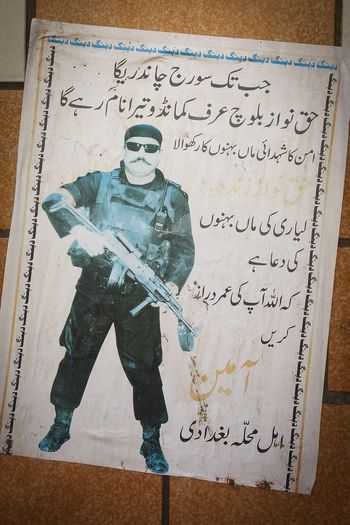
Besides being an instrument of social navigation and the sounding board of a state of generalized disorder, Janbaz is also a stage where the protagonists of the conflict confront each other, under the critical gaze of the public. Beyond its macabre photographs, the newspaper has built its notoriety on the ‘challenges’ that the gangsters throw at each other or at the police on the front page of the newspaper. This editorial practice, which was unprecedented in the Karachi press, culminated in January–February 2015 with the publication of a series of invectives between one of the main gangsters of the time, Shiraz ‘Comrade’, and the Station House Officer (SHO) of Baghdadi district, a locality of Lyari known for its high crime rate. The policeman in question, Haq Nawaz Baloch, alias ‘Dabang’, was a controversial character. When he decided to cross the iron with Shiraz ‘Comrade’, he had already carved a certain reputation by parading through Lyari the spoils of gangsters that he had slaughtered and circulating these videos on social media. Parallel to these performances, Janbaz helped this media-savvy policeman make a name for himself by giving him the opportunity to showcase his masculine prowess, his sense of honour, and his devotion to the common good. This enterprise at self-aggrandisement drew on several registers of legitimation, starting with Bollywood cinema: the term ‘dabang’ refers to someone with a dabdaba—that is, someone who exercises control over a territory and its population. But it is also the title of one of the biggest Bollywood hits of recent times. The film, which was released in 2010, relates the adventures of a corrupt but fearless police officer, played by the mega-star Salman Khan, and has been a source of inspiration for gangsters and policemen alike in Karachi, much like Khalnayak in the 1990s. Meanwhile, with his black scarves, his sunglasses, and his dark uniforms, Haq Nawaz was inspired by the ‘commando’ style of the army and the elite units of the police—a style that also made its influence felt over gang leaders, who sometimes address their bodyguards as ‘commandos’. Finally, by printing posters in which he takes a martial pose and claims the support of the mothers and daughters of Lyari (see Figure 2), Haq Nawaz replicated the advertising strategies of Lyari gangsters, which, at the end of the 2000s, saturated the visual environment of the neighbourhood with posters eulogizing them.
Poster eulogizing Haq Nawaz. The poem, in Urdu, reads: ‘As long as the sun and the moon will shine / Haq Nawaz, alias “Commando”, your name will remain / The keeper of peace and protector of mothers and sisters / “Long Live Haq Nawaz!” / The mothers and sisters of Lyari pray that god grants you a long life / Amen / The residents of Baghdadi’. The word ‘dabang’ is repeated all along the edge of the poster. Source: photograph by L. Gayer.

One can only be struck, here, by the mirroring effects between the strategies of legitimation deployed by the gangsters and by this type of policemen known in the Indian subcontinent as ‘encounter specialists’ (‘encounter’ is generally used as a euphemism for summary executions). These mimetic relations emphasize that internecine wars are not only factors of social polarization, but also partake in the formation of a shared domain of ethics and aesthetics, up until the battles between seemingly sworn enemies. At the same time, these strategies of legitimization are not necessarily accepted by their intended audience. Thus, the readership of Janbaz to an extent denied Haq Nawaz the grandeur that he made a claim to by also submitting this claim to a critical examination informed by their experience.
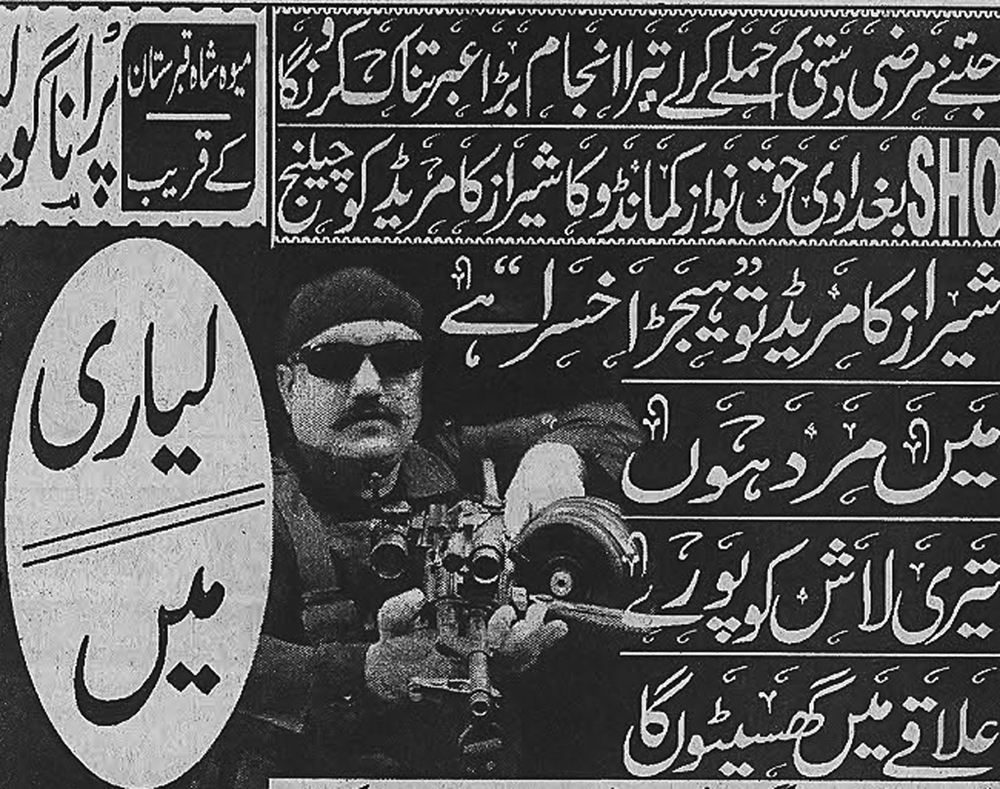
The ‘challenges’ exchanged by Haq Nawaz and Shiraz Comrade, which rely heavily on gendered and sexualized language, began with the following message, which was published on 13 January 2015 on the front page of Janbaz (see Figure 3): ‘The challenge of SHO Baghdadi Haq Nawaz Commando to Shiraz Comrade: “No matter how many homemade bombs you throw at me, I will ensure you meet a dreadful end. Shiraz Comrade, you are a eunuch [khusra]. I am a man. I will drag your corpse all over the neighbourhood”.’ To which Shiraz ‘Comrade’ replied, the following day: ‘You fake “commando” terrorizing the poor and wearing a veil (dupata) over your head like a woman, mend your ways or there will be no one to carry your bier at your funeral.’
The challenge of Haq Nawaz to Shiraz Comrade, Janbaz, 13 January 2015. Source: photograph by N. Kirmani.

The same day, another declaration of the policeman was published in Janbaz: ‘Shiraz Comrade, you are in my line of sight. Very soon, I will offer your corpse to you lord Uzair Baloch.’
The following day, Shiraz Comrade reiterated his own threats: ‘You fake commando, we respect the uniform of the police. So take off your uniform and we will see who's brave and who's a eunuch. It won't take us/me more than an hour to show that you're an impostor.’
Finally, on 15 January, Haq Nawaz threw a last challenge to his arch rival: ‘Shiraz Comrade, alias “eunuch”, I am waiting for you in front of your house. If you are a true son of the Baloch, come on out and confront me. Don't act like a hijra [eunuch].’
We see here how the preoccupations conveyed in the editorials of Janbaz for the fake and the counterfeit extend through the mimetic confrontation between two figures denying each other honour, masculine virility, and authenticity. In this rivalry, the policeman and the gangster become interchangeable figures, claiming legitimacy based on the same orders of worth (physical courage, masculinity, devotion to the weak). In this race for honour, Haq Nawaz does not hesitate to threaten his adversary with execution, plain and simple. Up until his excesses (it would take several months before he was transferred to another police station in the city), Haq Nawaz points at the routinization of extrajudicial violence in Karachi: rather than a ‘public secret’—‘that which is known but cannot be spoken’Footnote 88—these police killings receive enough support by the police and political authorities as well as by sections of the population that they can be brandished as a public threat by law-enforcement officers.
This phenomenon is not unique to Karachi: throughout South Asia and in much of the Global South, ‘police vigilantism’—an apparent contradiction in terms—has gained wide acceptance in recent years, both within and without police forces.Footnote 89 This is not to say that there was no hubris in Haq Nawaz's strategy of self-aggrandisement through (the threat of) extrajudicial violence. On the contrary, in his tussle with Shiraz Comrade, he appears emblematic of these agents of repression carried away by their fantasized representations of the omnipotence of the adversary.Footnote 90 By self-consciously breaching the law, these avengers discover the jubilant pleasure of playing the terrorist or, in this case, the gangster. This exhilarating aspect of mimetic violence was identified by Michael Taussig when he pointed out that ‘There is something insufferably attractive about the margin of law where the state re-creates the very terror it is meant to combat’.Footnote 91 Through this mimetic dynamic, however, it is the intoxication of state power that wins these actors—a boundless power, peculiar to a state unbound by mimesis, in which the boundaries between the original and the copy, and thus between legitimate and illegitimate violence, are abolished. While emphasizing the importance of these mimetic practices in contemporary antiterrorism, Begonia Aretxaga draws our attention to their amateurism and their tendency to go awry. State actors playing the terrorist tend to parody their opponent: they push to the extreme the tendency of any social actor to overplay his role, at the risk of compromising his performance. It is precisely what appears to have occurred with Haq Nawaz, who, despite the close attention he paid to his appearance and manners, was caught in the act of misrepresentation.Footnote 92
What most of our respondents reproached the policeman about was not so much that he had adopted some gangster poses or that he had been acting outside of the law, but that he had not delivered on his promises. Thus, for Janbaz photographer Wali Khan, ‘He just liked to show off (voh showbaz tha). Those he picked up were just some small fry (mamuli badmash). When Shiraz Comrade's men were around, he would hide in his police station’. Similarly, for Arif, a school principal from the Nawalane neighbourhood, ‘Haq Nawaz was involved in extrajudicial killings. But he didn't kill the big guys, just small-time gangsters (Mashur admion ko qatl nahin kiya. Chote wale hi)’. What seems illegitimate, here, is not so much extrajudicial violence per se as its partial character, with the manly poses of this self-proclaimed avenger being found to be wanting. Once again, these popular judgements refer to a conception of the state as the place par excellence of the factitious and the counterfeit. The term commonly used across South Asia to refer to extrajudicial killings, ‘fake encounters’, confers a ‘spectral quality’ to these killings, which conjures up the image of military confrontations while revealing the artificial nature of these clashes.Footnote 93 With Haq Nawaz, extrajudicial violence is assumed as such—false clashes give way to real assassinations. It is not easy, however, for agents of the Pakistani state, even the most ‘unbound’ among them, to avoid suspicion of being a fraud. The ‘real’ motives behind these executions are in turn a matter of controversy, which ends up reinforcing the idea that the state is a forgery, even when it claims to prove its authenticity by assuming the ‘terrible ambiguity’ that is at the heart of its secret nature and that has to do with the fuzzy boundaries between the law and ‘violence at the heart of a state of law’.Footnote 94
What is at stake in this epidemic of fakes simultaneously denounced and fuelled by Janbaz? Certainly not a formal criticism of the state, which is never questioned as such in the pages of the newspaper. It should also be noted that the army and the Rangers—the state's paramilitary forces in charge of the operation to ‘clean up’ the city—have escaped all incrimination and have gained increasing visibility on the front pages of the newspaper at the expense of gangsters since 2015. This change is part of a broader reassertion of military power since 2013, in Karachi as well as in the rest of Pakistan. If it participates in a political imagination of the state, where the latter oscillates between a fake and an all-powerful occult entity, this trope of deception and counterfeiting is first and foremost a discourse on urban disorder—on a city plagued by discord and piracy of all kinds, in which fakes engender more fakes.Footnote 95
Despite its attempts to rise above the melee, Janbaz is very must part of the fray. The newspaper is widely perceived by the inhabitants of Lyari as a criminal as well as a media enterprise, to which gambling dens owners, builders, gangsters, and dealers would regularly pay bhatta (protection money) to guard themselves against negative coverage in its pages. A university in Lyari is even widely believed by Lyariites to have been extorted money in exchange for the silence of the newspaper in a case of corruption. The case ended up being revealed anyway, even though the university was thought to have paid the necessary bribe. Suspicions of corruption and extortion weighing on the newspaper were heightened in 2016, to the point at which, during the summer, the newspaper issued warnings against crooks seeking to extort money on its behalf. With these calls for vigilance, the loop was closed; after framing Karachi's ‘crisis’ as a problem of facticity, Janbaz started spreading the idea that it itself had been counterfeited. Readers reacted to these announcements with the same critical spirit as usual, many of them judging that these rumours of imposture were themselves a tactic of deception—fake news aiming to conceal real criminal activities. Once again, the critical mind displayed by Janbaz readers and Lyariites at large came as a reminder that the self-perpetuating nature of counterfeit realities is not inevitable. Fakes do tend to beget more fakes—copies of copies, with varying levels of authenticity (thus the oxymoron of the ‘genuine fake’).Footnote 96 But this law of reproduction can be disrupted by various interferences, starting with the reality tests to which any object or individual making a claim to truth and value is subject on the part of suspicious publics. And, unlike what much of the anthropological literature on ‘counterfeit modernities’ tends to suggest, social struggles to restore truth to the world do not always resort to supernatural solutions (deliverance narratives, spirit invocation)Footnote 97 or, more ominously, ‘dismembered refutations’ (as exemplified by the vivisectionist proclivities of ethnocidal violence).Footnote 98 This economy of suspicion may also be conducive to a new public culture reasserting the value of truth as a common good and rediscovering that its pursuit is, by its very nature, a collective endeavour.
Conclusion
Our analysis of this particular local newspaper and its consumption by readers sheds light on the everyday experiences and practices of those living in situations of chronic uncertainty. A grotesque emanation of a society plagued by discord and suspicion for decades, Janbaz is symptomatic of the disruptions that characterize societies under situations of internecine warfare. These wars ‘within the family’Footnote 99 are also wars within the familiar and, as such, generate continuous ‘crises of evidences’ and anxieties about where to look and what to believe. While at times providing Lyariites with a social compass, helping them to navigate risks in their daily Umwelt, Janbaz does not solely serve a monitoring function for its readers—or any clear function at all, for that matter. Hence, functionalist interpretations so often applied to the media, as well as moralist approaches à la Sontag, which refuse to engage ‘unethically’ with the spectacle of war and suffering, fail to take the full measure of what is at stake here, in the myriad ways that the readers of Janbaz have to ‘poach’Footnote 100 in these illustrated news and, in the process, to forge new tactics of coping in a world upside down. The distinction between coping in and coping with crisis, which we borrow from Henrik Vigh,Footnote 101 is an important one and underlines our departure from a certain tendency in the phenomenological literature on civil wars to overestimate the ability of civilian populations to normalize situations of chronic uncertainty. On the contrary, the attempts on the part of Janbaz readers to retrieve a sense of normalcy and predictability remained fragile and never stabilized into proper forms of habituation. In such situations of protracted civil strife, the (re)production of an ‘everyday’—in the phenomenological sense of an ordinary realm of experience in which the social and material world can largely be taken for granted—tends to be challenged by the shifting patterns of violent occurrences and more generally by the constant actualization of the sources of uncertainty and insecurity. Here lies the source of these populations’ enduring sense of fear: their surrounding environment and the nature of the threats always change faster than their attempts to cope with them.
In a context in which economic transformations taking place in the city have left many of Lyari's residents unemployed or underemployed, the sensationalist character of Janbaz can also provide its readers with a form of ‘timepass’, serving as fodder for idle gossip among neighbours and friends, which suggests that the nonchalant consumption of ghastly news is no monopoly of a pacified West relishing the spectacle of war-torn societies. This is not to say that these readers have been numbed by the spectacle of ordinary violence nor have they been dumbed by the overflow of ‘fake news’. Even though they may enjoy being taken for a ride now and then, they have not fully surrendered to the idea of living in a ‘post-truth’ era. Rather, Janbaz is the site of a continuous series of everyday reality tests and the focal point of private and collective investigations by its readers, pooling knowledge in a context where state and non-state actors engage in mimetic practices to collude in the production of chronic uncertainty. Through its own shortcomings, Janbaz helps to recreate social ties in a world plagued by discord and isolation while at the same time contributing to this sense of discord through its highlighting of threats between competing sovereigns and its obsession with the macabre. One of the main contributions of this case study to the anthropology of fakes, which, along warzone phenomenology, has nourished our reflection, is precisely to emphasize that the deception and mistrust that characterize conflict situations not only have deleterious effects, but can at the same time be conducive to new forms of sociability in an otherwise uncertain world. And, even if they do not exhaust the engagement of Janbaz’s readers with the information circulated by the newspaper—which can also be enjoyed with full knowledge of its falsity—the critical faculties displayed by many of these readers come as a disclaimer to the emerging literature on ‘fake-news’ consumption, which tends to depict the new publics of the so-called ‘post-truth’ era as a passive lot playing into the hands of the masters of deception.Footnote 102