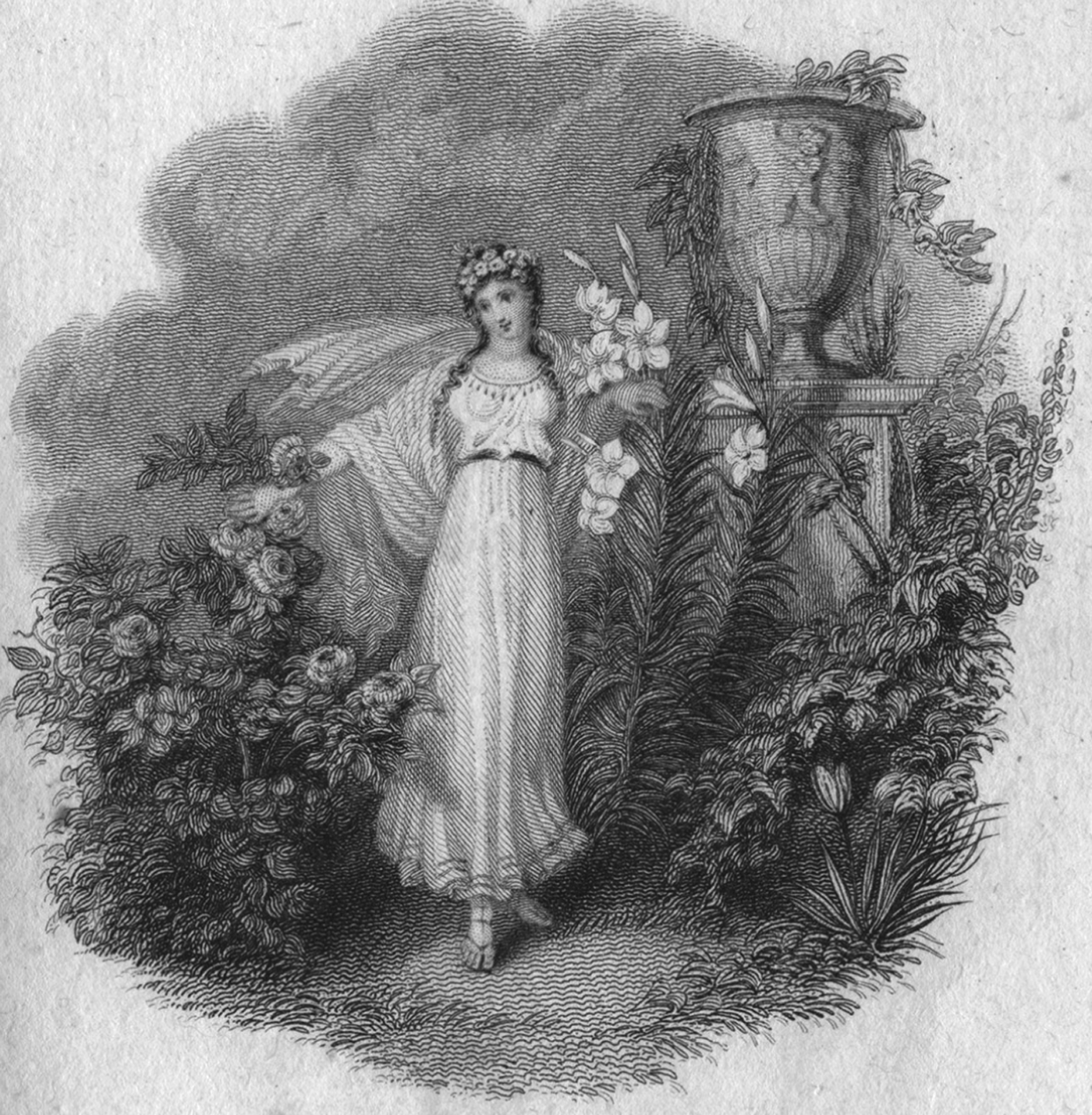
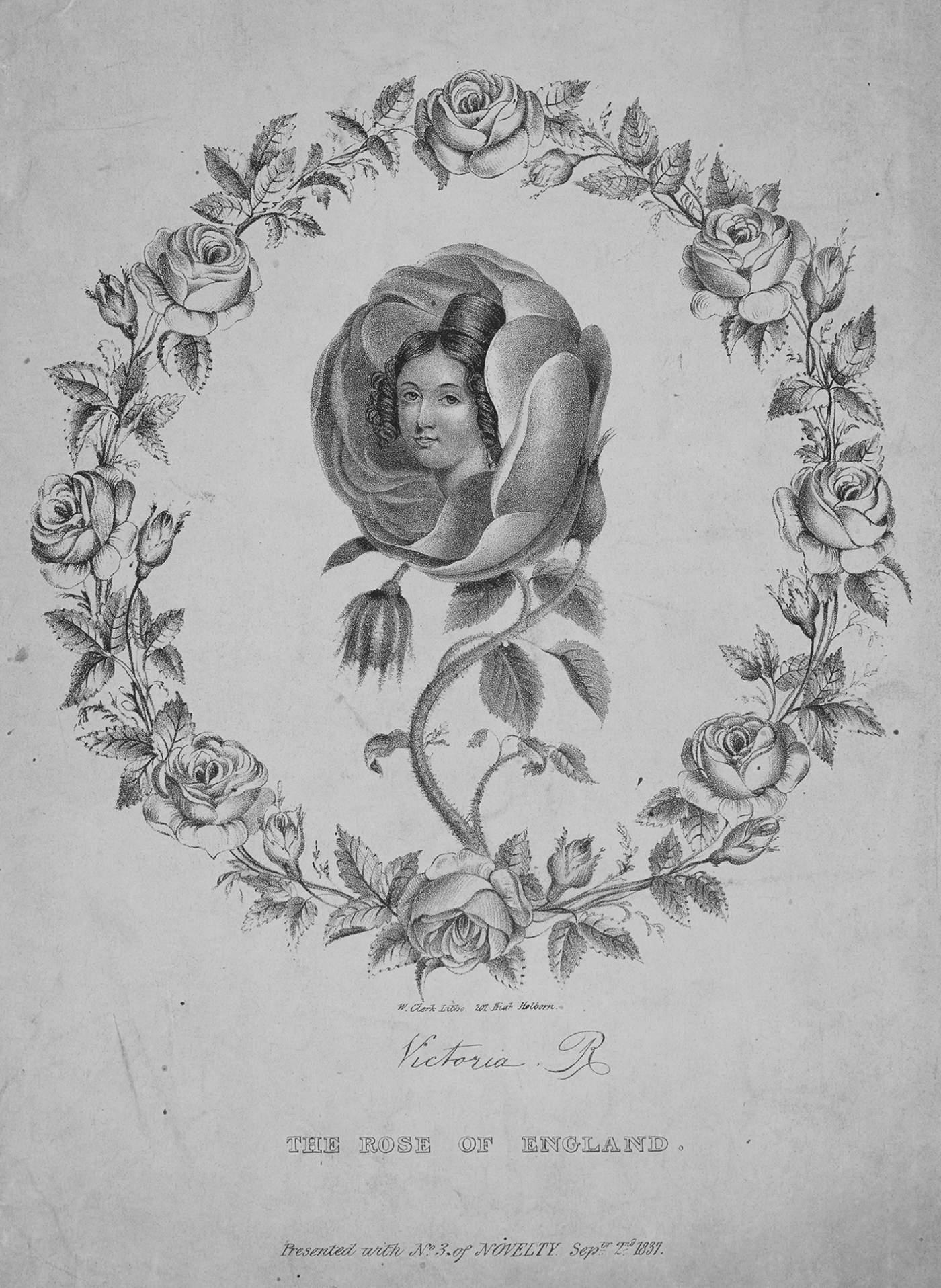
These lines by the late eighteenth-century English poet William Cowper begin a tale about the contest between a lily and a rose for recognition as queen, the rose having ‘Appeal'd to many a poet's page’, and the tall lily ‘A fair imperial flow'r’ who ‘seem'd design'd for Flora's hand / The sceptre of her pow'r’. The goddess Flora, upon overhearing the ‘civil bickering and debate’, identifies noble and stately qualities in each flower and proclaims, ‘And, till a third surpass you, / Let each be deem'd a queen’ (see Figure 1).Footnote 2 Appearing during the reign of King George III, Cowper's poetic duellers met no third rival until King William IV's death and Queen Victoria's accession to the throne on 20 June 1837. But rather than be overshadowed by Victoria, the flowers embraced her – or, more precisely, symbolically became her. The remarkable Amazonian water lily, encountered only earlier that year by an imperial explorer, by late summer acquired the name Victoria, and, coincidentally, an image of the young queen as ‘the Rose of England’ circulated in print (Figure 2).Footnote 3
Portrait of Flora mediating a quarrel between a lily and a rose by J.H. Robinson. ‘The Lily and the Rose’, in The Minor Works of William Cowper of the Inner Temple, London, 1825 edn, Part II, facing p. 46. Special Collections, Bradley University.

Lithograph of ‘Victoria R., the Rose of England’, by William Clark, Novelty (2 September 1837) 3. ©Trustees of the British Museum.
In ‘talking about Victorian science’, Iwan Morus suggested that any big-picture narrative might ‘place politics at the centre’ – ‘making authority and the distribution of authority our central themes’.Footnote 4 Sympathetic with Morus, I return to the case of the Victoria water lily to analyse how the distribution of authority in relation to its naming may tell us something about the bigger picture of ‘Victorian science’. This case is especially salient in this regard precisely because of Queen Victoria's involvement, potentially enabling us, in Margaret Homans's words, to ‘put Victoria back into Victorian’.Footnote 5 The case is very rich, but in analysing it I will focus on one aspect only, the controversy surrounding the naming of the lily after Victoria. I will suggest that the publicized aspects of the naming debate had the effect of obscuring private decisions, and that ultimate authority in the making of botanical knowledge in this case hinged on the duellers’ claims to priority in obtaining royal favour.
This article systematically reconstructs the naming controversy against the backdrop of the broader elevation of science in the early years of Victoria's reign. Central to this story, as we will see, the duelling naturalists prioritized their scientific knowledge claims in alignment with their representations of the queen's commands. This alignment served to preserve and advance botany as a noble science, within which deference to nobility underpinned the distribution of scientific authority. Critically, the royal dedication of the lily thus inaugurated a broader pattern by which Queen Victoria provided a focus in ‘talking about Victorian science’ – also suggesting how we might put ‘Victoria back into Victorian’.
Claiming: ‘it would be more becoming’
The South American water lily's ascension to queenly status involved much more than a coronation. Minimally, such prestige required its establishment as a sensational imperial discovery, justification for its basis as an honour to a royal personage, creation of a scientifically viable binomial classification, receipt of Her Majesty's ‘pleasure’ for the honour, and ‘baptism’ of the nomenclature via official publication. Each one of these stages in the naming process proved both complicated and controversial among Britain's leading naturalists.
As detailed by D. Graham Burnett in his extended analysis of British exploration of Guyana, the anglicized German explorer Robert Hermann Schomburgk encountered a field of the gargantuan lilies floating upon the River Berbice on New Year's Day, 1837 (Figure 3). Schomburgk, who was travelling under the auspices of the Royal Geographical Society (RGS), recorded his team's encounter with the lily in his journal:
we arrived at a point where the river expanded, and formed on its eastern bank a smooth basin, the current of the river directing its course along the opposite shore. Some object on the southern point of the basin attracted my attention; I could not form any idea of what it might be, and I hurried the crew to increase the rate of their paddling; in short time we were opposite the object of our curiosity – a vegetable wonder! All calamities were forgotten; I felt as a botanist, and felt myself rewarded. A gigantic leaf, from five to six feet in diameter, salver-shaped, with a broad rim of light green above, and a vivid crimson below, rested upon the water: quite in character with the wonderful leaf was the luxuriant flower, consisting of many hundred petals, passing in alternate tints from pure white to rose and pink.Footnote 6
He penned a set of two (identical) formal descriptions for dispatch to the RGS; these, in turn, became the sources for a range of published accounts that appeared in the British scientific periodical literature over the ensuing decade.Footnote 7 Believing the flower to be a member of Nymphaea, a genus also containing species of water lilies native to Europe (for example the white water lily, Nymphaea alba), Schomburgk suggested ‘the most interesting of my botanical discoveries’ be named, appropriately enough, in dedication to Britain's noble living nymph, the young maiden princess Victoria, as the Nymphaea Victoria, ‘if otherwise approved of’.Footnote 8
Frontispiece to Robert H. Schomburgk, Twelve Views in the Interior of Guiana, London: Ackermann, 1841, drafted by John Morrison, afterwards finished by Charles Bentley. Rare Books Division, New York Public Library, Astor, Lennox and Tilden Foundations.
Amazingly, Schomburgk – and his audience of naturalists back in Britain – were wholly unaware that this ‘vegetable wonder’ was already known to Continental explorers – namely Tadeáš Haenke (in 1801), Aimé Bonpland (1819), Alcide D'Orbigny (1827) and Eduard Poeppig (1832, misidentifying it as belonging to the genus Euryale and giving it the species name Amazonica), among others – a background not illuminated until William Jackson Hooker, director of the Royal Botanic Gardens, Kew, pieced it together a full decade later. In the absence of this background knowledge, Schomburgk's claim to discovery and the specialists’ validation of it proceeded to establish the lily as a new British possession.Footnote 9 And it was within British scientific circles that sparring over its naming ensued.
Schomburgk's first communication about the ‘discovery’ left the port of New Amsterdam in mid-May 1837. At that time, he also explained that two sets of like drawings of the lily would soon follow. The RGS received the letter, first, and then ‘a packet’ containing the drawings and descriptions by 18 July 1837.Footnote 10 To disseminate his discovery and make the royal dedication, Schomburgk directed the RGS to pass the original set of his account and drawings to the new Botanical Society of London: ‘I have written in the enclosure to the Secretary of the Society, and I have requested him to consult with you on the mode in which the original drawing might be laid before Princess Victoria’.Footnote 11 As he later wrote, ‘I scarcely ventured to request that favour from the Council [of the RGS] as never any interest [was] ever shown to my botanical discoveries’.Footnote 12 Partially in compliance with Schomburgk's request, the RGS council indeed sent one set of the descriptions and drawings to the Botanical Society of London – but, departing from Schomburgk's request, the RGS retained the originals and acted independently to secure the royal appellation, with drastic consequences for the fate of the lily's name.
Schomburgk's oblique criticism of the RGS's general lack of interest in his botanical work exposed an ongoing uneasiness between him and the council. From the beginning, Schomburgk had planned to detail the natural history of the colony's interior and ship exotic specimens to British subscribers.Footnote 13 This scheme was intended to contribute as much to his funding as to natural knowledge, but royal patronage complicated this to some degree. By 1834, the very terms of his funding made explicit the RGS council's disinterest in natural history, as the society's foremost concern lay in the colony's physical geography, with the specific objective of an accurate mapping of the yet unexplored interior.Footnote 14 As RGS secretary Alexander Maconochie stipulated,
All geographical information obtained by you during the above [stated] period of three years, whether physical, political, or astronomical, shall be considered the property of the Society, and at its disposal to be published in any manner it may think fit. But collections of natural history shall be your property …Footnote 15
In the Council's financial report for 1835, the first year of Schomburgk's journey, it highlighted two aspects: the ‘expedition behind British Guiana’ as the primary ‘extraordinary expense incurred [by the Society] during the last year’, as well as the receipt of £1,000 from ‘his Majesty's Government’ granted for the benefit of the expedition, thus underlining the high pressure placed on Schomburgk to achieve geographical results.Footnote 16
As Peter Rivière concluded, in light of the government funding, the council redirected Schomburgk's original priorities ‘to ensure that full justice be done to the physical geography of the colony in return for the British government's patronage’.Footnote 17 In keeping with the council's instructions, then, Schomburgk's reports to the RGS focused primarily on descriptions of the physical geography, and he ultimately produced the desired map, sent with a mix of both apology and pride: ‘Incomplete as such a map confessedly is, it is still the only one yet compiled, that has any pretensions to accuracy, of the colony of British Guyana’.Footnote 18 In surveying the physical geography of the colony's interior, he kept his aged royal patron, King William IV, in mind. Upon encountering an impasse in the form of a cataract (a waterfall), and after learning that his team were the first European explorers to reach it and that apparently no ‘native name’ existed, he suggested ‘King William's Cataract’ – an interesting precedent to his later dedication of the water lily to William's niece (and anticipated successor). A subsequent, embellished version of Schomburgk's original map included the sites of both discoveries bearing their royal appellations (Figure 4).Footnote 19
Detail of the fold-out map of ‘British Guiana’, by Robert Schomburgk, showing the location of the Victoria lily's discovery (centre). From the frontispiece to Robert H. Schomburgk, A Description of British Guiana, Geographical and Statistical, London: Simpkin, Marshall and Co., 1840. Northwestern University Library.
Despite the purported focus on mapping, Schomburgk's team amassed hundreds of natural-history specimens throughout the journey. By the summer of 1836, sixty-six birds had gone to the British Museum; a variety of botanical specimens preserved in spirits, to illustrate botanical papers, had gone to the Linnean Society; and dried specimens of some 170 species of plant (‘among which are some highly curious’) and an unspecified batch of seeds had gone to the Horticultural Society of London, all to be distributed to subscribers.Footnote 20 Schomburgk's request, then, that his detailed description of the lily be sent to a society concerned with botany, as opposed to being retained by the RGS, was in keeping with this broader pattern.
Further factors illuminate Schomburgk's decision to approach the new Botanical Society of London, instead of more prestigious, longer-standing alternatives like the Linnean Society or the Horticultural Society. For one, as he explained to the RGS, he believed Victoria to be the new society's patroness: ‘I enclose herewith two representations of the plant, and would feel obliged if you would have the goodness, to send one to the Botanical Society of which Her Royl Highness is Patroness if I am not mistaken’.Footnote 21 But he was mistaken. Although Princess Victoria had condescended her patronage on a variety hospitals, asylums, social work and educational institutions, she did not do so for any scientific societies until she inherited this role from her late uncle upon her succession to the throne. As for botany, the Botanical Society of Edinburgh received her favour, but, despite its hopes, the Botanical Society of London did not.Footnote 22 Adding to this, Schomburgk likely sought affinity with a new society professing liberality and openness to a broad membership, unlike the staunchness of the Linnean Society, from which he received slights, or the Horticultural Society of London, from which he received complaints about poorly preserved shipments of specimens, characteristically arriving damaged and rotting.Footnote 23 The Botanical Society's first president, John Edward Gray, assistant to the keeper of natural history at the British Museum, was also a founding fellow of the RGS and, as such, subscribed to the society's journal, and therefore received the published reports of the Guyana expedition contained therein.Footnote 24 Gray later considered his own involvement in Schomburgk's case for the lily as ‘a simple act of friendship’, suggesting the possibility of a private agreement, but publicly Gray noted Schomburgk's gift to the Botanical Society as ‘spontaneous and unsolicited’.Footnote 25
The RGS's new secretary, John Washington, a captain of the Royal Navy, wrote to Schomburgk on 1 August 1837: ‘The drawings also of the new genus of flower discovered by you, and named Nymphaea … have been forwarded by permission of the Council, with the description, to the Botanical Society’.Footnote 26 However, Washington explained a slight, but significant, departure from Schomburgk's original request in the wake of Victoria's accession to the throne in the interim:
the only point in which your request has not been complied with literally is with respect to the drawing to be presented to Her Majesty, which the Council conceived it would be more becoming to present direct from this Society in your name, instead of going through the hands of a third party with whom you have no sort of connection.Footnote 27
This was, in fact, precisely what the Council had done within the previous fortnight, under obscure circumstances which became a persistent source of confusion for the lily's official name in the years to come.
Dedication: ‘to see my botanical discovery properly appreciated’
Despite the many commentators on the fate of the lily's naming, cultivation and popularity, the precise course of events has yet to be subjected to historical scrutiny. I turn to this task now, particularly in view of its critical relevance to the constitution of authority in early Victorian botany, authority which flowed between a full range of contexts – that of the amateur collectors in the field overseas, that of the professed naturalists in metropolitan institutions (museum, university and botanic garden), that of the gentlemen cultivators in society clubrooms, and, cardinally, that of royal patrons in palace rooms. My reconstruction of the events of that fortnight, extending from Washington's receipt of Schomburgk's materials on 18 July 1837 to their transmission to the Botanical Society on 30 July 1837, will rely upon a fairly rich, yet largely untapped, record of the correspondents’ letters and their subsequent recollections.Footnote 28
On the eve of the RGS's affairs concerning the lily, the society held a special meeting on 6 July 1837, called to officially express the council's ‘sense of gratitude to Her Most Gracious Majesty for her condescension in taking the Society under her Patronage’.Footnote 29 This continuation of William's patronage under Victoria's new reign stands among the queen's earliest acts in support of science. The council had wasted no time in securing it, sanctioning ‘an interview with the Secretary of State for the Home Department to ascertain the best mode of proceeding & the proper time for presenting an address to Her Majesty’ – only six days after the queen's accession.Footnote 30 Lord John Russell, leader of the Whigs in the House of Commons, promptly wrote on 30 June 1837, ‘I have been honoured with her Majesty's commands to inform you that her Majesty will be pleased to take the Geographical Society under her patronage and to continue the annual donation of His late Majesty of fifty guineas’.Footnote 31 Patronage in hand, the RGS recessed for its annual vacation. For most of the next four months the library remained closed and the council suspended meetings, not resuming until 13 November 1837. Although Washington kept up the society's correspondence during the holiday, he made no official reports to the council until its reconvening.Footnote 32 Nevertheless, a variety of transactions involving Schomburgk's discovery took place, beginning with a flurry of correspondence between the vacationing RGS, the Royal Household, the Botanical Society, the Horticultural Society of London, and, indeed, the travelling Schomburgk.
Schomburgk's second transmission of materials regarding the discovery – dated 12 May 1837 and containing his drawings and descriptions – foreshadowed and likely influenced the decisions and course of events that followed. Marked ‘Private’, this letter to Captain Washington contained Schomburgk's request for a proper handling of the dedication and his suggestion that an alternative plan be executed should the Botanical Society of London fail, as royal appreciation signified redemption from his earlier exploratory failures:
my request is now personally directed to you … to consult with the Secretary of the Botanical Society on the best means my wish might be executed – As one hope that I have at least one reward arising from my disastrous trip up the Berbice, namely to see my botanical discovery properly appreciated. Should the drawing, intended to be laid before Her Royl Highness Princess Victoria – after her permission has been obtained that it might bear her name – be considered not executed in the way it ought to be, if intended for such a high personage, I beg you to have a copy by one of your flower painters executed and to present that in lieu thereof, provided with the generic and specific name and a dedication to the Princess, the choice of which I leave to you. Dr. [John] Lindley has in his hands about 9£ 12 l. and I shall request him in my next letter, to pay out of it any expenses to you which you may have had to carry my object in question. For your better information, I leave the letter for the Secretary of the Bot. Society open, and to you to seal it before delivery.Footnote 33
Consistent with Schomburgk's own suggestion, Washington approached John Lindley, professor of natural history at the University of London, a secretary of the Horticultural Society of London and fellow of the RGS, about the matter. As Lindley later recalled, there were ‘numerous visitors that called to see the drawings within the first fortnight’, thus counting himself among the witnesses.Footnote 34 Moreover (as Gray later noted), Washington and Lindley ‘were in constant communication … (the Geographical Soc then being lodgers in the Hort. Soc house)’.Footnote 35 Within this context, Washington quickly decided that the RGS should act independently to secure the royal dedication, putting forward a classification different from Schomburgk's and in line with, as Lindley put it, ‘the name I suggested’.Footnote 36 The incoming RGS president, William Richard Hamilton, contacted the Royal Household, and on 26 July 1837 Sir Henry Wheatley, Keeper of the Privy Purse, replied with the queen's ‘command’ that the drawings be sent for her consideration. The next day, Hamilton dispatched one set of these items, along with the petition, ‘I have the honor [sic] to send to you the Drawings of the singular species of Nymphea [sic] discovered by Mr Schomburgk … I beg to add his humble request that he may be allowed to affix to it the name of “Victoria”’.Footnote 37 Presumably another letter (unrecorded and not extant) followed to clarify Lindley's preferred name, Victoria regia, placing the flower in its own genus distinct from Nymphaea.Footnote 38 On 29 July 1837, Sir Henry sent Her Majesty's response, which conflated the two classifications:
I this morning received the Drawing of the species of Nymphae [sic] discovered by Mr Schomberg [sic], which I have lost no time in submitting to The Queen, and Her Majesty has directed me to express Her sense of Mr Schomberg's attention in sending it, and to convey to that Gentleman Her Majesty's permission that the name of ‘Victoria Regia’ should be affixed to the Flower.Footnote 39
In her journal, although Victoria made no mention of the lily, she recorded having met with Wheatley on that day.Footnote 40
With the queen's approval for the name Victoria regia secured, Washington then complied with Schomburgk's stated request and sent a set of the drawings and descriptions to the secretary of the Botanical Society. In his cover letter, Washington outlined the terms under which the RGS expected the Botanical Society to comply, namely to recognize the RGS's authority in any communications with the Crown:
I have the honor [sic] to forward to the Botanical Society the accompanying drawings of two flowers with descriptions, transmitted to this Society by Mr Schomburg [sic], our traveller in British Guayana [sic], who has written requesting permission to that effect, which request the Council has immediately complied with; – and I am further directed to state that as Mr Schomburg is travelling entirely under the control, and at the expense of this Society, the Council are of opinion that it would be more becoming that whatever drawing or other object he may wish to present to Her Majesty, should pass directly through the hands of the Royal Geographical Society to Her Majesty, and will therefore relieve the Botanical Society from any further trouble on that account.Footnote 41
Washington communicated these developments promptly to Schomburgk: ‘You will be glad to know Her Majesty has been pleased to accept the dedication of the flower and to allow it to be named “Victoria Regia”, it will be placed in proper train for being suitably engraved, described and published’ – explaining the departure from the proposed name in a separate letter, ‘as it will prove to be a new genus’.Footnote 42
Despite Washington's instructions meant to ‘relieve the Botanical Society’ from a further role in the matter, Gray (known to possess a ‘shrewdness in discerning hidden motives’) completely ignored this posturing.Footnote 43 My reconstruction of Gray's own actions within the naming affair is, unfortunately, based on his own retrospective account alone, as I have been unable to trace further sources to corroborate his claims. As I will elaborate, however, the veracity or falsity of Gray's actions – relevant indeed to establishing a complete and factual record of events – is quite irrelevant to the outcome of the debate that would ensue.
According to Gray, upon receipt of the parcel, which he believed to contain the only set of drawings and descriptions sent – and without asking whether the RGS had already secured Crown permission to dedicate the lily – he also corresponded with Sir Henry Wheatley and ‘obtained Her Majesty's opinion that Mr Schomburgk might call it Victoria regina’.Footnote 44 Like Lindley, Gray independently recognized the plant as belonging to a distinct genus, having ‘compared with the specimens of Nymphæaceæ in the Herbarium of the British Museum’ and thus having been ‘satisfied that it would form a new group intermediate between Nymphæa and Euryale’.Footnote 45 Putatively in receipt of Victoria's approval of the name Victoria regina, Gray also won council approval to adopt the lily, by that name, as the young society's official emblem – perhaps a tactic to attract an elusive royal patroness.Footnote 46 Recalling his guiding assumptions, Gray retrospectively professed, ‘We believed as we do still that we had the only copy of the paper and drawings and we were only determ. to do justice to the gentleman who unsolicited sent it to us’.Footnote 47 So it would seem, if Gray's account can be trusted, and in the absence of further corroborating documentary evidence, that there thus emerged a second name for the lily, distinguished from the first by a minor difference in spelling and a different part of speech – Gray's nominal regina versus Lindley's adjectival regia.
Publishing: ‘a tissue of mistakes’
Having discharged the materials intended for the Botanical Society, Washington proceeded with formal arrangements for publishing Schomburgk's memoir and drawings under the auspices of the RGS. Informally, Washington already set this in motion prior to his contact with the Botanical Society, as Wheatley returned the queen's drawing to Hamilton ‘for the purpose named in your letter’ on the same date he communicated Her Majesty's approval of the RGS's dedication, i.e. on 29 July 1837. The implied ‘purpose’ involved publication under Lindley's stewardship, as Washington and Lindley already judged, privately, that the Botanical Society could not execute a proper one of its own. Almost dismissively, Washington explained his rationale to Schomburgk:
Dr. Lindley has undertaken to publish it and to write a correct description, (a copy of your's [sic] I conceive) in the name of this Society – as the Botanical Society has hitherto published no transactions – it was probably to the Linnean Society that you intended to send it.Footnote 48
On 3 August 1837, Washington communicated the RGS's official deputation of Lindley:
I have the pleasure to transmit to you the original drawings and description of a new species of flower … and as you have kindly acceded to our request to superintend the publication of the flower and to prepare a correct description of it, I am desired by the President of this Society to state that it is now confided to you for that purpose.Footnote 49
Lindley officially accepted this assignment by return letter on the next day, specifying his plans for limited publication: ‘A very small number of copies will be struck off, of which I shall do myself the honour of presenting one to Her Majesty’.Footnote 50 Washington reinforced the desirability of this to Schomburgk: ‘A very few copies will be struck off, as we must not make it common’.Footnote 51
This genre of publication was in keeping with conventions for very large folio volumes consisting of hand-coloured plates, typically financed through aristocratic subscriptions and thus circulated within rather elite learned circles. Intended as a dedication to the queen, Washington and Lindley understood that the work's physicality must itself be of noble rank. A model known to Lindley was the work recently commenced (and issued in parts) by his horticultural associate, James Bateman, Orchidaceæ of Mexico and Guatemala, consisting of forty hand-coloured plates measuring about twenty-seven inches in height by twenty inches in width – only 125 copies were to be printed.Footnote 52 Lindley executed one hand-coloured plate of Schomburgk's best drawing and three pages of gold-leafed text description, plus a dedicatory page, and limited the printing of his similarly sized (24½ by 19 inches) A Notice of Victoria Regia to twenty-five copies only.Footnote 53 Shortly after its printing in October 1837, he remarked to Hooker, to whom he promised a copy (‘as you are a great friend of mine’), ‘But you must tell me how to send it. It is big & as unpackable as Bateman's book’.Footnote 54 In 1841, Schomburgk capitalized on this blossoming yet boutiquish literary genre as a means for representing the colony to genteel metropolitan audiences in his Twelve Views in the Interior of Guiana, a folio twenty-one by fourteen inches, effectively luring viewers into idyllic scenes through his frontispiece illustration of enchanting Victorias floating on a serene River Berbice.Footnote 55
Lindley's page-length dedication ‘To Her Most Gracious Majesty The Queen’ prayed for an alignment between her reign and the plant's own high status: ‘That the reign of Queen Victoria may be as much distinguished in the annals of history, as the majestic plant henceforward to bear that Royal name is preeminent in the Flora of its native country’.Footnote 56 Lindley presented copies of the handsome folio to the queen and the RGS in early November, and the RGS then sent two copies, as promised, to Schomburgk.Footnote 57 The botanical description of the plant quoted largely from Schomburgk's memoir, but Lindley clarified his placement of it within a new genus. In this context, Lindley claimed full naming rights:
But it proves, upon examination of the drawings and papers, which the Royal Geographical Society have placed in my hands for publication, that the plant is not a Nymphæa, as Mr Schomburgk supposed, but a new and well marked genus; for this reason it has appeared to me that the object of its discoverer will be best attained by suppressing the name of Nymphæa Victoria, under which he had proposed to distinguish the plant, and by embodying Her Majesty's name in the usual way in that of the genus. I have therefore proposed to name it Victoria Regia.Footnote 58
Lindley thereby asserted his authority in the matter within a private, exclusive publication, but he ensured wider dissemination by including excerpts in his January 1838 edition of the popular monthly Edwards's Botanical Register (published by the same James Ridgway and Sons who published Bateman's orchids folio). Hooker noted shortly thereafter that ‘copious extracts appeared in numerous papers and journals’.Footnote 59
Meanwhile, Washington prepared sections from Schomburgk's expedition journal, including the New Year Day's entry recounting the Victoria discovery, for publication in the RGS's Journal for 1837 – a standard practice for disseminating reports received from explorers travelling under the society's auspices. In keeping with the journal's emphasis on physical geography, once issued in early 1838, the article included no botanic illustration, but a footnote acknowledged Lindley's ‘kind and liberal offer to write a fuller description, and to superintend the engraving, of the flower’, as had just been accomplished.Footnote 60 In this way, the RGS also introduced the Victoria regia, noting the happy attribution to Her Majesty, who was, as the editor noted, ‘the Rose and the expectancy of our state’.Footnote 61 Thus two strands of literature – one emanating from this RGS Journal account, and one from Lindley's privately published folio (and its extracts) – served as the source for common references to the plant as Victoria regia.
Alongside these developments, Gray took up his own dissemination strategies, undeterred by his society's lack of transactions. Whereas Washington and Lindley took the high road of noble literary conventions, Gray (consistent with Botanical Society liberality) took the lower road of the general press. After communicating Schomburgk's paper at the Botanical Society's ordinary meeting on the evening of Thursday, 7 September 1837, Gray released the content for publication in the Athenaeum and other newspapers for Saturday's circulation.Footnote 62 The annual meeting of the British Association for the Advancement of Science commenced days later (on Monday, 11 September) in Liverpool, and Gray took the opportunity to exhibit Schomburgk's drawings in the Zoology and Botany Section, a report of which was published in the Athenaeum as well as in the October issue of the Magazine of Zoology and Botany.Footnote 63 Present at this session, the latter magazine's editor, Sir William Jardine, ‘asked for the use of the Paper and drawing’ for printing in November.Footnote 64 Accompanied by William Home Lizars's coloured etching of one of Schomburgk's drawings (depicting a large pad surrounded by flowers in different stages of bloom), the piece reinforced the Victoria regina classification, ascribing it to Gray. Unfortunately, ‘by an odd blunder’ the caption to the drawing introduced yet a third variant, Victoria regalis, prompting an immediate complaint from Gray. In a letter to Jardine, Gray showed his earliest awareness of the competing name proposed by Lindley: ‘you have called the Water Lily Victoria Regalis instead of V. regina which I first named it, Lindley in his Pirated Plates has called it V. Regia’.Footnote 65 Meanwhile, with Schomburgk's materials temporarily in Edinburgh, the Botanical Society council, recognizing ‘we were not a publishing Society’, ‘agreed to offer the Paper to the Linnean Society’.Footnote 66 This plan for further dissemination aligned well with the Botanical Society's practical orientation and eagerness ‘to promote the Science in any way’, especially through exchange of information and specimens with other societies.Footnote 67
But an unexpected visit from Washington squelched this intended further liberality. As Gray afterwards explained the situation, ‘Capt. Washington came and requested it [the paper] for the Geographical Society, and as we received it through that society we considered they had the first claim, and the request was immediately granted’.Footnote 68 It seems that Washington made no disclosure of the publication and engraving already in progress by Lindley, and Gray simply saw this as a loan of the only copy of Schomburgk's original paper for the purpose of further dissemination through a society with a justifiable interest. To Gray, Washington's request could pose no threat of undercutting his priority in view of the Athenaeum's baptism of the lily's name and Jardine's forthcoming publication of its image. It is unlikely that Washington required the Botanical Society's manuscript for further publication, given that the RGS already possessed a set of Schomburgk's original materials. Whatever Washington's reasons, the Botanical Society received Schomburgk's manuscript back and managed its own publication in its first – and only – volume of proceedings, issued in February 1839.Footnote 69 Throughout these developments, Gray and his followers called the lily Victoria regina, even as Lindley and the Royal Geographical Society adhered to Victoria regia.
Both names thus went into circulation, but Gray ignored the competing variations until 1850 when Hooker announced his plans to commemorate Kew's successful cultivation of the plant through yet a further publication. By then Victoria's flowering – first at Chatsworth, then at Syon, and finally at Kew – became a public sensation.Footnote 70 Ceremonious deliveries of cut blooms to the queen followed, with Chatsworth's head gardener, Joseph Paxton, leading the way on 14 November 1849.Footnote 71 Hooker's opportunity came in the following summer. Commanded to a dinner party at Osborne Palace, he directed his staff to cut a budding Victoria flower and enclose it within a tin box for transport to the palace for the occasion. Upon the box's opening, on 3 August 1850, the bud had fully opened, displaying its ‘noble & richly coloured petals’, evoking the queen's ‘first word’ upon her joining Hooker and other guests at dinner: ‘Pray tell Sir William Hooker that I am delighted with the flower he was so good to bring for me: it was in the most beautiful state possible’.Footnote 72
For the publication, Hooker collaborated with the rising botanical illustrator Walter Hood Fitch to produce an elephant folio of hand-coloured sketches (measuring 29½ by 22 inches), dedicated to the Duchess of Northumberland, who had graciously given Hooker and Fitch access to Syon's remarkable examples (Figure 5).Footnote 73 During the preparations, Hooker was conflicted over which name to use, at one point flirting with a grammatical variation on Gray's version, i.e. Victoria reginae.Footnote 74 Gray promptly tried to dissuade Hooker from introducing a further incorrect form of the name, already bastardized, as Gray believed, through typographical errors:
I fear that Victoria Regia arose apparently from an accident for I find that in the Index to the Atheneum [sic], referring to where it is described, they have used the name Regia and in the Annals of Natural History they have made the same mistake … Perhaps these names may have mislead [sic] Dr Lindley.Footnote 75
Later, Lindley explained things quite differently, interpreting in the case of the Athenaeum that the editor ‘silently corrected’ a form which he scholastically considered an ‘absurdity’.Footnote 76 To set the record straight, Gray attempted to document what he viewed to be the only authorized name:
I have sent you a copy of the Proceedings of the Bot. Soc., which contains an abstract of Schomburgk Paper and a reference to the Atheneum [sic] where the abstract was first printed, shewing that the plant was published under the above name, which I have always considered as Schomburgk and not mine, in September 1837 and consequently earlier than the V. Regia.Footnote 77
Gray emphasized, ‘You will also observe that V Regina was the name which H. M. the Queen sanctioned’.Footnote 78
Hand-coloured drawing by Walter Hood Fitch of an expanded flower of the Victoria lily, based on a cultivar at the Royal Botanic Gardens, Kew. Walter Fitch and Sir W. J. Hooker, Victoria Regia, or Illustrations of the Royal Water-Lily, London: Bradbury & Evans, 1851. Rare Books Division, New York Public Library, Astor, Lennox and Tilden Foundations.
To further defend the form regina, Gray noted its consistency with other royal appellations used ‘for the Strelitzia and other plants’ – although, for Strelitzia the form was reginae.Footnote 79 Gray and Hooker corresponded privately over the matter throughout July 1850, ending with Gray feeling accused of a form of impropriety. He wrote, ‘If you think that either the Botanical Society or I were running a race to get out the account … before the Geographical Society or Mr Lindley – you do us both, an injustice’, adding, ‘We did not exhibit any selfishness in the affair’.Footnote 80
In the face of Gray's priority claim, Hooker, who was already long predisposed to Lindley's regia, was ultimately unconvinced by Gray's arguments. A few years earlier, when anticipating the galleys of a folio version of his notice of the lily for Curtis's Botanical Magazine, he wrote to his botanical father-in-law, Dawson Turner, for his assistance in checking proofs, ‘As it will have to meet the eye of Majesty’.Footnote 81 Hooker presented the folio, consisting of four coloured plates, gold leafing and a red watered silk binding, to the queen with the words, ‘To Her most gracious Majesty Queen Victoria, with the profound & dutiful respect of the Author. / Royal Gardens, / Kew. Jan. 21, 1847.’Footnote 82 He also followed his wife Maria's suggestion to include an epitaph consisting of Cowper's lines – ‘Aspiring to the rank of Queen, / The Lily and the Rose’ – thus making the earliest such allusion.Footnote 83 When Turner completed his charge, he questioned Hooker's choice, regia, for the species name. Hooker gave a lengthy response, citing both allegiance to Lindley and, ironically, Linnaean conventions, of which he was typically critical:Footnote 84
I wish I could carry out your views respecting the specific name. I had long made up my mind as to ‘Regina’ being better & more to the purpose: – but here the right of priority comes in, & although I verily believe if Lindley had been left to himself he would have adopted the word Regina, yet knowing as he did that Mr Gray, (no Botanist & a man for whom he has the most perfect contempt) was thus reading a paper on the subject to the Lond. Bot. Socy, under the name of Regina, he chose to call it regia: – & his generic character & description & name were [as Hooker then believed] the first published. He would never forgive me if I were to adopt ‘Regina’ & I could not do it consistently with Linnean [sic] or botanical rules.Footnote 85
Hooker's allegiance to Lindley actually dates to the time of the flower's first introduction to British audiences in 1837. As one of the subscribers of Schomburgk's various Guyanan specimens, and being Lindley's friend, Hooker corresponded with him that same autumn. Their exchange gave Lindley an opportunity to air his grievances over Schomburgk's poor botanical parcels, as well as his intentions regarding the flower's name: ‘there is a new arrival from Schomburgk of a few plants … Mine are not in good order. I hope yours are better … His Victoria is a fine thing. “V. regia” it is a name half mine & half his’.Footnote 86 As already pointed out, Lindley failed to carry this private acknowledgement of shared credit into publication.
Despite his predisposition, Hooker heard out Gray's 1850 pleas. To develop his case, Gray sent Hooker his chronology of the publication record, then went public with the matter in August 1850.Footnote 87 In a published note, Gray justified using Victoria regina over regia by citing the earliest Athenaeum account containing the former name, i.e. ‘the one first used and published … the undoubted right of priority’. He reinforced Schomburgk's credit for the naming, despite the variation from Schomburgk's original suggestion, Nymphaea Victoria: ‘I have always considered that both the generic and the specific name properly belong to Mr (now Sir Robert) Schomburgk.’Footnote 88 As for Lindley's privately circulated volume, Gray dismissed it in his correspondence with Hooker: ‘I have some doubt if the printing of 25 copies of a large work for private distribution is to be considered a publication’.Footnote 89 Undergirding these points lay a standard of priority resting on first publication, a principle Gray regularly upheld in debates over nomenclature. But at this stage, he still remained unaware of the decisions and actions of the RGS council during the fortnight prior to the Botanical Society's involvement in August 1837. As Gray claimed, he knew only what had been directly communicated: ‘the letter to the Botanical Society is the only one they ever received from the Royal Geographical Society on the subject’.Footnote 90
Further challenged by Hooker, who questioned ‘some dates’, Gray was ‘induced’ to visit the RGS archives ‘to see what I could find there relating to the subject’.Footnote 91 ‘[M]uch surprised’, as Gray wrote, ‘with the new light they [the archives] threw on the question’, he sent to Hooker extracts of the pertinent correspondence between the RGS and the Royal Household, the Botanical Society and Schomburgk, and then Gray prepared a note quoting these abstracts for publication in the Annals and Magazine of Natural History.Footnote 92 Once faced with the documented steps taken by the RGS prior to its contact with the Botanical Society, Gray could only retract his previous claim; as he wrote to Hooker, ‘I hasten to tell you that after considerable trouble & the examination of documents and letters I have determined that Victoria regia must be adopted’, adding, ‘If [the RGS councillors] had communicated … an account of what they were doing the whole of this confusion would have been avoided. I am glad to say that the correspondence entirely exonerates Dr Lindley’.Footnote 93 Nevertheless, he concluded with the warning, ‘I feel assured that you will find that Victoria regina is the proper name and that eventually truth and justice will prevail over artifice’.Footnote 94
Contrary to his earlier assumption that the RGS had acquiesced authority in the matter to the Botanical Society in line with Schomburgk's wishes, Gray now learned the RGS had already secured its authority in the matter through prior royal approval, and he was therefore obliged to concede the RGS's priority. That the RGS had sponsored the expedition, also with royal patronage, only strengthened its position. Unaware of the existence of two sets of Schomburgk's reports, Gray (incorrectly) assumed that Washington passed unauthorized ‘the original description and drawing into the hands of Dr Lindley’.Footnote 95 Gray publicly summarized his position:
Had the Botanical Society known that the Royal Geographical Society considered the communication as their property, and had deputed Dr Lindley to publish it, and that Her Majesty had already given Mr Schomburgk permission to affix the name Victoria regia to the flower, they would certainly have used that name, and, indeed, I believe, that under those circumstances they would not have published it at all.Footnote 96
Privately, Gray interpreted the RGS councillors’ actions to be motivated by their quest for royal favour: ‘They only assumed the power they exercised over the paper on the water lily, which they seemed to think might be usefull [sic] to them to insure the favour of the Queen just come to the throne.’Footnote 97 He charged the RGS with trickery: ‘it is a very different thing to have your property taken from you under a false pretense, to have the work prepared on the sly, without any reference to the owner, and now to find the proceeding bolstered up by a pretense’.Footnote 98 Gray's communications on the naming affair collectively portrayed the RGS as underhandedly obfuscating the events of that fateful fortnight.
Lindley, an advocate for reforming British classifications according to the natural system, rejected Gray's claims for priority and argued in favour of his own claims rooted in disciplinary authority. He elaborated his views on ‘rules of priority’ to Hooker:
With respect to names I cannot resist that either you or I are bound by arbitrary rules of priority. We are I think capable of judging for ourselves, and have a right which that [sic] they should concede to us the capability of determining when, as must happen, rules unfit in themselves, are to be neglected. The laws of Botanists are not run thru Rudy & Peniary. We are by no means called upon to stretch rules inconsistently or to adopt absurdity. Priority is no doubt the foundation of a rash recommendation: but pushed to exam, and misapplied, it is calculated to do great harm. I shall, I hope, be able to put this matter in its true light when I come to the ex forum of Mr John Edward Gray's misstatements.Footnote 99
This Lindley did in a note for Paxton's Flower Garden, in which he slandered Gray's accusations as ‘a tissue of mistakes’:
[The lily] was generally known … to the numerous visitors that called to see the drawings within the first fortnight, by the name of Victoria Regia, and by no other; and that, consequently, Mr Gray might have informed himself of that circumstance had he made any inquiry, as we think he was called upon to do, before he ventured to make public a document which the Botanical Society had been officially informed was forwarded by a traveller ‘entirely under the control and at the cost of the Royal Geographical Society’, – a tolerably intelligible, although courteous hint, which most men would have known how to receive.Footnote 100
Lindley's comment suggested both discourteousness and disingenuousness on Gray's part, breaking with proper gentlemanly codes of deference within scientific society.Footnote 101
Noble baptisms
Given an examination of further circumstances, Lindley's implications do seem rather reasonable. Apart from failing to abide by the propriety of doing what one ‘was called upon to do’ and independently releasing Schomburgk's paper for rapid publication in the weekly press, at the outset Gray had ample opportunity to learn of Lindley's publication plans. After all, Lindley gave a ‘comment’ of his own within the same British Association Zoology and Botany Section in which Gray presented on 11 September 1837. Lindley was, moreover, a vice-president of the section, and his communication on the subject was noted on the very same page recording Gray's communication in the British Association's official published report of the meeting.Footnote 102 Moreover, the fuller description given to the session in the October number of the Magazine of Zoology and Botany unambiguously stated, ‘The drawings are proposed to be engraved and published by the Royal Geographical Society.’Footnote 103 Gray, who otherwise put a premium on publication, may very well have failed to follow this literature or fully understand its implications. More likely, he simply dismissed a code of conduct imposed by a genteel society – that is, deference – and acted single-mindedly to exercise the authority he viewed as properly belonging to the society appointed as agent by the naturalist in the field. Gray's exercise of Botanical Society liberality clashed directly with the conservatism of aristocratic order.Footnote 104
The Victoria naming affair, certainly not helping his position, followed closely on the heels of Gray's embroilment in Parliament's Select Commission of the Affairs of the British Museum of 1835–1836, from which Gray emerged victorious – but nonetheless still tinged by his foes’ severe criticisms – for his system of cataloguing the species held in the British Museum's collections. Through this, as Gordon McOuat has demonstrated, Gray defended a naming principle which survived in the decades to come, ultimately upheld by naturalists like Hugh Strickland, author of the British Association's Rules of Zoological Nomenclature, even when criticized by Charles Darwin:
All the naturalists of all ages and countries who may have occasion to investigate the (human not the natural) history of a species, must ultimately arrive at this one terminus, viz. the date of its first baptism … The true (according to the above principle) name of a species is thus worked out with as much certainty as a mathematical equation.Footnote 105
Consistent with his own principle, in the resolution to the debate over Victoria's name, Gray's adherence to the baptismal name accorded to the species guided his ultimate position on the question, even despite his private sense that ‘truth and justice will prevail over artifice’.
Claims to authority guided these duelling naturalists’ tactics during the whole naming affair. But authority to establish the flower's botanical name stemmed more from social contingencies than from principled standards. Authority did not rest with the collector, whose status suffered from a problematic misclassification of the species and hinged on the will of his sponsors. Despite Gray's defence, Schomburgk at best could claim, in Lindley's private assessment, only ‘half’ the credit; publicly, Lindley took all. Similarly, the source materials for the classification were not the collector's property or that of his intended beneficiary (the Botanical Society of London), but that of an aristocratic sponsor (the Royal Geographical Society) who placed them in the hands of its deputy (Lindley). At the heart of the matter lay a shared recognition of the lily's value for advancing science through royal favour. The timing of Schomburgk's communication, precisely during the installation of a new monarch, elevated the stakes for naming and introducing this new natural wonder to the British scientific world. Behind the spar over a name was a vying for noble favour.
Claims of various sorts to noble authority materialized throughout the controversy. To begin with, there was the claim of a royal sponsor's authority over the property and the will of a naturalist explorer. There were the claims of specialized societies’ authorities – in turn referencing gentlemanly codes of honour – over their respective, discipline-specific constructions of natural knowledge. The Royal Geographical Society principally concerned itself with physical geographical knowledge, typically leaving the botanical questions to their proper societies, though in this case preferring the Horticultural Society over the Botanical Society (lacking royal patronage as it did). Nevertheless, the RGS crossed disciplinary boundaries to claim ultimate authority over a noble botanical object. In parallel, there were also the claims of the specialists themselves, often protecting larger institutional interests, staking their authority in discerning disciplinary questions and marking priorities via publication. And cutting across, and above, these various kinds of authority, there was that based on class deference. Here is where invoking the name of that most exalted authority – the empire's sovereign – conferred special distinction on authoritative knowledge claims. It was, in the end, this very authority which settled the debate: her Majesty's pleasure trumped primacy of publication.
And what fate became of their debate? One modern author judged, ‘Neither man would step down and accept the other's name [for the flower]’, but one of them in fact did just that.Footnote 106 In concluding his November 1850 communication on the subject, Gray fully admitted, ‘I should be inclined, now that I am for the first time aware of these circumstances, to forgo the priority of publication and in future use the name of Victoria regia for the plant’.Footnote 107Regia remained the preferred designation until James De Carle Sowerby's suggestion, Victoria amazonica (joining the names suggested by Schomburgk and Poeppig), was urged in the twentieth century.Footnote 108
Victoria in Victorian science
Many factors contributed to the sensation created by this flower among the British. As James Secord noted, it appeared on the scene at virtually the same time as that other attention-grabber in science: Andrew Crosse's serendipitous, apparently spontaneous, and ultimately scandalous generation of live insects during his electro-chemical experiments at his Somerset country house, reported at the same British Association meeting in Liverpool.Footnote 109 Moreover, the decade-long failure to grow the lily within the climes and confines of the British Isles fuelled public suspense; the elusive secret to its successful growth only added to the wonder. This suspense brewed within the same context as that other much-talked-about secret, the authorship of Vestiges of the Natural History of Creation – a book which Victoria and Prince Albert read together.Footnote 110
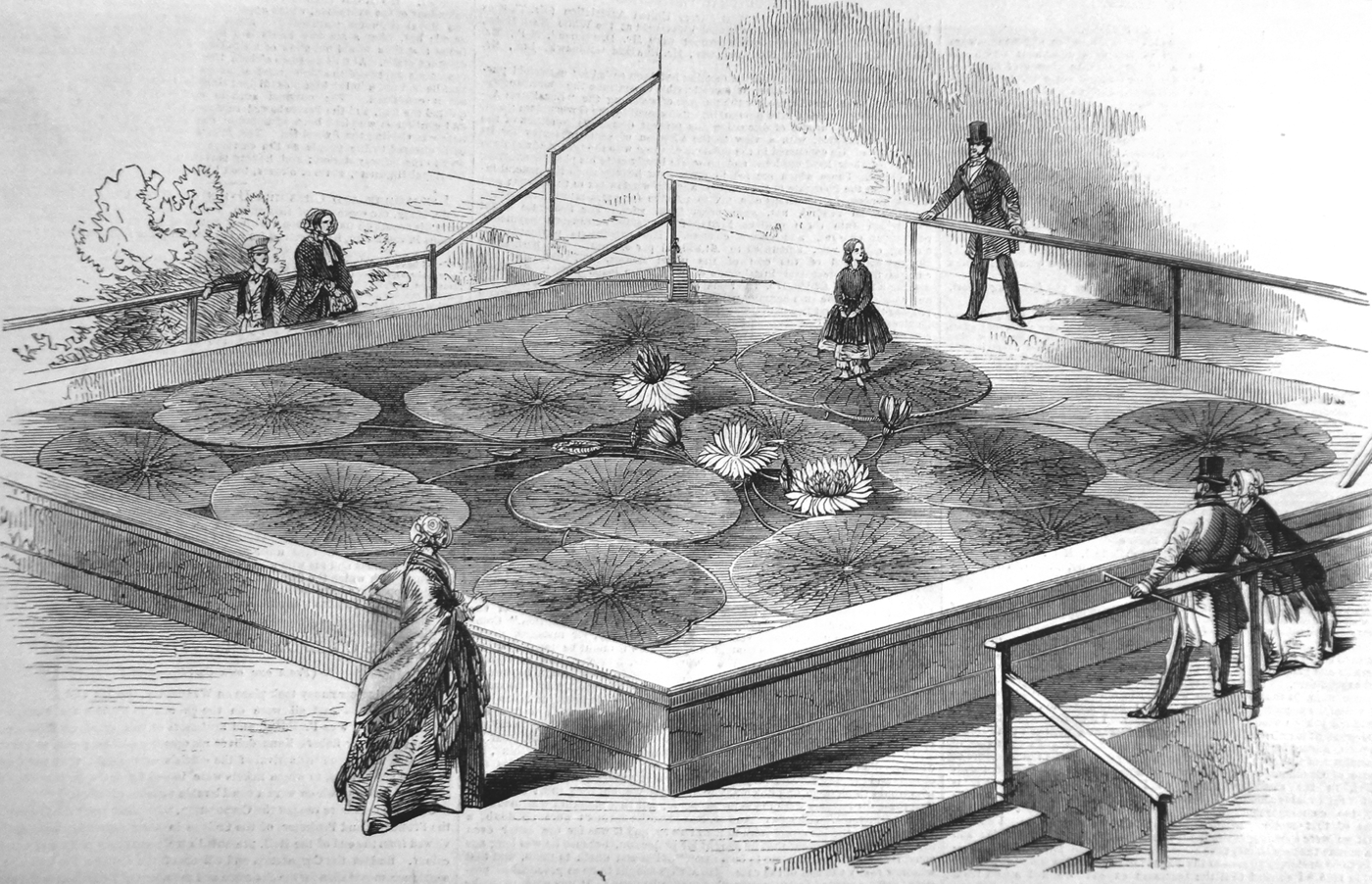
Sir Joseph Paxton's daughter, Annie, standing on a floating Victoria lily leaf at Chatsworth. The Illustrated London News, 17 November 1849, p. 328. Northwestern University Library. ©The Illustrated London News, Ltd.
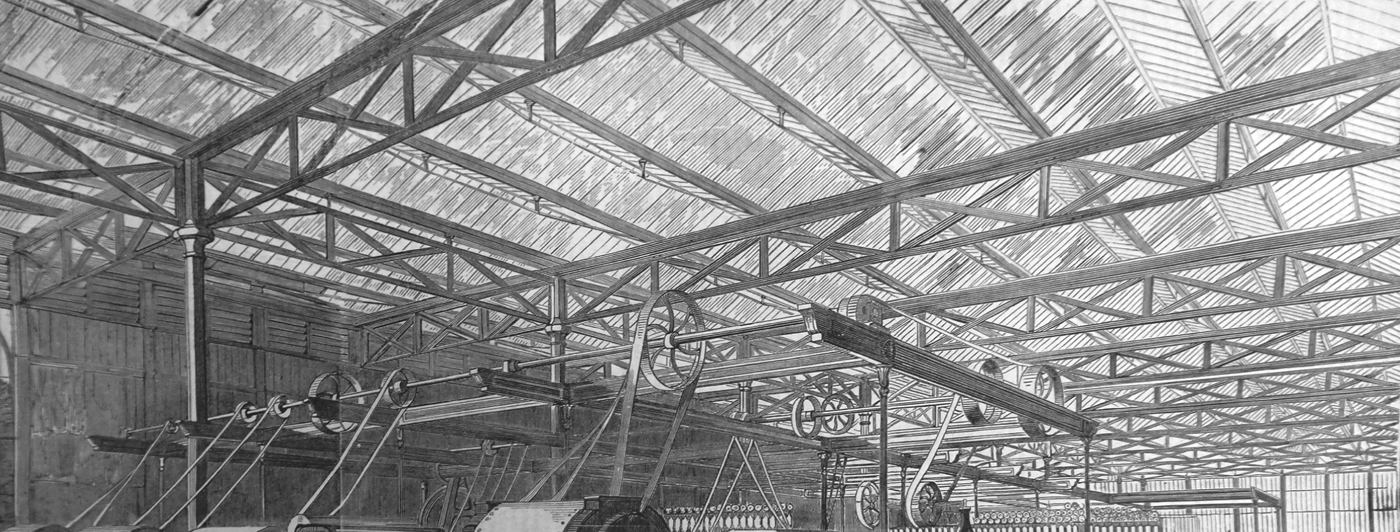
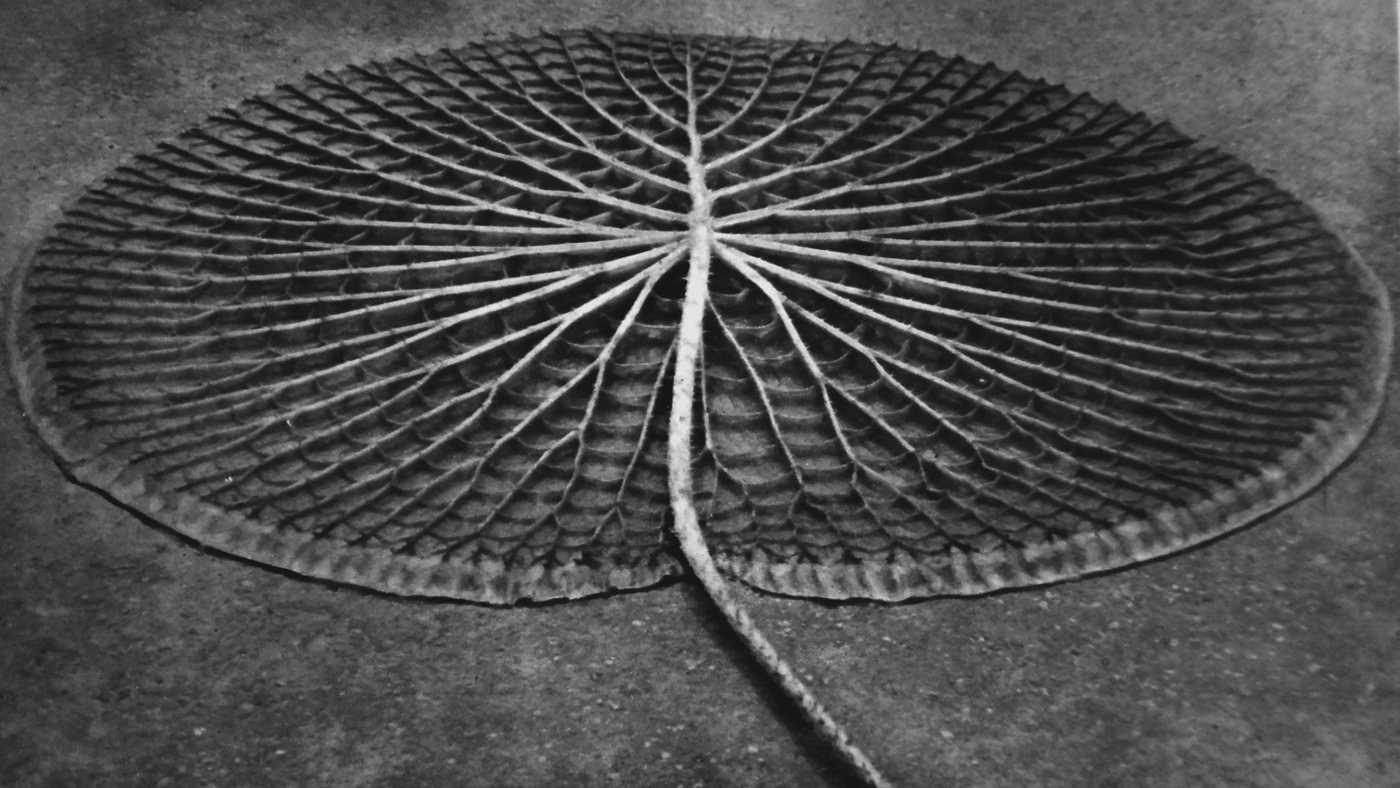
In step with Victorian domestications of goliaths (a tactic also taken with the Leviathan telescope of Parsonstown), Joseph Paxton set his daughter Annie upon one of the lily's pads at Chatsworth, giving rise to one of its most famous caricatures in the Illustrated London News (Figure 6).Footnote 111 By the end of the decade, the monarchy (represented principally by Prince Albert) purposefully put science on display in the ‘Exhibition of the Works of Industry of All Nations’, which Queen Victoria opened on May Day 1851, at the Crystal Palace in Hyde Park. Of Paxton's ingenuity, the ceiling of this architectural wonder was constructed on principles inspired by the Victoria lily's natural design (Figures 7 and 8).Footnote 112 When considered in the context of Britain's imperial expansion, this quick infusion of wonders and sensations had the effect of elevating science under Victoria as a form of big science (and Humboldtian in character).Footnote 113 The mammoth size of Schomburgk's ‘vegetable wonder’ – depicted in elephant folios and eventually showcased under the Crystal Palace (when relocated to Sydenham) – set a precedent for making size, increasingly, matter.
Detail of a lithograph of the Machinery Department of the Crystal Palace, Illustrated London News, 23 August 1851, p. 248. Northwestern University Library. ©The Illustrated London News, Ltd.
Underside of a Victoria lily leaf 6′ 2″ in diameter. From a photograph taken at Kew in July 1949, reproduced in the Illustrated London News, 25 November 1950, p. 872. Northwestern University Library. ©The Illustrated London News, Ltd.
The repositioning of objects and sites of natural study as emblems of Victoria's empire might be extended to both the Amazon lily and its new, domesticated habitats in Britain.Footnote 114 In the backdrop to the efforts of the gardening teams led by Joseph Paxton at Chatsworth, John Ivison at Syon and William Hooker at Kew, whose various acclimatizing efforts successfully brought the plant to flower between 1849 and 1850, a small coalition of naturalists and gentlemanly patrons mobilized to secure Kew as a public site for advancing botany. The progressive transfer of royal properties to the nation, expanding Kew from a pithy eighteen acres in 1841, when Hooker was appointed director, to 650 acres by 1845, launched Victoria's reign as one distinguished by its generous promotion of science.Footnote 115 For this, Hooker justified ‘the name of Victoria … to be handed down to posterity … seeing that Her Majesty has been graciously pleased to make these Gardens available to the public enjoyment’.Footnote 116
This instance of royal botanical appellation may very well serve as a thermostat of science's infusion in Victorian culture: from colonial encounter, to royal notice, to acclimatization, to public amusement, to artistic inspiration, and, indeed, to scientific controversy over nomenclature. The Victoria lily spawned not only new plants and blooms, but morphological and physiological studies, architectural and wax-flower designs, emblematic imagery, and daredevil feats. Its veins entered into the very skeleton of the Crystal Palace, itself a symbol of the heights reached within British science and industry under Victoria's reign.Footnote 117 As with Cowper's story of the lily and the rose, with which this article opened, the adversaries in this case aspired to sovereignty, marked by royal distinction. Their appeals to the monarchy, in the name of science, constitute a critical dimension in the making of authoritative knowledge in Victorian science.