Introduction
Chronic rhinosinusitis is a heterogeneous disorder characterised by inflammation of the nose and paranasal sinuses. There are two main subtypes: chronic rhinosinusitis with nasal polyps and chronic rhinosinusitis without nasal polyps.Reference Fokkens, Lund, Mullol, Bachert, Alobid and Baroody1
The definition and subclassification of chronic rhinosinusitis have evolved in recent decades as our understanding of its pathophysiological mechanisms has improved. Nevertheless, the role of allergy in chronic rhinosinusitis remains unclear; it is particularly controversial in chronic rhinosinusitis with nasal polyps.Reference Wilson, McMains and Orlandi2–Reference Pant, Ferguson and Macardle5 Allergy is more prevalent in chronic rhinosinusitis patients than in control participants, and is associated with more severe manifestations and worse outcomes.Reference Emanuel and Shah6, Reference Houser and Keen7 The reported prevalence of allergy in chronic rhinosinusitis with nasal polyps patients varies between 10 per cent and 64 per centReference Blumstein and Tuft8, Reference Drake-Lee9; however, some studies have failed to demonstrate an association.Reference Bunnag, Pacharee, Vipulakom and Siriyananda10–Reference Liu, Shun and Hsu12
The terms ‘allergy’ and ‘atopy’ are used inconsistently in the literature. Atopy refers to a state in which a person is sensitised to an allergen and produces allergen-specific immunoglobulin E (IgE) antibodies detectable by in vitro laboratory tests or skin prick tests,Reference Wilson, McMains and Orlandi2, Reference Pant, Ferguson and Macardle5 but remains asymptomatic. Thus, many published reports on the relationship between chronic rhinosinusitis and allergy are actually assessing atopy. Common in vitro tests for atopy include measuring serum levels of allergen-specific IgE antibodies, total IgE and eosinophil cationic protein (ECP).Reference Loutsios, Farahi, Porter, Lok, Peters and Condliffe13 Serum total IgE levels may reflect the atopic status of the patient and correlate with skin prick test results.Reference Halonen, Barbee, Lebowitz and Burrows14, Reference Tschopp, Sistek, Schindler, Leuenberger, Perruchoud and Wüthrich15 Serum ECP, a biomarker of eosinophilic inflammation, is also increased in atopic individuals and may even be associated with asthma severity.Reference Joseph-Bowen, de Klerk, Holt and Sly16–Reference Badar, Saeed, Hussain and Aslam18 The Phadiatop test is an in vitro test for serum IgE antibodies that specifically recognises a mixture of relevant inhaled allergens and provides qualitative (i.e. positive or negative) results.Reference Duc, Peitrequin and Pécoud19–Reference Wood, Schuberth and Sampson21 In clinical practice, positive multi-allergen Phadiatop test findings indicate that specific IgE tests or skin prick tests to individual allergens are needed.
Based on the limited data currently available, atopy cannot be considered a risk factor for chronic rhinosinusitis. Although there is controversy over disease causality, clinicians should be more concerned about whether an atopic condition can aggravate disease severity and accelerate its recurrence. This study explored the relationship of atopy with clinical severity and disease recurrence in chronic rhinosinusitis with nasal polyps patients. To preclude bias, patients with potentially confounding conditions such as asthma and fungal disease were excluded.
Materials and methods
Patients
A total of 316 Chinese patients treated in the Department of Otorhinolaryngology – Head and Neck Surgery, First Affiliated Hospital, College of Medicine, Zhejiang University, Hangzhou, China, between January 2010 and June 2014 were prospectively enrolled. All patients had been diagnosed with chronic rhinosinusitis with nasal polyps according to the definition of the European Position Paper on Rhinosinusitis and Nasal Polyps 2012,Reference Fokkens, Lund, Mullol, Bachert, Alobid and Baroody1 and had undergone endoscopy and computed tomography (CT). After exclusion of 106 patients (5 aged under 14 years, 18 with asthma, 76 with fungal disease and 7 who had received immunotherapy or antihistamine therapy in the preceding 6 months), a total of 210 patients were enrolled in the study. Of these, 188 had primary chronic rhinosinusitis with nasal polyps and 22 had recurrent disease; the latter had previously undergone functional endoscopic sinus surgery.
The study was approved by the institutional review board. Written informed consent was obtained from each patient before inclusion.
Patient evaluation
Patient demographic data were documented. Total symptom severity was estimated by assigning a visual analogue scale (VAS) score on a 10-cm line representing a measurable continuum of severity.Reference Fokkens, Lund, Mullol, Bachert, Alobid and Baroody1 The Lund–Kennedy endoscopic score is a semi-quantitative assessment of polyps (0, none; 1, middle meatus only; 2, beyond the middle meatus), oedema (0, absent; 1, mild; 2, severe), discharge (0, none; 1, clear and thin; 2, thick and purulent), post-operative scarring (0, absent; 1, mild; 2, severe) and post-operative crusting (0, absent; 1, mild; 2, severe). Bilateral scores were combined to give a maximum score of 20.Reference Lund and Kennedy22 The Lund–Mackay CT score is a semi-quantitative assessment of the degree of opacification (0, normal; 1, partial; 2, total) of each sinus (maxillary, anterior ethmoid, posterior ethmoid, sphenoid and frontal) and the degree of occlusion (0, not occluded; 2, occluded) of the ostiomeatal complex.Reference Lund and Mackay23 Bilateral scores were combined to give a maximum score of 24.
Venous blood was collected from each patient before treatment (topical or oral steroids, nasal saline irrigation, or doxycycline). In vitro atopy laboratory tests (total IgE and ECP serum levels and the Phadiatop test) were performed on blood samples using a UniCAP100 system (Pharmacia, Stockholm, Sweden). Skin prick testing was not performed because most patients refused consent.
Statistical analysis
SPSS software version 18.0 (IBM, Armonk, New York, USA) was used to analyse the clinical data. The chi-square test, Student's t-test, Mann–Whitney U test and Spearman's rank correlation analysis were performed as appropriate. A p value of less than 0.05 was considered statistically significant.
Ethical standards
All procedures contributing to this work complied with the ethical standards of the institutional guideline on human experimentation of the First Affiliated Hospital, College of Medicine, Zhejiang University, Hangzhou, China, and with the Helsinki Declaration of 1975, as revised in 2008.
Results
The 210 patients were assigned to two groups: the primary group, comprising 188 patients with a first diagnosis of chronic rhinosinusitis with nasal polyps; and the recurrent group, comprising 22 patients with recurrent disease who had undergone functional endoscopic sinus surgery. There were no significant inter-group differences regarding age, sex, VAS score or Lund–Mackay CT score. Similarly, the primary and recurrent groups did not differ significantly in total serum IgE and ECP or Phadiatop test findings when either the exact values or positive percentages (i.e. above the normal reference range) were analysed (Table I).
Comparison of primary and recurrent CRSWNP patients*

* Primary group, n = 188; recurrent group, n = 22. †Median (interquartile range). +, value above normal reference range; −, value within normal reference range. CRSWNP = chronic rhinosinusitis with nasal polyps; VAS = visual analogue scale; LMS = Lund–Mackay computed tomography scores; IgE = immunoglobulin E; ECP = eosinophil cationic protein
A total of 99 patients (47 per cent) had at least one positive result out of the three in vitro atopy tests and were defined as the atopic group. The remaining 111 patients were defined as the non-atopic group. Although the median age of the atopic group was lower than that of the non-atopic group (p = 0.017), there was no significant differences in sex, VAS score, Lund–Kennedy endoscopy score, Lund–Mackay CT score or recurrence rate between groups (Table II). When the atopy tests were analysed separately, the median ages of the total IgE-positive (n = 55) and Phadiatop test-positive (n = 32) groups were lower than those of the corresponding groups with negative test results (p = 0.006 for total IgE levels; p = 0.01 for Phadiatop test findings). However, there was no difference in sex, VAS score, Lund–Kennedy endoscopy score, Lund–Mackay CT score or recurrence rate between these groups.
Comparison between atopic and non-atopic patients*

* Atopic patients, n = 99; non-atopic patients, n = 111. †Median (interquartile range). VAS = visual analogue scale; LKS = Lund–Kennedy endoscopy score; LMS = Lund–Mackay computed tomography scores. ‡p < 0.05 compared with non-atopic group (Mann–Whitney U test).
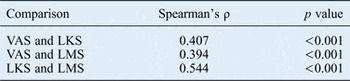
Spearman's rank correlation analysis showed no correlation between atopy test results (total IgE or ECP levels, or Phadiatop test findings) and severity score (VAS, Lund–Kennedy endoscopy or Lund–Mackay CT). Additionally, age did not correlate with atopy test result or severity score. The VAS, Lund–Kennedy endoscopy and Lund–Mackay CT scores each correlated with the results of the other two tests (Table III). Phadiatop test findings correlated with both the total IgE (Spearman's ρ = 0.495; p < 0.001) and ECP (Spearman's ρ = 0.158; p = 0.022) levels, but there was no correlation between total IgE and ECP levels.
Correlations between VAS score, LKS and LMS

VAS = visual analogue scale; LKS = Lund–Kennedy endoscopic score; LMS = Lund–Mackay computed tomography score.
Discussion
This study found that patients with primary and recurrent chronic rhinosinusitis with nasal polyps had the same atopy prevalence and clinical disease severity (as measured by the VAS and Lund–Mackay CT scores). Additionally, the same disease severity and recurrence rates were experienced by atopic and non-atopic patients. Erbek and colleagues evaluated 83 patients with chronic rhinosinusitis with nasal polyps and found no associations among positive skin prick tests, polyp size, symptom severity (CT scores) and recurrence rate.Reference Erbek, Erbek, Topal and Cakmak24 In a prospective study of 63 patients with chronic rhinosinusitis with nasal polyps, the post-operative outcome did not differ significantly between patients with and without positive atopy tests.Reference Bonfils and Malinvaud25 Moreover, a recent study of 193 patients with chronic rhinosinusitis with or without nasal polyps found no association between atopy status and symptom scores.Reference Robinson, Douglas and Wormald26 In the latter study, CT scores were higher for atopic patients than for non-atopic patients, but the difference was not statistically significant. The authors also observed no difference in revision surgery rates between atopic and non-atopic patients, as found in the present study. Thus, there is no evidence that atopy is associated with disease severity or recurrence in patients with chronic rhinosinusitis with nasal polyps.
A previous study reported that pre-operative total serum IgE levels in chronic rhinosinusitis patients correlated with disease severity (based on sinus CT scans), but that total IgE levels were unchanged at one year post-operatively.Reference Lal, Baroody, Weitzel, deTineo and Naclerio27 Immunoglobulin E antibodies specific for inhaled antigens are also reported to correlate with disease extent on CT scans.Reference Newman, Platts-Mills, Phillips, Hazen and Gross28 The relationship between levels of ECP (an indicator of eosinophil activation) and chronic rhinosinusitis with nasal polyps has been examined: although data for serum ECP levels are lacking, ECP levels in nasal secretions of chronic rhinosinusitis with nasal polyps patients correlated with the presence of asthma, aspirin intolerance and disease severity (i.e. CT) scores.Reference Sun, Joo, Auo and Kang29, Reference Scavuzzo, Fattori, Ruffoli, Rocchi, Carpi and Berni30 The present study excluded patients with asthma and fungal disease; therefore, the evidence for a lack of correlation between atopy test results (total IgE or ECP levels or Phadiatop testing) and severity scores might be more convincing for this defined subgroup of chronic rhinosinusitis with nasal polyps patients. Correlation analysis among all three atopy tests may further delineate the disease mechanism of chronic rhinosinusitis.
Results of this study suggest that routine atopy testing may not be warranted for evaluating the severity and prognosis of chronic rhinosinusitis with nasal polyps. However, skin prick testing might be more relevant and should be examined in future studies.
A limitation of this study was that only Chinese patients were included. The aetiology and pathophysiology of chronic rhinosinusitis with nasal polyps varies between races. In Asian patients, the disease is associated with cytokine skewing in T helper 1 and T helper 17 cells and a lower eosinophilia rate compared with Caucasian patients,Reference Zhang, Van Zele, Perez-Novo, Van Bruaene, Holtappels and DeRuyck31–Reference Shen, Tang, Yang, Ke, Kou and Pan35 suggesting that our conclusions may not be globally applicable. In addition, potentially complicating conditions (e.g. cystic fibrosis and mucociliary problems) could have been missed if patients did not exhibit typical disease features, and this may have influenced the accuracy of results. Findings on the relationship between atopy and the development of chronic rhinosinusitis with nasal polyps differ between this and other studies. One potential reason is that the causality of chronic rhinosinusitis with nasal polyps is controversial, and studies that did not exclude patients with complicating allergic disease (such as asthmaReference Wilson, McMains and Orlandi2) may have drawn erroneous conclusions about the aetiological relationship. Thus, the question remains: does atopy play a major role in the pathophysiology of chronic rhinosinusitis with nasal polyps or is it simply a disease trigger? Delineating the precise mechanistic relationship will require further study.
This study found that atopic patients with chronic rhinosinusitis with nasal polyps were younger than non-atopic patients, but that age did not correlate with the findings of individual atopy tests or with severity scores. In contrast, a recent review found a lower prevalence of allergy with advancing age in both healthy participants and allergic respiratory disease patients.Reference Scichilone, Callari, Augugliaro, Marchese, Togias and Bellia36 Future basic and clinical research with the aim of resolving these contradictory data may increase our understanding of allergic diseases.
• Chronic rhinosinusitis is a heterogeneous disorder characterised by inflammation of the nose and the paranasal sinuses
• The role of atopy in chronic rhinosinusitis is unclear; it is particularly controversial in chronic rhinosinusitis with nasal polyps
• Atopy was not associated with disease severity or recurrence in chronic rhinosinusitis with nasal polyps patients
• Routine atopy testing may not be warranted for evaluating disease severity and prognosis
Evaluating the clinical severity of chronic rhinosinusitis is important for both treatment and research. This study found strong correlations among the VAS, Lund–Kennedy endoscopy and Lund–Mackay CT scores. Combining these three scoring systems may provide a comprehensive assessment of endoscopy and imaging findings and patient symptoms that is reliable, objective and accurate.
Conclusion
No association was found between atopy status and disease severity or recurrence in patients with chronic rhinosinusitis with nasal polyps, although atopic patients were younger than non-atopic patients.
Acknowledgements
We thank S Wang, S Lin, L Ling, Y Xu, H Chen, L Chai and Q Wang of the Department of Otorhinolaryngology – Head and Neck Surgery, First Affiliated Hospital, College of Medicine, Zhejiang University, for their expertise and support in clinical research.