Introduction
The basic income proposal involves the granting of regular, non-means-tested cash transfers to all permanent residents of a political territory on an individual basis, without means-test or work requirement. Whilst debate about this scheme as an alternative to means-tested support has a long history, a rise in economic insecurity in post-crisis Europe has refocused attention from the abstract to the empirical, and from critique of the welfare state to scoping basic income reform in different contexts. A number of factors have pushed basic income onto the political agenda since 2016, and consequently have drawn attention to opportunistic themes. However, media attention belies the real and arguably growing constraints.
Specifically, at stake in present-day income security reform – the direction it takes – is the form of response to crises of incorporation following three decades of market reforms and public austerity. Hence, the case of basic income reform sheds light on factors that intercede in the contemporary tension between economic liberalisation and democratisation, understood as forms of institutional change with, respectively, a propensity to propel the social exclusion and inclusion of citizens.
Accordingly, I propose an interactive framework that takes account of, on the one hand, the intersection between accelerating changes in the global economy and local society, and of, on the other hand, institutional constraints and governance capacity within individual countries. Whilst the former propel a surge in social need, political protest, and populist tides which impact on the emergence of basic income politically, real change is delimited by global and domestic institutional factors.
Whereas institutional scholars have highlighted ‘exhaustion’ as an institutional change mechanism occurring when an institution is depleted (Steeck and Thelen, Reference Streeck and Thelen2005: 30), and therefore its capacity to function is undercut, I argue it is timely to underscore how the prevalence of this phenomenon is underwritten by decline in public sector capacity as a whole. The varying extent to which this is true brings into view long-run factors linked with consolidating states’ capabilities to govern under globalisation.
On this basis, this article argues that the institutional change literature is useful for understanding mechanisms of change, but less so for examining conditions for different directions of travel. A commitment to neutrality in comparison of national systems makes the institutional literature literature less likely to pick up how governance capacity translates into effectiveness, and the determinants concerned. Looking comparatively at conditions for, and debate about, basic income helps rectify this flaw, by showing how the prior democratisation of the state and society intercedes. More specifically, two pertinent criteria of governance effectiveness, expressed in the realm of income security, are public capacity to secure citizens, and the existence of public and societal capabilities to spot and react to emerging gaps in social inclusion.
In all, I situate inherited public governance capacity – defined as institutional conditions for social incorporation and lower inequality – as comprising a set of underlying factors that are key in shaping the speed and direction of change. For example, attention to this deeper factor helps explain how, in some countries, smaller crises in incorporation – as exemplified in the case of income security – are given more attention, whilst paradoxically larger crises are side-stepped or diverted in other states. More specifically, it will be argued that inter-country differences can be tracked along two dimensions, considering the level and combination of traditions of developmentalism and universalism in welfare state structure. These two dimensions are central in the building of public governance capacity, and thus in shaping an underlying Equality Paradox, which pertains to the way basic income is less likely in conditions (of high inequality) where it seems most needed. This is because the political conditions that generate high inequality tend to be associated with low public governance capacity and so weaker conditions for basic income reform (see the article by Haagh, Reference Haagh2018, and Haagh, Reference Haagh2019b).
Illustrating this, high equality and governance capacity countries are more likely to experiment with steps towards basic income reform, and to sustain experiments where local government is stronger. However, said countries also face more immediate political tensions over basic income reform in the light of recent global trends, which threaten the cooperative basis and substance of welfare institutions already in place. On the other hand, higher inequality countries face greater institutional capacity barriers, which casts basic income as an unattractive or unattainable step.
To explore these topics, this introduction is organised into five sections, covering briefly an overview of the changing politics and narrative about basic income in relation to the welfare state, followed by elaboration of an analytical frame to consider the role of, respectively, public governance capacity, processes of change, and political support and trade-offs connected with basic income debates and scenarios under globalisation.
A window of opportunity. . . or a policy bubble?
As the basic income proposal has been flagging in the political winds of Europe since 2016, aspiration has been tested against harsh reality. Among basic income advocates, a dominant narrative is that of a ‘programmatic success’ story (McConnell, Reference McConnell2010): the time for basic income is now (De Wispelaere, Reference De Wispelaere2016). In actuality, popular understanding, let alone acceptance, of basic income is still far from established, especially among mainstream parties. The prevailing public austerity framework situates the basic income debate within polemics about services versus cash (Coyle, Reference Coyle2017). Within public bureaucracies, and arguably among advocates too, support for decent income security converges with promotion of ‘simplicity’ and rationalising public expenditure (Haagh, Reference Haagh2019a). Hence, although the case for basic income supplements a wider moral argument for restoration of civil rights (Haagh, Reference Haagh2017, Reference Haagh2019a), immediate steps towards, and finance of, basic income, come up against the constraints brought on by marketisation and new public management.
The deeper political tensions earthed up by the basic income proposal are illustrated in the case studies presented in this section. Whilst some small liberal and Green parties in Europe are established supporters, basic income also forms part of the new landscape of protest politics, and the accompanying left and right populist surge, which many see as a representation of globalisation burn-out. In Spain, heightened interest in basic income dovetailed on the stellar performance of Podemos in post-crisis conditions. Yet, the initial enthusiastic support turned out to be short-lived or ‘cheap’ (De Wispelaere, Reference De Wispelaere2016), with the leadership swiftly ditching its earlier commitment to basic income in its economic program. In the UK, the governing Tories have put all their stock in universal credit (Jordan, Reference Jordan2012; Martin, Reference Martin2016; Millar and Bennett, Reference Millar and Bennett2016), which has been inextricably linked with tight benefit conditionality. Basic income has garnered some interest within the Labour Party – notably with Shadow Chancellor John McDonnell. However, a significant sector of the Labour Party are sceptical about basic income, repudiating what they see as its potential disconnect with longed-for social democratic structures and values (Cruddas and Kibasi, Reference Cruddas and Kibasi2016). Traditionally social democratic societies in which conservative governments have licensed limited experiments in features of basic income – e.g. easing or removal of work conditionalities – are also conflicted. In the case of the Finland experiment that ran in 2017, limitations imposed from the outset on experimental design and implementation, combined with the introduction of new activation measures in the latest round of social security reform, put a dampener on the idea that Finland will be introducing a basic income scheme after the experiment has run its course (De Wispelaere et al., Reference De Wispelaere, Halmetoja and Pulkka2018).
In the case of the Netherlands, initiatives to conduct experiments in the municipalities of Utrecht, Tilburg, Wageningen and Amsterdam rapidly ran into intransigence and resistance at the level of the national government, and the resulting compromises and trade-offs again bode ill for the short-term future of basic income policy development in the Low Countries. In the Danish case, municipalities have also been conducting small pilot projects, which entail lifting conditionalities on basic income support, on a license to pursue trial-and-error pilots on a basis of local autonomy that was given a boost under Social Democrat-led government, and continued thereafter. Whilst this has given traction to support among smaller green parties (e.g. Alternativet and some groups within Enhedslisten, Haagh, Reference Haagh2019a), the major parties are still sceptical.
The political economy of basic income in the European welfare states
What do the high levels of prevarication about the idea of basic income in some countries, as set against more concerted local experimentation with lifting benefit conditionalities in others, tell us about contemporary conditions for institutional change? Two interlinked developments challenge conventional wisdom, which pits basic income reform as a radical alternative to established welfare state structures (van Parijs, Reference Van Parijs1995). On the one hand, mature welfare states have been at the forefront of policy experiments. On the other hand, global public austerity puts the foundations for public funding for distribution and development into doubt.
The implication of these developments is to shift the tectonic plates that have informed basic income debates. Differences aside, e.g. a tendency to stress alternative taxes by left libertarians, and to assume a strong contributory regime by social democrat advocates, arguably both approaches implicitly or explicitly rely on two conditions: (i) a high level of shared finance, and (ii) the presence of stable economic opportunities and services in support of valuable choices (Haagh, Reference Haagh2015). As these favourable conditions for basic income can no longer be assumed, old questions that used to divide libertarians and social democrat approaches (Haagh, Reference Haagh2011) are now supplemented with new concerns.
The spike in public visibility of basic income in the past five years runs parallel with a further deepening of public sector restructuring in the wake of the global financial crisis, typically incorporating a turn to punitive administration of income benefits across OECD states (Knotz, Reference Knotz2018). This means that broader changes in the state itself are entailed in the debate about basic income reform. Hence, whilst a real basic income experiment cannot be run – because a whole-society, long-term change is involved, and no two societies are alike in a way that effects could be isolated – there are two reasons for taking policy experiments linked with features of basic income seriously. First, looking at the current policy juncture in terms of steps or otherwise towards basic income allows us to look at societal changes induced by global pressures as the basis for a demand from within society for changes in the state. Second, relatedly, looking at political and public sector conditions for basic income offers a window into state capacity to respond.
The case of income security reform encapsulates the intersection of three forms of inclusion crisis, of employment, of public finance, and of incorporation through benefit systems designed to insure citizens and society as a whole against risks. To varying degrees, OECD states have seen the share of wages in GDP fall steadily over the last four decades. According to the IMF, the share of labour income in national income fell from around 55 per cent in 1970 to 39 per cent in 2015 (IMF, 2017). Moreover, this general trend hides growing fragmentation within the labour share of income. Despite the greater demand this creates for public support, states have raised the barriers to income benefit access, and scaled back the value of benefits, generating an incipient crisis of incorporation and a genuine policy vacuum (Haagh, Reference Haagh2019a).
The signs society is fragmenting are ubiquitous across Europe, from electoral defection from the mainstream, to growing inequality in the fiscal capacity of local government with growing responsibility for welfare services. The ultimate manifestation of governance failure and democratic crisis are sanctions policies, which push the most vulnerable sectors in the labour market outside the frame of public protection. In a recent indictment on the present income security system, only 19 per cent of respondents to a survey by the Royal Society of Arts in Britain (RSA, 2018) felt that the existing system of income security functioned well, and that no changes were needed. A number of recent studies have demonstrated a direct connection between protest votes and austerity, and economic globalisation and nationalism, as poor communities tend to be harder squeezed by labour market precarity and welfare cuts (Fetzer, Reference Fetzer2018).
In all, the basic income debate shows up not only the moral defectiveness of modern government, but the much deeper challenges linked with public governance capacity (Haagh, Reference Haagh2019b). In this context, the attractiveness of basic income – or at least many of its elements – to public administrators today lie not in ideals, but necessity. Yet, the public sector may not be positioned in a way that would make basic income feasible, generating an interesting tension between demand and supply within the state and policy establishment.
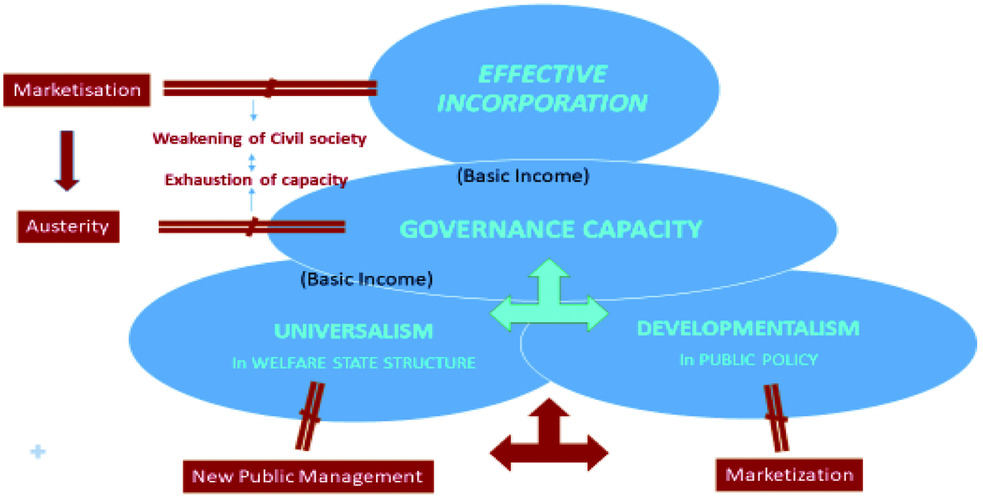
As Figure 1 illustrates schematically, the successive processes of marketisation and public austerity act to undermine the sources of effective incorporation and governance capacity. At the level of direct effect, marketisation generates employment and income insecurity, whereas austerity impacts state capacity to supplement income. However, there are also two more indirect effects, as illustrated at the bottom of the figure. Longer-term exhaustion of state capacity is linked with public sector restructuring, which ultimately undermines universalism by fragmenting services and generating pressures to streamline income security provision. On the other hand, weakening of employment regulation not only generates more insecure employment but also corrodes regulatory capacity.
Governance capacity and incorporation in society

In this context, we can expect a disjuncture between the moral and feasible case for basic income reform. If globalisation has generated a new need, it has also weakened the state's capacity to respond to it. In turn, this points to a self-fulfilling aspect of exhaustion of state capacity: undermining of state capacity tends to coincide with expansion of social needs, which then over time deepens the policy vacuum in income security and the corrosion of mechanisms to avert it. At the same time, the extent to (and way in) which this is true varies greatly, as the articles in this themed section indicate. Specifically, I argue identification, recognition, and response to the challenge presented by the growing vacuum in social security are strongly related with capacity to meet it. Hence, the self-fulfilling process that can be linked with exhaustion of state capacity is not inexorable, although it becomes proportionately harder to address the further along liberalisation proceeds. The way thus the case of income security reform draws out the intersection between contemporary crisis and governance capacity begs and propels a change in the study of institutional change, as I examine next.
Public governance capacity in varieties of capitalism and welfare state
The study of basic income can escavate insights from the comparative literature on incremental change, but also can help drive this literature forward by drawing attention to the key role of public governance capacity – and factors that shape it. The cases in this themed section illustrate in various ways how prior adaptations of income security systems – such as the emergence of tax credits and employment subsidies – are at work in shaping small steps towards basic income reform (Haagh, Reference Haagh2019a). Using the terms of the incremental change literature, basic income experimentation has emerged through a form of layering, a process through which ‘specific institutions develop through an accumulation of innovations inspired by competing motives, which engenders a tense layering of new arrangements on top of pre-existing structures’ (Schickler, Reference Schickler2001: 15). However, whilst describing change this way helps depict its continuous nature, the description remains exactly that – more of a snapshot than an explanation of variation and the content of change. Hence, I argue a framework that looks more explicitly at public governance systems is needed.
Two intersecting schools within comparative political economy focus on institutional comparison around types of capitalism and welfare state, on the one hand, and mechanisms of change, on the other hand. In the comparative literature on capitalism and labour regimes, also referred to as the Varieties of Capitalism (VOC), the national inclusiveness of skills systems explains economic performance and investment (Hall and Soskice, Reference Hall and Soskice2001), and drives a shared commitment to income security and welfare (Pagano, Reference Pagano1991; Thelen, Reference Thelen2004; Haagh, Reference Haagh2012, Reference Haagh2015). The welfare state typology literature pioneered by Gøsta Esping-Andersen (Reference Esping-Andersen1990, Reference Esping-Andersen1999) sets out regime types that broadly track differences delineated in the comparative capitalism literature. Both the welfare state and comparative capitalism perspectives arrive at the same broad regime agglomerations, which suggests that social insurance institutions and skills regimes reinforce each other over time. On the other hand, both perspectives have been accused of not being sufficiently attentive to change and the mechanisms through which change happens in an ongoing way (Bronk, Reference Bronk2009). Long-run change can be explained in a dynamic way by contributing a ‘trajectory’ perspective within the regime typology literature. Yet, the trajectory literature is based on a loose comparison – that is, an understanding that different cases require different explanatory variables (Steinmo, Reference Steinmo2010).
In this context, using a multi-level perspective on change can help integrate ‘structure’ and ‘change’ approaches in the institutional literature in a more systematic manner. Fledging out the model in Figure 1, public governance systems can be broadly defined as the political economy that shapes the rights and obligations of citizens through institutions governing public finance, education, employment, economic security structures and welfare services. Assuming these interact strongly, taking a part of the system gives a window into the logic that characterises the rule premises, operation and sources of change in the system as a whole. A model that in line with this kind of variation sets the treatment of policy problems in the context of varying public governance capacity, and factors which shape it, confronts three flaws in the comparative institutional literature.
First, it helps address a contradiction at the heart of the comparative literatures on capitalism and institutional change which hangs on their commitment to neutrality: on the one hand, said literatures clearly demonstrate that performance in relation to certain outcomes (skills investment, enjoyment of occupational rights and security) are a product of coordinated development (Hall and Soskice, Reference Hall and Soskice2001; Thelen, Reference Thelen2004). Yet, neither school can own or develop this because both approaches are also wedded to a comparative neutrality framework.Footnote 1 Specifically, the incremental change literature can be said to lack explanations for when certain patterns of change occur, and what grounds differences among cases (Haagh, Reference Haagh2019b).
A way to own VOC's insights concerning variance in coordinated skills development is to further explore the connection this has with public governance capacity, e.g. skills coordinating institutions is in this frame a form of development of hybrid property which generates governance capacity, as incorporating mechanisms strengthen civil society as a basis for the ongoing contestation and development of citizens’ rights (Haagh, Reference Haagh2019a). In turn this approach addresses a second problem in the institutional change literature, which is again a form of ex ante commitment: in this case to say that system formation and change are governed through agents or actors, their coalitions, institutions and conflicts.
For example, in Hacker et al.’s (Reference Hacker, Pierson, Thelen, Mahoney and Thelen2015) description of the mechanisms of ‘drift’ and ‘conversion’, actors’ intentions appear paramount in affecting change. Drift takes place when ‘formal rules are deliberately held constant in the face of major environmental shifts, causing their outcomes to change’, whereas conversion occurs ‘when political actors reinterpret ambiguous rules or use the discretion inherent in them to redirect them toward new purposes’ (Hacker et al., Reference Hacker, Pierson, Thelen, Mahoney and Thelen2015, 180).
In another example, Thelen's argument (Reference Thelen2014: 65–6) – that liberalisation in Denmark since the 1990s was more secure due to a focus on education and social protection – hones in on the key role of social accords. Using the VOC framework, Thelen (Reference Thelen2014: 24) makes the case that more encompassing labour associations in Denmark against Sweden (for instance, Thelen, Reference Thelen2014: 24) generates a wider set of public policy tools at the state's disposal. However, in the 1990s, labour in Denmark was weakening, whereas sustained investment in skills in this period can be linked with a deep embedding of high education investment across public institutions forged over time (Haagh, Reference Haagh2015, Reference Haagh2019a). This tradition was relatively more insulated from the business cycle in a way and degree that labour's terms and conditions were not. It is therefore arguably long-run capacity, rather than directly actors’ accords, which explains continued high education and training spend in Denmark.
This example illuminates a broader point, which is how a material change in the form of politics and institutional change has occurred as a consequence of liberalisation. In a previous work, Streeck and Thelen (Reference Streeck and Thelen2005: 33) make the first point in an illuminating way, in observing that the logic of politics within institutional change has altered over time, from key events playing a significant role, to incremental and embedded change mechanisms now being more important.
As they suggest, ‘liberalization within capitalism may face far fewer collective action problems than the organization of capitalism, and much more than the latter, it may be achievable by default: by letting things happen that are happening anyway.’ And they continue, ‘all that may be needed for liberalization to progress would be to give people a market alternative to an existing system based on collective solidarity, and then give free reign to the private insurance companies and their sales forces.’
Streeck and Thelen make a crucial suggestion here, which is that liberalisation processes are not necessarily controlled by anyone. They ‘happen’. Their outcomes are thus often unforeseen. However, Streeck and Thelen merely hint at the idea that the mechanisms of change they highlight as ways to understand continuous change are in fact linked with liberalisation and marketisation as, respectively, a new process of change in – and mode of – governance.
Hence, there are three problems with the new focus on mechanical change within liberalisation, especially when focusing on discrete sectors or industrial actors.
First, the above quote suggests old public institutions are replaced with new private ones – e.g. liberalisation in this sense ‘works’. However, there is a quite a lot of evidence that loss of income security coverage is not being replaced by new forms (Haagh, Reference Haagh2019a). It is not necessarily the case that individuals can turn to private insurance companies for income support. Consumer debt has continued to rise (IMF, 2017), whilst real wages have fallen, at the lower end, and across the distribution (Blanchflower and Machin, Reference Blanchflower and Machin2014). Public reform does not necessarily fill the gap either, or not in the same way or degree (International Federation of Red Cross and Red Crescent Societies, 2013; Stovicek and Turrini, Reference Stovicek and Turrini2012).
In this context, second, what needs to be clarified is that liberalisation is not just a process that affects particular institutions in a dynamic way. It also affects governance itself. Inability to respond to rising need is a form of exhaustion of governance capacity. Streeck and Thelen (Reference Streeck and Thelen2005: 31) describe exhaustion of an institution as follows: ‘the normal working of an institution undermines its external preconditions’. I argue that, at the level of governance, exhaustion entails that the normal working of the system undermines its internal preconditions. The resulting mode of governing is thus self-destructive. This is similar to what Streeck and Thelen (Reference Streeck and Thelen2005: 31) refer to as self-consumption to describe institutions that decay; except at stake in systemic corrosion, as I describe it here, is not just an individual institution, but civilisation itself – the frame that makes individual institutions possible.
Hence, third, it is important to underscore how the degree of liberalisation – and the way it is contained – intercedes in change dynamics. A way to identify when change under general conditions of liberalisation extends the process, or contests it, is needed, including that can uncover the role of underlying factors in the difference. Streeck and Thelen (Reference Streeck and Thelen2005: 19–31) identify five modes of gradual change – displacement, layering, drift, conversion, and exhaustion of institutions and their function. They also tentatively link all of them with liberalisation processes. However, the five-factorial frame is not very good at identifying forms, or sources, of resistance to liberalisation, nor where different levels and effects of liberalisation sit in a sequence.
If we take liberalisation as a form of breakdown in public capacity and governance, the sequence runs from drift (‘deliberate neglect’) through lax regulation (marketisation), followed by displacement (‘institutional incoherence’), and (through austerity) finally exhaustion (over time overall depletion of capacity). However, crucially, the extent to which this is happening at the level of individual institutions is, I argue, affected by the extent to which it is happening at the level of governance. This in turn creates obvious sources of variance across cases.
For example, comparative study of privatisation of building regulation has shown that previous deregulation interacts with declining regulatory capacity to further accelerate liberalisation (in Canada in the 1980s and Australia in the 1990s) (Van der Heijden, Reference van der Heijden2015). In Holland, liberalisation is restrained by a long-standing tussle between local and central government over regulatory control. In the Dutch case, however, a national ‘simplification’ programme also ensues in lowering public capacity at both levels (van der Heijden, Reference van der Heijden2016), albeit more slowly.
The case of recent income security reform allows us to further explore how governance capacity shapes responses to crises, and how the responses in turn act as platforms for new directions in change. A relevant hypothesis is greater capacity, combined with the level of recent liberalisation, conditions actors to consider adaptive forms of layering or conversion, defined as reinvention of governance capacity. Conversely, under lower capacity, or more extensive liberalisation, the same mechanisms are more likely to tend towards further displacement and/or drift. On the other hand, the trade-offs linked with a too narrow focus on simplicity – a particular risk in income security debates about basic income – also assert themselves, as we can see in the cases within this section. In sum, I contend the ‘case’ of basic income begs attention to how inherited institutional stock intercedes in the contemporary tension between economic liberalisation and democratisation, defined in terms of citizen inclusion.
We can see the bases for these dynamics in the cases discussed in this themed section. Some countries, e.g. Britain, have higher but falling capacity with extensive liberalisation, whilst others, e.g. Spain, have low capacity, such as defined in higher economic informality, and some liberalisation. Social democratic cases also differ, e.g. with differential forms of limited liberalisation under high capacity, in Finland and Denmark, and intermediate liberalisation and capacity, in Holland. Liberalisation sets the direction of change, which means all cases in this section have suffered governance corrosion – defined as reduction in one or more dimensions of capacity to incorporate. However, the pressure this exerts on policy choices and actors is shaped by inherited levels of capacity, combined with the scale of liberalisation itself.
In sum, focusing on change mechanisms like layering and conversion without a wider reference to governance capacity as a whole does not tell us that much about the form or extent of change. Even if, as Streeck and Thelen (Reference Streeck and Thelen2005) suggest, liberalisation is inherently change by default down the line, to what extent (and when) can we talk about managed change, or unravelling of capacity? It is conceivable, for example, that even if government is very active, it may still unravel capacity; and, conversely, government that is relatively passive may retain capacity. What matters is not activity per se, but how it relates to capacity. As already noted, the focus on mechanical change suggests liberalisation is largely a passive process of adaptation and re-embedding, whereas, instead, I argue the process may not be passive, and may not entail re-embedding, because the tendency in liberalisation is to curtail capacity. For example, it is conceivable that previous active commitments to radical liberalisation leads to ignorance of re-embedding failing, e.g. as in the case of the persistence of Universal Credit in the UK (Martinelli and Pearce, Reference Martinelli and Pearce2018), despite a number of serious shortcomings identified by national and international agencies (ibid. Haagh, Reference Haagh2019a). So, for example, the UK in enacting Universal Credit – a major undertaking – has been proactive in effecting a form of ‘conversion’ and ‘layering’ of existing systems. The trouble is, so have countries like Denmark and Holland, albeit through different sequences, both compared with Britain and with each other – e.g. in the Netherlands experiments vis-a-vis the unemployed have been structured to test behaviour in order to support motivation, whereas in Denmark they have been more orientated to test trust, and in Finland to promote work incentives through both voluntarism and the market. In these cases – especially Holland and Denmark – reincorporation has been a more explicit objective. In all these cases, there is some conversion (redeployment of old structures) as well as layering (defeat of the old) at stake. At the same time, arguably, change is slower and more measured in these cases of greater capacity. This suggests then, finally, the importance of focusing on the interplay between the speed of changes, inherited capacity, and the direction of change. Taking incorporation as a standard for both inherited capacity and the direction of change, what we find in the case of income security is that countries with greater capacity are more likely to preserve and slowly adapt existing structures.
Conversely, ‘drift’ or intentional neglect as an attitude of policy makers or bureaucrats is more likely when capacity is low, and incentives to change this are weak. So, for instance, states which intentionally or otherwise have reduced capacity for incorporation through – in our case – income security, e.g. Spain and the UK in our set, will be less sensitive and pay less attention to societal pressure or need, because weak capacity is a disincentive to do so. A good example is the Universal Credit in the UK through which the government enacted to dis-incentivise reliance on benefits, coinciding with, and arguably extending, weak capacity to incorporate. At stake in all these cases is a form of disarticulation of collective responsibility for risk in a context of potentially radical simplification. It is important to understand that a basic income reform in such settings would in effect consolidate said trend.
This underscores my point that incremental change is not context neutral. The way dynamic change is shaped by past commitments and existing capacity calls for more attention to the sources of resilient capacity. Accordingly, and more specifically to further illuminate the relation between short and long-run change as it relates to the basic income debate in Europe, it is pertinent to distinguish between two descriptors and drivers of institutional capacity: developmentalism and universalism. As explored in more detail in Haagh (Reference Haagh2018), developmentalism involves intentional development of coordinated skills investment and institutions. Universalism involves inclusive public services and income transfer mechanisms. In the long-run, developmentalism drives labour integration, but, where it is not complemented with universal inclusion mechanisms, this affects the coverage and terms of income security institutions, whilst also impacting on the structure and level of public finance. In turn, these outcomes affect the conditions for basic income, and inform the direction of change. Simply put, developmentalism generates depth, and universalism breadth, in relation to public finance and income security coverage.
To give two quick examples, developmentalism builds occupational regimes, which then promote employment inclusion and (typically) several tiers of (more generous) income security. On the other hand, universalism generates inclusion through coverage across groups. What Haagh (Reference Haagh2018) describes as cooperative public finance in Nordic states is a consequence of the coincidence of both factors: there are high rates of tax across income groups, but also – given the occupational structure – capacity behind, and support for, a universally high tax regime. Similarly, there is also legitimacy around generous two-tier income security: both the lowest level of income assistance and contributory regimes are more generous in comparative terms (Haagh, Reference Haagh2012, Reference Haagh2019b). A high level of formal equal standing of women in Denmark – as in other Nordic states – lends support to the incorporation argument: e.g. it is incorporation in cooperative schemes which sustains the nexus between universalism and developmentalism – and active commitment to sustain it. As Columbino et al. (Reference Columbino, Locatelli, Narazani and O'Donoghue2010) have shown, it is formal inclusion, specifically of women within employment, that has generated fiscal capability for basic income in a high tax state like Denmark. On the other hand, partial developmentalism, as in dual labour regimes characterised by occupational insiders and outsiders (Rueda, Reference Rueda2007), prevalent in South European welfare regimes, generates either less depth or less breadth (or both) in income security. Finally, in liberal regimes such as the UK, developmentalism is generally weak, and income security is relatively flat and punitive. Hence, where developmentalism is not supported historically by universalism (or vice versa), as is characteristic of countries with initially high inequality, high levels of formalisation and tax are compromised. Such countries rapidly get stuck in the partial development of income security, affecting either coverage or breadth (Spain) or level or depth (UK). This generates an equality paradox (Haagh, Reference Haagh2018), as the need for basic income is greater in countries with high inequality and poverty, and consequently greater insecurity, which however are also less likely to have the capacity, or political support, to undertake basic income reform. On the other hand, in recent decades, high equality countries have also seen a corrosion of developmental policies that construct social integration, which explains why basic income, which many see as an extension of marketisation, remains controversial.
Across the cases considered in this themed section, we find weak universalism in the liberal regime of the UK, and strong universalism in the Nordic welfare regimes of Finland and Denmark, the latter as historically driven by weak and strong developmentalism, respectively. In the cases in the middle of the range, notably in Spain, developmentalism is partial, and therefore income security remains more fragmented. The typology around developmentalism and universalism is useful when there are prospects for basic income reform because institutional capacity inevitably constrains political choices, which helps explain the relative incidence of basic income policy debates and moves towards trialling basic income pilots or experiments, as well as the form these take.
In recent years, in all European welfare states, both developmentalism and universalism have come under pressure by, respectively, marketisation and austerity. It is important to understand this dynamic development in relation to long-run trends. Whilst long-run trends explain developments that have led to calls for piloting basic income in high tax countries (Finland, Denmark, Netherlands), recent dynamic trends help explain the highly partial form of steps in the direction of basic income that have been taken, and the still narrower choice set that exists in cases like the UK and Spain. In Spain, historically, partial developmentalism and universalism, leading to stratified labour markets and weak public finance capacity, reduce the menu of policy choices. This then is an important factor in explaining the u-turn on basic income by key parties (e.g. Podemos, above). In Britain, a general rise in precarious work, and hollowing out of income security provision since the 1980s – through deep public sector restructuring and cuts, indicating the reproduction of a low level of developmentalism and universalism, narrows policy choices through a different sequence. In Denmark, at the other end of the spectrum, a high level of both developmentalism and universalism lead to a more developmental sanctions regime, and a push to overturn it by pursuing a more unconditional form of developmental policy (Haagh, Reference Haagh2019a). A trend towards streamlining of income security provision in Finland, and experimentation with different behavioural incentive models within benefit policy in Holland, also can be said to reflect different dimensions of universalism and developmentalism in each case, as the next section explores.
Basic income trajectories
In the case of Denmark, the way developmentalism and universalism are embedded in the structure of income security arguably explains the emphasis on developmental approaches in partial basic income trials. In Denmark, during austerity, spending on training was reinforced, whereas in the Netherlands it was sharply reduced.Footnote 2 This reflects two different approaches to flexicurity, with fast case load reduction a core objective in the Low Countries. Spain increased public spending on training, but against a background of greater labour market stratification and lower levels of public finance in GDP. The problems generated by stratification in terms of lower levels of income security coverage help explain the public interest in versions of basic income in Spain among parties on the Left, whilst actual steps towards basic income are judged to be premature, pending build-up through means-testing of a broader system of income security for those not in the occupational system. Hence in Spain, the partial nature of both developmentalism and universalism entails a strong bias towards proceeding through building up means-tested schemes, as argued by Noguera in this themed section. In the UK, persistent hollowing out of universalism and developmentalism generates a conservative approach to income security reform, through a continuation of a trend towards a flattening of income security provision (Haagh, Reference Haagh2012; Clasen and Clegg, Reference Clasen, Clegg, Bonoli and Natali2012). The direction of change in this case can be considered to emerge on the back of weak occupational systems (Finegold and Soskice, Reference Finegold and Soskice1988) and a steady dilution of coverage of income security benefit systems, starting in the 1980s with the effective abandonment of wage-linked unemployment insurance (Clasen, Reference Clasen2001).
In short, ongoing basic income debate, as well as recent initiatives to pilot limited partial basic income schemes in select European welfare states, reflect state adaptation to changing labour market and fiscal conditions filtered through firmly entrenched institutions. On the other hand, the impetus for basic income experimentation comes on the back of incremental changes to streamline income security (Finland), public sector audits of sanctions policies (Denmark), and concern with motivational disincentives built into existing systems (Holland). The way this has occurred has not simply – or even mainly – been the outcome of political bargaining, as class-coalitional models linked with the comparative welfare state literature might lead one to expect. The UK can be considered as a relevant counterfactual: in Britain there has been a broadly negative reception of basic income within the policy establishment. The effect of deep political bias against unconditional working age welfare, along with deep fiscal constraints, entail highly conservative projections about basic income levels, funding, and prospects (Haagh Reference Haagh2019a; Martinelli, Reference Martinelliforthcoming).
The cases at hand also help show how political dynamics linked with liberalisation processes change over time, and how changes in the whole system of governing is involved in such sequences. What Streeck and Thelen (Reference Streeck and Thelen2005) identify as ‘slow conversion of existing institutions’ of income security arguably is more likely in countries with greater capacity and lower inequality, whereas ‘tolerated drift of institutions away from social reality’ is more likely under low capacity and high inequality.
At the same time, changes in income security cannot be isolated from patterns of change in, and levels of, governance capacity as a whole – e.g. in Britain the ‘social reality’ that cannot be met in the case of income security is connected with a high level of wage erosion and precarity, which in the end generate needs and pressures that existing public support systems cannot easily meet. In a constrained environment, rather than adapt the system to needs, the state constrains access as a mode of adjustment. In this case, then, low capacity leads to active drift, reinforcing or extending low capacity. The mechanisms of public sector exhaustion inherent in liberalisation manifest more strongly – e.g. whereby the scale of unmanageable social challenges generates decreasing returns in attempting to tackle them fully.
In sum, underlying conditions and drivers of change also shape the likely mechanisms of change. In countries where high universalism and developmentalism shape income security adaptation (e.g. Denmark), institutional capacity supports a form of intentional change which is both revertive – a turning back to reinforce developmental traditions against Neo-Liberal trends – and potentially transformative. On the other hand, in Finland where experiments have emerged on the back of reforms to streamline income security in the context of a strong tradition of universalism, but weaker developmentalism in terms of skills coordination, it is relevant to speak about a continuing form of layering. In the Netherlands, where both universalism and developmentalism are relatively more partial, a form of conversion whereby actors use existing institutions for new purposes – e.g. a new form of local behaviour experimentation – is visible. In Spain where developmentalism (occupational regimes) is highly stratified – featuring a large informal sector – and universalism in income protection is weak, institutional change is less likely and necessarily gradual. In the UK, with a more developed residual income protection system, gradually falling coverage interacts with greater short-term constraints to present a strong barrier to change.
An important factor in varying public governance capacity and policy innovation across the cases considered is local government. The case of incorporating innovation in income security shows how bureaucrats at national and local level perform potentially key roles in resistance to trend, in a context in which the importance of public governance capacity has increased, yet national government is constrained. This is especially true where local government is relatively better resourced and autonomous. In particular, local governments and administrators (e.g. cases of Holland and Denmark in this section) have been shown to play a key role. Notably, in both Holland and Denmark, national policy steering is complemented with devolved governance of intersections between labour market and income security policy (Mosley, Reference Mosley2012, 15–16).Footnote 3
Whilst devolution of managerial responsibility is a global tendency, countries in which local responsibility translates into legal flexibility typically are cases in which legacies of universalism and developmentalism have become more embedded in local civil society and public administration. This can be for different reasons – such as in Holland the consociational framework (Skelcher et al., Reference Skelcher, Klijn, Kübler, Sorensen and Sullivan2011), and in Denmark a tradition of state-delegated local administrative powers within a public governance model with strong accent on universalist education and interventionist labour market policies (Kongshøj-Madsen, Reference Kongshøj-Madsen, Auer and Cazes2003). In both cases, practical ties with labour market partners, or/and execution of areas of employment or education policy, assert themselves. Embeddedness of governance capacity, albeit more circumscribed in Holland, as this themed section suggests, has been a conduit for innovation in income security. In this instance, the case of Finland can be taken as a counterfactual, which demonstrates – by negation – the significance of local government in asserting public governance capacity. Although legacies of developmentalism and universalism are in some ways stronger compared with Holland, in Finland contention around the much-touted national income assistance experiment entailed an early setback (Halmetoja et al., Reference Halmetoja, De Wispelaere and Perkiö2018). This can be set against slow-burning but persistent experimentation in Holland and Denmark and – at local level – Spain.Footnote 4 The UK is also a relevant comparative contrast, in this case as relatively more unbridged regional inequalities and public austerity combine to weaken local government capacity despite devolved responsibility.Footnote 5
Unpacking political support for basic income
In this context, what shapes political support for basic income reform, and to what extent does support for basic income drive change? An implicit assumption in both the comparative capitalism and welfare state literatures is that class coalitions or/and specific social accords express political support for welfare and drive policy change. However, looking at recent partial basic income trials in Europe, it is clear that the question of political support for social policy change is far more nuanced. Support among elites and electorates may be informed by different concerns. Backing by public sector (institutional) actors, e.g. senior public bureaucrats and administrators of social assistance offices in local councils, represent key – but not necessarily politically visible – agents in change. Their agency may turn out to be more important for partial steps towards basic income than commonly assumed – as the articles in this themed section by Groot et al. (Reference Groot, Muffels and Verlaat2018) and Haagh (Reference Haagh2018), on the Netherlands and Denmark, suggest.
However, whilst the potential for basic income to reverse the trend towards policy fragmentation, by improving complementarity between income security and other social programmes (Haagh, Reference Haagh2017), is recognised by many actors (Haagh, Reference Haagh2019a, Reference Haagh2019b), this does not necessarily amount to a funding base for full basic income reform, a durable social coalition, or a popular electoral strategy.
Looking at the cases in this themed section, a disconnect between popular support for basic income, such as is visible in opinion polls, and support by policy elites, is apparent. Surprisingly, support among peak social actors is more reserved and conditional in welfare states with greater capacity to implement basic income reform (Haagh, Reference Haagh2019a). I maintain these differences and apparent paradoxes can be explained in a macro-configurational analysis, which takes account of the impact of both the long-run evolution of welfare state structures, and the influence of recent trends.
First, with regards to popular support, the European Social Survey (2017) suggests a paradoxical disconnect between popular support for basic income and social democracy (e.g. support is lower in Sweden and Norway). One explanation, conforming to the stylised model introduced above, suggests that demand for basic income is lower where welfare states offer better – more generous and more easily accessible – social security (Lee, Reference Lee2018).Footnote 6 Perhaps unsurprisingly, support for basic income is higher in countries that are trialling a basic income (or cognate), such as Finland and the Netherlands. Unpacking popular support further reveals that high aggregate levels of basic income support may not translate into a robust basic income coalition, as austerity tends to generate strong policy trade-offs (Haagh, Reference Haagh2019a), and introducing details about taxation or choice of policies to replace rather than complement drastically splits support (Haagh, Reference Haagh2018; Pulkka, Reference Pulkka2018). This is consistent with the idea that high levels of basic income support depend on a ‘veil of vagueness’ that obscures design details (De Wispelaere, Reference De Wispelaere2016). However, scepticism about basic income is not entirely without reason. In a context of corroding governance capacity, political actors are concerned about the trade-offs potentially set out between basic income and other welfare spend and institutions (Haagh, Reference Haagh2018).
In all, the articles in this themed section suggest welfare state structure plays a role in the form of scepticism about basic income reform among peak social and political actors, e.g. the connection between welfare state structure and political support is not direct but mediated by wider considerations. In Denmark and the Netherlands, there is a clear disjuncture between local experimentation in partial basic income trials, and support among peak actors at national level. In the Danish case, concern focusses on the dangers represented by Neo-Liberalism, whereas, in the UK, debate reflects fiscal policy trade-offs, and an intention to preserve the outcomes of anti-poverty targeting. In the case of Spain, the dual nature of the labour market, combined with high inequality and poverty, and even greater fiscal constraints, lead to a more determined emphasis to first develop effective means-tested income security.Footnote 7 In sum, whilst the basic income discussion generates polemical responses in all cases, in the fiscally stronger welfare states, elements of basic income are ruled in, albeit with strong caveats in all cases, whereas in both Britain and Spain, greater ideological polarisation around basic income as an idea has ruled basic income out from serious policy discussion, at least for now.
A new movement for basic income among sectors directly hit by austerity and sanctions policies have emerged in Europe, comprising a number of groups, many – but not all – directly connected with one another. This movement is behind the Swiss Referendum in 2016, and a preceding campaign to force a vote in the European Parliament through the European Citizens InitiativeFootnote 8, which drew 285,042 signatures in 2014. The movement comprises young activists in Germany crowd-funding to fund cash grants with features of a basic income, through to new local and regional affiliates of the recognised network fostering basic income debate (the Basic income Earth Network, formed in 1986). Moreover, groups most directly affected by income security changes, including unemployed facing sanctions, have become activists for basic income in a number of countries. The way this has occurred reflects the legacies of developmentalism and universalism, but the changed context presented by liberalisation and austerity generates a new set of trade-offs and challenges. It seems no accident that the couching of opposition to sanctions in terms of freedoms of the people, and a rights-based state, has prominence in Nordic countries, where universalism and developmentalism have combined to generate a culture of so-called ‘statist individualism’. On the other hand, a growing divide between the new basic income movement and the organised working class presents a disconnect of the new form of protest with broader social forces and institutions arguably needed to support it (Haagh, Reference Haagh2018).
In all, the discussion of basic income in a context of austerity, and the new populism in Europe linked with anti-poverty protest against it, generates a range of difficult questions and trade-offs. The surge in anti-poverty protest in Europe is populist not only in the sense that it represents a new groundswell of reaction to seeping grievances, but in that focus on immediate relief and solutions generates a contradictory set of demands. In the case of the yellow-jackets protests in France in December 2018, activists demand both low taxes and better services (The Observer, 2018).
The new political scenario highlights a wider problem, which is how in a dynamic economy, durable solidarity politics rests on a complex bargain. In the context of a broader politics of regulatory simplicity, the basic income proposal (and activism around it) risks becoming caught up in the process of governance erosion. Who might seem an ally today may not turn out to be a friend tomorrow. Conversely, immediate competitors may actually be long-term supporters. ‘Outsiders’ to the labour market want a right to income today without harsh conditions, but they may also want a right to stable employment tomorrow. Those defending strong rights to income and to occupation have more in common than meets the eye. In this context, greater political contestation about basic income in Nordic countries may be seen as a manifestation of governance capacity: open political debate and disagreement between labour union representatives, basic income activists, and other sectors – e.g. employers and political party leaders – is a sign that the kind of civil society needed to support universal rights is alive and kicking, even (and perhaps especially) when it does not support basic income on any terms. Organised social groups may not support basic income, but they represent political capacity, and the possibility of the formation of a public discourse.
The fact is that rising insecurity across groups does not generate social solidarity, or a solid coalition for institutional changes like a basic income reform, because the new politics of insecurity is characterised by political and social fragmentation. The old duality of the welfare state, which van Parijs (Reference Van Parijs1996) famously (and rightly) pointed out begged a new common income security platform to soften the divide between labour market insiders and outsiders, was based on a more stable form of social incorporation. Although it generated status divides, said divides were contestable through institutional channels, which created the possibility of a progressive, reformist politics. As austerity in Europe has pushed up inequality and poverty everywhere, both advocates and policy-makers are caught between the politics of populism and slow-changing institutional adjustment. One of the most difficult aspects of the apparent policy window for basic income is the pressure it generates for finding money for a quick transition. Finding a ‘coalition’ for basic income that avoids the simplicity and short-termism of populist electoral politics is going to be difficult. The constrained fiscal and political scenario generates a series of devil's deals, defined as trading basic income for previous institutional gains. In the case of basic income reform today, we see how actors sometimes subvert long-term drivers of public capacity to achieve short-term goals, e.g. the proposal to trade subsidy of unemployment insurance for funding basic income in Nordic states (Haagh, Reference Haagh2019a). Whilst ostensibly an effect is to strip advantages accruing to privileged employment sectors, this move can also be seen as ushering in a new low. As argued above, income security reform shows a Polanyian process of re-embedding security has not taken place in Europe. Hence, liberalisation is a threat to incorporation, which demands a concerted response. Therefore, inaugurating a basic income premised on a narrative that takes as a starting point the inevitable demise of stable employment, and security and regulatory structures that occupational structures tend to create and widen, may turn out to be short-sighted. The fate of basic income across Europe may depend on establishing a wider society-constitutive case (Haagh, Reference Haagh2019a). If actors cannot shift the tectonic plates – such as bigger forces driving austerity – directly, they can make more or less judicious choices. Whether and how to evade the temptation to destroy old institutions of social security, to pave the way for basic income under immediate fiscal constraints, may be the most important choice facing actors today.
Conclusion
This article has taken the basic income discussion and policy experiments linked with it as a window into understanding contemporary patterns of institutional change, and their underlying conditions and drivers.
The study of basic income as a policy problem in European welfare states shows the emergence of new forms of state with weaker roots in society, although the extent to which this is true varies significantly between different countries, with notable consequences for basic income debate and policy choices. A key message is that what actors can do is limited. This being so entails that making the right choices is critical.
Whether for reasons of fiscal capacity (Spain in this themed section, as discussed by Noguera, Reference Noguera2018) or constraint (Britain and Holland), or trade-offs in the welfare state (Denmark and Finland), realising basic income reform in the short-term seems unlikely. Therefore, sustainable steps towards basic income today involve a battle on two fronts, with two different time-horizons: in the short-term, focusing on benefit reform moving in the direction of unconditionality and universality; and – in the medium and longer term – securing wider conditions for public funding and governance.
Global trends linked with flexibilisation of work and austerity have narrowed policy choices within the domain of income security reform in European countries, even as the very same trends beg the case for basic income reform. The country studies discussed in this section all exemplify this constrained set of circumstances, whilst at the same time focus on factors in welfare state evolution help illuminate how cumulative institutional capacity filters domestic responses.
The policy trade-offs and challenges identified in each of the country case studies suggest both debate about – and steps towards – elements of basic income in European welfare states have evolved incrementally. However, the depth and direction of transformation – and the way that layering conditions, and is sequenced with, other mechanisms of institutional change – are informed by features of public sector capacity. Underpinning country responses are long-run patterns of evolution in institutional capacity. Specifically, the combination and level of developmentalism and universalism in the structuring of labour and income security institutions intercede: by affecting, respectively, the depth and breadth of formal inclusion.
The cases examined broadly bear out the thesis that high equality countries are more likely to experiment with steps towards basic income reform. However, said countries also face, therefore, more immediate political tensions around policy direction in the light of how, in the context of recent global trends, steps towards basic income appear to threaten the cooperative basis and substance of welfare institutions already in place. On the other hand, high inequality countries face greater institutional barriers within policy change, which casts basic income as a fiscally and politically radical reform. The overall upshot is a conservative scenario, in which in different ways European welfare states are unable to adopt basic income as standardly conceived. This recasts the ‘policy problem’ of basic income reform in terms of feasible trajectories of long-term evolution: in high equality countries, how to work basic income within existing systems without losing coverage; and in low inequality countries, how to build or restore institutional capacity.
The case shows how governance erosion is a self-fulfilling process, when loss of capacity also entails mechanisms of readjustment become less likely: pushing governance corrosion past a certain point leads not to readjustment, but a heightened risk of breakdown, as indicated where there is a growing disjuncture between policy adaptation and need. In the context of marketisation processes, the same mechanisms of weakening of information, which famously Amartya Sen (Reference Sen1998: 43) linked with the occurrence of famine in command economies, come into play. In both cases, mechanisms of policy response to challenges are weakened in the absence of a relatively independent and secure civil society.
In sum, the study of basic income as a policy problem contributes to the literature on institutional change, including by bringing this field closer to the study of varieties of welfare state, and democratisation. Whilst shifting political coalitions in the welfare state matter for how basic income is perceived, ultimately political agents act within a set of constraints and trade-offs shaped by shifting global trends, and the institutionalisation of past political choices. The study of basic income as a policy problem in European welfare states shows political actors may have less control of change than indicated in the institutional change literature, and must adapt strategically to changes both ‘from within’ and ‘from without’ to an extent and in ways also not fully captured through a comparative typology lens. This review article has put forward new tools to study change from a macro-configurational and multi-level perspective.
Acknowledgements
I would like to thank the Editors and two anonymous referees for their insightful comments, as well as Jurgen de Wispelaere for his contributions to earlier drafts – especially section 1. All errors are mine.