INTRODUCTION
The blue shark, Prionace glauca (Linnaeus, 1758), is a wide-ranging, oceanic-epipelagic and fringe-littoral shark, occurring from the surface to at least 152 m depth (Compagno, Reference Compagno1984). It is oceanic and circumglobal in temperate and tropical waters of both hemispheres and probably the widest ranging chondrichthyan (Compagno, Reference Compagno1984). The species occurs throughout the Mediterranean where it is considered as a by-catch species (Serena, Reference Serena2005).
Earliest records of P. glauca from Turkish waters dated back to the beginning of the 20th Century. Ninni (Reference Ninni1923), Deveciyan (Reference Deveciyan1926) and Ayaşlı (Reference Ayaşlı1937) reported the species from Bosphoric and Marmaric waters, where it is now apparently extinct. Moreover, the occurrence of the species along the Aegean and Mediterranean coasts of Turkey is well-documented (e.g. Akşıray, Reference Akşıray1987; Kabasakal, Reference Kabasakal2002). Throughout its range along the Turkish coast, the blue shark is a seldom by-catch of drift-netters and swordfish long-liners, as well as stationary netters (Kabasakal, personal observation).
Off the Turkish coast of the northern Aegean Sea, records of the blue sharks are rather rare. Despite records by Ulutürk (Reference Ulutürk1987) and Kabasakal & Kabasakal (Reference Kabasakal and Kabasakal2004), it is obvious that there is a lack of well-documented records with basic data on specimens. In the present study, the author reports on the recent capture of a small free-swimming specimen and an adult female off the Turkish coast of the northern Aegean Sea.
MATERIALS AND METHODS
Both specimens were caught by trammel-netters in coastal waters of Edremit Bay (Figure 1). Specimen No. 1 (Figure 2) was preserved in a deep-freezer and delivered to the author for examination. Specimen No. 2 was seen at a fishmonger while on display in the village of Ayvacık. Total length (TL) of sharks was measured to the nearest 0.5 cm with a measurement tape. TL is the distance between the tip of the snout and the tip of the dorsal lobe of the caudal fin, where the caudal fin is placed in its natural position. Weight of the specimen No. 1 was measured with a spring balance, while weight of the specimen No. 2 was obtained from the fishing log.
Map indicating the fishing locations of specimen No. 1 and specimen No. 2 (black circles) and previous records (PR with black square) of the blue sharks, Prionace glauca, off the Turkish coast of the north-eastern Aegean Sea.

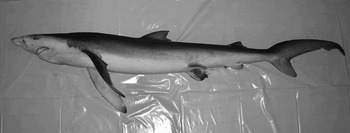
Specimen No. 1 of the present study (total length = 98 cm; weight= 3 kg).

A piece of vertebral column including several first cervical vertebrae was removed from specimen No. 1, for age determination. Following the procedure outlined by Rizzo et al. (Reference Rizzo, Gancitano, Badalucco, Enajjar, Mancusi, Mosteiro Cabañelas, Saidi and Sion2006), vertebral centrum was prepared for observation under dissecting microscope with oblique lateral illumination. Stomach content of specimen No. 1 was removed, preserved in 70% ethanol and identified to the possible lowest taxon. Upper rostral length (URL) of cephalopod beaks was measured by means of an eye-piece micrometer. URL versus weight curve (Clarke, Reference Clarke1962) was used to estimate the mass of cephalopods found in the stomach. Upper and lower jaws of specimen No. 1 are kept at the Ichthyological Research Society (IRS). Unfortunately, the fishmonger did not allow the author sampling from specimen No. 2.
RESULTS
Specimen No. 1, a juvenile female, was caught on 18 October 2008 off the Altınoluk coast. It was 98 cm TL and weighed 3 kg. Specimen No. 2, an adult female, was caught on 16 August 2009 off the Ayvacık coast. It was 350 cm TL and weighed 100 kg. Only one growth ring was observed subsequent to birth mark on vertebral centrum of specimen No. 1. Thus, it was estimated to be 1 year old. One Mullus spp. (mass 11.7 g), and 2 upper and 2 lower beaks of Sepia spp. were found in its stomach. URLs of both upper beaks were 3.5 and 4.15 mm, and the corresponding estimated mass was 112 and 125 g, respectively. In addition to teleost remains and Sepia spp. beaks, 1 cuttlefish bone and 8 ocular lenses were also found in the stomach content. Two unidentified amphipods were also found in the stomach of specimen No. 1, which may have ingested them from the bottom during hunting or they had previously been ingested by its preys. No umblical scar was observed on the ventral surface between the pectoral fins of specimen No. 1. The second blue shark was displayed at the fishmonger for a few days. Although the fishmonger intended to sell the shark, its further status is unknown.
DISCUSSION AND CONCLUSIONS
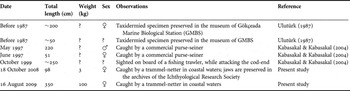
The seldom occurrence of P. glauca in the studied area suggested three possible explanations for the lack of data on the blue shark distribution in the north-eastern Aegean Sea. Firstly, the lack of data may be a consequence of misidentification or confusion with other shark species, secondly, a lack of cooperation between ichthyologists and fishermen, or thirdly, a real rarity of P. glauca in the studied area. Due to distinctive dorsal coloration and other diagnostic features of the species, P. glauca can be easily separated from other local sharks. Furthermore, the author witnessed many times that local fishermen can identify the blue shark. Not only the specimen No. 1 of the present study, local fishermen donated also several specimens of large sharks to the IRS in the past; therefore, a valuable cooperation between ichthyologists and fishermen is obvious. We can discard the first two possibilities, at least for the studied area. Despite records of P. glauca off Gökçeada Island (Figure 1) by Ulutürk (Reference Ulutürk1987) and Kabasakal & Kabasakal (Reference Kabasakal and Kabasakal2004), the species was not recorded in waters of Edremit Bay in the recent study on the fish fauna of the bay area by Torcu & Aka (Reference Torcu and Aka2000). Available data suggest a real rarity of the blue shark in the studied area. Previous and present records of P. glauca are summarized in Table 1.
Previous and present records of the blue sharks, Prionace glauca, off the Turkish coast of the north-eastern Aegean Sea.

Blue sharks can feed on a wide variety of fish and cephalopods associated with both pelagic and inshore habitats (Clarke & Stevens, Reference Clarke and Stevens1974; Tricas, Reference Tricas1979; Henderson et al., Reference Henderson, Flannery and Dunne2001; McCord & Campana, Reference McCord and Campana2003; Pardo-Gandarillas et al., Reference Pardo-Gandarillas, Duarte, Chong and Ibáñez2007). Based on the mass estimated from URL, Sepia spp. (mass 237 g) was the primary food item of specimen No. 1, and followed by the groundfish Mullus spp. (11.7 g). Sepia officinalis, a muscular and nutritious species, was considered the most important cephalopod by weight in the diet of the blue sharks caught off south Cornwall (Clarke & Stevens, Reference Clarke and Stevens1974). These authors estimated that 26.6% of flesh represented by beaks was S. officinalis. According to Pardo-Gandarillas et al. (Reference Pardo-Gandarillas, Duarte, Chong and Ibáñez2007), the cephalopod Dosidicus gigas was the second major prey item of the juvenile blue sharks, caught in coastal waters off central-south Chile, after anchovy Engraulis ringens. Sixty per cent of the examined stomachs contained D. gigas. Capapé et al. (Reference Capapé, Guélorget, Quignard, El Abed, Ben Souissi and Zaouali2004) reported that the stomach content of a juvenile male (79 cm TL) caught in Bahiret el Biban (southern Tunisia, central Mediterranean), consisted of an important number of unidentified fish. The occurrence of the groundfish Mullus spp., in the diet of specimen No. 1 indicates that, P. glauca can feed directly off the bottom, as Stevens (1973; cited in Henderson et al., Reference Henderson, Flannery and Dunne2001) suggested.
According to Compagno (Reference Compagno1984), the size at birth of P. glauca varies between 35 to 44 cm; however, Lipej et al. (Reference Lipej, De Maddalena and Soldo2004) extend the upper limit to 52 cm. Tortonese (1956) reported on a new-born blue shark of 53 cm, with an umblical scar on its belly, caught off Napoli. Together with the new-born of 51 cm TL, caught off Gökçeada Island (Kabasakal & Kabasakal, Reference Kabasakal and Kabasakal2004; Table 1), capture of specimen No. 1 suggests that young of the year and juvenile blue sharks can occur in the coastal waters of the studied area, where they can be subjected to coastal artisanal fishery. The size at age of the 1 year old female P. glauca from the North Atlantic Ocean (Skomal & Natanson, Reference Skomal and Natanson2003; 97 cm), coincides with the size of specimen No. 1 (98 cm TL) of the present study. Available data suggest that P. glauca enters fishery in the studied area in the first year of life.
Regarding the maximum size of P. glauca, which was reported as 383 cm by Compagno (Reference Compagno1984), specimen No. 2 (350 cm TL) is one of the largest specimens ever reported. As the fishmonger did not allow the author to dissect the specimen No. 2, I could not tell whether it was pregnant, or how old it was. Based on the observations during four consecutive years, Hemida & Capapé (Reference Hemida and Capapé2003) concluded that, in the western Mediterranean, the Algerian coast is a mating area for P. glauca, and fertilized females probably migrate to southern areas such as the Gulf of Gabès and to northern areas such as the Italian coasts to expel their foetuses. Capapé et al. (Reference Capapé, Guélorget, Quignard, El Abed, Ben Souissi and Zaouali2004) considered Tunisian marine areas as a possible nursery area for the blue sharks. The occurrence of the young of the year blue shark off the north of Gökçeada Island (Kabasakal & Kabasakal, Reference Kabasakal and Kabasakal2004), as well as specimen No. 1 in Edremit Bay suggests a possible nursery ground for P. glauca off the north-eastern Aegean Sea coast.
Although, Megalofonou et al. (Reference Megalofonou, Damalas and Yannopoulos2005) concluded that the blue sharks were the most common by-catch sharks in the eastern Mediterranean Sea, during the period 1998–2001, their population dynamics off theTurkish coast need to be clarified. For the moment, it is still a point of discussion, whether the occurrence of neonates and juveniles of the blue sharks in waters of Edremit Bay, is regular or incidental. Due to the paucity of existing data, no speculation could be made upon the fishing pressure of coastal fishermen on young of the year and juvenile blue sharks. However, available data suggest that coastal trammel- and gill-netting is a serious threat to the survival of the young populations of the blue sharks, as well as other large sharks in the studied area. Currently, the blue shark is listed in the FAO classification of marine species as B3, which means a species that is exploited by directed fisheries or by-catch and, due to a limited reproductive potential and/or their life history characteristics, is especially vulnerable to overfishing and/or being fished in its nursery area. Furthermore, IUCN listed the blue shark as near threatened, and in the Mediterranean a vulnerable species (Serena, Reference Serena2005).
ACKNOWLEDGEMENTS
The author wishes to thank Mr Ayhan Şentürk for providing the specimen No. 1, and Mr Sait Özgür Gedikoğlu for his assisstance in the laboratory work. A special thanks goes to Mrs Özgür Kabasakal.