Taste is, after all, a matter of will, of moral and social decision. To take a famous example from the modernist tradition in literature, we are assured that Joyce's Ulysses is a difficult masterpiece, and we try to read it, determined, perhaps, to prove our cultural superiority by our appreciation. After the initial repugnance for much of the book experienced by a great many readers, most of us succeed in the end in deriving great pleasure from all of it. Similarly, in the history of music from Bach to the present, by repeated listening we have learned to love the music that has at first puzzled and even repelled us.
Charles Rosen, ‘Who's Afraid of the Avant-Garde?’Footnote 1The dominant theories of art and criticism in the twentieth century grew out of a militant denial of human nature. One legacy is ugly, baffling, and insulting art. The other is pretentious and unintelligible scholarship.
Steven Pinker, The Blank Slate Footnote 2Introduction: Klangfarbenmelodie and cognitive constraints
A few years ago I gave a paper on the aesthetics of ‘noise,’ that is, on the ways in which non-musical sounds can be given aesthetic shape and structure, and thereby form the basis of significant aesthetic experience. Along the way I made reference to Arnold Schoenberg's musical theory, in particular his notion of Klangfarbenmelodie, literally ‘sound colour melody,’ or musical form based on timbre or tonal colour rather than on melody, harmony or rhythm. Schoenberg articulated his ideas about Klangfarbenmelodie in the final section of his Harmonielehre (1911). ‘Pitch is nothing else but tone colour measured in one direction,’ wrote Schoenberg. ‘Now, if it is possible to create patterns out of tone colours that are differentiated according to pitch, patterns we call ‘melodies’…then it must also be possible to make such progressions out of the tone colours of the other dimension, out of that which we simply call “tone colour.”’Footnote 3 In other words, traditional melodies work by abstracting and structuring the dominant pitch characterizing a musical sound, while ‘sound colour melodies’ work, Schoenberg argues, by structuring the combined set of pitches contained in a given musical sound (the overtones as well as the dominant pitch). Schoenberg is emphatic that, although a neglected and underdeveloped possibility within Western classical music, ‘sound colour melody’ is a perfectly legitimate and viable form of musical expression; indeed for Schoenberg it is a musical form with enormous potential.
Schoenberg's ideas on Klangfarbenmelodie were also explored by his pupil Anton Webern, and further developed in the 1950s by Stockhausen, among others, who attempted to systematize the treatment of timbre through the application of serialist principles; and still later, combining composition with the psychology of music, by Fred Lerdahl.Footnote 4 Parallel with these developments in the worlds of music and music theory, we see the same principles surfacing in a particular strand of avant-garde filmmaking, especially from the 1960s onwards.Footnote 5 In certain films, in place of conventional soundtrack elements – dialogue, sound effects, and music, integrated with the moving image to create a unified storyworld – we find abstract, textured soundtracks, eschewing or subordinating both reference (to a fictional diegesis, or to the world itself) and traditional musical form (scores based on conventional uses of melody, harmony and rhythm). William Raban's Sundial (1992), for example, creates a playful montage based on the sights and sounds of East London around the original Canary Wharf tower (figure 1). The sounds of traffic, trains, voices, jackhammers and other urban sonic detritus are abstracted and structured into patterns of similarity and contrast, sometimes flowing, at other times staccato, in their development. We never lose sight of the fact that we are looking at a miniature portrait of a corner of London; but it is equally plain that the film aspires to a kind of musicality, one born in part out of the Klangfarbenmelodie woven into the soundtrack.
Sundial (William Raban, 1992).

All of this, it turned out, was a mistake.
Or if it wasn't a mistake, the line of thought I presented on Klangfarbenmelodie and the aesthetics of noise certainly hit a lively nerve with some members of the audience. I was told, in no uncertain terms, that Schoenberg's theory and his proposal for ‘timbre melody’ flew in the face of everything we knew about the nature of musical form and our perception of sound. In reviving Schoenberg's ideas, and suggesting that they were in some measure embodied in Sundial, I was ‘spitting in the wind’ – of our natural predispositions. We simply don't possess, so the objection went, an auditory system capable of perceiving the subtle but systematic patterns of timbral variation and form that I argued were present in Sundial; these patterns are ‘cognitively opaque,’ to use Lerdahl's phrase.Footnote 6Sundial is a representational work, triggering our recognitional capacities, and as such it invites us to perceive and interpret its sounds referentially, that is, in terms of depicted locations, objects, and events. Our perceptual apparatus compels us to interpret the sounds of the film ecologically, as sounds affording information about the space depicted. And even if it does succeed in creating a kind of quasi-musical, abstract structure overlaid upon its depictive content, it is far from clear that this musical structure takes or indeed can take the form of a Klangfarbenmelodie.
Or so my detractors claimed. What this episode points to most directly is the question – again drawing on Lerdahl's terminology – of the ‘cognitive constraints’ at play in cognition in general, and in the making and apprehension of artworks in particular. Are there perceptual and cognitive limits to what perceivers of artworks can appreciate? If so, what are they, and to what degree is it possible for us to predict and specify what and where those limits may lie? Behind this problem lies a broader question, concerning the extent to which philosophically naturalistic approaches to the arts, especially those which appeal to evolutionary theory, are compatible with the kind of creative freedom that has been central to the ethos and the practice of avant-garde art. And this is a question whose descriptive, explanatory, and normative strands are tightly interwoven. In the remainder of this essay, I begin by exploring the question of ‘cognitive constraints’ in a little more detail, by examining practices of point-of-viewing editing and the depiction of emotion in film, before focussing on this framing issue.
Cognitive-evolutionary explanations of artistic practices
As often as not I find myself on the other side of such animated exchanges about the grounding of artistic forms and techniques in our natural psychological capacities. There are now well-established cognitive-evolutionary explanations for many basic cinematic techniques, including point-of-view editing, reverse-shot editing, the norms of pictorial composition, and sound perspective. Noël Carroll, for example, has persuasively argued that point-of-view editing works by mimicking ‘deictic gazing,’ that is, the perceptual behaviour of following the glance of an agent to its target (from the Ancient Greek δεῖξις, a display, demonstration, or reference).Footnote 7 In a real situation, you glance over my shoulder in mid-conversation, and I am prompted to follow your gaze in order to discover just what is of such momentous interest. Watching a movie, I see character A looking off-screen right; the next shot shows character B, and I infer that B is the object of A's gaze. A sequence in The Bourne Identity (Doug Liman, 2002) shows the technique in action (figures 2.1–2.8). Pursued by police, Jason Bourne (Matt Damon) seeks refuge in the US Embassy in Zurich. He joins a line of American citizens awaiting service. The space of the embassy is now mapped out by a series of point-of-view edits, alternating shots of Bourne glancing off-screen with shots of other characters and objects occupying different zones of the embassy space.
Point-of-view editing in The Bourne Identity (Doug Liman, Universal Pictures, 2002).
Each shot on the right is immediately preceded by the paired shot on the left. According to Carroll, the reason we so readily infer that the figures in the right hand series of shots are the objects of Bourne's gaze, as it is depicted in the left hand series, is that this way of stitching shots together exploits the basic ‘biological inheritance’Footnote 8 of deictic gazing. Viewers of sequences exemplifying the practice of point-of-view editing, like this one, are able to readily map the elements of the real world behaviour onto the equivalent filmic elements: my perception of my interlocutor's glance is mapped onto the shot of the character looking off-screen, while my act of following the glance of my interlocutor is mapped onto the ‘answering’ shot in the film sequence, the shot that shows us the second character. Point-of-view editing, as a conventional practice, thus builds upon and exploits the ordinary behaviour of deictic gazing.
Shot/reverse-shot editing, as represented by this pair of shots (figures 3.1–3.2) from Trainspotting (Danny Boyle, 1996), is based on an elaboration of this principle. We see Begbie (Robert Carlyle) looking and blowing smoke off-screen left; this shot is directly ‘answered’ by the shot of Renton (Ewan McGregor) looking off-screen right, returning Begbie's gaze while receiving the smoke blown into his face. The directions of the glances of the two characters thus knit together just as they would if we were encountering a real confrontation of this type in an actual space. Shot/reverse-shot editing is thus a special case of point-of-view editing in which the reciprocal gazing of two characters is represented mimetically, tapping into our evolved propensity to track and follow the glances of others to their objects.
Shot/reverse-shot editing in Trainspotting (Danny Boyle, PolyGram Filmed Entertainment, 1996).
Note that there are two layers to such an explanation of an artistic practice. Most immediately, a representational practice – here point-of-view or shot/reverse-shot editing – is explained by reference to a real-world perceptual behaviour on which the representational practice piggy-backs. The second (often implicit) layer of explanation concerns the perceptual behaviour itself. So in this case, deictic gazing is held up as a product of evolution (it is a ‘biological inheritance’). It is important to see that these two layers of explanation are detachable, however. A non-transitive relation obtains across the three elements: the fact that certain evolutionary considerations explain deictic gazing does not mean that those same considerations explain point-of-view editing. We cannot get from evolutionary pressures to film practices in one explanatorily homogeneous step. A representational practice might be mimetic – imitative of some ordinary perceptual behaviour – but the mimicked behaviour might be culturally specific, and not in that sense apt to be directly explained in evolutionary terms. And, as will become plain in this paper, representational practices can be non- or anti-mimetic, in the sense that they may evoke or refer to a perceptual routine (biologically basic or culturally specific) while not seeking to mimic or feed off of that routine (in the way that, on Carroll's argument, the practice of point-of-view editing feeds off of deictic gazing). This last point is particularly complex and will certainly need further unpacking. At this stage, the important thing to grasp is that a full-blooded cognitive-evolutionary explanation conjoins these two layers (even if they are detachable): as in the point-of-view example, the claim is that a representational practice mimics a perceptual behaviour that is plausibly regarded as a product of biological evolution.
Importantly, then, there is no claim here that point-of-view editing is itself a product of evolution, as Carroll himself firmly underlines.Footnote 9 In a parallel context, Jesse Prinz notes that while ‘[s]carcity [according to certain evolutionary psychologists] may trigger a biological disposition for belligerence…[it] does not cause us to invent canons, peace treaties, or agriculture. These specific tools for coping with scarcity depend on insight and toil, rather than innate knowledge.’Footnote 10 In Carroll's and Prinz' examples alike, we can tease out four distinct elements: an ecologically-given problem (the need for food and other material resources; the need for information about the environment and our conspecifics' relationship with it); a suite of capacities and behaviours which have evolved in response to those problems (belligerence, deictic gazing); and a variety of cultural inventions – including technologies – which build upon these capacities in order to expand and enhance the solutions available (canons, peace treaties, agriculture; cinema, point-of-view editing). And we can lay out the relationship between these four elements, and the two layers of cognitive-evolutionary explanations discussed above, in the following way (figure 4):
Layer 2 (deictic gazing) precedes layer 1 (point-of-view editing) historically, of course, even though layer 1 occupies the frontal position, so to speak, in the explanation at stake (and is numbered as such). The impulse behind naturalistic explanations of the arts and human behaviour more generally is to capture all four of these elements, not to fold everything into the box labelled ‘biology.’
Layers of explanation.
Such cognitive-evolutionary arguments, even when carefully qualified in this way, are not always well received. Some audiences are bothered not only by what they see as the ‘reduction’ of culture to nature – an issue to which we will return – but by what they believe to be the implications of these arguments for experimental forms of cinema like Sundial, that is, the cinematic equivalents of the sort of modernist musical innovations proposed by Schoenberg; artworks based on practices which don't seem to exploit our natural propensities, and in some cases seem to cut deliberately against them. They suspect that some sort of naturalistic sleight of hand is in the offing; is an ‘ought’ being smuggled in via an ‘is,’ they query?
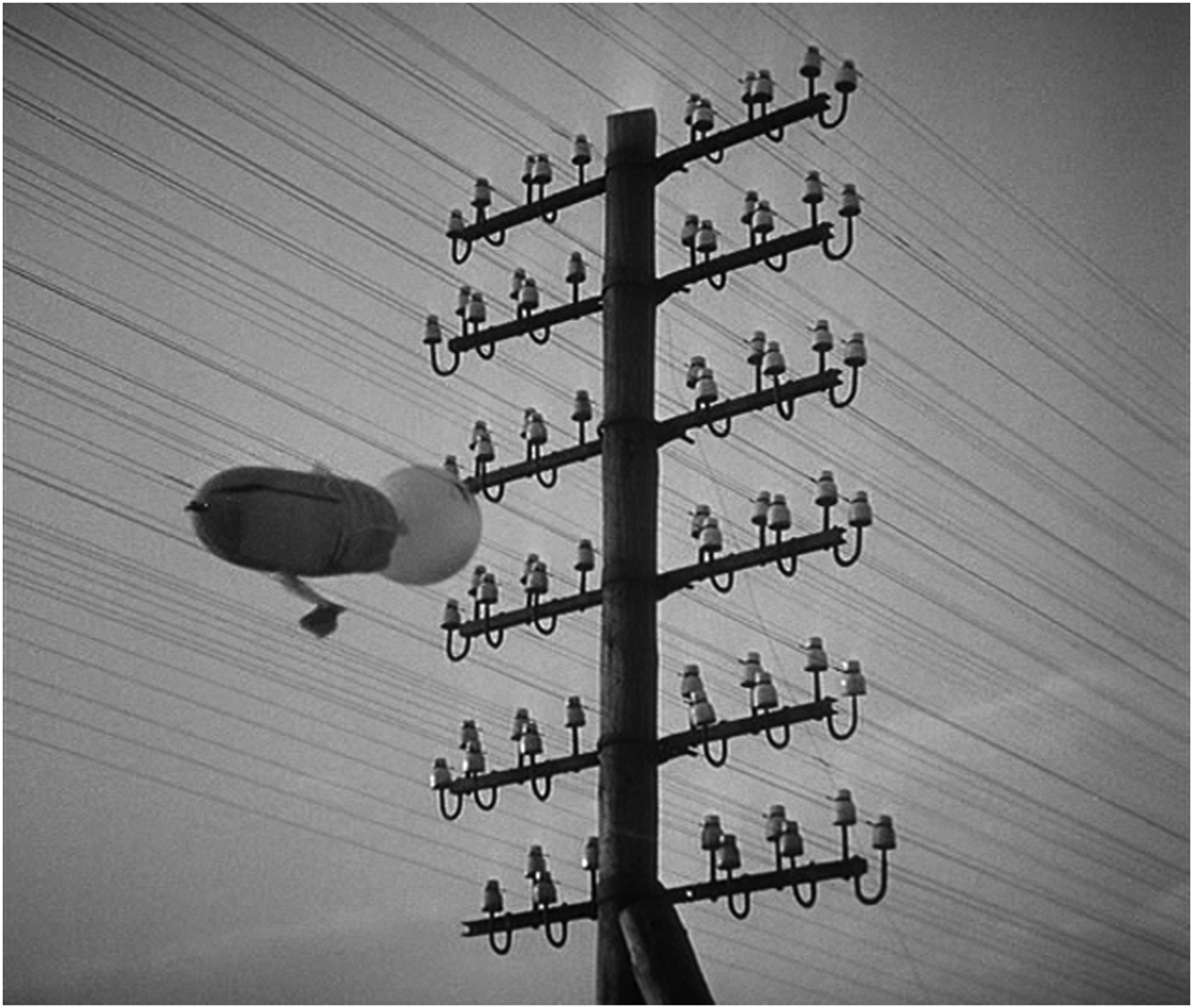
As further examples of experimental practice where the kind of explanation offered by Carroll in relation to point-of-view editing seems unlikely, consider the two unusual forms of editing that James Peterson identifies as constituents of the ‘radicalized rhetoric’ of American avant-garde filmmaking. Peterson labels the first of these two types of editing radical metonymy. In ordinary metonymy, a complex action or sequence of events is represented by a single salient detail; an entire trip might be represented by a single shot of a character seated on an airplane, for example. In radical metonymy, however, we are required to infer an event on the basis of a marginal detail rather than a central and salient feature. In Fritz Lang's M (1931), for example, in order to understand the story, we have to infer that the little girl Elsie (Inge Landgut) has been murdered by virtue of the sight of her balloon – which we have seen the child murderer buy her – drifting free and becoming entangled in telephone wires (figure 5). The balloon stands in metonymically for Elsie (and perhaps there is a hint of metaphor in the way that the telephone lines trap the balloon). An ordinary use of metonymy here might involve a shot of a single limb of the dead girl, or the sound of her cries heard off-screen: parts of the action which more directly represent the whole action (the murder).
Radical metonymy in M (Fritz Lang, 20th Century Fox, 1931).
In such cases, Peterson notes, ‘the inference we make is more difficult and less certain’ than in the case of ordinary metonymy; moreover, although in the example from M the murder is confirmed in the following scene, in avant-garde films the inferred event will often remain a more tentative hypothesis. In the world of avant-garde film, ‘we must be prepared to make bold inferences and live without confirmation.’Footnote 11 Peterson tellingly notes that critic and filmmaker Jonas Mekas, who was to become one of the staunchest advocates of avant-garde cinema, was at first ‘puzzled and irritated’ by such filmmaking, an instance of Rosen's typical ‘first reaction’ of perceivers of modernist works.Footnote 12
Peterson discusses such radical metonymy alongside the second constituent of the radical rhetoric of the avant-garde, radical metaphor, the comprehension of which requires us to discern the target of the metaphor through the source of the metaphor alone. In Stan Brakhage's Reflections on Black (1955), for example, Peterson argues that a shot of a coffee pot boiling over is most reasonably interpreted as a metaphor for male orgasm.Footnote 13 As in the case of radical metonymy in M, the larger context of the film allows us to make this metaphorical inference. But this interpretation is nevertheless ‘retarded’ – in the Russian Formalist sense of ‘made difficult’ for the sake of artistic interest – by virtue of the fact that we are only shown the coffee pot, not the coffee pot (the source of the metaphor) and the male figure experiencing the orgasm (the target). What radical metonymy and radical metaphor share, and what makes them ‘radical’ variants of ordinary metonymy and metaphor respectively, is their highly-elliptical nature. The metonymic parts and metaphorical sources in these rhetorical figures are only indirectly and tenuously connected with their targets. Perhaps we can envisage a cognitive-evolutionary explanation for ordinary metonymy and metaphor; perhaps these aspects of our cognition are basic biological endowments that form the basis for certain representational practices. It is difficult to see how such an explanation could extend to the radical variants of metonymy and metaphor, however, as this would require identifying an ecological function – a function in ordinary rather than artistic contexts – apt to be selected, for such elliptical and indirect representation.
Generalizing from such techniques, we might wonder about the stylistic practices associated with Soviet montage, Yasujirō Ozu, Robert Bresson, Jean-Luc Godard, and other radical innovators in the cinema. Can a cognitive-evolutionary approach illuminate the broadly modernist explorations that we find in the work of such filmmakers? One well-trodden path leads from this question to the kind of stand-off I have staged through the two quotations at the head of this essay. On the one hand, we have Charles Rosen's view that artistic appreciation (‘taste’) is ‘a matter of will, of moral and social decision,’ implying an infinite or at least indefinite range of artistic possibilities, the appreciation of many of which will require sustained engagement and effort with works that we may initially find incomprehensible or ‘repugnant.’ Ranged against this perspective we have Steven Pinker's view that the type of position represented by Rosen involves a ‘militant denial of human nature’ resulting in ‘baffling’ art – art that cannot be genuinely appreciated; that is, appreciated without self-deception or some secondary, non-artistic rationale. Rosen himself astutely acknowledges the pursuit of social status and ‘cultural superiority’ through art appreciation, a phenomenon famously explored by Thorstein Veblen, and in our time by Pierre Bourdieu.Footnote 14
Emotional expression in film
The extent to which (some) artistic practices can be explained on a cognitive-evolutionary basis comes more sharply into focus if we juxtapose two ways in which the facial expression of emotion has been treated by filmmakers. On one end of the spectrum, there are filmmakers who treat such expression more-or-less naturalistically – in the sense that they adopt the familiar patterns of such expression in the everyday world, with only relatively minor modifications and expressive heightenings. Consider as an example the sneer exhibited by Begbie in Trainspotting, seen here in the film's concluding freeze frame credit sequence (figure 6.1). Set alongside a still from Kevin Keegan's infamous live television rant against fellow football manager Alex Ferguson (figure 6.2)Footnote 15 – like Trainspotting, from 1996 – and the similarities in both the component parts of the expression and its overall form are evident.
Sneering in reality and in Trainspotting (Danny Boyle, PolyGram Filmed Entertainment, 1996).
This comparison illustrates the strong continuities between the generally unrehearsed expressions captured by documentary footage, and the kind of facial expressions we see in fiction films committed to naturalistic performance styles. And here again we see the two layers of cognitive-evolutionary explanations of representational practices I noted above: the form of the practice in question (facial expression of emotion as performed and depicted) is held to mirror a facet of actual behaviour (facial expression of emotion), and that behaviour is held to be a product of evolution (a widely-held perspective with regard to at least ‘basic’ emotional expressions). Note, however, that – as in the case of point-of-view editing – this does not imply that the representational practice is itself directly explained as a product of evolution; no-one is arguing that close-ups of emoting faces or ‘scenes of empathy’ are direct products of evolution.Footnote 16 Instead, the evolutionary element enters the explanation in the second or ‘lower’ (and often implicit) layer of explanation. The practice of using shots depicting legible, basic emotional expressions is an artistic invention that represents through mimesis the evolved behaviour of expressing and communicating emotions facially.
In contrast to this practice and at the other end of the spectrum, there are modernist directors who use the human visage in quite ‘unnatural,’ or at least, unfamiliar ways. The films of Robert Bresson provide an excellent example, challenging us as they do with a style of acting which almost wholly eschews facial expression, substituting a ritualized emphasis on objects and gestures. In one sequence from Bresson's L'Argent (1983), the protagonist Yvon (Christian Patey) is accused of attempting to avoid paying his bill in a restaurant. His indignation is given expression through a series of stylized movements – standing up, grasping the shirt of the restaurant waiter and pushing him away – and capped by a cut to a shot of Yvon's hand extended in the shape of a fan, sustained for several seconds (figure 7).
Stylized performance in L'Argent (Robert Bresson, MK2 Diffusion, 1983).
This striking and rather abstract shot replaces the prototypical shot of the ‘climax’ of a facial expression – that is, the moment when it is fully developed – of the type that we see in Trainspotting, and indeed in the vast majority of popular narrative films worldwide.Footnote 17
So the treatment of facial expression in film ranges from the mimesis of familiar everyday expressions, towards exaggeration of such expressions in one direction, and suppression and displacement of them in the other. Doubtless there are many further possibilities not captured by this analysis. Now, one might think that our grasp of this array of possibilities is aided by the recognition that mainstream narrative films adopt, to a very considerable degree, the modes of facial expression that are operative in real life, expressions that are largely the product of evolution. Again, though, there are those in aesthetics, film studies, and the humanities more generally, who are allergic to evolutionary psychological explanations of any aspect of any type of film or cultural object, taking issue even with the present modest proposal. The stance here is culturalist and socially constructivist: human existence is understood to be cultural ‘all the way down,’ in the sense that human behaviour is held to be so variable that (it is argued) our underlying biology plays no substantial role in shaping the forms of culture. Through much of the twentieth century, the orthodox view of emotional expression in anthropology was culturalist in this sense: all expression was considered culturally ‘constructed’ and learned.Footnote 18 The anthropologist David Schneider declared biology to be irrelevant to anthropology, and in more recent times the philosopher John Dupré has defended what Kim Sterelny aptly labels a ‘post-biological’ perspective on human behaviour.Footnote 19 ‘Literary Darwinism’ is the most recent lightning rod for dispute around the question of the relevance of our evolved biology to culture, with many critics dismissing the insights claimed by the literary Darwinists as either trivial or mistaken.
Semiotic arguments concerning the putative ‘naturalization’ of cultural and ideological practices – the distorting and illegitimate treatment of culturally-specific behaviours and practices as biologically-given universals – are orthodox in contemporary literary and film theory; the classic text is Roland Barthes' Mythologies (1957). But the anxiety predates the emergence of semiotics. Writing in 1911 of the traditional system of harmony as it had developed up to the nineteenth century, Schoenberg complained that this ‘system would arrogate to itself the status of a natural system, whereas it will scarcely do as a system of presentation.’Footnote 20 For Schoenberg, a ‘system of presentation’ is something like a ‘cultural tradition’ – a set of possibilities that have been ‘built up’ over time, but only a set of possibilities, not an exhaustive mining of every option within the natural spectrum of possibilities. Schoenberg's position (in his theory and practice) accords well with the theory of ‘radical innovation’ in the arts advanced by Patrick Hogan (a theory in turn heavily influenced by the work of cognitive psychologist Howard Gardner).Footnote 21 According to Hogan, radical innovation involves reclaiming a set of possibilities which have not been selected or systematized (‘built up’) within a certain culture, but which can then be made the basis of a new system. Childhood practices, as well as the aesthetic practices of other cultures, might both function as sources of inspiration and initial models for the new aesthetic system. Taking Picasso as one example, Hogan writes that ‘African, Iberian, and other traditions [of art]…suggest to him his own forgotten practices and they offer him preliminary systematizations of those practices. He then takes up these practices and systemizations for his own purposes and shapes them for a different audience.’Footnote 22
The critical point here is that ‘a system of presentation’ involves the selective development of certain natural affordances; it depends upon choice, dialogue, and co-ordination among many individuals, often over many generations. It is at least as much a matter of invention as of discovery. By contrast, a ‘natural system’ on Schoenberg's view is one mandated by physics and physiology, allowing little or no scope for choice and selective development, and is a matter of discovery. And Schoenberg insists that ‘a system of presentation’ should not be confused with ‘a natural system,’ though our assimilation of the principles of a ‘system of presentation’ make it very easy to mistake one for the other. If we are immersed from an early age in the principles of tonal harmony – whether through formal education or informal exposure – that system will become our musical reality, and be experienced as the natural musical order of things. Assuming that it is correct to think of tonality as a ‘system of presentation’ in Schoenberg's sense, it will take considerable effort to experience it as such, rather than as a ‘natural system.’
Art, Freedom, and Naturalistic Explanation
All of the above points to a dilemma facing those studying art and aesthetics from an evolutionary perspective: how to reconcile the mutability of art, and its strong association with human freedom, with an approach that by definition seeks to ground and explain art in naturalistic terms? This is a familiar enough dilemma, echoing as it does one of the antinomies (the Third) that Kant regarded as a fundamental and ineradicable part of ordinary human thought. Human beings appear, on the one hand, as part of the fabric of the physical, causal world, and we take their behaviour to be determined as such; on the other hand, we appear to ourselves and one another as rational agents, possessing and exercising free will. The association of art with human freedom is particularly strong in the Romantic tradition: for the Romantic theorist, art is the pre-eminent vehicle for individual expression, and individual expression is valued in part according to its unique and idiosyncratic character. Joris-Karl Huysmans' novel À rebours (1884) – ‘against the grain,’ or as it is usually translated, ‘against nature’ – is a classic example from this tradition, depicting a character who asserts his freedom through the pursuit of eccentric artistic tastes and quests. And not coincidentally, À rebours is widely regarded as an important precursor or early example of avant-garde culture, because of its emphasis on strident artistic non-conformity and the overturning of established practice. The values of such works grate with naturalistic approaches that seek to identify and explain pattern and regularity in the world of art – and so the dilemma emerges.
Stated in the starkest, Manichean terms, the argument here is between a kind of sociobiology which sees culture as being ‘on the leash’ of nature, and a form of social constructionism which assumes total plasticity in the domain of the human mind and culture, the (in)famous ‘blank slate.’Footnote 23 The quotation from Rosen that I began with seems to assume something like total plasticity. If ‘[t]aste is…a matter of will, of moral and social decision,’ it would appear to operate within few constraints; certainly Rosen's essay does not pause to acknowledge any constraints. No matter how sympathetic one might be to Rosen's desire to defend ‘difficult’ art, the assertion in the first sentence of the quoted passage comes across as little more than a declaration of hope by a sentimental avant-gardist. It is, however, in the very starkness of the opposition we find between Rosen's position and the sociobiological stance exemplified by Pinker, that we begin to see the possibility of a resolution to the dilemma. Neither of these extreme positions are very plausible, and more refined and moderate conceptions of the relationship between nature and culture will begin to open up some elbow room – to enable us to see, that is, how a naturalistic approach to art can accommodate a measure of freedom of action, of choice within constraints, and an acknowledgement of the unpredictability of the future course of art.
So how, and to what extent, does a naturalistic, evolutionary account of art allow for modernism? Before working through this question in detail, two broad preliminary points are worth emphasizing. First, an appeal to evolutionary theory does not entail the claim that evolutionary factors entirely determine cultural phenomena – as we have seen in the analysis of cognitive-evolutionary explanations of point-of-view editing and facial expression of emotion in film. Thus an appeal to evolutionary theory does not necessarily imply that the theory will furnish a comprehensive explanation of all facets of the phenomenon in question. In other words, an appeal to evolutionary theory should not be confused with a commitment to ‘adaptationism,’ that is, the view of the mind as wholly or largely the product of natural and (for some theorists) sexual selection.Footnote 24 David Bordwell has suggested that evolutionary considerations should be treated ‘as one constraint on theorizing about the psychology of film;’Footnote 25 while Stephen Jay Gould argued that ‘biological potentiality’ was as important a concept and phenomenon as biological determinism. With this concept, Gould meant to emphasize the range of directions evolution might take from any given point in the history of an environment, depending on the mutations which happened to arise, changes in the environment, and so forth. Other perspectives beyond evolutionary ones may be necessary to explain why a particular direction in evolutionary history was indeed realized, and thus to complete an explanation of which evolutionary theory forms a part. In order to investigate the relevance of evolutionary theory to some domain, we need only hypothesize that there is an evolutionary dimension to this domain; we do not need to commit to the idea that it can be comprehensively described and explained in evolutionary terms.Footnote 26
A second preliminary point worth stressing is that the environments described, explained and envisaged by evolutionary biology centrally feature both ‘innovation’ (in the form of genetic mutation) and ‘diversity’ (in the form of the diversity of species that come to occupy different niches within the environment). So even in what is usually regarded as the ‘home’ territory of evolutionary theory (ie. biology), we can see how it accommodates two phenomena that are important in any theory of art, that is, change and diversity (variability through time and across space, as it were). The fact that the features of snakes, spiders and sea cucumbers – not to mention humans – are all explained by the theory of evolution hardly makes us overlook the very significant differences among such species. So any worry that evolutionary theory seeks to reduce the diversity of phenomena in a given domain (biological, cultural, and so forth) to some sort of false homogeneity seems misplaced. Identifying shared underlying principles should be no more of a worry here than it is with respect to any other form of theory – as theorization is an activity that by definition seeks general principles. The semiotician, or the expressive theorist of art, is just as interested in discovering general principles that apply to a wide range of cases as the evolutionary theorist. None of them are guilty of ‘reduction’ in this sense. (Of course there may be worries about other forms of ‘reductiveness’ lurking – reduction to a single principle or kind of explanation, for example; but we can at least head off concerns about ‘blindness to difference and variation,’ as one form of reduction, at the outset.)
Thus far I have been running together naturalism, cognitivism, and evolutionary theory, as well as (for the most part) talking of evolutionary theory in the singular. It is time to make some distinctions. Evolutionary theory as I am using the term encompasses not only evolutionary biology, but evolutionary psychology, as well as evolutionary epistemology and the study of cultural evolution (which includes, but is by no means exhausted by, the somewhat disreputable field of ‘memetics’). What binds all of these semi-discrete fields and research programmes together is a commitment to a post-Darwinian conception of evolution; all of them hold that change occurs through a process of variation, replication, and selective retention across time. The locus of replication, the rate and dynamics of evolutionary change – these and many other factors both vary and are the object of debate across these sub-fields; but all orient themselves towards the conceptual framework introduced by Darwin. From our point of view, evolutionary psychology and the study of cultural evolution are the most relevant research domains, and I will organize the remainder of this essay by considering each of them in turn. What role might evolutionary psychology on the one hand, and research on cultural evolution on the other, contribute to a naturalized aesthetics in general, and an understanding of modernism in particular?
Cultural Evolution and Memetics
Among the theories of cultural evolution that have been advanced, memetics is the best-known but most controversial variant. The label for this nascent field of study is derived from the concept of the ‘meme’ (short for ‘mimeme’), posited by Richard Dawkins as the cultural equivalent of the ‘gene’ – that is to say, a cultural ‘unit of replication’ which acts as the vehicle of ‘cultural transmission’ just as the gene acts as the unit of biological transmission. Dawkins lists ‘tunes, ideas, catch-phrases, clothes fashions, ways of making pots or of building arches’ as examples of memes.Footnote 27 On Dawkins' theory, we can conceive of all of these items as packets of information, sets of instructions for the creation of cultural representations and artifacts. Daniel Dennett, who has elaborated Dawkins' proposal in the greatest detail, adds that memes are ‘distinct memorable units,’ and that memetic ‘units are the smallest elements that replicate themselves with reliability and fecundity.’Footnote 28 The process of cultural transmission is constituted by the copying of these packets of information from one agent to another – that is, through a process of mimesis or imitation of one agent by one or more other agents. Just as mutations (and thus variation) occur in the biological domain through errors in the copying of DNA from one generation to the next, so the process of copying-through-imitation throws up errors and variation. And, crucially, the spread of memes is not to be explained in intentional terms, that is, in terms of what individual agents and groups of agents seek to achieve through their actions. The proposal, rather, is that memes will be reproduced selectively according to their ‘fitness’ within the cultural environment that they exist. Memetics invites us to see the world of cultural entities in terms of a blind process of selective replication, rather than as a field of intended individual and collective actions.
This very direct analogy between biological and cultural evolution has provoked heated debate, and there are certainly many difficulties for the proponents of memetics to overcome. Dawkins' list looks like a quite heterogeneous heap of items, ranging from very abstract (ideas) to very concrete (building techniques) entities. While the direction of genetic transmission is downward through the generations, memes spread laterally (through social groups well beyond the bounds of the biological family) and may be transmitted ‘upwards’ as well as downwards in generational terms (your children may have learned nursery rhymes from you, but a few years later you may find yourself humming songs that they have brought into the family home). My aim here, however, is neither to shoot down nor to defend memetics, but rather to emphasize a point already touched upon briefly above, namely, that the theory of memetics involves a radical rethink of what we regard as the proper domain of evolution. Evolution has been traditionally conceived as a biological theory. Biology is its ‘home’ territory. Memetics, by contrast, implies that evolution describes a more general principle and process of development, which explains and can be applied to many domains, including the biological and cultural. So long as there are entities that are replicated, variation among these entities, and a selective process of replication based on the differential fitness of the variations to the environment in which they exist, we can talk without analogy of evolution. From this perspective, sometimes referred to as ‘Universal Darwinism,’ it is a mistake to think of talk of the ‘evolution of culture’ as merely metaphorical.
What contribution, then, might memetics make to our understanding of culture, and of modernism in particular? I want to suggest that memetics might provide a description of the ordinary cultural backdrop – and the process by which this backdrop gets established and sustained – against which modernism occurs. An important assumption here, then, is that modernism is a kind of ‘counter-tradition’ that latches onto familiar conventions in order to modify them radically or reject them altogether. The idea of an artistic or other cultural practice that might act ‘against nature’ is an instance of just this sort of revolutionary stance. Because modernism has this strongly ‘dialectical’ character, we need an understanding of the cultural backdrop against which modernism reacts. How does the memetic perspective aid us in this task?
As I have already noted above, Hogan emphasizes that the development of artistic practices works in part through a process of cultural selection and systematization. Certain practices are selected by cultures from among the array of possibilities that emerges in the development of the child; these are then systematized into a more elaborate set of conventions and associated techniques. In this way, the practices that are transmitted and sustained across generations come to constitute a cultural environment that exerts selective pressure on which conventions will continue to be replicated. Techniques and practices which either duplicate existing practices, or which fit comfortably alongside them, are much more likely to be selected and transmitted. There is thus a self-perpetuating dimension to this process. This dynamic accords with what social psychology tells us about the strong tendency towards conformity within social groups: people tend to copy whatever is most prevalent in their society.Footnote 29
On the face of it, the spread and stabilization of a cultural practice across a social group, and its evolution – that is, its replication-with-variation-and-selective-retention – through time, look rather similar to a phenomenon at the centre of research in the humanities, and one that I have referred to several times in the course of the argument so far: the tradition. When we speak of a tradition we refer to a set of assumptions and practices shared by a large community, sustained over generations. The realist novel, classical Hollywood filmmaking, and popular songwriting are all artistic traditions in this sense. But the word ‘tradition’ implies something more: it implies that the practice has coalesced and been sustained by a process of guided judgement. Practitioners and critics reflect on the works produced within the tradition, innovating within its parameters and offering judgements on the value of individual works within the tradition, or even the value of the tradition as a whole. Huysmans wrote À rebours partly out of disillusionment with the tradition of the naturalistic novel that he had, up to that point, worked within. In the preface to the 1903 reprint of the novel, Huysmans wrote:
Naturalism was then at its height; but that school, which was supposed to perform the unforgettable service of showing real personages in their precise surroundings, was doomed to repeat itself endlessly, to mark time on the same spot. It could barely tolerate, in theory at any rate, the exceptional; it therefore limited itself to the delineation of everyday existence, forced itself, under the pretext of making its characters lifelike, to create beings as similar as possible to the general average of people.Footnote 30
Huysmans' reflections here testify to his conscious awareness of the tradition in which he is writing, one that he eventually comes to challenge; a process quite distinct from the blind process of selective retention theorised by memetics and other accounts of cultural evolution.
Given these differences between memetics and the humanistic study of cultural tradition, it does not seem that they are redundant with one another. But to the extent that they share an explanandum – the emergence and maintenance of networks of shared, integrated cultural practices – we might ask: are they, as explanans, in direct competition with one another? Are they mutually exclusive? This too seems doubtful. Looking at cultural dynamics from a memetic perspective, we make the supra-individual dimensions of culture highly salient, and we specify the nature of transmission in a particular way. Practices get replicated or ‘reproduced’ because the cultural environment selects for them, not (only) because of more mysterious or at least elusive factors, like the charismatic power of individual practitioners. In effect, memetics is one way of approaching the ‘problem of the unintended social repercussions of intentional human actions,’ in E. H. Gombrich's words.Footnote 31 So there is no intent to deny the significance of human intention to culture; rather the point is to insist that there is more to culture and its development than the intentions of agents. The co-presence of evolutionary and intentional processes within the sphere of culture is no more mysterious than the co-presence of casual and intentional factors. When, for example, we describe Josef Von Sternberg's ability to create a certain kind of pattern of light and shadow, we assume that he's doing this on the basis of the physical laws governing light, not in place of them. Likewise there is no contradiction between intentional and memetic processes. The underlying thought here, then, is that far from being either redundant or mutually exclusive with the humanistic study of cultural tradition, memetics is complementary to it.
The presence of both arms races (where intense competition within an environment gives rise to ‘extravagant exaggeration,’ as embodied by the peacock's tail) and convergent evolution (where identical adaptive features emerge in similar, though separate, environments) within the cultural sphere gives further support to the hypothesis that evolutionary dynamics are found in culture (if not specifically to the memetic version of this hypothesis). Examples of cultural arms races might include the progressive increases in the height of Gothic spires in the late medieval period, and of skyscrapers in our own time; similarly Gombrich argues that the ‘flamboyant Gothic style’ of ornament arose from a competitive dynamic among artists working within that tradition to outdo one another.Footnote 32 In the world of filmmaking, the increasing length and complexity of action sequences, culminating in the positively baroque constructions of the contemporary action film, provide another example. In all of these cases, the race seems to continue until it is curbed either by prevailing limitations at the level of engineering (a spire or skyscraper can only go as high as the techniques of the day allow) or by virtue of the exaggerated feature causing the work as a whole to become dysfunctional and maladapted (a Hollywood film cannot be completely subsumed by extended action sequences and still function as a film of that type – it needs, for example, narrative exposition to set up what is at stake in the action sequences).
The world of filmmaking also affords us with examples of convergent cultural evolution. Over the first two decades of cinema, such fundamental techniques as the close-up, the match on action, and staging in depth emerged independently in different national contexts; filmmakers were discovering, more or less simultaneously, the same solutions to the same problems, the overarching problem being: how to use the new technology of film to convey stories clearly and vividly? Of course, influence and interchange among filmmakers working in different national contexts rapidly emerged, but this does not gainsay the reality of convergence on the same solutions and practices by filmmakers working in isolation from one another.
Evolutionary Psychology
So the study of cultural evolution may enrich our understanding of the fabric of culture, complementing the more familiar study of cultural traditions as they are sustained by the reflections, judgements and creative acts of individuals and groups. What of evolutionary psychology – that more familiar branch of evolutionary theory which considers, among other things, the consequences of the evolutionary history of the human mind for modern social and cultural phenomena? What role might it play in explaining modernism, if it is not simply ruling out the project as a whole, as it pretty well does in the hands of Pinker? Evolutionary psychology reveals, I want to suggest, the broad, underlying psychological processes that establish the array of possibilities from which culture selects. It thus establishes the natural parameters for the ‘cultural survival’ of memes in general, and the radically innovative memes of modernism in particular. Innovations which simply fly in the face of our perceptual or cognitive predispositions, or exceed our capacities – those which are wholly ‘cognitively opaque’ – are not likely to be replicated. A symphony composed in pitches entirely outside the range of human hearing – Smith's Silent Symphony – will probably not form the basis of a new artistic genre (though it might well survive as a conceptual joke). So there are natural constraints on the kinds of innovation that can be expected to succeed in the long run. Pinker is right about that. Culture is on a leash. Total plasticity of the mind and thus of culture is a fantasy. This is a bullet that, I fear, even the most devout modernist must bite.
That said, there are much trickier cases than Smith's Silent Symphony. Consider Twin Earth Trainspotting, in which our assumptions about spatial direction are systematically disrupted. In this hypothetical film, with each successive shot, screen direction is reversed – in other words, with each shot the camera is repositioned on the opposite side of the ‘axis of action,’ the imaginary line running between the two characters. Thus in the two shots here (figures 8.1–8.2), Begbie and Renton are still locking glances, even though both are shown in right profile, and it will be difficult for us to resist the inference that both characters are looking off to the right, rather than at each other. Or imagine Sneer < > Smile, a film that takes Bresson's strategies a step further, not merely attenuating and displacing facial expression, but, so to speak, reversing its polarities – so that a smile stands for anger and other negative emotions, while joy is expressed by a grimace, and sneering is to be understood as a means of communicating respect and social ease. It seems unlikely that the gravitational force of our evolved assumptions about the meaning of expressions could ever be wholly eradicated, even by Sneer < > Smile.
‘Contranuity’ editing in Twin Earth Trainspotting.
This hypothetical example bears some resemblance to the actual case of twelve-tone composition – the radical innovation for which Schoenberg is best known. From the outset, Schoenberg's twelve-tone theory and the works composed on the basis of its principles attracted controversy, with various commentators holding that the harmonic structures created in such works cannot be cognized by listeners. In Lerdahl's terms, dodecaphonic works are ‘cognitively opaque’ because of the gap between the harmonic structures created by their composers and listeners' (in)ability to apprehend them – between compositional and listening ‘grammar.’ Diana Raffmann goes so far as to suggest that twelve-tone works may be artistically ‘defective’ or ‘fraudulent’ because ‘twelve-tone pitch structure is not perceptually real.’Footnote 33 Denis Dutton, drawing on the work of music psychologist David Huron to demonstrate the deeply strange, ‘reverse musical psychology’ of serialism, is similarly sceptical of its perceptual and aesthetic legitimacy.Footnote 34 Huron himself is more circumspect, noting that some listeners ‘have adapted to the contrarian aesthetic [of modernists like Schoenberg], and have internalized the same contrarian principle as a basis for auditory expectation.’Footnote 35 In Lerdahl's terms, these listeners have acquired a listening grammar to match the compositional grammar of the works themselves. In a similar spirit, Lerdahl notes that a listening strategy apt for serial works is ‘much harder to learn than is its tonal counterpart,’ while elswhere noting his admiration for the ‘remarkable work’ by Pierre Boulez, Le Marteau sans Maître (1954), that forms his primary case study, as well as his general allegiance to the spirit of avant-garde exploration: ‘Like the old avant-gardists, I dream of the breath of other plants.’Footnote 36
Perhaps most significantly here, Lerdahl argues that certain principles of tonal harmony together act as an inevitable ‘cognitive reference point,’ even in more experimental musical contexts, because these experiments necessarily operate within our evolved cognitive constraints. The same is plausibly true of Sneer < > Smile and Twin Earth Trainspotting: it would be hard to learn and to habituate oneself to a viewing strategy in which the polarities of expression, and of spatial orientation, were systematically reversed, but assuming it is possible, our normal assumptions regarding the valence of expressions and implications of gaze direction would remain in the background, poised for re-activation, and giving sense to the alternative strategies as calculatedly contrarian aesthetic devices.Footnote 37 So this is the sense in which an artistic practice may evoke an ordinary behaviour without seeking to mimic it, a possibility we noted above (see page 7). Bresson's treatment of facial expression is the clearest case of such a strategy among the actual examples canvassed here.
So the picture I am painting here is by no means all bad news for Rosen. I have already stressed the fact that an evolutionary perspective allows for, indeed would ‘predict’ for, variation and diversity. There is no suggestion here that all culture will or should converge into a homogeneous, banal glop. Lerdahl stresses that ‘there are innumerable and radically new ways to use and extend’ the space available within the constraints of human perception and cognition; ‘[t]he future is open.’Footnote 38 We might add that the complex interaction among modalities of perception, levels of cognition, and types of affective response involved in art makes it hard to predict where the constraints on artistic innovation lie. Thought experiments may be sufficient to establish the principle of cognitive constraints, but actual artistic experiment is usually necessary to find specific boundaries. John Stuart Mill argued that ‘experiments of living’ were necessary to discover the possible forms of the good life, that the good and the right could not be predicted or known a priori; we may similarly hold that artistic ‘experiments of living’ play an essential role in discovering what is cognitively open to us and valued as art by us.Footnote 39 For all these reasons, recognition of cognitive constraints should be contrasted with a stronger ‘cognitive closure’ thesis: that the kind of radical innovation in the arts associated with modernism cannot be appreciated because it exceeds our cognitive capacities. The closure thesis is ‘atheistic’ in spirit; the constraints thesis by contrast represents a kind of naturalized aesthetic agnosticism, much more sceptical about our ability to know in advance what will and what will not work in artistic practice.
In my sketch of memetics, I wrote as if it made sense to talk of a single, unified cultural environment. Large, modern cultures, however, are not complelety unified, but contain within them various ‘niches’ in which different sorts of cultural activity thrive. Now the types of artistic activity that thrive in these different niches will be various, and one way such activity will vary will depend on the degree of tutelage, formal or informal, imposed or self-motivated, that it requires. Learning to comprehend and appreciate Joycean prose or Brakhagean ‘plastic editing’ requires both considerable will and formal cultural apprenticeship, in a way that watching a film based on canonical compositional and narrative norms does not. Now, in one sense in which the word ‘natural’ is used, one might say that this makes the more canonical film more natural than the experimental works – the sense in which something is ‘natural’ to the extent that it is not the product of human intervention or artifice. But from the perspective I have advanced in this essay, the greater significance of cultural learning in the modernist, experimental cases does not straightforwardly make one of these sorts of culture more or less natural than the other, any more than dolphins are more or less natural than sea anemones. In each case, the phenomena vary in terms of their complexity and the elaborateness with which they exploit their environment, but in a deeper sense they are both part of that environment. And in the human case, cultural practices are integral to the way that the environment is shaped and exploited. It is not as if there is such a thing as a purely natural type of filmmaking, standing completely outside or before cultural influences and intentional activity. But it does not follow that our natural, evolved history and the predispositions and capacities they bestow upon us are irrelevant. All films – all artworks – are products of human artifice, and all human artifice involves the cultural elaboration of natural affordances.
Rosen himself puts his finger on another important point. His talk of ‘will’ is really shorthand for the way in which our natural capacities can be developed and ‘educated’ in particular directions. Indeed, since culture is an evolved aspect of human nature, our natural capacities must be realized through cultural expressions, just as much as our cultural practices must draw on our natural capacities. Think of a lullaby, for example. Undoubtedly the concept ‘lullaby’ is a cultural concept, and close investigation would probably reveal subtle differences between our notion and apparently identical notions in other cultures. But only certain sounds and rhythms will serve our cultural purpose in singing a lullaby – good luck to the relativist parent (if such exists) who sings ‘Rock a Bye Baby’ in the manner of ‘Rock Around the Rock’ – because of our natural predisposition to respond to certain sounds and rhythmic patterns in certain ways. A lullaby composed of grating dissonances will probably not be replicated; though those same dissonances might serve another musical purpose very well.
Recall here that in Hogan's framework, systematization is as important as selection, and systematization amounts to the cultural elaboration of a natural possibility. The leash is long; in certain respects the mind possesses great, if not total, plasticity. In the words of Peter Goldie, a great many of our evolved psychological capacities are characterized by considerable developmental openness (though such openness comes in degrees, and some psychological capacities are more open than others). For example, while the predisposition to learn language is widely held to be instinctive, the particular language that we speak and the way we speak it will be shaped according to the specific path of our development in a particular cultural environment; Goldie contends that this is true also of much of our emotional development. He argues against what he calls the avocado pear conception of the relationship between natural predisposition and cultural elaboration, in which there is a dichotomy between ‘a soft outer structure (that which varies culturally), and a hard inner core (that which is biological and universal).’ His own model might be likened to a squwish Footnote 40 – a firm but flexible structure capable of considerable, but not total, reshaping, in which a ‘single developed capability’ has been ‘shaped by the culture and environment in which the individual is placed.’Footnote 41 If Goldie is right about the developmental openness of such specific cognitive attributes as language and the emotion system, how much more plausible is this idea in relation to something as ‘high-level’ and synthetic as art? Here, openness is compounded by the range of psychological capacities that art in general, and film in particular, draw upon.Footnote 42
Some Concluding Remarks
Does this, as Arthur Danto claims is characteristic of philosophical interventions, leave everything just where it was before?Footnote 43 Are we, in effect, back to the familiar, vague characterization of human behaviour as an admixture of nature and nurture? Well, not quite. For one thing, on the model outlined here, culture is no longer opposed to nature, but seen as part of (human) nature. As the blank slate gives way to the squwish, to a conception of the mind as prestructured but developmentally open, so the Hegelian ‘alienation’ between culture and nature gives way to a view of culture as emergent from, and as an extension of, nature.Footnote 44
I have concentrated in this essay on the possibility of a naturalistic, evolutionary description and explanation of modernist art. But lurking in the background, even more contentiously, is the question of evaluation. What bearing, if any, does our evolutionary inheritance have upon our aesthetic standards? As we have seen, some would reject this question out of hand, insisting that aesthetics, as an aspect of culture, is entirely independent of biology and our evolutionary history. But even if we take a more moderate position, accepting that our evolved natures will have some bearing on aesthetic and artistic evaluation, it remains to be specified – for we surely do not want to say simply that the more straightforwardly a work of art exploits our natural predispositions, the better it is. As Lerdahl suggests, ‘[t]here is no obvious relationship between the comprehensibility of a piece [of music] and its value. Many masterpieces are esoteric, while most ephemeral music is all too comprehensible.’Footnote 45 Pinker is tellingly equivocal on this matter. He seems to imply for the most part that artworks should mesh straightforwardly with our adaptive capacities if they are to give us aesthetic pleasure (which he defines rather narrowly); but then he concedes that some modernist works ‘offered invigorating intellectual workouts.’Footnote 46
One way of handling the question of value within a cognitive-evolutionary framework is to propose that our perceptual and cognitive make-ups are such that there is a certain ‘optimal’ level of stimulation which will engage us most fully, or a range within which successful works of art are going to need to operate, if they are not to bore or frustrate us.Footnote 47 Even putting this in terms of a range rather than a single point, however, won't take us very far in establishing standards of aesthetic value, since the level of ‘challenge’ or ‘difficulty’ presented by a work of art is itself a normative question. That is, different cultural traditions value Rosen's ‘puzzlement’ to different degrees. A finely-crafted whodunnit is not going to fare very well in the modernist cultural niche, in spite of its many excellent features, to the extent that it lacks the ‘difficulties’ prized in this tradition. Such a novel is not well-adapted to the modernist cultural niche. Evolutionary psychology – allied with psychology more generally – can limn for us the natural, cognitive constraints on our perception and cognition, and we can describe the developmental dynamics of cultural traditions in the language of evolution. But neither the study of cultural evolution nor evolutionary psychology can decide for us, or explain, how it is that we value particular possibilities, with different levels and types of challenge, within the natural array of possibilities. Traditional humanistic approaches remain important with respect to these questions, and not only these questions: the case being made for evolutionary theory here is that it may complement and enrich familiar humanistic approaches, not that it can or should supplant them.
There can be little doubt that Schoenberg was spitting in the wind – nobody knew this better than he did. But the wind into which he was spitting was not quite as straightforwardly organic as the mistral, but rather the force of a musical tradition that develops from and progressively refines certain naturally-occurring phenomena. Writing of his compositional work with timbre inspired by Schoenberg's Klangfarbenmelodie, Lerdahl urges ‘that timbral consonance and dissonance be developed not on some arbitrary foundation but on the sensory experience of timbre. The resulting system can get a running start, so to speak, from perception.’Footnote 48 Traditions of this type, developed over many generations, can be very powerful, but they are never all-consuming, as the persistence of variety and innovation in the domain of art testifies. Looking back, I'm confident that my antagonists were far too quick to dismiss the efforts of Sundial to explore ‘tone colour’ and indeed the film's achievements in this regard. Taste – aesthetic responsiveness – may not be entirely a matter of will, but no more is it entirely a matter of uneducated natural predisposition. We need to keep in view, simultaneously, not only the power of traditional ‘systems of presentation’ and the fact that there are limits to the kinds of aesthetic form we finite and contingent humans are capable of experiencing, but the humility and patience necessary to see such systems of presentation for the naturally-grounded, culturally-elaborated entities that they are. Only then will we be open to artistic ‘experiments of living’ – to the multitude of viable artistic innovations lying beyond the horizons of these systems and our existing artistic histories.