This article is about a Cape Verdean institution named tabanca – a form of religious mutual aid association. It analyses the continuous flow of resources, values and goods that takes place within this institution in a society deeply marked by migration. More specifically, it examines the effects of some practices of the so-called Cape Verdean diaspora on local forms of sociality, in order to show that, rather than catalysing or inducing local transformations, these flows have a remarkable conservative tendency and contribute to the reproduction of traditional forms of social organization.
Cape Verde is composed of nine inhabited islands which are physically very different from one another. Some islands are flat and sandy, such as Maio, Boa Vista and Sal; some have rainfall patterns and soils that enable rudimentary agricultural practice, such as Santiago, Santo Antão and São Nicolau; others are rocky and arid with lunar landscapes, severely restricting possibilities for human settlement. This is the case in São Vicente and some parts of Fogo. The society that emerged in the Cape Verde Islands is the result of the historical encounter between Portuguese and Africans in which the parties involved had to reach a compromise continually negotiated to accommodate social, cultural and linguistic differences in a context in which neither party had the necessary means to impose its own way of life on the other. Creolization is the term I have been using when referring to this historical compromise, and Creole society is the locution naming the social formation that emerged from this process.Footnote 1 Since this is an extremely heterogeneous society, it is important to specify exactly what is being addressed when dealing with Cape Verde, in order to avoid meaningless generalizations. The data analysed in this article come from peasant communities in inner Santiago Island.
The Cape Verde I present in this article is at variance with the standard image of the country in current anthropological literature, which approaches social life in the archipelago using analytical tools provided by a theoretical framework that draws variously on globalization theory and post-colonial, transnational or diasporic studies (Batalha and Carling Reference Batalha and Carling2008; Åkesson Reference Åkesson2004; Batalha Reference Batalha2004; Fikes Reference Fikes2000; Lesourd Reference Lesourd1995).Footnote 2 Migration reigns sovereign in these studies and the image of Cape Verde that comes out of them is that of an unbounded nation, deterritorialized by never-ending flows of people, goods and symbols, the culture of which is closer to the Caribbean world than to Africa.
These labels do not comprise a monolithic field of study. Rather, they vie for hegemonic status in theoretical thinking, though sharing a common perspective, which has to do with the supposed contemporary crisis of culture and society, namely the bounded nature of the nation states (Clifford Reference Clifford1994; Hannerz Reference Hannerz1997: 26; Foster Reference Foster1991). Furthermore, they share a thoroughly mystified jargon that seems to have a life of its own, with which they try to make sense of social life in a world that has been shrinking by simultaneous displacements of cultural signs (Harvey Reference Harvey1989; Hannerz Reference Hannerz1989). Hybridity, diaspora, globalization and transnationalism are some of the tags loosely used to make sense of the flows of people, goods, symbols, values and resources that are believed to produce diasporic and hybrid communities populated by people with multiple and fragmented identities which tend to subvert the nation state (Bhabha Reference Bhabha1994; Clifford Reference Clifford1994, Reference Clifford1997; Gilroy Reference Gilroy1993).3
I feel uncomfortable with these approaches for a number of reasons. First, the picture they draw is largely ahistorical, being a replica in new disguise of old teleologies, such as modernization theory (Cooper Reference Cooper2005). We should never forget that the flows of people, capital, information, goods and values in time and space are not limited to contemporary times (Amselle Reference Amselle2002; Hannerz Reference Hannerz1997; Tambiah Reference Tambiah2000).Footnote 4 Second, these theories integrate culture and society rather poorly. In post-colonial and diasporic studies, society (with its structural features, forms of organization and patterns of reproduction) is largely uninvited and culture is conceived merely as a set of traits, despite the abstruse theoretical fabrication and the mysterious claim to anti-essentialism that are ever-present in these works.Footnote 5 Third, the literary turn that is quite widely disseminated in post-colonial studies tends to underrate the search for objective explanation and favour the power of evocation that is proper to poetics, thus leading to a kind of unruly theorization that is much too dependent on the rhetorical gift of the analyst and is often quite obscure.Footnote 6 Finally, because they privilege transmigrants’ experiences abroad, they lose sight of what happens to those who remain at home, which is the focus of this article.
CAPE VERDE: A POLITICAL CULTURE THAT PRODUCES MIGRANTS
In this article I purposely approach ethnographic data by an unusual route. Focusing on an institution that exists exclusively on the island of Santiago,Footnote 7 I put the Cape Verde case in the general context of West African political culture to argue that some of its attributes, which appear in literature on transnationalism, diaspora and globalization as the outcome of contemporary transformation, can best be explained in terms of structural continuity with the political culture that evolved in the northern part of West Africa, known as Senegambia. I argue that underneath the similarities with other diaspora cultures, the Creole society that emerged in the Cape Verde Islands is essentially linked to West African societies by two types of structural similarities. First, for a long time it had the same structure of social reproduction as the mestiço settlements in the fortified riverine villages of the Guinean coast. Cape Verde sent people (soldiers, civil servants and traders), knowledge and goods such as cloth, distilled drinks, beads and European manufactured products to these areas and in return received dye, rice and people (slaves), as well as values and social practices. Second, it shared with African political cultures the structural features governing formation and reproduction of social units. With some qualifications, this perspective, which proposes a profound continuity between the political cultures of traditional African societies and the Cape Verdean Creole society, can offer a substratist explanation both for the case of the Cape Verde diaspora and the meanings Creole peasants assign to the goods they receive from abroad.
The population movements that resulted in the spatial configuration encountered by the Portuguese in the fifteenth century on the west coast of Africa fit the model of formation and reproduction of African societies proposed by Kopytoff (1987). According to this model, political and social units are formed during the process of occupation of frontiers in a context marked by the existence of a sufficient stock of free land available for settlement. Such a model also suggests that the political culture of these societies is characterized by structural obstacles which, under the most varied expressive forms of conflict, such as the fission of kin groups, recurring accusations of witchcraft and complex struggles over succession, provided a necessary motivation for the production of frontiersmen – groups which left their native communities in order to settle in the no-man's land that lies between the established polities. In these spaces, aspiring to maintain a way of life considered to be culturally legitimate, but which is for some reason impossible in their native polities, frontiersmen created a social order in the new settlements reproducing that of their native communities through creative use of old organizational forms and cultural practices (Kopytoff Reference Kopytoff and Kopytoff1987: 33–9). The social configuration resulting from these processes is characterized by ethnically ambiguous social units, marked by great fluidity and by multiple identifications and feelings of belonging, which are often contradictory.
The structural attributes of societies which emerged in the process of frontier settlement in Africa are somewhat akin to those highlighted in studies of diaspora communities and transnational migrations. However, the frontier model does not involve any assumption of radical discontinuity with the past, as suggested by many studies of the global ecumene. Rather, it suggests that social reproduction takes on a conservative configuration. The political culture which regularly produces groups willing to move to frontiers re-synthesizes new socio-cultural units in these spaces, which maintain continuities with established communities. The immediate result of this conservative style of social reproduction is the existence of long-lasting cultural themes diffused by the various societies that constitute the pan-African ecumene.
The creolization which took place along the coast of Guinea and the Cape Verde Islands is rooted in the process of Portuguese expansion throughout the world, in the West African political culture that emerges from frontier settlement and in the set of practices and dispositions that shape a distinctive ethos (Trajano Filho 1998, 2003). On the Guinean coast, this took place through regular and long-lasting contacts between a Portuguese minority (later Luso-Africans) and Africans guided by local values which regulated relationships with strangers. Despite being intimately related to the process of creolization which occurred in Guinea, the Creole society in Cape Verde has its own peculiarities. The archipelago was uninhabited when Portuguese ships first landed there. The Africans who were transplanted to the islands belonged to various societies of the adjacent African coast, with linguistic, social and cultural differences. Brought as slaves, they lacked political conditions to fully reproduce their communities of origin in the new environment of the islands. Neither did the European minority have the economic means, demographic density and political power to reproduce their original mode of life. In a situation of relative asymmetry in which neither of the forces creating the new society could give full continuity to its forms and projects of social life, from very early on the social formation emerging in the archipelago took on a creolized form: a third entity creatively and imaginatively sharing the cultural syntaxes, the institutions and forms of social organization brought by the Africans and Europeans.
Beneath the attributes on the surface, which indicate dominance of a Europeanized way of life, the African substratum, which structures social reproduction in the archipelago, is very consistent. One of the most characteristic features of Cape Verdean society is its capacity to produce, for a number of reasons, a prolific flow of emigrants. My point is that this is the Creole equivalent of African production of frontiersmen and it can be observed historically in the entrepreneurship of the Cape Verdean lançados who traded on the African coast during the fifteenth and sixteenth centuries, in the participation of Creole traders in the Atlantic slave trade until the first half of the nineteenth century, and even in the growing masses of unskilled workers who have been leaving the country in search of better opportunities. All of these factors are economic expressions of the structural obstacles which led Creole society to opt for migration for some of its members. The decline at the end of the nineteenth century of landholding systems based on the value of seniority, known as morgadio, represents another structural feature that drove the youngest children of landholding families to leave their communities.Footnote 8 In colonial times (and, to a certain extent, in the aftermath of independence) intrigues and political disputes pushed many people away from their communities. The structural factors encouraging people to abandon their communities also have cultural expressions. Although Cape Verdean society does not fully share a cosmology and moral philosophy with societies of the West African coast, the deep-rooted beliefs in the power of some people to cause misfortunes, constantly observed in the rumours spread around the islands, force those who are seen as having anti-social powers to go abroad. In addition, some important tropes of the popular culture – the sea, saudade (a kind of nostalgic longing), terra-longe (the far away land) and the return – have the power to keep alive the urge for adventure in the ‘far away land’ (Carreira Reference Carreira1972, Reference Carreira1983, Reference Carreira1984; Furtado Reference Furtado1993: 64–8; Lesourd Reference Lesourd1995: 313–17; Lobban Jr Reference Lobban1995; Andrade Reference Andrade1996; Dias Reference Dias2000). Complementing these structural obstacles, environmental factors such as the severe droughts that have periodically caused crises or famine of dramatic proportions have also forced people to leave the country.
These economic, political and cultural characteristics, which act as driving forces for emigration, represent the Cape Verdean expression of the above-mentioned structural obstacles of the African cultural ecumene. Their regular and long-lasting existence in Cape Verdean society generates unbearable tensions that would tear the social fabric were it not for the ethos that emphasizes a lack of anxiety in regard to physical separation between those who stay and those who leave, and the maintenance of a strong feeling of relatedness, acting as a bridge for the physical distance, by means of continuity of material obligations.Footnote 9
Despite the structural promptness with which the Cape Verdean society produces its emigrants, it is necessary to point out that migration has always been a tension-laden social fact. Mention of the dual and terrible suffering afflicting the souls of Cape Verdeans is recurrent, being summarized in the difficult choice between leaving and staying. This dilemma has been so profoundly experienced in the daily life of the islanders that it has become a trope in the high culture of the archipelago. In poetry, popular urban music and in novels, such a predicament has been repeated ad nauseam, which has resulted in the crystallization of the image of Cape Verdeans as a people who are profoundly divided between their urges to leave and to stay. This dilemma is experienced through the notion of saudade – a feeling that involves a nostalgic disposition associated with the idea of loss that constructs the community of sentiment that is the nation.Footnote 10 In this context, saudade is conservative because it reinforces the ideology of migration in the Creole political culture.
Emigrants who have returned, for good or for a short period, can be found all over the country. However, their importance is not only due to their pervasive presence; it is also shown in the main narrative genres in use locally, appearing as a significant subject and symbol. Returnees are extremely valued in popular music, and have a guaranteed presence in the coladeiras that chronicle everyday life.Footnote 11 In these, their lives, frustrations and difficulties abroad are portrayed with fine irony, but hardships faced upon their return are also sharply emphasized (particularly the discovery of being cuckolded by wives who stayed). Written literature has also conceded plenty of space to returnees (cf. Almeida Reference Almeida1995; Lopes Reference Lopes1997; Sousa Reference Sousa1984, Reference Sousa1987).
In real life and in narrative genres, returnees are beloved, envied and, above all, visible. The extreme ostentation of golden chains, bracelets and rings proudly displayed on their bodies, the frequent code switching used in conversation – with the deliberate dropping of the most prosaic Creole language terms, replaced by words from the languages of the countries in which they are living – and the ostentatious generosity with which they pay the expenses of nearby strangers who keep them company in bars and restaurants make those who leave easily recognizable by those who stay. The experience gained during their years abroad is embodied, hence its visibility. Their clothing is a statement in its own right. The image the returnees build for themselves finds expression in a way of dressing that causes astonishment among those who stay. Its use indicates the existence of an abyssal gap between the grammars of local and Euro-American fashion.12
REFLUXES ON PEASANT LIFE: RETURNEES AND THE GOODS THEY BRING BACK
In this section I will deal with a set of specific flows that act conservatively in the reproduction of peasants’ social institutions in the interior of Santiago. It is composed of a differentiated series of movements on a global scale, involving the sending of material goods and financial resources from Europe and the United States to the small rural communities in the Santa Catarina Concelho, as well as the transitory or definitive movement of the people who live in these countries back to their communities, in the context of a local institution called the tabanca.
To understand the role played by this flow in the tabancas one needs some background information about the social universe in which they operate. In 2000 and 2001 I collected information in eight locations in the Santa Catarina Concelho, which is subdivided into various communities (Chão de Tanque, Palha Carga, Achada Grande, Mato Sancho, Tomba Toiro, Achada Falcão, Achada Leite and Charco). Each has a different spatial configuration, varying from compact villages to sets of dispersed hamlets in which territorial limits are not well defined. The various communities that make up these locations are very small in population. The biggest ones, with a more compact configuration, have between 200 and 300 inhabitants, whilst the smallest have less than three dozen people and are more dispersed. The typical family unit in this region is the extended family, composed of husband, wife, unmarried offspring (either children or adults), some grandchildren and, in some cases, the wives of married sons who have emigrated. Observation of domestic units in these locations indicates that these are groups where family heads are very old and in which there is a noteworthy absence of adult men. This scenario is partially confirmed by census data on emigration in the rural part of Santiago between 1979 and 1981. For every 100 emigrants, 92 were male (Andrade Reference Andrade and Almeida1998: 81), which represents the migratory profile with the greatest gender imbalance in Cape Verde.
These communities are located on very irregular terrain cut by a few streams, along the banks of which vegetables and roots are planted during the rainy season. The hillsides, which are often quite steep, are used for growing corn and various types of beans and pumpkins. These portions of land on which dry-land agriculture is carried out are called lugares. In the few areas in which there is water on a permanent basis, they grow sugar cane, manioc and a wide variety of vegetables. These parcels of land are known as hortas (vegetable gardens). Close to them, mills in which the cane is processed to distil grogo (liquor) have been set up.
The forms of land tenure vary from formal property, registered in notary offices, through various types of arrendamento (leasing) and parcerias (sharecropping), to occupation and de facto possession of land that belongs to the state or was owned by the Portuguese in colonial times, and whose legal status is still in dispute. There are areas in which the land has been in the hands of small peasants for a long time, as appears to be the case of the areas surrounding Chão de Tanque and Palha Carga. Other areas were owned by the morgados (large landholders), leased in colonial times on contracts very unfavourable to the tenants. Cape Verdean independence caused a rupture in the old system of property, which was not replaced by any other. There is still much legal uncertainty. The Church and the state still own most of the land. Many plots have been uncultivated for years because of conflicts between tenants and landowners. Legal controversies and disputes over property prevent investment in the restoration of water sources and the improvement of irrigation systems, and often cause tenants of vegetable gardens to abandon them.13
Changes in the landholding system since independence and the movement of people among different locations, associated with the development cycle of the domestic peasant group, have produced a very curious pattern of territorial occupation over the past 30 years. It is common for each family to become involved in agricultural activities on more than one plot of land, frequently very distant from each other and from the family residence. This pattern of working on dispersed plots of land, distant from the family house, is related both to the availability of land for sale or for leasing at a given point in time and to the spatial footprints left by the biographies of family heads.
The Cape Verdean tabanca is a type of mutual aid association that recruits its members on a territorial basis.Footnote 14 It functions as a brotherhood that celebrates the patron saint of the area, in general the saints of popular Catholicism (Saint Anthony, Saint John and Saint Peter). However, in addition to religious devotion, the tabanca performs other functions. It promotes mutual assistance among its members and the neighbouring communities, coordinating a substantial part of the agricultural work through collective work groups (the junta mon) involved in sowing and clearing the plots of land.Footnote 15 It also helps its participants during life crises such as death and illness, as well as in marriage and the construction of houses. Last, but not least, it is an important institution in the context of local sociality. In this way, it sanctions certain rules of conduct that value the practice of generosity and solidarity among members, establishes prescriptive forms of behaviour on important occasions of social life, such as funerals and collective prayers, and interdicts conduct considered to be inadequate. Moreover, it creates rules for the education of the young and, as an institution of religious devotion, it inculcates moral and religious values that regulate social life.
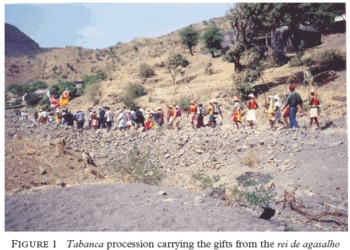
The activities of these associations take place throughout the year, but they become most visible during the patron saint festivities in June. These start a week before the saint's day, with the preparation of an altar in the house where the association is based, which is called the capela (chapel) or corte (court). During these days the leaders of the tabanca collect annual fees from each adult residing in the community, both in money and in kind, and purchase the animals for the communal meals. The basic cycle of the ceremonies obeys the following general pattern: on the patron saint's day the group goes to the nearest church, where a mass is said in honour of the saint. After that, they return home, and a long recital is prayed and sung in the tabanca chapel. The praying is followed by a series of plays, dances, and drumming that go on throughout the night. In the following days the tabanca goes in a colourful and festive procession to the houses of their reis or rainhas de agasalho (literally, the kings or queens of shelter) from whom they receive a series of gifts. When the festive group – now in the company of its benefactors, their relatives and followers – returns, a large communal meal is served to the members and guests. At nightfall, now fuelled by large amounts of food and liquor, the drumming and the dancing restart, and often continue until dawn, unless they are interrupted by occasional fights and quarrels. On the last night, all the gifts received from the reis and rainhas de agasalho are sold in auction to the members of the association. The sums raised, recorded in the association book, constitute the fund that will partly finance the festivities in the following year. Nowadays, festivities last three to four days, while in the past they would often last a week and longer.
In general, reis or rainhas de agasalho live in other communities, sometimes very far from the village where the association is based. They hold office for two or three years, after which they choose a neighbour or a relative to replace them.Footnote 16 Each tabanca has two or three reis or rainhas de agasalho, whom they visit in a one-day procession. The kings/queens must receive the association with generosity, expressed in the abundant offer of food and beverages for the tired and thirsty contingent who have marched for hours under the sun through the steep valleys of the island. After feeding the visitors, the rei/rainha must present a gift consisting of various items such as sugar cane, coconuts, bananas, papayas, mangos and liquor, which are brought to the tabanca chapel and ritually exhibited to the entire community – to the pride or shame of those who make the donations.
The authors who have dealt with the functioning of the tabancas are unanimous in pointing out that they were subject to various interdictions, prohibitions and constraints during colonial times, thereby highlighting their political dimension. Almada (1997: 85) argues that three types of conflicts operated to constrain their activities: explicit and direct prohibition by the colonial power; repression by the Church, whose priests refused to administer sacraments such as baptism, matrimony and extreme unction to those who participated in these associations; and, finally, the diffuse social coercion which emerged from the perception of the elite, who belittled the participants as social subjects in need of civility. Spínola (1997: 96) argues that, as well as satirizing the established power during their ritualized festivities, when their members went out in procession along the roads of Santiago, depicting the powerful individuals in society in an ironic manner, the tabancas in the peasant communities of Santiago filled the vacuum of power left by the absence of the colonial state. Thus, they were able to establish their own social order in the peasant communities.Footnote 17 According to these writers, their survival in spite of the violence of the colonial period symbolizes in the present the Cape Verdean capacity for resistance.
The corollary to this type of perception is the weakening of the tabancas after the end of the colonial regime. After independence, without having an external power to oppose, and with the end of the imperious need to resist, they lost their main reason for existence. This point of view is corroborated by interpretations of the current state of these brotherhoods. There is widespread consensus among Cape Verdean intellectuals that, as institutions of mutual aid which set in motion mechanisms of solidarity and reciprocity, the tabancas are currently in a clear decline. They are threatened by accelerated urbanization, the agricultural crisis that impels peasants to emigrate, and the introduction of modern values into the rural environment. Their disappearance, in the case of rural associations, or their ‘folklorization’, as in the case of the tabancas of Praia, appears to be their inevitable fate. Their loss of authenticity, and increasing dependence on governmental funding in order to hold their festivals, are also mentioned. Now, they argue, is the time of tabancas sponsored by state institutions – in contrast with those of the past, which existed despite colonial power. The ideas of cultural resistance in the past and decline in the present also colour the perspective of some members of the associations. During my fieldwork in Santiago, I heard several comments on the weakening of the tabancas. Their life was ebbing away, it was said: with poor armamento (ornaments like flags, ceremonial costumes and musical instruments used during the procession and the drumming), little food, and few people willing to give time or make an effort for them to function properly. The present is seen as a time in which the tabanca law is no longer obeyed; a time in which the severe ritual discipline that ruled the festivities in the past, and which helped to maintain order in communities during these long days of drinking, singing and dancing, is fading away. My informants also complained about the large number of young people living abroad, with only older people, without the necessary energy for such a lively celebration, remaining as a result. In addition, the growing monetization of the economy, associated with the low salaries received by the few who find work, the lack of rain and the shortage of people to work the land are other elements mentioned to explain the decline of these Creole associations.
The festivities I watched were lively and generous, blatantly contradicting the discourse of decline and weakness. In all cases the associations had managed to save funds from the previous year's auction, which indicates that their leaders still have financial and organizational abilities. Financing for the activities which take place during the festival involves the allocation of material resources that are substantial in relation to the economic capacity of Santiago's peasants. The tabancas offer sumptuous meals to their members and guests, which means feeding around 150 people for two to three days. In general, during the festivities three large pigs, three goats and many chickens are consumed. The quantity of corn, beans, manioc and sweet potato cooked is enormous. Dozens of litres of homemade fruit juice or industrialized soft drink and a huge quantity of liquor and cheap Portuguese wine are drunk. My rough calculations suggest that in the three to four days of the festival around 60,000 escudos (approximately €600) are spent, though the costs can exceed 100,000 escudos, depending on the size of the community, the economic situation of residents and the mobilization capacity of their leaders.
Tabancas have two internal sources of funding. The first comes from the annual fee paid by each adult member a few days before the beginning of the festival, on average 400 escudos (€4) per person. The second comes from the auction held on the last night of the festival, when the gifts given by the reis or rainhas de agasalho and other devotees of the saint are sold. These products are auctioned to the local residents at a cost far above their market value and are paid for over a period of up to a year after the auction. The funds raised internally are complemented by money obtained during the visits to the reis or rainhas. They come from spontaneous contributions of people who like the tabanca festival in the area through which the procession passes; from gifts and money donated by devotees of the patron saint in various locations; from small government grants; from donations of people holding public office; and from what is compulsorily raised during the processions in the form of ceremonial fines imposed on everyone for breaking the tabanca law; from the symbolic fees paid for the mock medical examinations given by tabanca ‘nurses’ and ‘doctors’; from and the tolls paid by the drivers of vehicles who cross paths with the procession.
The differentiated vitality of the tabancas and their greater or lesser capacity to organize a wide range of activities during the festivals are ritually displayed through the embodied practices and dispositions that characterize the Creole ethos. The tabanca role structure, the coordination of work, the prohibitions that regulate the conduct of men and women, and the distribution of people during the march toward the rei de agasalho residence are strongly marked by the principle of seniority and the social distance between people of different ages and genders. This ethos is manifested in the dual structure of ritual roles according to gender and age. The tabancas have their own reis and rainhas, commanders (men) and mandoras (responsible for discipline and order among women), soldiers and filhas de santo (daughters of the saint) with clearly separate ritual functions. The men go at the front of the procession, the women behind. The men play the musical instruments, while the women sing and dance. The leaders are elderly and the subordinate mass of soldiers and filhas de santo are young. In addition, there is a series of taboos, called quebra michela or quebra bandeja, which prohibit physical proximity between sexes during the festival period.
The vitality of the associations is also related to the flow of goods, values and people triggered by emigration. Local discourse suggests that emigration and new values linked to it are one of the main causes of the decline of these Creole brotherhoods. The objective of this article is to present evidence supporting the opposite perspective: that the flows resulting from migratory movement strengthen the tabanca and help maintain its traditional functions. I will deal with three types of flows. First, I will focus on the flow of goods from abroad, emphasizing their contribution to the revitalization of this Creole institution. Next, I will examine the role of monetary remittances in the funding of the festivities. These flows perform a conservative function of maintaining relationships among people who have been spatially separated, by means of material transactions, in accordance with the values of African political culture. Finally, I will deal with the movement of people and values and the impact caused by returnees in the reproduction of the tabanca.
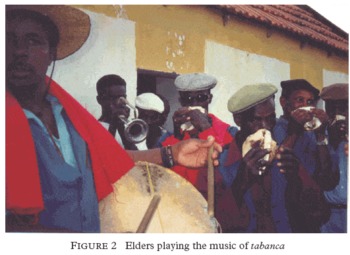
Armamento is one of the criteria used by the local population to judge the vitality of their tabanca. Through this category, people evaluate the exteriority of the institution, its appearance, pomp and grandiosity, in short, the way it presents itself as the unit that represents a particular community to other communities during the processions throughout the vicinity. The armamento of the tabanca consists of the standardized uniforms worn by their members: the aprons and the ornamented hats with shreds of coloured ribbons used by women, the red kerchiefs decorating the necks of horn players and drummers, the appropriate outfits to dress as ‘police’, ‘doctors’, and ‘nurses’ who fine and offer ‘medical consultations’ to passers-by during the processions. Decorations such as banners and flags are also part of the armamento. Some associations carry other decorations such as wooden arms on the backs of the soldiers and scale replicas of ships and planes. The drums, the conch horns, called cornetas, and the bugle are also part of the armamento. These are the musical instruments that compose the band that plays the tabanca's music in the processions to the rei de agasalho's residence and during the playful activities that occur after the large communal meals. The conch horns are large sea shells into which a small mouth hole is drilled. They produce an intense sound, the pitch of which varies according to the size of the shell. Ideally, a tabanca should have a very large corneta that produces a deep sound and two pairs of cornetas with more high pitched sounds, making a minimum of five. There are two or three drums, but the poorest associations have only one, which can sometimes be in very bad shape. The bugle is highly valued, though few tabancas possess one.
Having a strong armamento requires having enough drums, horns and bugles to play good tabanca music. It also means being able to provide clothes with the colours of the saint for female members, neckerchiefs for musicians, military uniforms for commanders and soldiers, professional uniforms for ‘doctors’ and ‘nurses’, coloured banners and flags, and other decorations. In addition, it means having a procession in good order, in a rigorous Indian file, with many consultations and fines, in order to please the saint and to make the celebration exciting. However, the conditions required to maintain a good armamento are not always met. It is common for funds to run short when buying fabric to make uniforms for the filhas de santo. And when these funds exist, there are not always enough people able to make these in the necessary quantities. The simple flags of the popular saints are relatively easy to make, but it is not always possible to find the colourful banners and flags that make the marches more joyful and colourful. Military uniforms and doctors’ and nurses’ clothes are not easy to find in these areas. Gifts sent by the emigrants somewhat reduce these shortages. The majority of Cape Verdeans abroad work in jobs that require few qualifications. They are security guards, nightwatchmen, janitors, and unskilled workers in supermarkets, hospitals, restaurants and other service companies. It is thus very common that their working clothes, diverted from their original context, serve to emulate military and professional uniforms such as doctors and nurses. It is also common for them to send these pieces of clothing as presents to family members or to bring them back on their many trips home.
Flags are a more interesting case. Those that are raised over the capela stand for the patron saints and are as simple as possible, symbolizing the poverty and purity of the devotees. During the processions, the tabanca carries, along with the patron saint's flag, others of a very different nature: colourful in the extreme, with very different outlines that reveal the operation of a syncretic thinking that voraciously assimilates everything that falls into its grasp, they provide colour and liveliness to the long processions the group makes to the houses of the reis and rainhas de agasalho. These emblems of vitality and joy reflect the peculiar form that Cape Verdeans have found for the reproduction of their society, characterized by the ideology of emigration. Only in a society of emigrants is it possible to find as daily objects – presents from those who have left to those who stayed home – flags of football teams from places as different as Spain, Portugal and Turkey. It is only in a Creole society that incorporates everything at hand that one can find, as symbols of the locality, anything as extra-local as the national flags of various countries, with the American and Portuguese flags being the most common, or the odd banners of the globalized world in which foreign national colours and symbols (American, Jamaican) are mixed with mass culture heroes such as Michael Jackson and Bob Marley (cf. Trajano Filho 2005).
Musical instruments are also powerful symbols of the tabanca. Bugles are much appreciated, and I think that their high value derives from the fact that they are motivated symbols which vividly evoke the ideas of strength and order that distinguish the instrument's original context of use, that is, the military universe. In this way they are especially fit to function as a sign of the association's vitality. The easiest way to obtain this desired object of prestige is to manage to get someone to send one from abroad. This is what happened with the tabanca of Achada Leite, which received an old bugle as a gift from an emigrant living in France. This instrument became the object of admiration and has since granted the association great distinction. The case of the conch horns is more interesting because it reveals an older flow and in a different direction from the flows dealt with above. Rare goods with conditions of production and supply that cannot meet local demands, the sea shells from which the cornetas are made are no longer found on the island of Santiago. They confer much prestige on the associations that possess them. The horns are so important that some of them receive names and have their own histories, known all around the local neighbourhoods (like the objects of kula).
Other types of gifts also contribute to the ritual effectiveness of the tabanca festivals in so far as they bring the actual celebrations close to the idealized model of what makes a good festival. On the altars set up in honour of the patron saint, always overloaded with objects and offerings, various religious images and statues can be found. Mass produced and sold at low prices in churches and shrines of Catholic pilgrimages in Europe, the paper images of Our Lady and plaster statues of Saint Anthony and Saint John are much appreciated by the devotee peasant families of Santiago. Aware of this devotion, those who emigrate send or bring these objects as gifts to relatives whenever they can. These are much valued because they make the tabanca's altars sacred and display the pride the peasant communities have in their Christian faith.
The financial remittances contribute to the proper functioning of the tabancas at various levels. The most common are remittances made directly to the leaders of the associations from devotees living abroad. These gifts show the extreme devotion that binds the Cape Verdean people to the popular saints and the powerful feeling of relatedness that links them to their communities, despite the physical distance. Sums that, when converted, vary from €10 to €20 are sent for the saint's festival and are exhibited on the altar. In some tabancas, the amount sent from abroad can exceed €100, which represents up to 10 per cent of the money raised in the festivities. However, the most common form through which the financial remittances of emigrants have impact on the reproduction of these institutions has to do with the monetization of the local economy. A substantial part of the money that circulates locally comes directly from the remittances of those who live abroad. This is the money that many emigrants send regularly for the livelihood of parents, children and wives who remain at home, for the construction of the house in which they dream of living when they return to stay, or to pay for the leasing of the hortas being looked after by relatives, among many other purposes. These are the resources that drive the monetized part of the local economy. Thanks to them, the local population acquires goods not produced in Cape Verde. With this money the tabanca leaders can buy the cloth used in making the outfits worn by the filhas de santo and the pigs and goats for the feasts.
One consequence of these financial remittances on the ritual effectiveness of the festivities and on the reproduction of these Creole brotherhoods deserves consideration. The idealized model of the functioning of the tabanca establishes that each association should have a chapel for the altar of the patron saint. However, only two tabancas, among the nine in which I collected information, had their own chapels. Finding a house to serve as the saint's chapel is a problem the tabanca leaders face almost every year. On the other hand, there are many empty houses in these areas. They were built with the money sent by the emigrants and stay unoccupied for long periods, waiting for the return, permanent or temporary, of their owners. Therefore, it is not uncommon for some of them to be lent to the tabanca for setting up the saint's altar. In doing so, the owners will enhance their prestige in the community and will be blessed by the saint.
Emigration has caused a profound impact on the organization of these peasant communities, transforming, among other things, the local landholding structure. The departure of the former Portuguese landowners after independence and the persistence of the relative neglect in the way the traditional Cape Verdean morgados deal with their properties created opportunities for people who had accumulated some capital and were willing to work the land to get access to a plot. The best candidates are those who have spent part of their lives abroad and want to return to their native land. They come back with some savings and in many cases with a regular source of income in foreign currency that comes from the retirement pensions they are entitled to after years of working abroad. They are people born in the region, who know the hardships of local agriculture and who have a network of relatives in the area ready to inform them about good opportunities that arise to buy or lease land. In this way, during the years they are abroad they buy hortas and lugares here and there, build houses and lease their newly acquired properties. When they return for good, they already have plots of land to work on and a regular source of income. This was generally the case of the leaders of the nine tabancas I visited and also of their reis de agasalho. They are relatively affluent peasants whose economic and social status was achieved through emigration. However, keeping their position depends on their involvement with traditional institutions such as the tabanca, which thus become a very dear association to them.
The traditional model of the peasant economy states that the land should be worked by the family unit. Nevertheless, the implementation of this model has become increasingly difficult because the affluent peasants are getting old and no longer have the work capacity that they had in the past. The majority of tabanca leaders are more than 60 years old. Their children are either repeating their trajectories, living abroad, or were seduced by the values of education and urbanism and moved to Praia, Assomada or other major cities of the country. Thus, despite having land to exploit, the wealthy peasants are unable to mobilize the labour force of their domestic units. With the exception of a son who might have stayed home, a grandchild they are raising, a godchild, or an available client, these affluent people constantly face the problem of lack of help for agricultural work, a problem that becomes more acute in relation to the irrigated hortas, which require work for the greater part of the year.
When the family labour force is insufficient to carry out the necessary agricultural work, the affluent peasants contract local young people to work for a few days. In general this is done during the period of clearing the lugares where corn and beans are grown (which requires intensive work approximately three times during the agricultural cycle), for the planting of vegetables in the hortas, and for the cutting of the cane and distillation of the juice. However, the work paid on a daily basis is not well regarded either by those who hire it or by those who are hired. The latter regard this kind of work as something that grants little or no prestige, as it is badly paid and irregular. To them it means mostly a temporary arrangement rather than a permanent way of earning a living. Nor is it the best solution for those who do the hiring. They complain about the lack of dedication of the people they hire, the lack of money to pay them and the shortage of people willing to work. Daily work contracts are not well regarded by the two parties involved because they are, if taken in isolation, a relatively inefficient form of reciprocity and suggest a deficit of sociality on the part of those involved in the contract. As a mere economic transaction, they do not generate other obligations or social bonds.
The absence of sociality which characterizes the daily work contract is intensified by the circumstances of emigration associated with the spatial distribution of the settlements in the region and the dispersal of the parcels of cultivated land. The scarcity of young adults in these areas has become even more serious because the hortas or lugares that a family cultivates are highly dispersed. Ideally, the shortage of labour force in any given location could be mitigated through various arrangements such as the direct exchange of labour between neighbouring or related families, or else through the seasonal employment of dependants and godchildren. These arrangements could be viable and efficient when, for example, a rendeiro from Lem Cabral leases a horta in Engenho and uses the work of a godchild or dependant who lives either near him or in Engenho, close to the leased plot of land. However, the model starts to unravel when the same person has a second horta in Sedeguma, as well as growing crops in a lugar in Achada Grande and another in Achada Galego. It is improbable that such a person will have enough dependants, godchildren and relatives scattered in so many places at the same time. It is thus more usual to use daily contracts. Nonetheless, the risks of hiring people from different areas are high, since relationships with these people are not always regular and long-lasting.
The tabancas operate in this context to reduce the constraints on the system of production centred on the activities of the returnees. Having reis and rainhas de agasalho who live in other villages, offering collective meals to locals and guests from other communities, and through the colourful and noisy processions that wind their way through the streams, valleys and peaks of the Santiago hinterland, these Creole brotherhoods integrate dispersed communities at the same time as they convey a feeling of identity to their members. If we take a tabanca as a knot in a network of relationships, it is possible to observe immediately the way it integrates communities that are spatially separated and strengthens the existing relationships among them. Exchanges between the members of these associations are intense and regulated by the kinship ties that unite the key individuals in this web of relationships. The rei of Mato Sancho who lives in Gamboa is an in-law of the head of the Achada Grande tabanca, who in turn is the cousin of the rei of Mato Sancho. Some provide services to the others, get people to work on the land of the others, and offer all sorts of solidarity in life-crisis situations such as sickness and death.
During the festivities in honour of the patron saints, the tabancas present themselves to the residents of the neighbouring villages as the institution that represents the community. The entire community needs to be mobilized for the saint's festival. In addition, it is also necessary to accumulate the material resources to carry out the big commensal rites, efficiently distribute tasks such as the making of uniforms and decorations to be used in the processions, prepare the communal meals for all members and guests, set up the altar in homage of the patron saint, and develop efficient channels of communication among the various communities in the region. This all requires a complex coordination of activities, a significant sense of responsibility, a high decision-making capacity, an enormous amount of time, a complex division of labour, a long repertoire of routines, and complex practical knowledge that has to do, among other things, with handling rules of accounting, recording material transactions and manipulating social hierarchies and the distribution of power and prestige in the whole region.
The presence of the tabanca in the everyday life of the community is felt throughout the year to the extent that its members find themselves effectively linked through the reciprocity that emerges from the reciprocal exchange of services and goods. This is shown whenever a tabanca member dies. It is also shown in the exchange of services among its members, which constitutes a way of overcoming the obstacles created by the shortage of labour force within domestic units and the lack of financial resources to pay workers on a daily basis. Governing a complex network of mutual assistance (the junta mon) concerned with the activities of the various stages of the agricultural cycle, the association acts as a kind of social glue for relations that otherwise would be purely economic and lack any social value. In the domain of agricultural production, in addition to the organization of the collective work associated with the junta mon system, the tabanca helps the most affluent peasants to get people to work on their land in exchange for the gifts that, as reis de agasalho, they offer for two or three years to the association. And even when this work takes the form of a daily work contract, the reciprocity existing among the parties due to the activities of the tabanca reduces the risks of radical utilitarianism militating against sociality.
CONCLUDING REMARKS
Scholars who have studied the tabancas argue that they are going through a process of folklorization and that the spectacle is becoming more important than the religious and functional aspects (Semedo and Turano 1997: 112). They are certainly changing; their festivities increasingly depend on state resources and the mutual-aid activities are being reduced and becoming more specialized. The participation of community members in the festivities has faltered, as has the duration of the cycle of ceremonies. Their reduction to a spectacle, most visible in the associations in Praia city, can also be seen in some of the tabancas in the interior, especially during political campaigns, when candidates from all parties use tabanca music to enliven their political meetings, either paying for the labour of the horn players and drummers or persuading the leaders of the associations, who act as political brokers, to recruit in their communities a group of adherents and dependants for this purpose.
In this article I have sought to show that the tabancas in the interior of Santiago are nevertheless going through a period of vitality, despite the perspective of Cape Verdean intellectuals and the recurrent discourse about its present weakness. I have argued that its vitality maintains a series of traditional values such as the belief in the power of saints as the providers of health, fertility and bountiful harvests in the fields and in the life of people, the local forms of reciprocity such as the junta mon, very important in the organization of collective work, and the traditional modes of expression of power, manifested in the importance attributed to the pomp and the liveliness of the processions, the colours of the banners and uniforms, the intense sounds of the horns and drums, the altars overloaded with offerings and images, and the abundant food and drink. In addition, adherence to the tabanca law contributes to the maintenance of the Creole ethos characterized by the value of seniority, the social distance between the sexes and the absence of anxiety in relation to physical separation. Working in this way, the tabancas contribute to the conservative reproduction of society. This does not mean that social life in these peasant communities is static or that migration brings about no change. Certainly, the repertoire of cultural symbols is enlarging and changing as people experience other realities abroad. Together with the flows of people and goods, people living in the hinterland of Santiago have to deal with new forms of organizing activities, new items of knowledge and new modes of being related. However, behind this unending flux, the most basic features of social and cultural structure insist on continuing to work.
Curiously, the conservative aspect is expressed here in the practice of social actors who are generally viewed in the social sciences as inducers of change: the emigrants. In the traditional version of migration studies, they are what Robert Park (1928) called marginal men, that is, liminal beings who have abandoned the values of their communities of origin, but who have not yet acquired the necessary skills to navigate in the new place of residence. In the contemporary version of transnational studies, they are the hybrid travellers who, divided among multiple belongings, subvert, in the national sphere, the dogma of the nation state and, at the local level, the primordial values of communities. However, in the case examined here, the flow of emigrants and objects operates in the direction of maintaining traditional values and practices rather than introducing structural changes or causing ruptures. As part of a dynamic Creole society, the communities in the interior of Santiago use new elements in their practices and institutions. However, in the process, they incorporate these new elements as something of their own, giving them new meanings and making them carry out traditional functions. In other words they ‘creolize’ them anthropophagically.
This mode of action expresses a deep identity between the cultural syntax of the Creole world and the West African political culture. The emigrants who return or who send goods and resources back home mirror, as their Creole equivalents, the frontiersmen in African societies. They are the product of structural forces that in Africa, for different historical reasons, push people out of their communities. And likewise here, according to the frontier model, they seek to reproduce creatively a traditional mode of life. However, differently from the African frontiersmen, the peasants of Santiago live in a small island with no open frontiers. In order to fulfil their ideal of a good life, they have to be separated from their communities, live a liminal life abroad, waiting for the moment to return: only then can they embrace their destiny as full persons. In the context of the tabancas, the relatively affluent peasants, who have achieved their status thanks to the economic and social capital accumulated while they were embarcados, mix with the poorer people from the small villages to put into action a broad network of reciprocity that has guaranteed over the years the reproduction of the structure of differences that is peculiar to the Creole society of Santiago.
Tabanca procession carrying the gifts from the rei de agasalho

Elders playing the music of tabanca