Introduction
Solemyidae is a family of primitive bivalves with a widespread distribution from tropical to temperate latitudes and intertidal to below 5000 m depth (Allen, Reference Allen1979; Zardus, Reference Zardus2002; Taylor and Glover, Reference Taylor, Glover and Kiel2010). Extant solemyids are euryhaline, some broadly tolerant to salinities >34 ppt and <20 ppt after acclimatization (Castagno and Chanley, Reference Castagno and Chanley1973). They are well known for their ability to live under oxygen-poor conditions through symbiosis with chemoautotrophic bacteria oxidizing sulfur (e.g., Reid and Brand, Reference Reid and Brand1987; Fisher, Reference Fisher1990; Distel, Reference Distel1998; Stewart and Cavanaugh, Reference Stewart and Cavanaugh2006). They live infaunally in silty to sandy sediments and are able to swim briefly through expulsion of a water jet from their posterior opening (Reid, Reference Reid1980).
Externally, solemyids are difficult to distinguish based only on valve morphology (Neulinger et al., Reference Neulinger, Sahling, Süling and Imhoff2006). They possess thin aragonitic valves with a high content of organic matrix (Taylor et al., Reference Taylor, Kennedy and Hall1969). The valves are equilateral, anteriorly elongate, subcylindrical, with dorsal and ventral margins usually parallel, and with an edentate hinge that represents an early apomorphic trait (see Bailey, Reference Bailey2011, and references therein). Studies using electron microscopy show a wide variety of shell microstructures, from outer layers characterized by radially elongate simple prismatic structures to reticulate structures not known in any other mollusk, and inner layers with laminar, homogeneous, and irregular complex crossed-lamellar structure (see Sato et al., Reference Sato, Nakashima, Majima, Watanabe and Sasaki2013b). They are covered externally by a coarse and shiny periostracum that frequently extends over the shell margin. Taxonomically, there are two modern genera, Solemya Lamarck, Reference Lamarck1818 and Acharax Dall, Reference Dall1908, which are principally distinguished by the position of the ligament, internal or external, respectively (e.g., Cox et al., Reference Cox, Newell, Boyd, Branson, Casey, Chavan, Coogan, Dechaseaux, Fleming, Haas, Hertlein, Kaufmann, Keen, LaRocque, McAlester, Moore, Nuttal, Perkins, Puri, Smith, Soot-Ryen, Stenzel, Trueman, Turner, Weir, Moore and Teichert1969; Coan and Valentich-Scott, Reference Coan and Valentich-Scott2012).
Fossil representatives of Solemyida are known since the Early Ordovician (Cox et al., Reference Cox, Newell, Boyd, Branson, Casey, Chavan, Coogan, Dechaseaux, Fleming, Haas, Hertlein, Kaufmann, Keen, LaRocque, McAlester, Moore, Nuttal, Perkins, Puri, Smith, Soot-Ryen, Stenzel, Trueman, Turner, Weir, Moore and Teichert1969; Pojeta, Reference Pojeta1988; Cope, Reference Cope1996, Reference Cope, Harper, Taylor and Crame2000; Bailey, Reference Bailey2011). Recent phylogenetic analyses suggest that both Solemya and Acharax have an early Paleozoic origin (Sharma et al., Reference Sharma, Zardus, Boyle, González, Jennings, McIntyre, Wheeler, Etter and Giribet2013), and are probably among the most ancient chemosymbiotic bivalves (Taylor et al., Reference Taylor, Glover and Williams2008). Despite this early origin, the evolutionary history of the group is poorly documented and the fossil record shows many gaps along the Phanerozoic (Vokes, Reference Vokes1955; Pojeta, Reference Pojeta1988), although the record at fossil seeps seems relatively good in comparison (e.g., Kiel, Reference Kiel and Kiel2010; Hryniewicz et al., Reference Hryniewicz, Jakubowicz, Belka, Dopieralska and Kaim2017). The solemyid fossil record from the Miocene is concentrated in the Northern Hemisphere with representatives known from Japan (Amano and Little, Reference Amano and Little2005; Amano and Ando, Reference Amano and Ando2011), Russia (Ilyina, Reference Ilyina1963), the Mediterranean (Taviani et al., Reference Taviani, Angeletti and Ceregato2011), Oregon (Moore, Reference Moore1963), Cuba (Cooke, Reference Cooke1919), Panama and Costa Rica (Olsson, Reference Olsson1942), and Barbados and Venezuela (Gill et al., Reference Gill, Harding, Little and Todd2005). The only record from the Southern Hemisphere, apart from some undescribed species from New Zealand (Marwick, Reference Marwick1931; Vokes, Reference Vokes1955; Saether et al., Reference Saether, Sha, Little and Campbell2016), seems to be Solenomya antarctica Philippi, Reference Philippi1887, coming from the early Miocene of central Chile (33°S). However, since Philippi's (Reference Philippi1887) work (simultaneously published in German and Spanish), no other specimen has been described. The first confirmed specimen of the family in ca. 130 years comes from the Arauco Peninsula (Kiel and Nielsen, Reference Kiel and Nielsen2010, tab. dr1), at ~37°S, and is described here as a new species along with a discussion of Solenomya antarctica Philippi, Reference Philippi1887.
Geological setting
The material described here comes from the Ranquil Formation on Arauco Peninsula, south-central Chile (Fig. 1), consisting mostly of mudstones with intercalated sandstone beds. It unconformably overlies the Eocene Millongue Formation and underlies the Huenteguapi Sandstone (Le Roux et al., Reference Le Roux, Nielsen, Kemnitz and Henriquez2008) with an erosional discontinuity. The studied material comes from locality RAN (37°30'25”S, 73°35'28”W; WGS84), consisting of massive brown sandstones with intercalations of greenish glauconite-bearing sandstone beds exposed at coastal bluffs and the intertidal platform. Nielsen and Glodny (Reference Nielsen and Glodny2009) gave an age of ca. 21.8–19.4 Ma using strontium isotope stratigraphy for this locality, and Finger (Reference Finger2013), using biostratigraphy, gave its age as 22.5–17.5 Ma based on the occurrence of the planktic foraminifera Paragloborotalia mayeri (Cushman and Ellisor, Reference Cushman and Ellisor1939), Catapsydrax dissimilis (Cushman and Bermúdez, Reference Cushman and Bermúdez1937), Globoquadrina dehiscens (Chapman, Parr, and Collins, Reference Chapman, Parr and Collins1934), Gq. praedehiscens Blow and Banner, Reference Blow, Banner, Eames, Banner, Blow and Clarke1962, Globigerina praebulloides Blow, Reference Blow1959, G. venezuelana Hedberg, Reference Hedberg1937, Globigerinoides trilobus (Reuss, Reference Reuss1850), and Globoturborotalia woodi (Jenkins, Reference Jenkins1960). Benthic foraminifera support a bathyal paleobathymetric interpretation for this locality based on a high number of species ranging from the upper to lower bathyal (Finger, Reference Finger2013). The accompanying molluscan fauna includes, among others, Ameranella verruculosa (Sowerby, Reference Sowerby1846), Astele chilensis (d'Orbigny, Reference d'Orbigny1852), Aturia cubaensis (Lea, Reference Lea1841), Cancellaria medinae Philippi, Reference Philippi1887, Distorsio ringens Philippi, Reference Philippi1887, Echinophoria monilifera (Sowerby, Reference Sowerby1846), Glossaulax pachystoma (Hupé, Reference Hupé and Gay1854), Lamprodomina dimidiata (Sowerby, Reference Sowerby1846), Neilo volckmanni (Philippi, Reference Philippi1887), Pachycymbiola vidali (Philippi, Reference Philippi1897), Panopea sp., Sassia armata (Hupé, Reference Hupé and Gay1854), Scaphander remondi (Philippi, Reference Philippi1887), turritellids, Zeacuminia costellata (Sowerby, Reference Sowerby1846), and Zygochlamys hupeanus (Philippi, Reference Philippi1887) (Nielsen et al., Reference Nielsen, Frassinetti and Bandel2004, Reference Nielsen, Bandel and Kröger2009; Nielsen and Frassinetti, Reference Nielsen and Frassinetti2007a; Griffin and Nielsen, Reference Griffin and Nielsen2008; Beu, Reference Beu2010), and is typical for lower Miocene units equivalent to the Navidad Formation (Kiel and Nielsen, Reference Kiel and Nielsen2010). Contrary to the microfossil record, these species represent a rather shallow-water environment (Finger et al., Reference Finger, Nielsen, DeVries, Encinas and Peterson2007). A detailed sedimentological description and evaluation of depositional environment and processes to clarify these ambiguous data, however, is lacking.
Type localities of early Miocene Solemyidae from Chile. (1) Approximate type locality of Solemya antarctica Philippi, Reference Philippi1887 from the Navidad Formation at the mouth of the river Rapel; (2) type locality of Solemya lucifuga n. sp. from the Ranquil Formation.

Materials and methods
For this work, the collections of the Museo Nacional de Historia Natural in Santiago, Chile, were revised for fossil solemyids. These include the collections of Philippi and Tavera, the latter having been transferred partially from Universidad de Chile.
Repositories and institutional abbreviations.—Museo Nacional de Historia Natural (MNHNcl), Santiago, Chile; Invertebrate Paleontology Collection (SGO.PI.) of MNHNcl; Museo de Zoología. Facultad de Ciencias Naturales y Oceanográficas, Universidad de Concepción (MZUC-UCCC), Concepción, Chile.
Systematic paleontology
Class Bivalvia Linnaeus, Reference Linnaeus1758
Subclass Protobranchia Pelseneer, Reference Pelseneer1889
Incertae sedis
Solemya? antarctica Philippi, Reference Philippi1887
Figure 2
- Reference Philippi1887
Solenomya antarctica Philippi, p. 186, pl. 42, fig. 5.
- ?Reference Tavera1942
Solenomya antártica [sic]; Tavera, p. 602.
- ?Reference Tavera1979
Solenomya antarctica; Tavera, p. 139.
- ?Reference Bernard1983
Solemya (Petrasma) antarctica; Bernard, p. 9.
- Reference Villarroel and Stuardo1998
Solenomya antarctica, Villarroel and Stuardo, p. 169.
Solemya antarctica Philippi, Reference Philippi1887. Original drawing of holotype from Philippi (Reference Philippi1887). Specimen length is 11 mm.

Holotype
Philippi (Reference Philippi1887) indicated the existence of a single specimen, which would be the holotype, that appears lost from the SGO.PI. collections. Other materials mentioned from Arauco and Navidad (Tavera, Reference Tavera1942, Reference Tavera1979), as well as a possible solemyid from Chiloé (Tavera et al., Reference Tavera, Valdivia and Valenzuela1985), were also not found in the collections. The type locality is the mouth of the Rapel River (original designation), Navidad, Navidad Formation.
Occurrence
Navidad Formation, lower Miocene.
Description
From Latin, according to Philippi (Reference Philippi1887, p. 186), “Shell elongate, rounded at both ends, anterior slightly narrower; radials not much impressed, descending from apex to posterior end; apices situated at fifth part of length. Length almost 11 mm.”
Remarks
The generic name, Solenomya, used by Philippi is an unjustified emendation by Children (Reference Children1823) of the valid name Solemya Lamarck, Reference Lamarck1818 (Cox et al., Reference Cox, Newell, Boyd, Branson, Casey, Chavan, Coogan, Dechaseaux, Fleming, Haas, Hertlein, Kaufmann, Keen, LaRocque, McAlester, Moore, Nuttal, Perkins, Puri, Smith, Soot-Ryen, Stenzel, Trueman, Turner, Weir, Moore and Teichert1969). Note that Philippi (Reference Philippi1887) had taken the anterior (longer) for the posterior (shorter) part. He did not mention internal characters because the specimen was included in a “large rock.” The type material is not available and the limited information given by Philippi (Reference Philippi1887, p. 186, pl. 42, fig. 5) in text and figure is insufficient to clarify the generic position of this species. The position of the ligament (internal or external) is of prime importance to differentiate between the two principal solemyid genera, Acharax Dall, Reference Dall1908 and Solemya Lamarck, Reference Lamarck1818 (see Cox et al., Reference Cox, Newell, Boyd, Branson, Casey, Chavan, Coogan, Dechaseaux, Fleming, Haas, Hertlein, Kaufmann, Keen, LaRocque, McAlester, Moore, Nuttal, Perkins, Puri, Smith, Soot-Ryen, Stenzel, Trueman, Turner, Weir, Moore and Teichert1969; Taylor et al., Reference Taylor, Glover and Williams2008; Coan and Valentich-Scott, Reference Coan and Valentich-Scott2012). Nevertheless, several unique characters emphasized by Philippi deserve attention. The presence of a small and acute apex from which subtle radial grooves start that run in an oblique manner over the anterior half would not be a preservational artifact. Philippi asserted that the specimen was well preserved. Due to its small size, it is not clear if it represented a juvenile or an adult. Philippi had doubts in this respect, although he accepted the possibility of it being an adult comparing it with Solemya velum Say, Reference Say1822, a species of barely larger size now living in the North Atlantic. The general characters described by Philippi are consistent with a solemyid. However, similar external morphologies exist in some Siliculidae (Nuculanidae). For example, the figure given by Philippi resembles juveniles of Silicula rouchi Lamy, Reference Lamy1911, a species now living in circum-Antarctic waters (Engl, Reference Engl2012). The form and position of the apex (small and acute) and the presence of subtle radial grooves in the antero-dorsal region are similar. A direct examination of several specimens present in the MZUC-UCCC collection confirm this similarity. Internally, Siliculidae are easily separable from Solemyidae by the presence of elongated teeth that run in an oblique manner along the dorsal margin (Allen and Sanders, Reference Allen and Sanders1973). However, internal features of Philippi's species are not known.
Despite the mentioned limitations, this species cannot be considered anything other than a protobranch, although the generic position as well as the family remain unclear. Therefore, following the opinion of Philippi (Reference Philippi1887), the type genus of Solemyidae, Solemya Lamarck, Reference Lamarck1818, is maintained with certain doubt.
Tavera (Reference Tavera1942, p. 620) mentioned a Solenomya antártica [sic] from the “clays of the Navidad Beds of Isla Santa María,” Gulf of Arauco, together with Limopsis and Balaeonoptera? bones. He considered that this specimen was “identical to Solenomya rossiana Wilckens” from the Cretaceous of Seymour Island, Antarctica. However, the holotype illustrated by Wilckens (Reference Wilckens1910; see also Little et al., Reference Little, Birgel, Boyce, Crame, Francis, Kiel, Peckmann, Pirrie, Rollinson and Witts2015, p. 220, fig. 5K) differs from this claim—its outline and ornamentation differing clearly through an oblique truncated anterior margin, the dorsal and ventral margins being divergent and not paralleled and its ornamentation is less dense than in Solemya? antarctica Philippi. Tavera added that his specimen was about the size of the Cretaceous species of Wilckens. The lower Miocene Ranquil Formation actually crops out on Isla Santa María (Melnick et al., Reference Melnick, Bookhagen, Echtler and Strecker2006), but the comments of Tavera suggest the existence of a species different from Solemya? antarctica.
Later, Tavera (Reference Tavera1979, p. 73) mentioned that he obtained his specimen in situ from the Navidad Member (Navidad Formation, sensu Encinas et al., Reference Encinas, Le Roux, Buatois, Nielsen, Finger, Fourtanier and Lavenu2006). Unfortunately, this specimen, as well as the one from Santa María Island, was neither described nor illustrated for comparison. Tavera added that Solemya? antarctica is also present in the Eocene of Arauco Peninsula (Tavera, Reference Tavera1979, p. 76). A sample in the Tavera collection at MNHNcl is labelled as Solenomya sp. (SGO.PI.19079) coming from Docas Island, situated immediately off the coast of Mocha Island (to the south of Arauco). The label says Eocene, which coincides with the local geology. The lithology also agrees with the material listed previously as Solenomya sp. by Tavera and Veyl (Reference Tavera and Veyl1958, p. 171), who referred to this material as part of an assemblage correlated with the Millongue Formation (Eocene of Arauco). However, examination of specimen SGO.PI.19079 revealed that there is no solemyid among the various taxa present in the rock sample. The presence of Solenomya araucana Philippi, Reference Philippi1887 in the Chilean Eocene, or any other solemyid from this age, remains doubtful until a revision of the Paleogene faunas from Arauco.
This species was also listed as extant (Bernard, Reference Bernard1983) with the combination Solemya (Petrasma) antarctica Phillippi, Reference Philippi1887. Unfortunately, Bernard did not give more specific data, apart from a fossil record since the Miocene, living at 50°S, in 40 m depth, and at 3–11°C temperature. He also did not indicate where the examined material was housed and the Museo Nacional de Historia Natural in Santiago is not among the institutions listed, so apparently the type material was not consulted. Furthermore, the inclusion of Philippi's species in Petrasma Dall, Reference Dall1908 raises further doubts, since, as mentioned previously, its internal characters were never described. It is more likely, that the extant material seen by Bernard belongs to a different taxon.
According to Villarroel and Stuardo (Reference Villarroel and Stuardo1998), Solenomya antarctica Philippi, Reference Philippi1887 is the only fossil solemyid appropriately included in the genus Solemya. However, these authors did not provide any evidence to justify this claim nor did they consult the type material.
Order Solemyida Dall, Reference Dall1899
Superfamily Solemyoidea Gray, Reference Gray1840
Family Solemyidae Gray, Reference Gray1840
Genus Solemya Lamarck, Reference Lamarck1818
Type species
Solemya mediterranea Lamarck, Reference Lamarck1818 by subsequent designation of Children (Reference Children1823) (=Tellina togata Poli, Reference Poli1795). Extant, Mediterranean Sea.
Solemya (s.l.) lucifuga new species
Figure 3
- ?Reference Tavera1942
Solenomya antártica [sic], Tavera, p. 620.
- ?Reference Tavera and Veyl1958
Solenomya sp., Tavera and Veyl, p. 171.
- Reference Kiel and Nielsen2010
Solemya sp., Kiel and Nielsen, tab. dr1.
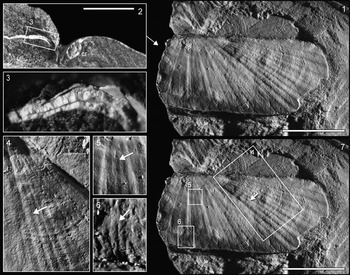
Solemya lucifuga n sp. holotype SGO.PI.23102. (1, 7) General view of the valves in butterfly position; (2) view of posterior area showing thickening of shell giving way to the chondrophore (cr) where the internal ligament is situated; white arrow indicating position of detail; (3) enlarged detail of the thickened shell through superposition of aragonite layers; (4–6) details of bifurcating ribs indicated in (7). Scale bars 5 mm.

Holotype
Holotype SGO.PI.23102. A two-valved specimen in butterfly position. Right valve visible, left valve in matrix. Type locality is the intertidal platform at Ranquil (RAN), Ranquil Formation, Arauco.
Diagnosis
Solemya with parallel ventral and dorsal margins. Ornamentation of >20 dense radial ribs and narrow interspaces, which cover the whole shell surface. Ribs sometimes bifurcate.
Occurrence
Ranquil Formation (RAN), lower Miocene.
Description
Valves small (27 mm incomplete length, 12.5 mm height), thin, equivalve, inequilateral, compressed. Outline elongate–subquadrate, anterior end elongate and well rounded. Posterior end partly unknown. Dorsal and ventral margins straight, parallel. External ornamentation weak, consisting of many narrow, poorly defined, radial ribs (~20 visible) of variable width, some bifurcating. Anteriorwards, ornamentation getting stronger. Interior unknown, except for chondrophore seen in fracture surface.
Etymology
From the Latin lucifugum (n) in feminine declination, lucifuga. Shy of the light. Figurative in the sense of reluctant to be discovered.
Remarks
This is the specimen listed by Kiel and Nielsen (Reference Kiel and Nielsen2010, tab. dr1). The posterior end is broken and therefore prevents knowing total shell length and rib count. The section view shows a limited thickening of the shell in the form of a swelling situated behind the dorsal margin. This feature differs from Acharax Dall, Reference Dall1908, where a similar swelling would be the place for the nymph projecting farther than the margin and where the external ligament would be attached (for reference, see Taylor et al., Reference Taylor, Glover and Williams2008, fig. 1; Bailey, Reference Bailey2011, text-fig. 2; Walton, Reference Walton2015, fig. 1). The visible structure (swelling; Fig. 3.3) corresponds to development of the chondrophore (Kamenev, Reference Kamenev2009, figs. 2–6). The ligament of the new species is internal, such as occurs in Solemya Lamarck, Reference Lamarck1818 and its subgenera (Solemya, Petrasma, Zesolemya, Austrosolemya, Solemyarina). Absence of an internal view does not allow interpretation of other structures, therefore impeding precision of its taxonomic position. Due to this, the new species is treated as Solemya in a broad sense (s.l.).
Solemya lucifuga n. sp. is characterized by the high density of ribs, which are rather narrow and vary in width (~0.3–1.0 mm), thus giving the shell a slightly irregular appearance. The ribs are little divergent among each other, with generally narrow interspaces. Solemya lucifuga n. sp. can be differentiated from Solemya? antarctica Philippi, Reference Philippi1887, by its outline and the presence of ornamentation on the whole shell surface. Other solemyids, such as the extant Acharax patagonica (Smith, Reference Smith1885), show an ornamentation that broadens notably towards the margin. Similarly, it differs from A. yokosukensis Kanie and Kuramochi, Reference Kanie and Kuramochi1995, from the Miocene of Japan (Amano and Ando, Reference Amano and Ando2011), and from the extant A. johnsoni (Dall, Reference Dall1899), both of which show strong ribs of low density and, therefore, with wider interspaces. Solemya lucifuga n. sp. differs from the Oligocene S. lomitensis Olsson, Reference Olsson1931, from Lomitos in Peru, by the smooth and polished shell surface of the latter, where only about six very slight radial impressions at the anterior are visible (Olsson, Reference Olsson1931). It differs from S. sulcifera Cooke, Reference Cooke1919, from the Eocene of Cuba (see Kiel and Hansen, Reference Kiel and Hansen2015, for age), whose holotype is larger but has a lower number of ribs (n = 15) while S. pateri Zinsmeister, Reference Zinsmeister1984, from the Eocene of Seymour Island (Stilwell and Zinsmeister, Reference Stilwell and Zinsmeister1992) has an ornamentation of wider ribs and narrower interspaces. It differs from Solemya sp. (Amano and Little, Reference Amano and Little2005, fig. 5G), reported from whale-fall communities in the Miocene of Hokkaido, Japan, which is higher and shorter. Solemya lucifuga n. sp. is similar to Solemya puata Walton, Reference Walton2015, a living species from New Zealand, due to the subparallel dorsal and ventral margins and a rounded anterior margin, but it can be differentiated by its denser, broader, and more regular radial ornamentation.
Taylor et al. (Reference Taylor, Kennedy and Hall1969) described the shell mineralogy and structure of Solemyoidea as consisting of two aragonitic layers, an outer prismatic one and an inner homogeneous one. This pattern seems consistent with that seen along almost the entire dorso-ventral section of S. lucifuga n. sp. although we cannot specify the structure of those layers. The knowledge about the microstructure of solemyids has been recently increased using scanning electron microscopy, showing a greater diversity of structures than previously reported (Sato et al., Reference Sato, Nakashima, Majima, Watanabe and Sasaki2013b; Sato and Sasaki, Reference Sato and Sasaki2015). Nonetheless, the number of layers and microstructure of thickened structures, such as the chondrophore in Solemya and the nymph in Acharax, where the ligament attached, have not been evaluated. Towards the end of the dorsal margin of S. lucifuga n. sp., where the chondrophore is developed, at least four layers can be seen (Fig. 3.3).
Discussion and conclusions
Since Philippi (Reference Philippi1887) described for the first time a species from Chile assigned to the Solemyidae, no other records of this group can be confirmed due to the loss of other specimens mentioned in the literature. Loss of the type material of Solemya? antarctica Philippi, Reference Philippi1887 also prevents clarifying its relation to other species. The possibility that it is a morphotype with a wide chronostratigraphic range, as indicated by Bernard (Reference Bernard1983), is at least doubtful. Although some cases exist where it has been documented that Miocene shells are indistinguishable from modern ones, such as Architectonica karsteni Rutsch, Reference Rutsch1934 (Frassinetti and Covacevich, Reference Frassinetti and Covacevich1981; DeVries, Reference DeVries1985; Nielsen and Frassinetti, Reference Nielsen and Frassinetti2007b) and Cyclochlamys argentina Pastorino and Griffin, Reference Pastorino and Griffin2018, it is more likely that the modern material had been misidentified. After Bernard's work, Petrasma atacama Kuznetsov and Schileyko, Reference Kuznetsov and Schileyko1984, has been described from the Peru-Chile Trench, while other solemyids are well known from the Southern Hemisphere high latitudes, including Acharax patagonica (=A. macrodactila Mabille and Rochebrune in Rochebrune and Mabille, 1889) (Smith, Reference Smith1885; Osorio and Bahamonde, Reference Osorio and Bahamonde1970; Osorio and Reid, Reference Osorio and Reid2004; Osorio et al., Reference Osorio, Reid and Ramajo2005) and Acharax sp. (Villarroel and Stuardo, Reference Villarroel and Stuardo1998), the latter collected from Sarmiento Channel at 51°S. Modern Petrasma are not described from high latitudes of the Pacific coast.
The holotype of Solemya lucifuga n. sp. is situated in a grayish-olive, medium- to fine-grained, well-sorted sandstone. Its valves are very fragile and the internal ligament is reduced, typical of Solemya (s.l.). The preservation of both valves semi-articulated and in butterfly position suggests depositional conditions of very low energy. Deep-sea, soft-sediment environments provide pronounced stability and homogeneity over long periods of time (Allen, Reference Allen1979). The presence of an articulated chimaeriform fish (G. Arratia, unpublished manuscript) from the same beds supports this interpretation, while benthic foraminifera indicate a bathyal depth of ~1500 m (Finger, Reference Finger2013). A bathymetric separation of mostly bathyal Acharax (>400 m) and more shallow water Solemya (<600 m) has been noted by Neulinger et al. (Reference Neulinger, Sahling, Süling and Imhoff2006) and Huber (Reference Huber2010), but deep-dwelling Solemya certainly do occur (Kamenev, Reference Kamenev2009; Sato et al., Reference Sato, Watanabe and Sasaki2013a). With regard to the bathyal depth indicated by benthic foraminifera for this locality (Finger, Reference Finger2013), this could indicate that the new species is a bathymetric exception, or that the sediment package containing it derived from more shallow water and was displaced into greater depth, as indicated by the additional mollusk fauna (Finger et al., Reference Finger, Nielsen, DeVries, Encinas and Peterson2007). The rather fragile shell and butterfly position makes a more exceptional deeper water presence of S. lucifuga n. sp. more likely, but detailed sedimentological studies are needed to clarify the situation.
More than a century since Philippi's (Reference Philippi1887) description of Solemya? antarctica, the name-bearing specimen of Solemya lucifuga n. sp. is the only confirmed solemyid from the Miocene of Chile and the only known species of Solemya (s.l.) from the Neogene of the Southern Hemisphere.
Acknowledgments
This work was financially supported by Fondecyt grant 1150664 “Miocene diversity along the coast of central to southern Chile across multiple taxa” to SNN. We thank J. Bolomey (Universidad Austral de Chile, Valdivia, Chile) for preparation of the holotype, and I. Araya (Museo Nacional de Historia Natural, Chile) and M. Ramírez (Museo de Zoología, Universidad de Concepción, Chile) for help with collections. Critical reviews by S. Kiel (Swedish Museum of Natural History, Sweden) and K. Amano (Joetsu University of Education, Japan) significantly improved the manuscript.