Implications
Positive nutritional experiences with low-quality foods can change animals’ motivation to eat them; although, this is not always translated into a higher preference for these foods when foraging. Foraging decisions are also affected by the temporal and spatial distribution of foods. We show that positive experiences with low-quality foods improve preferences only if access to high-quality foods is restricted. Animals prefer to ‘eat the best and leave the rest,’ but if the best is restricted, they ‘eat the best of the rest;’ and here is where past experiences with low-quality foods impact preferences.
Introduction
The nutritional context in which a low-quality food is ingested can affect herbivores’ subsequent behavior toward that food. For instance, intake of and preference for flavored low-quality hay by lambs is greater when its consumption is immediately followed by the ingestion of a high-quality food than when ingestion of the high-quality food is delayed (Freidin et al., Reference Freidin, Catanese, Didoné and Distel2011 and Reference Freidin, Catanese, Cuello and Distel2012). Likewise, sheep showed higher intake of grass hay when a high-quality hay (Medicago sativa L.) was introduced into the rumen than when the same grass hay was introduced (Favreau et al., Reference Favreau, Ginane and Baumont2010). A limitation to the generalization of most conditioning studies is that the conditioned stimulus is not a certain type of food but a flavor (e.g., Sclafani, Reference Sclafani1997). Testing conditioned preferences involves free-choice tests of the same food presented in different flavors (e.g., Villalba and Provenza, Reference Villalba and Provenza1999), but the results do not always correspond with those obtained in free-choice situations involving food options of greater quality (Ralphs, Reference Ralphs2005; Catanese et al., Reference Catanese, Distel, Rodriguez Iglesias and Villalba2010). For instance, sheep fed a toxin-containing plant (Centaurea maculosa Lam.) conditioned with molasses (high-energy food) showed greater intake of this plant than control sheep; however, selection of this plant during a subsequent field trial, in which palatable grasses were also present, was similar between conditioned and control sheep (Whitney and Olson, Reference Whitney and Olson2007).
In nature, choice situations are particularly complex because foods have not only diverse nutritional and toxicological properties but also variable temporal and spatial distribution (O’Reagain and Schwartz, Reference O’Reagain and Schwartz1995). This complexity has a significant impact on decision-making rules for food selection, and should be taken into consideration to better understand animals’ choices. In this regard, optimal foraging (OF) models represent a source of testable predictions about herbivores’ foraging decisions (e.g., Farnsworth and Illius, Reference Farnsworth and Illius1998). One key prediction from OF models is that the inclusion of a food in an herbivore’s diet depends on its quality and on the encounter rate with higher-quality food options (Stephens and Krebs, Reference Stephens and Krebs1986). If accessibility to the highest-quality foods is unlimited, animals are expected to select this food and to reject foods of lower nutritional quality (e.g., O’Reagain and Grau, Reference O’Reagain and Grau1995). However, restrictions in accessibility (e.g., low encounter rates) to high-quality foods increase foraging costs up to a level where it becomes more profitable to start including the lower-quality options in the diet (e.g., Dumont et al., Reference Dumont, Dutronc and Petit1998). Low-quality foods are expected to be progressively incorporated into a diet as a function of their own rewarding properties (Stephens and Krebs, Reference Stephens and Krebs1986). Herbivores can assess foods’ nutritional attributes by a learning process (Provenza et al., Reference Provenza, Villalba, Dziba, Atwood and Banner2003), and experience can be improved by the contextual situation in which a food is eaten (Freidin et al., Reference Freidin, Catanese, Didoné and Distel2011). Therefore, past experiences may have the potential to influence the inclusion of a low-quality food in the diet during the foraging period.
We hypothesized that in a choice situation involving a low- and a high-quality food, the expression of a conditioned preference for the low-quality food is modulated by the costs of foraging the high-quality food. We predicted that (1) regardless of past experiences with the low-quality food, sheep will avoid the low-quality food when a high-quality alternative is fully accessible, and (2) reductions in accessibility to the high-quality food (with a consequent rise in foraging costs) will increase animals’ motivation to include the low-quality food in the diet, and this effect will be more pronounced in conditioned relative to non-conditioned animals.
Material and methods
The study was conducted at the ‘Centro de Recursos Naturales Renovables de la Zona Semiárida’ (CERZOS) located in Bahía Blanca (38° 44' S; 62° 16' W), Argentina, from March 2012 to June 2012. All experimental protocols fulfilled animal welfare regulations of the Universidad Nacional del Sur (Bahía Blanca, Argentina), and adhere to the ASAB/ABS (2006) guidelines for the use of animals in research. Throughout the study, the sheep had free access to water and trace mineral salt blocks.
Animals, housing and training phase
A total of 24 9-month-old male Corriedale sheep (Ovis aries; 34.07±4.68 kg of live weight (LW)(mean±s.d.)) were kept as a group in a protected enclosure (20×20 m), and fed to maintenance with a mid-bloom grass hay (hereafter, ‘pasture hay;’ CP: 9.5 g/100 g, NDF: 62.3 g/100 g, ADF: 30.3 g/100 g, metabolizable energy (ME): 9.04 MJ/kg, mean particle size: 20 mm) at 1700 h.
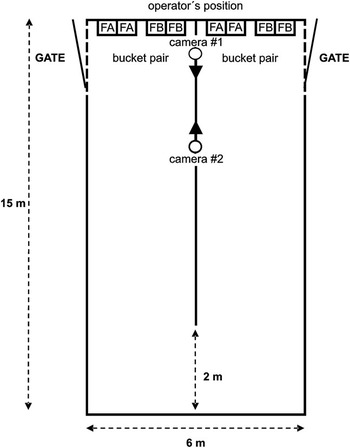
The sheep were exposed to a training phase in a U-shaped corridor (hereafter, ‘corridor,’ Figure 1) with the objective of familiarizing them with the facilities and the experimental protocol that was later used during testing. The corridor (15×6 m) was built with black canvas walls (1.5 m high), and provided at both ends a pair of plastic buckets (50×30 and 20 cm high) with two equal compartments (Figure 1). The buckets were large enough to allow a pair of sheep to eat from the same bucket with minimal interference (Lynch et al., Reference Lynch, Hinch and Adams1992).
A schematic representation of the U-shaped corridor used in the study, depicting its dimensions and placements of food buckets, video cameras, operator and gates. For illustrative purpose, FA and FB represents different foods in a pair of buckets with two equal compartments, each located at both ends of the corridor. Open circles represents video cameras, and solid arrows the direction of video recording.

Training sessions were conducted from 0800 to 1200 h, during 7 consecutive days. We decided to train sheep in pairs instead of using individual animals because social isolation is stressful for gregarious animals like sheep and may affect behavior in complex foraging environments (Dumont and Boissy, Reference Dumont and Boissy2000, Sibbald and Hooper, Reference Sibbald and Hooper2004). Sheep pairs were selected at random and blocked by LW, and were maintained throughout the experiment. During training sessions, a pair of sheep was taken at random and walked into the corridor through either of the two gates (Figure 1). Once inside the corridor, the gate was closed and 0.032% of LW (mean LW of the pair; 10.9±1.5 g, mean±s.d.) of ground corn grain (CP: 9.5 g/100 g, NDF: 11.0 g/100 g, ADF: 3.7 g/100 g, ME: 13.2 MJ/kg, mean particle size: 2 mm) was added to all feeding buckets (i.e., inside all compartments). After the sheep finished the ration of corn at one end of the corridor, we waited 3 min to see if they voluntarily moved to the other end of the corridor; if not, we walked them carefully that direction. Once the sheep started feeding at this new location, we added corn to the pair of buckets previously visited and depleted. Food was always provided by the same operator through a small window located in the wall behind the buckets; the sheep were not able to see when the depleted buckets were filled with food nor the operator that was performing this procedure. We ran this protocol until the sheep moved from one end of the corridor to the other at least five times. Once the training session was completed, we opened the gate closest to the sheep’s positions, allowing the pair to return to the communal enclosure. The same procedure was repeated until all pairs of sheep had had their daily training session. By the end of training, all pairs of sheep successfully moved from one end to the other end of the corridor without human intervention.
Treatments and conditioning phase
The day after the training phase ended, all sheep were weighed and individually penned (adjacent wooden pens of 2.5×2.5 m each) outdoors under a protective roof. All animals were randomly assigned to two treatments (12 sheep/treatment), with two restrictions on randomization: animals from the same pair were kept in the same treatment, and treatments were balanced by LW. The sheep were familiarized with the new experimental conditions for 7 days, during which time they were fed pasture hay at 2.5% of LW/day (940.7±122.3 g, mean±s.d.). After familiarization, the conditioning phase started daily from 0900 to 1000 h.
Conditioning sessions started by offering all sheep a bucket (similar to that used in the corridor) with an ad libitum amount of ground oat hay (low-quality food; CP: 6.1 g/100 g, NDF: 73.6 g/100 g, ADF: 39.7 g/100 g, ME: 7.1 MJ/kg, mean particle size: 11 mm) for 20 min (0900 to 0920 h). Then, the bucket with oat hay was removed and conditioned group (CS+) was offered a bucket with 0.4% of LW (149.3±14.3 g, mean±s.d.) of ground soybean meal (CP: 48.1 g/100 g, NDF: 13.9 g/100 g, ADF: 9.7 g/100 g, ME: 11.9 MJ/kg, mean particle size: 2 mm;) for 30 min (0930 to 1000 h), whereas the other group (control group, CS−) received an empty bucket for the same period of time. In the afternoon (1600 h), all of the sheep were fed pasture hay at 2.5% of LW (964.3±126.2 g, mean±s.d.). In addition, CS− sheep were fed soybean meal at 0.4% of LW (151.7±24.3 g, mean±s.d.), to compensate for the type and amount of food offered daily to CS+ sheep. The conditioning phase lasted 15 days.
Testing phase
The objective of this phase was to assess sheep motivation to eat oat hay as a function of previous experiences with the low-quality hay (CS+ and CS−) and the availability of a high-quality alternative (alfalfa hay; CP: 15.1 g/100 g, NDF: 49.0 g/100 g, ADF: 37.8 g/100 g, ME: 8.03 MJ/kg, mean particle size: 10 mm).
The sheep were tested in the corridor following the same protocol as for the training phase, except that the duration of each daily session was limited to 15 min and sheep were never forced to move inside the corridor. At each end of the corridor, one bucket contained oat hay in ad libitum amounts, and the other bucket contained (in both inner compartments) one of four different amounts of alfalfa hay. The amounts of alfalfa hay were: ad libitum (hereafter, ‘CHOICE,’ because both oat and alfalfa hays were freely available), high (hereafter, ‘HIGH’), intermediate (hereafter, ‘INTER’) and low (hereafter, ‘LOW’); the latter three levels corresponded to 0.20%, 0.10% and 0.05% of the average LW of the sheep pair (77.1±10.1, 38.6±5.0 and 19.3±2.5 g; respectively, mean±s.d.). The amounts of alfalfa hay used for HIGH, INTER and LOW were selected based on previous work by Dumont et al. (Reference Dumont, Dutronc and Petit1998). The position was randomly assigned daily for the oat hay and alfalfa hay in the pair of buckets at both ends of the corridor. Once the alfalfa hay was depleted, the sheep had to decide whether to stay and eat oat hay or go to the other end of the corridor to eat more alfalfa hay. Therefore, by manipulating the amounts of alfalfa hay available in the corridor, we affected the accessibility to this food; lower availability implied higher walking to obtain alfalfa hay and therefore higher foraging costs. All pairs of sheep were randomly exposed to each level of alfalfa hay accessibility in periods of 4 consecutive days. Between periods of different levels of alfalfa hay accessibility, the sheep were put in their individual pens and exposed daily to the same protocol as for the conditioning phase for 3 days (hereafter, ‘inter-testing conditioning’). This procedure was performed to avoid potential carry-over effects due to exposure to oat hay without conditioning during successive tests.
Two video cameras (Foscam FI8904W, ShenZhen Foscam Intelligent Technology Co., Shenzhen, China) were set in the corridor (Figure 1) to obtain recordings at 30 frames/s (i.e., real-time) of sheep behavior during each testing session.
Chemical analyses of feeds
All feeds used during the study were sampled each time before feeding, composited for 7 days, and then prepared for chemical determination. Composited samples were dried for 48 h at 60°C, ground using a Wiley Mill (1-mm mesh) and analyzed for CP (Association of Official Analytical Chemists, 2002; Method 990.03), NDF (without the addition of sodium sulfide; Van Soest et al., Reference Van Soest, Robertson and Lewis1991) and ADF (using NDF residue; Association of Official Analytical Chemists, 2002; Method 973.18). ME content was obtained from National Research Council’s tables (1985).
Measurements and statistical analyses
Only data from the last two sessions of each level of alfalfa hay accessibility were considered for statistical analyses. We consider that at these sessions sheep had the greatest level of exposure to the particular conditions of the test (i.e., level of alfalfa hay accessibility), and therefore, foraging behavior would be more stable than during the first sessions.
Oat and alfalfa hay intake was calculated by the difference between offered and refused amounts, whereas preference or selection (see Parsons et al., Reference Parsons, Newman, Penning, Harvey and Orr1994) for oat hay was calculated as the intake of oat hay divided by total intake (oat hay+alfalfa hay).
Video recordings were analyzed and recorded activities were: eating oat hay, eating alfalfa hay, walking, and involvement in other activities (hereafter, ‘idling’). These activities were recorded by taking instantaneous scan samples on each sheep in 15-s time intervals (Martin and Bateson, Reference Martin and Bateson1993). The time between when sheep started eating and when they stopped and started walking to the opposite end of the corridor (hereafter, ‘residence time’), as well as the time between when sheep stopped eating from the buckets at one end of the corridor until the time they start eating from the buckets at the other end (hereafter, ‘approach latency’) were also recorded.
Statistical analyses were performed using the R environment (R Core Team, 2012). Mixed effects models were evaluated during a parameters selection process according to the procedure detailed in Zuur et al. (Reference Zuur, Ieno, Walker, Saveliev and Smith2009). Model diagnostics also included testing for normal distribution, homogeneity of variance and linearity. Least square means and standard errors were obtained with the ‘lsmeans’ package (Lenth, Reference Lenth2012). All data are reported as the means±1 s.e.m.
Oat hay intake during conditioning and each inter-testing conditioning session were analyzed separately using a mixed effects model (Pinheiro et al., Reference Pinheiro, Bates, DebRoy and Sarkar2012), which included treatment (CS+ and CS−), day, and treatment×day interaction as fixed effects, and sheep as random effects. The model was fitted with an autoregressive order-1 covariance structure (χ 2 test: X 1>66.9, P<0.001 for all analyses).
Data on oat hay, alfalfa hay and total ME intake, and preference or selection of oat hay during testing, were averaged over the last 2 days of each level of alfalfa hay accessibility and analyzed using a mixed effects model. The model included treatment, level of alfalfa hay accessibility and treatment×level of alfalfa hay accessibility interaction as fixed effects, and the pair of sheep as the random effect (because we could not discriminate intake from each individuals of the pair). The model was fitted with an autoregressive order-1 covariance structure (χ 2 test: X 1>14.8, P<0.001 for all analyses), and variance heterogeneity was modeled with a potential function (χ 2 test: X 1>32.9, P<0.001 for all analyses).
Data on the proportion of scans in which sheep were eating oat hay, eating alfalfa hay, walking and idling during the testing phase, were averaged over the last 2 days of each level of alfalfa hay accessibility and analyzed using a mixed effects model. Separate analyses were run for each level of alfalfa hay accessibility because variance heterogeneity in the full model (i.e., including alfalfa hay accessibility as a factor) was significant and it could not be solved with data transformation or variance modeling. The model included treatment as fixed effect, and individual sheep nested within each pair of sheep as random effects. The same was done to analyze residence time and approach latency. In addition, the probability of a given animal to alternate between activities (eating oat hay, eating alfalfa hay, walking and idling) was analyzed using a time-homogeneous Markov model with treatment as a covariate factor. This model was run using the ‘msm’ package (Jackson, Reference Jackson2011).
Results
Conditioning and inter-testing conditioning phase
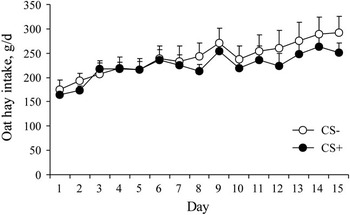
Average oat hay intakes during conditioning phase are shown in Figure 2. Sheep in CS+ and CS− showed similar intake of oat hay across the conditioning phase (253.2 v. 235.3±25.4 g/day for CS− and CS+, respectively; F 1,22=0.15, P=0.704). At the end of the conditioning phase, LW was similar between CS+ and CS− sheep (38.3 v. 38.9±1.5 kg, respectively; F 1,22=0.08, P=0.781).
Intake of oat hay by sheep (n=12) during the conditioning phase, when they were fed either oat hay for 20 min immediately followed by soybean meal (0.4% of live weight) (conditioned sheep, CS+) or oat hay for 20 min and the provision of soybean meal was delayed (unconditioned sheep, CS−). Bars represent +1 s.e.m.

The average oat hay intake of CS+ and CS− sheep was also similar in the first (248.7 v. 272.9±29.2 g/day, respectively; F 1,22=0.46, P=0.504), second (289.5 v. 293.2±29.5 g/day, respectively; F 1,22=0.61, P=0.443) and third (261.2 v. 276.7±29.5 g/day, respectively; F 1,22=0.31, P=0.583) inter-testing conditioning phases.
Testing phase
Intake, preference and selection
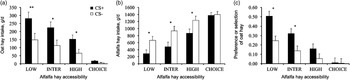
Data on oat hay and alfalfa hay intake, and preference or selection of oat hay during testing phase, are summarized in Figure 3. Oat hay intake showed a significant treatment (CS+, CS−)×alfalfa hay accessibility interaction (F 1,30=4.47, P=0.043), due to the differential increase of oat hay intake between CS+ and CS− sheep along the progressive reduction in alfalfa hay accessibility. When alfalfa hay was offered at CHOICE, CS+ and CS− sheep showed similar intake of oat hay (F 3,30=0.25, P=0.859 ), whereas when accessibility to alfalfa hay was restricted (HIGH, INTER and LOW), CS+ sheep ate more oat hay than CS− sheep (Figure 3a).
Intake of oat hay (a) and alfalfa hay (b), and preference or selection of oat hay (c) by pairs of sheep (n=6) subjected to a preference conditioning procedure with the oat hay (CS+), or to a similar nutritional situation but with no conditioning (CS−) during testing sessions of 15 min (run in the U-shaped corridor depicted in Figure 1). Oat hay was always offered ad libitum, whereas alfalfa hay was offered ad libitum (CHOICE) or in amounts representing 0.20% (HIGH), 0.10% (INTER) and 0.05% (LOW) of live weight (mean live weight of the pair). Bars represent +1 s.e.m., *P<0.05 and **P<0.01.

Alfalfa hay intake showed a significant treatment×alfalfa hay accessibility interaction (F 1,30=3.19, P=0.038). Sheep in CS+ and CS− showed similar intake of alfalfa hay at CHOICE (F 3,30=0.26, P=0.854), but CS− sheep had higher intake of alfalfa hay than CS+ sheep at HIGH, INTER and LOW levels of alfalfa hay accessibility (Figure 3b).
Preference for oat hay showed a significant treatment×alfalfa hay accessibility interaction (F 1,30=12.5, P=0.001), due to a differential increase observed between CS+ and CS− sheep as the accessibility to alfalfa hay decreased. When alfalfa hay was offered at CHOICE or HIGH accessibility, preference and selection, respectively, of oat hay of CS+ and CS− sheep was similar, while when alfalfa hay was offered at INTER or LOW accessibility, CS+ sheep showed higher selection of oat hay than CS− sheep (Figure 3c).
Total ME intake showed a significant treatment×alfalfa hay accessibility interaction (F 1,30=5.06, P=0.032). Sheep in CS+ and CS− showed similar intake at CHOICE (5.75 v. 6.16±0.46 MJ, respectively; F 3,30=0.76, P=0.528), but CS− sheep had higher total intake than CS+ sheep at HIGH (5.35 v. 4.24±0.39 MJ, respectively; F 3,30=2.97, P=0.048), INTER (3.44 v. 2.38±0.34 MJ, respectively; F 3,30=3.36, P=0.031) and LOW (4.08 v. 2.95±0.35 MJ, respectively; F 3,30=3.59, P=0.025) levels of alfalfa hay accessibility.
At the end of the testing phase, CS+ and CS− sheep had similar LW (41.3 v. 41.8±1.5 kg, respectively; F 1,22=0.05, P=0.815).
Behavior
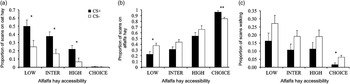
Data on the proportion of scans for sheep eating oat hay, eating alfalfa hay and walking during the testing phase are summarized in Figure 4. Sheep in CS+ had a higher proportion of scans eating oat hay than CS− sheep at HIGH, INTER and LOW levels of alfalfa hay accessibility (Figure 4a). The proportion of scans eating alfalfa hay was higher in CS− sheep than in CS+ sheep at LOW accessibility to alfalfa hay, whereas it was higher in CS+ sheep than in CS− sheep when alfalfa hay accessibility was at CHOICE (Figure 4b).
Proportion of scans in which sheep pairs (n=6), subjected to a preference conditioning procedure with the oat hay (CS+) or to a similar nutritional situation but with no conditioning (CS−), were either eating oat hay (a), eating alfalfa hay (b) or walking (c), during testing sessions of 15 min (run in the U-shaped corridor depicted in Figure 1). Oat hay was always offered ad libitum, whereas alfalfa hay was offered ad libitum (CHOICE) or in amounts representing 0.20% (HIGH), 0.10% (INTER) and 0.05% (LOW) of live weight (mean live weight of the pair). Bars represent +1 s.e.m., *P<0.05 and **P<0.01.

The proportion of scans in which sheep were walking was higher in CS− sheep than in CS+ sheep only at CHOICE level of alfalfa hay accessibility (Figure 4c). No differences between CS+ and CS− sheep were observed in the proportion of scans in which sheep were idling at all levels of alfalfa hay accessibility (F 1,22<0.03, P>0.864; for all analyses).
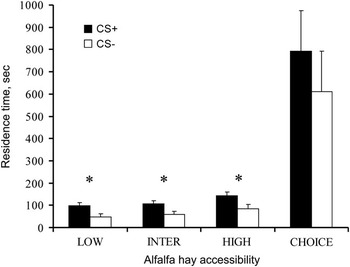
Data on residence time (the average time the sheep remained in one end of the corridor eating) are summarized in Figure 5. Residence time was higher in CS+ sheep than in CS− sheep when alfalfa hay accessibility was LOW, INTER and HIGH. No differences were detected between CS+ and CS− sheep when alfalfa hay was offered at CHOICE (F 1,22=1.03, P=0.322). On the other hand, approach latency (the average time between when the sheep stopped eating from the buckets at one end of the corridor until the time they started eating from the buckets at the other end) was similar between CS+ and CS− sheep at all levels of alfalfa hay accessibility (the approach latency averaged over all levels of alfalfa hay accessibility was 18.57 v. 18.60±1.95 s, for CS+ and CS− sheep, respectively; F 1,22=0.02, P=0.890).
Residence time (the average time the sheep remained in one end of the corridor eating) by pairs of sheep (n=6) subjected to a preference conditioning procedure with the oat hay (CS+), or to a similar nutritional situation but with no conditioning (CS−) during testing sessions of 15 min (run in the U-shaped corridor depicted in Figure 1). Oat hay was always offered ad libitum, whereas alfalfa hay was offered ad libitum (CHOICE) or in amounts representing 0.20% (HIGH), 0.10% (INTER) and 0.05% (LOW) of live weight (mean live weight of the pair). Bars represent +1 s.e.m., *P<0.05 and **P<0.01.

The analyses of transition probabilities showed that adding treatment as a covariate improved the Markov model when the alfalfa hay accessibility was at LOW, INTER and HIGH levels (χ 2 test: X 7=52.38, P<0.001; X 7=45.57, P<0.001; and X 7=59.17, P<0.001; respectively), but did not when it was at CHOICE level (χ 2 test: X 7=9.18, P=0.195). Sheep in CS+ were more likely than sheep in CS− to change from eating alfalfa hay to eating oat hay (0.53 [95% confidence intervals: 0.36 to 0.56] v. 0.21 [0.06 to 0.25]; 0.30 [0.23 to 0.34] v. 0.15 [0.05 to 0.18]; 0.16 [0.11 to 0.19] v. 0.07 [0.03 to 0.08]; at LOW, INTER and HIGH levels of alfalfa hay accessibility, respectively). Walking through the corridor was followed by eating oat hay with a greater probability in CS+ sheep than in CS− sheep when alfalfa hay accessibility was at LOW (0.44 [0.29 to 0.49] v. 0.14 [0.05 to 0.18], respectively), INTER (0.25 [0.17 to 0.30] v. 0.13 [0.04 to 0.15], respectively) and HIGH levels (0.10 [0.05 to 0.11] v. 0.05 [0.02 to 0.07], respectively). When alfalfa hay accessibility was at HIGH level, CS+ sheep were more likely than CS− sheep to eat oat hay if the immediately previous scan had also been eating oat hay (0.46 [0.29 to 0.54] v. 0.10 [0.03 to 0.21], respectively).
Discussion
Our results show that positive feeding experience with a low-quality food (oat hay) increases selection of that food and that behavioral expression of such experience depends on the costs associated with foraging an alternative high-quality food (alfalfa hay). When the low- and high-quality foods were equally accessible, both CS+ and CS− sheep fed almost exclusively on the higher quality alternative. However, when accessibility to the high-quality option was restricted, CS+ sheep showed higher intake and selection of the low-quality food than did CS− sheep. As argued by Shettleworth (Reference Shettleworth1998), animals’ knowledge must be measured in the appropriate way to become expressed in behavior; otherwise we can wrongly assume that learning has not taken place.
Acceptance (i.e., voluntary intake of a given food when no other alternatives are present) of the low-quality food during conditioning and inter-testing conditioning phases was similar between CS+ and CS− sheep; however, results from the testing phase clearly indicated that CS+ sheep were sensitive to past positive experience with the low-quality food. Learning involves deep cognitive changes, although the expression of these changes through modifications in behavior is not always evident (Dickinson, Reference Dickinson1980). In food conditioning procedures, it is more difficult to observe changes in behavior when evaluating food acceptance rather than food preference (i.e., relative intake of a given food when there is at least one more alternative available), probably because acceptance can be altered by other intervening variables such as hunger (Sclafani, Reference Sclafani1997).
Choice feeding tests have long been the standard method for assessing herbivores’ motivation to eat a particular food (Meier et al., Reference Meier, Kreuzer and Marquardt2012), and a common assumption is that animal’s preference for a given food is proportional to its relative rewarding properties (‘matching law;’ e.g., Matthews and Temple, Reference Matthews and Temple1979). If so, improvements in the incentive value of a low-quality food through conditioning should lead to a proportional increase in its preference. Our results do not support this prediction. Sheep in CS+ showed a higher selection of oat hay than sheep in CS− when alfalfa hay accessibility was restricted; however, this difference (or its proportional contribution) was not evident when alfalfa hay availability was HIGH or without restrictions (CHOICE). Nevertheless, interpretation of results under ‘matching law’ rules can still hold by considering that biases from perfect matching are expected for herbivores foraging on small scales such as at feeding stations and/or patches (i.e., those used in the present experiment) (Senft et al., Reference Senft, Coughenour, Bailey, Rittenhouse, Sala and Swift1987). Sheep may fail to discriminate when the profitability of foraging options is similar (Illius et al., Reference Illius, Gordon, Elston and Milne1999; e.g., at the lowest level of alfalfa hay availability it should be equally profitable to accept the low-quality food than to refuse it and search for more alfalfa hay), and in this case, animals with a better previous experience with the lower quality alternative are expected to bias their selection toward this food. This can also explain the high success of preference conditioning procedures when the conditioned stimulus is a flavor and foods used for testing preference are the same (i.e., equal ‘real’ profitability) (e.g., Freidin et al., Reference Freidin, Catanese, Didoné and Distel2011). Discrimination may increase exponentially (‘overmatching;’ Distel et al., Reference Distel, Laca, Griggs and Demment1995) when the difference in profitability between foods increases, and animals should properly identify and choose the better quality option (e.g., alfalfa hay in our case) when the contrast is maximal (e.g., when alfalfa hay was available without restriction). However, as suggested by Illius et al. (Reference Illius, Gordon, Elston and Milne1999), matching rules do not give a functional explanation for the herbivore’s behavioral response while foraging.
OF models were meant to provide a functional explanation for foraging decisions by using an evolutionary approach in which fitness maximization is the main goal (Stephens and Krebs, Reference Stephens and Krebs1986). A prediction of OF theory is that herbivores will be sensitive to the foraging cost of preferred foods (Bailey et al., Reference Bailey, Gross, Laca, Rittenhouse, Coughenour, Swift and Sims1996; Focardi et al., Reference Focardi, Marcellini and Montanaro1996). In our case, we manipulated foraging costs by reducing accessibility to alfalfa by requiring the sheep to walk more (from one end to the other end of the corridor) for a given amount of nutrient intake. Concordantly, with OF predictions, sheep increased the proportion of time invested eating oat hay when the cost of foraging alfalfa hay increased. More importantly, this change was influenced by the animals’ previous experiences with the low-quality hay. Sheep in CS+ showed higher intake and selection of oat hay than CS− sheep, particularly at the highest levels of restriction of alfalfa hay (INTER and LOW). In agreement, Shaw et al. (Reference Shaw, Villalba and Provenza2006) observed in a field study that when animal density was low and there was high availability of preferred herbs, sheep that were previously encouraged to eat Artemisia tridentata (a low-quality shrub) and high-quality herbs in close temporal association showed similar preference for the shrub as sheep that had previously eaten the shrub but only when the high-quality herbs were depleted. However, when the animal density increased and there was a lower probability of encountering the preferred herbs, animals in the first group displayed a greater selection of A. tridentata than animals in the second group (see also Ralphs, Reference Ralphs2005).
Vegetal species are commonly clumped in patches of similar composition. At this level of spatial organization, herbivores have to decide not only what type of vegetal species they will include in their diet but also for how long they will stay foraging before moving to the next patch. As resources depletion within a patch proceeds, the likelihood of moving to a new patch of vegetation increases (Distel et al., Reference Distel, Laca, Griggs and Demment1995); although, this is also dependent on the cost of traveling between patches (Prache et al., Reference Prache, Gordon and Rook1998). Considering the pair of buckets at each end of the corridor as food patches (see Bailey et al., Reference Bailey, Gross, Laca, Rittenhouse, Coughenour, Swift and Sims1996), our results suggest that patch residence time is also affected by animals’ previous experience with the component species. When restrictions in the availability of alfalfa hay were imposed, residence time was higher for CS+ sheep than for CS− sheep. Sheep in CS+ were more likely than CS− sheep to switch to oat hay if they had previously been eating alfalfa hay, which caused a greater exploitation of the patch and contributed to the longer residence time in that patch. Following this reasoning, we could have also expected a higher proportion of walking scans for sheep in CS− than sheep in CS+; although this is not supported by the results. High within-group variability may explain at least in part the lack of differences in this activity between groups at different levels of accessibility to alfalfa hay. However, higher motivation to walk could have been promoted in CS− sheep across trials considering that they showed a higher proportion of scans walking when this action was unnecessary (when alfalfa hay was fully available at each end of the corridor) than sheep in CS+ (see also Dumont et al., Reference Dumont, Dutronc and Petit1998).
When availability of the high-quality food was restricted, sheep in CS+ showed a lower intake of this food than sheep in CS−. In addition, total ME intake during these same testing sessions was higher for sheep in CS− than sheep in CS+. This can be interpreted as a sub-optimal decision influenced by previous experiences of sheep in CS+. Sheep in CS+ could have lower motivation to eat alfalfa than sheep in CS−, especially because the first group had a better experience with oat hay. However, this is not supported by evidence because the latency to approach alfalfa hay did not differ between groups, which could be used as an indicator of motivation to eat this food (Eder et al., Reference Eder, Elliot and Harmon-Jones2013). A likely explanation is the greater amount of time spent foraging oat hay by CS+ than CS−, time therefore not spent exploiting alfalfa hay by the first group. Accordingly, sheep in CS− showed a greater proportion of time invested eating alfalfa hay, especially when its availability was LOW. Nevertheless, we have to consider that short-term trials, as with the 15-min testing sessions in the corridor, can fail to represent foraging processes that take place over longer periods of time, and this is still a topic of debate in ruminant foraging research (Dumont et al., Reference Dumont, Dutronc and Petit1998).
As a final remark, learning models of diet selection in herbivores were developed as an alternative to OF models for explaining foraging behavior (Provenza et al., Reference Provenza, Villalba, Dziba, Atwood and Banner2003). However, as our results show, they probably are parts of a larger foraging decision-making process. OF models define how the ‘game’ (diet selection) should be ‘played’ depending on decision variables (e.g., which types of food should be included and how long to stay in a given patch) and environmental constrains (e.g., distribution, availability and encounter rate), and learning models define how animals obtain, process and store information about the profitability of the game’s options (e.g., the nutritional and toxicological status of foods).
Acknowledgments
This work was funded by the Agencia Nacional de Promoción Científica y Tecnológica (ANPCyT) de la República Argentina through the Fondo para la Investigación Científica y Tecnológica (FONCyT, Préstamo BID PICT 2012 Nº 0008), Consejo Nacional de Investigaciones Científicas y Técnicas de la República Argentina (CONICET, PIP 2012 Nº11220110100340) and Universidad Nacional del Sur (PGI 24/A198). The authors gratefully acknowledge B. Delucchi for technical support. The authors would like to thank Professor Frederick D. Provenza for helpful discussions and comments on previous drafts of the manuscript.