The Sri Lankan civil war, which began on 23 July 1983 when the Liberation Tigers of Tamil Eelam (LTTE) killed thirteen members of the Sinhalese-dominated government forces, is one of the deadliest ongoing armed conflicts in the world. As of 2008, more than 70,000 lives had been claimed over twenty-five years of the conflict, and this number seems to be escalating: an estimated 9,000 were killed on both sides over the last two years of that period alone.Footnote 1 Meanwhile, to Sri Lanka’s north, India’s mélange of ethnic groups have avoided serious armed conflict over the sixty-odd years since the country’s independence. With over nineteen ethno-linguistic groups with populations over 10 million in India, the wealth of civil war literature on the danger that ethnic fractionalization poses for a country’s stability would predict just the opposite for these two countries. How can we explain this puzzle?
There has been increasing interest over the past decade concerning the effect a country’s social structure has on the risk of civil war onset. These studies have focused on a variety of social cleavages, including socio-economic class, ethnicity and religion, positing that certain characteristics of these cleavages (e.g. fractionalization and polarization) make societies more likely to engage in civil war.Footnote 2 A long-recognized shortcoming of such models, however, is how to handle the inclusion of two (or more) cleavages. Specifically, two significant challenges relate to this multiple-cleavage issue: the first and most important is capturing how multiple cleavages relate to each other, or what Lipset terms the overall structure of a society’s salient cleavages;Footnote 3 the second challenge is how we should include social structure characteristics in civil war models – additively, as they have been thus far, or multiplicatively? To address this problem, this article seeks to contribute to the conceptualization, measurement and empirical testing of cleavage structures in relation to civil war. Notably, I return to the characteristic of cross-cuttingness, which received much theoretical attention in the pioneering work of Lipset and others in the 1960s and 1970s, and introduce the first cross-country index of ethno-religious cross-cuttingness.Footnote 4 Indeed, it is cross-cuttingness that answers the Sri Lanka–India question posed at the outset: because religion reinforces ethnicity in Sri Lanka, the divisibility of conflictual issues and their susceptibility to resolution by bargaining is hopelessly diminished. In contrast, religion cross-cuts ethnicity in India and has helped moderate potentially divisive issues, making possible such compromises as regional autonomy for certain ethnic groups.Footnote 5
In this article, I argue that ethno-religious cross-cuttingness makes civil war less likely because it reduces the saliency of out-group differences and thus makes it harder for potential rebel leaders to recruit by appealing to ethnicity. The major empirical finding of this article is that cross-cuttingness is a significant determinant, both substantively and statistically, of the onset of civil war conditional on ethnic fractionalization. Specifically, the marginal effect of cross-cuttingness on the onset of civil war is negative and significant at low levels of ethnic fractionalization. This result is robust to the numerous sources of civil war onset data and the numerous indices of ethnic fractionalization and bipolarization. Thus, our understanding of the role ethnicity plays in civil war onset is inaccurate unless we take into account the modifying effect of cross-cutting cleavages.
The article proceeds as follows. First, I review the state of knowledge relating social structure to civil war onset, highlighting several areas where innovation is needed. Secondly, I present the logic linking cross-cuttingness to civil war. I then proceed to define cross-cuttingness, discussing various ways it has been conceptualized and measured in the literature. Next, I describe the new index and proceed to test the influence of cross-cuttingness on civil war onset. The final section concludes with a discussion on future innovation in the area of social structure and civil war.
Social Structure And Civil War
The civil war literature is immense, and many diverse determinants of civil war onset have been postulated and empirically evaluated. It is not my intention to review this literature in its entirety; rather, I emphasize two major strands: motivation and feasibility.Footnote 6 The motivation literature has examined the reasons that rebel groups choose to engage in armed conflict, focusing on greed vs. grievance as triggering factors.Footnote 7 In the second strand, feasibility, falls works such as Fearon and Laitin’sFootnote 8 study on favourable geographic conditions for insurgency and Urdal’sFootnote 9 study on youth ‘bulges’ – the idea being that geography and demographics, respectively, lower the cost of financing rebel military forces. Social structure theory incorporates elements of both these strands: in terms of motivation, while it is irrelevant what the precise stimulus of the civil war is, certain societal arrangements increase the likelihood that some kind of spark will ignite into armed conflict.
With regard to feasibility, social structure theory posits that certain kinds of structures lower the costs associated with civil war. For example, recent work by Cederman et al. argues that the geographic distribution of ethnic groups makes it easier for potential rebels to recruit militants.Footnote 10 The logic is two-fold: first, when ethnic groups are concentrated in a geographic region, transportation costs of recruitment decline. Secondly, geographic concentration of ethnic groups strengthens in-group loyalties by forming ethno-regional identities, which are crucial to the emergence of proto-nations.
I argue in this article that the structure of two salient cleavages in society – ethnicity and religion – affects both the likelihood that disagreements are interpreted in less bargainable and divisible ascriptive group terms (motivation) and the costs of potential rebels recruiting combatants (feasibility). The motivational part of my argument captures something about the diversity, or harmony, of societal preferences concerning various social, political and economic issues. For example, we might expect a society with many different linguistic groups to be more divided over education policy, perhaps because each linguistic group will demand instruction in its own language. Or take the distribution of bureaucratic jobs; we might expect two large, evenly-sized ethnic groups to fight for dominance of the share of jobs and perhaps the working language of government (this is, in fact, a frequent problem in the developing world). In short, group loyalty is associated with different preferences on issues, especially resource distribution or policy implementation.
The strength of group loyalty – a group’s sense of self, its organizational capacities or the loyalty of its members – also affects the feasibility aspect of my argument.Footnote 11 In the same way that greater association of geographic region with ethnicity strengthens group loyalty, greater association between religious affiliation and ethnicity also leads to more solidified group loyalties. In turn, the costs of recruiting rebels are lowered. First, because in a sense individuals now have two reasons to mistrust members of society who do not share either ethnic or religious identity, rebels do not need to expend as many resources convincing disaffected members of their in-group to join their cause. When a social group has a clearly defined sense of self, its members share common knowledge that make interaction with, and understanding of, fellow members easier.Footnote 12 Religious and ethnic affiliation also provides ready-made social networks that make recruitment easier.Footnote 13
Before proceeding, let me respond briefly to a common critique of work that looks at social structure (the work on ethnic fractionalization has been the favourite whipping boy) and civil war, which is as follows: If group-based grievances underlie civil wars, why not employ a more direct measure of how aggrieved ethnic groups are? Indeed, recent work has suggested that ‘the key factor driving this struggle over state resources is political discrimination orchestrated by powerful state actors’.Footnote 14 Cederman and Girardin’s exemplary work creates an aggregate measure of ethnic political discrimination for each state in the sample.Footnote 15 Such innovations are to be commended and, rather than invalidating social structure theory, which tends towards the ‘grand’ end of the levels of theory spectrum, this literature on ethnic exclusion has more specifically tested the motivational mechanism that underlies social structure theory. The problem with conflating this work with tests of social structure theories is two-fold. First, political discrimination only captures expressed instances of group-based grievances. Thus, it cannot answer the question of which arrangements of social groups most reduce the likelihood of the onset of civil war. Furthermore, political discrimination is essentially one part of broader inter-group conflict, of which violence and civil war constitute other elements. Thus, there is a possible endogeneity problem with using a measure of political discrimination.
Instead, I advocate the use of general social structure data to examine ethnic and religious causes of conflict. Specifically, these measures capture the potential for all types of inter-group conflict, including political discrimination and political violence. Certainly, political discrimination may be one possible intervening variable, but primordialists would argue that ethnic groups fight out of some inherent dislike for each other unrelated to actual grievances. Lastly, civil wars can ignite in very short periods of time. Prolonged prior grievances, such as political discrimination, are not a necessary precondition for an outbreak. Thus, social structure measures, as gauges of potential conflict of all types and intensities, better capture the relevant social dynamics.
Three questions regarding social structure have occupied the literature in relation to civil war onset: which cleavages, which groups and which characteristics? The first question has captured the most attention. Whilst numerous scholars have argued that a country’s social structureFootnote 16 makes conflict more likely, they have not agreed on which cleavages matter.Footnote 17 For example, Horowitz argues convincingly that the ethnic cleavage is chief amongst the underlying determinants of civil war.Footnote 18 Fox provides a similar compendium to Horowitz with regard to the relationship between religion and civil war.Footnote 19 Collier and HoefflerFootnote 20 have consistently argued that socio-economic class, in the form of inequality measures, explains civil war.Footnote 21 Lastly, CedermanFootnote 22 argues that geo-cultural identity is related to the likelihood of nationalist insurgency.Footnote 23
This study focuses on ethnicity and religion.Footnote 24 Rae and Taylor argue that ethnicity and religion are ascriptive, i.e. individuals are born with these identities, or memberships, which are then difficult, if not impossible, to change or hide.Footnote 25 Owing to their permanent nature, ascriptive cleavages make bargaining over issues difficult. One needs only to think of the Israeli–Palestinian situation to see how immovable policy positions are in an ethno-religiously split nation. Indeed, as we scan the world, in almost every society we find countless examples of ethnic or religious conflict.Footnote 26 Thus, scholars have focused on characteristics of ethnicity and religion assuming that the ascriptive nature of these two cleavages makes their salience likely (though not certain) to be high in most societies.Footnote 27 In contrast, groups along the socio-economic cleavage are likely to find it much harder to overcome the collective action problem. In addition, distributional debates, which will be the issue at the heart of disputes along the socio-economic cleavage, are much easier to solve since the bargaining space is continuous.
In addition to which cleavage matters, fruitful discussion has taken place on which groups within cleavages matter.Footnote 28 Should we be concerned only about relevant/politicized groups,Footnote 29 or are we trying to capture the latent potential for conflict?Footnote 30 Posner, in his study of economic development in Africa, argues for the inclusion of only those ethnic groups that ‘participate in politics as distinct, recognizable groups’ engaging in ‘interethnic competition on economic policymaking’.Footnote 31 The claim is not that Posner’s revised fractionalization index is appropriate for all studies, but that the inclusion of groups should reflect the explicit mechanism the researcher is trying to test. For the current study, I thus favour the use of all potential groups with which individuals can identify. The logic is that counting only politically relevant groups seems to introduce something of an endogeneity problem in the case of civil war onset. Specifically, if relevant groups are chosen because of their political involvement, where involvement may include political violence, there is danger of circular logic. Furthermore, which groups would the researcher select in countries that have experienced no civil war?
Finally, once we have decided which cleavages and groups matter, there is the issue of which characteristics of these cleavages matter. These characteristics and terms are not used consistently throughout the literature and thus a brief clarification is in order.Footnote 32 Fractionalization (or fragmentation) of either the religious or ethnic cleavages is the most common characteristic used in civil war literature.Footnote 33 This measures the number of groups on a cleavage weighted by their size – the effective number of groups. More recently, Reynal-Querol introduces a measure of bipolarization (the extent a cleavage is characterized by two groups of equal size), again along the ethnic and religious cleavages.Footnote 34 A number of other characteristics have been suggested and tested, including size of the largest group, size of the largest minority group and percentage of population not speaking the official language.Footnote 35 All these measures are uni-dimensional, that is, they describe a single cleavage. To date, little work has been done on multi-dimensional, or multi-cleavage, characteristics.
Empirical studies have diverged greatly regarding which characteristics affect the likelihood of social conflict, and even what the direction of that characteristic’s relationship with civil war is. Moreover, a focus on different characteristics produces different theoretical stories. Scholars who have used ethnic fractionalization argue that the multiplicity of diverging preferences in society leads to a higher risk of conflict. Others who have looked at bipolarization insist that two large groups of equal size make conflict more likely because preferences are more intense, less divisible and less susceptible to resolution by bargaining. Currently, we have little sense of which theoretical arguments are empirically most supported.
Collier and Hoeffler find that social fractionalization is negatively related to civil war onset.Footnote 36 Their index is statistically significant, but has a small substantive effect. Fearon and Laitin, in contrast, find both ethnic and religious fractionalization to be positively related to civil war onset, but not significantly so.Footnote 37 Montalvo and Reynal-Querol confirm Fearon and Laitin’s findings on ethnic and religious fractionalization being statistically insignificant (though the latter is negatively related).Footnote 38 Nevertheless, the authors find that both ethnic and religious bipolarization is positively related to civil war onset with their coefficients being substantively and statistically significant. Hegre and Sambanis, attempting to sort out these empirical inconsistencies, perform sensitivity analysis and find that variables representing ethnic difference in the population are robust only in relation to lower-level armed conflict.Footnote 39 However, Quinn, Hechter and Wibbels use a Bayesian approach and conclude that once measurement error is taken into account, ethnic diversity turns out to have a significant effect on civil war onset at high levels of armed conflict.Footnote 40 In sum, previous studies exploring the link between social structure and civil war have been inconclusive regarding both the direction and statistical significance of various characteristics.
To my knowledge, only one attempt has been made to deal with multiple cleavages other than summarily including them in an additive model. Collier and Hoeffler offer a measure of social fractionalization to handle multiple cleavages in the absence of a true measure of cross-cuttingness.Footnote 41 The Collier and Hoeffler social fractionalization measure takes the product of the separate religious and ethnic fractionalization indices plus the higher of the two. This, they say, captures the maximum potential for social fractionalization. They do not find strong evidence for its inclusion in civil war models, however.
Cross-Cuttingness And Other Cleavage-Structure Characteristics
One reason for the inconsistency of findings relating single-cleavage characteristics to civil war is that a major piece of information is missing that relates them to the underlying mechanisms: how one characteristic is structured in relation to other salient cleavages. Specifically, in this article I investigate how ethnic identity is structured in relation to religious identity (and vice versa). Whether one chooses to draw on the preferences, collective action or in-group altruism logic, fractionalization (or bipolarization) alone fails to capture the underlying mechanisms relating social structure to civil war. Consider two societies with identical levels of religious and ethnic fractionalization and bipolarization. For illustrative purposes, consider two societies with two ethnic groups and two religious groups of equal size. In the first society, ethnic group a belongs entirely to religion j, and ethnic group b belongs entirely to religion k. In contrast, in the second society, both ethnic groups are equally divided among the two religions. Looking solely at fractionalization or bipolarization measures, we would mistakenly conclude that both societies have equal potential for conflict. This is incorrect because the second society is more likely to have similar preferences between its two groups due to their belonging to the same religion. In contrast, in the first society, preferences become more polarized between ethnic groups due to the religious split.
The roots of cross-cutting theory can be attributed to German sociologist George Simmel, who in his 1908 Soziologie postulated relationships between a number of characteristics of macro social structure and various aspects of social life.Footnote 42 Specifically, Simmel argued that cross-cutting social circles led to higher levels of individualization. Greater individualization, in turn, means lower in-group altruism, which is key in breaking down boundaries and building bridges amongst social groups, thus reducing the potential for conflict. Sociologists further developed Simmel’s idea of cross-cuttingness, with Peter Blau spearheading its development into the sub-field of macro-sociology. Blau writes that cross-cuttingness can be thought of as maximizing diversity of memberships across cleavages.Footnote 43 As the diversity of memberships increases, ‘group boundaries [become] more permeable, status distinctions more easily bridged, and intergroup relations more frequent’.Footnote 44 Group boundaries are most permeable when knowing one’s group membership on one cleavage tells you nothing about her membership on another cleavage. Blau measures cross-cuttingness with a chi-square measure of independence. I refer to this conceptualization of cross-cuttingness as pure cross-cuttingness, which I will define and measure in more detail below.
The field of anthropology should take the ‘credit for having [first] brought to light [cross-cuttingness’s] full significance for the study of social organization’, writes sociologist Andre Beteille.Footnote 45 However, the anthropological definition of cross-cuttingness differed from the sociological one in important ways. Beginning with Evans-Pritchard, social anthropologists sought to understand how societies, lacking the institution of government, nevertheless maintained an ordered existence.Footnote 46 Gluckman’s interpretation of these ethnographies emphasized conflict of loyalties as the key to these societies’ stability: because an individual’s loyalty was split in a cross-cutting society, his or her commitment to any one group was mitigated.Footnote 47 For example, take Kroeber’s description of the Zũni society: ‘The clans, the fraternities, the priesthoods, the kivas … if they coincided, the rifts in the social structure would be deep; by countering each other, they cause segmentation which produces an almost marvellous complexity, but can never break the national entity apart.’Footnote 48 This cross-cutting pattern of social structure segmented society into multiple sub-groups, each with a complex web of pressures from each salient social dimension.
Though anthropologists did not seek to quantify cross-cuttingness, their use of the term seems to capture concepts different than pure cross-cuttingness, or statistical independence. Specifically, an increase in either the number of salient cleavages or the number of groups within cleavages can multiply the number of sub-groups. We might want to isolate the first concept, an increase in the number of salient cleavages, and refer to it as a distinctive characteristic, say heterogeneity. Alternatively, we could take a fractionalization measure of sub-groups to capture the second concept. Thus, we see that anthropology’s theoretical focus, operating at a different level of analysis, led to two different concepts, which in fact are quite different from pure cross-cuttingness.
Within political science, an even greater variety of concepts has masqueraded under the term ‘cross-cuttingness’. In addition to pure cross-cuttingness, heterogeneity and sub-group fractionalization, two additional concepts, can be identified with the appellation cross-cuttingness. Cross-cutting theory enjoyed widespread scholarly popularity in the 1950s and 1960s, and political scientists applied the notion to studies on social order, political violence, voting behaviour, political organization and democratic stability. Truman’s work on democratic stability, for example, focused on compromise within the group.Footnote 49 His group cohesion theory argued that the ‘influence of the affected group depend[s] upon the conflicting loyalties of any significant segment of the group’. One implication of group cohesion theory is that the more fragmented a group is on a second cleavage, the less hold it has on its members, i.e. the lower in-group altruism. This version of cross-cuttingness seems to be best captured by cross-fragmentation, a concept formalized by Rae and Taylor.Footnote 50 Elsewhere in the democratic stability literature, Lipset argues that: ‘A system in which the support of different parties corresponds too closely to basic social division cannot continue on a democratic basis.’Footnote 51 This concept of cross-cuttingness is most similar to sociology’s pure cross-cuttingness.
The voting literature and its focus on the individual, however, alluded to yet a different concept – heterogeneity. When deciding for whom to vote, membership in different groups with different political opinions was said to pull an individual in different political directions. ‘More memberships’ is another way of saying that more salient cleavages exist in a given society. Lastly, Dahl reasoned: ‘If most individuals in the society identify with more than one group, then there is some positive probability that any majority contains individuals who identify for certain purposes with the threatened minority.’Footnote 52 This probability is maximized when all groups on all cleavages are proportional in size and when any given group is evenly split amongst groups on a second cleavage. Elsewhere, I have referred to this definition of cross-cuttingness as cross-proportionality.Footnote 53
In general, then, the term cross-cuttingness has been used to refer to a variety of characteristics describing the structure of cleavages in society. These cleavage-structure characteristics differed depending on the motivating level of analysis of the question. Thus, at the individual level, the focus is on the competing identities and/or associations of an individual with multiple group affiliations. The more identities an individual possesses, the more he or she feels cross-pressured from these different groups, so the logic goes. Rae and Taylor’s cross-fragmentation measure was motivated by this first dynamic of individual cross-pressures, deriving their measure from the premising question: what is the probability two individuals belong to the same group on one cleavage, but different groups on another cleavage?Footnote 54 In contrast, Blau’s conceptualization and measure of cleavage structure was motivated by dynamics at the cleavage level.Footnote 55 Specifically, he wondered how ‘lines of differentiation (cleavages) [were] related to one another’, and about the ‘strength of the relationship of two or more social differences’.Footnote 56 This led Blau to conceptualize the structure of cleavages in terms of how independent each salient cleavage is from the other. Lipset also seemed to operate at the cleavage level as he focused on the fluidity of issue coalitions. When cleavages are highly related (reinforcing society), Lipset sees less flexibility in coalitions. The same coalitions appear over and over again on every issue. In contrast, when cleavages are highly independent, different coalitions are possible for each issue that arises; the us’s and the them’s are constantly changing.Footnote 57 In the remainder of this section, then, I define and measure these two major characteristics of cleavage structure more precisely, testing them both in the empirical section.
Cross-Fragmentation
Cross-fragmentation, whose formal definition can be attributed to Rae and Taylor, measures the proportion of all pairs of individuals who are in the same group on one cleavage but in different groups on another cleavage.Footnote 58 It is given by the equation:

where xij are frequencies in the cells of a contingency table of the two cleavages i and j, xi• and x •j are the marginal frequencies and N is the total number of individuals in the society. If N is large enough for the approximation 1/N(N − 1) = 1/N 2 to hold, then Rae and Taylor show that this can be written

which after some transformation is simply:

or two times the sub-group fractionalization minus the fractionalization scores for each of the individual cleavages. Like F, CF varies between 0 and 1, with 0 signifying complete ‘reinforcingness’ and 1 complete cross-fragmentation. At the maximum, complete cross-fragmentation occurs when all pairs belonging to the same group on i belong to different groups on j, and vice versa. Put differently, every member of any given group would have to belong to his or her own group on a second cleavage. While this maximum may appear absurd, more practically we can think of cross-fragmentation increasing ‘the smaller the number of persons who are in the same group in both cleavages’.
Pure Cross-Cuttingness
Other scholars have used a measure that I refer to as pure cross-cuttingness, which seems to isolate a single, distinct characteristic: the extent to which members of different groups on i belong to the same j groups (and vice versa). In other words, in answer to the question, ‘In what way should groups on a cleavage i be distributed amongst groups on a second cleavage j to maximize cross-cuttingness?’, pure cross-cuttingness says, ‘when groups are distributed identically’. That is, given the number of groups and given their relative size, cross-cuttingness is maximized when groups are identically distributed among groups on a second cleavage. To the statistically conversant, this seems much like the concept of statistical independence, which it indeed is. To make C comparable regardless of the number of groups, I use the normalization of the chi-square statistic given by Cramer.Footnote 59

where

is the chi-square statistic of independence,Footnote 60 N is the number of observations, and the term max{(c − 1), (r − 1)} is the larger of either the number of columns (c) minus one or the number of rows (r) minus one. Pure cross-cutting is maximized when knowing the group affiliation of an individual on one cleavage tells you nothing about what his/her group affiliation is on a second cleavage.
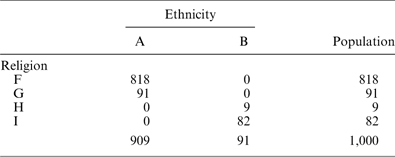
To get a further sense of how cross-fragmentation and pure cross-cuttingness diverge, consider the situation where two ethnic groups are each split amongst two religions, but no member of either ethnic group shares a single religious group with a member of the other ethnic group, as in Table 1. Cross-fragmentation will have a positive value (0.15) signifying that groups have less hold on their members. In the same scenario, C gives a value of zero, signifying that even though ethnic groups are divided religiously, they still identify with and/or associate with members of their ethnic group. Despite this difference, both measures are sensitive to sub-group identities and thus fulfil my cross-cutting axiom of Subgroup Identity Sensitivity developed elsewhere.Footnote 61
Hypothetical Society

Note: The table shows a situation where cross-fragmentation measures 0.15 and pure cross-cutting is zero.
Cross-fragmentation should still not be confused with cross-cuttingness. While the measure is sensitive to independence between cleavages, cross-fragmentation is also sensitive to fractionalization of either of the cleavages; pure cross-cuttingness is not sensitive to the latter. Cross-fragmentation is perhaps best described as simultaneously capturing cross-cuttingness and fractionalization. Indeed, as the empirical data below show, cross-fragmentation is a completely separate cleavage-structure characteristic from cross-cuttingness.
Pure Cross-Cuttingness, Cross-Fragmentation And Civil War
The implications of pure cross-cuttingness and cross-fragmentation for conflict and civil war are as follows. Higher levels of either cross-fragmentation or pure cross-cuttingness are associated with lower levels of conflict. The risk of conflict, however, is very different from the commencement of (or deterioration into) a civil war. Many other characteristics must be controlled for, including the level of economic development and conditions making insurgency more likely (geographic terrain, a non-contiguous state, etc.). Nevertheless, once these other factors are controlled for, higher levels of cross-cuttingness and cross-fragmentation should decrease the likelihood of civil war onset.
Hypothesis 1: Higher levels of cross-cuttingness decrease the likelihood of civil war.
Hypothesis 2: Higher levels of cross-fragmentation decrease the likelihood of civil war.
An important issue that accompanies the introduction of pure cross-cuttingness and cross-fragmentation is how they should be entered into our empirical model with single-cleavage characteristics of social structure, i.e. ethnic and religious fractionalization and bipolarization. The choice between additive and multiplicative models is in question here. I posit that the effects of cross-cuttingness and cross-fragmentation are modified by single-cleavage characteristics (and vice versa). In other words, an interactive model is most appropriate.Footnote 62 Ultimately, this can be viewed as an empirical question, but I now present some theoretical support for such a specification.
One theory states that more ethnic groups entail more preferences in society, and thus more likelihood of disagreement and conflict. Cross-cuttingness theory, however, argues that these differences become less significant in a highly cross-cutting society. For illustrative purposes, consider two societies with two ethnic groups and two religious groups of equal size. In the first society, ethnic group a belongs entirely to religion j, and ethnic group b belongs entirely to religion k. In contrast, in the second society, both ethnic groups are equally divided among the two religions. If it is the multiplicity of groups that matters, then one possible line of argument might be that the second society has effectively one group due to the cross-cutting of cleavages. Indeed, as the level of cross-cuttingness increases, the effect of the number of social groups, whether captured by fractionalization of bipolarization, should decrease. This line of reasoning generates the following hypothesis:
Hypothesis 3: Higher levels of ethnic fractionalization increase the likelihood of civil war. This effect decreases as cross-cuttingness (3.1) or cross-fragmentation (3.2) increases.
The same logic can be applied to the common theory that higher levels of bipolarization make conflict more likely. Again, consider two societies with two ethnic groups and two religious groups of equal size. They both have the maximum levels of bipolarization. However, in a perfectly cross-cutting society, there would effectively be one group, or effectively zero bipolarization. Thus, we get:
Hypothesis 4: Higher levels of ethnic bipolarization increase the likelihood of civil war. This effect decreases as cross-cuttingness (4.1) or cross-fragmentation (4.2) increases.
In addition, we can add two more similar hypotheses for the religious cleavage:
Hypothesis 5: Higher levels of religious fractionalization increase the likelihood of civil war. This effect decreases as cross-cuttingness (5.1) or cross-fragmentation (5.2) increases.
Hypothesis 6: Higher levels of religious bipolarization increase the likelihood of civil war. This effect decreases as cross-cuttingness (6.1) or cross-fragmentation (6.2) increases.
Hypotheses 3–6 can be tested using the relevant version of the interaction model:

replacing Ethfrag with the respective single-dimension variable and swapping CrossFrag in for CrossCut.
The marginal effect of the single-dimension variables is:

again replacing EthFrag and CrossCut, as each hypothesis calls for. This effect (identical for all single-dimension characteristics) should be positive and significant when cross-cuttingness is sufficiently low. β 1 should be positive because the effect of ethnic fractionalization on civil war is expected to be increasing when cleavages are perfectly reinforcing. Assuming β 1 is positive, β 3 should be negative because the marginal effect of ethnic fractionalization is expected to be decreasing as the structure of cleavages becomes more cross-cutting (less reinforcing). It is helpful to think of cross-cuttingness modifying the effect of fractionalization or bipolarization on civil war. In this theory, as cross-cuttingness increases, the effect of fractionalization (bipolarization) on civil war decreases.
Ultimately, I test Hypotheses 3–6 in several models: first, with each single-cleavage characteristic entered separately; and secondly, in models with various combinations of pairs of single-cleavage characteristics. The most extensive model, then, has five variables that attempt to capture social structure, and can be given by the following specification:

The marginal effect of cross-cuttingness is:

Thus, assuming β 3 is negative, I expect β 4 and β 5 to be positive, i.e. as fractionalization (bipolarization) increases, the marginal effect of cross-cuttingness should decrease. Hence, we get the following hypotheses:
Hypothesis 7: Higher levels of cross-cuttingness decrease the likelihood of civil war. This effect increases as either ethnic/ religious fractionalization/bipolarization (7.1–7.4) increases.
Hypothesis 8: Higher levels of cross-fragmentation decrease the likelihood of civil war. This effect increases as either ethnic/religious fractionalization/bipolarization (8.1–8.4) increases.
The Empirical Relationship Between Measures Of Social Structure
In this section, I compare the empirical content of the two-dimensional characteristics of cleavage structure first with each other and second with single-cleavage characteristics. If pure cross-cuttingness and cross-fragmentation are highly related, the differences discussed above would be minor. However, the data reveal that they are indeed distinct characteristics. Moreover, cross-fragmentation, while being partially derived from both religious and ethnic fractionalization, captures something quite different than either the two separate measures. In this section, I describe the data sources for my social structure measures, comparing them to existing indices to ensure a degree of robustness.
The most accurate source for these data would be country censuses. However, many countries do not collect such information, and even for those that do the raw data are difficult to obtain. An alternative strategy is to extract similar information from nationally representative surveys, such as public opinion surveys. Accordingly, I compiled my indices from seven sources: The World Values Survey (WVS),Footnote 63 The Eurobarometer (EB),Footnote 64 the Afrobarometer (AFB),Footnote 65 the Latin American Public Opinion Project (LP),Footnote 66 the Asian Barometer (AB),Footnote 67 the Comparative Study of Electoral Systems (CSES)Footnote 68 and the World Health Organization (WHO).Footnote 69 In addition to the several rounds of WVS, the use of several surveys allowed me to test the robustness of my scores for a handful of countries that appeared on two or more of the surveys. The full data are displayed in Table 1 of the appendix.Footnote 70
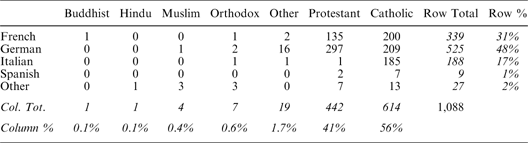
I begin my description of the data with a worked example of how the cross-cuttingness score is calculated. I chose Switzerland, since it was the quintessential example of a cross-cutting country in the earlier political science literature cited above. The data come from the World Values Survey round conducted in 1996. Four ethnic groups are picked up by the survey (German 48 per cent, French 31 per cent, Italian 10 per cent and Spanish 1 per cent), as well as an additional category of ‘Other’, which constitute 2 per cent of the population and likely includes the Romansch people. The survey also picks up six religious affiliations plus an ‘Other’ category, the largest two, Catholic and Protestant, constituting 56.4 per cent and 40.6 per cent, respectively, of the population. Table 2 displays these two cleavages in a cross-tabulation. Out of a total N of 1,088 respondents, the largest ethno-religious group is German-Protestants, with 297 individuals, or 27.3 per cent of the population.
Ethno-Religious Subgroups in Switzerland

Source: World Values Survey, 1996.
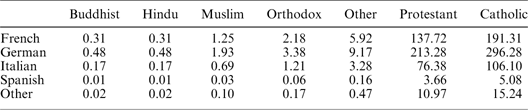
Table 3 displays the expected size of ethno-religious groups if the society were perfectly cross-cutting. This is calculated by taking the product of N and the column and row percentages from Table 2. We thus see that the expected number of German-Protestants is 213.28. The next stage in the process is to subtract the expected values from the observed values. Each of these numbers are then squared and divided by the respective expected values. To save space, I do not show these stages in tabular form. Taking the sum of the values from the previous stage gives us the chi-square value, which in the case of Switzerland is 381. To normalize this value, I first divide the chi-square value by N (1,088) and the lesser of the number of ethnic groups minus one (4) or the number of religious groups minus one (6), as follows.

Finally, I take the square root of this number and subtract it from unity.

Expected Size of Ethno-Religious Subgroups in Switzerland if Religion and Ethnicity were Perfectly Cross-Cutting

This produces a final cross-cuttingness score of 0.706 for Switzerland.
I performed several robustness checks on the indices to ensure that the data were reliable. A full description of these checks is available in the appendix, and provides confidence that the methods of survey sampling across the various surveys were adequately similar and ensured representativeness of the populations.Footnote 71 In addition, as I was using several surveys, there were a number of countries for which I was able to calculate several scores. In general, the scores were very similar. For example, the average standard deviation for cross-fragmentation was 0.072. Final scores were averaged unless there were theoretical reasons to favour one over the other, such as the tendency to pick up latent cleavages, or worrisome divergence from existing social structure indices.Footnote 72 As such, the measures are fairly consistent across surveys. Finally, I compared ethnic categorizations in the various surveys to Posner’s index of Politically Relevant Ethnic Groups (PREG) to ensure that the surveys were picking up latent cleavages, which I argue are appropriate for this study.Footnote 73
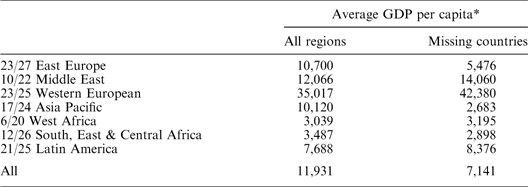
Since I am using this index to study civil war, I was concerned about the geographic spread of the countries for which I was able to compute a score. Moreover, since gross domestic product (GDP) per capita is at the heart of Fearon and Laitin’s theory of state strength, it is important to ensure that the sample of countries I have in my index is representative.Footnote 74 Of the 168 countries with a population over 400,000, the CC and CF indices have scores for 102 countries: 23 of 25 countries in Western Europe, 23 of 27 in Eastern Europe, 17 of 24 in Asia Pacific, 21 of 25 in Latin America, 10 of 22 in the Middle East and North Africa, and 18 of 46 in Sub-Saharan Africa.Footnote 75 The average GDP per capita of countries not included in the cross-cutting and cross-fragmentation measures are given in Table 4.
Representativeness of World Geographic Regions and of Economic Development

*2008 $US per annum (World Bank)
The difference in economic development between countries included in or excluded from the sample is almost $5,000, meaning that the regression results might be biased away from factors of civil war in poorer countries, which may tend to experience more civil wars than richer countries. However, this disparity in levels of economic development is not seriously pronounced in the region that experiences the most civil wars – Africa. Indeed, in West Africa, countries excluded from the sample actually have a higher GDP per capita. Nevertheless, this difference in average GDP per capita is certainly something to be aware of when evaluating the results. In general, the indices have good regional coverage.
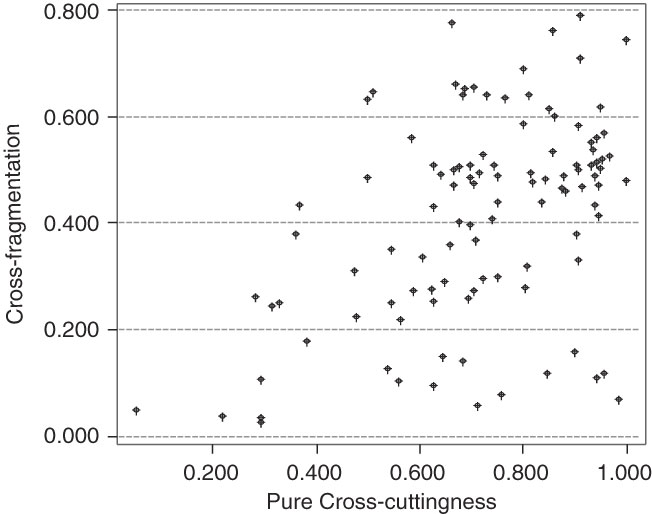
Figure 1 shows a scatter plot of pure cross-cuttingness and cross-fragmentation. Both measures are on a 0–1 scale, though the maximum value of CF is 0.78. While there is a mild positive relationship (0.403 Pearson correlation), it is clear that for the majority of observations, which lie in the right half of the graph, a country’s level of pure cross-cuttingness (CC) does not easily predict its level of cross-fragmentation (CF). That the few observations in the left-hand side of the graph are more strongly correlated supports a theoretical statement I made previously. All measures and conceptualizations of cross-cuttingness in the literature seemed to agree on the definition of the minimum level of cross-cuttingness (reinforcingness); it was in the definition of the maximum where divergence took place. Indeed, from a CC value of about 0.5 upwards, CF ranges almost across the entire spectrum. Thus, CC and CF are slightly related but clearly very different characteristics.
Scatter plot of pure cross-cuttingness versus cross-fragmentation

Regression Results
In this section, I add cross-cuttingness to Fearon and Laitin’s model of civil war.Footnote 76 Their model consists of variables measuring state strength and the favourability of a country’s geography to insurgency, which they argue is the major method in which civil war has been waged since the end of the Second World War. In their study, Fearon and Laitin find no support for religious or ethnic fractionalization determining civil war. The unit of analysis is ‘country year’, and each observation is assigned a value of 1 if a civil war began (but not continued) in that year and a 0 otherwise. As such, I use a logit model to estimate the coefficients. Since the data are Binary Time-Series Cross-Sectional (BTSCS), I follow Beck, Katz and Tucker and employ natural cubic splines to control for temporal dependence between observations.Footnote 77 I also employ robust standard errors clustered by country to control for within-country effects. The sample includes 160 countries and covers the period 1945–99. In the initial analysis, I use the Peace Research Institute of Oslo (PRIO) dataset for civil wars.Footnote 78 PRIO defines a civil war as a contested incompatibility that concerns government and/or territory, where the use of armed force between two parties, of which at least one is the government of a state, results in at least twenty-five yearly battle-related deaths and a minimum of 1,000 during the course of the civil war. In the robustness appendix, I test the results using alternative sources of onset data.Footnote 79
Because aspects of social structure could be associated with other things believed to influence civil wars, I control for several variables that affect the cost of rebel groups engaging in armed conflict. First, I control for state strength, captured as follows: the log of per capita income lagged one year (Income), the log of the population size lagged one year (Population), whether the country experienced a significant change in its political regime in any of the previous three years (Instability), and whether the country is in its first or second year of independence (New State). The first two of these proxies may also be capturing direct costs of rebel recruitment. In terms of state strength, richer states are better able to finance standing armies, which would both deter and control rebellious activities. Collier and Hoeffler use this same measure, however, to proxy for forgone income – higher per capita income makes it harder for rebel groups to recruit.Footnote 80 Conversely, states with larger populations are inherently weaker, thus increasing the likelihood of civil war. With regard to state strength, larger populations make it harder and more costly for the government to track activities at the local level. However, larger populations also increase the pool of potential combatants that rebel leaders can draw on. In addition to Income and Population, the cost of rebel activities is reduced (in this instance, in sheer financial terms) if the country has economic activities in primary commodities. Collier and Hoeffler find that oil is the primary commodity that seems to contribute most to rebel financing.Footnote 81 Thus, I simply use a dummy for whether a country is an oil exporter (Oil).
Next, I control for geographic conditions that make insurgency more likely. Fearon and Laitin persuasively argue that civil wars following the Second World War have mainly taken the form of insurgency, or rural guerrilla warfare, and offer the two following proxies: the log of the proportion of the country that is mountainous (Mountains) and whether the country is non-contiguous (consists of territories separated from the land area containing the capital city (Non-contiguous)).Footnote 82 The existence of these geographic conditions favourable to insurgency thus reduces the costs of rebel groups engaging in armed conflict.Footnote 83
For the social structure characteristics I rely initially on all my measures calculated from the surveys mentioned above, namely cross-cuttingness (CC), cross-fragmentation (CF), ethno-linguistic fractionalization (SELF), ethno-linguistic bipolarization (SELB), religious fractionalization (SRF) and religious bipolarization (SRB). In the robustness section, I present my findings using alternative indices of these characteristics.
Pure Cross-Cuttingness And The Onset Of Civil War
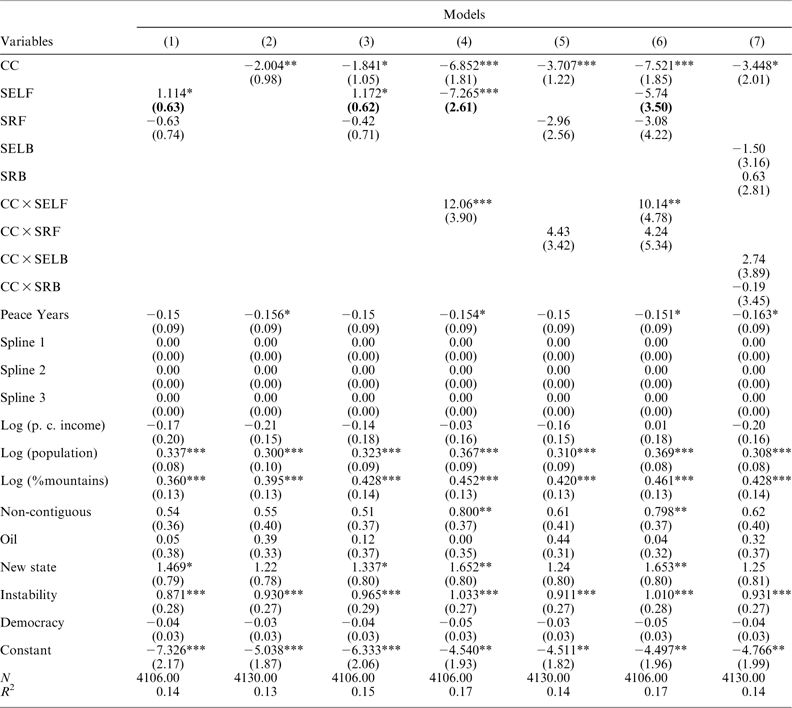
In Model 1 of Table 5, I replicate Fearon and Laitin’s (F&L) model of civil war onset with PRIOonset as the dependent variable and my social structure variables for ethnic and religious fractionalization. Similar to F&L’s findings, the coefficient on religious fractionalization is small and statistically insignificant.Footnote 84 However, as the several more recent studies that I cite above have shown, we cannot be as certain of F&L’s conclusion concerning ethnic fractionalization: using my social-structure data, ethnic fractionalization is significant and positive at p > 0.01. However, substituting back in F&L’s original ethnic and religious variables, it again loses significance. The two measures of state strength, log of GDP per capita and the oil dummy, are notably both insignificant in Model 1. Changing back to the original F&L onset data for the dependent variable, but with my social structure variables finally finds Oil and Income significant again. It appears, from this sensitivity analysis, that even the empirical support for state strength determining civil war is shaky.Footnote 85
Logistic Regression of Determinants of Civil War Onset, Cross-Cuttingness

Notes: Robust standard errors, clustered by country, are in parentheses.
*p < 0.05; **p < 0.01; ***p < 0.001.
†Lagged one year.
‡In ’000s.
§Coefficients of Peace Years cubic spline segments.
In Model 2, I add pure cross-cuttingness (CC) as the sole measure of social structure, keeping all other variables the same as in Model 1. The coefficient on CC is negative and significant, both substantively and statistically, as expected. In Model 3, I add ethnic fractionalization (SELF) and religious fractionalization (SRF) back into the model. SRF remains insignificant, while CC and SELF are both significant again. Robustness tests, however, do not confirm that either pure cross-cuttingness or ethnic fractionalization are significant in additive models.Footnote 86
Model 4 includes an interactive term between SELF and CC. The coefficient on CC is negative and significant, indicating that the marginal effect of CC on civil war onset is significant when SELF is zero. The interactive term, moreover, is positive, indicating that as SELF increases, the effect of CC on war onset increases; the coefficient is also significant. In Model 5, where I interact cross-cuttingness with religion, the coefficient on SRF and the interaction term are not significant. It is important to remember, though, that we are not primarily interested in whether the coefficient on this interaction term is significant. Instead, what we really want to know is the direction and significance of the marginal effect of ethnic fractionalization. Kam and Franzese caution us about conflating coefficients with marginal effects.Footnote 87 Thus, they suggest plotting the marginal effect (taking the partial derivative with respect to the variable of interest) along a reasonable range of values of the variable with which it interacts. Doing so reveals a richer story of how social structure affects civil war. Specifically, I find that the marginal effect of ethnic fractionalization is significant, but only at certain levels of cross-cuttingness.
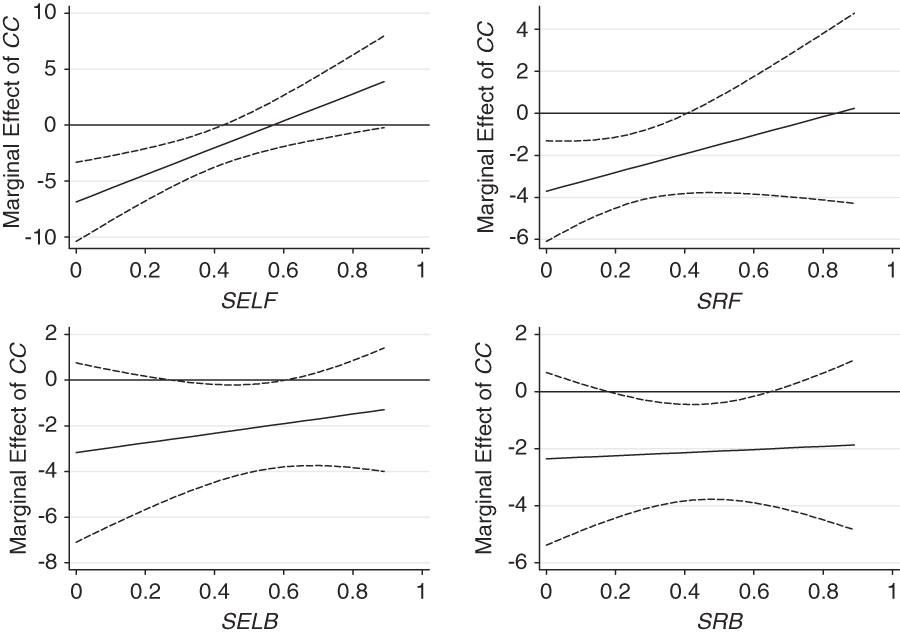
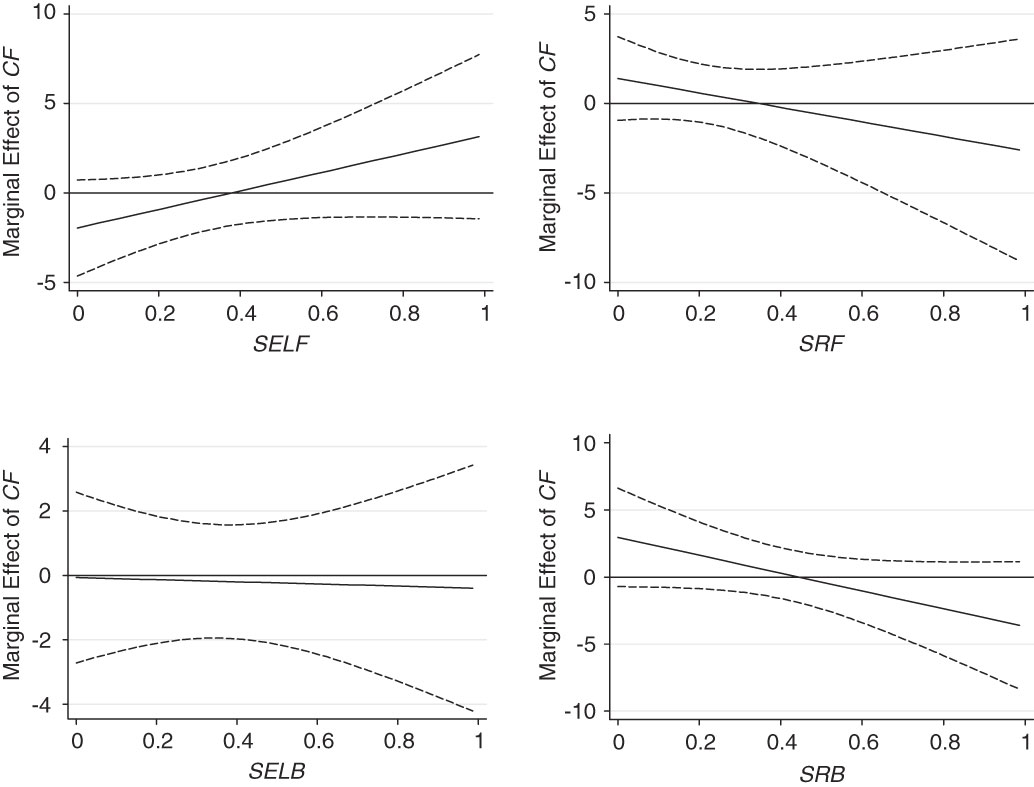
What we are most interested in, however, is the marginal effect of cross-cuttingness on civil war. Figure 2 (top left) shows that at certain levels of each of the single-cleavage characteristics, the marginal effect of cross-cuttingness on civil war onset is negative and significant. One can easily observe significance in marginal effect plots: the effect of ethnic fractionalization is significant whenever the upper and lower bounds of the confidence interval are both either above or below the 0 line. Figure 2 (top left) shows that when fractionalization is low (less than 0.4), the effect of cross-cuttingness on civil war is significantly negative. Put differently, when there are effectively two ethnic groups or less in a society, the effect of cross-cuttingness on civil war is significantly negative.
Marginal effect of cross-cuttingness on civil war onset across levels of ethnic fractionalization, religious fractionalization, ethnic bipolarization and religious bipolarization

Thus, cross-cuttingness really matters in societies composed of a large ethnic group and a small minority. However, when there are effectively more than two ethnic groups, cross-cuttingness does not have a significant reductive effect on the likelihood of civil war onset. The positive slope also suggests that as ethnic fractionalization increases, the reductive effect of cross-cuttingness on civil war weakens. Thus, CC matters more the smaller the minority. This is contrary to Hypothesis 7.1, but nevertheless intuitive. For the other three single-cleavage characteristics (ethnic and religious bipolarization and religious fractionalization), the marginal effect of cross-cuttingness is negative and significant at medium values, as shown in the remaining plots of Figure 2. As with ethnic fractionalization, the reductive effect of cross-cuttingness actually decreases as ethnic bipolarization increases, though the slope is much less steep. For the two religion variables, however, the effect is exactly as specified in Hypothesis 7.1: the reductive effect of cross-cuttingness increases as each of these variables increases. In Models 6 and 7 of Table 5, for which I do not show marginal plots, the effect of cross-cuttingness continues to be negative and significant regardless of the level of the second modifying variable.Footnote 88
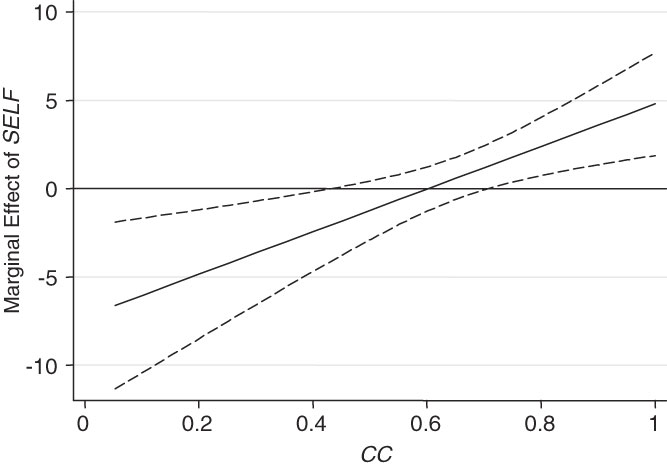
Next, I turn to the other single-cleavage characteristics. Since only the marginal effect of ethnic fractionalization is significant, I show only its plot in Figure 3. We see that the effect of ethnic fractionalization on civil war is significantly positive only when cross-cuttingness is high (at its mean of 0.75 or above). Thus, ethnic fractionalization increases the likelihood of civil war, as stated in Hypothesis 3.1. Contrary to this hypothesis, however, the effect of ethnic fractionalization becomes stronger as cross-cuttingness increases. Hypothesis 3.1 stated that the effect of ethnic fractionalization should weaken at higher levels of cross-cuttingness. One possible explanation of this empirical finding is that cross-cuttingness actually increases the number of preferences in society. Specifically, an additional cross-cutting cleavage may divide society into more subgroups; those subgroups then develop unique preferences for a variety of issues, making conflict more likely.
Marginal effect of ethnic fractionalization on civil war onset across values of cross-cuttingness

Cross-Fragmentation And Civil War Onset
Next, I test whether cross-fragmentation is a significant determinant of civil war onset. As the empirics showed in the previous section, cross-fragmentation and pure cross-cuttingness are separate concepts only mildly correlated. Thus, this next section is not a robustness test of the concept of cross-cuttingness, but rather a test of a different characteristic of cleavage structure altogether. In contrast to pure cross-cuttingness, cross-fragmentation is not statistically significant in any of the models.Footnote 89 Nevertheless, plots of the marginal effect of cross-fragmentation (Figure 4) show similar signs and slopes to Figure 2. Similar coefficients of the other independent variables, including their signs, size and significance are also obtained in the cross-fragmentation models.
Marginal effect of cross-fragmentation on civil war onset across levels of ethnic fractionalization, religious fractionalization, ethnic bipolarization and religious bipolarization

Robustness To Alternative Definitions Of Civil War
I also tested my findings using the several alternative datasets of civil war onset. These datasets included Correlates of War (COW),Footnote 90 Political Instability Task Force (PITF),Footnote 91 Major Events of Political Violence (MEPV)Footnote 92 and Fearon and Laitin (F&L).Footnote 93 In addition, for each of these datasets, I substituted the differing ethnic/religious fractionalization/bipolarization indices mentioned in the previous section. Here, I report the results using my social structure variables.
While there are important differences in the way that these datasets define what a civil war is, I differentiate them here based on intensity.Footnote 94 As mentioned above, PRIO counts cases that have at least twemty-five annual deaths and a minimum of 1,000 conflict-related deaths during the course of the civil war. F&L has the strictest threshold rule; it only counts cases with at least 100 annual deaths and a minimum of 1,000 deaths overall. PITF’s two thresholds are at least 1,000 direct conflict-related deaths over the full course of the armed conflict and at least one year when the annual conflict-related death toll exceeds 100 fatalities. COW maintains the same 1,000 overall minimum, but does not have an annual deaths minimum. MEPV has the lowest overall minimum of at least 500 directly-related deaths over the course of the episode, again with no yearly minimum. All datasets were restricted to the years 1945–99 to maximize comparability.
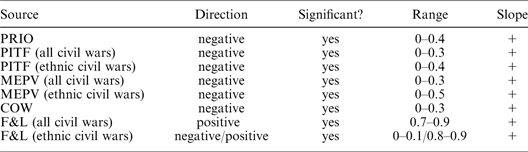
Table 6 summarizes the marginal plots for cross-cuttingness using each of the three alternative datasets. Importantly, PITF, MEPV and COW yield similar results to Figure 2, confirming the robustness of the major result of this study. The F&L dataset yielded slightly different results. The two plots, described in the last two rows of Table 6, suggest that at high levels of ethnic fractionalization, cross-cuttingness actually increases the likelihood of civil war. While these results cannot be completely ignored, it is notable that the F&L dataset has the strictest intensity rules. Moreover, using other measures of ethnic fractionalization in the F&L model in Table 6 produced results in support of the major finding of this article. Thus, we can comfortably conclude that the results are robust in all but the most intense levels of civil war. Robustness results for the other single-cleavage characteristics are not shown due to their inconsistency. Thus, the major robust finding of this article is that the marginal effect of cross-cuttingness on civil war onset is negative and significant when ethnic fractionalization is low (less than 0.5 approximately). This result is robust to the measure of ethnic fractionalization used, source of civil war onset data and statistical technique.
The Marginal Effect of Cross-Cuttingness on Civil War Onset with respect to SELF Using Different Sources of Onset Data

Note: A positive slope means that the marginal effect of CC increases with SELF.
The marginal effect of ethnic fractionalization is less certain. Two of the four alternative measures yielded insignificant results, while the other two returned similar results (including direction, range and slope) as were seen in Figure 3. Moreover, when alternative sources of civil war onset are used, the marginal effect of ethnic fractionalization is insignificant in two of the seven models (using only SELF) and in three models actually reduces the likelihood of civil war onset, though this occurs at low levels of cross-cuttingness. Lastly, in four of the models, the marginal effect of ethnic fractionalization is the same as in Figure 3. In general, then, the range and slope of Figure 3 are confirmed, but it is possible that at low levels of cross-cuttingness, ethnic fractionalization actually reduces the likelihood of civil war. In the conclusion, I address future strategies to assess these results further.
Robustness To Ethnic Civil Wars
There is some disagreement in the literature regarding the use of general civil wars vs. ethnic civil wars as the dependent variable. Proponents of using the latter argue that ethnic wars have different determinants than other types of civil war.Footnote 95 As such, I ran all the models using three different sources for ethnic civil wars onset data: Major Events of Political Violence (MEPV), Fearon and Laitin (F&L) and Political Instability Task Force (PITF), the latter of which I coded myself for ethnic wars. The major results of this article are supported substituting in measures of ethnic civil wars. The marginal effect of cross-cuttingness is significant in all three models, while the marginal effect of ethnic fragmentation is significant in two of the three regressions.Footnote 96
Conclusion
I started by arguing that past models of civil war onset seeking to test the influence of social structure are biased because they do not consider the structure of cleavages. Indeed, this study has confirmed that when single-cleavage social structure characteristics are regressed on civil war, they are insignificant. While intuition tells us that social structure should matter, the vast number of past studies has been inconclusive. This article has suggested that characteristics capturing how two (or more) cleavages are structurally related to each other are an important part of measuring social structure. The empirical results have shown that one such characteristic, cross-cuttingness, is a significant determinant of civil war onset at low levels of ethnic fractionalization. However, the empirical evidence for cross-fragmentation is not so favourable. Moreover, there is weaker support for the marginal effect of ethnic fractionalization, and even weaker evidence that any of the single-cleavage characteristics significantly determine civil war.
Yet this study is only the beginning of a more comprehensive approach to both conceptualizing and measuring social structure. Two other important characteristics come to mind. First, the geographic dispersion of ethnic and religious groups may be important for the actual physical interaction of groups. Consider two highly cross-cutting societies where two ethnic groups share a single religion. In one country, however, ethnic groups are evenly dispersed around the country, whereas in the other they are concentrated in certain regions. In the first society, the ethno-religious cross-cuttingness is more likely to result in actual physical interaction between ethnic groups, but not in the latter. Ethnic groups living near each other might go to the same churches, mosques or temples, or be involved in intra-ethnic organizations or events. In the second country, shared religious identity may not mean much at all. One way to capture this is the ever-elusive measure of which cleavages are salient. However, a measure more achievable in the near future might be a geographic segregation measure similarly derived from surveys.Footnote 97 A second characteristic to be included in future studies should be something that captures the economic inequality among ethnic (or religious) groups. While we might think that ethnic and religious disputes transcend economic ‘greed’, wealth disparity should intensify ascriptive differences. Again, national surveys provide a ready source for such data.
In conclusion, we currently have very little understanding about if and how social structure might affect the likelihood of social conflict. Ethno-religious cross-cuttingness is one step towards a richer sociological theory, and has been shown in this study to be a significant determinant of civil war onset. Certainly, any future study should include cross-cuttingness in a multiplicative specification.
 , where pi is the proportion of society that identifies with a given ethnic group.
 , where pi is again the proportion of society that identifies with a given ethnic group. While this equation is similar to Esteban and Ray’s measure of polarization, Reynal-Querol imposes an assumption that the distance, or intensity of difference, between any pair of groups is identical. In other words, cultural distance is already contained in the underlying assumption. To avoid confusion with cultural polarization, I use the term bipolarization, since the measure is maximized with two groups (or two poles) of equal size. See: