


Online learning in postsecondary institutions has increased dramatically across the United States and Canada. In the United States, enrollment in online courses at degree-granting institutions increased by 345% between 2002 and 2012 (Allen and Seamen 2014, 15). By 2014, an estimated 28% of American students were enrolled in at least one online course (Allen et al. 2016, 43). Although this number is much lower in Canada—only an estimated 4% of students took an online course in 2012—online education also has experienced sustained growth (Canadian Virtual University Consortium 2012, 17).
This expansion reflects student demand for increased accessibility to postsecondary education—especially distance-learning options—as well as greater flexibility and diversity in course offerings. Administrative concerns also have driven this growth, including efforts to find cost savings, increase productivity, and create profit-making opportunities (Cowen and Tabarrok Reference Cowen and Tabarrok2014). In the province where we teach, government also has taken notice, investing millions of dollars in online-learning initiatives (Ontario 2015). Pedagogically, the move online offers instructors the ability to capture the digital environment’s strengths and improve the quality of instruction, offers students better preparation for the knowledge economy, and engages them in active and collaborative learning (Appana Reference Appana2008).
Despite this growth, however, many teaching faculty remain reticent to embrace online learning. A 2014 survey of American postsecondary faculty and administrators found that only 17% of respondents strongly agreed that their institution should expand their online course offerings (Jaschik and Lederman Reference Jaschik and Lederman2014, 34). Among the many concerns expressed about online learning, the most significant was the perception that it was a lower-quality experience for both students and faculty when compared to in-person instruction. A similar 2015 survey found that only 5% of faculty strongly agreed that online courses could achieve the same learning outcomes as equivalent in-person courses (Straumsheim, Jaschik, and Lederman Reference Straumsheim, Jaschik and Lederman2015, 12).
At the root of this concern is the belief that online-learning environments impede faculty–student interaction, the capacity to deliver course content that meets learning objectives, and the ability to reach “at-risk” students (Straumsheim et al. Reference Straumsheim, Jaschik and Lederman2015). Compounding this impression is the reputation of online courses as breeding grounds for passive learning and academic misconduct, as well as suffering from the use of outdated or cumbersome technology (Bailey and Bailey 2011; Grijalva, Nowell, and Kerkvliet Reference Grijalva, Nowell and Kerkvliet2006; Miller and Young-Jones Reference Miller and Young-Jones2012). Whereas research remains somewhat mixed on the level of cheating in online courses (Lanier Reference Lanier2006; Miller and Young-Jones Reference Miller and Young-Jones2012), current research on online teaching demonstrates that there are “no significant differences in the learning outcomes between activities and courses that are taken at a distance and those in the classroom” (Dron and Anderson Reference Dron and Anderson2014, 36). Adapting our pedagogical approach to meet the strengths of the online environment—along with the selection of appropriate tools for digital learning and communication—can address these concerns and improve the online-learning experience for both students and faculty.
We examined the use of a free third-party platform called Slack—originally designed to facilitate connection and collaboration in media and technology firms—as a tool to facilitate better communication among students and faculty, enable the delivery of diverse and dynamic course content, and reach students in an online environment that supports both independent and collaborative learning (Dabbagh and Kitsantas Reference Dabbagh and Kitsantas2011). Many instructors have embraced the use of social-media and audio-visual platforms including Twitter and YouTube, as well as institution-based technologies like Blackboard, to enhance online learning.
We examined the use of a free third-party platform called Slack—originally designed to facilitate connection and collaboration in media and technology firms—as a tool to facilitate better communication among students and faculty, enable the delivery of diverse and dynamic course content, and reach students in an online environment that supports both independent and collaborative learning (Dabbagh and Kitsantas Reference Dabbagh and Kitsantas2011).
Identifying ways to integrate these tools within an accessible online environment, as well as adapting online pedagogical approaches to meet learning objectives, remains challenging for faculty given technological and administrative constraints. As such, we argue that using collaborative social technologies such as Slack—which both replicates and integrates the online and social-media environments that our students already inhabit—can assist faculty in meeting their pedagogical goals online.
This article relates our experiences in delivering course materials and active learning exercises through Slack. We briefly review the literature on active and social learning. We discuss the design of our course and the use of active and social learning exercises to facilitate peer-to-peer interaction. We then analyze student and instructor experiences with Slack and our learning exercises. We conclude by exploring the adoption of new technologies for the digital classroom and the implications for political scientists seeking innovative ways to increase participation, communication, and interaction online.
ACTIVE AND SOCIAL LEARNING THROUGH THIRD-PARTY PLATFORMS
In 2015–16, we delivered a second-year introductory course in Canadian environmental politics at the University of Toronto. The expansion to online learning is a new initiative at our institution, which currently offers only 21 online courses for a student population of more than 50,000. Lectures, course materials, and discussion groups were delivered online except for two in-person tests mandated by university policy. The course had an enrollment of 160 students drawn from the political science and geography departments.
The course was designed so that two lectures were posted online each week for students to stream or download. The purpose of the lectures was to introduce and explain concepts; discussion groups were used to engage students in learning exercises and peer-to-peer interaction. Students completed four online quizzes (10% of total grade), two written assignments (25%), an in-person midterm (15%), and a final exam (25%); they also were expected to actively participate in weekly discussion groups (25%).
Although our observations were generated within the confines of a large public university, our conclusions are applicable to the broad spectrum of learning institutions offering online education in the United States and Canada. Overcoming the communications gap among instructors and students is an important issue regardless of institutional size or form, but it is one that can be addressed through the selection of appropriate and effective pedagogies and technological innovations (Dron and Anderson Reference Dron and Anderson2014; Stein et al. Reference Stein, Wanstreet, Calvin, Overtoom and Wheaton2005). The adoption of new technologies may require additional resources, especially for mature learners, but this should not dissuade instructors from adapting and adopting new course forms and delivery mechanisms.
In adapting this course for delivery online, we confronted two challenges. First, we needed to consider how best to adapt our pedagogical approach and learning objectives from the classroom to the online environment. Second, we wanted to select the best online tool to meet this approach and ensure continued quality in student learning. We canvassed the online-learning literature and selected both active and social learning models to deliver our course content. The models took advantage of the online-learning environment’s strengths in ease of communication, interactivity, and diversity of content. We found that older online-learning platforms, supplied by our university, lacked the flexibility now present in online communications, as well as the ability to take full advantage of Web 2.0 and social-networking content.
Active learning is case- and problem-based learning (Lamy Reference Lamy2007), whereas social learning occurs through the presence and participation of other learners. Together, these models engage “learners emotionally and cognitively in the education process” by empowering students to participate in the teaching process as both independent and peer-based learners (Dron and Anderson Reference Dron and Anderson2014, 18; Rubin and Hebert Reference Rubin and Hebert1998). Active and social learning requires “students to do meaningful learning activities and to think about what they are doing” in a social environment (Prince Reference Prince2004, 223). Not only does social engagement among students increase the human element of online courses, it also leads to better learning outcomes. Richardson and Swan (Reference Richardson and Swan2003) found, for example, that students enrolled in online courses with high “social presence” reported greater perceived learning and higher satisfaction with the instructor. To promote positive learning outcomes, these models require exercises and assignments specifically designed for the purpose, with active and social components drawn throughout exercise conception, delivery, and evaluation (Bromley Reference Bromley2013).
The online environment is well suited to this type of learning given its accessibility across time and space, convenience, and ability to facilitate self-directed and collaborative learning among students (Appana Reference Appana2008; Cole, Shelley, and Swartz Reference Cole, Shelley and Swartz2014). As McCarthy, Miller, and Skidmore (2004, 11) argued, “[n]etworks are the language of our time, but our institutions are not programmed to understand them.” Adopting active and social pedagogies not only meets students where they are but also recognizes differences and strengths of the online environment in comparison to traditional brick-and-mortar classrooms. Finding simpatico between approach and form is important, according to Dron and Anderson (2014, 7), because the “media utilized by educators have very profound effects on the content taught, the organization of the learning, and the range of available activities” used in online courses.
Slack and Active Learning
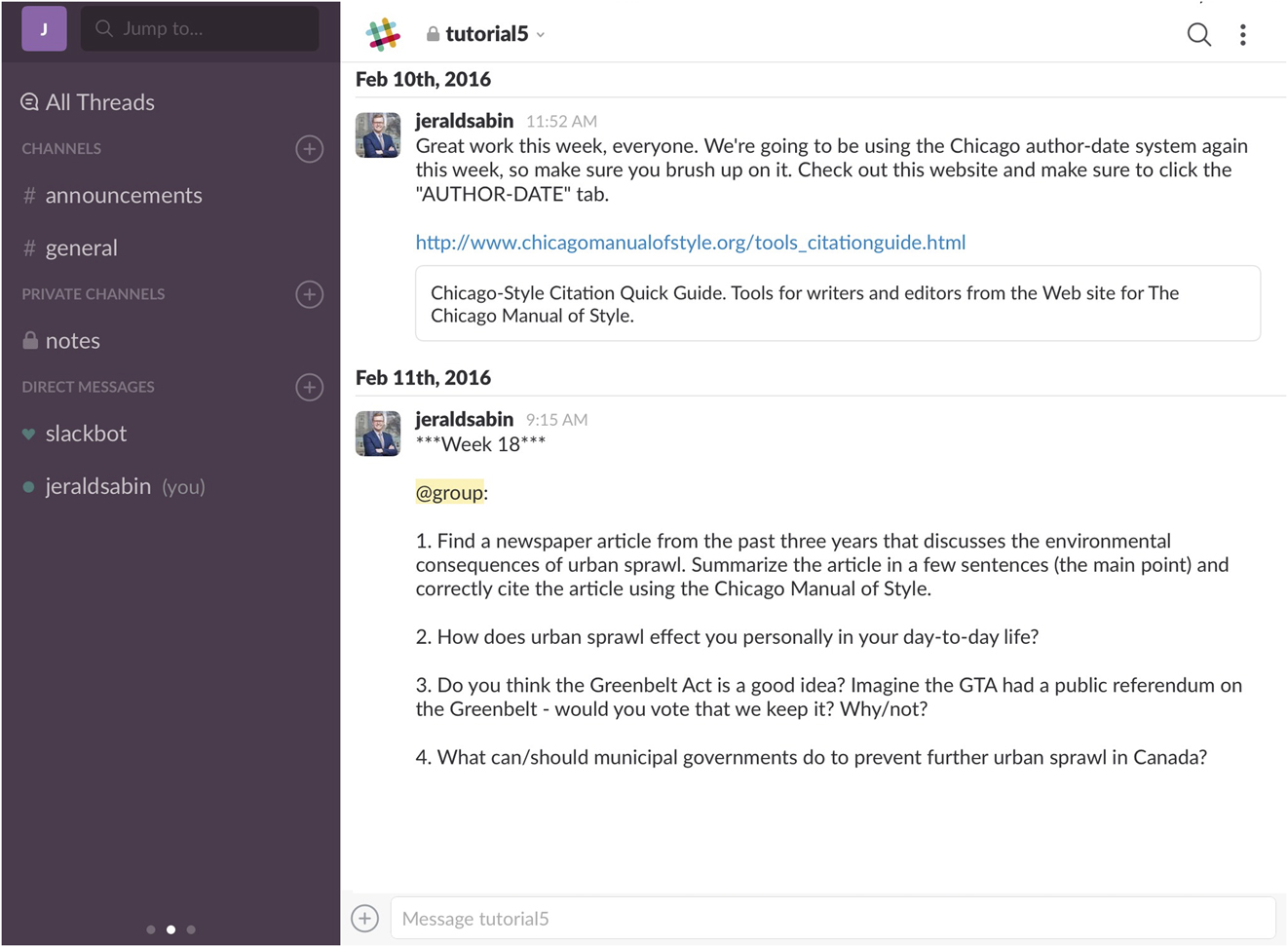
Active and social learning exercises were a central component of the online tutorials, and course discussion was facilitated through a third-party platform we selected called Slack. We found traditional university-provided software to be outmoded and cumbersome, and we looked outside of our institution for solutions. Slack is a free Internet-based application that allows users to chat, share content, and direct messages through a web browser, desktop application, tablet, or smartphone app. Footnote 1 The app (shown in figure 1) has been widely adopted as a means of office communications across the private sector and particularly by journalism, media, and Internet companies (Hess Reference Hess2015). Its popularity derives from the fact that it “syncs seamlessly across devices, features a powerful internal search engine, and is highly compatible with dozens of other programs that keep businesses running” (Hess Reference Hess2015).
Active Learning Exercise (iPad Version)
From a student perspective, Slack also offers something that traditional university-based technologies do not: it replicates and integrates the social-media environment that students inhabit. Students are already integrating social media into their learning in both formal and informal ways (Dabbagh and Kitsantas Reference Dabbagh and Kitsantas2011). The further adoption of social-networking technologies by instructors of online courses is “enabling individual knowledge management and construction” among students and is changing the online-learning environment “into a social learning platform or system where knowledge is socially mediated” (Dabbagh and Kitsantas Reference Dabbagh and Kitsantas2011, 3). The ability to like and up-vote comments, add emojis and GIFs, and embed links, images, and YouTube videos creates a dynamic and familiar environment for students that encourages them to not only consume but also create content. This is important because it encouraged students to log into Slack almost every day during the term as they would Facebook, Instagram, or any other social-networking app. By building a larger learning community on Slack, course learning becomes a part of our students’ larger social-media diet and one that is seamlessly integrated into their lives.
The ability to like and up-vote comments, add emojis and GIFs, and embed links, images, and YouTube videos creates a dynamic and familiar environment for students that encourages them to not only consume but also create content.
Our class of 160 students initially was divided into 16 groups of 10, similar to traditional in-person tutorial groups, for the purposes of discussion. (When enrollment subsequently decreased to 135, a few groups were combined to keep membership in each to about 12 students.) Slack allowed us to create as many private groups as necessary to accommodate tutorials. This meant that students were discussing only in their own “tutorial” of 10 to 12 students. The private channels also created a sense of camaraderie as the students got to know one another during the year.
Tutorial discussion was open to students 24 hours a day, seven days a week. However, formal discussion started on a Tuesday or a Thursday (alternating weeks) and ended at 11:59 p.m. on Sunday nights. Students were graded on their submitted work during those times in the tutorial channels. The grading scheme encouraged them to not only discuss course material but also to actively engage their peers and to apply relevant professional, personal, or other real-world experiences. Students frequently were asked to bring their own material into discussion through library-research exercises and media scans. In moving beyond the lecture material, they developed and delivered content to one another—with instructor oversight and commentary—and became active participants and stakeholders in their own learning.
The types of active and social learning exercises posed during tutorials were generally one of the three following types:
-
(1) Opinion/attitude responses, such as “Do you think the government is doing enough to combat climate change? If not, what else should it be doing? If yes, how effective will climate policy be in this country/province?” These types of exercises engaged students’ critical thinking and creativity. They were encouraged to respond to one another’s responses, ask questions, and provide additional information in support of their fellow learners.
-
(2) Debates, in which students were divided into opposing sides and asked to research, present, and respond to arguments, such as “Should Canada implement a meat tax?” Students were divided into opposing sides and provided with structured opportunities to debate an issue. They were required to engage their own research but also could use course materials.
-
(3) Research questions, which asked students to find data or evidence to support a claim using journal articles, newspaper articles, and government and NGO websites. Students were provided with a research prompt and asked to develop their own argument or assessment of the topic using the research materials they had gathered. They were asked a series of questions to lead them through an assessment of the research before engaging in a discussion of its findings and conclusions (figure 2).
Slack and Political Literacy (iPad Version)
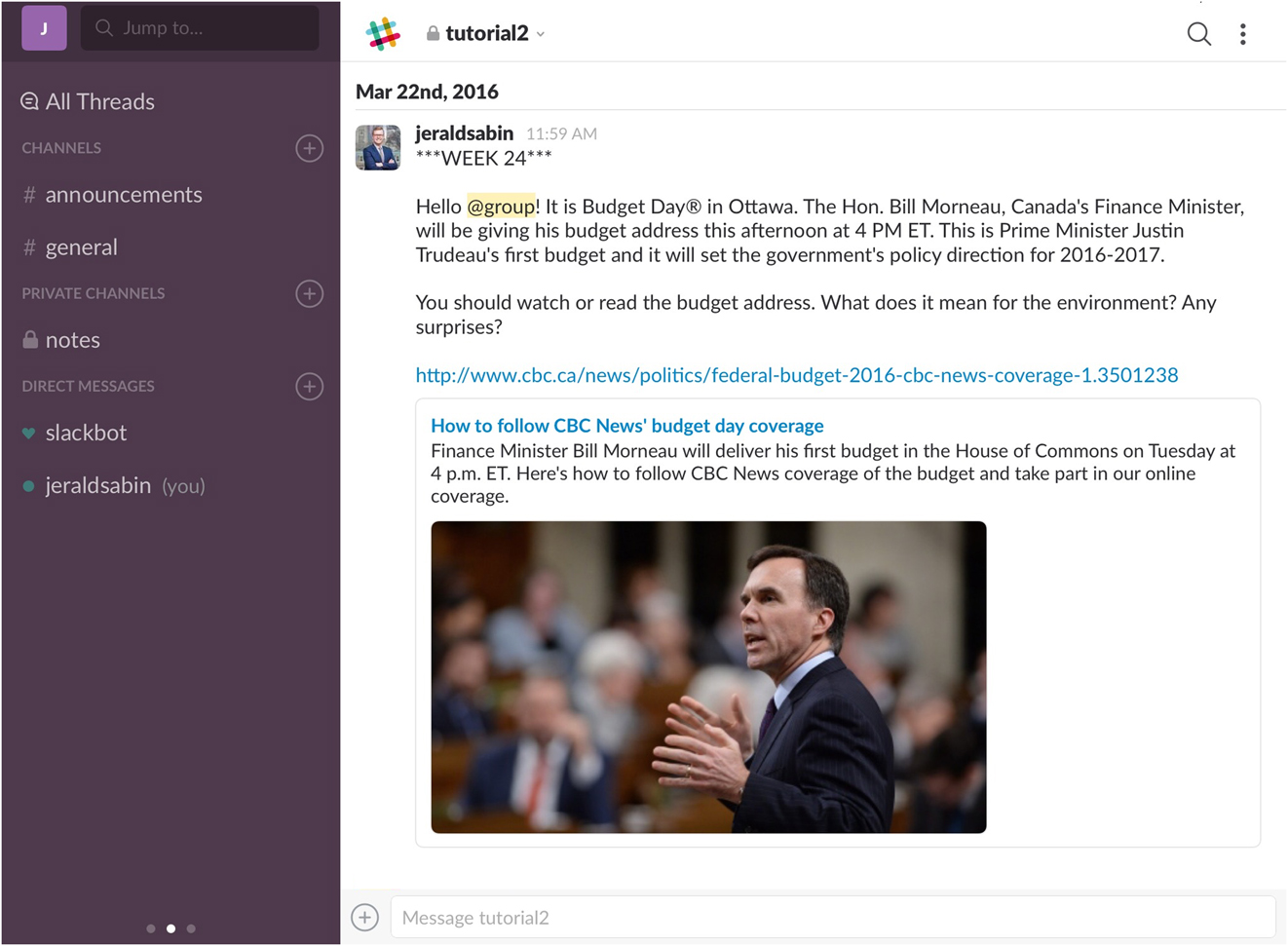
The latter two categories were most related to active learning by asking students to conduct real-time research, analyze and present that research, and effectively teach their fellow participants about their findings. All three types of exercises, as well as the grading rubric, asked students to interact and learn from one another. In addition, they were asked to provide citations using The Chicago Manual of Style author-date system, which allowed them to practice an essential skill while engaging in primary research.
For all 160 students, we also created course-wide forums outside of the private tutorial groups—a space that Slack calls “channels.” These channels included announcements (#announcements); a question-and-answer section (#questions_and_answers), where students could post a question at any time and anyone could answer it, including other students; and a general channel for discussion (#general). If students wanted to direct a question to the professor or a teaching assistant, they could use the appropriate user handle, such as @jeraldsabin. The #general channel was particularly popular because students could post anything at any time, including posts about ongoing environmental news related to climate change, pipelines, and politics. These channels also created a space for students to discuss events that were happening live, such as the 2015 federal election in Canada, the 2016 US primaries, and the COP21 talks in Paris. Unexpectedly, students also logged onto Slack after the November 2015 mass shootings in Paris to talk and be with one another. This was one of the most surprising uses of Slack, which suggests that a genuine online community was created among students.
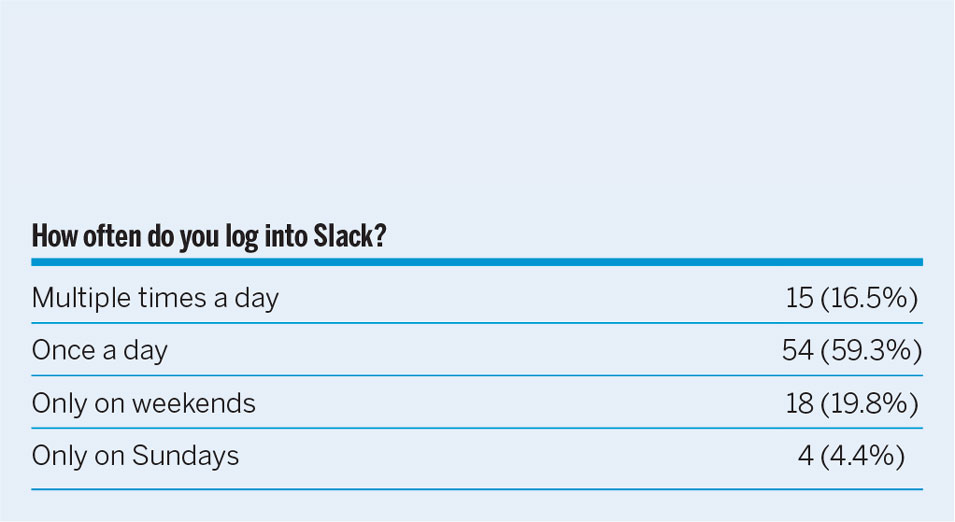
Slack enabled us to collect data on the volume of student participation and provided us with a weekly summary. On average, students posted between 500 and 600 messages to the public and private discussion channels. Therefore, each student was posting three to four responses every week. In a set of student surveys, we asked students how often they logged into Slack. Three quarters (75.6%) logged in daily and sometimes multiple times a day (table 1). Slack’s user data and the level of participation in groups observed weekly corroborated the self-reported data. Although the board is always open, Sunday evenings were the busiest time. The open-ended nature of discussion allowed for ongoing engagement during the week. It also encouraged the development of community that is not possible in traditional classroom settings. We heard from several students that they wished similar technology were available in all of their classes, both online and in-person.
How Often Do You Log into Slack? (February 2016, n = 91)
LEARNING EXPERIENCE
In this section, we review student and instructor experiences using Slack to encourage active and social learning in our course. The introduction of this social technology enhanced both student-instructor interaction and, by the end of the course, student satisfaction with the learning experience.
Student Experience
We collected student feedback in November 2015 and February 2016. In the November survey, we asked students about their early use and attitude toward Slack. We received responses from 126 students, an 82% response rate (155 students were enrolled at the time). Students stated that they used Slack daily (6%), three to four times a week (30%), twice a week (38%), only on Sundays (21%), and rarely to never (5%). These percentages changed dramatically during the course of the year.
Three open-ended questions were posed: (1) What do you like about the course?; (2) What do you dislike about the course?; and (3) What suggestions do you have about Slack? There was even distribution among the course, with a third of students enthusiastic, a third relatively neutral, and a third confused or frustrated by Slack. Students who were positive about Slack left comments such as the following:
I really like the online discussion (slack.com); we can share our ideas and discuss with other people in this course as well. People have different thoughts about the same statement. Also sometimes people share [a] really interesting link or article, even YouTube video[s].
Of those students who did not like Slack, the response was more related to how it was integrated into the course and graded. For example:
I’m not a massive fan of Slack, but that’s just likely due to time constraints. It’s very difficult for me to always go on at a reasonable time and post on Slack, especially recently. While I do like the discussions, I also feel I start seeing the same people over and over again, and it always feels too disconnected. It’s hard to pin that one down, admittedly.
In late February 2016, we asked students to complete a more formal assessment of Slack after using it for five months in the course. In this survey, we received 91 responses, a response rate of 67% (student enrollment was 132 at the time). We asked students to compare their use of Slack in this course to platforms used in other online courses they had taken. We also asked them how they accessed Slack and how often. We saw a significant increase in daily access, with three quarters of respondents accessing the platform once or more per day. Although the majority of those logins were through Slack’s desktop website, we also saw a sizeable number using the platform’s smartphone app (35.2%).
They also expressed that the dynamism of the platform allowed for greater interaction and conversation—a key component of active and social learning approaches. As one student stated, “It’s a great way to start a discussion as opposed to just using the Blackboard discussion board (as I have used previously in another online class).”
When they compared Slack to other online-learning platforms, students used terms including “easier” and “user friendly.” They also expressed that the dynamism of the platform allowed for greater interaction and conversation—a key component of active and social learning approaches. As one student stated, “It’s a great way to start a discussion as opposed to just using the Blackboard discussion board (as I have used previously in another online class).”
We also asked students about the active learning components of the course; the reaction was more mixed. Whereas some enjoyed conducting research for discussion, others were less enthusiastic (e.g., “Nothing too strenuous. I don’t mind”) or cautiously coming around (e.g., “I used to find it tedious because I was not used to it, however I enjoy it now”). Others were concerned about the time involved and the incentives to participate. As one student responded, “To motivate the research, maybe give extra points; discussion time is consuming. Then you add the research time and it’s a full assignment per week. Considering that we have other classes, work, and a personal life, it is hard to balance.”
Instructor Experience
Slack has enriched our teaching in numerous and unexpected ways. When we mention to colleagues that we teach online, they often remark, “Don’t you miss teaching?” or “Aren’t the students all just cheating?” In response to the first question, we find ourselves arguing that we now interact with our students more, not less. We log into Slack daily and discuss current events and course material with them. At online-instructor orientation, we were told repeatedly, “Social presence and teacher immediacy have a positive impact on student satisfaction and learning” (Gunderson et al. Reference Gunderson, Theiss, Wood and Conti-O’Hare2014, 1). Indeed, we were strongly encouraged to “connect” with our students. Slack is our connection.
Slack is a way to provide a “state of being there when using an outside medium” as well as a way for the professor to reduce “psychological distance in interpersonal communication” (Gunderson et al. Reference Gunderson, Theiss, Wood and Conti-O’Hare2014, 338; Short, Williams, and Christie Reference Short, Williams and Christie1976). We can chat with our students in real time in diverse ways, ranging from emojis and hashtags to peer-reviewed course material. It is the best of their world combined with the best of ours. In fact, we now spend more time than before engaging with students.
Using Slack also reoriented our course time. Lectures are shorter, with two 30-minute lectures instead of a single 2-hour in-person lecture, which frees up time to log into Slack. Also, we genuinely enjoy Slack because students are posting various types of relevant discussion, information, articles, and funny insights into our world of environmental policy. Slack is time well spent as both instructor and researcher.
OVERCOMING THE COMMUNICATIONS GAP
Slack provides a way to merge active and online learning in an environment that reflects the digital lives of our students. We recommend the adoption of active and social learning frameworks—in conjunction with collaborative tools such as Slack—to assist faculty in enhancing communication and collaboration among students and instructors, building meaningful social relationships among students in online courses, and improving learning outcomes (Schroeder, Minocha, and Schneider Reference Schroeder, Minocha and Schneider2010). In combining active and social learning exercises with a nimble online-learning environment, our students demonstrated an ongoing engagement with the course, its material, and the larger political world.
Slack enabled us to overcome the communications gap among students and instructors in online courses. We were able to reach out to at-risk students, engage our students in discussions about real-time political events, and empower them to direct their own and their peers’ learning. Given the lengthy and cumbersome procurement processes of many postsecondary institutions, embracing third-party technologies to reach students where they are is an essential component of our approach to innovation in teaching.
Online learning is here to stay, and embracing technologies such as Slack, Twitter, and YouTube—the latter of which is already in wide use in many online classrooms—rather than distracting from core learning objectives can actually enhance our teaching and student learning outcomes. As our institutions turn to greater accessibility and flexibility in the delivery of online education, it will become increasingly incumbent on instructors to seek new approaches and technologies to meet an ever-changing online environment. Our students benefit from social connection both in the classroom and online. As such, using technologies such as Slack, combined with an active and social learning approach, has created a robust collaborative environment in our course that has been embraced by our students.



