According to The Literary Gazette, Gustavus the Third – adapted from Daniel Auber’s Gustave III – ‘depend[ed] chiefly on the eye’ and only ‘somewhat on the ear’ for its success.Footnote 1 Premiered at Covent Garden on 13 November 1833, the new version received 101 performances in its debut season. What kept drawing audiences, critics reported, was the finale: a grand masquerade ball depicting the assassination of the Swedish king Gustav III at the Stockholm opera house. More specifically, they were astounded by the scene’s brilliance; the stage was illuminated all round by means of chandeliers, lamps, brackets, tripods and candelabras.Footnote 2 At first glance, the situation in Paris had been much the same. Gustave III, introduced at the Opéra less than nine months earlier, also won accolades and multiple repeat performances thanks to its spectacular final tableau. But the specific significations of gas lighting in London meant that Gustave was experienced quite differently as Gustavus. Its transference from the Opéra to Covent Garden, after all, involved far more than the adaptation of score and libretto.
Musicologists have already begun to challenge the notion that the early nineteenth century was a time when music was privileged as purely sonic experience, stimulating (at most) the inner eye. Sarah Hibberd, Anselm Gerhard and Cormac Newark, among others, have explored how staging technologies worked in conjunction with music to create critically acclaimed audio-visual effects at the Paris Opéra in the 1820s–40s and beyond.Footnote 3 And James Q. Davies has demonstrated that the visual and bodily were central even to performances of instrumental music in early to mid-nineteenth-century London.Footnote 4 This prevalence of visuality in musical culture should come as no surprise. Sensory historians have argued that the print revolution and Enlightenment elevated sight so that by the nineteenth century it was considered the most important of the senses, linked as it was with observation, rationalism and capitalist display − in a word, with modernity.Footnote 5 This sensory hierarchy persisted into the twentieth century, and it is only in recent years that research has begun to push against it in the form of sound studies. My goal here is not to champion one sense over another, but to draw attention both to the audio-visual sophistication of opera in London and to the critical esteem in which the multisensory potential of musical entertainments was still held.
The inhabitants of London in the 1830s, as Jonathan Crary and Chris Otter have shown, were particularly consumed with vision: with exhibiting, with new lighting technologies and with reaching a better scientific understanding of the eye.Footnote 6 As vision came to be understood as a process dependent on physiological idiosyncrasies, the public became enamoured with having their eyes deceived. Scientists and philosophers deliberated over how modernity was impacting individual minds and bodies as urban life became evermore overcrowded with visual signs and newly installed gaslights. Arguably, nowhere was this stimulation more intensely felt than at the theatre, where performances were marketed through spectacle.
The illuminations in the finale of Gustavus and their clamorous reception, I should like to propose, fed into and reflected the contemporary fascination with lighting technology and illusion. When light has been discussed in relation to nineteenth-century opera, it has typically been within a loose narrative of increasing control over audience experience. Jennifer Hall-Witt draws out a correlation between the level of light in auditoria and the social aspect of opera-going in London.Footnote 7 With regard to Paris, James H. Johnson has proposed that auditorium darkening may have contributed to attentive listening.Footnote 8 Few have investigated the effects of the introduction of gas lighting on the operatic stage, however, or the more varied ways in which changes in lighting technology could affect audiences’ experiences of opera.Footnote 9 In Gustavus, the proliferation of light, as I show here, caused audiences and critics to marvel at the material and visual, to the extent of feeling removed from the narrative altogether. To bring light into the discussion not only enables us to focus on an element of urban and theatrical life that was dominating contemporary discourse, therefore, but also offers ways to deepen our understanding of how opera – and grand opéra in particular – was experienced in 1830s London.
Opera for the eye
Competition between London theatres had created a market for audio-visual spectacle by 1833. Before the Theatre Regulation Act of 1843, only the patent theatres, Covent Garden and Drury Lane, were licensed to stage spoken drama, while through-sung opera in Italian was the domain of the King’s Theatre. Both as a legal necessity and as a bid to draw audiences, the minor (or ‘illegitimate’) theatres embraced pantomime, farce and melodrama, all fitted out with new music and increasingly elaborate stage effects.Footnote 10 It was not long before such entertainments became so popular that managers of the patent theatres were forced to imitate them. Alfred Bunn (c.1797–1860) was one such manager; renowned for his willingness to sacrifice national or ‘legitimate’ drama for crowd-pulling spectacle, he employed circus performers, star singers and imported foreign opera and ballet in an attempt to reverse the decline of the patent theatres.Footnote 11 In 1833–5, he took the unprecedented step of becoming manager of both Covent Garden and Drury Lane to form what he called the ‘Grand Junction’ of the patents.Footnote 12 Covent Garden, he announced in 1833, would be reserved for opera and pantomime, Drury Lane for drama and farce. In themselves, these pairings reveal something about Bunn’s conception of how opera should be staged: as an entertainment that could rival spoken drama, while sharing the technology, scenery and costumes used in pantomime.
French grands opéras, with their extravagant tableaux, were ripe for adaptation in this fluid theatrical landscape. Before Gustave III, Auber’s La Muette de Portici (1828) had been performed as a ballet-pantomime at the King’s Theatre (1829) and an equestrian spectacle at Astley’s Amphitheatre (1833), while Meyerbeer’s Robert le diable (1831) had been treated to four contrasting adaptations in 1832 alone. To render these operas suitable for the London stage, libretti were translated, the number of acts reduced and – save in the case of the King’s Theatre – recitative replaced with dialogue; the essential components of the spectacle were retained, although reworked depending on the theatre’s means.Footnote 13
The ubiquity of spectacle in London’s theatres did not, however, go unchallenged. Since spectacle frequently suspended the action and demanded less sustained concentration on the spoken word than ‘legitimate drama’, critics feared that audiences were being encouraged to disengage, and even that such entertainments might, in Jane Moody’s words, ‘threaten the survival of imagination and indeed the future of the British political and cultural state’.Footnote 14 There were moral implications too. Music and impressive stage effects could be appreciated at a distance, thus allowing theatre capacities to grow. This not only facilitated further disengagement, but also meant that undesirable behaviour, such as gambling and prostitution, could pass by unnoticed.Footnote 15
In the instance of Gustavus the Third, however, critical appreciation of the visual element was near unanimous. What is more, the very potential of spectacle to distract served to shape the drama. Praise for the costumes, scenery and, above all, the well-lit finale dominated the reviews, while what was left of Auber’s score after its arrangement by Thomas Cooke was widely dismissed. The same went for Eugène Scribe’s libretto, adapted by James Robinson Planché (1796–1880).Footnote 16 According to Edward Sterling, writing for The Times, such a vision-centred reception was unique to London: ‘At Paris … Gustavus has been long a favourite, chiefly in consequence of Auber’s music. It is not, however, for the same reason that it will be popular here’, he wrote, before proceeding to describe the scenery.Footnote 17
Bunn had taken particular care to make this opera a treat for the eye. In preparation for the season, he travelled to Paris to view the techniques of the Opéra first-hand and to source repertoire.Footnote 18 Once back in London, he pooled the resources of both his theatres for maximum effect and appointed Charles Farley (1771–1859), whose expertise lay in pantomime, as the opera’s director. To ensure that the production retained its splendour throughout its first run, the sets and costumes were replaced twice.Footnote 19 As performances of Gustavus pushed on almost uninterrupted into 1834, there were some misgivings − complaints that ‘the whole interest [lay] in the adjuncts of the scene-painter, the property-man, and the person who so abundantly provides that dainty material nightly exhibited in petticoatees’;Footnote 20 but the fact remained that Bunn was continuing to ‘wake the sleeping public’, as it was phrased in The Athenaeum, to the existence of the patent national theatres in place of the ‘illegitimates’.Footnote 21
Indeed, the visual aspect of London productions was often treated as a matter of national pride: while critics habitually grumbled about importing foreign works, they could praise the locally constructed sets, costumes and lighting. When in 1833 The Metropolitan Magazine published an article lamenting the fact that ballet imports from Paris were superseding English drama and opera, the author nonetheless granted that a recent performance of Ferdinand Hérold’s ballet La Belle au bois dormant was ‘a splendid affair’ owing to its inclusion of a panorama by Clarkson Stanfield.Footnote 22 Evidently, special satisfaction was found in the skills of London’s scene painters. For Gustavus, the sets were provided by the Grieve family, a group so respected that Thomas Love Peacock of The Examiner ranked them (along with Farley) in ‘first place’, in terms of their contribution to the opera, with ‘second place’ awarded to Auber.Footnote 23 The scenes that received the highest accolades were those with the greatest obvious visual appeal: the finale and the moonlit view of Stockholm in the second act. Reviewers took time to critique the colouring of this latter scene, even suggesting ways in which the Grieves could improve by paying closer attention to their shades of green and blue, which were diluted under the gaslight.Footnote 24 Further evidence for the high esteem in which London-made visual effects were held can be found in the playbills, many of which listed the new scenes in detail, and named the Grieves family, Farley, the decorator, machinist, plumassiers and costume-makers, but omitted Cooke and Auber.Footnote 25 In an apparently unprecedented move, another native artist’s name was emblazoned on the playbills: that of the chandelier maker, a Mr Brookes.
Light as spectacle
It was the lighting, after all, that most thrilled audiences. The careful arrangement of lights in the finale was crucial in adding weight to a moment that had already been rendered more tragic in the adaptation process. In the historical events of 1792, the attack on King Gustav had been political, but in Scribe’s libretto for Paris the potentially incendiary nature of a political assassination was reduced: Gustav’s friend and first minister Ankastrom is instead talked into the assassination after discovering that Gustav is in love with his wife. Not only was the assassination of a monarch a sensitive subject to make it past the Lord Chamberlain’s pen, but the addition of an illicit love intrigue threatened to offend living Swedish royals. In his preface to the libretto, Planché also suggested that changes were necessary in the name of historical veracity.Footnote 26 He therefore split the part of Gustav in two, inventing a new character, Colonel Lillienhorn, to whom the objectionable aspects of Scribe’s character were given (potential adultery, singing), leaving Gustav as a blameless speaking part, and making his death more patently tragic.Footnote 27
This tragedy was felt more keenly by the assassination coming at a moment of extreme distraction, generated in large part by the level of light. So impressive were the illuminations that language relating to light permeated the reviews: the scene ‘eclipse[d]’ everything before it, while the lights were ‘splendid’ and ‘brilliant’, and Auber’s music ‘sparkling’.Footnote 28 Critics had been primed for such reactions by the playbills, which promised ‘a degree of splendour never before attempted on the English stage’.Footnote 29 Even Planché’s libretto used more language relating to light than Scribe’s for this scene. The opening chorus sings of a ‘glittering maze’, a ‘gallant young spark’ and ‘flash[ing] eyes’, and the stage directions specify that the hall be ‘splendidly illuminated’, and filled with costumes to create a ‘brilliant’ picture.Footnote 30
To elicit such a positive critical reaction was to successfully negotiate public ambivalence towards gas lighting. Since its instalment around the auditoriums and stages of London theatres in 1817, first at the Lyceum and then at Covent Garden and Drury Lane, gaslight had been both praised as emblematic of modernity and condemned as a public menace in near-equal measure. Letters to journals and newspapers flooded in from doctors, scientists, critics and general audience members conveying their reservations. Along with expressions of concern about leaks and explosions came complaints about the aesthetic problems of gaslight. While this lighting was intended to improve the spectacle in the auditorium, according to ‘an enemy to gas’ writing to The Theatrical Inquisitor in 1820, ‘the ghastly gleams of the gas’ gave ladies’ faces ‘a wan and meagre aspect, truly sepulchral, whilst the circumstance of the light being shed from the forehead and cheek bones upon the rest of the countenance, complete[d] its spectral appearance’.Footnote 31
This description of deathly countenances hints at broader fears that gaslight was bringing about inner decay: fears underpinned by new revelations about how the eye worked. Since the early seventeenth century, the process of seeing had been understood through the model of the camera obscura − a dark chamber with a small hole through which light passes to reproduce an inverted image on the inside. By the end of the following century, however, scientists realised that images were not simply projected onto the retina; instead, nerve receptors translated light into signals conveyed along optic nerves to the brain.Footnote 32 The discovery that seeing and levels of light had a physical impact on the nerves led some scientists to suggest that gaslight could cause dangerous overstimulation. A medic wrote to The Dramatic Magazine in 1829, for instance:
The strong vivid light, evolved from the numerous gas-lamps on the stage, so powerfully stimulates the brain, through the medium of the optic nerves, as to occasion a preternatural determination of blood to the head, capable of producing headaches or giddiness; and if the subject should at the time laugh heartily, the additional influx of blood which takes place may rupture a vessel, the consequence of which will be, from the effusion or blood within the substance of the brain, or on its surface, fatal apoplexy.Footnote 33
This dulling of the senses was also linked by some with a supposed dulling of taste. The aforementioned ‘enemy to gas’ blamed the ‘present degraded state of the drama’ on the ‘present mode of lighting the theatres’.Footnote 34
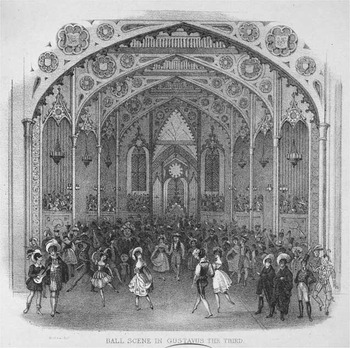
What impressed audiences about the spectacle in Gustavus, therefore, was not necessarily the strength of the light, or even the extent of the gas fittings, but rather the demonstration of the ability to control and manipulate a mixture of lighting apparatus. This mixture was in part a practical issue. Gas had not completely displaced previous lighting methods − oil lamps and candles continued to be used alongside gas well into the nineteenth century.Footnote 35 And for Gustavus, there were limitations as to which parts of the stage gas could reach. If chandeliers hung from the set as indicated in Figure 1, the only way to supply these with gas would have been by short lengths of portable piping.Footnote 36 The standing candelabras and lamps would have required this system too. Such a tangle of piping would have been impractical considering the number of dancers on the stage, and would have detracted from the splendour of the scene; candles and oil lamps were thus implemented instead. The brackets and wing lights on the side walls, the footlights and the chandeliers hung from the ceiling, however, would have been supplied by the gas pipe lines installed back in 1817.Footnote 37
Image taken from the cover of ‘The Masquerade Song’, arranged as a rondo for the piano-forte by S.T. Rosenberg (London, 1834), published by D’Almaine. ©The British Library.

Employing mixed lighting in this way addressed one of the most commonly expressed complaints about stage illumination at that time: the use of gas in the footlights. These footlights consisted of metal reflectors that directed light from foot-high naked gas flames into the stage area. While it had been hoped that using gas in the theatres might be ‘like the striking of daylight’,Footnote 38 the new brightness from the bottom of the stage produced a hellish glare on the actors’ faces and ghostly shadows behind.Footnote 39 The footlights did remain in Gustavus, but their effect was alleviated by the plethora of other lights used. In the finale, light shone in from all directions – from chandeliers on the ceiling, brackets on the walls, candelabras propped on tables and tripods on the floor.Footnote 40 The cut glass in the chandeliers meanwhile further diffused and augmented the light. The overall effect was of a deluge of gentle light that balanced out the harsh effects of the footlights and illuminated right to the back of the stage.
In the end, it was therefore gaslight’s associations with progress – rather than with decay or distaste – that infiltrated the reviews. As Lynda Nead has shown, gaslight signalled modernity as much as degeneration in nineteenth-century London. With gas came the ability to conquer darkness: to illuminate dark places and extend working hours.Footnote 41 However reluctant some were to concede that gas illumination was an important innovation, others made claims for its powerful potential. In an article detailing ‘A History of Gas’ from 1834, for instance, this new technology was praised as ‘a leap in the march of improvement far beyond any that had been previously made or hoped for’.Footnote 42
Such was the admiration for controlled gaslight that The Athenaeum used it as a metaphor for Gustavus’s success, reporting that the opera had
thrown all [Covent Garden’s] former successes into shade. Those productions which we thought splendid before, now twinkle in our mind’s eye like rush-lights, when compared with the gas of ‘Gustavus the Third’ … The last scene surpasses, not only in grandeur, but in chasteness and elegance, all that we have ever beheld either on our own or on the Parisian stage.Footnote 43
The emphasis on ‘chasteness and elegance’ exempts the scene from the immoral and taste-compromising effects that were typically associated with overly strong lighting. Just a year before, a similarly bright ballroom scene in Planché’s military spectacle His First Campaign had been described as ‘brilliant, but not tasteful’.Footnote 44 And reactions to a later French import reveal the benefits of having employed mixed lighting for Gustavus. Early in 1835, Bunn attempted to replicate the previous season’s success with a new Auber opera featuring a grand ballroom scene: Lestocq (1834).Footnote 45 This time, Bunn drastically increased the number of gas lamps used, inducing critics to once more give detailed accounts of the display:
In order to produce the extraordinary and novel effects exhibited in the scene of the Fête of the Hermitage, it was absolutely necessary to lay down an entirely new gas apparatus, from the stage to the top of the proscenium, which has increased the number of lights now used in the scene to above 4,200, including all the lamps, candelabras, chandeliers, candles, illuminated columns and borders.Footnote 46
But Lestocq did not fare as well as its predecessor. With the stage flooded with gaslight, objections to overstimulation were made: ‘to our eye’, complained Edward Taylor of The Spectator, ‘it is all glare’.Footnote 47
The combination of gas with older lighting methods in Gustavus invited favourable comparisons with the past. Maribeth Clark has argued that for Gustave III in Paris, extravagantly staging an eighteenth-century ball scene using all the space and technical effects available at the Opéra encouraged observations on the advancements made in French staging techniques in the preceding decades – steps that had made the Opéra world-renowned for its divertissements.Footnote 48 A similar case might be made for London’s Gustavus regarding the lighting. Critics mentioned seeing wax candles in some of the chandeliers, which indicated that this was a ball held in an age before theatres were fitted with gaslight;Footnote 49 and yet, from all sides, this candlelight was illuminated by gaslight fixtures. This layering of lighting – the theatrical gas illumination and, within that, the situational candlelight – may well have drawn attention to the power of present-day theatre technologies in contrast to those of the previous century.
London opera-goers could equally contrast the staging positively with efforts across the channel. Critic after critic proclaimed that London’s Gustavus was far more spectacular than the Parisian Gustave, and there may have been some validity to these claims.Footnote 50 On seeing the opera in Paris, Bunn had declared that in London ‘some parts’ would ‘be better done’;Footnote 51 the lighting may well have been on his mind. At this time, it was not Paris but London that was known as the ‘city of light’, owing to the extent of its gas networks and street lighting. London had been the first in Europe to install gaslight in its theatres – the Paris Opéra began using gas in 1821, while Italian and German theatres would not catch up until the 1830s and 1840s respectively.Footnote 52 It seems inconceivable this had no impact on the sophistication with which gas was harnessed at the theatre. Indeed, that, according to a report in La Revue des modes de Paris, the director of the Paris Opéra, Louis Véron, travelled to London in 1833 to study the lighting methods used there reinforces the notion that the London theatres would have been able to outstrip their European neighbours in this respect.Footnote 53
In this age of technological exhibition and competition, critics delighted in trying to count and describe the light fittings in Gustavus as accurately as possible. Some approximated (‘nearly 40 cut-glass chandeliers, besides lamps, brackets, tripods, and candelabras, holding some seven or eight hundred lights’,Footnote 54 ‘about thirty glass lustres’Footnote 55 ), while in The News, a footnote provided a thorough rundown:
In lighting this scene there are made use of 36 cut glass chandeliers containing 468 lights, 6 tripods containing 78, Gothic and other lamps holding 125, and 52 brackets mounting 308 – in all 979; a blaze of light never before seen on a stage.Footnote 56
Wonder at the material is also evident in comments on the lustres, which were made especially for the performance, being ‘real glass; none of your hoops from butter tubs with bits of tallow stuck round them, but veritable cut-glass chandeliers’.Footnote 57 Much like gaslight, London’s recent advances in glass-making (as detailed by Isobel Armstrong) were at that time inviting widespread contemplation of modern achievement.Footnote 58 No wonder that, faced with this assembly of fine glass and multitudinous lights, one critic claimed that the scene represented ‘the ne plus ultra of human invention and effect’.Footnote 59
As had become characteristic of works conceived for the Paris Opéra, the finale to Gustave III comprised a climactic audio-visual tableau. For both London and Paris, the finale presented the brightest and the most tragic moment in the opera. But at Covent Garden, both aspects were heightened. Where in each version, the brightness of the scene was accentuated by the dimness of the previous acts, Planché cut an earlier ball scene, allowing the finale to become a clearer visual peak. As in Paris, the final act came after the opera’s darkest moment: the view of Stockholm by moonlight in Act II, although the first scene of Act III (an anteroom at the opera house) provided some gradation. Moonlit penultimate settings became a prominent feature of Romantic theatre with the introduction of dimmable gaslights, and were a common method of heightening the impact of dramatic finales in London’s playhouses. To take examples from that Covent Garden season alone, in the pantomime of St. George and the Dragon, a ‘Dragon’s Haunt by Moonlight’ appeared before the fight scene finale; and the melodrama The Ferry and The Mill (November 1833) showed a moonlit ferry house before the bursting of the dam in the final act. Finales with astonishing lighting effects were popular too. In 1832, a burletta of Don Quixote at the Adelphi was advertised as featuring ‘jets and fountains illuminated by coloured lights’ in the final scene.Footnote 60 Gustavus combined the two practices (dark penultimate scenes and bright finales) by ending with the opera’s brightest and most visually astounding moment.
In Paris, a typical method of building towards the final tragic moment in grand opéra was through sensory overload.Footnote 61 Hibberd has argued that in Gustave III, the whirl of mesmeric dances, bright lights, vibrant costumes and myriad dancers temporarily disorientated audiences to render the moment of assassination all the more cataclysmic.Footnote 62 A similar effect was achieved in London; but again, it was the onslaught of visual stimuli that most preoccupied the critics. Where some were eager to quantify the brightness by counting the lights, others pronounced them ‘innumerable’.Footnote 63 The reviewer for The Morning Post declared himself unable to ‘chronicle the least ray of [the scene’s] splendour’.Footnote 64 To another, the lighting was ‘dazzling’, implying that, at least momentarily, the level of light overpowered the senses.Footnote 65
The extended stage and numerous extras compounded the confusion. Sterling’s account for The Times of masqueraders in ‘numbers more than can be counted’, in ‘dresses of endless variety’, ‘flit[ting] before our bewildered eyes’ gives some indication of the experience of the scene.Footnote 66 The playbill stated that there were 250 supernumeraries, while a later review asserted that this, in conjunction with the actual company and extra audience members brought on to sit in the onstage galleries, meant that there were ‘between four and five hundred people on the stage’.Footnote 67 Such numbers are likely to have been unprecedented (and thus overwhelming) − they were only achievable because Bunn had combined the forces of both his theatres.Footnote 68 Critics were ‘astonished’, too, by the ‘vastness’Footnote 69 of the stage, so deep, even ‘interminable’Footnote 70 it appeared, full of reflective glass and with its back and sides opened out. Sterling, among others, described the effect as an optical illusion:
The whole space of the stage, up to the extreme end, represents a hall brightly lighted, and by an ingenious contrivance the actual space is made to appear much greater than it is.Footnote 71
Others called it ‘pictorial deception’Footnote 72 or ‘magic’.Footnote 73 In Paris, Hibberd has suggested, the equivalent scene resonated with the overwhelming rate of political change in France at that time.Footnote 74 In London, however, the frequent expressions of disorientation and attempts to assess the glass and gaslight suggest that the finale’s pace and brightness resonated with the rapidly modernising, dazzling city, just beyond the theatre walls. The use of light and glass for the sake of illusion invites comparisons with what Armstrong describes as the ‘gas-lit mirrored spaces’ of London’s 1830s shopfronts, whose ‘sensuous allure of light and transparency created optical overload’.Footnote 75
Sound completed the effect. At the moment of assassination, there was a sudden shift from extreme audio-visual–dramatic cohesion to extreme disjunction. Auber’s ‘sparkling’ music matched the visual brightness and celebratory mood of the ball; but with the fatal gunshot, according to one critic, the ‘whole complexion of the scene reversed’. As Gustavus lay wounded on the stage ‘slight catches of music [were] heard at intervals from the more distant apartments’, adding to the feeling that this scene stretched spatially beyond the audience’s vision.Footnote 76 Where the scene’s brightness had previously been a source of delight – of illusion, of modernity – now, it forced the eye to gaze upon the dying monarch. The offstage music and onstage lights became a glaring reminder of the recent merriment of the party, casting an embarrassment of brightness over the tragic scene.
The illusion of access
The shock was more intensely felt because the gunshot forced audiences back into a narrative world that had been temporarily paused. The illuminations made the picture so vivid, and gaslight was so entwined with modern London, that the scene resembled an enterable reality.Footnote 77 Clark and Hibberd have described Gustave III’s opera ball finale at the Opéra as a ‘kaleidoscopic’ layering of past and present, Paris and Stockholm. The dances were decidedly contemporary and local – the galop, in particular, had only been popularised in France in the late 1820s – while the fully costumed revellers belonged to a pre-revolutionary age. Masquerade balls were still held occasionally in Paris, but men were banned from wearing costumes.Footnote 78 In London, however, there were no such restrictions.Footnote 79 The costumes worn in Gustavus, moreover, were typical of contemporary masquerades: a host of recently popularised characters appeared, such as Paul Pry (the titular character of a play of 1825 by John Poole) and Don Giovanni (whose opera only reached London in 1817).Footnote 80 Where in Paris, audiences viewed eighteenth-century characters dancing to 1830s music, in London both appeared modern, meaning that the scene became more thoroughly detached from the rest of the opera. What resulted was more mirror than kaleidoscope.
It was perhaps inevitable that this scene would be understood as a virtual reflection of the operagoer’s reality: the ball was after all set in an opera house. In London, though, a crucial change was made to the setting. Where Scribe’s libretto placed the action in ‘la salle du bal de l’Opéra’ with a large granite staircase to the left, Planché chose simply the ‘opera-house stage’.Footnote 81 The scene was lined all around with galleries occupied by extra audience members, who reviewers recognised from ‘off the boards’.Footnote 82 Faced with people like themselves sat on the other side of the proscenium, the stage must have appeared to audiences like a mirror – a sensation attempted in more material terms by the looking-glass curtain at the Coburg Theatre eleven years earlier – or a mirage of Covent Garden set up for a masquerade on another night.Footnote 83
The scene not only closely resembled a London opera ball, but it simulated the slippage between participation and spectatorship typical at such events. The masked balls held in London’s theatres at that time allowed audiences to step into a quasi-operatic world. It was at the King’s Theatre, rather than Covent Garden, that opera masquerades were most commonly found (hence one critic’s remark that ‘the whole appearance’ of Gustavus ‘was that of such a masquerade as may be seen … at the Opera-house in the Haymarket’Footnote 84 ). These occasions, with their costuming, music and dance, were already inherently theatrical. But the King’s Theatre balls also included performances of popular ballet and opera numbers. In 1833, for instance, grand masquerades held there featured a German choir performing the huntsmen’s chorus from Der Freischütz ‘in character’ and, in 1834, the military scene from the ballet-pantomime La Révolte au sérail was acted out.Footnote 85 Guests could attend as spectators in the boxes and galleries or, for a higher price, promenade or dance on the stage, which was extended out across the pit to fill the auditorium.Footnote 86 Those dancing could draw close to the musicians, dancers and tumblers, and exhibit themselves to the audience to become part of the performance. As such, these hybrid entertainments enabled participants to move freely between performing and spectating. This served as a contrast to an evening at the opera, where the distinction was becoming increasingly delineated, in part owing to the powerful blaze of the gas-lit proscenium.
Just as balls featured theatrical set pieces, it was not uncommon for theatrical entertainments to contain ball scenes. In addition to His First Campaign, recent productions with grand ballroom tableaux included Rossini’s La Cenerentola (as Cinderella) at Covent Garden (1830), John Buckstone’s melodrama Henriette the Forsaken at the Adelphi (1832), and Don Giovanni in various guises since 1817. The masked ball scene in Gustavus, however, offered something new. Bunn allowed his audiences a similar experience to that at an opera ball by inviting select audience members (largely gentlemen subscribers) to participate.Footnote 87 A chief incentive behind this venture was no doubt financial: Bunn was able to augment the number of supernumeraries on the stage and sell extra high-priced tickets in the process. It also catered to those who, on a typical night, would wait in the greenroom for their favourite dancers, actors and singers to exit the stage. But it meant additionally that the scene became a potentially interactive spectacle.
That many of those who appeared in the final scene were recognisable figures from public life further shattered the fictive world generated in the previous acts. As at an opera ball, only a privileged few could afford these places. In consequence, audiences found the characters of Gustavus joined by lords, politicians, ambassadors and military men.Footnote 88 (For the Parisian Gustave, only women audience members were invited on stage, and appear to have been less widely recognised.Footnote 89 ) A song printed in The Age – a paper that specialised in gossip − listed some of the faces spotted. In a carnivalesque reversal typical of a masked ball, amusement was drawn from seeing powerful gentlemen in debasing costumes, such as ‘a maid’, ‘an ass’, ‘the Devil’ and ‘the horns of a pan’ (a cuckold).Footnote 90 The costume that sparked most discussion, however, was that of Napoleon, worn by Bunn himself. Not only was the costume anachronistic, but it also drew attention to its wearer, the self-proclaimed Napoleon of London’s theatres. As with the respectable gentlemen in undignified dress, the amusement depended on the audience disconnecting from the drama to recognise the face beneath the costume.
The music and choreography were also familiar, thus reinforcing the sense that this was a mirror of London. The galop would have sounded and looked contemporary, as in Paris. But where Auber’s dance music for Gustave III was new to Parisian audiences when the opera was first performed at the Opéra, in London it was already known.Footnote 91 Music from popular operas was staple fodder for the ballroom, and so when word about Gustave III’s success reached London, musicians were quick to act. A notice in The Theatrical Observer in April 1833 reported that ‘Mr. F. Weippert’ of Weippert’s band, had ‘left town on a musical mission to the French capital, to purchase the copyright of Auber’s last new Opera, entitled “Gustave; ou, le Bal Masque,” which is stated to contain some of the most beautiful quadrille music of any which this eminent musician has yet composed’.Footnote 92 The operation was evidently successful: in April, quadrilles from the opera were played by the band at the Southampton Annual Easter Ball and at the exclusive Almack’s club in London.Footnote 93 On 24 May, the dance music of Gustave III received an even more prestigious outing when it was performed for a ‘Juvenile Ball’ at St James’s Palace held in honour of Princess Victoria’s birthday.Footnote 94
When it came to the performances of Gustavus at Covent Garden, therefore, those who had attended these occasions would have heard Auber’s galop and quadrilles before. It is likely that there was substantial overlap in attendees – reviewers of the first night of Gustavus noted that a whole host of ‘fashionables’ were present, including Princess Victoria, who had heard the dances at her own ball.Footnote 95 The extensive lists of persons at these balls, printed in newspapers and magazines, also reveal that some of the guests were the same as those found on the stage during the finale. Among the figures noted in the song published in The Age was Prince Paul Lieven, whose name had also appeared frequently in the guest lists of the summer balls. Even those who did not move in such elite circles may have heard the music in advance. With Auber’s quadrilles having become the fashionable dances of the season, the London publisher D’Almaine advertised in July that a piano arrangement by Henry Herz was forthcoming. The galop was not printed until November, but this is not to say that it had not already been widely pirated beyond the ballroom.
The lighting intensified the sense of mirroring. The number of references to the ‘brilliant’ illuminations recalled descriptions found in notices for and accounts of balls.Footnote 96 Once again, however, it was to balls held in London’s theatres specifically that the lighting parallels were drawn. The wax-candle chandeliers hanging over the onstage audience boxes mirrored the wax-candle chandeliers above the dress and first circles; the auditorium, like the stage, had been recently fitted with mixed lighting methods since, while gaslight was desirable for the most part, candles were preferred in the intimate spaces of the boxes.Footnote 97 Further chandeliers hanging from the ceiling over the stage helped balance the light of the central chandelier, as would be the case at a theatre ball, where the light over the dancing space on the stage would need to match that over the pit, dissolving the frame of the proscenium in the process. With the stage opened out to the back of the building and the light spread evenly between auditorium and stage, it was not only unclear where the stage ended, but also where it began.
The feeling of watching a technologically enhanced, fairy-tale representation of reality would not have been unfamiliar to London audiences. Panoramas and dioramas had been popular forms of entertainment since the late eighteenth century, offering visitors the sensation of overlooking city- and mountain-scapes, or stepping through abandoned castles and monasteries. By the 1830s, these installations were frequently animated through theatrical technologies, using sound effects, moving scenery, living props, and carefully positioned gaslights to create the illusion of depth.Footnote 98 The finale of Gustavus appears to have brought to mind such entertainments. John Payne Collier of The Morning Chronicle described the dancers and actors as if they were cleverly engineered figurines moving through a diorama: ‘the whole stage, in its width and depth, is thrown open, brilliantly lighted, and filled with moving and dancing figures’.Footnote 99 Peacock’s account in The Examiner portrayed the scene more explicitly as a three-dimensional, living panorama. ‘Nor was life wanting in the picture’, he wrote; ‘instead of painted spectators in the galleries, as has been usual in such cases, we had an abundance of real men and women’.Footnote 100 And where chandeliers would typically have been painted above these ‘painted spectators’, here, functional lighting fixtures were used. So tangible was the picture that the song in The Age contained a refrain calling on audience members to enter the scene, just as they might a panorama: ‘come put on your domino—come! … “Gustavus the Third” is “at home”’.Footnote 101
Conclusion
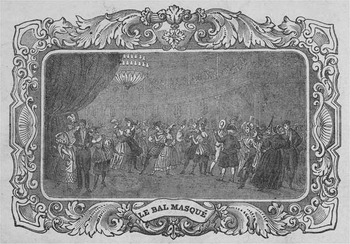
An illustration used by D’Almaine to decorate musical numbers published from Gustavus captures this feeling of being within, or at least potentially within, the action (Fig. 2). The perspective is ambiguous. At first glance, this is simply a view of the stage. A handful of characters are positioned in front of the curtain − the conspirators perhaps. But the grand chandelier in the top left is recognisably that of the auditorium, and there are too many tiers of boxes for this to be the seating on the stage. Neither is this a view of the historic scene at the Stockholm opera. It is inside the auditorium (not the opera house ballroom), and the puffed sleeves of the women and long trousers of some men betray their contemporaneity. Rather than conspirators, it appears that the gentlemen in the bottom corners are bewildered extras, surrounded by ladies, maybe dancers, whispering instructions on how to behave on the stage. And the figure in the bicorn hat, one arm raised as if in direction – might this be Bunn as Napoleon? So this is the Covent Garden stage, but the masked ball has spilled out beyond the proscenium into the auditorium, and the viewers have found themselves beyond the curtain. Or, if this is a view of the stage, as expected of an image used to decorate an opera extract score, then what we are looking at is a reflection. The ornate border – not found on D’Almaine’s other lithographs for sheet music from Gustavus − seems to play on interpretations of this finale as a living picture or mirror: a suspended moment that invited audiences to gaze into the scene, spotting famous faces, counting lights, searching for the back of the stage and imagining themselves as part of the action, only to be shocked back into the narrative at the moment of the assassination.
Image taken from the back page of the score ‘When time hath bereft thee’, second edition (London, 1835), published by D’Almaine. © The British Library.

The mirror I have described, however, was only directed towards a certain few. Not all would recognise figures like themselves among the dancing supernumeraries or spectators in the onstage boxes. Where the Tory Age enjoyed celebrity spotting during the masquerade, the satirical Figaro in London reported:
noblemen and other scum … by paying something extra, are allowed to fret their half hour upon the stage in dirty dominos. Three or four of these bipeds may every night be detected by their Wellington boots and their awkwardness.Footnote 102
Illuminations signalled elegance and progress only for those who were best situated to view them. New lighting technologies obscured the view for those in the cheaper seats. From the galleries at the top of the theatre, it was not possible to see to the back of the stage to witness the optical illusion described in the papers, and the view of the stage front was impaired by the gas footlights, which blazed upwards.Footnote 103 Spectators in the stalls equally suffered from the installation of gas – their perspective was obstructed by the tall footlights, and it was here that the odour and heat from the gas were worst. And yet, visual sources such as the lists of scenery on the playbills, the detailed descriptions in reviews and the lithographs on sheet music allowed these people to see through the eyes of those in the boxes – those with more power to control their sensory environment and to feel the benefits of London’s modernisation.
This account, then, points to ways in which we might consider how changing lighting technologies affected the ways in which opera was experienced in early nineteenth-century London. In this example, light dazzled, distracted, prompted audiences to delight in illusion, wonder at craftsmanship and technology, and become swept up in the scene. Indeed, despite critical reservations about spectacle, it was by playing on audiences’ fascination with technological display – on their tendency to disengage and revel in the visual – that the tragedy was heightened.Footnote 104 Such a reaction was only possible because gas remained at that time a source of novelty and modernity, which still had the power to overwhelm.