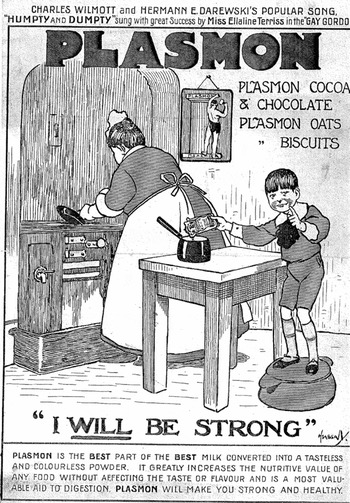
Those readers of Polar Record who are familiar with the narratives of Scott, Shackleton and Mawson during the ‘heroic age’ of Antarctic exploration, will have come across a sledging food called ‘plasmon’. Here, therefore, for their amusement is an outside page of an advertisement for that product, probably of the 1890's or early 1900's (Fig. 1). It measures 12 × 9 inches. Only the front and back pages form the advertisement which indicates on the back page that plasmon is available from all groceries and that a teaspoon a day ‘will prove a great aid to health and strength’. The centre pages carry the words and music of a song entitled ‘Humpty and Dumpty’ said to have been sung by Miss Ellaline Terriss (1871–1971), the well known, and long lived, actress and singer.
Page 1 of the plasmon advertisement

Only Sir Douglas Mawson says much about ‘plasmon’. In The home of the blizzard he states that the daily sledging allowance for one man included plasmon biscuit (12ozs) and plasmon chocolate (2ozs):
Plasmon biscuit was made of the best flour mixed with 30 per cent. of plasmon powder. Each biscuit weighed 2.25 ozs., and was made specially thick and hard to resist shaking and bumping in transit as well as the rough usage of a sledging journey. The effect of the high percentage of plasmon, apart from its nutritive value, was to impart additional toughness to the biscuit, which tested our teeth so severely that we should have preferred something less like a geological specimen and more like ordinary ‘hard tack.’ The favourite method of dealing with these biscuits was to smash them with an ice-axe or nibble them into small pieces and treat the fragments for a while to the solvent action of hot cocoa. Two important proteins were present in this food: plasmon, a trade-name for casein, the chief protein of milk, and gluten, a mixture of proteins in flour (Mawson Reference Mawson1914, I: 188).