Introduction
The use of anticoagulant drugs has steadily increased in recent years.1 Anticoagulant drugs are used to treat patients with pulmonary embolisms, deep vein thrombosis and metallic heart valve replacements, and to prevent secondary complications from atrial fibrillation.Reference Sardella, Mancone, Biondi-Zoccai, Conti, Canali and Stio2
Several new oral anticoagulants were recently approved by the UK National Institute for Health and Care Excellence and are now widely available. Rivaroxaban (Xarelto®), apixaban (Eliquis®) and dabigatran (Pradaxa®) have been licensed as alternatives to vitamin K antagonists for managing atrial fibrillation; rivaroxaban is licensed for thromboprophylaxis after hip and knee arthroplasty and for treating venous thromboembolic events.
Anticoagulant drugs have had a significant impact on otolaryngological practice because haemorrhagic complications such as epistaxis are common, requiring nasal packing, hospital admission and, in severe cases, surgical intervention.Reference Smith, Siddiq, Dyer, Rainsbury and Kim3–Reference Hollowell, Ruigómez, Johansson, Wallander and García-Rodríguez5 Many of the newer agents have different pharmacokinetic profiles compared with older anticoagulant agents, affecting their bioavailability, half-life and elimination. These properties have a substantial effect on potential bleeding complications, and therefore on peri-operative management and the length of hospital stay. Otolaryngologists are increasingly likely to encounter these newer agents; therefore, a good working knowledge of them is becoming ever more important.
This study aimed to explore consultants' and trainee doctors' understanding of various anticoagulant medications and to provide an overview of these drugs to serve as an educational reference for future clinical practice.
Materials and methods
Study design
A questionnaire-based survey was distributed to junior (senior house officers and core surgical trainees), middle-grade (specialist registrars) and senior (consultants) doctors at a regional training day in November 2013.
The questions were designed to obtain data on: awareness of the new oral anticoagulants currently licensed for use; confidence about managing patients taking older anticoagulant therapies compared with those taking new oral anticoagulants; understanding of when new oral anticoagulants should be stopped before elective surgery; methods of drug reversal; the likely need to seek assistance from relevant specialists; and any self-directed learning about new oral anticoagulants.
Following analysis of the results and a review of the current literature, the British National Formulary, National Institute for Health and Care Excellence guidelines and the European Society of Cardiology working taskforce on anticoagulation, a learning resource summary was produced. This resource is described in the discussion section.
Results
In total, 50 doctors completed the questionnaire: 28 junior, 13 middle-grade and 9 senior doctors. The results showed poor clinical and pharmacokinetic knowledge of newly licensed anticoagulant medications. Indeed, when questioned only 3 out of 50 doctors could correctly identify all 3 new oral anticoagulant medications from a list of other similar sounding drugs. Perceived confidence in the management of new oral anticoagulants was low across all grades of doctors (Figure 1). However, perceived confidence in the management of older anticoagulant medications (e.g. warfarin) was better across all grades, particularly the senior level (Figure 2).
Graph showing the mean perceived confidence levels of doctors when managing patients taking new oral anticoagulant medications.

Graph showing the mean perceived confidence levels of doctors when managing patients taking newer vs older anticoagulant medications.
When questioned on when to stop anticoagulant medications before surgery, many clinicians thought that new oral anticoagulants required five to seven days of abstinence for reversal (Figure 3). None correctly stated that less than five days is sufficient. Following dissemination of the questionnaire results, there was consensus on the value of an educational resource providing detailed information on the new forms of anticoagulant medications.
Graph showing the number of days that doctors thought the new oral anticoagulant medications needed to be stopped for reversal to be achieved before major surgery in patients with normal creatine in clearance rates.
Discussion
Key findings
This study found that most doctors have a good working knowledge of the older established forms of anticoagulant medication but their knowledge on newly licensed drugs is poor. Indeed, many doctors were unaware of the reversal times required for these medications before surgery, thus potentially putting patients at risk of thrombotic complications if medication is inappropriately withheld for longer than absolutely necessary. Therefore, an educational guide on new oral anticoagulants will be very useful.
Improvements in clinical practice
To improve the poor knowledge of new oral anticoagulant medications and thus improve patient safety, we have formulated an educational resource comprising a brief outline of these medications and a treatment algorithm. This resource was produced with specialist input from haematologists and otolaryngologists. It has been distributed across the region to improve knowledge of these drugs and presented at regional and national meetings. Furthermore, management tables included in the resource have been put in otolaryngology treatment areas to help improve the future clinical management of patients taking these medications.
Overview of new oral anticoagulants
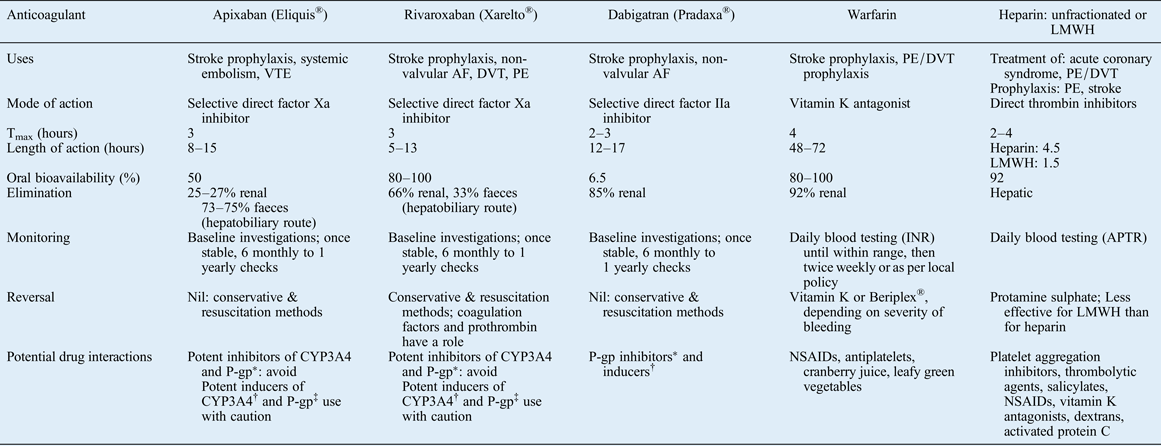
Until recently, vitamin K antagonists (e.g. warfarin) were the only oral anticoagulants available; however, the numerous limitations associated with their use, such as drug and dietary interactions plus a narrow therapeutic index prompted the introduction of new oral anticoagulants.Reference Hollowell, Ruigómez, Johansson, Wallander and García-Rodríguez5 Alongside warfarin and heparin, three additional anticoagulants are currently licensed for use in the UK: dabigatran, a direct thrombin inhibitor; and apixaban and rivaroxaban, which are direct inhibitors of activated factor X. Although these drugs will affect the downstream function of the coagulation cascade, their effects are not dose dependent.Reference De Caterina, Husted, Wallentin, Andreotti, Arnesen and Bachmann6 Therefore, all three drugs are administered in fixed doses and coagulation monitoring has been considered unnecessary (see Table I).Reference Sorbera, Bozzo and Castaner7, Reference Stangier, Eriksson, Dahl, Ahnfelt, Nehmiz and Stähler8
Pharmacodynamic and pharmacokinetic profiles of oral anticoagulants
Table taken from Massicotte and reproduced with permission from SAGE Publications.Reference Stangier, Eriksson, Dahl, Ahnfelt, Nehmiz and Stähler8 *Potent CYP3A4 inhibitors include antifungals (e.g. ketoconazole, itraconazole, voriconazole, posaconazole), chloramphenicol, clarithromycin) and protease inhibitors (e.g. ritonavir, atazanavir); P-gp inhibitors include verapamil, amiodarone, quinidine and clarithromycin. †Potent CYP3A4 inducers include phenytoin, carbamazepine, phenobarbital and St. John's wort (Hypericum perforatum). ‡P-gp inducers include rifampicin, St. John's wort, carbamazepine and phenytoin. LMWH = low molecular weight heparin; VTE = venous thromboembolism; AF = atrial fibrillation; DVT = deep vein thrombosis; PE = pulmonary embolism; Tmax = time to peak concentration; INR = international normalised ratio; APTR = activated partial thromboplastin time ratio; NSAID = nonsteroidal anti-inflammatory drug; CYP3A4 = cytochrome P450 family 3 subfamily A polypeptide 4; P-gp = P-glycoprotein.
Dabigatran
Dabigatran etexilate is a synthetic, low molecular weight peptidomimetic that binds directly (and reversibly) to the catalytic site of thrombin.Reference De Caterina, Husted, Wallentin, Andreotti, Arnesen and Bachmann6 For the prophylaxis of stroke and systemic embolism in non-valvular atrial fibrillation, a dose of 150 mg twice a day is usual. Patients aged over 80 years at a high risk of bleeding and with a creatinine clearance rate of under 50 ml/minute or receiving concomitant therapy with verapamil or amiodarone are given a reduced dose of 110 mg twice a day. Dabigatran is a pro-drug with 6 per cent bioavailability after oral administration. Once absorbed, the compound is rapidly and completely biotransformed to the active compound dabigatran by esterase-mediated hydrolysis. Plasma levels peak two to three hours after oral administration.Reference Eerenberg, Kamphuisen, Sijpkens, Meijers, Buller and Levi9 This drug has a half-life of 12–17 hours in healthy elderly patients.Reference Jiang, Hu, Zhang, Yang, Mueck and Kubitza10 Eighty-five per cent eliminated by the kidneys; therefore, plasma concentrations are higher in patients with impaired renal function and close clinical surveillance is recommended for this patient group. The drug is contraindicated when the creatinine clearance rate is less than 30 ml/minute. Dabigatran is metabolised in the liver via the P-glycoprotein (P-gp; also known as ATP-binding cassette sub-family B member 5) enzyme system; hence, potent P-gp inducers can decrease dabigatran plasma concentrations and should be avoided (see drug interactions in Table I).Reference De Caterina, Husted, Wallentin, Andreotti, Arnesen and Bachmann6
There are currently no specific reversal agents for dabigatran. Through thrombin inhibition, dabigatran prolongs the activated partial thromboplastin time and thrombin time.11 Therefore, the administration of fresh frozen plasma or prothrombin complex concentrates is ineffective in reversing its effects.Reference De Caterina, Husted, Wallentin, Andreotti, Arnesen and Bachmann6, 11 However, the administration of activated pro-thrombin complex concentrates has been shown to attenuate dabigatran-induced bleeding in animals in a dose-dependent fashion.Reference De Caterina, Husted, Wallentin, Andreotti, Arnesen and Bachmann6, 11 Therefore, activated prothrombin complex concentrates or recombinant activated factor VII may be helpful in cases of uncontrolled bleeding.
Rivaroxaban
Rivaroxaban is a highly selective, reversible, direct factor Xa inhibitor which is rapidly absorbed after oral administration (peak concentration after two to four hours).Reference De Caterina, Husted, Wallentin, Andreotti, Arnesen and Bachmann6, Reference Jiang, Hu, Zhang, Yang, Mueck and Kubitza10 A dose of 20 mg once a day is usually given for the prophylaxis of stroke and systemic embolism in cases of non-valvular atrial fibrillation unless the estimated glomerular filtration rate is less than 50 ml/minute/1.73 m2. Under the latter conditions, a dose of 15 mg once daily is administered. For treating deep vein thrombosis and pulmonary embolism, 15 mg is given twice a day for the first three weeks, followed by a continuation dose of 20 mg once a day (or 15 mg if the estimated glomerular filtration rate is less than 50 ml/minute/1.73 m2). Rivaroxaban has an absolute bioavailability in the fasting state of approximately 66 per cent, but increases with food intake,Reference De Caterina, Husted, Wallentin, Andreotti, Arnesen and Bachmann6 and should therefore be taken after breakfast. One-third of the drug is renally excreted, whilst two-thirds are metabolised in the liver. This drug is not recommended in patients with a creatinine clearance rate of less than 15 ml/minute.Reference Massicotte12 The half-life of the drug is 5–13 hours and the drug is administered once per day for all indications. The drug is metabolised in the liver via cytochrome P450 family 3 sub-family A polypeptide 4 (CYP3A4) and P-gp dependent mechanisms. It should therefore not be taken in combination with strong inducers of these enzymes or its efficacy is likely to be reduced (Table I).Reference De Caterina, Husted, Wallentin, Andreotti, Arnesen and Bachmann6
There is no specific reversal agent or antidote for rivaroxaban. It primarily acts to prolong the prothrombin time. Prothrombin complex concentrates have been shown to reverse rivaroxaban-induced prolongation of prothrombin time.11
Apixaban
Apixaban is a highly selective, reversible, direct factor Xa inhibitor.Reference Stangier, Eriksson, Dahl, Ahnfelt, Nehmiz and Stähler8 For the prophylaxis of stroke and systemic embolism in non-valvular atrial fibrillation, the usual dose is 5 mg twice a day. The dose is reduced to 2.5 mg twice a day if the patient is aged over 80 years, weighs less than 60 kg or has an estimated glomerular filtration rate of less than 30 ml/minute/1.73 m2.Reference Stangier, Eriksson, Dahl, Ahnfelt, Nehmiz and Stähler8 Maximum plasma concentrations are obtained three to four hours after oral administration.Reference De Caterina, Husted, Wallentin, Andreotti, Arnesen and Bachmann6 This drug has a half-life of 8–15 hours, and is given twice daily for all indications.Reference De Caterina, Husted, Wallentin, Andreotti, Arnesen and Bachmann6 Seventy-five per cent of apixaban is metabolised in the liver via the same mechanisms as rivaroxaban, and 25 per cent is metabolised via the kidneys. Apixaban should be avoided in patients with a creatinine clearance rate of less than 15 ml/minute.Reference Stangier, Eriksson, Dahl, Ahnfelt, Nehmiz and Stähler8 The same drug contraindications exist as for rivaroxaban, especially regarding the concomitant use of strong CYP3A4 and P-gp inducers (Table I).Reference Sorbera, Bozzo and Castaner7 There is currently no specific reversal agent or antidote for apixaban. In cases of severe bleeding, management is the same as that used for patients taking rivaroxaban.
Drug interactions
P-glycoprotein forms part of a transporter system located in intestinal epithelial cells (enterocytes).Reference Sorbera, Bozzo and Castaner7 As drug molecules diffuse through enterocytes, P-gp binds to them and returns them to the luminal side of the cell, thus preventing them from reaching the circulation.Reference Sorbera, Bozzo and Castaner7 Therefore, when a drug inhibits the P-gp pump system, it increases the systemic availability of a P-gp-sensitive drug, with a resultant increase in activity and/or toxicity.Reference Sorbera, Bozzo and Castaner7 P-gp inhibitors include verapamil, amiodarone, quinidine and clarithromycin.Reference Sorbera, Bozzo and Castaner7 Clarithromycin is particularly pertinent to otolaryngology because it is commonly used to treat penicillin allergies and for managing chronic rhinosinusitis patients. Conversely, if a drug induces the P-gp system (e.g. rifampicin, St. John's wort (Hypericum perforatum), carbamazepine, phenytoin),Reference De Caterina, Husted, Wallentin, Andreotti, Arnesen and Bachmann6 less of the drug reaches the systemic circulation and its activity is therefore decreased.Reference Stangier, Eriksson, Dahl, Ahnfelt, Nehmiz and Stähler8
The CYP3A4 enzyme is located in the liver and metabolises a wide variety of drugs.Reference Sorbera, Bozzo and Castaner7 Inhibition of this enzyme decreases the metabolism of drugs eliminated by this enzyme, thereby increasing their activity or toxicity.Reference Stangier, Eriksson, Dahl, Ahnfelt, Nehmiz and Stähler8 Potent CYP3A4 inhibitors include antifungals (e.g. ketoconazole, itraconazole, voriconazole, posaconazole), chloramphenicol, clarithromycin and protease inhibitors (e.g. ritonavir, atazanavir).Reference De Caterina, Husted, Wallentin, Andreotti, Arnesen and Bachmann6 Conversely, if CYP3A4 is induced, drugs that are eliminated via this enzyme will be eliminated at a higher rate and their activity will therefore be diminished. Potent CYP3A4 inducers include rifampicin, phenytoin, carbamazepine, phenobarbital and St. John's wort.
Drug monitoring
Routine laboratory monitoring is not required after dabigatran, rivaroxaban and apixaban administration because their stable pharmacokinetic properties provide predictable and consistent anticoagulant activity.Reference Stangier, Eriksson, Dahl, Ahnfelt, Nehmiz and Stähler8
Before commencing treatment, patients should have undergone a baseline clotting screen, a full blood count, and renal and liver function tests. These tests should be repeated at least once a year.Reference Stangier, Eriksson, Dahl, Ahnfelt, Nehmiz and Stähler8 Patients should be monitored in the community or at specialist anticoagulation clinics every three months to assess compliance with drug treatment, to provide advice on dosing and to assess thromboembolic events.Reference Sorbera, Bozzo and Castaner7
Bleeding complications
Bleeding is the most common adverse effect of the new oral anticoagulants that are pertinent to otolaryngological surgery.Reference Stangier, Eriksson, Dahl, Ahnfelt, Nehmiz and Stähler8 Their adverse effects may be manifested by emergency presentations of patients taking new oral anticoagulants. These patients may present with bleeding in the form of epistaxis, tracheostomy-related bleeding complications or post-diagnostic tonsillectomy bleeding. However, none of the standard coagulation tests constitute a sensitive or specific measure of their therapeutic activity and there are no specific antidotes for these newer agents.Reference Stangier, Eriksson, Dahl, Ahnfelt, Nehmiz and Stähler8 An appreciation of the lack of reversible agents for new oral anticoagulants (in contrast to warfarin) should lower the threshold for operative intervention in haemodynamically unstable otolaryngology patients. Therefore, management is conservative in the first instance, and close haematological support may be required.Reference Sorbera, Bozzo and Castaner7 For a severe haemorrhage, administration of blood products in the form of packed red cells, fresh frozen plasma, platelets or cryoprecipitate should depend on the associated pathology, for example anaemia, thrombocytopenia and coagulopathies, and their relevant co-morbidities.Reference Stangier, Eriksson, Dahl, Ahnfelt, Nehmiz and Stähler8 Haematological advice is essential for treating severe or uncontrolled haemorrhage. This should include when to consider the use of haemostatic agents such as activated prothrombin complex concentrates. Activated charcoal may slow down the absorption of new oral anticoagulants if administered within a few hours of ingestion. Dabigatran binds weakly to plasma proteins and may hence be cleared via haemofiltration.Reference Eerenberg, Kamphuisen, Sijpkens, Meijers, Buller and Levi9
Pre-operative discontinuation
Accurate pre-operative discontinuation advice will minimise the bleeding risk during otolaryngology surgery and reduce unnecessarily prolonged pre-operative discontinuation and predisposition to adverse risks. The decision to temporarily discontinue anticoagulants before elective otolaryngological surgery, together with the duration of discontinuation, will depend on the individual patient's risk of a thromboembolic event compared with the bleeding risk associated with the procedure. In complex cases, obtaining early advice from cardiology and haematology specialists is essential. However, knowledge of the basic pharmacology of new oral anticoagulants can prevent management delay due to unnecessary specialist calls and can enhance an awareness of the appropriate time to seek help. This can therefore save the valuable time of both otolaryngology surgeons and relevant medical physicians.
Procedures with negligible bleeding risks can be performed just before the next dose of dabigatran, rivaroxaban and apixaban, or approximately 18–24 hours after the last dose was taken (i.e. one dose may be missed).Reference Stangier, Eriksson, Dahl, Ahnfelt, Nehmiz and Stähler8
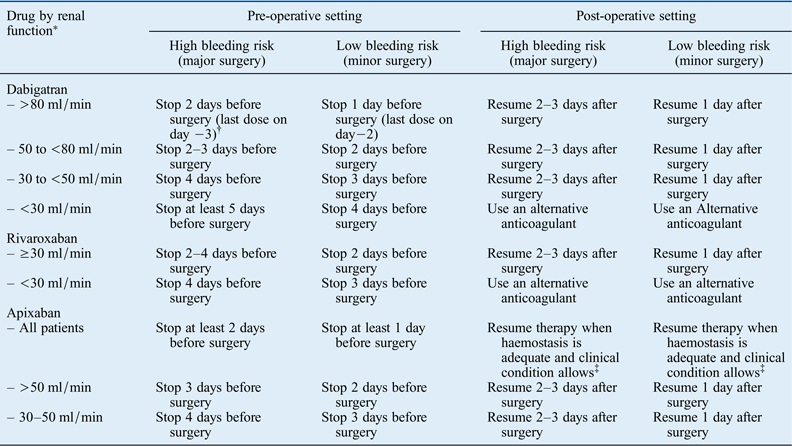
For procedures with a low bleeding risk, dabigatran, rivaroxaban or apixaban should be stopped 24 hours before the procedure.Reference Sorbera, Bozzo and Castaner7 However, patients taking dabigatran and with renal impairment and a creatinine clearance rate of 50–80 ml/minute should stop taking the drug 36 hours beforehand; those with a creatinine clearance rate of 30–50 ml/minute should stop the drug at least 48 hours beforehand.Reference Sorbera, Bozzo and Castaner7, Reference Stangier, Eriksson, Dahl, Ahnfelt, Nehmiz and Stähler8 Patients taking rivaroxaban or apixaban and with renal impairment (creatinine clearance rate of 15–30 ml/minute) who undergo procedures with a low bleeding risk should discontinue the drug 36 hours before the procedure.Reference Sorbera, Bozzo and Castaner7, Reference Stangier, Eriksson, Dahl, Ahnfelt, Nehmiz and Stähler8
• Many new anticoagulant agents are now licensed for use in the UK
• They are especially used to manage atrial fibrillation
• The questionnaire revealed that knowledge of these new medications is poor for all otolaryngologists
• This study provides an educational guide for managing patients taking the new anticoagulant agents
For procedures with a high bleeding risk, dabigatran, rivaroxaban or apixaban should be discontinued 48 hours before the intervention. However, if renal impairment exists, then dabigatran should be stopped for 72 hours (for a creatinine clearance rate of 50–80 ml/minute) or 96 hours (for a creatinine clearance rate of 30–50 ml/minute) before surgery (summarised in Table II).Reference Sorbera, Bozzo and Castaner7, Reference Stangier, Eriksson, Dahl, Ahnfelt, Nehmiz and Stähler8
Peri-operative management of new oral anticoagulants
Table taken from Massicotte and reproduced with permission from SAGE Publications.Reference Massicotte12 *Creatine in clearance rate. †Day 0 is the day of the surgery. ‡The product monograph from the manufacturer provides only this general statement.
Post-operative recommencement
Precise post-operative recommencement instructions can further minimise the adverse thromboembolic risk for otolaryngology patients. It can also decrease the hospital stay within otolaryngology wards, thus providing clinical and financial benefits.
In procedures with no clinically important bleeding risk, all three recently licensed oral anticoagulants may be recommenced six hours post-operatively.Reference Sorbera, Bozzo and Castaner7 For patients taking dabigatran, the drug can be restarted 48–72 hours after major surgery, (24 hours after minor surgery) unless the creatinine clearance rate is less than 30 ml/minute (see Table II). In this case, an alternative anticoagulant agent should be used after both major and minor surgery. Patients taking rivaroxaban or apixaban and with normal renal function should also re-commence the drug 48–72 hours after major surgery or 24 hours after minor surgery. An alternative anticoagulant should be used following either major or minor surgery for patients receiving rivaroxaban or apixaban and with a creatinine clearance rate of less than 15 mL/minute.Reference Sorbera, Bozzo and Castaner7
Conclusion
This study reveals that all grades of otolaryngologists are poor at recognising newly licensed anticoagulant drugs. Many are confident in the clinical management of patients taking the more established drugs but have low confidence in treating those taking newly licensed anticoagulant medications. Knowledge of the new anticoagulant drugs is essential for otolaryngologists, many of whom will manage patients with complex symptoms and moderate to severe haemorrhage. This resource therefore provides a valuable broad overview of new developments in this area.