INTRODUCTION
Numerous studies have investigated whether attention-deficit/hyperactivity disorder (ADHD) is associated with specific neuropsychological deficits in an attempt to shed light on the etiology of this disorder. This research has primarily focused on ADHD-related deficits in executive functions (EFs; i.e., cognitive functions responsible for maintaining internal goals to perform task-relevant behaviors; Miller & Cohen, Reference Miller and Cohen2001; Miyake et al., Reference Miyake, Friedman, Emerson, Witzki, Howerter and Wager2000). EFs can be classified under two domains: “cool” or “hot.” “Cool” EFs are non-emotionally laden functions that are typically subserved by the dorsolateral prefrontal cortex (DLPFC), which has strong connections to the thalamus, basal ganglia, hippocampus, and association areas of the neocortex thought to be important for cognition (Zelazo & Müller, Reference Zelazo and Müller2011). Tasks such as the Wisconsin Card Sorting Test (WCST), Erickson flanker task, and the Dimensional Card Sort have been described as typical “cool” EF tasks (Zelazo & Carlson, Reference Zelazo and Carlson2012). Additional studies have included nonverbal and verbal working memory tasks such as the self-ordered pointing task and digit spans to examine “cool” EF performance (Hongwanishkul, Happaney, Lee, & Zelazo, Reference Hongwanishkul, Happaney, Lee and Zelazo2005; Prencipe et al., Reference Prencipe, Kesek, Cohen, Lamm, Lewis and Zelazo2011). Compared with typically developing controls, children with ADHD are often found to have impairments in “cool” EF functions, including working memory (Martinussen, Hayden, Hogg-Johnson, & Tannock, Reference Martinussen, Hayden, Hogg-Johnson and Tannock2005), response inhibition (Willcutt, Doyle, Nigg, Faraone, & Pennington, Reference Willcutt, Doyle, Nigg, Faraone and Pennington2005), and planning and problem solving (Kopecky, Chang, Klorman, Thatcher, & Borgstedt, Reference Kopecky, Chang, Klorman, Thatcher and Borgstedt2005; Romine et al., Reference Romine, Lee, Wolfe, Homack, George and Riccio2004; Weyandt & Willis, Reference Weyandt and Willis1994).
In contrast with “cool” EFs, “hot” EFs refer to the cognitive abilities needed for motivationally or emotionally salient decision making and goal setting (Zelazo & Müller, 2002). Studies examining “hot” EFs typically use gambling, choice delay, delay discounting, or risky choice tasks to obtain measures of decision making within a motivational context (e.g., Garon, Moore, & Waschbusch, Reference Garon, Moore and Waschbusch2006; Shiels et al., Reference Shiels, Hawk, Reynolds, Mazzullo, Rhodes, Pelham and Gangloff2009; Solanto et al., Reference Solanto, Abikoff, Sonuga-Barke, Schachar, Logan, Wigal and Turkel2001; Wilson, Mitchell, Musser Schmitt, & Nigg, Reference Wilson, Mitchell, Musser, Schmitt and Nigg2011; Zelazo & Carlson, Reference Zelazo and Carlson2012). Imaging research suggests that these abilities are subserved by regions distinct from those of “cool” EFs, including the orbitofrontal and ventromedial regions of the prefrontal cortex (OF/VMPFC), which have connections to the amygdala and limbic system implicated in emotional processing (e.g., Phan, Wager, Taylor, & Liberzon, Reference Phan, Wagner, Taylor and Liberzon2004). In particular, a meta-analysis by Krain and colleagues (Krain, Wilson, Arbuckle, Castellanos, & Milham, Reference Krain, Wilson, Arbuckle, Castellanos and Milham2006) showed distinctions between regions of brain activation associated with risky decision making as assessed with “hot” EF tasks (e.g., Iowa Gambling Task, Cambridge Risk Task) and non-risky, ambiguous decision-making as assessed with “cool” EF tasks (e.g., card decision task, card-playing task). However, in comparison with “cool” EF deficits, far fewer studies have examined “hot” EF deficits in children with ADHD and results are mixed as to whether children with ADHD are impaired on these “hot” EF tasks in comparison with typically developing children.
Whether examining “cool” or “hot” deficits, it is apparent that not all patients with ADHD exhibit the same pattern of EF deficits (Willcutt et al., Reference Willcutt, Doyle, Nigg, Faraone and Pennington2005). Investigators have explored a variety of demographic (e.g., gender) and clinical variables (e.g., ADHD subtype) that might identify predictors of neurocognitive deficits in children with ADHD but, to date, no variable reliably predicts which children with ADHD will present with EF deficits, nor which domain of EF (i.e., “hot” or “cool”) will be impaired in which individuals (e.g., Faraone, Biederman, Weber, & Russell, Reference Faraone, Biederman, Weber and Russell1998; Geurts, Verté, Oosterlaan, Roeyers, & Sergeant, Reference Geurts, Verté, Oosterlaan, Roeyers and Sergeant2005; Nigg, Blaskey, Huang-Pollock, & Rappley, Reference Nigg, Blaskey, Huang-Pollock and Rappley2002; Seidman et al., Reference Seidman, Biederman, Monuteaux, Valera, Doyle and Faraone2005).
One understudied variable that could potentially moderate patterns of executive impairment in children with ADHD is comorbidity. Many children with ADHD meet criteria for at least one other psychiatric diagnosis. Oppositional defiant disorder (ODD) is the most common comorbid disorder in this population, with an estimated 40% of children with ADHD also meeting diagnostic criteria for ODD (Angold, Costello, & Erkanli, Reference Angold, Costello and Erkanli1999; MTA Cooperative Group, 1999). Children with ADHD who have comorbid ODD evidence greater social problems (Becker, Luebbe, & Langberg, Reference Becker, Luebbe and Langberg2012), increased academic difficulties (Barkley, 1990; Moffitt, Reference Moffitt1990), and more negativity in parent–child interactions (Barkley, Fischer, Edelbrock, & Smallish, Reference Barkley, Fischer, Edelbrock and Smallish1991) than children with ADHD alone.
Along with increased functional impairment, comorbid ODD may also be associated with distinctive patterns of cognitive deficits in children with ADHD. ADHD has been associated with increased emotional impulsivity (Barkley & Fischer, Reference Barkley and Fischer2010) and the emotional difficulties often observed in individuals with ADHD are related to the irritable/reaction symptoms of ODD (as opposed to the defiant/vindictive symptoms; Factor, Rosen, & Reyes, Reference Factor, Rosen and Reyes2013). It is possible that increased emotional impulsivity confers a unique association between comorbid ODD and “hot” EF deficits in children with ADHD. Several pieces of evidence support this hypothesis. First, children with ODD perform more poorly than controls on “hot” EF tasks such as computerized gambling tasks (Luman, Sergeant, Knol, & Oosterlaan, Reference Luman, Sergeant, Knol and Oosterlaan2010; Matthys, van Goozen, Snoek, & Van Engeland, Reference Matthys, Van Goozen, Snoek and Van Engeland2004). Second, Hobson, Scott, and Rubia (Reference Hobson, Scott and Rubia2011) found that ODD/conduct disorder (CD) symptoms, but not ADHD symptoms, were related to poor performance on a “hot” EF task (i.e., Iowa Gambling Task). Finally, a recent study comparing neuropsychological performance on a “hot” EF task (i.e., Balloon Analog Risk Task) found that children with ADHD+ODD displayed riskier behavior than children with ADHD alone (Humphreys & Lee, Reference Humphreys and Lee2011). However, it is important to note that other studies have not found comorbid ODD to be uniquely related to “hot” EF deficits in children with ADHD. For example, Yang et al. (Reference Yang, Chan, Gracia, Cao, Zou, Jing and Shum2011) found that ADHD was associated with both “hot” and “cool” EF deficits after controlling for comorbid diagnoses (including ODD).
Understanding how ODD comorbidity is related to EF performance in children with ADHD is important for understanding heterogeneity in neurocognitive impairments. In an attempt to better understand these relations, we assessed the performance of children with ADHD without comorbid ODD (ADHD-ODD), children with ADHD and comorbid ODD (ADHD+ODD), and typically developing controls on “hot” and “cool” neuropsychological tasks. Since ODD does not appear to be related to “cool” EF deficits (Klorman et al., Reference Klorman, Hazel-Fernandez, Shaywitz, Fletcher, Marchione, Holahan and Shaywitz1999; Oosterlaan, Scheres, & Sergeant, Reference Oosterlaan, Scheres and Sergeant2005; Qian, Shuai, Cao, Chan, & Wang, Reference Qian, Shuai, Cao, Chan and Wang2010; Sarkis, Sarkis, Marshall, & Archer, Reference Sarkis, Sarkis, Marshall and Archer2005), we hypothesized that both ADHD groups (ADHD+ODD and ADHD-ODD) would exhibit “cool” EF deficits compared with controls, but would not differ from each other. Although mixed findings have been reported regarding “hot” EFs, we hypothesized that the ADHD+ODD group would perform worse on “hot” EF tasks than both the ADHD-ODD group and typically developing controls which would not differ from each other. To our knowledge, this is the first study to examine both “hot” and “cool” EFs across distinct ADHD-ODD, ADHD+ODD, and control groups.
METHOD
Participants and Recruitment
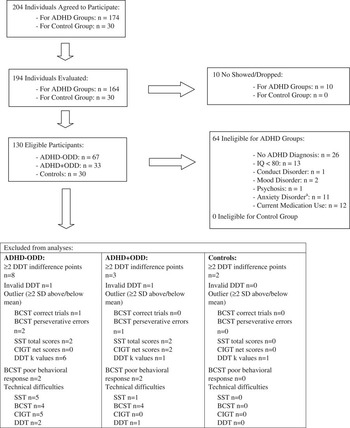
Families seeking ADHD evaluations for their 7- to 12-year-old children through a specialty ADHD clinic were invited to participate. See the CONSORT diagram in Figure 1. The final clinical sample consisted of 100 children with ADHD [67 with ADHD and no ODD (ADHD-ODD) and 33 with ADHD and ODD (ADHD+ODD)]. Thirty typically developing controls were recruited through advertisements and from a list of families who had expressed interest in research participation.
CONSORT flow diagram for participant recruitment, participation, and eligibility. Note. aChildren with an anxiety disorder were excluded with the exception of separation anxiety disorder and specific phobia (see text for more detail).

Diagnostic Classification, Inclusion Criteria, and Demographics
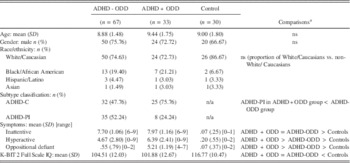
The Kiddie Schedule for Affective Disorders and Schizophrenia for School-Age Children-Present and Lifetime Version (K-SADS-PL; Kaufman, Birmaher, Brent, Rao, & Ryan, Reference Kaufman, Birmaher, Brent, Rao and Ryan1996) was administered to parents. Children in both ADHD groups met DSM-IV criteria for ADHD Predominantly Inattentive Type (ADHD-PI; n=43) or Combined Type (ADHD-C; n=57); see Table 1 for breakdown between the groups with and without ODD. Those in the ADHD+ODD group (n=33) met diagnostic criteria for ODD in addition to ADHD. Those in the ADHD-ODD group (n=67) were required to have ≤2 ODD symptoms. Controls did not meet criteria for ADHD or ODD. Children in all three groups were excluded if they met diagnostic criteria for a current mood, conduct, or psychotic disorder. With the exception of specific phobias (1 ADHD-ODD, 1 ADHD+ODD, 0 controls) and separation anxiety disorder (1 ADHD-ODD, 1 ADHD+ODD, 1 control), which tend to be prevalent in the 7- to 12-year-old general population (American Psychiatric Association, 2013), children with anxiety disorders (social anxiety disorder, obsessive compulsive disorder, generalized anxiety disorder, panic disorder, and post-traumatic stress disorder) were also excluded.Footnote 1 In addition, children were excluded if they had suspected/diagnosed Autism Spectrum Disorder, a medical condition/injury that could affect cognition (e.g., epilepsy), an estimated full scale IQ score below 80 on the Kaufman Brief Intelligence Test-2 (Kaufman & Kaufman, Reference Kaufman and Kaufman2004), and/or were currently taking any psychiatric medications (including psychostimulants). See Figure 1.
Participant demographics by group

Note. ns=not significant. ADHD-C=ADHD Combined Type; ADHD-PI=ADHD Predominantly Inattentive Type; K-BIT 2=Kaufman Brief Intelligence Tests-2; WIAT-III=Wechsler Individual Achievement Test-III; SS=standard score. See manuscript text for group comparison statistics.
a Alpha level of p<.05.
Groups did not significantly differ in age, gender, or race, but did differ by ADHD subtype, χ2(1)=7.07, p<.0001, and K-BIT Full Scale IQ scores, F(2,127)=14.67, p<.0001. See Table 1 for information regarding these demographics and group differences.
Procedure and EF Measures
This study was approved by our medical center’s Institutional Review Board. All parents provided written informed consent and all children gave their assent. The measures described below were completed during one study visit, within a larger fixed order battery of tasks that took a total of 2–2.5 hr. The four EF tasks were spread out across the battery and no two study tasks were administered consecutively. However, the relative order to each other within the battery (from earlier to later in the battery) was Delay Discounting Task, Berg Card Sorting Test, Child Version of the Iowa Gambling Task, and Spatial Span Task.
“Cool” Executive Function Tasks
Computerized Spatial Span Task (SST)
A computerized version of the Corsi Block Test (http://pebl.sourceforge.net/battery.html) was used to measure spatial WM. The task was administered based on the standardized task procedures developed by Kessels et al. (Reference Kessels, Van Zandvoort, Postma, Kappelle and De Haan2000). Nine static squares were presented on the screen. Sequences of squares were lit up one at a time, and participants were instructed to use the computer mouse to click the squares in the same order as they originally lit up on the screen. Beginning with a span length of two squares, two sequences of the same length were presented and then increased by one square. The task was discontinued after two sequences of the same length were answered incorrectly. The duration of this task was approximately 5 min. The Total Score was calculated as the raw number of correctly repeated trials.
Computerized Berg Card Sorting Test
The Berg Card Sorting Test (BCST; Grant & Berg, Reference Grant and Berg1948) measures an individual’s ability to form, maintain, and shift cognitive set, as well as to inhibit a pre-potent response. Participants in the current study completed an abbreviated computerized and validated version of the BCST (Piper et al., Reference Piper, Li, Eiwaz, Kobel, Benice, Chu and Mueller2012; http://pebl.sourceforge.net/battery.html). Sixty-four cards differing by shape, number, or color were presented on the screen one at a time. Participants were asked to match each card to one of four key cards without any explanation of how to do so. The participant received “correct” or “incorrect” feedback after each match. Once the participant successfully matched a set number of cards based on the current matching rule, the rule changed without any notice. The computer randomly selected the order of sorting rules for each participant. The duration of this task was approximately 10 min. Two BCST scores were calculated: raw total correct responses and total perseverative errors.
“Hot” Executive Function Tasks
Child version of the Iowa Gambling Task (CIGT)
We used a simplified, computerized version of the Iowa Gambling Task (Garon et al., Reference Garon, Moore and Waschbusch2006). Children were presented with four decks of cards and told to select a card from any deck of their choosing. They were told that each card selected would have several bears and tigers, and that for each bear, they would earn one point and for each tiger, they would lose one point. Participants were told to earn the most points possible by trying to select cards with more bears than tigers. After a child selected a card, feedback was provided regarding the number of bears and/or tigers on the deck he/she had selected (e.g., “you drew 2 bears and 0 tigers,” or “you drew 2 bears and 13 tigers”). The number of bears ranged from 1 to 2 and tigers from 0 to 13. Unbeknownst to participants, cards in decks A and B had two bears on them, but continually selecting from these decks led to more tigers than bears and a net loss in points. Cards in decks C and D had only one bear on them, but continually selecting from these decks resulted in a net gain in points. One disadvantageous deck and one advantageous deck had frequent losses of points whereas the other two decks had infrequent losses of points. Participants selected 80 cards from any of the 4 decks. The duration of this task was approximately eight minutes. The net score was calculated by subtracting the total raw number of disadvantageous card choices from the total raw number of advantageous card choices [(C+D) – (A+B)]; positive scores reflect more draws from the advantageous decks and negative scores reflect more draws from the disadvantageous decks.
Delay Discounting Task
The Delay Discounting Task (DDT) is a computerized task that requires participants to decide how long they are willing to wait for a hypothetical monetary reward (Mitchell, Reference Mitchell1999). Participants chose between varying small immediate hypothetical rewards and a larger delayed hypothetical reward. The immediate amount varied from $0–$10.00 in $0.50 increments and the delayed amount (always $10.00) was available after one of four hypothetical delays (7, 30, 90, or 180 days; e.g., $5 now vs. $10 in 7 days). The task included 88 trials. The duration of this task was approximately ten minutes. The discounting gradient (rate at which the delayed outcome was discounted) was calculated across trials using the hyperbolic equation:  $V={M \over {1{\plus}k{\rm D}}}$
, where V is the indifference point (the value at which there was no preference between the immediate item and the delayed $10.00 at each delay), M is the objective value of the delayed item ($10), and D is the delay length associated with receiving $10. k represents the gradient of discounting, which was the unit of measure for subsequent analyses. Larger k values represent steeper discounting gradients (i.e., greater preference for immediate rewards).
In line with Johnson and Bickel (Reference Johnson and Bickel2008), indifference points at each delay were examined for each participant. To identify nonsystematic data for deletion, data points were considered invalid if (1) any indifference point was greater in magnitude than the preceding point by more than 20% of $10, the largest reward (i.e., >$2), or (2) if the last indifference point (180 days) was greater than the first. For children with only one invalid indifference point following these criteria, the discounting gradient (k) was calculated using the remaining three indifference points. However, the last indifference point within these three remaining points had to remain less than or equal to the first (criterion 2).
Missing Data
Outlier scores were systematically dropped from all analyses (see Figure 1). Specifically, if a participant had two or more invalid indifference points on the DDT, then all DDT data for that participant were dropped. Additionally, all DDT data were dropped for any participant who had at least one invalid data point and poor understanding (e.g., participant did not understand values of money), random responding, or variable attention, as rated by the examiner during the task. In addition, BCST correct trials, BCST perseverative errors, SST total scores, CIGT net scores and DDT k values that were ≥2 standard deviations above or below the mean were dropped. BCST data from an additional four children were dropped due to poor attention/behavior and/or apparent random responding during the task. In addition to excluded data, a subset was also lost to technical difficulties or incomplete assessments. Among the children with ADHD, those who had excluded/missing data had lower IQ scores than those with a full set of data, t(97)=−2.13, p=.02. The two groups did not significantly differ in age, gender, ADHD subtype, or ODD status, from those with a full set of data (all ps >.05). The three control participants with excluded DDT data did not significantly differ in age or IQ scores from the remaining controls.
ANALYSES
Primary Analyses
All variables were generally normally distributed except DDT k values, which were corrected with a log transformation. Correlations among the two “hot” EF scores and among the three “cool” EF scores were also computed to inform how group differences in “hot” and “cool” EF scores would be examined. Group differences in “hot” and “cool” EF scores were examined using multivariate and univariate analyses of covariance using SAS PROC GLM. In each analysis, Group (ADHD+ODD, ADHD-ODD, control) was the independent variable and “hot” or “cool” EF score(s) were the dependent variables. Age was included as a covariate. Post hoc Tukey comparisons were used to parse out any significant Group main effects.
Secondary Analyses
Several sets of secondary analyses were conducted. First, despite convincing arguments for not using IQ as a covariate in neurocognitive studies (e.g., Dennis, Francis, Cirino, Schachar, & Fletcher, Reference Dennis, Francis, Cirino, Schachar and Fletcher2009), ADHD studies often control for IQ. Thus, to compare our results to others who have controlled for IQ when examining EFs in children with ADHD, statistical models with significant effects were recalculated with IQ as a covariate. Second, since the two ADHD groups differed in the distribution of ADHD subtype, we explored whether the relationship between ODD and EFs was specific to a particular ADHD subtype. For these analyses, the control group data were dropped, ADHD subtype (ADHD-C or ADHD-PI) and comorbidity status (ODD and no ODD) were included as independent variables, and the ADHD subtype × comorbidity status interaction was examined to determine whether ADHD subtype significantly moderated the relationship between the presence of ODD and EF performance.
Finally, to investigate the continuous relationship between EF and ADHD and ODD symptoms rather than diagnostic categories, separate regression models for each EF score were calculated and the total number of ADHD symptoms and total number of ODD symptoms were added as independent variables. The mean, standard deviation, and range of these symptoms are included in Table 1. The ADHD symptoms × ODD symptoms interaction was examined to determine whether there was a synergistic effect of ADHD and ODD symptoms on EF performance.
RESULTS
Primary Analyses
Correlations
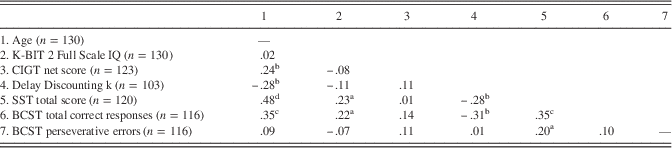
See Table 2 for correlations between age, IQ, and EF scores. Across all participants, age was significantly correlated with SST total scores (p<.0001) and BCST total correct responses (p=.0001). Similarly, CIGT net scores (p=.007) and transformed DDT k values (p=.004) were significantly positively and negatively correlated with age, respectively. Younger children had lower CIGT net scores, lower SST total scores, fewer BCST correct responses, and larger transformed DDT k values. Given the presence of significant associations between age and EF scores, all subsequent analyses examining group differences included age as a covariate.
Pearson correlation coefficients for age, IQ, and executive function scores
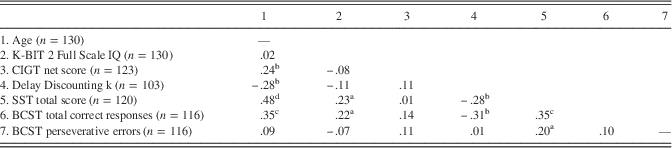
Note. K-BIT 2=Kaufman Brief Intelligence Tests-2; CIGT=Child Version of the Iowa Gambling Task; SST=Spatial Span Task; BCST=Berg Card Sorting Task. Delay discounting k values were log transformed prior to calculation of correlations.
a p<.05.
b p<.01.
c p<.001.
d p<.0001.
IQ scores were significantly correlated with SST total scores (p=.01) and BCST total correct responses (p=.02). However, IQ was not significantly correlated with BCST perseverative errors (p=.44), or either of the “hot” EF scores (CIGT net scores: p=.36; transformed DDT k values: p=.29).
Correlations examining the relationship between the three “cool” EF scores indicated that total scores on the SST were positively associated with BCST total correct responses (p=.0002) and perseverative errors (p=.04); those with higher WM scores answered more trials correctly on the BCST, but unexpectedly made more perseverative errors. With regard to the relationship between performance indicators from the “hot” EF tasks, CIGT net scores were not significantly correlated with transformed DDT k values (p=.26). Given the significant correlations between the “cool” EF scores, the three “cool” EF scores were included in a single multivariate analysis of covariance (MANCOVA). Given the lack of correlation between the “hot” EF scores, between-groups differences in “hot” EF scores were examined using separate ANCOVAs.
Group differences
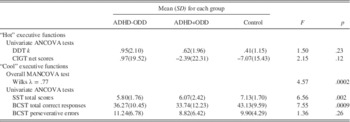
Two analyses of covariance (ANCOVAs) were used to examine group differences in the two measures of “hot” EF (i.e., transformed DDT k values, CIGT net scores) controlling for age. See Table 3. The effect of Group was not significant for transformed DDT k values, F(2,99)=1.50, p=.23, or CIGT net scores, F(2,119)=2.15, p=.12, indicating that neither of the “hot” EF scores differed significantly across groups. Since younger children may have difficulty understanding gambling tasks (e.g., Prencipe et al., Reference Prencipe, Kesek, Cohen, Lamm, Lewis and Zelazo2011), data from the 7- to 9-year-old participants were dropped, and analyses were conducted to examine group differences in CIGT net scores across the 10- to 12-year-old participants (41 ADHD-ODD, 15 ADHD+ODD, 18 controls). Even among this older cohort, the three groups did not differ, F(2,43)=.09, p=.91.
Group differences across “Hot” and “Cool” executive function tasks

Note. DDT=Delay Discounting Task; CIGT=Child Version of the Iowa Gambling Task; SST=Spatial Span Task; BCST=Berg Card Sorting Task. Delay discounting k values were log transformed prior to calculation of ANCOVA.
A MANCOVA including the three “cool” EF scores (SST total scores, BSCT total correct responses, BSCT perseverative errors) resulted in a significant multivariate effect of Group, Wilks’ λ=.78, F(6,204)=4.57, p=.0002. Univariate analyses revealed significant group differences for SST total scores, F(2,104)=6.56, p=.002, and BCST total correct responses, F(2,104)=9.19, p=.0009. In both cases, the ADHD-ODD (SST: p=.002; d=.77; BCST: p=.01; d=.68) and ADHD+ODD (SST: p=.03; d=.51; BCST: p=.0009; d=.85) groups had lower scores than controls, but did not differ from each other (SST p=.95; d=.13; BCST: p=.28; d=.22). The main effect of Group was not significant for BCST perseverative responses, F(2,104)=1.36, p=.26.
Secondary Analyses
Examining the relationship between EF scores and ADHD group differences on “Cool” EF scores after controlling for IQ
When adding IQ as a covariate to the “cool” EF MANCOVA, the main effect of Group remained significant, Wilks’ λ=.84, F(6,202)=3.10, p=.006. Again, there were significant Group main effects for SST total scores, F(2,103)=3.77, p=.03, and BCST total correct responses, F(2,102)=4.79, p=.01. The ADHD-ODD group had lower SST total scores than the controls (p=.02). Differences between the ADHD+ODD and control groups (p=.20) and between the ADHD-ODD and ADHD+ODD groups were not significant (p=.85). On the BCST, the ADHD+ODD group answered fewer trials correctly than the controls (p=.009). The ADHD-ODD group answered marginally fewer correct trials when compared with controls (p=.05). The ADHD-ODD and ADHD+ODD groups did not significantly differ on BCST correct trials (p=.36). The Group effect for BCST perseverative responses also was not significant, F(2,103)=1.38, p=.25.
Does ADHD subtype moderate the relationship between comorbid ODD and EF scores?
Two ANCOVAs were used to examine ADHD subtype as a moderator of the relationship between comorbid ODD and “hot” EF scores. The main effects of ADHD subtype, F(1,71)=.32, p=.57, ODD, F(1,71)=.08, p=.78, and the ADHD subtype × ODD interaction, F(1,71)=.69, p=.41, were not significant for transformed DDT k values. Also, the main effects of ADHD subtype, F(1,88)=2.03, p=.16, ODD, F(1,88)=.00, p=.97, and ADHD subtype × ODD interaction, F(1,88)=2.76, p=.10, were not significant for CIGT net scores.
A MANCOVA was used to examine ADHD subtype as a moderator of the relationship between comorbid ODD and “cool” EF scores. The main effects of ADHD subtype, Wilks’ λ=.95, F(3,71)=1.13, p=.34, ODD, Wilks’ λ=.96, F(3,71)=.99, p=.41, and the ADHD subtype×ODD interaction, Wilks’ λ=.96, F(3,71)=.75, p=.53, were not significant for “cool” EF scores.
Continuous relations between ADHD symptoms, ODD symptoms, and EF scores
Five separate regressions were conducted with each EF score as a dependent variable. Each model included the number of ADHD symptoms and the number of ODD symptoms as independent variables, the interaction between ADHD symptoms and ODD symptoms, and age as a covariate. Regarding “hot” EF analyses, the main effects of ADHD symptoms, F(1,98)=2.02, p=.16, ODD symptoms, F(1,98)=2.20, p=.14, as well as the ADHD symptoms×ODD symptoms interaction, F(1,98)=2.22, p=.14, were not significant for transformed DDT k values. The main effects of ADHD symptoms, F(1,118)=2.86, p=.09, ODD symptoms, F(1,118)=2.42, p=.12, as well as the ADHD symptoms × ODD symptoms interaction, F(1,118)=3.14, p=.08, were also not significant for CIGT net scores.
“Cool” EF regression analyses resulted in significant associations between the number of ADHD symptoms and SST total scores, F(1,115)=10.61, p=.002, and the number of ADHD symptoms and BCST total correct responses, F(1,111)=9.67, p=.002. More ADHD symptoms were associated with lower scores on the SST and fewer correct responses on the BCST. ADHD symptoms were not significantly associated with BCST perseverative errors, F(1,111)=0.30, p=.58. The main effects of ODD symptoms, F(1,115)=.03, p=.86, F(1,111)=.31, p=.58, F(1,111)=.25, p=.62, and the ADHD symptoms × ODD symptoms interactions, F(1,115)=.14, p=.71, F(1,111)=.08, p=.78, F(1,111)=.74, p=.39, were not significant for SST total scores, BCST total correct responses, or BCST perseverative errors, respectively.
DISCUSSION
Consistent with our hypotheses, both ADHD groups (ADHD+ODD, ADHD-ODD) performed more poorly on “cool” EF measures (i.e., SST total scores, BCST correct trials) than controls, but did not differ from each other. No significant differences between the two ADHD groups or between the ADHD and control groups were observed for performance on either of the two “hot” EF measures. When using continuous measures of ADHD and ODD symptoms rather than diagnostic categories, results remained consistent with those from our primary analyses. “Cool” EF scores were significantly associated with the number of ADHD symptoms, but not ODD symptoms. “Hot” EF scores were not significantly associated with ADHD or ODD symptoms.
Differences in “Cool” Executive Functions
On “cool” EF tasks, having a diagnosis of ADHD predicted poorer performance. However, the presence of a comorbid ODD diagnosis was not significantly related to additional decrements in “cool” EF scores. These findings are similar to prior research indicating that ADHD is associated with deficits in “cool” EFs. Indeed, multiple studies have shown that children with ADHD obtain lower scores on visuospatial WM tasks, including spatial span tasks (e.g., Gau & Shang, Reference Gau and Shang2010), when compared with typically developing controls (e.g., Martinussen et al., Reference Martinussen, Hayden, Hogg-Johnson and Tannock2005). Research also suggests that individuals with ADHD answer fewer trials correctly than typically developing controls on the Wisconsin Card Sorting Test (e.g., Romine et al., Reference Romine, Lee, Wolfe, Homack, George and Riccio2004).
The lack of differences between the ADHD+ODD and ADHD-ODD groups on “cool” EF tasks is also consistent with studies showing that comorbid ODD or ODD symptoms are not significantly associated with “cool” EF deficits in children with ADHD. For example, Thorell and Wählstedt (Reference Thorell and Wåhlstedt2006) found a significant relationship between ADHD symptoms and performance on a computerized measure of spatial WM (similar to this study’s task) in a population-based sample of young children. However, ODD symptoms and the interaction between ADHD and ODD symptoms were not significantly associated with performance. Similarly, comorbid ODD/CD does not appear to be associated with poorer WM performance in school-aged children with ADHD (Kalff et al., Reference Kalff, Hendriksen, Kroes, Vles, Steyaert, Feron and Jolles2002; Oosterlaan et al., Reference Oosterlaan, Scheres and Sergeant2005). In sum, “cool” EF results from this study are consistent with other studies and suggest that ADHD is associated with deficits in “cool” EFs, irrespective of comorbid ODD.
Differences in “Hot” Executive Functions
The presence of comorbid ODD was expected to account for “hot” EF deficits in children with ADHD. Therefore, when comparing the ADHD-ODD and control groups, significant differences in “hot” EF task performance were not anticipated. Indeed, our non-significant findings between these two groups were consistent with our hypotheses and some previous studies (e.g., Guerts et al., Reference Geurts, Van der Oord and Crone2006; Skogli, Egeland, Andersen, Hovik, & Øie, Reference Skogli, Egeland, Andersen, Hovik and Øie2014). Note, however, that other studies have found that children with ADHD do have deficits on similar “hot” EF tasks (e.g., Barkley et al., Reference Barkley, Edwards, Laneri, Fletcher and Metevia2001; Demurie et al., Reference Demurie, Roeyers, Baeyens and Sonuga-Barke2012; Scheres et al., Reference Scheres, Tontsch, Thoeny and Kaczkurkin2010). For example, Wilson et al. (Reference Wilson, Mitchell, Musser, Schmitt and Nigg2011) found significantly larger k values (i.e., steeper discounting) in 7- to 9-year-old children with ADHD compared with typically developing controls. Also, using a gambling task, Garon et al. (Reference Garon, Moore and Waschbusch2006) reported that children with ADHD demonstrate a riskier pattern of responding than controls. One possible explanation for differences across studies is that some of these studies (e.g., Garon et al., Reference Garon, Moore and Waschbusch2006) used external rewards (i.e., tokens to trade for small prizes for performance); our study did not. Our study’s lack of an external motivator linked to task performance may have attenuated the propensity for riskier decision making among children with ADHD. Without any subjective report of emotional salience or motivation during task completion, it is unknown whether the two hot EF tasks were motivationally or emotionally salient as intended. It is unfortunate that we did not collect such self-report ratings as these may have provided insight into the lack of group differences on the EF tasks.
We also expected that children in the ADHD+ODD group would demonstrate “hot” EF deficits (i.e., lower net scores and higher k values on the gambling and delay discounting tasks, respectively) when their performance on “hot” tasks was compared with that of the ADHD-ODD group and controls. In contrast with our hypotheses, there were no group differences on either “hot” EF task. While comorbid ODD has not been shown to contribute to poorer performance on a delayed discounting task (e.g., Barkley et al., Reference Barkley, Edwards, Laneri, Fletcher and Metevia2001; Wilson et al., Reference Wilson, Mitchell, Musser, Schmitt and Nigg2011), other research has shown that comorbid ODD is associated with poorer performance on gambling tasks in children with ADHD (Hobson et al., Reference Hobson, Scott and Rubia2011). There are several potential explanations for the lack of differences between the ADHD+ODD, ADHD-ODD, and control groups in the current study. First, as mentioned above, the lack of external motivators (i.e., money as a reward) may have contributed to a lack of motivational salience in the “hot” EF task stimuli and dampened the propensity toward risky decision making. Alternatively, children in this study may have been too young to understand the “hot” EF tasks. Indeed, very low gambling scores across the three groups indicate that children across all groups had difficulty consistently choosing advantageous cards more often than disadvantageous cards. These low scores suggest that the task may have been measuring whether children understood what they were supposed to be doing rather than their affinity for risky decision making. Another explanation is that “hot” EF deficits are associated with more severe disruptive behavior than ODD. For example, “hot” EF deficits might be more prominent in CD than ODD (Rubia, Reference Rubia2011). Similarly, although related, aggression and CD/ODD are distinct and it may be that reactively aggressive youth are especially prone to displaying “hot” EF deficits (Bobadilla, Wampler, & Taylor, Reference Bobadilla, Wampler and Taylor2012; Scarpa, Haden, & Tanaka, Reference Scarpa, Haden and Tanaka2010). Thus, by selecting ODD, and not CD or reactive aggression comorbidity, we may have biased our sample toward not having “hot” EF deficits. Furthermore, by recruiting children presenting to an ADHD clinic, and not a disruptive behavior disorders clinic, we likely selected children in the ADHD+ODD group for whom disruptive oppositional and defiant behavior was not the primary presenting problem. Thereby, the ODD among our ADHD+ODD group may have been of lower severity than if we had recruited from another site (i.e., a disruptive behavior disorders clinic). A final explanation is that we did not measure the “hot” EF deficit that may be associated with ODD. “Hot” EF tasks that induce frustration (e.g., paced auditory serial addition task), include emotional stimuli (e.g., emotional go/no-go tasks, emotional Stroop tasks), or assess delay aversion may be more strongly associated with ODD than the tasks we used in this study. It is also important to note that tasks purported to be “cool” EF function tasks (e.g., card sorting task) may induce frustration in participants and, thus, inadvertently include an emotional/motivational or “hot” EF component.
Although these considerations temper our ability to draw firm conclusions, our results nonetheless suggest that comorbid ODD does not account for heterogeneity in EFs across children with ADHD (Willcutt et al., Reference Willcutt, Doyle, Nigg, Faraone and Pennington2005). Thus, moderators of EF deficits among children with ADHD remain unknown. A variety of other factors could potentially explain the heterogeneity in EF performance deficits such as genes (Arcos-Burgos et al., Reference Arcos-Burgos, Castellanos, Pineda, Lopera, David Palacio, Guillermo Palacio and Muenke2004; Doyle et al., Reference Doyle, Faraone, Seidman, Willcutt, Nigg, Waldman and Biederman2005; Fisher et al., Reference Fisher, Francks, McCracken, McGough, Marlow, MacPhie and Smalley2002), brain structure and function (e.g., Casey et al., Reference Casey, Castellanos, Giedd, Marsh, Hamburger, Schubert and Rapoport1997), and family history of ADHD (e.g., Crosbie & Schachar, Reference Crosbie and Schachar2001). Furthermore, our results suggest that “cool” EF deficits may be more related than “hot” EF deficits to the behavioral phenotype of ADHD. Such a conclusion is consistent with Barkley’s (Reference Barkley1997, Reference Barkley2010) model, which focuses on deficits in inhibitory control (i.e., “cool” EF) and its link to deficits in working memory, self-regulation, and other areas of difficulty in individuals with ADHD. Our results seem to be inconsistent with dual-pathway models of ADHD (e.g., Sonuga-Barke, Reference Sonuga-Barke2003) which suggest that the pathway to the ADHD phenotype (regardless of comorbidity) can be either through deficits in response inhibition (i.e., “cool” EF deficit) or delay aversion (i.e., “hot” EF deficit). Indeed, some studies examining both “hot” and “cool” measures of EF in ADHD samples (e.g., Solanto et al., Reference Solanto, Abikoff, Sonuga-Barke, Schachar, Logan, Wigal and Turkel2001, Yang et al., Reference Yang, Chan, Gracia, Cao, Zou, Jing and Shum2011) have found ADHD-related deficits in both aspects of EF. Moreover, neurobiological models of ADHD posit dysfunction within the cortico-striato-thalamo-cortical loops (e.g., Castellanos, Sonuga-Barke, Milham, & Tannock, Reference Castellanos, Sonuga-Barke, Milham and Tannock2006) which would seem to affect both “cool” and/or “hot” EF. It is possible that the lack of “hot” EF deficits in our ADHD sample was due to sample selection (i.e., children presenting with primarily ADHD-related complaints may tend to have “cool,” as opposed to “hot” EF deficits). Alternatively, as suggested above, we may have not used the right “hot” EF tasks for this age range/population (e.g., Choice Delay Task).
Moderating Effects of ADHD Subtype
ADHD subtype did not moderate the effect of ODD on EF function. That is, the relationship between ODD and “hot” or “cool” EF functioning did not depend on ADHD subtype (i.e., ADHD-C or ADHD-PI). This, perhaps, is not surprising given that EF performance has not been shown to consistently differ across ADHD subtype (e.g., Demurie et al., Reference Demurie, Roeyers, Baeyens and Sonuga-Barke2012; Skogli et al., Reference Skogli, Egeland, Andersen, Hovik and Øie2014; Willcutt et al., Reference Willcutt, Doyle, Nigg, Faraone and Pennington2005; Wilson et al., Reference Wilson, Mitchell, Musser, Schmitt and Nigg2011).
Relationship between Executive Functions
Correlational analyses indicated an expected positive relationship between correct responses on the SST and BCST. However, an unexpected positive relationship emerged between BCST perseverative errors and SST correct trials, suggesting that those with better-developed WM made more perseverative errors. This is inconsistent with the results of a small study by Mullane and Corkum (Reference Mullane and Corkum2007) that found a negative correlation between a composite measure of WM and perseverative errors on the WCST in children (ages 6–11) with and without ADHD, although the relationship was fully mediated by age and IQ. Also, a study in typically developing children did not find a significant correlation between verbal WM performance and perseverative errors on a card sorting task (Bull & Scerif, Reference Bull and Scerif2001). Thus, the reason for the positive correlation in our sample is unclear, and should be further investigated. The lack of significant correlation between performance indicators suggests that the CIGT and DDT may be examining different “hot” EFs.
Clinical Implications
Current ADHD guidelines (American Academy of Pediatrics, 2011) rely on observable behavior across settings in the diagnosis of ADHD, rather than neuropsychological test results. However, neuropsychological testing is often completed as part of assessments when specific comorbid conditions (e.g., learning disability) are suspected or medical conditions are present. In addition, there is some evidence that performance on specific EF tasks may predict psychostimulant treatment response (Hale et al., Reference Hale, Reddy, Semrud-Clikeman, Hain, Whitaker, Morley and Jones2011). Within the context of a neuropsychological test battery, poor performance on “cool” measures of EF may be indicative of executive dysfunction often seen in children with ADHD, and thus support a diagnosis. However, results of the present study indicate that the “hot” EF measures used in this study do not predict ADHD diagnostic status. Furthermore, these neuropsychological indicators do not appear to be helpful in detecting comorbid ODD in children with ADHD.
LIMITATIONS AND CONCLUSIONS
In addition to the task limitations noted above, another limitation of this study was the selection of the study sample. We excluded children taking stimulants or any other psychiatric medication from this study, which may have resulted in our study sample having less severe psychopathology. Therefore, results may not generalize to all children with ADHD. In addition, EF tasks were completed in a fixed (rather than counter-balanced) order within a long battery of tests, which may have impacted performance. Nonetheless, our study is the first to include both “hot” and “cool” EF tasks in examining whether comorbid ODD is associated with greater EF deficits in children diagnosed with ADHD. Although replication of our results will be needed before drawing firm conclusions, findings from this study indicate that children with ADHD have “cool” EF deficits that are unaffected by comorbid ODD and challenge the possibility that ADHD (alone or comorbid with ODD) is associated with “hot” EF deficits.
Acknowledgments
This study was supported by funding from a University of Cincinnati Frakes Research Award to the first author and a grant from the Ohio Department of Mental Health (#12.1281) to the second author. There are no conflicts of interest for any of the contributing authors. The authors thank Megan Narad, Kathleen Kingery, Annie Garner, Abigail Webb, Monika Gaspar, Sarah Brenner, Mary Dobrozsi, Anna Bartels, and Anne Brassell for their assistance with data collection. They also thank Nancy Garon and Suzanne Mitchell for generously sharing their gambling and delay discounting tasks. Lastly, they are grateful to Keri Shiels for the assistance she provided regarding the management and analysis of delay discounting data.