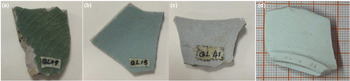
The Song dynasty (960–1279 ce) marked the heyday of the Chinese ceramic industry. The Ru kiln was one of the five most famous kilns (Ru, Kuan, Ge, Jun and Ding) in the Song dynasty and had the reputation for being the ‘chief kiln’ (Zhang et al., Reference Zhang, Cheng, Zhao, Gao, Li and Xie2006; Shi et al., Reference Shi, Wang, Zhang, Luo, Zhu and Fei2020). The site of the Ru kiln has undergone eight archaeological excavations since its discovery. In 2000, the kiln of the Imperial Ru porcelain was discovered at Qingliang Temple in Baofeng, Henan Province, China (Zhao et al., Reference Zhao, Lu, Li, Guo, Xie and Gao2006). From 2012 to 2014, three additional archaeological excavations were carried out by the Henan Provincial Institute of Cultural Heritage and Archaeology in the central firing area of the Ru Kuan kiln and the surrounding areas. A kiln furnace for unglazed firing and a small number of unglazed firing sherds were unearthed in the stratum of the nearest exploration pit (T85) to the central firing area of the Ru Kuan kiln, which was stratigraphically dated to the Northern Song or Jin dynasties. Large types of celadon, which differ from traditional Ru porcelain, were also found in the same stratigraphic layer in large quantities and concentrated piles. The celadons have similar glaze colours to those of Ru porcelain, such as sky green, grass green and egg green, and they show an obvious glass texture (Fig. 1), but the jade texture is not as strong as Ru ware glazes. The body was fine and smooth, but the grey-white colour was different from the incense ash colour of Ru porcelain. Judging from the types of the wares, this porcelain obviously inherited the varieties of Ru porcelain, including plates, bowls, bottles and so on. These porcelains are denoted as Ru-type wares to distinguish them from Ru wares (Sun & Zhao, Reference Sun and Zhao2019). According to the stratigraphic relationship, the dating of the firing of Ru-type wares was no later than the Jin dynasty. The wares were regular in shape, exquisite in texture and shiny in glaze, and they should be of official use based on the criteria for judging officials and civilians (Sun & Zhao, Reference Sun and Zhao2019). Moreover, the location of the Ru-type wares is the central firing area of the Ru kiln. It would be usual to inherit Ru kilns to continue firing imperial porcelain, but as for the official porcelain of the Northern Song dynasty or the Jin dynasty, further exploration and research is necessary. The discovery of Ru-type ware has enriched the firing history and cultural content of Ru kilns.
Typical samples of Ru-type ware and unglazed firing: (a) grass green, (b) sky green, (c) egg green and (d) unglazed firing.

A remarkable volume of research on Ru Kuan ware has been published since its discovery. Zhao et al. (Reference Zhao, Wu, Lu, Sun, Li, Guo and Xie2007) used neutron activation analysis to study the raw-material characteristics of Ru Kuan ware bodies, while Li et al. (Reference Li, Li, Deng, Wu and Guo2005) analysed the phase structure of the bodies and glazes of Ru Kuan ware with X-ray diffraction (XRD). Feng et al. (Reference Feng, Xu, Feng, Li, Yan and Huang2016) carried out a comprehensive analysis of Ru Kuan porcelain bodies and glazes. Nevertheless, the physicochemical properties of Ru-type ware have not been studied yet. In this paper, the chemical composition, firing temperature and phase structure of Ru-type and unglazed firing bodies were studied systematically using energy-dispersive X-ray fluorescence spectrometry (ED-XRF), thermal expansion and XRD. In addition, the consistency of the raw material sources of Ru-type ware bodies and the classification of Ru-type ware and unglazed firing bodies and their physical structures under the influence of firing temperature were investigated to provide a scientific basis for the dating of the firing of Ru-type ware and unglazed firing bodies. Furthermore, reference data are provided, which archaeologists could use to study whether a Ru-type ware is an official porcelain from the Northern Song or Jin dynasties, as well as the inheritance patterns of Ru kilns and the official kilns of the Northern and Southern Song dynasties.
Experimental
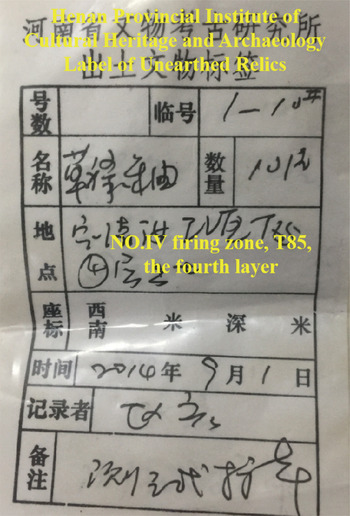
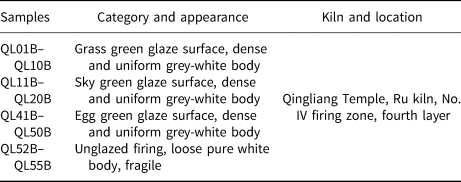
Four samples of unglazed firing bodies and thirty samples of Ru-type ware from the Qingliang Temple kiln were selected. All samples were from the Henan Provincial Institute of Cultural Heritage and Archaeology. According to the labels of the unearthed relics (Fig. 2), it was verified that all samples have authentic and reliable sources. The sample selection used is listed in Table 1.
The label for a partially unearthed shard.

Sample selection.

The reflectance spectra and dominant wavelengths of typical samples of Ru-type ware were collected using an ultraviolet–visible–near-infrared spectrophotometer (UV-3150, Japan) in the 400–800 nm wavelength range (accuracy 0.1 nm). The chemical composition of the bodies was determined using ED-XRF (EDAX Eagle-III μProbe, USA), using a Si–Li detector with a beam spot diameter of 1 mm, an operating voltage of 40 kV and an operating current of 250 mA. The cross-sections of the bodies were smoothed and polished before measurement to remove possible contamination of the surface due to underground burial. Then, the cross-sections were cleaned ultrasonically with deionized water and dried. The spectrometer is equipped with a vacuum chamber to reduce the absorption of the low-energy secondary X-rays produced by low-atomic-number elements. To calibrate the matrix effects and improve the accuracy of the data, we used a set of ceramic reference materials for ED-XRF from the Institute of High Energy Physics, and the fundamental parameter method was used for non-destructive quantitative analysis of the bodies. The ED-XRF results were processed with 1D and 2D dispersion analysis and factor analysis to study the distribution of chemical components in the various samples. The glaze layer was peeled from the inner and outer surfaces of the shards, and the bodies were shaped into rectangular solids and placed in a high-temperature thermal expansion tester (LINSEIS DIL L76, Germany) with a linear variable differential transformer sensor to measure the firing temperature expansion of the samples with a resolution of 0.05 nm from room temperature to 1300°C at a rate of 5°C min–1. The bodies were ground into powder and the physical structure of the bodies was analysed using XRD (X'Pert PRO MRD, The Netherlands) using a T-2T goniometer in the range of 10–80°2θ at 40 kV/40 mA. The XRD data of the Ru-type ware and unglazed firing bodies were processed using Jade 6.5 software; qualitative analysis was performed by comparison of the diffraction lines with Joint Committee on Powder Diffraction Standards (JCPDS) cards and quantitative analysis was performed by using the K-value method (Yuan et al., Reference Yuan, Liao, Wan, Wang and Wang2011).
Results and discussion
Reflectance spectra of glazes
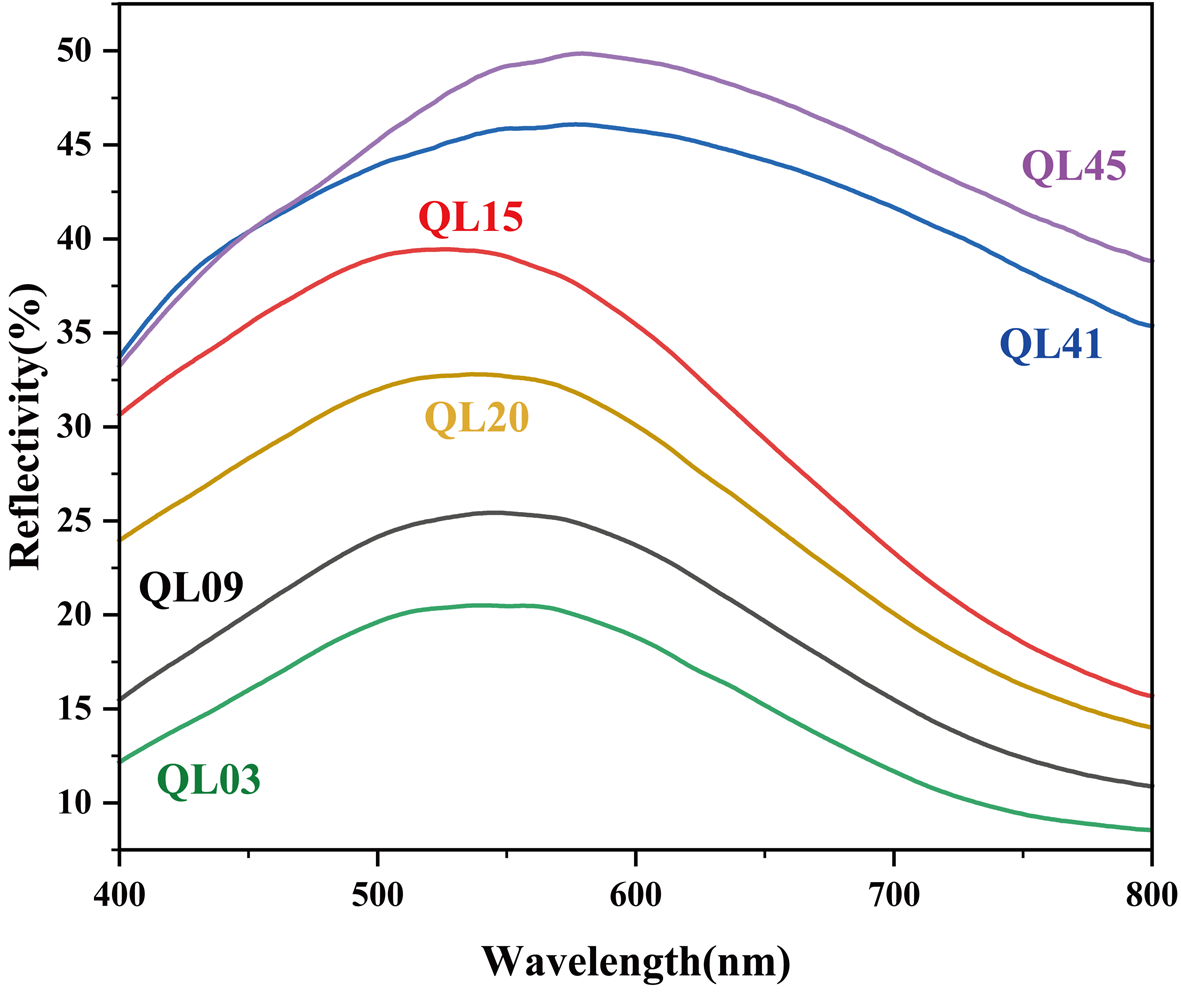
Figure 3 shows the reflectance spectra of typical samples of Ru-type ware. The dominant wavelength is in the range 520–580 nm, which belongs to the celadon system. The dominant wavelengths of grass green, sky green and egg green are ~540 nm (QL03: 542 nm, QL09: 544 nm), ~530 nm (QL15: 535 nm, QL20: 537 nm) and ~580 nm (QL41: 577 nm, QL45: 579 nm), respectively.
Reflectance spectra of glazes of typical samples of Ru-type ware.

Chemical composition
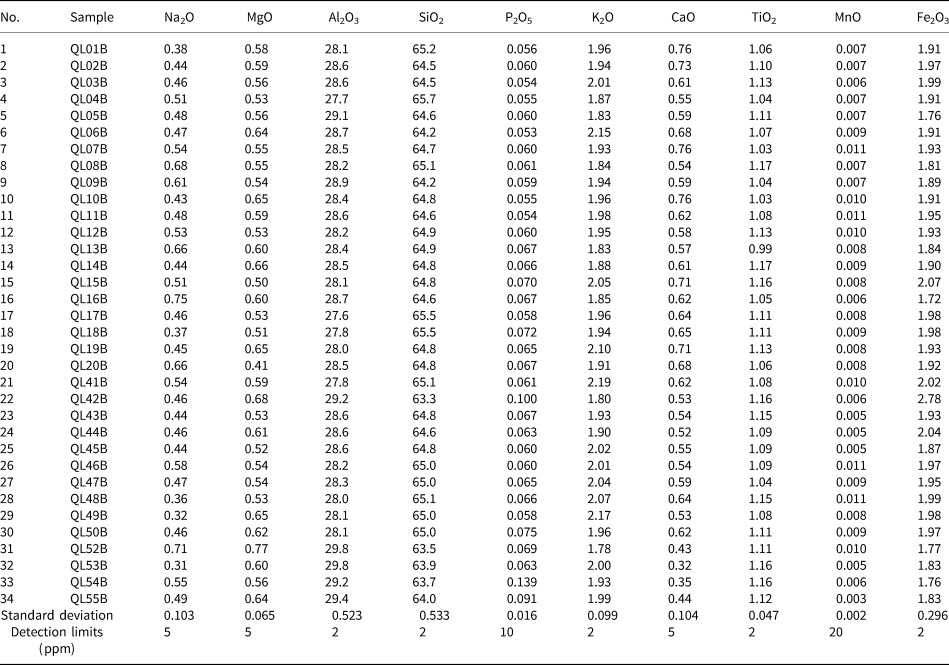
The major-element chemical compositions of the Ru-type ware and unglazed firing body samples determined by ED-XRF are listed in Table 2.
Quantitative analytical results of Ru-type ware and unglazed firing body samples using ED-XRF (wt.%).

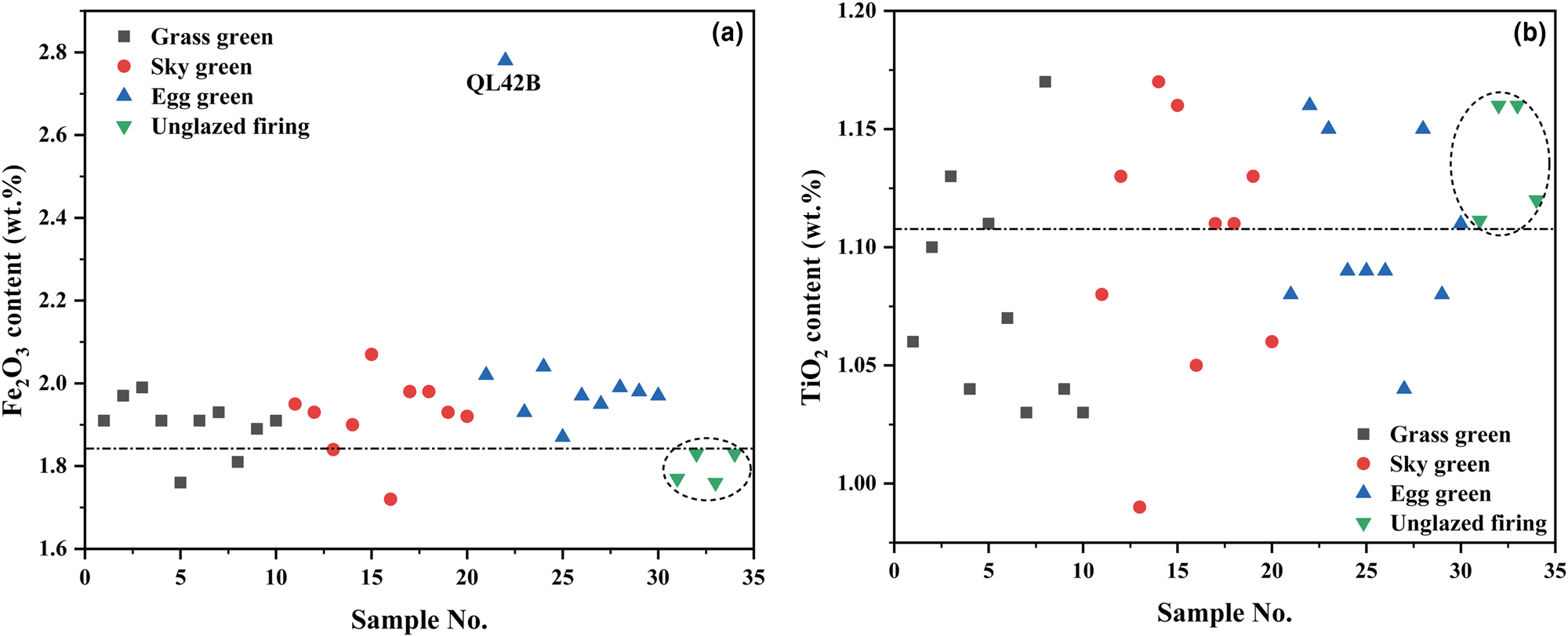
The main raw materials for the production of traditional ceramic bodies are clays from northern China. In addition to the hydrous aluminosilicate clay minerals, these clays contain small amounts of metal oxides, such as Fe2O3 and TiO2 (Yu, Reference Yu2018). Fe2O3 and TiO2 are dispersed in the clays as fine particles in the form of Fe-oxides/oxyhydroxides (hematite, goethite) and Ti-oxides (anatase, rutile) and their combinations, such as FeO⋅TiO2, 2FeO⋅TiO2 and Fe2O3⋅TiO2 at high temperatures, meaning that the bodies display various shades of grey (Yu, Reference Yu2018). The 1D dispersion analysis diagrams of the Fe2O3 and TiO2 contents are shown in Fig. 4. The amounts of Fe2O3 and TiO2 in the differently coloured glazes of Ru-type ware bodies are relatively similar, namely 1.76–2.07 wt.% (QL42B is an outlier with a large error and is ignored) and 0.99–1.17 wt.%, respectively. Therefore, the numbers of minerals that contain iron or titanium, such as hematite, ilmenite or rutile, are approximately the same in differently coloured Ru-type ware bodies. The unglazed firing bodies contain 1.77–1.83 wt.% Fe2O3 and 1.11–1.16 wt.% TiO2. Although the Fe2O3 and TiO2 contents of the unglazed firing bodies partially overlap with those of Ru-type ware bodies, the Fe2O3 content is smaller than those of the vast majority of Ru-type wares, and the TiO2 content is greater than in most Ru-type ware bodies. This indicates either that the raw materials of the unglazed firing bodies contain fewer iron minerals and more titanium minerals than their Ru-type counterparts or that the amount of iron minerals is reduced during raw material treatment processing, such as elutriation, in the preparation for unglazed firing.
1D dispersion analysis of (a) Fe2O3 and (b) TiO2.

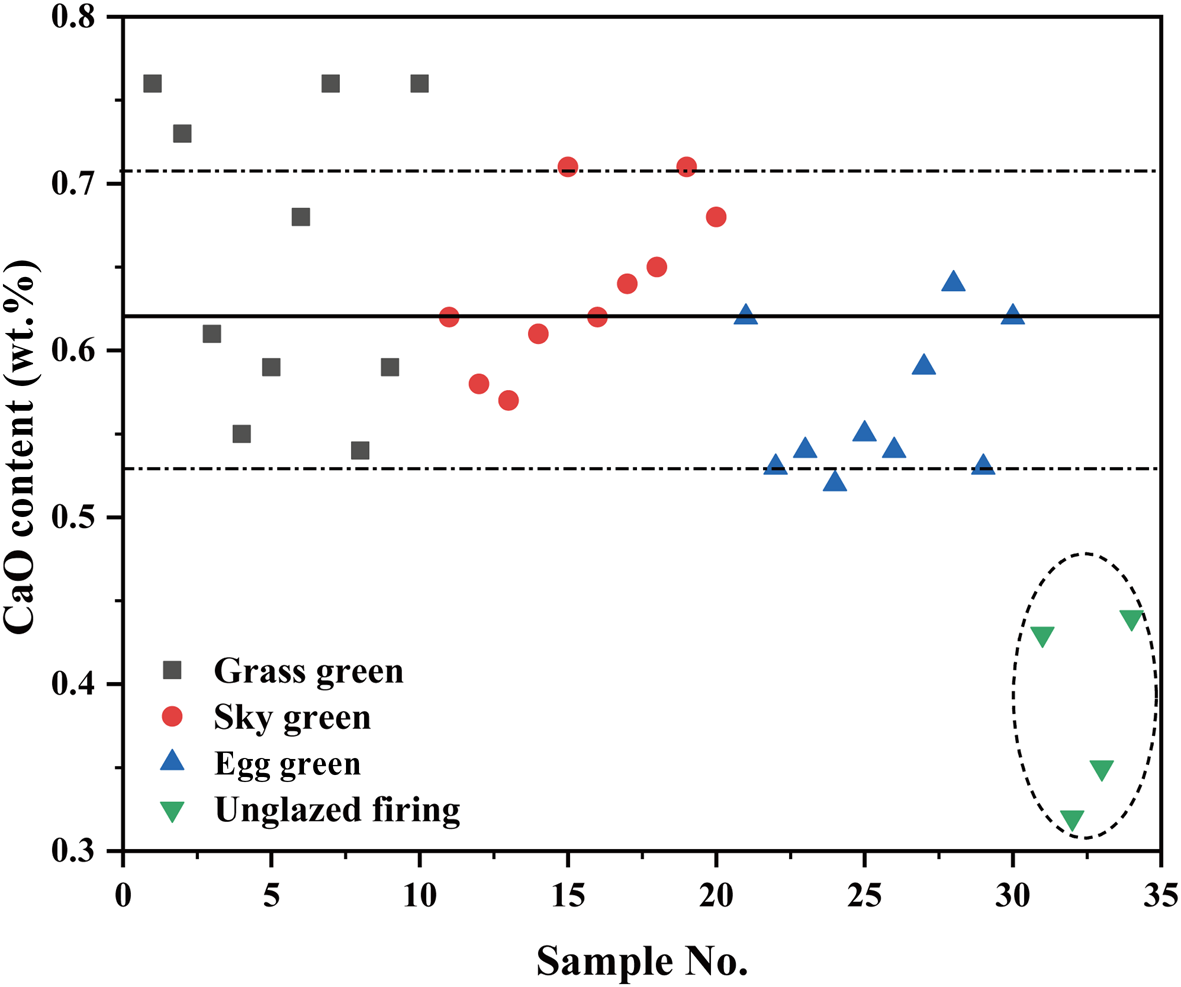
The sources of CaO as the main flux in ancient ceramic bodies are calcite or limestone fragments. Figure 5 shows the 1D dispersion analysis of the CaO content. The continuous line represents the arithmetic mean α and the dashed lines express the standard error δ. The grass green, sky green and egg green Ru-type ware bodies contain 0.57–0.76, 0.57–0.71 and 0.53–0.62 wt.% CaO, respectively (Table 2). The CaO content of a few grass green Ru-type ware bodies is greater than their counterparts, but the majority of the Ru-type ware bodies are within or at the edge of the range from α + δ to α – δ, with little variation between Ru-type ware body samples with different glaze colours. However, the CaO content of the total Ru-type ware bodies is greater than that of their unglazed firing counterparts, indicating that the raw materials of Ru-type ware bodies have a greater calcite content than those of unglazed firing bodies.
1D dispersion analysis of CaO.

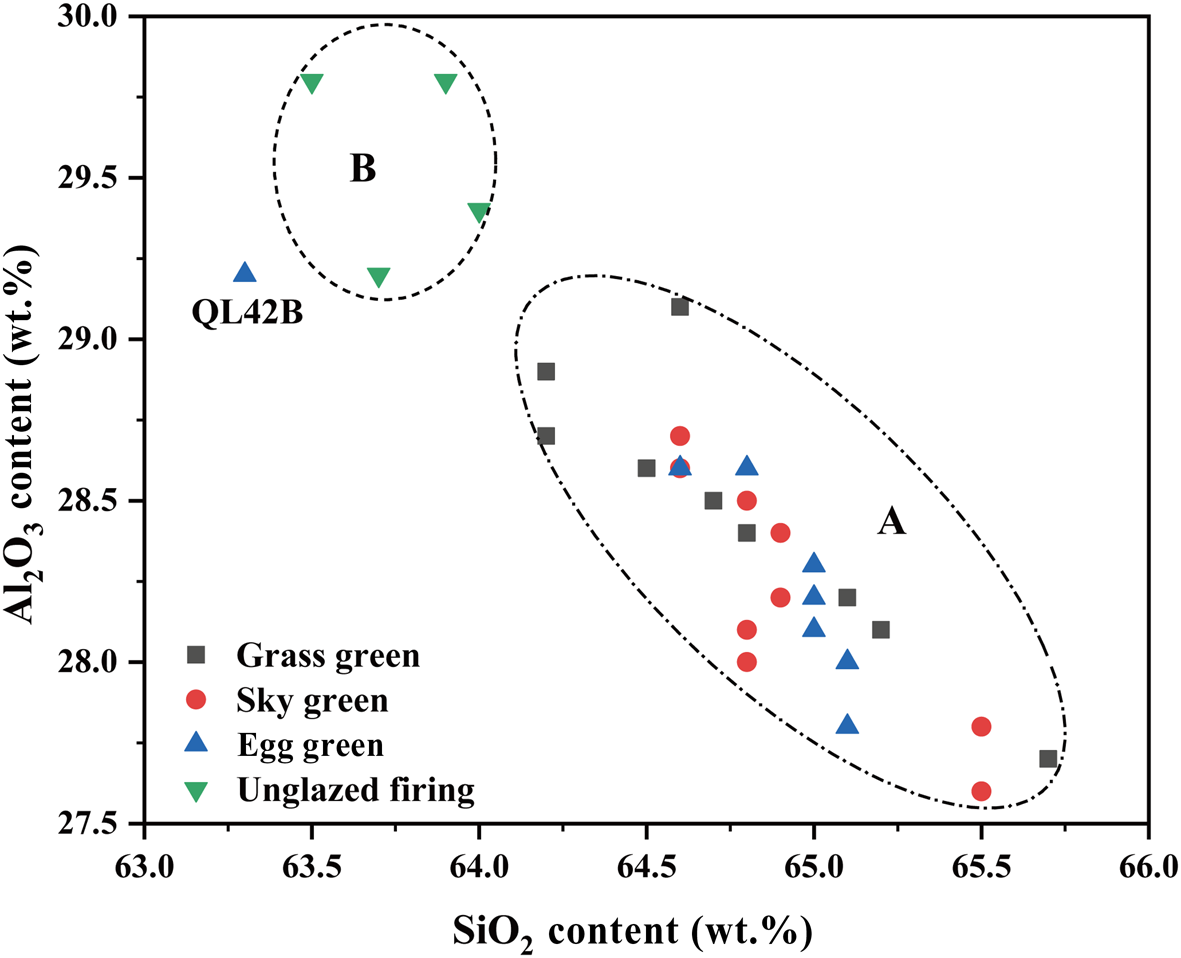
SiO2 is the most abundant oxide in ceramic bodies, followed by Al2O3. The total amounts of SiO2 and Al2O3 in Ru-type ware and unglazed firing bodies vary between 92.5–93.7% and 91.9–93.7%, respectively. A portion of these oxides participates in the structure of neoformed minerals, which forms the framework of the ceramic mass, and the other portion combines with the flux to form glass, filling the framework to form a dense and hard body. Figure 6 shows the 2D dispersion analysis diagram of the SiO2 and Al2O3 contents. The Ru-type ware bodies are projected in area A in Fig. 6, whereas the unglazed firing bodies are distributed in area B in Fig. 6. The two bodies are clearly separated; therefore, the two body formulations are not identical. The unglazed firing bodies have smaller SiO2 contents and greater Al2O3 contents than the Ru-type ware bodies; hence, the raw materials of the unglazed firing bodies contain greater amounts of kaolinite and feldspar, leading to a smaller SiO2 content and correspondingly a greater Al2O3 content (Zhang, Reference Zhang2000). Sample OL42B is not projected in the same area as the other Ru-type ware body samples (area A in Fig. 6) probably because of its age and sample contamination. This finding indicates that the raw materials of Ru-type ware bodies with different glaze colours come from a consistent and possibly single origin.
2D dispersion analysis of SiO2 and Al2O3.

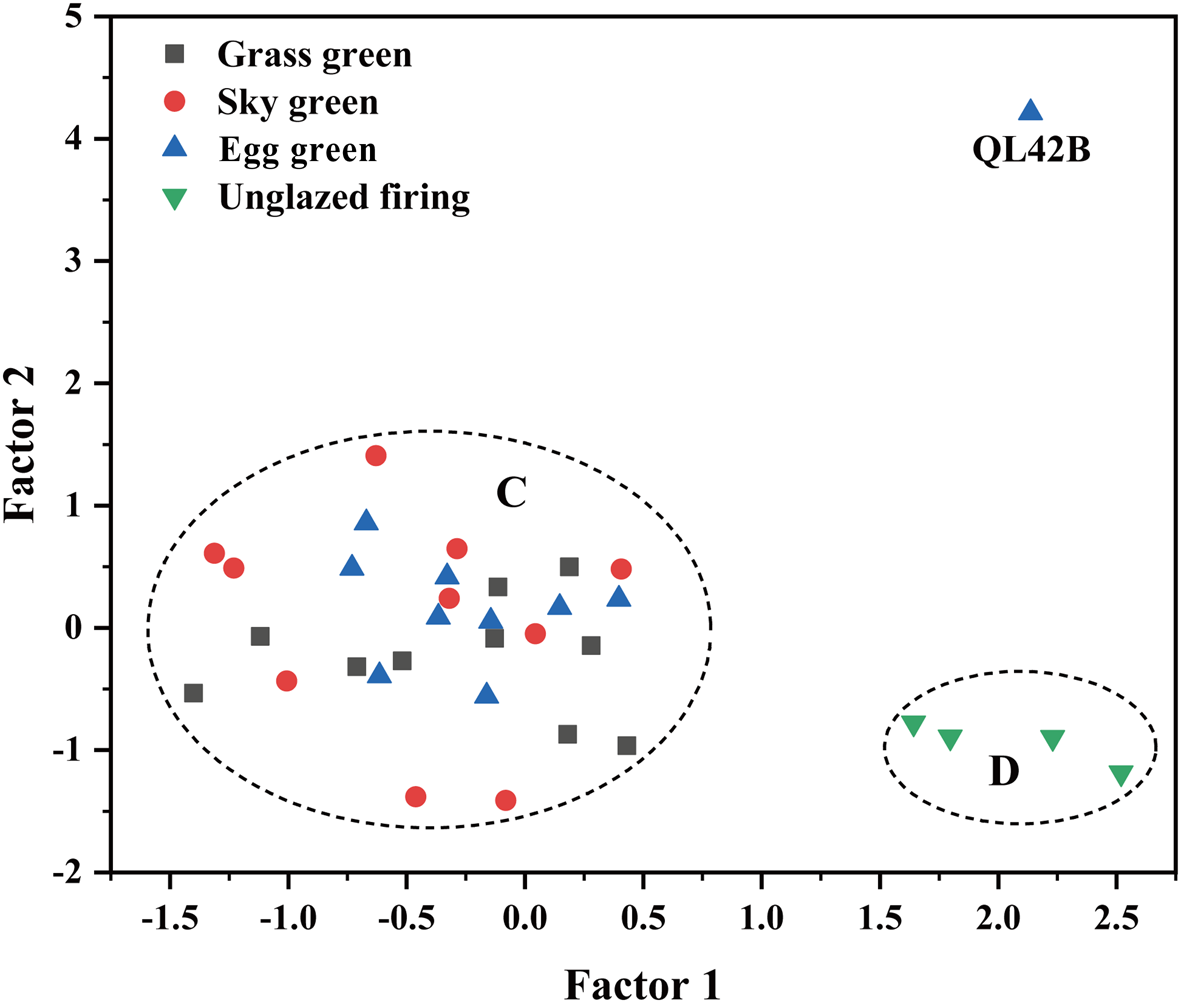
Factor analysis converts multiple variables into a small number of uncorrelated composite indicators to reduce the dimensionality of observations through linear transformation and to analyse the correlation between multiple variables (Härdle & Simar, Reference Härdle and Simar2003; Mukhopadhyay, Reference Mukhopadhyay2008). The Al2O3, SiO2, Fe2O3, CaO, TiO2 and MgO compositions of Ru-type ware and unglazed firing bodies were analysed by factor analysis. Factors 1 and 2, shown below, were extracted and explain 68.7% of the total variance (Fig. 7):


Factor analysis of the bodies.

The samples were divided into two groups. The Ru-type ware bodies are concentrated in area C in Fig. 7, except for QL42B, and the unglazed firing bodies are projected in area D in Fig. 7, indicating that the sources of raw materials of the two bodies are different. Sample QL42B is projected in a different area, suggesting that ancient craftsmen were not as precise as modern ones, which results in the different ratios of raw materials for this sample. Alternatively, this sample may have been contaminated due to it having been buried for a long time.
Firing temperature
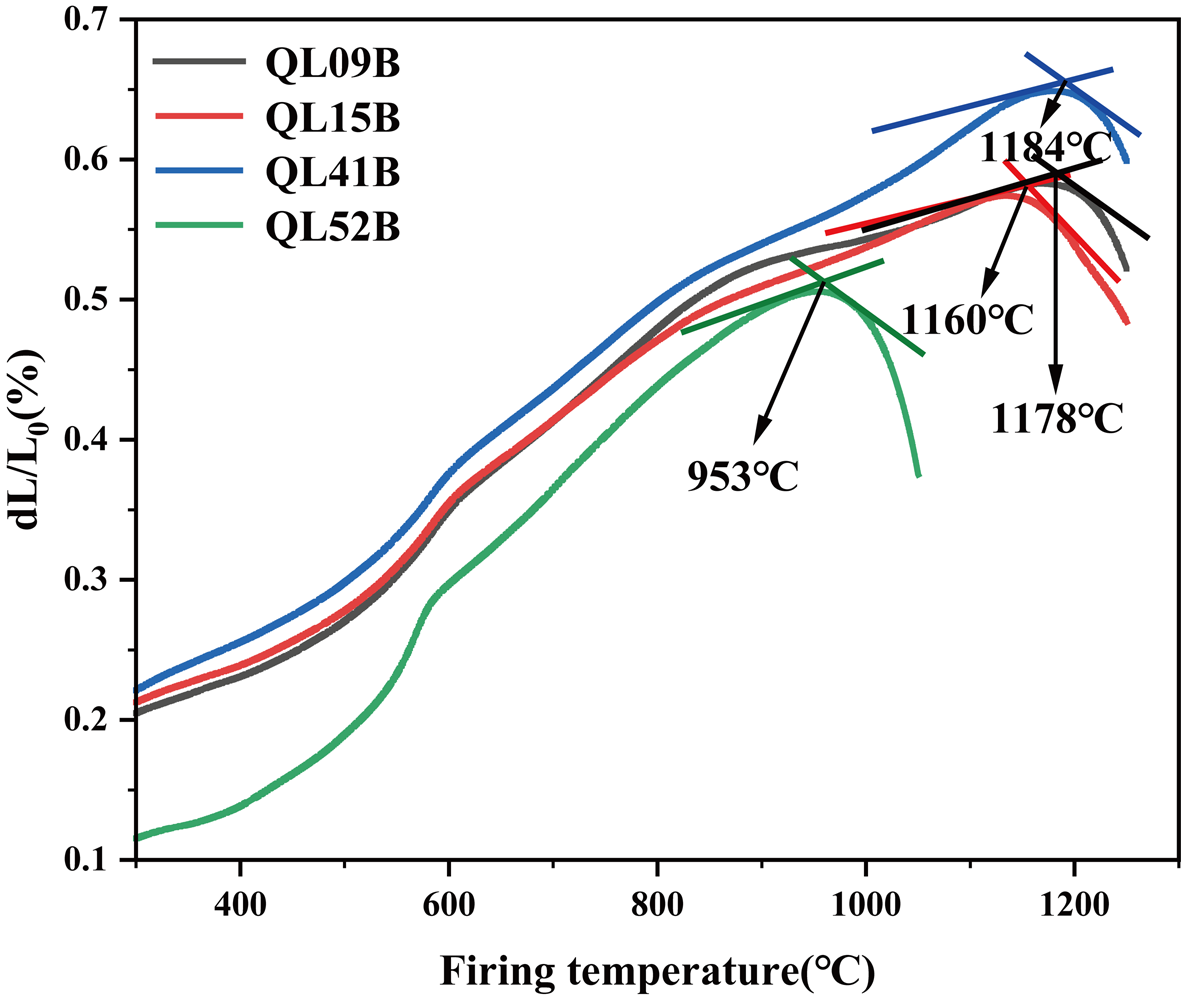
Firing temperature reflects the technological level in the production of ancient ceramics and has a significant influence on the quality of the ceramics (Tite, 1969b). The high-temperature thermal expansion method has been widely used to measure the firing temperature of ancient ceramics (Lu et al., Reference Lu, Xu and Li2020). A ceramic body exhibits normal linear reversible thermal expansion when heated from room temperature to its original firing temperature. In addition, a rapid irreversible contraction is superimposed on top of the existing reversible expansion when the ceramic is heated to sintering temperature. The starting point of this superimposed shrinkage effect is the basis for determining the original firing temperature (Tite, 1969a). Figure 8 shows the temperature curves of the Ru-type ware and unglazed firing bodies. The abscissa is temperature and the ordinate dL/L 0 is the relative change of sample length with temperature (L 0 is the original length of the sample, dL is the change in the length of the sample during heating). The tangent method (Tong & Wang, Reference Tong and Wang2019) was used to obtain the firing temperature. The firing temperature of the Ru-type ware bodies is >1150°C but does not exceed 1200°C, whereas the firing temperature of unglazed firing bodies is ~950°C.
Firing temperatures of the Ru-type ware and unglazed firing bodies.

Ceramic bodies are made of clay, which has a certain refractoriness that depends on the chemical composition of the raw material. A greater Al2O3 content corresponds to greater refractoriness. In contrast, the presence of alkali oxides reduces refractoriness. A body heated in the temperature range of refractoriness will result in one of three processes: underburning, sufficient firing and overfiring. The temperature of sufficient firing is the sintering temperature. The refractoriness and sintering temperature of a ceramic body can be calculated from Equations 1 and 2 for bodies with an Al2O3 content of 20–50% (Wu, Reference Wu1983):


where t r is the refractoriness (°C), t s is the sintering temperature (°C), W A is the mass fraction of Al2O3 when the total amounts of Al2O3 and SiO2 are normalized to 100% (%) and W MO is the mass fraction of flux oxides when the total amounts of Al2O3 and SiO2 are normalized to 100% (%). K2O was used as the standard flux oxide, and the remaining oxides were converted into K2O by multiplication with a corresponding conversion factor. For example, the effect of one portion of CaO on the reduction of the melting point is equivalent to 94.2 (relative molecular mass of K2O)/56.1 (relative molecular mass of CaO) = 1.7 portions of K2O.
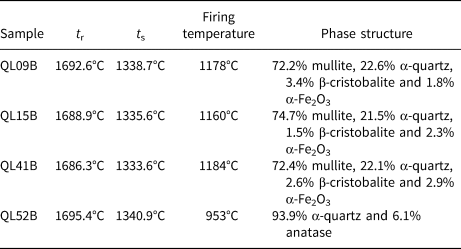
The refractoriness and sintering temperatures of QL09B, QL15B, QL41B and QL52B are shown in Table 3. The refractoriness of Ru-type ware and unglazed firing bodies approaches 1700°C, their sintering temperatures exceed 1300°C and the firing temperatures of Ru-type ware and unglazed firing bodies are ≤1200°C and 950°C, respectively. These results indicate that Ru-type ware and unglazed firing bodies are in underburning condition. The Al2O3 content of Ru-type ware and unglazed firing bodies is 27–30%; therefore, the firing temperature should be >1300°C to achieve densification of the bodies. However, the Al2O3 content of Ru-type ware glazes is ~12.0–14.5%; thus, the formulae for the body and glaze do not match. The firing temperature should not exceed 1220°C to give the glaze a jade texture and to obtain colouration such as sky green and egg green and to yield a body with a low degree of densification.
t r, t s, firing temperature and phase structure of Ru-type ware and unglazed firing bodies.

This method, which leads to the incomplete densification of the body to obtain a preferred glaze colour, is similar to that of Ru Kuan porcelain. Hence, Ru-type ware has an inheritance relationship with Ru Kuan ware to some extent. This aesthetic rather than practical approach clearly was not a firing technique for ordinary civilian porcelain. Considering that Ru-type ware represented official porcelain according to archaeological discoveries (Zhao, Reference Zhao2017), it follows that Ru-type ware may have had an official use from the perspective of science and technology.
Mineralogical composition
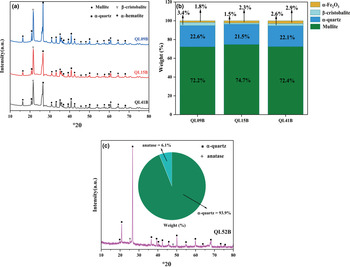
The XRD traces of the powders of QL09B, QL15B, QL41B and QL52B are shown in Fig. 9 and Table 3. The Ru-type ware bodies contain >70% mullite, ~22% α-quartz, 3% β-cristobalite and 2% α-Fe2O3. In comparison, unglazed firing bodies contain ~94% α-quartz and 6% of anatase.
(a) Mineralogical composition of Ru-type ware. (b) Quantitative analysis of Ru-type ware. (c) Mineralogical composition and quantitative analysis of unglazed firing bodies.

Kaolinite (Al2O3⋅2SiO2⋅2H2O) is the main hydrous mineral in ancient ceramic bodies in northern China and is transformed into other phases at high temperatures. Cristobalite might form from excess SiO2 during transformation of kaolinite into mullite and from transformation of edges of quartz crystals, both at high temperatures. The presence of large amounts of the mullite phase in Ru-type ware bodies was identified by XRD, suggesting the formation of cristobalite during the crystallization of mullite in Ru-type ware bodies. The structural water in kaolinite is released and the crystal structure is destroyed to form metakaolinite when the temperature is in the range 450–650°C (Equation 3). The metakaolinite decomposes into free Al2O3 and SiO2 at >900°C (Equation 4) and recrystallizes to mullite at ~1100°C. The excess SiO2 transforms into cristobalite (Equation 5), which forms the framework of the body together with the mullite crystals.


The presence of mullite and β-cristobalite phases in the XRD traces of Ru-type ware bodies indicates that the firing temperature of Ru-type ware exceeded 1100°C. No mullite and cristobalite but abundant α-quartz were detected in unglazed firing; therefore, the firing temperature of unglazed firing did not exceed 1100°C and was estimated to be ~950°C. In addition, the Al2O3 content of unglazed firing bodies is greater than that of Ru-type ware. Al2O3 mainly resides in kaolin and feldspar, with the melting temperature of feldspar being 1200°C. The XRD traces show that the unglazed firing bodies are free of feldspar. Hence, Al2O3 was not supplied by feldspar. The α-Fe2O3 and anatase in the Ru-type ware and unglazed firing bodies indicate the different origins of the raw materials of the two ceramic types. This finding confirms the ED-XRF results and may also explain why the colour of Ru-type ware bodies is grey-white whereas that of unglazed firing bodies is pure white.
Conclusions
The dominant wavelength of differently coloured Ru-type ware glazes is in the range 520–580 nm, which is typical of the celadon system. The source materials of the Ru-type wares with different colours are relatively consistent but differ from those of the unglazed firing bodies. The greater CaO and SiO2 contents and lesser Al2O3 content of Ru-type ware bodies compared with those of unglazed firing bodies suggest that the raw materials of Ru-type ware bodies contain greater amounts of calcite, whereas unglazed firing bodies are richer in kaolinite. The high-temperature phases of Ru-type ware and unglazed firing bodies are different. The Ru-type ware bodies contain >70% mullite, ~22% α-quartz, 3% β-cristobalite and 2% α-Fe2O3, while unglazed firing bodies contain ~94% α-quartz and 6% anatase. The Ru-type ware bodies have a greater Fe2O3 content because of hematite. The TiO2 content of unglazed firing bodies is greater than that of most Ru-type ware bodies because they contain anatase. The range of firing temperature of Ru-type ware bodies was 1150–1200°C, whereas that of unglazed firing bodies was ~950°C. Both are considered underburning firing temperatures. The densification degree of Ru-type ware bodies is low. This pursuit of aesthetic rather than practical outcomes led to incomplete densification of the firing body, and so this does not represent a firing technique for ordinary civilian porcelain. This approach is similar to that used in Ru Kuan ware. Therefore, Ru-type ware may have been for official use.
Financial support
This work was supported by National Natural Science Foundation of China 11275173 and 50572097.