1. INTRODUCTION
‘If the reader consults the list of the committees that administer these diverse works, he will find there the same names recorded many times for the various Geneva institutions that are seeking to bring help to those vanquished in the struggle for life. Those names belong to members of the Genevan elite who are striving to keep the charity bureau afloat financially.’Footnote 1
In this statement about philanthropic commitment in the city of Geneva, Paul Marin, who was himself involved in charity issues, asserted that the elite was the only social group involved in the city's charities. In a broader context contemporary scholars have concentrated their efforts on the almost symbiotic relationship developed by elites in Europe and in the United States with charitable work.Footnote 2 In a contribution dedicated to this issue, Francie Ostrower writes: ‘Philanthropy is an integral and defining element of elite culture.’Footnote 3 Understood as such it is not really surprising that scholars have concentrated their efforts on investigating why and how the leisure class did (and does) give and care for destitute people. Philanthropy has thus been recognised as a mark of social distinction for established social elites – in New York, for example, the old Knickerbocker families refused to integrate the newly wealthy into their charities.Footnote 4 Elites regarded philanthropy as a means of separating themselves from others or an aid in climbing the social ladder. Other scholars have also argued that elites who had lost their political position used philanthropy as a means of access to the public sphere, where they were involved in social reform. In Boston, the Brahmin, a group of upper-class families whose power had been eclipsed by Irish immigrants elected into political office, dominated charities during the nineteenth century.Footnote 5 In these cases, philanthropy consists of an alternative way of exercising power.Footnote 6
However, some recent studies have shown that elites were not the only social group involved in philanthropy. In his book, Philanthropy in America: a history, Olivier Zunz described together the efforts of a few large (the elite) and a multiplicity of small donors (‘mass philanthropy’) which shaped the history of philanthropy in the United States during the twentieth century.Footnote 7
In order to compare the social origins and commitment of philanthropists, we chose to concentrate on one geographical space (the canton of Geneva) to take into account a large sample of charities and philanthropists, which allows us to analyse how different actors could collaborate or compete. This choice is justified by the lack of a comprehensive study of Geneva. Much has been written on philanthropy in American cities such as New York and BostonFootnote 8 and in other European cities, such as Berlin,Footnote 9 HamburgFootnote 10 and Amsterdam,Footnote 11 but Geneva still awaits a comprehensive study. This gap is all the more surprising given that in Switzerland broadly and in Geneva in particular philanthropic activities appear to have been particularly abundant. In the late 1870s, Switzerland's poor relief amounted to 88 pence per capita, a sum that greatly exceeded the support provided in other European countries. This figure covers only communal and cantonal poor relief as well as private relief, as the federal state did not intervene significantly in this field before the First World War.Footnote 12
Whether understood as an elites’ tool of inclusivity or exclusivity, or as a means of social control, philanthropy forms social links, both among philanthropists of different social origins and between donors and recipients.Footnote 13 Literature on philanthropy has tended to concentrate on one specific sector, largely ignoring links amongst philanthropic sectors and actors, a gap that we propose to fill with our study of Geneva's philanthropic world. By focusing on the links between philanthropists, we can test for social homogeneity and analyse relationships. In asserting the existence of a philanthropic field in Geneva, a relatively autonomous system of relations between positions and actors as Pierre Bourdieu has theorised,Footnote 14 our aim is threefold. First, we want to demonstrate that a diversity of actors was involved in the charities of the city. Elites were not the only actors involved in philanthropy. Second, we would like to show that they were linked to each other by different kinds of ties (family links, cooperation between philanthropic sectors and activities, coordination among charities). Third, we study a large sample of charities and philanthropists, which includes different sectors of charities, in order to analyse the diversity of commitments and the way they were combined with each other, sometimes by the same person.
Our first step is to use socio-economic indicators to assess the social position of the philanthropists. This process allows us to identify social groups involved in Geneva's charities. Were philanthropists exclusively members of the city's elites? How did social and political conflicts inform the commitment of those actors? What was the social distance between philanthropists and their audience? This focus on linkages enables us to establish relationships between actors – the result is a picture of Geneva's philanthropic field with its key elements, points of tension and collaborative gestures highlighted.
Our analysis is based on an innovative research methodology. Concerned to establish links and uncover the philanthropists’ social positions, we combined the results of network analysis and multiple correspondence analysis performed on our sample of Geneva's philanthropists. We deepened this quantitative analysis with a qualitative approach in which we drew on written records.Footnote 15
As some authors have stressed, it is very difficult to produce a comprehensive definition of philanthropy.Footnote 16 Thus, following stimulating examples from scholars who analysed philanthropic activities and scope from primary sources, our definition of philanthropy and philanthropists also derives from the source. We consider as philanthropic or philanthropists all organisations and individuals listed as such by a charity directory published by a well-known philanthropist in 1903 in Geneva.Footnote 17 This methodological choice has one important advantage. By proceeding this way we avoid interpreting the past through our own contemporary categories. Much has been written about the concept of the charitable action,Footnote 18 but our primary aim is to focus on practices and thus on people who were associated by their contemporaries with philanthropy. Finding empirical evidence for this kind of actor is very difficult, especially if we need a relatively large and diversified sample. This is the reason why we decided to rely on a contemporary source.Footnote 19
In the first part of this article, we situate philanthropic activities in the economic, political and social context of Geneva at the turn of the twentieth century. We then present our data and our theoretical framework. In the fourth part, we discuss the results of the multiple correspondence analysis and of the structures of the philanthropists’ social space. We identify and describe the social fractions (to use the sociological term)Footnote 20 involved in philanthropic activities in Geneva around 1900. The final section of the article analyses relationships between fractions involved in philanthropy and the existing hierarchies between them and in so doing demonstrates the existence of a social field of philanthropy in Geneva at this date.
2. SOCIAL CHANGE AND THE DEVELOPMENT OF CHARITIES
During the second half of the nineteenth century, the number of charities in Geneva grew substantially. One large private relief organisation reported that between 1843 and 1904, the scale of spending by public and private charities in Geneva more than tripled: in 1843, 462,825 francs in public and private funding were spent, or 7.5 francs per capita, and in 1904 that figure was 2,933,347 francs, or 21.0 francs per capita.Footnote 21 The Hospice général, a public institution dedicated to relief that was established during this period, probably accounts for a large part of this total, but even then, the growth in relief funding undertaken by other institutions is still striking. The author of the report counted 24 charities for 1843 and 165 for 1904, but these figures did not account for all the charities in Geneva. Both the author of the first quotation of this article and scholars have identified the old Genevan elite, a social group that dominated the political life of Geneva since the Reformation and lost its political power in the middle of the nineteenth century, as the principal, and perhaps sole, promoters of charities.Footnote 22 As we will see, although members of Geneva's old elite sought to organise and lead the philanthropic field, theirs was not the only social group involved in philanthropy. Nonetheless, their philanthropic commitment was very great, which leads us to ask why they were so involved in charitable work. Like other contemporary urban elites, the Geneva elite used philanthropy as a means of regaining political power that they had lost. In Geneva as in New York and Boston, an old elite that had ruled the city for decades or even centuries had been challenged by a new upper class shaped by the economic development of the nineteenth century.Footnote 23 Eager for power, these newcomers challenged the old elite in many respects, including elected political positions. Scholars have recognised the competition between these groupings and have noted that in their commitment to philanthropic activities, the old elite found a means of reviving a form of political power.
Geneva's old elite had held sway in the city since the Reformation, specifically since 1536. In this regard they acted like an aristocracy, determining the character of the upper class of the city, and can be designated patricians. The Genevan revolution in 1792 saw their defeat by inhabitants who claimed greater political rights and the abolition of their economic privileges. Six years later, Geneva was first occupied by French troops and then integrated into France. With the defeat of the French in 1813, Geneva regained its independence, and the old elite was able to reclaim its political power. The political project known as the ‘Restoration’ saw the reintroduction of the old regime that had been in place before the revolution of 1792. As the elite's political agenda was also strongly influenced by liberal thought, their political approach can be regarded as liberal–conservative. The patricians negotiated the entry of Geneva into the Swiss Confederation in 1814.Footnote 24 They cultivated strong Protestant moral convictions, with an emphasis on the value of hard work and probity, and sought a spirit marked by temperance and order.Footnote 25
In 1846, the patricians again lost their political power during a revolution. Their adversaries, who have been termed liberal democrats, sought to institute universal (male) suffrage. They were the new elite, the newcomers mentioned above. They were less wealthy than the former elite and part of the expanding bourgeoisie. After 1846, liberal democrats ruled the city for decades. Members of the old elite tried to regain some of their former authority through a commitment to charity, which gave them a voice in public policies that were a response to issues identified as social problems – immigration, confessional conflicts, and labour disputes, for example – issues that were very heated throughout the nineteenth century.
Indeed, Geneva faced huge demographic and social changes during the nineteenth century. Perhaps most spectacular of all was the population growth of the second half of the century, when sustained economic growth required additional labour. In 1890, Switzerland shifted from net emigration to net immigration, and in 1910, 14 per cent of residents of Switzerland were foreign. Geneva's profile had long been skewed to a greater representation of foreigners: in 1850, of the city's 64,149 inhabitants, 23.6 per cent were foreign; by 1900, the population had grown to 132,389, with 38.9 per cent foreign.Footnote 26 Immigration took two forms: while many people came from neighbouring countries such as France, Germany and Italy, numerous migrants also moved from other Swiss cantons. While the latter, called Confederates,Footnote 27 enjoyed political rights, their social status was little different from that of their French, German and Italian counterparts. They had no access to public relief in Geneva,Footnote 28 as Swiss law stated that each municipality was to provide for its own citizens.Footnote 29 In 1900, Confederates represented 30.6 per cent of Geneva's population.Footnote 30
In the eyes of the Protestant old elite, immigration had an additional component: as most of the newcomers were Catholic, the Protestant identity of the city seemed under threat. Between 1850 and 1900, the proportion of Catholics to Protestants shifted in favour of the former, who then slightly outnumbered Protestants for the first time since the Reformation. These newcomers strengthened a process initiated by Geneva's incorporation into the Swiss Confederation. In 1815–1816, the Protestant Republic had to assimilate the Catholic population of the territories bordering on Geneva to join its territory to the Swiss Confederation. Thus, the absorption of territories taken from France and Savoy had already increased the size of the Catholic population, and that process was intensified by subsequent labour immigration. Throughout the century, confessional conflict remained rife, with the Catholic bishop even expelled from Geneva in 1873. Despite their growth in number, Catholics had very little involvement in politics and did not compete for political power.Footnote 31 As we will see below, confession was integral to philanthropy as a category for both recipients and donors. Charities might select their beneficiaries according to confession, have a specific religious identity, or be closely associated with a church. Furthermore, some charities had a proselytising mission to fulfil, targeting the conservation and development of Protestantism. Besides, they were also used to spread (and even impose) some Protestant moral values and were probably being used by the old elite for that purpose.
Economic development and population growth had a social impact. Many of the newcomers were employed in the developing industrial sector, and unskilled workers might also be employed as servants.Footnote 32 Their socio-economic position was precarious, for they were very sensitive to economic change. They lacked any form of social insurance, and all too readily, sickness or unemployment meant the loss of housing or extreme poverty. The old elite had to accommodate not only industrialisation, urbanisation and migration, but also associated issues related to the working class. The new elite was also confronted with these issues but, in contrast to the old elite, the new one promoted a larger involvement by the State as shown by the creation of a public relief institution (Hospice général) in 1867, while the old elite promoted individual intervention, notably from the voluntary sector.Footnote 33 The spectre of the ‘indigent’ or the ‘poor’ brought with it fears of a threat to society. The old elite wanted to impose their own moral values on the working class, who, they were aware, could be the cause of ‘terrific social crisis’.Footnote 34
With social conflict very much a part of this new configuration of society, workers began to come together in the effort to improve their working conditions. A series of strikes ran through the second half of the century, from the building workers’ strike of 1868 to the first general strike in Geneva, initiated by tramwaymen and broadly supported by other trade unions, in 1902. Furthermore, in 1866, Geneva was the host city for the congress of the International Workingmen's Association. Concerned at the mobilisation of labour, the old elite looked for ways to avert social conflict.Footnote 35
Charities were seen as one means of alleviating the problems from which conflict sprang and of spreading ideas about social improvement. Philanthropic members of the old elite believed that society should not be understood in terms of a clash between capital and work and that social reform could solve the problems of poverty.Footnote 36 They held that inequalities were not the product of economic or political systems; each individual had a personal responsibility for his or her situation and could improve that situation. This view led to the belief that philanthropists should help reform society by committing to charities. That commitment was not simply a financial matter. Private social programmes were to be promoted and self-help made possible through the inculcation of moral values such as prudence, temperance, probity and hard work. They promoted a vision of strongly individualist wellbeing, with everyone responsible for his or her own destiny, regardless of social origin. Framed more broadly, the substantial growth in the number of charities and in their spending was probably a response to socio-economic change.
3. SOURCE, SAMPLE AND THEORETICAL APPROACH
Our sample is based on a charity directory published in 1903 in Geneva by Frank Lombard, a member of the old elite. The directory's first two editions (1875 and 1879) had been published with the help of the Société genevoise d'utilité publique (SGUP; Geneva section of the Swiss Society of Public Welfare).Footnote 37 The first three publishers were prominent philanthropists in Geneva, with Gustave Moynier (1826–1910) a founder of the Red Cross. These philanthropists aimed to counter the lack of publicity for certain charities and sought to help potential donors find a suitable charity. They also hoped to rationalise philanthropic activities and prevent a growth in the number of beggars. The first edition of the directory was published during a period in which the charities were expanding. These members of old elite families planned an overview of the charitable field for the public, but in so doing they also asserted their own position as representatives of that field. Even just by counting, categorising and describing the charities, and by determining who and what would appear in the directory, they had become actors in the field. Similar directories for large cities such as London,Footnote 38 New YorkFootnote 39 and ParisFootnote 40 fulfilled the same functions. Such initiatives are indicative of how individuals could use statistical production to claim to represent their peers, with philanthropists from the old elite in this case standing for all philanthropists gathered in the directory.Footnote 41 As there was only a single directory for Geneva, the work had a dominant position – and by extension so too did its authors – and gained from this exclusivity a kind of universalism. Fifteen years later, another member of a prominent philanthropic family, Lombard, resumed the publication of the directory, which appeared in 1893, 1899 and 1903, still with the support of the SGUP. With the professionalisation and modernisation of one of the largest private relief institutions, the publication of the directory would subsequently cease.Footnote 42
The directory listed all institutions deemed philanthropic by its publisher, which meant it covered not just those institutions that involved the old elite but also institutions with ties to other actors, such as foreigners or members of the new political elites. Information on each charity was drawn from that charity's annual report or taken from declarations made by its representatives.Footnote 43
In the first edition published in 1875, the authors state: ‘By charity [we] consider not only, of course, distribution of material relief and alms. In [our] mind, the real charities are those which after having fulfilled the first needs of the body, aim at making the man able to get by on his own.’Footnote 44 They adopted a broad definition of philanthropy in order to strengthen their position as representatives of a large scale of activities. In so doing, they were obviously fulfilling a political agenda. That is why Lombard's 1903 directory adopted a similar broad definition of philanthropy. He quoted many charities involved in several domains like state and private schools, orphans’ homes, night shelters, homes for elderly, saving banks, mutual benefit societies, assistance through work charities, relief providers, hospitals and so on. It took into account state and private (both religious – the directory included charities related to Catholic, Protestant and Jewish communities – and lay) institutions and even listed sanatoria and shelters, which were not located in Geneva but ‘interact regularly with our charitable audience’. However, Lombard claimed that he excluded some organisations from the directory, namely societies related to instruction, sports, industrial and scientific development.Footnote 45 The work noted 706 charitable institutions,Footnote 46 listed by area of expertise. We decided to take into account the whole list of charities gathered in the directory in order to match the definition of philanthropy (and philanthropists) adopted by historical actors.
We took a number of steps in constructing our sample. First, we identified philanthropists’ names within Lombard's directory. We counted every philanthropist listed in the source and made sure nobody was counted twice by identifying everybody in other sources. The lack of systematic identification of these individuals in the directory complicated this task – for example, women could be identified by their husbands’ first and last names or by their maiden names. For both men and women, we had to be sure a single name used more than once always referred to the same individual. In order to identify these individuals, we drew on several kinds of sources: obituaries published in the Journal de Genève, the census of Geneva's population of 1903, the canton address book and the ‘Biographie genevoise’.Footnote 47
As our focus is on individuals highly involved in charities and as we are investigating connections within the field, we retained only philanthropists who appeared at least twice (117 people). We followed the methodology of scholars studying ‘interlocking directorates’ in order to focus on the people we presume were much involved and enjoyed connections within the philanthropic milieu, meaning, to quote Michael Useem, that they combined three factors of the ‘inner circle’: ‘the special ability to mobilize corporate resources, to emerge as the compromise representative, and to express the general outlook’.Footnote 48 We aim to analyse these people and their charities as a field, the field of Genevan philanthropy. According to Bourdieu, a field is a relatively autonomous and hierarchically structured space – important and well-studied examples include the literary field, the academic field or the economic field.Footnote 49 A field can be defined as a system of relations between positions which are endowed with different amounts and combinations of resources (capital). Most importantly, fields are composed of different fractions with specific social profiles and endowed with specific amounts and forms of resources or capital. In such systems of relations we can distinguish between incumbent (dominant or orthodox) fractions and challenging (dominated or heterodox) fractions which are linked through relations of domination or competition. However, specific fractions of the field might also cultivate relationships of coordination or collaborations with other fractions. Despite hierarchical relationships characterising most of the fields, all the actors agree about the objects and stakes of interest and dispute and hence contribute to perpetuate the field. In this article we thus assume that the field of Genevan philanthropy is composed of different positions, which are occupied by fractions endowed with different amounts of economic, cultural or social resources. Whereas certain fractions possess large amounts of wealth, of educational credentials and are very well connected within Genevan society, others who are also engaged within philanthropy might lack most of these resources. We also assume that besides hierarchical relationships between these fractions, they also engage in specific forms of collaboration, coordination or of division of work.
4. METHOD AND ANALYSES
4.1. Multiple correspondence analysis
Our analysis of the philanthropic field in Geneva at the beginning of the twentieth century relies on multiple correspondence analysis. This multivariant method was developed in the 1960s by French statistician Jean-Paul Benzécri and was used extensively by Bourdieu and Bourdieu-inspired scholars to understand relational dynamics within social spaces and fields. It was applied to historical issues for the first time by French historians in the seventies, notably by Antoine Prost.Footnote 50 More recently, research using historical data and relying on multiple correspondence analysis has been published in English. For instance, Joseph Gerters has used this method to identify segments related to political alignment among the American middle class during two different periods.Footnote 51
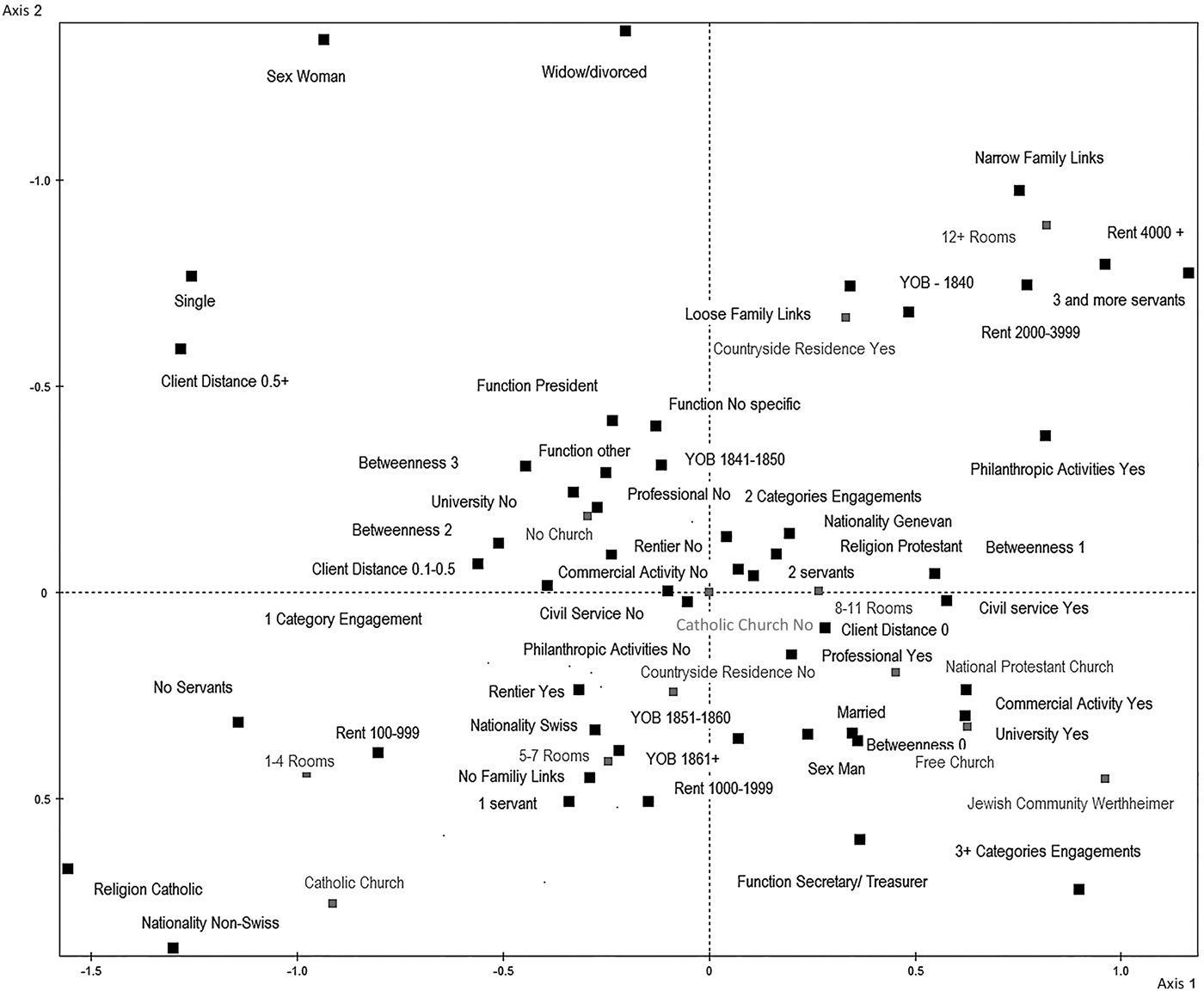
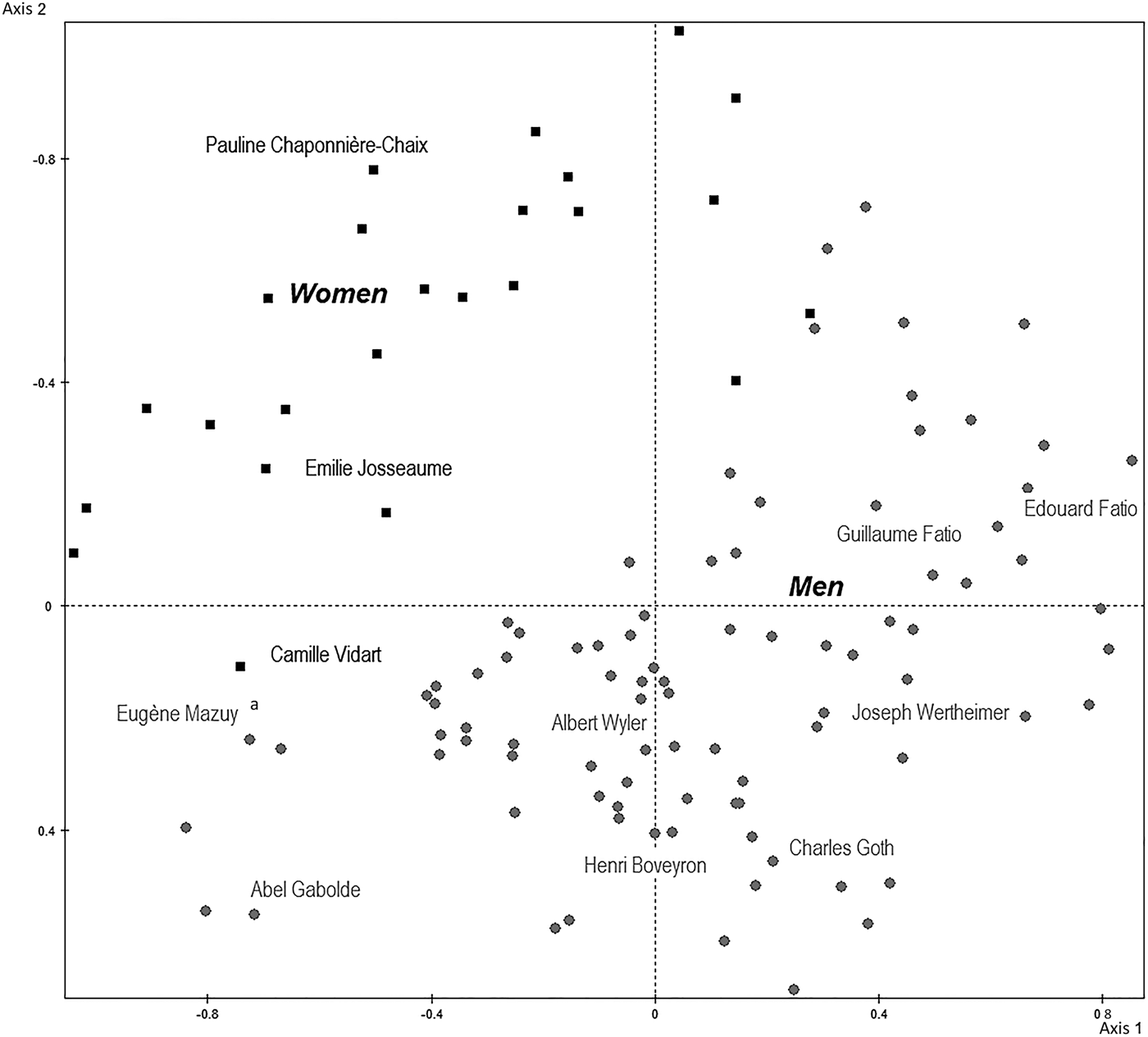
Multiple correspondence analysis is best suited to investigating structural relationships between different fractions within a field; that is, as a means of understanding positions within a field, the volume and the composition of the resources with which these positions are endowed, and the nature of their relationships in terms of domination or collaboration. Multiple correspondence analysis condenses the information provided by a large number of variables and allows the researcher to study the co-relations between these variables. The results of multiple correspondence analyses can be represented in one (or several) two-dimensional and relational graph(s).Footnote 52 Within this graph, a cloud of categories and a cloud of individuals can be distinguished. The relative position of categories and individuals constructs a field that illustrates the system of relationships in which they are involved. The closer individuals are to each other, the more categories they share; the further they are from each other, the fewer categories they share. Inversely, if two categories are close together, then they are shared by a larger number of individuals. In this article we first present the cloud of categories (Figure 1) and then the cloud of individuals (Figure 2) – both of these clouds are limited to two axes, represent the same space and can be read together. Each of the two axes explains a certain amount of the specific spread and distribution of the categories (called the ‘inertia’ or the ‘variance’), which is measured by the eigenvalue. This term refers to the explanatory strength of each axis. The higher the eigenvalue of an axis, the better this axis explains the distribution of the individuals and the variable in the clouds.
The field of Genevan philanthropy in 1900 – the cloud of categories derived from multiple correspondence analysis. YOB, Year of birth.

The field of Genevan philanthropy in 1900 – the cloud of individuals derived from multiple correspondence analysis.
One innovative feature of this study is that it combines this field-theoretical framework with a network theoretical approach. Even though multiple correspondence analyses and network analyses have often been thought to be mutually exclusive, several attempts have been made in recent years to combine these two perspectives.Footnote 53 Network analysis allows us to draw links created between different organisations (in our case charities) by common members. We consider that people who are mentioned in connection with different charities by the directory create a link between them. The link represents a social relation or an opportunity to develop a relationship.Footnote 54 In this article, we investigate the network of philanthropists and code the betweennessFootnote 55 of individuals in three categories: high betweenness, average betweenness and low betweenness. In addition, we establish whether philanthropists were part of Genevan family networks and then use this information as an indicator (see the variable descriptions below) in the multiple correspondence analysis. By including network indicators in the multiple correspondence analysis, we are able to take into account the proximity created by membership to the same charity in the construction of the social field. We can thus measure relations between actors and the ways in which they were linked.
4.2. Description of variables
Drawing from the sources, we have organised the active categories under six headings: sociodemographic variables, form of philanthropic engagement, occupation, residential situation, religious affiliation, and network variables. The variable labels in quotes correspond to the labels used in Figure 1.
Sociodemographic variables
The first sociodemographic variable we have used is gender. Educational level has been coded by distinguishing university-level education from no university education. Within the cohort, we sought to distinguish between age groups and potentially also between levels of seniority in philanthropy. We therefore differentiate by year of birth (YOB): ‘YOB –1840’, ‘YOB 1841–1850’, ‘YOB 1851–1860’, ‘YOB 1861+’. Under the variable ‘marital status’ we distinguished between ‘married’, ‘single’ and ‘widowed/divorced’ individuals. Three categories meaningful in the context of nineteenth-century Geneva fall under the nationality variable: ‘nationality Genevan’, ‘nationality Swiss’, and ‘nationality non-Swiss’.Footnote 56
Form of philanthropic engagement
Lombard's philanthropic directory contains indicators concerning each individual's number of memberships, position within each charity, and area of charity-related expertise. Multiple memberships and positions involving various forms of expertise also suggest the nature of the individual's commitment. Some people were involved in varied forms of charity, suggesting a universal commitment, whereas others specialised in a single area. The first variable concerns the number of categories of philanthropic engagement (religious or poverty-related, for example) in which an individual was involved. Those who participated in only one category of philanthropic engagement (‘1 category engagement’) are distinguished from those who participated in two (‘2 categories engagement’ or more ‘3+ categories engagement’). A second aspect concerns the individual's specific function within the philanthropic organisation: we coded for presidents, directors or founders (‘function president’), treasurers and secretaries (‘function secretary/treasurer’), other functions (‘function other’), and no specific function (‘function no specific’). Finally, we tried to operationalise the social distance between the philanthropist and people targeted by their charities with a score based on gender, religion and nationality. Our idea is to establish whether philanthropists took part in charities dedicated to people close to them in terms of social profile, for example, if women took more part than men in charities dedicated exclusively to women; and the same for Protestants and Catholics. If philanthropists and recipients of their charity have the same gender, religion and nationality, the score is three; if they share none of these characteristics, the score is zero. The higher the score the closer philanthropists were to the people they pretended to help. This distance is then placed in one of three categories: ‘client distance 0’, ‘client distance 0.1–0.5’ and ‘client distance 0.5+’.
Occupation
When it came to occupation, we had to take into account that philanthropists could have multiple occupations and might be engaged in mixed forms that involved both employment and philanthropic engagement. We have therefore created a series of binary indicators (yes or no) for occupation as a ‘rentier yes/no’ (living on family wealth, landed income), ‘professional yes/no’ (lawyers, physicists, etc.), ‘civil service yes/no’ (teacher, judge, etc.), ‘philanthropic activity yes/no’, and ‘commercial activity yes/no’.Footnote 57
Residential situation
Here we listed as the first binary variable whether the individual owned a secondary residence in the countryside (‘countryside residence yes’), which is a good indicator of membership of the upper class. This variable has only been used passively.Footnote 58 The second variable concerns the individual's annual rent, which has been coded in the following categories (counted in Swiss francs): ‘rent 100–999’, ‘rent 1,000–1,999’, ‘rent 2,000–3,999’ and ‘rent 4,000+’.Footnote 59 The variable ‘number of servants’ is also an indicator of socio-economic status: we distinguish between ‘no servant’, ‘1 servant’, ‘2 servants’ and ‘3 or more servants’.Footnote 60
Religious affiliation
Religion is covered by the variables ‘religion’ and ‘member of a church’. The latter variable is an indicator of an active religious life and that the individual was anchored in a religious community. It is used only as a passive variable. Religion was coded into ‘religion Protestant’ and ‘religion Catholic’; other confessions, which were very rare, have been excluded from the analysis.
Network variables
The first of the series of variables is related to the betweenness value. This indicator, which measures the capacity of an individual to bridge between different components of the network, was differentiated into three groupings, with high, average and low betweenness values (‘betweenness 1’, ‘betweenness 2’ and ‘betweenness 3’). Additionally, the family links between philanthropists referred to in the directory were also coded into three categories: those with relatives among the 117 people of our sample, those with relatives among the other philanthropists noted by the source (who only have one affiliation to a charity), and those with no relatives amongst the other philanthropists mentioned in the directory (‘narrow family links’, ‘loose family links’ and ‘no family links’).
Figure 1 represents the cloud of categories. The active categories (in black) have been used to construct the space, the passive categories (in grey) are only projected into the space and do not participate in its construction (see note 58). As in factor analysis in general, the first, horizontal axis represents the most important dimension and has the highest eigenvalue (0.18). The second axis represents the second most important contrast and has an eigenvalue of 0.15.
The axes must be interpreted separately. In the following interpretation only categories whose contributions to the axis are above the average are taken into account. The first, horizontal axis places individuals according to a combination of several criteria, such as gender, religion, and immigrant status. On the left side of the plan can be found philanthropists who have no servants, who have no university education, and who are Catholics. In other words, this side of the plane is composed of comparatively poor individuals with limited education, who are immigrants or at least of immigrant descent. Here we also find women who are single (or widowed) and women with only a single philanthropic affiliation within a narrow sector of philanthropy. Generally speaking, on this left side of the plane we mainly find outsiders (women, Catholics, non-married) who only have a limited and highly contained philanthropic involvement. On the right side of the plane we find individuals who share several attributes of respectability and social status: they have three or more servants, are married men, have a university education, and are Protestant. In this area we also find individuals involved in commercial activity. These attributes of respectability are linked to a more general (universal) philanthropic engagement that involves several positions and also several categories of philanthropic activity.
The interpretation of the second, vertical axis is even more straightforward: on the upper half of the plane, we find those who are economically dominant, whereas on the lower half of the plane are placed those who are economically dominated. In the lower half of the plane, we find younger individuals who live in a flat or house with a rent between 100 and 999 francs per year and have only one domestic servant. A stark contrast is evident with the slightly older fractions situated in the higher part of the plane, who pay a rent of 4000 francs or more and have three or more domestic servants. This impact of the economic situation is doubled with the differential integration of the networks of influential patrician families: whereas the poor fractions in the lower half have no links to those families, the rich fractions above are strongly integrated into those family networks. We should also note that the treasurers of the philanthropic associations are situated in the lower part of the plane.
With these two axes combined, the graph showcases four fractions, each of which represents an element within the Genevan philanthropic field. These four fractions reflect similarities in these actors’ social profile. Not all these fractions constitute groups in the sociological sense.Footnote 61 The main idea is therefore not to count their members, but to identify them loosely according to the similarity of their social profiles. The axes reveal the tendencies described above which allow us to define those four fractions. The existence of different social fractions defined by their socio-economic profile, their position in the field, and their philanthropic commitment does not mean that each grouping formed a separate world. On the contrary, we will argue that although these actors belonged to separate social spheres, they were able – and indeed needed – to collaborate, or at least were connected with members of other fractions. The existence of these connections did not mean, however, that they were performed within a peaceful and tension-free social space. As noted above, on the eve of the twentieth century, political, confessional and social conflicts were very real. This article will now describe and examine each fraction in turn, starting with the members of the old elite.
5. FOUR FRACTIONS INVOLVED IN PHILANTHROPY
5.1. Patricians
The established Protestant patricians are gathered within the upper right part of Figure 2. As noted, the literature on philanthropy has tended to identify these individuals as the most important, even sole, promoters of charities. These patricians formed the richest fraction amongst all the philanthropists of our sample; they also had the strongest connections to the network of Genevan families. They typically lived in rather expensive homes and had several servants, evidence of their wealth. Unlike the case of the rising bourgeoisie, their wealth was not tied to an advanced university education or to a well-paid (bourgeois) occupation. They were associated with families with inherited wealth and cultivated numerous links to other influential families. Depicted in Bourdieusian terms, their economically dominant position was based not on cultural capital, but on economic and social capital. When it came to philanthropic engagement, this fraction's participation was generalist, with several affiliations in different categories of charity, and often involved representative functions such as that of chairman. Only rarely do they seem to have run a charity, for example, as treasurer or general secretary.
Viewed in light of their political interests, this fraction is related to the liberal–conservative tendency, which lost political power in 1846, when liberal democrats first formed the government. Charities provided a means for the members to retain a degree of influence in the public sphere and a voice in social reform. Their names remained associated with the establishment and could confer respectability on charities. They also used philanthropic institutions to convey and promote their own values. Through their patronage, they endowed the charities with both a moral discourse on social reform and a certain standing.
This fraction's domination of the philanthropic field stemmed not only from the nature of the charity directory (whose author, Lombard, belonged to this fraction), but also from their involvement in its organisation. One example will serve here to illustrate their domination of the field and activities within it. Edouard Fatio was very much a member of the old patrician elite: his family had sat in the city's government or been involved in politics since the eighteenth century and up until the 1840s. Fatio occupied positions in various charities and sat on 10 committees, and these multiple positions within the field brought in turn multiple links with other philanthropists. His philanthropic activities were strongly related to his professional skills. Fatio was in effect one of the bankers of Geneva's philanthropists. Trained as a banker and having gained some practical experience, in 1873, he, with his brother-in-law, founded a mutual savings bank dedicated to small deposits. The institution had its own philanthropic function, for it sought to instil the virtues of saving in those of very modest means.
Since 1867, Edouard Fatio had also been involved in one of the major private charities of its time, the Central Charity Bureau (Bureau central de bienfaisance), an institution that aimed to organise philanthropy rationally and to counter ‘begging abuses’. Moral reform was given a scientific agenda. The moral qualities of every potential beneficiary of the Bureau were to be investigated in order to establish whether that individual was worthy of relief. Those who promoted charity did not want simply to provide funds; they sought to ‘lift up’ the beneficiary through measures undertaken by the Bureau. They provided relief in the form of, for example, labour coupons, coal and shoes to people who already received relief from the state or who were not entitled to such state relief because they did not hold Genevan citizenship. In 1876, Edouard Fatio left his position at the Bureau but remained its chairman, and his influence, as we will see, extended also to organising and coordinating the city's charities.
In 1903, Edouard Fatio still chaired the Bureau's committee and was involved in nine other charities. His name remained associated with the mutual savings bank although his son, Guillaume Fatio, had succeeded him as manager. Guillaume Fatio seems to have continued his father's legacy, and his position at the bank appears to have granted him authority to speak out on saving as a means of social improvement. Saving also had ties to other causes: to temperance, for instance, with people exhorted to save their money rather than spend it in public houses. He sought to demonstrate that even very small amounts could grow and thus saving could ensure a family's future.Footnote 62 The savings bank also sought to educate schoolchildren to save money by establishing a specific savings programme, known as the ‘Épargne des écoliers’. The promotion of saving by children was one way of transmitting moral values such as temperance, probity, prudence, hard work, dedication and discipline. The children of the day were the adults of the future; they also formed a bridge to their parents. Guillaume Fatio was a true savings activist. He published booklets about the development of savings banks in Switzerland and the benefits of small-scale saving, even for children.Footnote 63 Claiming that saving could improve social conditions and ensure a family's future was one way of asserting that each person was responsible for his or her own destiny.
5.2. Charities’ driving forces
Philanthropists gathered in the lower-right quadrant of the graphic had been university educated and held positions in commerce. Family networks appear to have been less important for this fraction, with their social position evidently based on bourgeois forms of capital, such as cultural capital and well-paid employment. We can assume this fraction of philanthropists to have been bourgeois, in crucial contrast to the patrician fraction described above. This bourgeoisie fraction performed a different function within the charities: its members also held several affiliations and were engaged in several categories of philanthropy, but they assumed positions such as secretary or treasurer. They can be regarded as the driving forces behind such charities, as organisers and involved in practical work. Their social profile seems to be very close to that of the individuals who gave their time and skills to charities in Paris, as described by Christian Topalov.Footnote 64 This fraction was not rich and was not part of the patrician establishment. Closer examination of the profiles of its members reveals that they were often very close to institutions of church or state. Here we illustrate their role and position within the philanthropic field with two examples: a liberal democrat politician and a Protestant minister.
Liberal democrats, the political group that had taken power after the revolution in 1846, belonged to this fraction containing philanthropy's driving forces. Members of the middle bourgeoisie, they started to claim more political rights and fought for universal (male) suffrage in the first half of the nineteenth century. Since coming to power, they had been able to create a public institution dedicated to relief by reforming the old hospital and converting it into two new institutions: the Hôpital cantonal dedicated to medical care and the Hospice général dedicated to poor relief for Geneva's citizens. The liberal democrats promoted relief that was supported by professional civil servants and organised by the state, while the old elite favoured a relief system generated by volunteers who gave their time freely according to their sense of moral duty.Footnote 65 Liberal democrats were less numerous within the charities themselves, although, as was the case for Henry Boveyron, they can be found amongst the significant players. In 1903, Boveyron's political career was in the ascendant, for he was a member of the city's parliament and 12 years later would be a member of the cantonal government. Trained for an occupation in commerce, he was typical of this new political class of the liberal democrats. In additional to his political involvement, Boveyron was a banker and board member of a number of companies, including his own bank, Lacroix & Boveyron.Footnote 66 He was involved in three charities and appeared three times as treasurer. Two of the institutions with which he was involved were related to pension saving and therefore involved the management of large sums, to which Boveyron would have brought his banking experience. Here, then, we encounter another aspect of this philanthropic world, for Boveyron not only provided his time and his growing respectability, but also made his skills as a banker available to the organisations to which he belonged. While patricians tended largely to be involved in individual relief efforts, Boveyron had connections with organisations that allowed people to buy goods collectively, enjoy a pension or that provided inexpensive hygiene facilities (hot baths and showers at reduced price) for those of modest means. Such institutions sought to improve living conditions through collective solutions, but without competing with the Hospice général.
Of the 21 Protestant ministers in our sample, 16 appear in this fraction. Only two of these ministers served the Free Evangelical Church, which had ties to the Christian revival movement, while the remainder of the pastors, such as Charles Goth (1852–1922), were members of the National Protestant Church, the main, state-supported church in the city. Their relief activities were part of their ministry, whether within charities related to the church or in their everyday engagement with members of their community, who both donated and received relief, with the ministers acting as intermediaries. They were also part of other charities that had ties to the church. Of the four charities with which Goth was involved, three were directly related to the church – two Tuesday schools for children and an evangelic school – with the fourth the Ladies’ Dispensary Society, a relief society that brought together ministers and female members of the patriciate. The geographical coverage of the society followed that of the Protestant church, and we can assume that each minister would have been involved in the society for his own parish. Ministers also functioned as character witnesses for other institutions, including the Central Charity Bureau. When the Bureau's committee needed information about the conduct or financial situation of a supplicant, it might turn to the pastors. With their detailed knowledge of their parish and its members, ministers provided charities with a pool of sociological information on which to draw.
5.3. Outsiders
The philanthropists located on the lower left of the graph are largely foreigners or migrants from other cantons. Their outsider status was often reinforced by their Catholicism, which made it difficult for them to enter Genevan society, Calvinist since the Reformation. Socially and institutionally isolated, this fraction cultivated almost no links with influential Genevan families, had no relatives among other philanthropists, and was involved in only one field of philanthropy. Their status as outsiders on two counts was compounded by their lower standard of living: unlike both the driving forces and the patrician fractions, which appear on the right side of the graph, they had no servants and lived in relatively modest housing. In terms of their philanthropic engagement, they often participated in only two charities, and those charities had as their recipients individuals who, according to our social distance indicator, were in a situation similar to that of the philanthropists themselves, for they tended to be Catholic and foreign. In this regard, they were very much the opposite of the patricians, who were involved in wider philanthropic activities that provided support for individuals with whom they had little in common.
The designations foreign and Catholic might overlap, but not all foreigners were Catholic and not all Catholics were foreign. As we noted, neither citizens of Switzerland beyond Geneva nor foreigners from outside the Swiss Confederation could benefit from public relief in Geneva. In this regard, both categories can be identified as outsiders. The Central Charity Bureau sought to direct foreign assistance seekers to their national charities and tried to obtain funding to assist Confederates from their commune of origin and, in the last resort, to send them back there.Footnote 67 As the analysis undertaken below will show, geographic origin played an important role in the organisation of both public and private relief.
The philanthropic commitment of Albert Wyler (1857–1925), a non-Genevan Swiss, contributed to his social integration and advancement. Even the conservative Journal de Genève recorded in his obituary that ‘despite his Thurgovian origins, [Wyler] became a true Genevan personality’.Footnote 68 Wyler was involved in five charities related to temperance and assistance through labour. As the director of the Société d'assistance par le travail, he collaborated with members of the old elite who were patrons of this charity. Wyler's commitment, like that of the patricians with whom he worked, was wide, related to broad social improvement.
While they shared some socio-economic characteristics with people like Wyler, the foreigners who were members of this outsiders’ fraction were closer to the people targeted by their charities, for they were substantially involved in charities that took care of their fellow countrymen. In their case, philanthropy was a community concern. In 1897, the French made up the largest foreign population of Geneva, with 33,050 residents.Footnote 69 Frenchmen Eugène Mazuy (1857–1928) and Abel Gabolde (1867–1960), who had settled in Geneva, were committed to two French charities, with Mazuy chairman of both societies and Gabolde treasurer. The French Philanthropic Society aimed to provide relief to French people in need or to ease their repatriation and made available a sociable gathering place for French people living in Geneva. The French Mutual and Philanthropic Society fell into the category of mutual fund charities, which brought people together to receive subscriptions and to provide support in case of illness or death, when the mutual funds would pay for medical treatment and provide a small sum of money for each day a member was unable to work.Footnote 70 These organisations tended to follow two possible models and could exhibit elements of both. On the one hand, they might function as a locus for the assembly and mobilisation of labour, even occasionally in the role of a proto-trade union. On the other hand, they might be created by members of the bourgeoisie, employers and patricians who saw in them an opportunity to tackle social problems and fight poverty. In Great Britain, where such funds were much more numerous than in Switzerland, ‘board members usually belonged to the honorary elite of the old labour aristocracy’.Footnote 71 In 1903, there were about 2,006 mutual funds in Switzerland with 500,000 members, or 14 per cent of the population.Footnote 72 The French Philanthropic and Mutual Funds Society had 427 members and paid indemnities of between 1.5 and 2 francs per day, which was in line with the average indemnity paid by other mutual funds in Switzerland and matched the daily wage of a woman in the textile industry;Footnote 73 by comparison, a typographer in Geneva earned 65 cents per hour.Footnote 74
Neither Mazuy nor Gabolde appears to have been financially dependent on mutual funds. As census data on the rents they paid show, they enjoyed a better social status than the average worker.Footnote 75 For these two men, the societies probably largely served a social purpose, as an opportunity for French people to come together. Care for the neediest members of the community could also have been a form of social control. By responding to the needs of those in their community who required relief, they averted a threat to the entire community. Furthermore, in so acting they stood as representatives of their community, for whom they then spoke. In this respect, they behaved like the patricians, but their influence was restricted to their own community, which they thus occasionally represented.
5.4. Women
Scholars have proposed that philanthropy offered bourgeois women an existence beyond the household, as it provided access to the public space. For some historians, philanthropy has even been viewed as ‘a school of emancipation’ for women.Footnote 76 Female philanthropists in our sample can be found in the upper left quadrant of the graph. These women, who were largely single or widowed, were closer to recipients of their charities in that women were providing for other women. The widows in this fraction were generally better off than those who had not married and were also more closely integrated into the network of families in Geneva. Some widows or single women seem to have belonged to the patrician fraction and might have been continuing the philanthropic commitment of their late husbands or families.
During the late nineteenth century, women's involvement in charity work was understood to be in accordance with their supposed ‘natural female disposition’, which deemed them suitable for caring for others and for providing relief and advice. They had first been called upon by the clergy to assist in charity work, but in the course of the nineteenth century, their involvement was institutionalised and they were integrated into charities.Footnote 77 Furthermore, the involvement of women in social work and nursing was about to change, as new training possibilities opened up, offering single bourgeois women employment opportunities and emancipation from their families.Footnote 78 These training institutions were not designed to provide women with access to paid jobs, but rather sought to train women as caregivers and to become good wives and mothers.Footnote 79 Among our female philanthropists, Pauline Chaponnière-Chaix embodied the process of professionalisation starting from a philanthropic commitment. She was only 28 years old and childless when her husband died. Chaponnière-Chaix trained in France as a deaconess and worked first with children and then in a women's prison. She also received a qualification in nursing. On her return to Geneva, she joined the Women's Union, an organisation that aimed to develop a spirit of solidarity among women to improve their moral, intellectual and material wellbeing. The Union's female promoters also wanted to create a rallying point for ‘the efforts made in the interest [of women]’.Footnote 80 In all, 390 people became members. Chaponnière-Chaix now dedicated her time and effort to women's causes, a commitment that included membership of the committee in charge of the first Swiss congress on women's interests.Footnote 81
In the Union, Chaponnière-Chaix worked in close collaboration with Camille Vidart, who like Chaponnière-Chaix was single and worked independently. Vidart had trained at the University of Lyon to become a language teacher and in Zurich taught at a girls’ school. Both Chaponnière-Chaix and Vidart were independent bourgeois women who worked in fields considered a natural context for women's abilities as caregivers, healers and educators. They used these tasks as points of access to the public sphere and as a means of emancipation. Their commitment within the Union proved to be the starting point of a wider mobilisation in the cause of women's rights. By the turn of the century, the Union was tackling legal aspects of women's status, most notably during the reform of the penal code.Footnote 82 Vidart's engagement with this cause developed in the following years. Between 1899 and 1904, she was secretary of the International Women's Association. Her dedication to women's interests and her desire to bring female activists together led to a commitment to equal political rights. She was a member of the International Alliance, which sought women's suffrage and was involved in a similar mobilisation in Switzerland, where, with the help of Auguste de Morsier, she created the Geneva Association for the Women's Vote and was involved in the founding of the Swiss Association for the Women's Vote.Footnote 83
Although Chaponnière-Chaix and Vidart sought more rights for women, they did not challenge the gendered division of work that assigned women roles related to their ‘nature’. They collaborated effectively with male charities such as the SGUP. As we will see, women had close ties to male philanthropists through family links and as a result of their involvement in funding charitable work.
5.5. Separate but connected
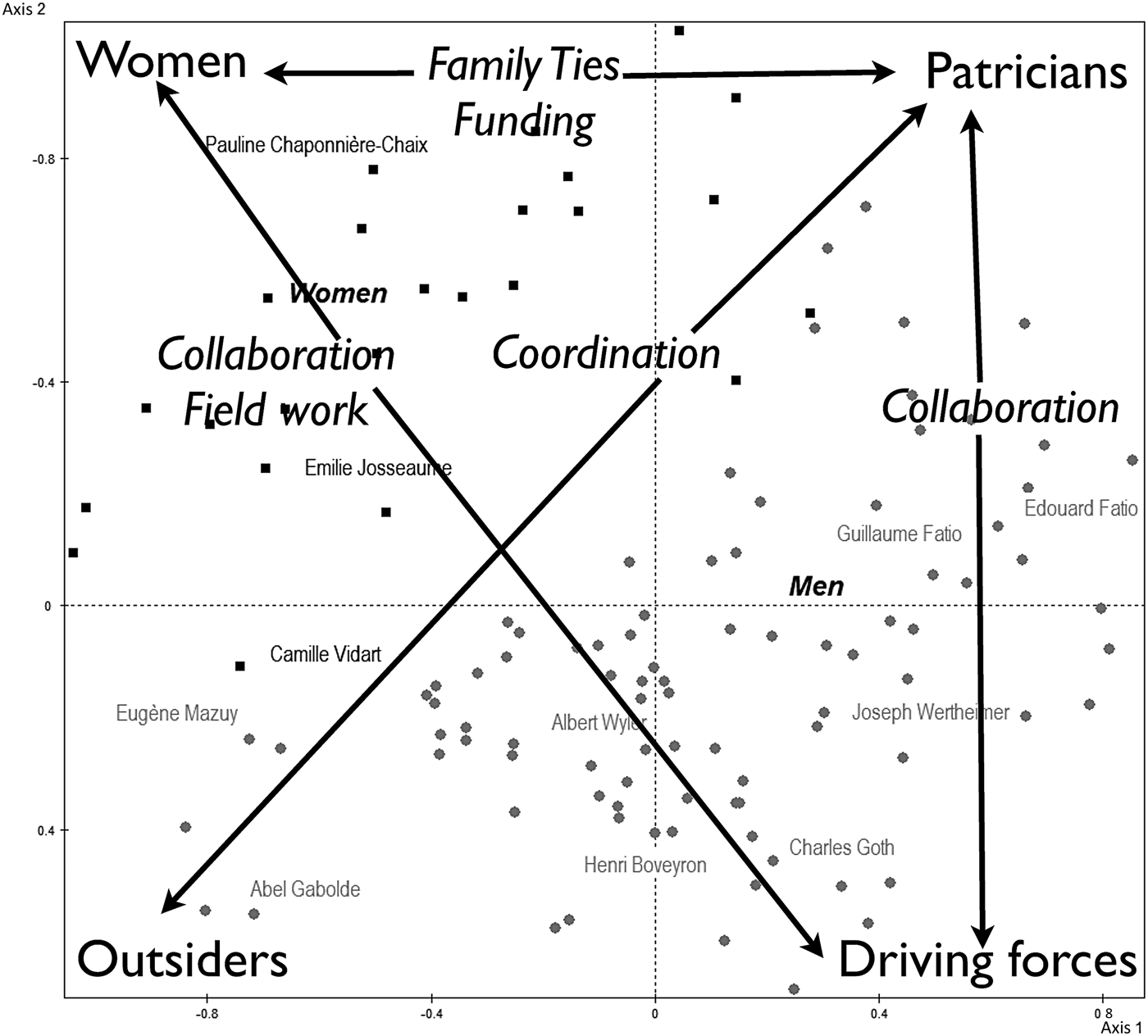
Whatever the literature on Geneva's philanthropy has argued, patricians were not the only actors involved in the philanthropic field. As we have seen in this article, a variety of fractions characterised by their socio-economic profile, their positions within charities, and the nature of their commitment can be identified within the charitable field in Geneva. The involvement of each fraction could be related to its members’ social standing, the improvement of their status, or the nature of the specific or broadly framed social project in which they were involved. One question remains: did these fractions form a social field, understood as an autonomous system of positions with specific internal relationships that included hierarchical structures, competition and collaboration? In this last section, we investigate the relationships between these fractions using both quantitative and qualitative methods and conclude that they shared a variety of relationships that shaped the disparate but interconnected philanthropic world, dominated by the old patricians at the top of the hierarchy. These relationships have been added schematically to the cloud of individuals (see Figure 2) and are shown in Figure 3.
The field of Genevan philanthropists in 1900 – schematic relationships between the four fractions derived from multiple correspondence analysis.
In their wish to gather and categorise Geneva's charities, old patricians showed their desire to dominate the charitable field. They felt they had a responsibility to bring order and organisation to the picture of the charities in Geneva. For some members of the patriciate, including Lombard, who published the directory, philanthropy was understood as a family tradition, an attitude that reinforced their legitimacy as organisers of the field. The desire to gather and categorise charities (a desire that was realised in the directory) brought the old patricians into contact with other fractions, with each of which they cultivated a distinct relationship.
First, by the turn of the century, the conflict between liberal democrats and liberal conservatives was no longer as heartfelt as it had been a few years earlier, when both groupings had taken to the street to fight pitched battles. The fact remained, however, that each fraction favoured a different model of relief. As we have seen, liberal democrats looked to collective solutions, while liberal conservatives preferred to emphasise the responsibility of each individual. Patricians sought to strengthen private relief, which they deemed superior to public aid, arguing that only private initiative would avoid permanent dependency. They promoted a private system that was accompanied by a strong moral ideology tied to their own values. By contrast, liberal democrats created the first public relief organisation (Hospice général), which did not take account of the confessional affiliation of those whom it aided but provided only for Genevans. At the end of the century, its committee was chaired by the husband of Edouard Fatio's niece, meaning that a patrician was at the helm of this public institution. Furthermore, the liberal democrats were a new political elite, and their participation in charities can be understood as part of a process by which they were integrated into the circles of the elite, but tensions, and, more importantly, different visions of relief remained.
Second, in their relationships with outsiders, in particular with foreigners, patricians pursued coordination. In 1880, representatives from relief societies signed an agreement on the distribution of those who requested relief. Each national society was to be responsible for petitioners of its own nationality who had lived in Geneva for more than one year. Thus, for instance, the French Society had responsibility for French supplicants.Footnote 84 The agreement was made under the umbrella of the Central Charity Bureau, which sought to ensure that those in need who had been settled in Geneva for less than one year returned to their country of origin. Swiss Confederates, for example, were to leave Geneva to return to their place of origin, even if they had never lived there.Footnote 85 This coordination among philanthropists reinforced the legitimacy of each grouping. The leading members of foreign groupings were to speak as representatives of their community, asserting their position. But, at the same time, by coordinating the organisation of the charities, patricians made evident their authority in relation to all charities in the city and that they spoke for all philanthropists. They could determine the rules according to which all philanthropists were to behave. By coordinating the charities, the Central Charity Bureau reinforced its central position within the field. Although the various organisations were distinct, the agreement brought the foreign philanthropists into contact with patricians and ensured that these foreign philanthropists coordinated the distribution of relief with the representatives of the Central Charity Bureau.
Third, female philanthropists were connected to the patricians by family ties. Many were themselves members of patrician families. Françoise Battagliola has noted a division in the philanthropic work of men and women from the Parisian bourgeoisie and aristocracy.Footnote 86 The female philanthropists in our Genevan sample were mostly widows or unmarried, but we can identify here a mechanism similar to that in Paris. One of the few married women, Yvonne Ador, the daughter of a patrician family whose father would become a member of the Swiss government in 1917, was married to a Protestant minister and therefore was probably involved in his philanthropic activities in addition to her own. Further investigation of the wives of philanthropists would probably reveal greater female involvement and make visible their contribution to their husband's activities. Additionally, a number of female philanthropists were connected to pastors, and thus to the driving forces’ fraction, most notably those within the Ladies’ Dispensary Society. This society was meant to provide health care for destitute people identified by pastors. It combined the action of three actors: pastors, physicians and women. The latter assessed the ‘hardships and honesty of the individual’ and provided for additional material care.Footnote 87
Furthermore, as also noted above, patricians had the highest number of individual positions. As a result they connected charities with each other and increased the odds that fractions would intermingle. As Edouard Fatio's example demonstrated, some patricians had central functions within charities that they themselves funded. Women were also highly involved in the funding of charities. As scholars have shown, women organised events that not only had a social function but also were intended to raise financial support for charities.Footnote 88 Women in our sample were also involved in other kinds of fundraising activities. Emilie Josseaume, who was single and lived with her aunts, took over their paper shop. In her obituary, Josseaume was described as a well-known and much appreciated figure in the old town, where the paper shop was located. A good and true Genevan, she was always ready to voice her opinion.Footnote 89 In her shop, Josseaume kept charity boxes where funds could be deposited for many charities. Each donor could indicate on a form the charity he or she wished to support. The boxes were emptied four times a year. In January 1903, the amount collected during the previous three months was 48,881 francs.Footnote 90 Along with Josseaume, Edouard Fatio also sat on the committee that organised the boxes, but as chairman. Fatio was responsible for the accounts that recorded the donated money, and representatives of the charities that received donations could claim those funds at the office of the mutual fund. Here we find a hierarchical relationship involving men and women. Josseaume and Fatio were part of a chain, with the former collecting the funds in her shop and the latter counting and distributing the money collected. While Josseaume was recognised for her role in enabling the fundraising, Fatio supervised the whole process and distributed the money at the end of the chain. The boxes collected funds for a large number of charities, and therefore many organisations had to be in contact with Fatio in order to receive the money that had been raised.
Collaboration amongst philanthropists and the broad framing of the directory both speak to reduced political and confessional conflict. Lombard's inclusion of Catholic institutions in the directory made sense in light of the agreement amongst charities to consider the confessional affiliations of those in need as they were assigned to individual relief institutions.
At the turn of the century, confessional and political tensions had evidently eased. Perhaps the key to this reduced friction lies in the economic and demographic changes taking place in the city during these years. All philanthropic actors, integrated in different ways within Genevan society, preferred collaboration to individual effort in tackling contemporary issues. For instance, the parties involved in responding to the needs of foreigners within the city were varied, but their response was uniform: the needy who had been living in the city for more than one year could seek relief from their national charity; those who had been in Geneva for less than a year were to be expelled from the city. These actors identified and acted on the same issues, another commonality that would have reinforced their ties and motivated former political or confessional opponents to collaborate.
6. CONCLUSION
Our aim in this article has been to demonstrate that elites were not the only actors involved in philanthropy. Varied philanthropic fractions defined by varied forms of capital (economic, social and cultural) and involved in varied philanthropic activities were interconnected and together shaped the philanthropic field, a system of relationships that was marked by tension and competition but also characterised by collaboration. The relationships between fractions have been the focus of our attention, not a single isolated fraction. These links have been explored through statistical methods including the innovative combination of network analysis indicators with multiple correspondence analysis. This form of analysis could also be undertaken, probably with very revealing results, for other cities that had a philanthropic directory, which would also enable us to compare fields and links between actors in different locations.
By examining this field through both quantitative and qualitative methods, we have been able to highlight the relationships and ties between actors. We could also observe how they collaborated and held principles in common. Even though their reasons might be varied, they could still agree on a common practice. However, it does not mean that they were pursuing the same objectives in their philanthropic commitment. In that regard, our social distance indicator (which measures the social proximity in terms of gender, confession and nationality between philanthropists and recipients of their charities) helped us to further characterise this commitment. We showed that patricians were keen on targeting people they did not share anything with, while outsiders and women were more dedicated to people like themselves. Patricians were in fact pursuing a very broad and universal commitment, which reinforced their dominant position within the field. They promoted individual solutions against poverty. Driving forces were closer to institutions related to both state and churches. Actually, they were committed to social reform through those institutions. Pastors provide a clear example: they became field workers because their mission in the church made it mandatory. Whatever their social position, their philanthropic commitment allowed all these individuals to raise their voices in the social reform debate.
ACKNOWLEDGEMENTS
This article was initiated while Thomas David was guest professor at the École des hautes études en sciences sociales (EHESS) in Paris. It is part of a wider project called ‘Europhil. Les philanthropes en Europe et la vulnérabilité sociale 1880–1920’, which benefited from the financial support of the Agence nationale de la recherche. First we would like to thank all our colleagues who took part in the data gathering for Geneva: Isabelle Paccaud, Sevan Pearson, Steven Piguet, Andrea Pilotti and Frédéric Rebmann. Great thanks to Stéphanie Ginalski who performed the network analysis we used in this article. A preliminary version of this paper was presented in Fribourg, in Lausanne, in Mainz and in Paris. We benefited from the helpful comments of Stéphane Baciocchi, Axelle Brodiez-Dolino, Marie-Emmanuelle Chessel, Christoph Conrad, Alexandre Lambelet, Gabriele Lingelbach, Sonja Matter, Sarah Panter, Johannes Paulmann, Brigitte Studer, Jean-Pierre Tabin and Christian Topalov. We also benefited from the comments of three anonymous reviewers.