Introduction
As one of the key steps in assisted reproductive technologies (ART), in vitro culture of embryos is sensitive to the growth environment, such as atmosphere, temperature, and humidity; culture medium type, pH, and osmotic pressure; and supplemental medium components, including growth factors, cytokines, amino acids, vitamins, sugars, and small thio compounds. A number of these factors can affect production efficiency and safe development of embryos. In the production of animal embryos, because of the complex ingredients in sera and serum albumin, as well as unusual developmental defects resulting from unknown compounds, some researchers have begun exploring media with explicit chemical components that are lacking sera or serum albumin, and they have successfully produced offspring from the embryos cultured in those media. However, the developmental efficiency of embryos in chemically defined media remains poor, and the abilities of animal embryos generated from different techniques, such as in vitro fertilization, parthenogenetic activation, and somatic cell cloning, to adapt to the in vitro culture environment differ (Yamanaka et al., Reference Yamanaka, Sugimura, Wakai, Kawahara and Sato2009). As a consequence, during the early stage of development, embryos display differential preferences towards various media (Chung et al., Reference Chung, Mann, Bartolomei and Latham2002). Hence, it is necessary to select a specific medium for a particular type of embryos.
During the past decades, the number of reports using the pig as a model animal for human diseases has gradually increased because of its similarity of anatomy and physiological function to humans, high litter size, and well established breeding practices. In addition, its embryos are readily available from abattoirs for producing low-cost materials as well as to use in developing human embryo culture media, and for quality control of producing certain biological compounds, solutions and supplies that are required for culturing porcine embryos, all of which are increasingly attracting people's attention. Currently, commonly used media for early porcine embryos include: (i) undefined media, such as PZM-5, i.e. porcine zygote medium (PZM) contains fetal bovine serum (FBS) (Suzuki et al., Reference Suzuki, Iwamura and Yoshioka2004); (ii) semi-defined media, such as NCSU-23, NCSU-37 (Petters and Wells, Reference Petters and Wells1993), BECM-3 (Dobrinsky et al., Reference Dobrinsky, Johnson and Rath1996) and PZM-3 (Yoshioka et al., Reference Yoshioka, Suzuki, Tanaka, Anas and Iwamura2002), all of which contain bovine serum albumin (BSA); and (iii) completely chemically defined media, such as PZM-4, i.e. PZM uses polyvinyl alcohol (PVA) as a replacement for FBS or BSA. Although chemically undefined or semi-defined media exhibit great performance in supporting early development of porcine embryos, the animal serum or BSA in these media contain complex ingredients from multiple sources, some times resulting in such disadvantages as poor experimental reproducibility, frequent embryo contamination, and uncertainty of physiological functions. In contrast, the chemically defined medium PZM-4 not only is suitable for the early development of in vitro fertilization (IVF) porcine embryos, but also has produced offspring (Yoshioka et al., Reference Yoshioka, Suzuki, Itoh, Kikuchi, Iwamura and Rodriguez-Martinez2003). Nevertheless, it remains unknown whether this chemically defined medium, PZM-4, supports early development of parthenogenetically activated and cloned porcine embryos.
Therefore, in this study the early developmental efficiencies of porcine parthenote embryos (PAEs) and nuclear transferred embryos (NTEs) in PZM-3, PZM-4 and PZM-5 were compared in order to select a more suitable medium for the early development of PA- and SCNT-derived porcine embryos, and to examine the suitability of PZM-4 for culturing these types of porcine embryos. This study might lay the foundation for future investigation into the physiological effects of energy compounds, hormones, cytokines, and vitamins on the early development of porcine embryos, and may provide evidence for the screening of compounds and treatments to induce the reprogramming of somatic cells.
Materials and methods
Unless noted otherwise, all chemical reagents were purchased from Sigma-Aldrich. Cell culture suppliers were BD Falcon products. Suppliers for in vitro maturation of oocytes and in vitro embryo culturing were purchased from Corning.
Solutions: Cell culture complete solution was high glucose DMEM (HyClone) supplemented with 1% (v/v) non-essential amino acids (NEAA), 75 μg/ml penicillin, 50 μg/ml streptomycin, and 10% (v/v) fetal bovine serum (FBS, HyClone). Cell detachment solution contained 0.25% (w/v) trypsin + 0.02% (w/v) EDTA. Oocyte-washing solution was DPBS (without calcium or magnesium, Gibco) containing 0.1% (w/v) polyvinyl alcohol (PVA). In vitro maturation (IVM) medium was TCM199 (without HEPES) supplemented with 10% (v/v) porcine follicular fluid (pFF), 10% (v/v) FBS, 10 IU/ml human chorionic gonadotropin (hCG), 10 IU/ml equine chorionic gonadotropin (eCG), 0.1 mg/ml l-cysteine and 10 ng/ml epidermal growth factor (EGF).
To prepare pFF, after aspirated from follicles of 4-8 mm in diameter in slaughterhouse derived ovaries, the extraction liquid was placed into a 15 ml centrifuge tube and centrifuged for 20 min at 2000 rpm. The supernatant was filtered through a filter (0.22–0.45 μm), aliquoted into 1.5 ml centrifuge tubes, and frozen at –20°C. In vitro oocyte/embryo handling solution was T2 composed of HEPES-buffered TCM199 + 2% (v/v) FBS. Micromanipulation buffer was T2 containing 5–7.5 μg/ml cytochalasin B (CB). Fusion/activation liquid consisted of 0.25 mol/l mannitol, 0.1 mmol/l CaCl2, 0.1 mmol/l MgCl2, 0.5 mmol/l HEPES and 0.01% (w/v) PVA. Basic embryo culture medium was PZM (Yoshioka et al., Reference Yoshioka, Suzuki, Tanaka, Anas and Iwamura2002) supplemented with 2.7756 mol/l inositol. PZM media used were PZM-3 (PZM + 3 mg/ml BSA), PZM-4 (PZM + 3 mg/ml PVA) and PZM-5 (PZM + 5% (v/v) FBS).
In vitro maturation of porcine oocytes
The experiment was performed according to Zhang et al.'s protocol (2007). Briefly, ovaries (taken from pre-pubertal pigs and from sows) collected from abattoirs were placed into 28–35°C physiological saline solution containing penicillin and streptomycin, were shipped to our lab within 2 h after slaughter, and were vigorously washed in physiological saline solution. Follicles at 3–6 mm were aspirated from ovaries with an 18-gauge needle with a sterile syringe. The extracted follicle liquid was gradually pipetted into 15 ml centrifuge tubes in a 38°C water bath to precipitate the cumulus–oocyte complexes (COCs). After about 15 min the upper boundary of the precipitate was clearly visible. The supernatant was discarded, and remaining precipitate was diluted in the oocyte washing solution (DPBS + 0.01% PVA) and mixed with gentle agitation. Under a stereomicroscope, COCs with over two layers of compact cumulus investment and dense, homogeneous cytoplasm were quickly selected and washed three times in DPBS + 0.01% PVA, and then washed three times in IVM medium. Subsequently, 15–20 of the washed COCs were matured in 50 μl IVM medium at 38.5°C and in 5% CO2 and humidified air for 42–44 h. COCs were then transferred to 1 mg/ml hyaluronidase in DPBS (without calcium or magnesium, Gibco) to remove cumulus cells. Oocytes with clear perivitelline space, intact cell membrane and with first polar body (PB1) extruded were selected for future manipulations.
Parthenogenetic activation of oocytes
Matured oocytes without cumulus were first washed three times in activation liquid that was prewarmed at 38°C. Equilibrated oocytes were transferred into a fusion chamber filled with activation liquid. Electrical activation was accomplished by applying two pulses of direct current of 1.56 kV/cm for 80 μs with a 1-s interval. Subsequently, oocytes were washed in embryo culture media three times, and transferred into the chemically assisted activation liquid (PZM-3/4/5 + 10 μg/ml CHX + 10 μg/ml CB) with a layer of liquid paraffin oil to be incubated for 4 h at 38°C and in 5% CO2 in a humidified chamber.
Somatic cell nuclear transfer (SCNT)
For cell culture, a porcine fetal fibroblast cell line was generated from Meishan pig fetuses as reported by Zhang et al. (Reference Zhang, Pan, Sun, Sun, Liu, Wang, Tian, Li, Dai and Li2006). Before SCNT, 1–3 day fetal fibroblast cells that exhibited contact inhibition were detached, washed, centrifuged and re-suspended in the cell culture medium to serve as nuclear donors.
For construction of SCNT embryos, matured oocytes and nuclear donor cells were placed into a drop of micromanipulation solution and incubated at 38.5°C and in 5% CO2 and saturated humidity for 10–15 min. Subsequently, using an inverted microscope (IX71, Olympus) equipped with a micromanipulator (Narishige, Japan) and warmed stage (Tokai Hit), one oocyte was fixed with a holding pipette (inner diameter: 25–35 μm and outer diameter: 100–120 μm). The first polar body was adjusted to the 1-o'clock position, and immediately after the needle entered from the 3-o'clock position, the first polar body together with 10–20% of the adjacent cytoplasm – presumably containing the metaphase plate – were aspirated out with a denucleation/injection pipette (inner diameter: 15–25 μm). A selected somatic cell that was globular, smooth, strongly refractive, and 15–20 μm in diameter was injected subsequently into the perivitelline space through the same slot. After the manipulation, reconstructed donor cell-ovum cytoplasm couplets were then transferred into T2 drops, incubated at 38.5°C and in 5% CO2 and 100% humidity for 30 min.
For fusion and activation, the reconstructed couplets, which had been recovering for 30 min in a drop of T2 liquid, were transferred in batches into the fusion liquid for 2 min to reach equilibrium, and washed three times in the fusion/activation liquid. Each group of 10 couplets was placed into the fusion chamber filled with the fusion/activation liquid. The couplets were aligned gently using a fine glass probe such that the interface of the donor somatic cells and acceptor oocytes was parallel to electrodes. Then a single 100 μs, direct current (DC) pulse of 1.56 kV/cm was applied to simultaneously induce fusion and activation using a CF-150B fusion machine (BLS, Budapest, Hungary). Subsequently, couplets were washed three times in embryo culture media and transferred into chemically assisted activation liquid (PZM-3/4/5 + 10 μg/ml CHX + 10 μg/ml CB) covered with mineral oil and incubated at 38.5°C and in 5% CO2 and 100% humidity. Four hours later, fusion results were examined under a stereomicroscope.
In vitro culture of embryos
PA embryos or fused SCNT embryos were washed three times in embryo culture media. Following the experimental design, random groups of PA or SCNT embryos were placed into a drop of pre-equilibrated (for at least 4 h) culture medium at a density of 15 per 50 μl, and were incubated at 38.5°C and in 5% CO2 and 100% humidity. Embryo cleavage and blastocyst development were observed and documented at days 2 and 7, respectively.
Staining and quantification of total blastocysts
In accordance with a previous report (Zhang et al., Reference Zhang, Li, Villemoes, Pedersen, Purup and Vajta2007), blastocysts at day 7 were taken out and fixed for 10 min in DPBS containing 4% paraformaldehyde. Fixed blastocysts were transferred to DPBS liquid containing 10 μg/ml Hoechst 33342, incubated at room temperature for 10–15 min in darkness. After staining, blastocysts were placed into a drop of glycerol on a glass slide, excessive liquid was removed before anchoring the four corners with Vaseline. A coverslip was placed on the top and gently pressed to stretch cells. Subsequently nail polish was used to seal the slides, which were examined, photographed, and counted with an inverted fluorescence microscope under UV illumination.
Experimental design
Experiment I. Effects of chemically defined media on early in vitro development of porcine PA embryos
Activated MII oocytes from the same batch were randomly placed into PZM-3, PZM-4 and PZM-5 media, maintained at 38°C and in 5% CO2, 20% O2 and 100% humidity. Cleavage and blastocyst development were documented at day 2 and day 7, respectively. Cleavage rates, blastocyst rates and average cell number per blastocyst were statistically analysed for the three groups.
Experiment II. Effects of chemically defined media on early in vitro development of porcine SCNT embryos
Fused and activated reconstructed oocytes from the same batch were randomly placed into PZM-3, PZM-4 and PZM-5 media, maintained at 38°C and in 5% CO2, 20% O2 and 100% humidity. Cleavage and blastocyst development were documented at day 2 and day 7, respectively. Cleavage rates, blastocyst rates and average cell number per blastocyst were statistically analysed for the three groups
Statistical analysis
All experiments were repeated at least three times. Unless noted otherwise, experimental data were presented as mean ± SEM values. SPSS (version 11.5) was used to conduct ANOVA analysis for maturation rate, cleavage rate, blastocyst rate and cell number per blastocyst. p < 0.05 was considered a significant difference.
Results
Effects of chemically defined media on early development of porcine PA embryos
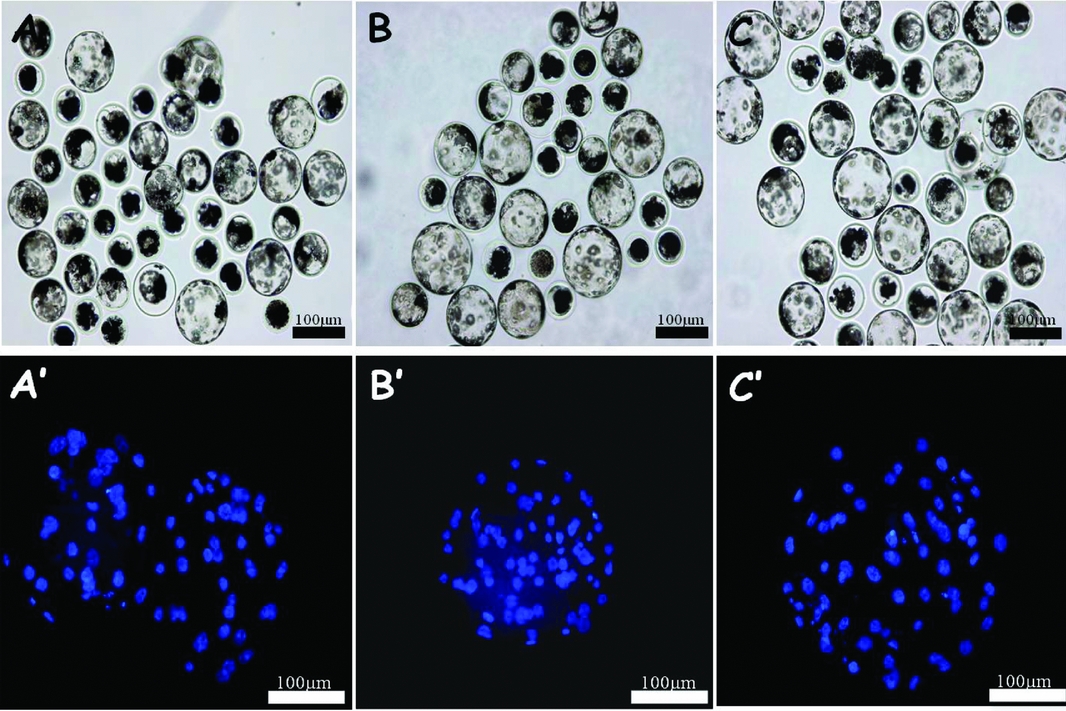
As shown in Table 1, the cleavage rates of the three media displayed no significant difference (p > 0.05); the PA blastocyst rate of PZM-3 (78.9%) was significantly higher than that of PZM-4 (36.0%) and PZM-5 (52.3%) (p < 0.05); in addition, PZM-3 resulted in notably more cells per blastocyst than PZM-5, but had no significant difference from PZM-4 in this regard (Fig. 1).
Effect of media on early in vitro development of porcine parthenogenetic embryos

*Cleavage rate = no. embryos cleaved/no. embryos cultured; **Blastocyst rate = no. blastocyst/no. embryos cultured. a–dDifferent superscripts in the same column indicate significant differences (p < 0.05).
Blastocysts developed in different culture media. (A) PZM4; (B) PZM5; and (C) PZM3, after parthenogenetic activation of sow-derived oocytes. Total cell numbers per blastocyst were determined after staining the day 7 parthenotes with Hoechst 33342. (A′) PZM4; (B′) PZM5; and (C′) PZM3. Scale bar: 100 μm.
Effects of chemically defined media on pre-implantation development of porcine SCNT embryos
As shown in Table 2, there was no significant difference among the cleavage rates and blastocyst rates from the three media (p > 0.05). However, PZM-3 generated notably more cells per blastocyst than PZM-5, although there was no notable difference between PZM-3 and PZM-4.
Effect of culture media on in vitro development of pre-implantation porcine SCNT embryos

aCleavage rate = no. embryos cleaved/no. embryos cultured; bBlastocyst rate = no. blastocyst/no. embryos cultured. Different superscripts in the same column indicate significant differences (p < 0.05).
Discussion
In the present study, we found that for culturing PA porcine embryos, PZM-3 showed similar cleavage rate as PZM-4 and PZM-5 but with significantly higher blastocyst rate; the number of cells per blastocyst for PZM-3 and PZM-4 were similar, and greater than PZM-5. In comparison, for culturing SCNT embryos, all three media exhibited similar cleavage rates and blastocyst rates. In addition, PZM-3 was again similar to PZM-4 but significantly higher than PZM-5 in total cells per blastocyst. Ever since its development, porcine embryo media based on PZM (Yoshioka et al., Reference Yoshioka, Suzuki, Tanaka, Anas and Iwamura2002) have been increasingly utilized (Kamiya et al., Reference Kamiya, Kobayashi and Fukui2006; Du et al., Reference Du, Kragh, Zhang, Li, Schmidt, Bogh, Zhang, Purup, Jorgensen, Pedersen, Villemoes, Yang, Bolund and Vajta2007; Li et al., Reference Li, Svarcova, Villemoes, Kragh, Schmidt, Bogh, Zhang, Du, Lin, Purup, Xue, Bolund, Yang, Maddox-Hyttel and Vajta2008; Yoshioka et al., Reference Yoshioka, Suzuki and Onishi2008; Wei et al., Reference Wei, Zhang, Ma, Li, Li, Dai and Li2009; Yamanaka et al., Reference Yamanaka, Sugimura, Wakai, Kawahara and Sato2009; Zhao et al., Reference Zhao, Ross, Hao, Spate, Walters, Samuel, Rieke, Murphy and Prather2009; Bauer et al., Reference Bauer, Isom, Spate, Whitworth, Spollen, Blake, Springer, Murphy and Prather2010; Mizobe et al., Reference Mizobe, Kurino, Sata, Mori, Yoshida and Miyoshi2010), and PZM-3 was found to be considerably more effective than NCSU-23 in culturing porcine PA (Nanassy et al., Reference Nanassy, Lee, Javor and Machaty2008) and cloned embryos (Im et al., Reference Im, Lai, Liu, Hao, Wax, Bonk and Prather2004). Thus the PZM-derived chemically defined medium PZM-4 will possibly be frequently used to study genetic reprogramming mechanisms during the early development of porcine SCNT embryos.
It has been shown that media containing no proteins (Dobrinsky et al., Reference Dobrinsky, Johnson and Rath1996) or the chemically defined medium PZM-4 (replacing BSA with PVA) can support the early development of porcine embryos derived from in vivo fertilization (Yoshioka et al., Reference Yoshioka, Suzuki, Itoh, Kikuchi, Iwamura and Rodriguez-Martinez2003). In this study, it was also shown that PZM-4 can effectively support the early development of PA- and SCNT-derived porcine embryos. Interestingly, in comparison with the undefined medium PZM-5 (containing FBS), the chemically semi-defined medium PZM-3 performs better in promoting the early development of the PA- and SCNT-generated embryos, which might result from unfavorable effects on porcine embryo development of certain serum ingredients (Cui et al., Reference Cui, Jeong, Lee, Cheon and Kim2004). In addition, although PZM-4 displayed lower efficacy than PZM-3 in culturing porcine PA embryos, it showed satisfactory results for culturing SCNT embryos, possibly related to the fact that different types of embryos have different dependence on media (Gao et al., Reference Gao, Chung, Williams, Riley, Moley and Latham2003; Mastromonaco et al., Reference Mastromonaco, Semple, Robert, Rho, Betts and King2004). The three NCSU-23 based media which were supplemented with BSA, PVA and FBS, respectively, showed similar PA blastocyst rates (Cui et al., Reference Cui, Jeong, Lee, Cheon and Kim2004), but exhibited appreciable difference in total cell number per blastocyst (BSA and PVA were both higher than FBS); for SCNT blastocyst rates, BSA (Roh & Hwang, Reference Roh and Hwang2002) was clearly superior to PVA and FBS. These data clearly differed from the trend in blastocyst rates of this study, which might originate from the different ingredients of NCSU-23 and PZM, e.g., only the former contains glucose. The intermediate metabolites of glucose possibly display differential adaptation (stimulation or inhibition) to culture conditions during the early development of PA or SCNT embryos.
BSA is a semi-purified protein widespread in mammalian reproductive tracts, which affects fetal development through mechanisms that are not fully understood. It has been shown that BSA indeed is beneficial for fetal development, because it is assimilated and broken down by embryos to generate large amounts of amino acids; in addition, BSA cleans some heavy metal ions and toxic compounds in media (Bavister, Reference Bavister1995). Our results also corroborated the stimulatory effect of BSA, which is more pronounced in the development of PA embryos. The cleavage rate (58.6%) and blastocyst rate (26.5%) of porcine PA embryos in PZM-3 reported by Wei et al. (Reference Wei, Zhang, Ma, Li, Li, Dai and Li2009) were both considerably lower than this study (78.9% and 53%), which might stem from the different activation parameters. In addition, although a few studies including this one used PZM-3 supplemented with BSA to culture porcine SCNT embryos, our data (blastocyst rate of 26.4%, and total cells per blastocyst of 53) were comparable with that of Zhang et al. (Reference Zhang, Li, Villemoes, Pedersen, Purup and Vajta2007) (17.7% and 47) and Yamanaka et al. (Reference Yamanaka, Sugimura, Wakai, Kawahara and Sato2009) (18.2% and 46), but considerably lower than the corresponding results of Li et al. (Reference Li, Svarcova, Villemoes, Kragh, Schmidt, Bogh, Zhang, Du, Lin, Purup, Xue, Bolund, Yang, Maddox-Hyttel and Vajta2008) (handmade cloned porcine embryo blastocyst rate of 54.3% and cells per blastocyst of 62). This situation is possibly due to the differences in the cytoplasm volume of the enucleated oocytes, BSA quality and atmosphere environment. It has been reported that PZM-3 performs better for embryo culture in a low oxygen environment (5% O2) (Yoshioka et al., Reference Yoshioka, Suzuki, Tanaka, Anas and Iwamura2002, Reference Yoshioka, Suzuki and Onishi2008).
Fetal bovine serum contains complex ingredients. In addition to energy substrates, growth factors or cytokines that are beneficial to fetal development, FBS might also harbour many harmful compounds. Although FBS was reported to promote survivability of IVF embryos in cryopreservation (Men et al., Reference Men, Agca, Critser and Critser2005), it displayed detrimental effects to development and cryotolerance of bovine IVF embryos (Rizos et al., Reference Rizos, Gutierrez-Adan, Perez-Garnelo, De La Fuente, Boland and Lonergan2003), and could cause ‘large offspring syndrome’ and behavioral abnormalities of offspring (Young et al., Reference Young, Sinclair and Wilmut1998; Lazzari et al., Reference Lazzari, Wrenzycki, Herrmann, Duchi, Kruip, Niemann and Galli2002; Farin et al., Reference Farin, Farin and Piedrahita2004; Fernandez-Gonzalez et al., Reference Fernandez-Gonzalez, Moreira, Bilbao, Jimenez, Perez-Crespo, Ramirez, Rodriguez De Fonseca, Pintado and Gutierrez-Adan2004). There is still controversy regarding the effects of FBS on the early development of PA- and SCNT-derived porcine embryos. For example, when NCSU-23 supplemented with FBS was used to culture porcine PA and SCNT embryos, the resulting blastocyst rate and cell number per blastocyst in PA embryos (39.3% and 24) (Okada et al., Reference Okada, Krylov, Kren and Fulka2006) and in SCNT embryos (6.4% and 17) were all considerably lower than the relevant data in this study, i.e., PA blastocyst rate (52.3%), total cell number per blastocyst (39), SCNT blastocyst rate (30%), total cell number per blastocyst (39). The discrepancy might stem from the different base media (NCSU-23 and PZM) as well as different activation parameters and methods. Although it has been reported that during culture of porcine PA embryos, PZM supplemented with FBS 48 h later generated a higher blastocyst rate (47%) and total cells per blastocyst (57) than PZM-3 (Cui et al., Reference Cui, Jeong, Lee, Cheon and Kim2004), we did not find such stimulatory effect with PZM-5. The divergence might be caused by dose, supplementing time, and quality of FBS.
It has been reported previously that offspring were generated from porcine in vivo fertilized embryos (Yoshioka et al., Reference Yoshioka, Suzuki, Tanaka, Anas and Iwamura2002) and IVF embryos (Yoshioka et al., Reference Yoshioka, Suzuki, Itoh, Kikuchi, Iwamura and Rodriguez-Martinez2003; Kamiya et al., Reference Kamiya, Kobayashi and Fukui2006), which were cultured on the chemically defined medium PZM-4 and transferred into recipient pigs. However, it remained unknown whether PZM-4 supports the early development of PA- and SCNT-derived porcine embryos. Here we showed that indeed it is the case, and that the PA- and SCNT-blastocyst rates (36%, 20.3%) as well as the total cells per blastocyst (43, 43) were all significantly higher than the corresponding data using NCSU-23 (12%, 6.4%; 22, 17), which replaces BSA with PVA. Such difference might be caused by the different base media, activation parameters, and methods. Lim et al. (Lim et al., Reference Lim, Jang, Ko, Lee, Park, Kim, Lee, Hwang, Lee and Kang2007) reported that when culturing bovine IVF embryos, chemically defined media using PVA instead of BSA or serum boosts the early blastocyst development rate and the eventual calving rate. Although in this study the chemically defined medium PZM-4 did not significantly increase the early developmental efficiency and blastocyst quality of PA- and SCNT-derived porcine embryos, the developmental efficiency was not inferior to that of PZM-3 (semi-defined medium) and PZM-5 (undefined medium).
Taken together, PZM-4, a chemically defined medium that lacks serum and albumin, can support the development of PA- and SCNT-derived porcine embryos. In addition, the medium also displays a few advantages including excellent experimental reproducibility, low contamination of viruses and pathogens, and simple ingredients. Nevertheless, whether it supports the full-term development of SCNT-derived porcine embryos remains to be investigated.
Acknowledgements
We are indebted to Mr Qi Wang for providing experimental supplies. We thank Mr Yuanliang Zhang and Ms Qing Jia in experimental preparation. This work was supported by National Natural Science Foundation of China (30700574) and National Transgenic Breeding Program of China (2009ZX08006–004B).