Introduction
Coral reefs are dynamic marine ecosystems that offer a wide range of ecological and economic benefits to human beings, especially in tropical countries. In the past few decades, coral reefs have suffered a significant decline. Natural factors such as coral bleaching, ocean acidification, disease outbreaks, and ocean deoxygenation coupled with human activities such as coral harvesting, destructive fishing practices, tourism, and pollution have considerably damaged global coral reef ecosystems (Hoegh-Guldberg et al. Reference Hoegh-Guldberg, Poloczanska, Skirving and Dove2017). Global coral bleaching events driven by climate change have been reported to be the major cause of reef decline during the past two decades (Hughes et al. Reference Hughes, Anderson, Connolly, Heron, Kerry, Lough, Baird, Baum, Berumen, Bridge, Claar, Eakin, Gilmour, Graham, Harrison, Hobbs, Hoey, Hoogenboom, Lowe, McCulloch, Pandolfi, Pratchett, Schoepf, Torda and Wilson2018). Mass bleaching events and the consequent coral mortalities have paved the way for the emergence and expansion of opportunistic space competitors such as macroalgae, octocorals, and sponges (Chadwick & Morrow Reference Chadwick, Morrow, Dubinsky and Stambler2011). These benthic space competitors can grow faster and snatch space from corals causing phase shifts. Particularly, when the environmental conditions are ideal for them, marine sponges act as strong space competitors causing damage to corals (e.g. Schönberg & Ortiz Reference Schönberg and Ortiz2008, Bell et al. Reference Bell, Davy, Jones, Taylor and Webster2013). Climate change has worsened this competition as the heat-stressed corals are often overpowered by sponges (Ashok et al. Reference Ashok, Schönberg, Raj, Bhoopathi, Bharath and Patterson2018, Schönberg et al. Reference Schönberg, Suwa, Hidaka and Loh2008).
India enjoys a tropical climate and is thus bestowed with coral reefs in different parts of the country. The Gulf of Mannar (GoM) in India is one of the biodiversity hotspots in the country, with significant extents of coral reefs and associated biodiversity. There are 21 uninhabited islands in GoM, around which major reef areas occur. Coral cover in GoM has declined significantly during the past couple of decades due to various climatic and non-climatic factors (Edward et al. Reference Edward, Mathews, Raj and Tamelander2008, Raj et al. Reference Raj, Aeby, Mathews, Williams, Caldwell, Laju, Selva, Dinesh Kumar, Arasamuthu, Gladwin, Lisa, Andrew, Monica and Edward2021). The bleaching event of 2016 was massive, which killed a significantly great population of corals in GoM (Raj et al. Reference Raj, Aeby, Mathews, Williams, Caldwell, Laju, Selva, Dinesh Kumar, Arasamuthu, Gladwin, Lisa, Andrew, Monica and Edward2021), facilitating the rise of space competitors such as algae and sponges (Ashok et al. Reference Ashok, Schönberg, Raj, Bhoopathi, Bharath and Patterson2018, Raj Reference Raj2021, Raj et al. Reference Raj, Aeby, Mathews, Williams, Caldwell, Laju, Selva, Dinesh Kumar, Arasamuthu, Gladwin, Lisa, Andrew, Monica and Edward2021). Recent reports from GoM highlight the intensity of sponge–coral interaction, which negatively affects corals (Raj et al. Reference Raj, Bharath, Mathews, Aeby and Edward2018a, Reference Raj, Mathews and Kumar2019, Ashok et al. Reference Ashok, Schönberg, Raj, Bhoopathi, Bharath and Patterson2018, Reference Ashok, Calcinai and Edward2020, Raj Reference Raj2021). For the purpose of conservation, all 21 islands and the surrounding shallow waters of GoM were declared as a marine protected area (MPA) called Gulf of Mannar Marine National Park (GOMMNP) in 1986. This MPA is a ‘no go’ and ‘no take’ zone, where human activities are restricted. However, there are certain other patch reefs in GoM falling outside the jurisdiction of this MPA even though they have a good coral cover (e.g., Raj et al. Reference Raj, Mathews and Kumar2019). In spite of the abundance, diversity, and significance of the coral reefs outside the boundary of the MPA, not many studies have happened on these patch reefs. In this study, we report the outbreak of the coral-killing sponge Clathria (Microciona) aceratoobtusa (Carter, 1887) in one such unprotected reef called the mainland patch reef in the Tuticorin region of GoM.
Materials and methods
GoM, one of the four major reef regions of India, occurs on the southeast coast of the country. Mainland patch reef occurs outside the jurisdiction of GOMMNP (Suppl. Fig. 1), where fishing and other human activities are allowed. The present underwater assessment was carried out in April 2020, when an outbreak of orange-reddish sponge was sighted during an explorative dive. The depth of the reef ranges between 1 and 6 m, but live corals are abundant at depths between 5 and 6 m where the outbreak was observed. For the assessment of the prevalence of sponge outbreak at the affected site, five 20-m line intercept transects (English et al. Reference English, Wilkinson and Baker1997) were laid on the reef to estimate the benthic cover. These transects, laid parallel to the mainland shore, were separated from each other by a minimum distance of 20 m. The benthic cover was categorized as live corals, octocorals, sponges, sand, dead corals, algae, crustose coralline algae, and others (sea stars, sea anemones, ascidians, zoanthids). Along these transects, the prevalence of coral colonies infested with the sponge was assessed by applying the belt transect method (English et al. Reference English, Wilkinson and Baker1997). Live coral colonies within 1 m on each side were identified up to genus level and counted. Coral colonies affected by the red sponge were counted separately along each transect. For taxonomical identification, small volumes of sponge samples were collected from sponge-infested corals and preserved in 80% ethanol for further analysis in the laboratory. The sponge species was identified following the protocols explained by Ashok et al. (Reference Ashok, Calcinai and Edward2020).
Results and discussion
All the major coral reef ecosystems in India are affected by bleaching events triggered by climate change (e.g. Arthur et al. Reference Arthur, Karkarey, Lobo, Alcoverro and Kelkar2012, Raj et al. Reference Raj, Mathews, Bharath, Sawant, Bhave, Apte and Edward2018b, Reference Raj, Aeby, Mathews, Williams, Caldwell, Laju, Selva, Dinesh Kumar, Arasamuthu, Gladwin, Lisa, Andrew, Monica and Edward2021). Space competition posed by sponges has been reported to be severe on reefs that are affected by bleaching events (Carballo et al. Reference Carballo, Bautista, Nava, Cruz-Barraza and Chávez2013). Incidences of sponges overpowering corals have increased considerably in the Indian reefs during the last decade (e.g. Ashok et al. Reference Ashok, Schönberg, Raj, Bhoopathi, Bharath and Patterson2018, Reference Ashok, Calcinai and Edward2020, Raj et al. Reference Raj, Bharath, Mathews, Aeby and Edward2018a, Reference Raj, Mathews and Kumar2019, Thinesh et al. Reference Thinesh, Jose, Hassan, Selvan and Selvin2015; Raj Reference Raj2021; Emmett et al. Reference Emmett, Raj, Mathews and Laju2021; Emmett and Raj Reference Emmett and Raj2022) and many of those incidences are from GoM. Reported species of coral-overgrowing sponges in GoM include Cliona spp., Terpios hoshinota Rützler & Muzik, 1993, C. (Microciona) aceratoobtusa, and Rhabdastrella globostellata Carter, 1883 (Ashok et al. Reference Ashok, Schönberg, Raj, Bhoopathi, Bharath and Patterson2018, Reference Ashok, Calcinai and Edward2020, Raj et al. Reference Raj, Bharath, Mathews, Aeby and Edward2018a, Reference Raj, Mathews and Kumar2019).
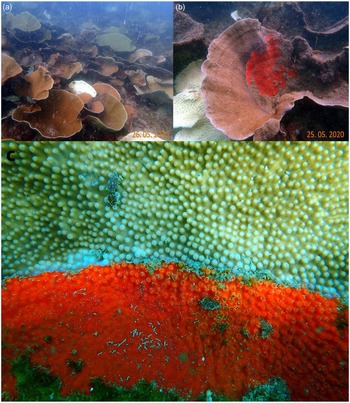
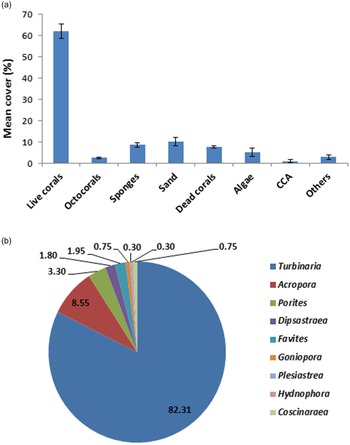
The sponge observed in this study was identified as the coral-killing species C. (Microciona) aceratoobtusa as per the descriptions given by Ashok et al. (Reference Ashok, Calcinai and Edward2020). Underwater morphology, colour, pattern (Figure 1), and spicule combinations (Suppl. Fig. 2) confirmed the species. The sponge is found to be progressing towards the live portion of corals as a thin red sheet making the infested portion look orange-reddish (Figure 1, Suppl. Fig. 3). A thin exposed coral skeleton is also observed at the contact front. In some cases, the sponge had almost killed the entire coral colony (Suppl. Fig. 3). Benthic community structure at the study site is dominated by live corals with 62.06% (SD±3.36), distantly followed by sand and sponges with 10.22% (SD±2.03) and 8.64% (SD±0.98), respectively (Figure 2). The live coral cover at the study site is comparatively higher than that of GOMMNP where the average live coral cover was only 23.78% in 2017 which decreased from 42.85% in 2009 (Raj et al. Reference Raj, Aeby, Mathews, Williams, Caldwell, Laju, Selva, Dinesh Kumar, Arasamuthu, Gladwin, Lisa, Andrew, Monica and Edward2021). Sharp declines in the coral cover have been witnessed in the GOMMNP due to bleaching-driven mass coral mortalities in 2010 and 2016 (Edward et al. Reference Edward, Mathews, Raj, Laju, Bharath, Arasamuthu, Kumar, Bilgi and Malleshappa2018; Raj et al. Reference Raj, Aeby, Mathews, Williams, Caldwell, Laju, Selva, Dinesh Kumar, Arasamuthu, Gladwin, Lisa, Andrew, Monica and Edward2021). The temporal trend of live coral cover in the mainland patch reef is not available as this reef has not been monitored regularly.
a. View of mainland patch reef dominated by Turbinaria; b. A Turbinaria colony infested by Clathria (Microciona) aceratoobtusa; c. A closer look at the progression front.

a. Benthic community structure at mainland patch reef (bars represent standard deviation); b. The proportion of coral genera at mainland patch reef.

The genus Turbinaria is the most abundant at the study site, with 82.31% (n = 549), distantly followed by Acropora with 8.55% (n = 57) (Figure 2). Other coral genera observed in the reef include Porites, Dipsastraea, Favites, Goniopora, Plesiastrea, Hydnophora, and Coscinaraea. Turbinaria is the only genus affected by C. (Microciona) aceratoobtusa with 21.86% (n = 120) of the total colonies found infested. Earlier studies have reported that this sponge overgrows coral genera such as Porites, Acropora, Montipora, Favia, and Turbinaria in GoM (Ashok et al. Reference Ashok, Calcinai and Edward2020). The sponge has been reported to affect the species Porites lutea with a prevalence of 50% in South Yemen (Benzoni et al. Reference Benzoni, Calcinai, Eisinger and Klaus2008). The dominance of Turbinaria in the study site is presumably the reason for the high impact on the genus. Other available genera at the study site were scattered while Turbinaria corals occur close to each other having direct contact.
Turbinaria has been reported as the preferred substrate of C. (Microciona) aceratoobtusa in GoM (Ashok et al. Reference Ashok, Calcinai and Edward2020). Another sponge from Cliona viridis complex was also found to affect Turbinaria in GoM (Ashok et al. Reference Ashok, Schönberg, Raj, Bhoopathi, Bharath and Patterson2018). Corals and sponges display a differential response to temperature anomalies depending on the symbiont species and clades associated with them (e.g. Schönberg & Ortiz Reference Schönberg and Ortiz2008, Fang et al. Reference Fang, Schönberg, Mello-Athayde, Achlatis, Hoegh-Guldberg and Dove2018). Focused studies on symbionts associated with Turbinaria and the infesting sponges are warranted to understand the susceptibility of this genus to the infection of bio-eroding sponges. After the 2016 bleaching event, the cover of the coral morphotype ‘coral foliose’ (CF) has decreased significantly in GoM (Raj et al. Reference Raj, Aeby, Mathews, Williams, Caldwell, Laju, Selva, Dinesh Kumar, Arasamuthu, Gladwin, Lisa, Andrew, Monica and Edward2021) and CF is represented only by Turbinaria spp. here. Thus Turbinaria is decreasing in abundance in GoM due to bleaching events and consequent space competition by sponges. A total of 120 infested colonies are significantly high considering the slow growth rate of this genus in GoM (Mathews Reference Mathews2009). The presence of Turbinaria is of critical importance for reef-associated organisms including fishes (Raj et al. Reference Raj, Aeby, Mathews, Williams, Caldwell, Laju, Selva, Dinesh Kumar, Arasamuthu, Gladwin, Lisa, Andrew, Monica and Edward2021), and hence the genus warrants conservation initiatives. Ashok et al. (Reference Ashok, Calcinai and Edward2020) reported the sponge infestation at depths between 2 and 4.5 m within the GOMMNP whereas the present observation was at depths 5 to 6 m in the mainland patch reef. In spite of the depth differences, the sponge was able to infest corals at both sites.
Future climate projections are not good for global coral reefs (Hooidonk et al. Reference Van Hooidonk, Maynard, Tamelander, Gove, Ahmadia, Raymundo and Planes2016) including GoM (Raj et al. Reference Raj, Aeby, Mathews, Williams, Caldwell, Laju, Selva, Dinesh Kumar, Arasamuthu, Gladwin, Lisa, Andrew, Monica and Edward2021). Sponges are comparatively tolerant to temperature anomalies and can proliferate during such temperature scenarios (Kelmo et al. Reference Kelmo, Bell and Attrill2013). Hence, sponges have been reported to fare better in projected climatic conditions in the future (Bell et al. Reference Bell, Davy, Jones, Taylor and Webster2013, Fang et al. Reference Fang, Mello-Athayde, Schönberg, Kline, Hoegh-Guldberg and Dove2013). Corals of GoM undergo annual bleaching (Edward et al. Reference Edward, Mathews, Raj and Tamelander2008) and have suffered severe mortalities (Raj et al. Reference Raj, Aeby, Mathews, Williams, Caldwell, Laju, Selva, Dinesh Kumar, Arasamuthu, Gladwin, Lisa, Andrew, Monica and Edward2021). The prevalence of coral colonies overgrown by sponges in Vaan Island was reported to increase from 9.69% in 2018 to 13.38% in 2021 and post-bleaching stress has been attributed to this increase (Raj Reference Raj2021). Vaan Island falls within the boundary of the GOMMNP and occurs at about 15 km from the mainland patch reef. Hence, it is likely that the same trend is happening in the mainland patch reef. It has been predicted that for the high emissions scenario RCP8.5 the reefs of GoM will experience severe annual bleaching before 2045 (Raj et al. Reference Raj, Aeby, Mathews, Williams, Caldwell, Laju, Selva, Dinesh Kumar, Arasamuthu, Gladwin, Lisa, Andrew, Monica and Edward2021). Hence, it is likely that space competition from sponges will be more aggressive in the reefs of GoM in the future. Reefs dominated by Turbinaria such as the mainland patch reef are likely to be affected by sponges severely in the future.
Apart from climate change implications, human-induced factors such as coastal development, destructive fishing methods, pollution, and tourism can affect reef ecosystems. Fishing activities such as trap fishing, spearfishing, trawling, and the use of bottom settling nets can be seen on the mainland patch reef regularly. Further, the mainland patch reef is surrounded by various industries including a major port. The cultivation of the dangerous invasive macroalga Kappaphycus alvarezii is also happening near the mainland patch reef (Suppl. Fig. 4). Thus, it is comparatively more disturbed by human activities than the reefs within the MPA. Disturbed reefs have been reported to be prone to sponge infestation (Thinesh et al. Reference Thinesh, Jose, Hassan, Selvan and Selvin2015). Sponges have been projected to withstand the effects of human-induced factors such as pollution, harmful fishing techniques, and sedimentation (Powell et al. Reference Powell, Smith, Hepburn, Jones, Berman, Jompa and Bell2014, Shi et al. Reference Shi, Liu, Yan and Zhang2012, Thinesh et al. Reference Thinesh, Jose, Hassan, Selvan and Selvin2015) while corals would not. Many global initiatives are being taken to tackle climate change implications and conserve coral reefs. However, local conservation initiatives to reduce human-induced threats are also equally or more important. The establishment of MPAs is one of the key initiatives to reduce human-induced threats such as fishing, tourism, and pollution (Lester et al. Reference Lester, Halpern, Grorud-Colvert, Lubchenco, Ruttenberg, Gaines and Warner2009, McCook et al. Reference McCook, Ayling, Cappo, Choat, Evans, De Freitas and Williamson2010). As the mainland patch reef occurs outside the MPA (GOMMNP), it suffers both climatic and human-induced threats. In spite of the threats, the live coral cover in the mainland patch reef is higher than that of the GOMMNP, showing its resilience. It is imperative that the status, diversity, associated organisms, and threats of the mainland patch reef are studied regularly to understand and conserve them better. This study recommends that the mainland patch reef should be accorded some sort of legal protection in order to have regular monitoring and conservation system. The results of this report provide evidence that the combination of climate change and human impacts would cause much bigger damage to coral reef ecosystems.
Supplementary material
To view supplementary material for this article, please visit https://doi.org/10.1017/S0266467422000487
Acknowledgment
The authors express their thanks to Dr. Arathy Mol Ashok for helping in the identification of sponge species, to the Tamil Nadu Forest Department for research permissions, and to Suganthi Devadason Marine Research Institute (SDMRI) for the provision of facilities.
Financial Support
This work was supported by the Science and Engineering Research Board (SERB), Department of Science and Technology (DST), Government of India (Sanction order No. EMR/2017/002510), and the Gulf of Mannar Biosphere Reserve Trust (GoMBRT), Govt. of Tamil Nadu (Proceedings No. BPO/2378/2017).
Competing Interests
The author(s) declare none.
Ethical Statement
None