INTRODUCTION
The Aqueduct is one of the Landmarks of Skopje, located in the northwestern part of Skopje, the capital of the Republic of North Macedonia. Originally part of a water-supply system (in use until 1915), with a total length of about 10 km, in general NE to SW direction, the monument as it stands today is more than 380 m long, with two access ramparts, 53 pillars, 54 base vaults, and 42 smaller vaults above the pillars. It is the only preserved monument of this type in Macedonia.
The historical development of the Aqueduct cannot be traced with certainty. There are three hypotheses about the timing of its construction. (1) The Aqueduct was built during the urbanization of Skopje (527–554 AD) by the Byzantine Emperor Justinian I, who was born in the vicinity of Skopje. This is supported by the notes of Procopius Caesariensis (a 6th-century historian), who wrote that along the beautiful buildings, castles, etc., a water supply system for the town of Justiniana Prima was built. (2) The Aqueduct was built in the 15th century (Kumbaradži-Bogojević Reference Kumbaradži‐Bogojević1998) by Mustafa Pasha who was responsible for a few other buildings in Skopje. (3) It was built in the 16th century (Balabanov et al. Reference Balabanov, Kikolovski and Kornakov1980; Petrv Reference Petrv1998) as a part of Isa-Beg’s water supply system.
In 2014, a comprehensive study of the Aqueduct was undertaken, and among other physico-chemical analyses, 6 mortar samples were submitted for radiocarbon (14C) dating. The analyses would hopefully resolve the question of the timing of the Aqueduct construction, or various phases of its construction.
Absolute mortar dating is often needed in archeological studies, and attempts to date mortar by 14C are as old as the radiocarbon dating itself (Labeyrie and Delibrias Reference Labeyrie and Delibrias1964; Baxter and Walton Reference Baxter and Walton1970; a review paper Hale et al. Reference Hale, Heinemeier, Lancaster, Lindroos and Ringbom2003). Mortar can be 14C-dated by isolating the atmospheric carbon fixed in mortar binder at the time the mortar was applied. However, results often are compromised with dead carbon contamination originating from unreacted limestone during the preparation of quick lime or as a part of the aggregate. Also, a sample can be contaminated with secondary carbonates from the environment (Lindroos et al. Reference Lindroos, Heinemeier, Ringbom, Braskén and Sveinbjörnsdóttir2007; Nonni et al. Reference Nonni, Marzaiolli, Mignardi, Passariello, Capano and Terrasi2018) and crystallization connected with capillary rise from ground water or rain water through older limestone leading to the recrystallization (Michalska and Czernik Reference Michalska and Czernik2015), with atmospheric carbon which was introduced later, due to later fire events (Lindroos et al. Reference Lindroos, Regev, Oinonen, Ringbom and Heinemeier2012), or delayed/stopped and re-started carbonization (e.g. Van Balen Reference Van Balen2005; Hajdas et al. Reference Hajdas, Lindroos, Heinemeier, Ringbom, Marzaioli, Terrasi, Passariello, Capano, Artioli, Addis, Secco, Michalska, Czernik, Goslar, Hayen, Van Strydonck, Fontaine, Boudin, Maspero, Panzeri, Galli, Urbanova and Guibert2017). It can take decades for the hardening process to end (Sonninen et al. Reference Sonninen, Erametsa, Jungner and Maniatis1989; Van Strydonck and Dupas 1991; Michalska et al. Reference Michalska, Czernik and Goslar2017). Due to these problems, several fractions need to be analyzed, making mortar dating economically challenging. Instructions on the optimal fraction selection and data interpretations are discussed in Lindroos et al. (Reference Lindroos, Ringbom, Heinemeier, Hodgins, Sonck-Koota, Sjöberg, Lancaster, Kaisti, Brock, Ranta, Caroselli and Lugli2018). Characterization of mortar is often applied, usually with basic petrographic, SEM, XRD, TGA, FTIR, EPR, and elemental analyses (Nawrocka et al. Reference Nawrocka, Pawlita and Pazdur2005; Chu et al. Reference Chu, Regev, Weiner and Boaretto2008; Ortega et al. Reference Ortega, Zuluaga, Alonso-Olazabal, Insausti and Ibańez2008, Reference Ortega, Zuluaga, Alonso-Olazabal, Murelaga, Insausta and Ibañez2012; Szczepaniak et al. Reference Szczepaniak, Nawrocka and Mrozek-Wysocka2008; Goslar et al. Reference Goslar, Nawrocka and Czernik2009; Nawrocka et al. 2009; Poduska et al. Reference Poduska, Regev, Berna, Mintz, Milevski, Kahalaily, Weiner and Boaretto2012; Nonni et al. Reference Nonni, Marzaioli, Secco, Passariello, Capano, Lubritto, Mignardi, Tonghini and Terrasi2013; Fabbri et al. Reference Fabbri, Gualtieri and Shoval2014; Kabacińska et al. Reference Kabacińska, Krzyminiewski, Michalska and Dobosz2014; Hayen et al. Reference Hayen, Van Strydonck, Boaretto, Lindross, Heinemeier, Ringbom, Hueglin, Michalska, Hajdas, Marzaoili, Maspero, Galli, Artioli, Moreau Ch, Caroselli, Papayianni, Stefanidou and Pachta2016, Reference Czernik, Goslar, Hayen, Van Strydonck, Fontaine, Boudin, Maspero, Panzeri, Galli, Urbanova and Guibert2017) as well as δ13C and δ18O composition of carbonate aggregates (Van Strydonk et al. Reference Van Strydonck, Dupas, Dauchot-Dehon and Pachiaudi1986, Reference Van Strydonck and Dupas1989; Michalska et al. Reference Michalska and Czernik2015).
Lime lumps are homogenous white spots of varying size that may form upon mortar production or before the mortar is mixed with an aggregate and used (Lindroos et al. Reference Lindroos, Heinemeier, Ringbom, Braskén and Sveinbjörnsdóttir2007). Lime lumps can be used for dating either in whole, after sequential dissolution, or treated with ultrasonic shock (Pesce et al. Reference Pesce, Quarta, Calganile, D’Elia, Cavaciocchi, lastrico and Guastella2009; Pesce and Ball Reference Pesce, Ball and Michalska Nawrocka2012; Lindroos et al. Reference Lindroos, Ranta, Heinemeier and Lill2014, Reference Lindroos, Ringbom, Heinemeier, Hodgins, Sonck-Koota, Sjöberg, Lancaster, Kaisti, Brock, Ranta, Caroselli and Lugli2018; Ringbom et al. Reference Ringbom, Lindroos, Heinemeier and Sonck-Koota2014; Carmine et al. Reference Carmine, Caroselli, Lugli, Marzaioli, Nonni, Marchetti, Dori and Terrasi2015).
If lime lumps are not available, selections of fractions based on grain size are applied (e.g. Michalska Nawrocka et al. Reference Michalska Nawrocka, Michczyńska, Pazdur and Czernik2007; Heinemeier et al. Reference Heinemeier, Ringbom, Lindroos and Sveinbjornsdottir2010; Ortega et al. Reference Ortega, Zuluaga, Alonso-Olazabal, Murelaga, Insausta and Ibañez2012), sometimes combined with the rate of hydrolyses decomposition/leaching reactions of each fraction (Michalska and Czernik Reference Michalska and Czernik2015; Michalska et al. Reference Michalska, Czernik and Goslar2017). Further, the CryoSonic/Cryo2Sonic procedure selects the portion that forms flocculates during treatment in ultrasonic water-bath (Nawrocka et al. Reference Nawrocka, Pawlita and Pazdur2005; Marzaioli et al. Reference Marzaioli, Nonni, Passariello, Capano, Ricci, Lubritto, De Cesare, Eramo, Quirós Castillo and Terrasi2013; Nonni et al. Reference Nonni, Marzaioli, Secco, Passariello, Capano, Lubritto, Mignardi, Tonghini and Terrasi2013, Reference Nonni, Marzaiolli, Mignardi, Passariello, Capano and Terrasi2018).
In this first attempt to absolutely date the construction of the Aqueduct in Skopje, we combined two methods for mortar dating: lime lumps and the CryoSonic procedure combined with acid leaching.
MATERIALS AND METHODS
Sampling Locations
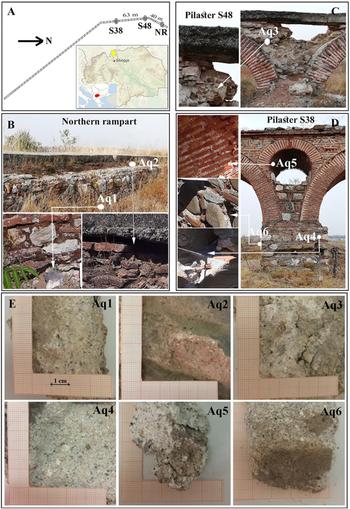
Sampling was conducted on July 28, 2017, at the site of the monument (Figure 1) near Skopje (Cfa climate type, average annual temperature 13ºC, summer 24ºC, and winter 2ºC). The sample locations were previously selected with the intention of comparing the mortar used in the foundation of the monument with the mortar used in the other constructive parts of the Aqueduct. Such a sampling strategy was based on the hypothesis that the foundation mortar is an original or the oldest mortar. For that purpose, a total of 6 samples were collected from different locations of the Aqueduct, which are demonstrated in Table 1 and Figure 1. The weight of each sample was 150–200 g.
Sampling locations and macrophotographs of samples: (A) a drawing of the overall length (387.98 m) of the Aqueduct and the distance between the sampling locations, along the monument with location of the Aqueduct (drop-like symbol) in Macedonia and location of Macedonia in Europe (inset figure); (B) part of the northern rampart and details of the sampling positions: Aq1 foundation mortar and Aq2 plumbing channel; (C) the ruined Pillar S48 and detail of the sampling position: Aq3-mortar core from the walled opening between the arches; (D) Pillar S38 and details of the sampling positions: Aq4-mortar joint between the bricks (inner layer), Aq5-mortar joint between brick (external layer) and Aq6-mortar joint between the stones/bricks, taken from the surface (external layer); (E) macrophotographs of samples.

Sampling locations and positions.

Measured a14C and δ13C for all analyzed fractions of mortar samples from Aq1 to Aq6: Laboratory Z represents a sample identification number at RBI, UGAMS is a sample identification number at CAIS, a14C expressed in pMC, conventional 14C age in BP, δ13C in per mill with σ of 0.1‰; fractions: Rest- > 450 µm-bulk; Sediment- < 450 µm, precipitate after ultrasonification, Susp- < 450 µm, suspended part, (-1, CO2 extracted within 60’, -2, CO2 extracted till the end of reaction:-1 + 2, CO2 extracted as bulk), Lime lump- > 450 µm, white powdery lumps.

(CAIS) = CO2 production and graphite preparation done at CAIS.
Sample Preparation and Analyses
Mortar samples had a negative reaction when tested on pH with phenolphthalein solution, i.e., their pH was lower than 8 (Ringbom et al. Reference Ringbom, Heinemeier, Lindroos and Brock2008). The surface of the samples was grey, and a few millimeters beneath the surface the samples were white, apart from sample Aq2, which was brick-brown-red throughout. The surface of Aq4 sample had a dark coating. All the samples had a white binder, visible carbonaceous lime lumps, and coarse aggregate, with some limestone aggregate, apart from Aq2, which had much finer aggregate, brick-red filler with some visible white lime lumps (Figure 1E). Lime lumps were macroscopically well-defined in all the samples. Since the size of the aggregates were coarse, and some carbonaceous (limestone) aggregates were found in the samples, implying that for the aggregates were not finely crushed during the mortar production, the possibility of dead carbon inside the Lime finding as initial precipitating particle was considered to be minimal and the Lime lumps were found to be the most reliable part for dating. In the Laboratory the mortars were subsampled by use of chisel and hammer: 2–3 cm below the surface to obtain 10–15 g of the subsample.
The CryoSonic method was applied for all samples to mechanically select mortar fractions on the basis of particle size (Nawrocka et al. Reference Nawrocka, Pawlita and Pazdur2005; Marzaioli et al. Reference Marzaioli, Nonni, Passariello, Capano, Ricci, Lubritto, De Cesare, Eramo, Quirós Castillo and Terrasi2013; Michalska et al. Reference Michalska, Czernik and Goslar2017).
Part of subsamples (∼5 g) was broken cryogenically by alternate cooling (dipping into liquid nitrogen) and heating (in the oven at 80ºC, for 20 min), for at least 4 cycles, and then gently crushed with a hammer. Samples were wet-filtered with ultrapure water (UPW) on a 450-µm sieve. Portions larger than 450 µm were optically inspected for lime lumps and two fractions were separated: Lime lumps—white powdery lumps assigned to the time to the building (Pesce and Ball Reference Pesce, Ball and Michalska Nawrocka2012), and Rest—all other. After the cryobreaking, the Lime lumps were found in samples Aq3 to Aq6. They ranged in size from 1 mm (Aq3) to 5 mm (Aq5 and Aq6) in diameter.
Portions finer than 450 µm were treated in UPW in ultrasonic bath for 30 min. Immediately after ultrasonification, suspended fractions (Susp) were decanted and centrifuged at 2662 g for 5 min and along with the precipitated fraction (Sediment) were oven dried at 80ºC over night. All fractions were analyzed by FTIR-ATR.
CO2 from mortar fractions of Rest, Lime lumps and Sediment was produced by 4 % HCl. From Susp fractions 85 % H3PO4 at 25ºC was used, and CO2 was collected in two consecutive fractions: Susp-1, the first 60 seconds of the reaction, and Susp-2, until the end of the reaction. If there were not enough gas produced for the carbon isotope analyses, the two CO2 fractions were merged into one: Susp-1 + 2
A portion of obtained CO2 was sealed in a pyrex glass tube for δ13C analyses on Isotope ratio mass spectrometer (IRMS), and another portion was Zn reduced to graphite for 14C Accelerator mass spectrometer (AMS) analyses at the Ruđer Bošković Institute (RBI) (Krajcar Bronić et al. Reference Krajcar Bronić, Horvatinčić, Sironić, Obelić, Barešić and Felja2010; Sironić et al. Reference Sironić, Krajcar Bronić, Horvatinčić, Barešić, Obelić and Felja2013). The IRMS and AMS 14C analyses were done at the Center for Applied Isotope Studies (CAIS), Athens, GA, USA.
Samples Aq1 Susp-1 + 2, Aq3 Susp-1 + 2 and Aq3 Lime lump (Z-6510, Z-6516, and Z-6731; Table 2) were prepared at CAIS as bulk CO2 produced by hydrolysis with 85 % H3PO4 at 20ºC.
Measured δ13C values are expressed in per mil relative to VPDB and 14C values are normalized to δ13C -25 ‰ and expressed as age before present (BP) or as a 14C in percent modern carbon (pMC; Mook and van der Plicht Reference Mook and van der Plicht1999). 14C conventional ages were calibrated by OxCal v4.2.4 software (Bronk Ramsey Reference Bronk Ramsey2016; OxCal v4.3.2, see Bronk Ramsey Reference Bronk Ramsey2017; r:5) and IntCal13 calibration curves (Reimer et al. Reference Reimer, Bard, Bayliss, Beck, Blackwell, Bronk Ramsey, Buck, Cheng, Edwards, Friedrich, Grootes, Guilderson, Haflidason, Hajdas, Hatté, Heaton, Hoffmann, Hogg, Hughen, Kaiser, Kromer, Manning, Niu, Reimer, Richards, Scott, Southon, Staff, Turney and van der Plicht2013).
Fourier-transform infrared attenuated total reflection (FTIR-ATR) spectra were recorded using a PerkinElmer UATR Two spectrometer in the range 450 cm–1 to 4000 cm–1, with a spectral resolution of 4 cm–1 and total of 8 scans accumulated. Automatic ATR correction algorithm was applied to account for relative intensity shift in the collected FTIR spectra. The ν2/ν4 peak intensity ratio corresponding to the out-of-plane bending (ν2 = 873 cm–1) and in-plane bending (ν4 = 712 cm–1) of calcite was calculated by drawing the baseline between the closest minima on the sides of these two peaks and reading the peak intensity values (Chu et al. Reference Chu, Regev, Weiner and Boaretto2008).
A chi-square test was used to evaluate the difference between measured values with a declared significance level α = 0.05.
RESULTS
FTIR-ATR Analyses—Mortar Characterization
Qualitative FTIR-ATR analyses of all samples (Figure 2) confirmed the presence of calcite as the major component, evidenced by the characteristic peaks positioned at 712, 873, 1408, 1796, and 2513 cm–1 (Chu et al. Reference Chu, Regev, Weiner and Boaretto2008; Poduska et al. Reference Poduska, Regev, Berna, Mintz, Milevski, Kahalaily, Weiner and Boaretto2012). Quartz, clay (kaolinite) and/or gypsum were also identified in most fractions (Figure 2). Based on the intensity of characteristic quartz signals at 695, 779, 798, 1082, and 1163 cm–1, it was found in Aq1 and Aq4 Rest samples and also in small amount in Aq1 and Aq2 Sediments. Absorption bands in Aq6 Rest fraction at 3526, 3400, 1622, 1107, 1006, 667, and 599 cm–1 indicate the presence of gypsum, which is also found in Aq3 Rest fractions. Lime lump fractions Aq4-Aq6 seem to be made of pure calcite while Aq3 Lime lump fraction also contains signals for kaolinite clay (broad absorption at 1009–1023 and 3200–3600 cm–1). Kaolinite bands are present in all Aq1-Aq6 Sediment and Susp fractions as well, suggesting that the binders of analyzed mortars were made of carbonaceous clay-containing minerals. Overall, all four fractions of each mortar appear as similar in their chemical composition, particularly Susp and Lime lump fractions.
FTIR-ATR spectra for sample Aq5 Lime lump, Aq2 Sediment, Aq1 Rest, Aq4 Susp, Aq6 Rest, Aq6 Sediment, Aq6 Susp, and Aq6 Lime lump fractions (from top to bottom): (c) calcite, (k) kaolinite, (g) gypsum, (q) quartz; fractions: Rest- > 450 um-bulk; Sediment- < 450 µm, precipitate after ultrasonification, Susp- < 450 µm, suspended part, (-1, CO2 extracted within 60’; -2, CO2 extracted till the end of reaction; -1 + 2, CO2 extracted as bulk); Susp and Lime lumps fractions of other samples are similar to those presented here.

The ν2/ν4 ratios (at 873 and 712 cm–1, respectively) of the corresponding CaCO3 vibration intensities for different samples were found in the range from 4.4–5.3 for Sediment fractions, 4.2–6.2 for Lime lump fractions, 5.0–6.6 for Susp fractions and 4.1–5.0 for Rest fractions. In comparison with Carrara marble as the pure geogenic calcite with the ν2/ν4 ratio of 2.3, elevated ν2/ν4 values for the studied samples suggest their anthropogenic origin (Chu et al. Reference Chu, Regev, Weiner and Boaretto2008).
Isotope 13C and 14C Analyses
The results of 14C and 13C measurements are presented in Table 2. δ13C values are similar within different fractions of individual mortar sample. Samples Aq1 and Aq4 have the most negative δ13C values, samples Aq2, Aq5, and Aq6 similar values and Aq3 has the most positive δ13C values for Sediment and Susp fractions, but similar to Aq5 and Aq6 for Lime lumps fraction. In each case where there were available both Susp-1 and Susp-2 fractions, δ13C for Susp-1 fraction is lower than for Susp-2 (Table 2). This is observed in case of consecutive fractions and explained as a kinetic effect (Van Strydonck et al. Reference Van Strydonck, Dupas, Dauchot-Dehon and Pachiaudi1986; Lindroos et al. Reference Lindroos, Heinemeier, Ringbom, Braskén and Sveinbjörnsdóttir2007): in the reaction with acid, the lighter carbon isotope reacts first, and then the heavier. a14C values of Susp-1 and Susp-2 fraction of mortar Aq6 are statistically the same which supports the presumption of the mentioned δ13C kinetic effect.
In general, for all samples with the exception of Aq4, the highest a14C values within each sample were observed in Lime lumps (if available) followed by Susp-1 fractions, and the lowest values in Rest. Only in the case of Aq3 the age of Susp fraction was in agreement with the Lime lumps fraction. For two samples, Aq5 and A6, Susp fractions were ∼100 14C yr older than Lime lumps, and for Aq4 ∼100 years younger. This leads to a conclusion that the Susp fractions are not reliable in dating, but are not far from the true age.
DISCUSSION
Correlations of δ13C to a14C
a14C to δ13C correlations (Figure 3) pinpoint to the dead-carbon or to biogenic carbon contamination. Dead carbon contamination would be visible as a trend toward lower a14C and higher δ13C values. We assumed for the dead-carbon contamination to be minimal or absent in Lime lumps, intermediate in Susp-1, Susp-2 and Sediment, and the most contaminated part would be Rest. Trends for δ13C and a14C fractions of samples Aq1, Aq2, and Aq5 (Figure 3) show such features pointing to dead carbon contamination.
Relations between a14C and δ13C for all analyzed fractions of each mortar sample. Insert shows enlarged area with data for samples Aq2, Aq3, Aq5, and Aq6; fractions: Rest- > 450 um-bulk; Sediment- < 450 µm, precipitate after ultrasonification, Susp- < 450 µm, suspended part, (-1, CO2 extracted within 60’; -2, CO2 extracted till the end of reaction; -1 + 2, CO2 extracted as bulk).

Aq3 is the only sample where a14C for Susp and Lime lumps fractions are statistically the same. The Sediment fraction has lower a14C than Lime lumps and Susp fractions indicating the dead-carbon contamination in Sediment. Aq3 Sediment and Susp-1 + 2 fractions δ13C are also similar, while δ13C for Lime lumps is lower (–11.6 ‰). This could be associated with the kinetic effect rather than with the influence of dead-carbon contamination. Longer slaking process creating the lime putty (hydroxylation of quick lime) results in lower δ13C values of precipitated carbonates (Ambers Reference Ambers1987). The lowest δ13C values for large Lime lumps can be explained by their formation during delayed slaking. In contrast, Susp fraction consists of flocculates formed on the surface, probably immediately after mortar application, and was influenced by quicker slaking process and would express higher δ13C values.
Modern a14C value of the Aq4 Sediment fraction implies delayed/stopped and re-started carbonization. All dated fractions show very low δ13C (–28 ‰ to –24 ‰) which could be associated with: fire-damaged mortar (Lindroos et al. Reference Lindroos, Regev, Oinonen, Ringbom and Heinemeier2012) or to a long slaking process (Ambers Reference Ambers1987). The sample Aq4 had dark coating on its surface, which was FTIR-ATR analyzed showing absorption bands at 2915 and 2848 cm–1 characteristic of mineral tar, suggesting that this mortar had been fire damaged. Since Lime lump has very low δ13C values (–28 ‰) it can be assumed for this fraction to be dead-carbon free and to give the date of a fire event. During delayed hardening process, after the fire, smaller particles could precipitate and would be extracted as Susp and Sediment fractions.
Aq6 δ13C and a14C values do not indicate dead-carbon (limestone) contamination (Figure 3). As previously shown (examples Aq1, Aq4 and Ambers [Reference Ambers1987]; Kosednar-Legenstein et al. [Reference Kosednar-Legenstein, Dietzel, Leis and Stingl2008]), mortar carbonate can have a very low δ13C value. In this case, it can be presumed that the building material for slaked lime was reused mortar, containing a mixture of non-reacted limestone (a14C of 0 pMC and δ13C of 0 ‰) and anthropogenic carbonate (high a14C and low δ13C ≤ –20 ‰). The mortar produced in this way would have Lime lumps reflecting the atmosphere (highest a14C and δ13C), while the Rest fraction would have lower a14C and δ13C, similar to a reused mortar.
Since the samples are expected to be from the same age, the similar 14C dates are grouped together, focusing on the ages of the Lime lumps. Two distinctive 14C age spans emerge: first from 584 ± 24 BP to 495 ± 21 BP (Susp-1 + 2 for Aq1 and Aq3 and Lime lumps for Aq3 and Aq4) and the second one from 353 ± 21 BP to 299 ± 21 BP (Aq2 Susp-1 and Lime lumps for Aq5 and Aq6).
Calibrating Dates of Mortar Samples
Calibrated ages for Susp-1 + 2 fractions of Aq1 and Aq3, Susp-1 of Aq2 and all Lime lump fractions of A3, Aq4, Aq5, and Aq6 are given in Figure 4. The assignment of the dates of construction is based on the ages of Lime lump fractions of Aq3 to Aq6 samples, and the ages of other fractions are associated based on the chi-square tests. Calibrated ages are reported for one σ range. Note that for the calibration of the two distinctive 14C age spans, for the Combine function (OxCal v4.3.2, see Bronk Ramsey Reference Bronk Ramsey2017) only the Lime lumps fractions were considered, since the Susp fractions were found unreliable in the most samples where it could be compared to Lime lumps.
(A) Calibrated ages for Susp-1 + 2 fractions of Aq1 and Aq3, Susp-1 of Aq2 and Combine functions for Aq3 and Aq4 Lime lumps (with probability data in Figure 4B) and for Aq5 and Aq6 Lime lumps (with probability data in Figure 4C); fractions: Susp- < 450 µm, suspended part, (-1, CO2 extracted within 60’; -2, CO2 extracted till the end of reaction; 1 + 2, CO2 extracted in a bulk), Lime lump- > 450 µm, white powdery lumps.

Using the chi-square test, ages of Susp fractions of Aq1 and Aq3 and Aq3 Lime lumps are not significantly different, implying that the ages of Aq1 and Aq3 are the same. Also, Lime lumps of Aq3 and Aq4, are not significantly different, equaling the age of Aq4 to Aq3, i.e., to Aq1. Combine function for Lime lumps fractions of Aq3 and Aq4 gives date cal AD 1414–1427 (Figure 4B).
Similarly, chi-square test for Susp Aq2 and Lime lumps Aq5 and Aq6 fractions shows that they are not significantly different and the date for Aq2 can be associated with Aq5 and Aq6 dates.
Combine function for Aq5 and Aq6 Lime lumps fractions gives cal AD 1518–1529, 1544–1594, and cal AD 1618–1634 (Figure 4C).
One group of assembled samples—Aq1, Aq3, Aq4—collected from the Aqueduct foundation can all be dated to 15th century. Aq1 and Aq3 resembled on macroscopic morphology, also. Another group, Aq2, Aq5, and Aq6 resembled on the aggregate size (smaller than for Aq1 and Aq3), were all sampled from the non-degraded part of the Aqueduct and pointed to 16th and the first half of 17th century. However, considering these were preliminary results of mortar dating in the Zagreb Radiocarbon Laboratory and due to a low number of samples analyzed, it can be concluded that these samples belong to the period between 15th and 17th century.
CONCLUSION
We described the first attempt to date the mortar at the Ruđer Bošković Institute (Croatia) with the help from the Center for Applied Isotope Studies, University of Georgia, USA. Non-hydraulic mortar from the Aqueduct from Skopje was sampled at 6 locations. A number of fractions were extracted using cryogenic breaking, lime lumps selection and ultrasonification. FTIR-ATR was used to qualitatively determine the chemical composition of fractions. The plausible dates were selected on the basis of 13C to 14C correlations and coinciding 14C dates of the fractions predominantly based on the lime lump fractions. On the basis of morphology, sampling positions and calibrated 14C ages, the samples were divided into two groups and were dated to the period between the 15th and 17th century.
ACKNOWLEDGMENTS
The Executive project design for conservation and restoration of the Aqueduct in Skopje (2014) is gratefully acknowledged for the financial support. FTIR-ATR was acquired through the Croatian Science Foundation (grant no. 9310). Thanks to Dr.sc. Ivanka Lovrenčić Mikelić for help with geological issues. We are especially thankful for the suggestions of the two anonymous reviewers.