INTRODUCTION
Video footage of Special Anti-Robbery Squad (SARS) officers shooting a young man in Delta state on 3 October 2020, became the trigger to a protest against police brutality in Nigeria (Keating Reference Keating2020). The video generated an outcry on social media, especially Twitter, where the hashtag #EndSARS began trending globally. Nationwide protests started on 8 October 2020, calling on the authorities to abolish SARS, provide justice to police brutality victims, and reform the police (Human Rights Watch 2020; Malumfashi Reference Malumfashi2020). In response, the police shot tear gas, water cannons, and live rounds at protesters, killing at least four people and wounding many others. Finally, on 11 October 2020, the government capitulated to the protestors and announced that the SARS unit would be disbanded. However, the disbandment of the police unit did not satisfy the protesters; they widened their demands. They demanded that government deliver equitable economic prosperity for its citizens and youths in particular. Also, they called on law enforcement agencies to respect the rule of law, human rights and democracy (Human Rights Watch 2020; Ojewale Reference Ojewale2020). Tunisia witnessed a similar phenomenon when Mohamed Bouazizi self-immolated following abuse from the police on 17 December 2010. This incident sparked the Tunisian Revolution and the wider ‘Arab Spring’ protests against autocratic regimes (Friend Reference Friend2011).
These two events bring forth the issue of government accountability. Accountability mitigates clientelism and helps the country move close to an ideal form of bureaucracy that represents most citizens. In its ideal form, bureaucracy is impersonal and rational. It is centred on rules rather than kinship ties, friendship, or patrimonial or charismatic authority (Weber Reference Weber1994). Like any other institution, bureaucracy is a link between leaders and the public, and both the public and leaders play a role in maintaining it (Bowler & Donovan Reference Bowler and Donovan2002). An ordinary citizen is instructed by upper-level government officials to follow codified institutions, and lower-level government officials such as police ensure adherence to institutions by legal means. Citizens expect these institutions to function impartially (Persson et al. Reference Persson, Parker and Widmalm2017) and fairly distribute public goods and services.
However, corruption affects the function of institutions. African governments have been combating corruption since independence (Muma Reference Muma2018), which has led to low economic and political development (Lawal Reference Lawal2007). This outcome is similar in democracies and authoritarian regimes (Lawal & Oladunjoye Reference Lawal and Oladunjoye2010; Hollyer & Wantchekon Reference Hollyer and Wantchekon2012). Corruption erodes legitimacy because citizens doubt their government's competence (You Reference You2018). The lack of political will to ensure that anti-corruption legislation and administrative measures are enforced exacerbates the level of corruption in Africa (Agbor Reference Agbor2019).
As a result, corruption has continued to affect the poor and marginalised groups in society (Riley Reference Riley1998) and has led to inequality (Uslaner Reference Uslaner2008). It is endemic in both lower and highest levels of government. The prevalence of corruption has increased the lack of trust in lower-level government institutions. Lack of confidence in the police has been influenced by the belief that most police are corrupt (Adelopo & Rufai Reference Adelopo and Rufai2020). The nature of the interaction between police and the public has led to distrust in police (Logan et al. Reference Logan, Fujiwara and Parish2006).
Police interact with the public frequently. They reflect the nature of state institutions and the extent to which they uphold the law to the public in their daily operations. For example, police might solicit bribes from the public or conduct arbitrary arrests that disadvantage some members of the public (Fry Reference Fry2013). Due to unpleasant experiences with police, private citizens’ perception of police can be negative. This perception is likely to influence how citizens view upper-level government officials. Thus the perception of police as members of street-level government officials (Lipsky Reference Lipsky2010: Bierschenk Reference Bierschenk, Beek, Göpfert, Owen and Steinberg2017) may affect the perception of upper-level government officials. Therefore, I explore whether public interaction with police is likely to be the basis to evaluate the function of government institutions and upper-level government officials.
Thus, this paper looks at whether the corruption perception of the police (as street-level government officials) influences the perception of corruption of the upper-level government officials (officials in the president's office). Researchers (Waller et al. Reference Waller, Verdier and Gardner2002; Morris Reference Morris2009, Reference Morris2011) have looked at the connection between the corruption of lower-level and upper-level government officials, but not enough emphasis has been put on citizens’ interaction with police as a source of citizens’ corruption perceptions of upper-level government officials. This evaluation mechanism is most likely to manifest in cases where the majority of citizens have limited access to information or the media but engage with police frequently.
I employ the ordinal logistics model to demonstrate that police corruption perception influences the corruption perception of upper-level government officials. My findings imply that in democracies and competitive authoritarian regimes (to some extent), the ruling government might suffer because citizens’ perception of police might translate into votes that can affect the incumbent government's fate. In an authoritarian regime, this might affect whether scapegoating works.
Even though experience might not be reliable due to its subjective nature, knowing its effect on perception should push government policies that hold police accountable. These policies would prevent the association of police corruption with the corruption perception of upper-level government officials and maintain government legitimacy, which is important for stability. On the other hand, if levels of perceived corruption are higher, trust in state institutions will deteriorate and consequently affect state legitimacy (Logan et al. Reference Logan, Fujiwara and Parish2006: 34).
CORRUPTION IN AFRICA
If inherited institutions are considered path-dependent (Acemoglu & Robinson Reference Acemoglu and Robinson2012; Kay Reference Kay2012), a historical understanding of corruption in Africa is important because the state and police have always had a close relationship (Bierschenk Reference Bierschenk2016: 17). The police are the embodiment of internal monopoly of force (Bierschenk Reference Bierschenk2016: 17). The police manifest the regulatory competencies of the state in law enforcement, and form one of the many components of bureaucracy (Bierschenk Reference Bierschenk2016).
During colonialism, policing was developed in an ad hoc manner. The police's main task was to pacify the ‘natives’, protect colonial economic interests, boost the colonial government, and maintain law and order. In Nigeria, the native administration ‘policeman’ was a powerful figure in the community, having the same position ‘as the staff chiefs and native council members. However, they were corrupt and frequently abused their power’ (Cole Reference Cole and Mawby1999: 94).
After independence, the characteristics of colonial policing continued to manifest (Mulinge & Lesetedi Reference Mulinge and Lesetedi1998). Police were used to achieve political ends for some political leaders: intimidating political opponents and dissidents (Bratton & van de Walle Reference Bratton and Van de Walle1992; Cole Reference Cole and Mawby1999). Hence, the salience of police corruption, brutality and inefficiency can be traced back to the colonial period (Carter & Marenin Reference Carter and Marenin1977; Odekunle Reference Odekunle1984; Igbinovia Reference Igbinovia1985). The government-agent public image that police had during the colonial period continued to exist and enabled police to abuse their power with impunity (Alemika Reference Alemika1993; Cole Reference Cole and Mawby1999).
Transparency International has shown that African countries are among the most corrupt countries in the world, and members of the public in most African countries have bemoaned the lack of confidence in law enforcement (Muntingh & Dereymaeker Reference Muntingh and Dereymaeker2013). In Kenya, the endemic culture of police corruption remains a critical problem. Kenyan police are involved in bribes, extortion and abuse of citizens (Mathenge Reference Mathenge2014; Hope Reference Hope2019). In Ghana, an increased police salary did not reduce the level of corruption among police. Police continued soliciting bribes from motorists even after the government raised their salaries (Foltz & Opoku-Agyemang Reference Foltz and Opoku-Agyemang2015). In Nigeria, police's corrupt practices have been identified as one of the most visible manifestations of corruption in the country, leading to the Inspector General of Police's highlighting that corruption is a common phenomenon in Nigeria's law enforcement (Aborisade & Fayemi Reference Aborisade and Fayemi2015). Such realities have implications for the functioning of a state.
Bureaucratic malfunctions resulting from corruption affect most ordinary citizens who see their government through the eyes of government officials they frequently interact with, such as the police. These citizens have no direct access to information about upper-level government officials. They can barely assess the actions of upper-level government officials through the media because most citizens have limited access to the press, and press freedom is curtailed (Tettey Reference Tettey2008). Citizens get their information more from the public than from private broadcasts (Moehler & Singh Reference Moehler and Singh2011).
Despite the changes that have taken place in the areas of press freedom and free speech since the 1990s, much remains to be done. There are many unfulfilled promises, including legal reform and media pluralism, due to a lack of political will to move from rhetoric to actual implementation. These unfulfilled promises have led to a human rights setback in Africa (Callamard Reference Callamard2010). Tettey (Reference Tettey2001) finds that despite the remarkable progress in media proliferation and diversity over the last few years, there are still some challenges. Free press continues to be non-existent in many so-called democratic countries in Africa. Journalists have endured many acts of harassment from political parties trying to manipulate the news coverage (Lemke Reference Lemke2020).
Moreover, Moehler & Singh (Reference Moehler and Singh2011) find that citizens in post-authoritarian African democracies trust government-owned broadcast media more than private broadcasters. The government can be very selective on information that the public broadcaster can share with the public, and this might hinder clarity of responsibility on corruption issues (Tavits Reference Tavits2007; Schwindt-Bayer & Tavits Reference Schwindt-Bayer and Tavits2016). When the government owns a larger share of media outlets and infrastructure and regulates the media industry, citizens are more likely to be politically ignorant and apathetic (Leeson Reference Leeson2008). For that reason, citizens might have little or no information about grand corruption when upper-level government officials abuse public office (Rose-Ackerman Reference Rose-Ackerman1999, Reference Rose-Ackerman2002). But, petty corruption involving bribes and other direct and illegal incentives to police (Lambert-Mogiliansky et al. Reference Lambert-Mogiliansky, Majumdar and Radner2007: 352) can influence the public evaluation of their government.
POLICE INTERACTION WITH THE PUBLIC
The public has certain expectations from the police as law enforcers. They are expected to act in accordance with established norms and values and are supposed to maintain order, and solve and prevent crimes (Tankebe Reference Tankebe2008). Police have a dual relationship with the public. They can be seen as friends or enemies (Van Maanen Reference Van Maanen, Manning and Van Maanen1978), and they can also be heroes and monsters depending on the type of interaction with the public (Niederhoffer Reference Niederhoffer1967). Likewise, they can be criminal and law enforcers (Cooper-Knock & Owen Reference Cooper-Knock and Owen2015). In the same vein, they can be corrupt or fair depending on their interaction with the public (Tankebe Reference Tankebe2008). According to O'Regan (Reference O'Regan2018: 1), in Africa, the ‘politicization of police forces and general mistrust of the police inhibit citizens’ willingness to interact with the police’.
Therefore, the way police are viewed is dependent on the quality of interaction. Police effectiveness can contribute to police legitimacy. It is the necessary condition for maintaining legitimacy. Police legitimacy is associated with public judgements about the fairness of the processes through which the police exercise authority (Sunshine & Tyler Reference Sunshine and Tyler2003). The legitimation of police occurs when police manifest dignity and fairness (Tankebe Reference Tankebe2008). However, police abuse, corruption and ineffectiveness are serious in Africa. These characteristics manifest when police treat people procedurally unfairly. They deny citizens the opportunity to voice their opinions or display bias and unpredictability. Police sometimes display disdain for citizens when they report crimes (Tankebe Reference Tankebe2009). The acute level of corruption increases reluctance to reporting crimes. Tankebe (Reference Tankebe2009) finds that in Ghana, police untrustworthiness has an influence on support for vigilantism. Nigerians and South Africans are suspicious of the criminal justice system. They think police do not function to serve the public (Cooper-Knock & Owen Reference Cooper-Knock and Owen2015: 359). In Nigeria, police brutality is manifested in the killing and maiming of those who refuse to respond to police requests for bribery (Aborisade & Fayemi Reference Aborisade and Fayemi2015). When it comes to the perception of corruption, police fare the worst in Africa (Logan et al. Reference Logan, Fujiwara and Parish2006).
Roadblocks are a common phenomenon in Africa. Some of these roadblocks are permanent representations of the state's authority and characterise the relationship between the police and the public. In South Africa, the numbers of stop and search overwhelmingly indicate the nature of the frequent interaction between police and the public (Muntingh Reference Muntingh2015). Although some of these roadblocks are staged to give some citizens a sense of relief that the police are doing something positive, some citizens feel targeted, scrutinised, and restricted in exercising their basic rights (Muntingh Reference Muntingh2015). In the Democratic Republic of Congo, police roadblocks target private vehicles for money (Baaz & Olson Reference Baaz and Olsson2011). The target is systematic such that police target private cars in the morning because it is profitable. Most targets are often on their way to meetings, and they are compelled to solve the issue on the spot (Baaz & Olson Reference Baaz and Olsson2011).
According to a South African Police Service (SAPS) annual report, around 39,000 roadblocks were in South Africa, and more than 23 million people were subjected to stop and search (Muntingh Reference Muntingh2015: 23). Such experiences at roadblocks can shape citizens’ perceptions of police corruption. Afrobarometer surveys from 1999–2017 show that around 26% of respondents have said they do not trust the police at all (O'Regan Reference O'Regan2018). Survey data from Kenya indicate that 39% of respondents said most police were involved in corruption, and 24% said that ‘All police’ were involved in corruption (Van der Spuy & Röntsch Reference Spuy and Röntsch2008). Figure 1 shows Afrobarometer respondents' perception of police corruption. The respondents from different countries were asked, ‘How many of the following people do you think are involved in corruption, or haven't you heard enough about them to say?’ Police was one of the options among the people listed. Overall, people perceived the police as corrupt. One does not have to have an experience with police to have a particular perception of police; people's experiences from trusted friends and family can also influence their perception of police (Schuck & Rosenbaum Reference Schuck and Rosenbaum2005).
Perception of police trust in selected African countries. Source: Afrobarometer Wave 6 (2016).

Police are closely connected to the head of state, and this connection is manifested in police action at the behest of heads of state. Heads of state frequently ‘value the police as a tool for enforcing political decisions, maintaining order, regulating activities and regime representation’ (Hills Reference Hills2007: 407). For that reason, police in some African countries are tools for regime maintenance rather than crime control (Cooper-Knock & Owen Reference Cooper-Knock and Owen2015: 358).
In Nigeria, police are often referred to as the ‘president's men’ (Alemika Reference Alemika2009). State leaders co-opt them to maintain regime security. The ‘president's men’ status is associated with abuse of police power, widespread corruption and repressive crime control (Van der Spuy & Röntsch Reference Spuy and Röntsch2008). This close connection between police and the head of state can strengthen the relationship between corruption perception of police and corruption perception of upper-level government officials if there are no alternative sources of information, hence providing a mechanism to appraise the government.
Figure 2 shows Afrobarometer respondents’ corruption perception of officials in the office of the president. Respondents from 36 countries were asked, ‘How many of the following people do you think are involved in corruption, or haven't you heard enough about them to say?’ The Likert scale shows their responses in relation to officials in the office of the president. Figures 1 and 2 show strong similarities on the second Likert scale, ‘Some of them’ and the third, ‘Most of them’, indicating the relationship between the corruption perception of police and upper-level government officials.
Perception of police trust in selected Africa countries. Source: Afrobarometer Wave 6 (2016).

CORRUPTION AND PERCEPTION OF THE GOVERNMENT
The news and information gathered from interpersonal interaction might influence citizens' perception of their national government, but that might have less weight than direct experience or experiences they hear from trusted friends and family. For that reason, it is important to ask how citizens judge the quality of the national government. In what ways can citizens of African countries tell whether their government is doing well or not? Although freedom of the press leads to high government accountability (Tettey Reference Tettey2006; Starke et al. Reference Starke, Naab and Scherer2016), this might not be the case in new democracies or authoritarian regimes in Africa since most African countries do not have competitive media markets. Authoritarian regimes might restrict freedom of the press, but they might not restrict citizens and local government officials' interaction – this interaction is almost inevitable. Hence, citizens are likely to base their perception of the national government on local government officials they interact with more frequently, like the police. Citizens might get restricted information from the press, but their interaction with police can influence the perception of the national government. This is because police coincide with the law (Bierschenk Reference Bierschenk2016). Therefore, in citizens' eyes, the principal (upper-level government officials) and the agent (police) are collapsed into one entity when evaluating corruption. This association of police with the state is similar to an institutionalist understanding of police and state. ‘In the European Early Modern period, the concept of policey Footnote 1 was synonymous with the state administration’ (Bierschenk Reference Bierschenk2016: 157). Hence, today police are described as a state agency (Heidenheimer Reference Heidenheimer1986; Bierschenk Reference Bierschenk2016).
The principal is the upper-level government official overseeing a task force against corruption, and the agent is the police (Klitgaard Reference Klitgaard1998; Persson et al. Reference Persson, Rothstein and Teorell2010). However, it is not the imperfect, benevolent principal who promotes police corruption; in contrast, the property violations are organised from the top – large portions of money collected from motorists flow upward in the chain of command. Officers in charge of managing finances are under constant pressure to provide for the people at the top of the system. If they fail to deliver, they may be punished by redeployment, dismissal, suspension and incarceration (Baaz & Olsson Reference Baaz and Olsson2011). When regimes take power, they denounce the corruption of their predecessors and promise to eradicate corruption as they justify their claim on office, but the anti-corruption measures they take become mixed up in the very corrupt networks that they aim to fight (Mungiu Reference Mungiu2006; Ittner Reference Ittner2009). Therefore, in view of corruption, upper-level government officials and police are collapsed into one corrupt entity. Perceptually, citizens might not differentiate between the principal and agent because citizens interact more with police and have little or no information that distinguishes police and upper-level government officials due to a lack of transparency (Ojiagu et al. Reference Ojiagu, Nzewi and Arachie2020).
In Tunisia, citizens had limited information about President Ben Ali's corruption practices as his family and friends ruthlessly exploited the country. Other than structural issues such as unemployment and inequality, it would be hard to say that most citizens directly experienced the corruption of the upper-level government officials or heard about it. State media was biased (Barata Reference Barata2013), but their experience with police provided a gauging mechanism. People perceived the corruption of the upper-level government officials through their interaction with the police. The public sympathised with Mohammed Bouazizi because his experience with police connected to their own experience and influenced demand for regime change (Schraeder & Redissi Reference Schraeder and Redissi2011).
Moreover, citizens' interaction with the police can still significantly impact their appraisal of the government when they have access to information from the media. Even if citizens have access to information about the government and know that the government might be fighting corruption in the government offices, attitudes formed through direct behavioural experience better predict later behaviour than attitudes formed through indirect experience. Direct experience affects the attitude formation process by altering how the available information is processed (Fazio et al. Reference Fazio, Zanna and Cooper1978; Smith & Swinyard Reference Smith and Swinyard1983; Guo et al. Reference Guo, Zhu and Chen2001; Hamilton & Thompson Reference Hamilton and Thompson2007). Attitudes more strongly predicted future behaviour when participants directly experienced the attitude object (Glasman & Albarracín Reference Glasman and Albarracín2006). Thus, with little or no information, citizens' experience with police will significantly influence their government's appraisal more than indirect experience from the news or other secondary sources. Li & Meng (Reference Li and Meng2020) find that experience of corruption enhances perceived corruption and has a negative effect on the evaluation of the government. Thus, experience has a stronger effect on perception than social information. Nonetheless, when it comes to public perception of anti-corruption measures, the approval of basic public service delivery can mitigate the influence of the experience of corruption on public perception of the government (Li & Meng Reference Li and Meng2020).
Moreover, reports from the media can augment rather than mitigate the effect of direct experience and upper-level government officials' evaluation. Mutz (Reference Mutz1994) investigates the influence of mass media on the direct impact of personal experiences on evaluating the president's performance and the indirect impact of personal experiences. The findings demonstrate that the effect of personal influence on presidential performance evaluation was enhanced by exposure to news about unemployment. This reliance on personal experience is also observed in voting. Relying on personal experience is a low-cost approach compared with searching for an alternative source of information. Thus, it becomes a viable mechanism with which voters may base their decisions (Mutz Reference Mutz1994).
More sophisticated voters can use more sophisticated types of information. However, less sophisticated voters who do not have relevant macroeconomic information resort to personal experience as a source of information on which they base their evaluation of policies and politicians (Conover et al. Reference Conover, Feldman and Knight1986). This phenomenon is very likely in most African countries with limited sources of information due to poor press freedom (Patel Reference Patel2019). Therefore when there is not enough information available, people will resort to parochial personal experiences as the basis for their perception of upper-level government officials (Mutz Reference Mutz1994). People who are not informed about corruption will base their perception of upper-level government officials’ corruption on their experience with the police. Therefore, there is a general politicisation of personal experience among the less informed (Weatherford Reference Weatherford1983). Such politicisation can shape the public's view of upper-level government officials.
Procedurally, the upper-level government officials and police are distinct because the hierarchical nature of the bureaucratic structure makes them distinct entities. But broadly, they are all part of the state from an institutional perspective, since the police maintain state monopoly. However, the public may not view the upper-level government officials and police as a conceptually single entity – in broad terms. Therefore, people may not invoke a conceptual understanding of upper-level government officials and police in evaluating upper-level government officials, but they are more likely to subscribe to a hierarchal distinction between police and upper-level government officials. However, while they are more likely to have experience with police due to frequent interactions, they do not have the same experience with upper-level government officials. The public rarely has interaction with upper-level government officials. But experience with police influences the public's perception of upper-level government officials. The procedural distinction is not clear to the public because the public has limited access to information about officials in the president's office to delineate the difference between the level of police corruption and corruption of upper-level government officials. Therefore, people resort to narrow experience-based generalised evaluations. Hence, collapsing police and upper-level government officials together as if they have a conceptual understanding of police and upper-level government officials as a single entity. Thus, the following hypotheses:
Hypothesis: (H1) The public's corruption perception of police positively influences the public corruption perception of upper-level government officials.
Hypothesis: (H2) Frequent access to media and the perception that the media monitors the government positively influences public corruption perception of upper-level government officials.
I expect the relationship between public corruption perception of police and corruption perception of upper-level government officials to still be significant after accounting for media effect. Of course, the media can influence the public corruption perception of upper-level government officials, but the effect of police corruption is still strong.
A NOTE ON CAUSAL DIRECTION
I note that there may be an issue of endogeneity with respect to the causal direction of corruption perception of police and corruption perception of upper-level government officials. One might state that the corruption perception of upper-level government officials can also influence the corruption perception of police when the public has information about the upper-level government officials. Nonetheless, the causal direction I propose, as I have demonstrated, is supported by the literature. Given the lack of media freedom, poor access to media by most of the population, and unlikely interaction between the upper-level government officials and the majority of the people in many African countries, the suggestion for a reverse causal direction might not be strong.
Despite the significant expansion in internet coverage across the globe, the most uncovered continent is Africa. In 2018, 44% of sub-Saharan Africa hosted the world's most uncovered population (Richard Reference Richard2019). Reporters Without Borders have noted that many African countries have struggled to improve press freedom. Even though some countries have some improvements, the average score on freedom of the press has not changed because press freedom is deteriorating in other countries. For example, Namibia has the best score among all the African countries, placed at 24th out of 180 countries, and Egypt is the worst placed at 166th out of 180 countries in the world ranking (Patel Reference Patel2019). Moreover, Baaz & Olsson (Reference Baaz and Olsson2011) demonstrate that police corruption goes to the top of the bureaucracy. Hence people's experience with police is a proxy evaluation mechanism of what is happening in the top offices.
DATA DESCRIPTION
To test my hypothesis, I use the Afrobarometer Wave 6 dataset. ‘Afrobarometer is a non-partisan, pan-African research institution conducting public attitude surveys on democracy, governance, the economy, and society in [more than 30 countries] repeated on a regular cycle’ (Afrobarometer). In this version, there are more than Ni = 51,549 observations nested in Nj = 36 African countries.Footnote 2 Such coverage of different African countries and observations provide an opportunity for a good measurement of my hypothesis. I also use the polity data from the Center for Systematic PeaceFootnote 3 to control for democracy and Gross Domestic Product Per Capita (GDP per Capita) from the World BankFootnote 4 to control for national wealth (World Bank Reference World Bank2021). In the following section, I present variables and measurements. I use ordinal logistic fixed effect and multilevel mixed-effects ordered logistic models to account for country-level differences.
VARIABLE EXPLANATIONS AND ANALYSES
Dependent variable: corruption of the upper-level government officials
Upper-level government officials are officials working in the highest administration office – the office of the president. These officials are top decision-makers – the president and the cabinet are upper-level bureaucracy (Downs Reference Downs1965). To measure the public's corruption perception of upper-level government officials, I use the question: ‘How many of the following people do you think are involved in corruption, or haven't you heard enough about them to say?’ The ‘President and Officials in his/her office’ and Members of Parliament (MPs) are among the people to identify. The question provides the following options respondents can choose from after identifying one of the people on the list: ‘None of them (0)’, ‘Some of them (1)’, ‘Most of them (2)’, or ‘All of them (3)’.
Independent variable: street-level government officials
Police are officials working in the lower-level offices, i.e. street-level government officials. These officials interact with the public and sometimes work at their discretion (Lipsky Reference Lipsky2010). To measure the public's perception of police corruption, I use the question: ‘How many of the following people do you think are involved in corruption, or haven't you heard enough about them to say?’ Among the people to identify in the question is the ‘Police’. The question provides the following options the respondents can choose from after identifying one of the people on the list: ‘None of them (0)’, ‘Some of them (1)’, ‘Most of them (2)’, or ‘All of them (3)’.
I account for media effect on corruption perception of upper-level government officials. To account for media reports on corruption, I use two questions. The first question asks if the media checks on the government or avoids negative reporting (Media Check on Government). This dichotomous variable is coded as: ‘Does not check (0)’ and ‘Does check (1)’. The second question asks how often respondents watch television news (Television), and the respondents’ options are as follows: ‘Never (0)’, ‘Less than once a month (1)’, ‘A few times a month (2)’, ‘A few times a week (3)’, ‘Every day (4)’. These two questions measure the effect of media, but they are different. The first question asks respondents about the level of government monitoring. The second question is more general – it asks about the frequency of media access.
Control variables
To account for other factors’ influence on the corruption perception of upper-level government officials, I select various control variables and account for socioeconomic status. I use a question that asks respondents’ level of education as a control variable (Education). Perception can be influenced by education (Melgar et al. Reference Melgar, Rossi and Smith2010). The level of education ranges from ‘No education (0)’ to ‘Post-graduate degree (9)’. I also control for economic status (Economic Status); this variable is an additive index ranging from 0–20. There can be dissimilarities in how the corruption perception of police influences corruption perception of upper-level government officials due to variance in economic status (living standards). In comparison to people with lower economic status, people with a better living standard might feel the effect of corruption less.
Gender and age are other socioeconomic variables I consider. Gender (Male) is a dichotomous variable: 0 denoting ‘Women’ and 1 indicating ‘Men’. Age is a continuous variable ranging from 18–105 (Age) (Maeda & Ziegfeld Reference Maeda and Ziegfeld2015). These factors influence the nature of the interaction with police and respondents’ evaluation of corruption of upper-level government officials.
Urban and rural (Urban) differences are also important factors in determining the effect of police corruption on the corruption perception of upper-level government officials (Riley & Chilanga Reference Riley and Chilanga2018). Interaction with police in urban and rural areas may differ; hence the nature of these interactions can impact the respondents’ corruption perceptions of upper-level government officials. Urban is a dichotomous variable: 0 denoting Rural and 1 denoting Urban.
I also account for whether respondents’ perception of the extent of democracy (Democracy Outlook) in their respective countries can affect how their interaction with police influences their perception of upper-level government officials. I would expect that citizens perceiving their country as a democracy will associate democracy with transparency in the upper-level bureaucracy (Schwindt-Bayer & Tavits Reference Schwindt-Bayer and Tavits2016). Therefore, they are likely to think that corruption perception of police is not linked to upper-level government officials. This variable ranges from 1–4.
To account for country-level economic factors that might affect the influence of interaction with police on corruption perception of upper-level government officials (Getz & Volkema Reference Getz and Volkema2001), I use GDP per Capita. This variable is continuous. Finally, I have stated that the influence of the corruption perception of street-level government officials (police) on the corruption perception of upper-level government officials (officials in the president's office) is a phenomenon in both democracies and autocracies. To demonstrate that, I control for democracy (Democracy). I use the Polity Score to measure the level of democracies (Marshall et al. Reference Marshall, Gurr and Jaggers2016); countries with a Polity Score of 6–10 are coded as democracies (1), and countries with a Polity Score of −10–5 are coded as autocracies (0).
Analysis and discussion
This paper seeks to determine if the corruption perception of police affects the corruption perception of upper-level government officials. Table I shows a strong positive correlation between the corruption perception of police (Police) and the corruption perception of upper-level government officials. This correlation supports the first hypothesis. Table I indicates that the public's interaction with street-level government officials (police) influences respondents’ corruption perception of upper-level government officials (officials in the president's office). When respondents think that police are corrupt, they are most likely to think that officials in the president's office are also corrupt. On the other hand, when respondents think that police are not corrupt, they think officials in the president's office are not corrupt.
Correlation Between Perception of Police Corruption and Perception of Upper-Level Bureaucracy Corruption (%).

Source: Afrobarometer Wave 6.
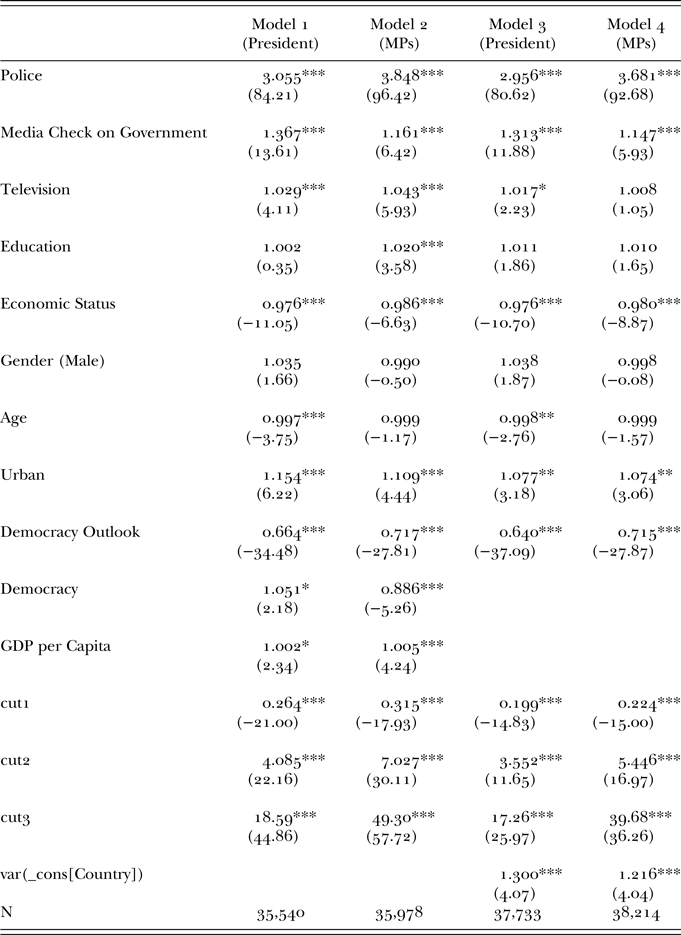
In the following section (Table II), I provide multivariate analyses, using fixed-effects and mixed-effects ordered logistic regression analyses, with control variables to test the strength of the relationship between corruption perception of police and corruption perception of upper-level government officials. In the first two models, Model 1 shows a positive and significant relationship between police corruption and the corruption perception of officials in the president's office (P > 0.001, odds ratio 3.06, 95% CI: 2.98, 3.14). The log odds of officials in the president's office (upper-level government officials) being perceived as corrupt rather than not corrupt will increase by 3.06 if the order of corruption perception of police moves from ‘None of them’ to ‘All of them’.Footnote 5 In Model 3, I account for country-level differences with a multi-level mixed-effects ordered logistic model. I employ this model because I cannot assume that the empirical relationship represents all the Nj = 36 countries in the Afrobarometer dataset. Therefore, I consider country-specific factors that might have an influence on the results. After controlling for country differences, the relationship between corruption perception of police and the corruption perception of upper-level government officials is positive and statistically significant (P < 0.001, odds ratio 2.96, 95% CI: 2.88, 3.04). The relationship still holds having controlled for the perception of media check on the government (Media Check on Government) and the frequency of watching television news (Television) in both models. I include these variables in the models to account for their effect on the corruption perception of upper-level government officials. Media Check on Government (Model 1: P < 0.001, odds ratio 1.37, 95% CI: 1.31, 1.43 and Model 3: P < 0.001, odds ratio 1.31, 95% CI: 1.26, 1.37) and Television (Model 1: P < 0.001, odds ratio 1.03, 95% CI: 1.02, 1.04 and Model 3: P < 0.026, odds ratio 1.02, 95% CI: 1.0, 1.03) have a positive and significant effect on corruption perception of upper-level government officials in Models 1 and 3.
Corruption Perception of Police on Corruption Perception of the President's Office. Odds ratios.

Z score in parentheses * p < 0.05, ** p < 0.01, *** p < 0.001.
Source: Afrobarometer Wave 6; World Bank; Center for Systematic Peace.
Therefore, the perceptions that the media monitors government corruption and the frequency of watching television positively influence the corruption perception of officials in the president's office. People who think that the media monitors the government and those who watch television more frequently are more likely to view officials in the president's office as corrupt. These people are likely to think this way because they often access critical information about the government from the media.
Therefore, even when I account for the media, the relationship between corruption perception of police and officials in the president's office is positive and statistically significant. Thus, although the media can influence the corruption perception of upper-level government officials, the corruption perception of police still has a strong influence on the perception of upper-level government officials. In Models 2 and 4, I replicate the result from Models 1 and 3 using a different measure of upper-level government officials to check for robustness. I use the corruption perception of members of the parliament (MP); the results are similar. The result from Table II strongly supports Hypothesis (H1) even though it does not exhaustively support Hypothesis (H2). Only the frequency of watching television (Television) shows an insignificant relationship in Model 4. Therefore, the relationship between the frequency of media exposure and corruption perception of MPs is not significant in all countries. These results mean that this relationship is dependent on country context.
Some control variables also show significant results with corruption perception of upper-level government officials. Economic Status has a negative and significant influence on the corruption perception of upper-level government officials. This result suggests that people with higher economic status are more likely to view top government officials positively. They may have better standards of living that shield them from the effect of corruption than people of lower economic status. Hence, their perception of upper-level government officials may not be mainly dependent on their interaction with the police.
Age shows a significant negative relationship in Models 1 and 3. The reason for this outcome might be contextual. In most African countries, there is a high likelihood that older people lived under weak governments or repressive regimes at a younger age. Therefore, their present judgements of officials in the president's office might be relative and retrospective because the current situation in their country is likely to have significantly improved from when they were growing up. For that reason, they might have a more positive evaluation of upper-level government officials than younger people who have had different experiences.
Respondents from urban areas (Urban) strongly perceive officials in the president's office as corrupt. This result is consistent with the protests in Nigeria and Tunisia that began primarily in urban areas (Moaddel Reference Moaddel2012; Uwazuruike Reference Uwazuruike2020). The perception of the extent of democracy (Democracy Outlook) shows a negative and significant relationship with the corruption perception of officials in the president's office in all Models. This outcome suggests that respondents who think that their country is a democracy do not view upper-level government officials as corrupt. Therefore, these respondents might perceive institutions they are under to have accountability and transparency; consequently, they are less likely to associate upper-level government officials with corruption. This perception of democracy can be driven by propaganda. The objective measure of democracy shows that people in democracies (Democracy) are likely to perceive their upper-level government officials as corrupt.
GDP per Capita's relationship with perception of upper-level government officials corruption is positive and significant. This result suggests that people in countries with more national wealth are more sensitive to corruption due to institutionalisation (Treisman Reference Treisman2020) or economic growth increases the level of rent to exploit (Wedeman Reference Wedeman1997), increasing corruption of the upper-level government officials.
The results confirm the hypotheses after accounting for country differences. These findings suggest that the relationship between the corruption perception of police and the corruption perception of upper-level government officials is robust. The findings support the theory that direct experience has a strong influence on judgement. Citizens collapse together the street-level and upper-level government officials when appraising their institutions. For that reason, the corruption perception of police is likely to affect the corruption perception of upper-level government officials, having accounted for media. This relationship is visible in most African countries. It is also manifested in protests against the government triggered by citizens' interaction with police: the #EndSARS protests in Nigeria and the events preceding the Arab Spring in Tunisia.
CONCLUSION
This paper looks at how the corruption perception of police influences the corruption perception of upper-level government officials. Police interact with the public more frequently; therefore, the public might judge the level of upper-level government officials' corruption based on interactions with the police. Police might solicit bribes from the public or conduct arbitrary arrests that disadvantage some members of the public. Due to these experiences, private citizens’ perception of police might be linked to the perception of government institutions overall. Citizens are less likely to separate corruption of street-level government officials from corruption of upper-level government officials because the judgement of the level of upper-level government officials corruption is likely to be based on citizens’ interactions with police. Researchers have looked at the connection between corruption in the lower-level bureaucracy and upper-level bureaucracy but have not explored what the public is likely to base its corruption perception of upper-level government officials on (Waller et al. Reference Waller, Verdier and Gardner2002; Morris Reference Morris2009, Reference Morris2011); especially in cases where citizens are not basing their assessment on other information sources but experience with street-level government officials.
The findings show a strong positive significant relationship between the perception of police and upper-level government officials, suggesting that citizens appraise their upper-level government institutions through their interaction with street-level government officials. These results apply in both democratic and authoritarian regimes. These findings have the following implications: citizens get cues from their experience with police, these cues influence their perception of upper-level government officials, and might influence political behaviour.
In democracies and competitive authoritarian regimes (to some extent), the ruling government might suffer because citizens’ perception of police might translate into votes that might affect the incumbent government's fate (Mutz Reference Mutz1994). In authoritarian regimes, this might affect whether scapegoating works. Authoritarian regimes are likely to use police as scapegoats for their flaws to keep their legitimacy (Ran Reference Ran2017; Harmel &Yeh Reference Harmel and Yeh2020). However, when citizens’ perception of the national government is affected by their perception of police, the likelihood of scapegoating working might be very low. For that reason, the interaction with police influences citizens’ perception of upper-level institutions, regardless of regime type. Protests against SARS in Nigeria and events preceding the Arab Spring in Tunisia resulted from disconcerting experiences with police. For that reason, it is not only the media that informs the public about the corruption of the upper-level government officials but also experience.
Reforms in policing can be a tool for ensuring regime resilience by reelection in a democracy. Though police might be a tool for repression in autocracies, if this repression is coupled with corruption, the likelihood of citizens' dissatisfaction might be higher, hence influencing protest against the regime. Therefore, authoritarian regimes also have a duty to introduce reforms in policing if they are to maintain power. Even though their use of force can be justified by citing the maintenance of order, the corruption perception of police can weaken the claim to maintain order.
Experience might be subjective, but knowing its effect on perception should push governments to improve police accountability mechanisms. When police are held accountable for corruption, the association of police corruption with the corruption perception of upper-level government officials can be diminished, therefore maintaining government legitimacy, which is important for stability. Conversely, if perceived corruption is higher, trust in state institutions will deteriorate and consequently affect state legitimacy (Logan et al. Reference Logan, Fujiwara and Parish2006: 34). Therefore, the government has an obligation to combat police corruption because higher levels of police corruption will deteriorate both police and government legitimacy. Transparency in the upper-level government offices can mitigate the association of corruption perception of street-level government officials with upper-level government officials. However, this is more likely in democracies than autocracies.
This study is not definitive. It is only suggestive and presents a direction that future research could take. More exploration in this area can help reveal the weakness or the strength of my findings. In future research, I would like to explore more than one year and evaluate if the results I find in the Wave 6 Afrobarometer data are consistent with other waves. Also, individuals do not necessarily answer questions consistently over time, suggesting that answers might vary. Changes in the economic and political environment might influence responses. Survey data also provide fixed predetermined answers – such means of data collection can prevent nuanced answers that can improve findings. Therefore, other methods can be employed to strengthen my findings: conducting fieldwork interviews that give closer contact with the respondents. Close experience with respondents can improve my results and expose me to new phenomena and complexities.