During the Cultural Revolution, Chinese youths and intellectuals were sent “up to the mountains, down to the countryside” (shangshan xiaxiang 上山下乡) to serve the people. Today, Chinese leaders want their farmers and companies to go “down to the African countryside” to serve China's strategic interests. This ratcheting up of China's re-engagement with rural Africa builds on a history of more than four decades of aid and other forms of engagement. More than 44 African countries have hosted Chinese agricultural aid projects, and the Chinese have developed more than 90 farms through their aid.Footnote 1 Agriculture made up about a fifth of the more than 900 “turn-key” projects (those built by the donor and then handed over in working order) constructed by China's aid programme between 1960 and 2006.Footnote 2 Today, Chinese investment in agriculture-related ventures is on the rise. Yet little is known about the nature of China's aid or investment in rural Africa. Much is shrouded in the fog of rumour, a slowly changing tradition of secrecy concerning foreign aid, and the simple difficulties posed by research in challenging environments.
The context for Chinese interest in African agriculture is complex. Although Chinese farmers still produce nearly 95 per cent of the nation's consumption, the country is rapidly approaching the point set by leaders as the “red line” for food security: 120 million hectares of arable land.Footnote 3 Millions of Chinese farmers have been pushed from their land by the encroachment of cities. These new pressures – food security and farmers in search of land – also explain some of the obvious attraction posed by Africa. In addition, the African continent has been a net importer of food since 1973, and many countries spend millions of dollars importing rice and other grains each year. Assistance for agriculture is welcome in Africa and can produce diplomatic benefits while also expanding global food supplies, a benefit for China, which became a net food importer in 2003.Footnote 4
This article has two primary purposes. First, it investigates the dimensions of China's agricultural engagement, tracing the changes and continuities in China's policies in rural Africa from the 1960s to the present decade. Second, it provides a preliminary analysis of the scope and impact of three overlapping patterns in this agricultural engagement: diplomacy-based aid, public–private partnerships and overseas investment by Chinese companies. We argue that Chinese aid and sponsorship of public–private partnerships today reflect lessons from its past failures in diplomacy-based agricultural aid. These lessons are incomplete, however. While they demonstrate a practical evolution from diplomatically useful but unsustainable agricultural projects towards a model that hopes to foster sustainability through incentives for China's nascent agri-business corporations, there is little evidence that they incorporate lessons on the social and political context shaping agricultural practice in Africa. While Chinese companies' growing interest in the potential for profit in African agriculture is often welcomed by African governments, who see both public and private gains, it risks increasing the vulnerability of traditional subsistence farmers and smallholders. Some of the large-scale concessions under discussion have the potential to do far more to change the face of rural Africa than all the oil wells and copper mines that have been the focus of attention in China's renewed African engagement.
There is very little scholarly research on the issue of China's engagement in rural Africa.Footnote 5 This article builds on extensive field research and archival work on Chinese agricultural engagement in West Africa between 1983 and 1995, and field visits to West Africa, East Africa and China (Beijing and Baoding 保定) between 2007 and 2008. The first three sections present historic stages in the development of China's aid and other activities in rural Africa. The final section provides case studies that illustrate the risks and opportunities in the current engagement. Overall, the article emphasizes Chinese experimentation and efforts to learn from the past, and the role of the Chinese developmental state in building on these past experiences by providing an array of tools to foster multiple forms of engagement.
From State Farms to Support for African Smallholders, 1960–1982
The People's Republic of China's agricultural engagement in Africa began as an instrument of diplomacy, countering the active agricultural aid programme, Operation Vanguard, operated by Taiwan. Taiwan's programme was launched in 1961 as part of the arsenal of political tools that it and its patrons (particularly the United States) hoped would keep the People's Republic isolated internationally.Footnote 6 A generous aid programme for newly independent states, Operation Vanguard focused on small and medium-scale rice and vegetable demonstration farms combined with technical assistance to smallholders. At its peak in 1968, the programme had more than 1,200 agricultural experts in 27 countries, mainly in Africa.Footnote 7
In contrast, Chinese projects in the 1960s tended to be large, state-owned farms like Tanzania's Mbarali state farm, which boasted 3,200 hectares of irrigated rice, complete with its own hydropower station, dairy farm and poultry operation.Footnote 8 During this period, Beijing also built the integrated Koba farm complex in Guinea, and large, state-owned sugar or tea plantations in Mali, Benin, Togo, Madagascar, Zanzibar and Sierra Leone. China's aid programme continued to finance some large farms up until the mid-1980s (Magbass sugar complex in Sierra Leone, Kapatwee rice seed multiplication farm in Liberia and others). However, competition with Taiwan and the difficulties of keeping large, state-owned farms operating caused a decisive shift in China's approach.
This accelerated after 1971, when Beijing was finally able to reclaim the China seat at the United Nations, in part through the votes of African countries that had switched diplomatic recognition from Taipei to Beijing. Most of Taiwan's demonstration farms in Africa were taken over by experts from China. In Sierra Leone, for example, Chinese experts took over Taiwan's demonstration farms, and then built another half-dozen small and medium-sized rice demonstration stations across the country, all following the Taiwanese model of demonstration farms and extension support for smallholders. Shifts in China's own domestic agriculture policies in the late 1970s also supported China's shift away from the large, state farm model.
By 1985, Beijing was supporting agricultural aid projects in 25 African countries (35 worldwide), covering some 48,000 hectares of farmland.Footnote 9 Agriculture as an arena of diplomatic competition with Taiwan remained an issue as late as 1997, when two Chinese researchers commented that food shortages were politically destabilizing: “Some African state leaders are eager to gain immediate success and this provides opportunities for the ‘money diplomacy’ of Taiwan. We expand China's political influence when we strengthen agricultural aid for Africa.”Footnote 10 But despite the political importance of agriculture, the Chinese found that it was hard to achieve sustainability for their rural projects. The World Bank, for example, reported a failure rate of 50 per cent for its African rural development projects between 1965 and 1986.Footnote 11 The Chinese had similar difficulties.
Consolidation and Experimentation, 1982–1995
Agricultural aid from traditional donors declined sharply after the mid-1980s, a trend pushed by donor frustration with the poor outcomes of integrated rural development projects and a related shift towards policy-based structural adjustment lending.Footnote 12 The Chinese continued to engage in rural Africa. In 1986, for example, 70 Chinese agricultural projects of various kinds were under preparation or being implemented in Africa.Footnote 13 At the same, time, however, Beijing began to experiment with ways to make economic relations with Africa more sustainable and mutually beneficial, a goal announced by premier Zhao Ziyang in his historic 1982–83 trip to Africa.Footnote 14
The aid and economic co-operation experiments launched during Zhao Ziyang's leadership took many forms, including consolidation of existing projects and tripartite projects with the United Nations. But as the departments of China's ministries and provinces that formerly carried out foreign aid projects were transformed into “foreign co-operation corporations,” other experiments began to blur the line between aid and profit: joint ventures, co-operation contracts, debt–equity swaps, public–private partnerships and aid for joint ventures.
Consolidation
Under the new emphasis on consolidation launched in the 1980s, Chinese teams returned to repair and rehabilitate buildings, bridges, irrigation systems and other public works constructed in the 1960s and 1970s, and which were now a bit the worse for wear. These consolidation activities were particularly important from a diplomatic perspective. They usually focused on very visible projects and were generally funded by China's foreign aid grants rather than loans.
Sierra Leone provides insight into the operations of the consolidation programme. In 1988, Beijing dispatched a team of Chinese experts from Wuhan Municipal Foreign Co-operation Corporation in Hubei province (formerly the municipal foreign aid office) to Sierra Leone to rebuild and assist some of the 1970s' irrigated rice stations. The civil war that began in 1991 drove the Chinese experts to retreat from the hinterland to the station at Lumley farm outside the coastal capital, Freetown. China finally suspended the project in 1997 when the war reached Freetown, but sent the experts back to Sierra Leone when things calmed down in September 1999 (the war formally ended only in 2002). Teams from Wuhan again rebuilt some of the rice stations, particularly in the politically contentious areas where the fighting had been heaviest. Some of the Wuhan agricultural experts remained in Sierra Leone as late as September 2008, a full 20 years of consolidation activities.Footnote 15 Their work helped ensure that demonstration fields known locally as “Chinese farms” remained visibly verdant symbols of Chinese assistance.
Joint ventures and contracts
A second initiative launched on an experimental basis in 1985 involved Chinese funds set up to promote joint ventures between Chinese companies and those in Africa. In Sierra Leone, one of these funds nurtured several joint ventures in agriculture (oil palm) and fisheries. Chinese companies also began to establish locally based construction companies who could do contract work for profit or undertake to manage an existing farm, either in the public or private sector. For example, China Agriculture, Livestock and Fisheries Corporation (known in Sierra Leone as China Agricon), one of the companies owned by China's Ministry of Agriculture, contracted with one wealthy Sierra Leonean to send eight Chinese experts to develop and manage his private estate.
These companies were often given a business boost by the Chinese government through being assigned a contract to build a turn-key aid project. This positioned them well to win a contract from the recipient government to continue to manage the project once it was handed over. For example, until Liberia's civil war began in 1989, a Chinese company had a profitable contract to manage Liberia's state-owned Kpatawee rice seed multiplication farm, a former aid project. This form of consolidation also ensured that projects were less likely to simply collapse once handed over. The Chinese team leader at the Kpatawee project had repeatedly called for local counterparts to work alongside their experts, something the Liberian Ministry of Agriculture failed to do.
Tripartite co-operation
China's practice of tripartite co-operation began in the late 1970s, as it expanded its engagement with the United Nations, which it had finally been allowed to join in 1971. Beijing would provide teams of experts as an “in-kind” contribution to the UN's various social development funds. These experts would carry out projects in other countries. The UN would finance some of the costs, and the host government would provide housing and other support. These tripartite programmes continue in the south–south co-operation programme with the UN Food and Agriculture Organization, discussed below. The tripartite co-operation initiative also fits with the model of aid as diplomacy.
Investment and public–private partnerships
Finally, Chinese state-owned companies were directed to lead the way as China began to experiment with the first stages of overseas investment. Ironically, the move to the market under structural adjustment policies being pushed by traditional donors in the 1980s and 1990s opened up opportunities for Chinese state-owned companies to take over productive assets built earlier as Chinese turn-key aid projects. Many African governments had accumulated debt to China under the foreign aid loans that financed most infrastructure and productive projects. Beijing began to experiment with using debt equity swaps and lease arrangements to involve Chinese companies in ownership roles on China's former aid projects as they were being privatized. Other Chinese companies looked for profitable new investment opportunities that were opening up with other forms of privatization.
China State Farm Agribusiness Corporation (CSFAC) (Zhongguo nongken jituan gongsi 中国农垦集团公司) and its provincial subsidiaries took a lead role in many of these experiments. In 1990, CSFAC's provincial subsidiary Jiangsu State Farm Agribusiness Corporation bought land in Zambia and established the China–Zambia friendship farm. It followed this by developing Zhongken farm, also in Zambia, and purchasing an existing sisal farm being privatized by the government in Tanzania. CSFAC expanded Guinea's 250-hectare Koba rice farm, a former Chinese aid project, into an integrated agricultural complex of 1,800 hectares, employing 14 Chinese and 500 Guineans in ten different enterprises, including several factories. It also took over the former Chinese-assisted state-owned Sikasso tea plantation and factory in Mali.
Other Chinese companies originally assigned to implement aid projects under various Chinese ministries followed CSFAC's lead. China National Overseas Engineering Corporation (Zhongguo haiwai gongcheng zonggongsi 中国海外工程总公司), which had built the Segou sugar refinery in Mali, took a stake in the refinery. In Sierra Leone, China Complete Plant Export Import Corporation (Complant) (Zhongguo chengtao shebei jinchukou gongsi 中国成套设备进出口公司) negotiated a lease for the Magbass sugar complex it had built and managed from 1982 until the mid-1990s. Complant also leased Chinese-built sugar complexes privatized by governments in Togo and Madagascar, and renovated the M'pourié (Mpoli) Farm in Mauritania.Footnote 16
During the 1990s, the consensus grew among Chinese experts that China's traditional agriculture projects were not sustainable without continued Chinese support. As one such expert reflected in 2000, “almost all of them without exception have gone through the odd cycle of ‘quick starting, quick results and quick decline’.”Footnote 17 Yet African countries frequently requested agricultural aid, and China rarely vetoed these requests, particularly in view of the ongoing diplomatic struggle with Taiwan. Consolidation efforts were one way to keep agriculture projects going, but the Chinese continued to explore other paths that would allow their diplomatic and economic goals to converge. During the 1990s, Beijing planners put in place a framework for agricultural aid and engagement that relies heavily for sustainability on the incentives it offers to Chinese agri-business firms who will be responsible for ensuring the continuation of many aid projects.
“Going Global,” 1995–Present
The experiments launched by Zhao Ziyang in the 1980s were reviewed in a series of meetings in the early 1990s that led eventually to major aid reform in 1995. These reforms evolved further into the “going global” policies during the 1990s and are continuing to grow in the new millennium. While diplomacy remains a major purpose of aid, significant reforms in the 1990s and 2000s positioned China's official engagement in Africa to bolster China's long-standing policy that aid should generate “mutual benefit.”
Five trends emerged over this period for China's agricultural engagement. First, the poor results of earlier aid projects and a reluctance to waste resources fostered the principle of integrating aid and Chinese enterprises. Second, the new “going global” strategy generated new opportunities for Chinese firms in agriculture. Third, Beijing established new tools and instruments to promote Chinese business engagement in Africa. Fourth, diplomacy, aid and business were packaged together in a series of summits and high-level announcements, including the November 2006 Forum on China Africa Co-operation (FOCAC) summit in Beijing. Finally, a backlash developed against the idea of large overseas farms, and in particular the notion that China was investing overseas primarily to ship grain back to China for domestic food security.
This section outlines these five trends and how they affected China's agricultural engagement. The next section provides case studies illustrating the risks and opportunities engendered by the current wave of Chinese engagement.
Linking aid with enterprises
The discussions of the early 1990s led to the idea that productive aid projects had their best chance of sustainability if Chinese partners with a profit motive were firmly involved as owners or leaseholders, not simply offering long-term technical assistance or serving as managers. In 1996, a Hong Kong newspaper reported on discussions about these reforms, commenting: “The linking of project returns with enterprise interests will help consolidate the achievements of co-operative projects and increase the returns of aid; and furthermore, recipient countries will earn more and have more job opportunities.”Footnote 18 By 2002, the strategy had clearly become official policy. Wei Jianguo 魏建国, vice-minister for foreign aid in the Ministry of Foreign Trade and Economic Co-operation, told a seminar on Chinese agricultural investment in Africa that “China–Africa agricultural co-operation in the new century must be conducted by enterprises and should be market-oriented.”Footnote 19 China's Africa policy white paper, released in January 2006, reflected the lessons from almost two decades of slowly growing business engagement. China's “mutually-beneficial agricultural co-operation” in Africa would focus in the future on opening up new lands for development, setting up agricultural plantations, fostering breeding technologies, enhancing African food security, and promoting agricultural machinery and agricultural processing.Footnote 20
“Going global”
In the new millennium, mutual benefit meant that agricultural engagement in Africa would need to support China's “going global” strategy (zou chuqu 走出去): a set of policies worked out to enable Chinese companies to become global firms. “Going global” meant three things: building global brands from China's most competitive enterprises; providing higher-value technology and service exports; and increased overseas investment by Chinese companies. As the decade advanced, Chinese observers began to comment that agricultural investment in Africa also had the potential to relocate Chinese farmers displaced through the dual pressures of WTO trade liberalization and China's rapid urbanization.Footnote 21 Some suggested that Africa could also serve as a source of future supply for China's own food security.Footnote 22
Crafting new tools
The Chinese needed new tools to realize the goal of linking aid and other forms of economic engagement. In 1995, Beijing opened a concessional loan window at China's new Export Import Bank which would use foreign aid funds to subsidize loans for joint ventures, Chinese-built infrastructure projects and other mutually beneficial projects. Later, the Bank added preferential buyer's credits which would enable governments to finance the import of Chinese goods and services at very competitive rates. The Ministry of Foreign Trade and Economic Co-operation, the Ministry of Foreign Affairs and the Ministry of Agriculture began to co-sponsor seminars on agribusiness opportunities in Africa for Chinese companies and provincial officials, emphasizing a range of assistance the state could provide overseas entrepreneurs: information and connections, risk assessments, diplomatic support, help with work permits and immigration requirements, preferential tax and foreign exchange control policies, insurance, assistance with customs, and low-cost loans.Footnote 23 The Chinese government prominently featured agro-industrial crops like rubber, fuel oils (oil palm) and cotton, vegetable cultivation, animal husbandry and aquaculture, and agricultural machinery assembly in the catalogue of preferred projects for Chinese companies investing overseas.Footnote 24
In 2006, the China Development Bank and the Chinese Ministry of Agriculture announced an agreement to work together to encourage projects using land and water resources overseas.Footnote 25 Separately, China Export Import Bank promised to offer full support, including project development, finance and marketing assistance, for agricultural projects in Africa.Footnote 26 In late 2007, the parent corporation of CSFAC, China National Agriculture Development Corporation, signed an agreement with the China–Africa Development Fund and China Development Bank to explore new investment in large integrated agricultural projects in Africa.Footnote 27 Several months later, in early 2008, unconfirmed media reports said that China's Ministry of Agriculture had submitted a draft plan to the State Council outlining policies that would encourage five major Chinese state-owned agricultural companies to obtain land abroad for agricultural use on a large scale.Footnote 28
Continuing diplomacy: FOCAC and the UN pledges
Agricultural engagement, and aid in particular, still needed to serve the goals of diplomacy. Governments in some developing countries feared that China's rise would squeeze out opportunities for their nations; others worried that China's growing interest in African resources would merely replicate exploitative patterns developed by the West. The Chinese worked to embed their expertise in agriculture as a component of diplomatic efforts to shape their engagement with Africa. As the director of China State Farm Agribusiness Corporation commented: “China's growing interest in energy and mineral projects in Africa is likely to trigger some negative reactions.”Footnote 29 China should offer to combine exploitation of other countries' resources with help for the development of their agriculture, he suggested. This would “implement the principle of combining ‘getting’ and ‘giving’ (qu yu jiehe 取予结合).”
The principle of “getting and giving” was further enshrined in China's global diplomacy: there were pledges at several rounds of UN meetings on the Millennium Development Goals, as well as FOCAC which was launched in 2000. FOCAC pledges on training meant that between 2003 and 2008 more than 4,000 Africans travelled to China for agriculture-related courses lasting between three weeks and three months.Footnote 30 At the FOCAC summit in November 2006, Chinese president Hu Jintao announced a further pledge of 100 agricultural experts and ten agricultural demonstration centres for Africa, with a focus on food security. Two years later, in September 2008, Chinese premier Wen Jiabao announced at a UN meeting on the Millennium Development Goals that over the next five years China would send 1,000 agricultural experts overseas, build 30 agricultural technology centres and offer agricultural training courses in China for 3,000 people.Footnote 31 A south–south co-operation programme with the UN's Food and Agriculture Organization provided additional diplomatic depth. These initiatives deftly mixed diplomacy, public relations and practical help to address African concerns about food security. And as shown below, the agricultural demonstration centres would be designed along the new model of linking aid to enterprise results.
Myths, realities and backlash
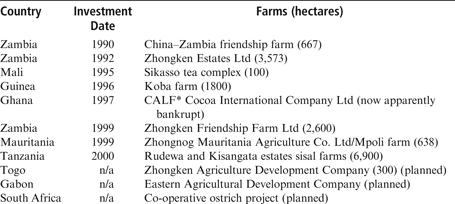
The diplomacy around the FOCAC and other summits was not enough to prevent a backlash that began to arise in 2007 against the idea of large-scale Chinese investment in agriculture overseas, symbolized by headlines such as “China and the great global land grab” and deepened by a warning from a top UN official that large-scale land purchases by the Chinese and other food importers risked becoming a new kind of colonialism.Footnote 32 Despite these fears, even as late as 2008 there was still very little large-scale Chinese farming in Africa. The pioneer China State Farm Agribusiness Corporation was operating at least 11 agricultural projects on 16,000 hectares of land in Africa (Table 1), several of which were former aid projects, as noted above.Footnote 33 CSFAC's initial efforts in Zambia influenced other Chinese to invest. By 2006, there were more than 20 state-owned and private Chinese farms in Zambia, with more than 10,000 hectares under production.Footnote 34 But all these farms were producing for the Zambian domestic market (to the chagrin of at least some Zambian farmers who did not welcome the competition they provided).
China National Agricultural Development Corporation in Africa
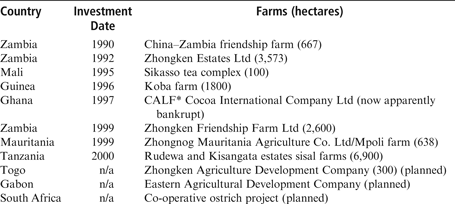
Note:
*CALF = China Agriculture, Livestock and Fisheries Corporation (now defunct).
Source:
China State Farm Agribusiness Corporation, a subsidiary company of China National Agriculture Development Corporation.
Many myths arose. For example, at the invitation of Zimbabwean president Robert Mugabe, CSFAC explored investment in that troubled country. This led to rumours that farms taken without due process from white farmers in Zimbabwe's chaotic and crony-ridden land reform were now being operated by the Chinese. In reality, as an official in Zimbabwe's Ministry of Agriculture reported, CSFAC decided not to invest, citing security problems and a poor business environment.Footnote 35 The Zimbabwe government also signed a contract with a Chinese engineering company to develop 250,000 acres of land for irrigated maize.Footnote 36 This contract was also widely (and erroneously) reported as an example of “Chinese farmers” in Africa.Footnote 37 However, when Zimbabwe was unable to make payments, the Chinese company withdrew its construction crews and suspended work on the project.
Late in 2007, at least one Chinese company did sign an agreement for a large land concession, but not nearly as large as advertised in the press. A newspaper reported rumours that Zhong Xing (中兴) Telecommunication Equipment Company (ZTE), one of China's largest state-owned telecoms companies, was initiating a joint venture in an oil palm bio-fuels project of three million hectares in the Democratic Republic of the Congo (DRC).Footnote 38 A concession of this size would have dwarfed many others in Africa.Footnote 39 Yet the Chinese ambassador in the DRC publicly corrected the initial report, stating that the ZTE project encompassed 300,000 hectares in total.Footnote 40 When the DRC Council of Ministers gave their stamp of approval to the project in August 2007, they approved only an initial stage of 100,000 hectares, still a very large concession.Footnote 41
Similarly, an East Timorese researcher from Singapore reported, without much evidence, that “China is committed to transforming Mozambique into one of its main food suppliers, particularly for rice.”Footnote 42 Chinese interest in helping Mozambique increase rice production from 100,000 to 500,000 tonnes was “clearly destined for export to the Chinese market,” he wrote, since only a “tiny fraction” of Mozambicans ate rice. In reality, Mozambique imports more than 400,000 tonnes of rice annually, with a domestic demand increasing at nearly 20 per cent per year.Footnote 43 Any increase in rice production on the scale envisaged would almost certainly be absorbed by Mozambicans.
Stung by a wave of criticism that followed news reports like this, officials in Beijing said that they were encouraging agricultural investment under the “going global” policies but denied that they had a policy to promote large-scale investment overseas to grow grain to ship back to China.Footnote 44 Indeed, Chinese incentives for overseas agriculture-related investment did not even include wheat, corn and rice, the main crops that Chinese companies are already growing in Africa for local markets.Footnote 45 Even with elevated grain prices in 2008, shipping costs were simply too high to grow China's rice in Africa, others contended. As one Chinese official said, “There is a saying in Chinese: ‘Don't transport grain further than a thousand miles.’ It's not cost-efficient.”Footnote 46 A Ministry of Agriculture official commented, “As [grain] prices rise, offshore farming projects might become profitable. But so far, companies operating them [are] still struggling to repay their investments.”Footnote 47
However, the potential conflict between China's food security and Africa's was on the mind of Chinese analysts as long ago as 2000, when an article in a Chinese journal commented that Chinese engagement in African agriculture should take the contribution to African food security as its main goal. But if countries tried to use control over food as a weapon to pressure the Chinese government (as was happening in Iraq and Zimbabwe at the time), African production could be a backup strategy for China's food supply.Footnote 48 Yet the evidence is indeed overwhelming that at present, Chinese farms in Africa are producing almost exclusively for local sales (rice, wheat, livestock and poultry) or for export to global markers (high value vanilla from Uganda, sesame and organic vegetables from Senegal, sugar from Sierra Leone).Footnote 49
Case Studies of Chinese Agricultural Engagement in the New Millennium
What has happened so far in China's current engagement in African agriculture? How is China's renewed mix of diplomacy, public–private engagement, aid and business likely to affect development in rural Africa? This section reports preliminary evidence based on African fieldwork in 2007 and 2008.
Magbass: from aid into profit?
Magbass Sugar Complex was built in Sierra Leone in the late 1970s and early 1980s as a Chinese aid project. In 1982, it became the first turn-key aid project to be handed over directly to Chinese managers. Complant operated the complex under a contract until driven out by Sierra Leone's brutal civil war. At the end of the war, Complant returned and rehabilitated Magbass, now privatized under a 25-year lease arrangement. They brought in new machinery, replanted the sugarcane fields and within a few years were producing sugar which they were able to export to Europe, taking advantage of a special quota offered by the European Union.
At first, the local villages were grateful for employment opportunities at Magbass as they emerged from the war. But during the 2007 elections, issues that had been simmering for some time erupted. Most revolved around land. Magbass paid an annual rent for the land of around US$150,000, with the contract stipulating that the rate would rise each year based on expected production increases until it levelled off at full development. However, the villagers complained that they were not receiving enough of the rent, which passed through a chain that included officials in the Ministry of Agriculture and local landowners' committees that were aligned with local politicians. More importantly, however, the initial agreement had promised that the Chinese could double the size of the plantation and that the Sierra Leone government would make arrangements for the release of land from local communities who, it was believed, held ample fallow land that they themselves could not afford to develop. Yet when the Chinese began marking off the area agreed with the Ministry for development, some local residents resisted, sending delegations to the capital, Freetown.
“The Chinese think the government is the owner of the land all over the country, so they don't have to deal with the landowners,” one landowner said.Footnote 50 Work on the expansion of Magbass ground to a halt, as Complant's Chinese manager, the Ministry of Agriculture and the local communities tried to sort out the disagreements over land and local politics. Although the problems were eventually resolved, Complant then decided to divest itself of the sugar projects it had leased in Sierra Leone, Madagascar and Benin.Footnote 51 Its difficult experience in Sierra Leone reflected the conclusion voiced by a director of China State Farm Agribusiness Corporation: agricultural co-operation in Africa was not “a good chew on the bones.”Footnote 52
Chinese agro-technology demonstration parks
In the lead up to the FOCAC summit held in Beijing in November 2006, China's National Development and Reform Commission brought together 40 domestic and international experts to produce a plan for Chinese investment in Africa.Footnote 53 The experts singled out agricultural technology and seed cultivation as two areas where China could create opportunities for its own companies by offering products that would be useful and also profitable. They recommended that China do this by setting up “cutting edge” agricultural technology demonstration parks. This would be a way to make foreign aid sustainable by linking it with commercial opportunities for Chinese companies.
A central technology for dissemination in these agricultural technology parks is hybrid rice. Hybrids are stronger and more productive than their parent stock, but they have limitations: they need to be purchased again and again, as the seeds from hybrids do not reproduce the genetic traits of their parents. Hybrids are controversial because of this feature, and also because they can be patented and are often controlled by large multinational seed companies like American agribusinesses Pioneer and Monsanto, the Swiss firm Syngenta, and Germany's Bayer CropScience. This is not inherently a bad thing: it creates supply channels which, ideally, would meet the demands of farmers who wish to buy hybrid seeds because they are more productive and not because they are forced to because they no longer have access to their traditional seeds. In more developed countries such as the United States, about 95 per cent of corn (maize) is planted to hybrids, and many small-scale farmers in East and Southern Africa plant hybrid maize, suggesting that demand for hybrid rice might also find a market in Africa.Footnote 54
The global seed business is worth billions of dollars annually for those with patents on hybrids (or on genetically modified seeds). In 1979, China's patent on the hybrid rice developed by the “father of hybrid rice” Chinese scientist Yuan Longping 袁隆平 was the first agro-technology patent registered to China in the United States. Today, the Chinese lead in rice hybrids forms a significant share of the competitive advantage of China's nascent agribusiness corporations. As an official of China's Department of International Co-operation in the Ministry of Agriculture said in 2007: “We believe there will be great potential for trading co-operation between China and Africa in small and medium-sized farming equipment and hybrid rice seeding.”Footnote 55
After the FOCAC summit, the Ministries of Agriculture and Commerce held a number of workshops in Beijing and in the provinces to discuss how to design the ten agricultural centres (later increased to 14 to meet African demand). They invited experts from companies with agricultural experience in Africa and South-East Asia. The centres had three requirements. First, they needed to attract interest and demonstrate the new technologies. Second, they needed to have a training component for local peasants. And third, they would need to be sustainable. “The first two points were easy,” a Chinese official said, “so our discussions focused on the third issue. Before, when Chinese experts left, most of the projects collapsed. Now, the government will give a grant for construction and three years of support, then the enterprises should continue the work.”Footnote 56 The model followed experiments already being carried out by Chinese state-owned companies at Koba farm in Guinea and in Mozambique.
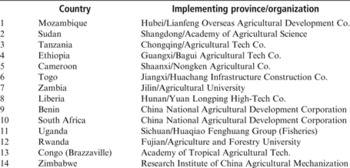
The Ministries of Commerce and Agriculture decided to arrange for eleven of China's more agriculturally strong provinces (who would each select one of their provincial agricultural companies), and two well-qualified central agricultural scientific research institutes and enterprises to implement the centres (Table 2).Footnote 57 The Chinese companies were asked to use the three years of support to explore operating “in a commercial, sustainable and mutually beneficial way.”Footnote 58 In some countries, the agreement called for the company to operate the centre for eight years, in others for only five, and in South Africa the government arranged for the Chinese to leave after the first three years of support. This may reflect the greater capacity of the South African government to support the centre itself, but it could also reflect a greater sensitivity to “Chinese farmers” in a country where access to land is still very politically sensitive.
Fourteen Agricultural Technology Demonstration Centres in Africa, 2006–2009

So far, Chinese interest in growing crops like hybrid rice in Africa is unlikely to be for shipment back to China. The emphasis on Chinese agro-technology companies and hybrid rice is far more likely to represent a mix of aid and a sensible business choice, “doing well by doing good.” While Western firms have locked up the African market for hybrid maize, the market for hybrid rice is wide open, and Africa imports over five million tonnes of rice annually, creating a potential market for a product the Chinese are proud of having developed and patented.
South–South Co-operation
Since 1996, China has participated in the UN Food and Agriculture Organization's “South–South Co-operation” (SSC) food security programme.Footnote 59 China's participation in the SSC programme represents the evolution of its own tripartite co-operation in the 1970s. The programme matches up developing countries who offer to work with counterparts in other developing countries on food security programmes. It promotes the transfer of practical knowledge without strict technological and material pre-conditions. China pledged to contribute 3,000 Chinese agricultural experts, mainly for diplomatically key regions where Taiwan was also active: the South Pacific, Caribbean and Africa.
In 2004, Nigeria received a particularly large contingent of 500 Chinese agricultural experts. Wang Yibin 王义彬, the deputy director of the Department of Agriculture in the city of Zhongxiang 钟祥, in Hubei province, was one of the experts sent to Nigeria. Wang was subsequently asked to head the new Sierra Leone SSC team in 2007. In Sierra Leone, the team under Wang's leadership set up four country stations (Kono, Kabala, Moyamba and Makali). Each emphasized a different technology – biogas digestion, honey bee culture, fish ponds and small-scale agricultural mechanization – as well as teaching local villagers basic skills in rice and vegetable production and poultry raising. The experts (not all of whom could speak English or a local language) used “teaching by doing” to transfer practical skills. Each of the four stations also built visible demonstrations of high-yield, short-duration (90 days) hybrid rice from China. And the SSC experts did outreach. For example, the team based in Kono visited 70 per cent of the villages in their district and tried to teach villagers how to make tools by themselves.Footnote 60 The team also did some consolidation work by rebuilding the irrigation system at Makali farm, another of China's aid projects built in the 1970s.
The SSC programme falls primarily into the “aid as diplomacy” category. SSC teams were not enterprises: their duty was limited to two years and did not include sustainable profitability as an objective. They focused on technical transfer by demonstrating, teaching and repairing, but did not investigate the economic dynamics such as markets, transportation or distribution, or the institutional chain required for the support of hybrid rice. They hoped to inspire local villagers by their working spirit and personal practice. “China used to be like this: no money, no food,” Wang said. “In 40 years, we solved it, but not in one or two years. That's impossible.”Footnote 61
Yet the terms of their programme left the complicated question of how to use these technologies to make profits and achieve economic growth largely up to others: local people, or (in some cases) Chinese firms. Like so many pioneering Chinese in rural Africa, some SSC team members still thought of the potential for profit. Wang actually invited two companies he knew to consider investing in Makali, but they refused to come after learning about the poor roads and lack of electricity. But about 30 of the 500 Chinese in the SSC programme in Nigeria stayed on when the first group went home. In Nigeria, diplomacy was the foundation, but individual Chinese searches for opportunities could eventually lead to more lasting outcomes for south–south co-operation, an evolution not directly planned by the programme's sponsors in the UN Food and Agriculture Organization.
Chinese settlers in rural Africa: the “Baoding farmers”
The agricultural demonstrations, and the investments by large state-owned companies described above represent one effort by the Chinese government to interest its agricultural companies in investments in the “new frontier” of Africa. However, most agricultural companies in China have been reluctant to invest in Africa, citing the lack of infrastructure and market uncertainties. Yet a small number of pioneers have been exploring commercial farming in Africa with support from entrepreneurial individuals. The story of farmers from Baoding in Hebei province, two hours by train from Beijing, illustrates the factors driving this.
In the 1990s, according to the story, 80 workers from the Baoding area were recruited to work in Zambia to build a dam. As Chinese workers overseas commonly do, they grew Chinese vegetables near the dam site for their communal kitchen. The rapid growth of the crops, the high prices for vegetables in nearby markets and the vast lands in Zambia appeared to be an opportunity with rich agricultural potential. When their two-year contract ended, some of the Baoding workers decided to stay in Zambia to farm. Liu Jianjun 刘建军, then the head of the Baoding City Bureau of Foreign Trade Promotion, heard about these farmers. As Baoding was suffering from the impact of the 1997 Asian economic crisis, he decided to promote farming in Africa. According to him, at least 28 “Baoding villages” have been set up in 17 African countries since 1998. Yet there is no exact headcount of “Baoding farmers” in Africa: Liu Jianjun himself has given figures varying from 7,000 to 15,000.Footnote 62 And some Chinese living in Africa believe that Liu Jianjun's Baoding villages do not actually exist.Footnote 63
In an interview, Liu Jianjun explained that every Baoding village in Africa was founded through a business project, such as planting, fishing or horticulture, and managed mainly by a private enterprise, much like the model chosen by the Ministry of Agriculture for the new agro-technical demonstration stations. In his eyes, profitable opportunities abound across the continent, such as cassava starch for tariff-free export to Europe and processing of animal skins for leather. Baoding villages aim to “enter through agriculture, get rich through processing” (nongye luohu, jiagong zhifu 农业落户, 加工致富).Footnote 64 Liu believed that such farming would be welcomed by Africans because it had the potential to relieve local food supply shortages. It would not be as controversial as mining, which is seen as neo-colonialist exploitation of natural resources. Yet already some Zambian farmers resent the competition from Chinese farmers selling beside them at the local markets, saying that the Chinese should restrict their marketing to the wholesale level.Footnote 65
How involved is Beijing in the Baoding farmer phenomenon? Liu Jianjun used his position in the Baoding administration to recruit farmers. However, he confirmed that the Beijing government has not given official support to this model.Footnote 66 Yet a prominent member of the Standing Committee of the Chinese Communist Party National Committee, Hu Deping 胡德平, attended the November 2008 press briefing held by Liu Jianjun to announce an agreement between Hebei provincial entrepreneurs and the Ugandan government to establish the Lake Victoria Free Trade Zone in East Africa.Footnote 67 This ambitious plan builds on the Chinese idea of special economic zones to encompass the whole value chain, including ancillary services such as housing, transport and infrastructure. Whether the Baoding villages themselves are an organized reality or an over-hyped marketing mechanism, there is no doubt that the stories have stimulated interest among many Chinese.
Conclusion
Chinese images of their involvement in rural Africa contrast sharply with images increasingly prevalent in the media outside China, both in Africa and around the world. On the Chinese side, engagement in rural Africa has been presented primarily as the acts of a socialist brother or a capitalist friend (depending on the era). The outside world sees much more threat, as symbolized by a growing number of news articles and blogs focused on the “land grab” theme. At the same time, very little research has been done on this issue, and there are as many myths as realities in stories about China's current engagement in rural Africa. As with oil, Chinese interest in African land “pushes buttons” for many people, particularly in a region where the alienation of land to outsiders has long been controversial. The Chinese government's efforts to make diplomacy-based aid more sustainable by incorporating incentives for Chinese businesses may have political ramifications, as some Chinese analysts have already warned.
The differences between rural China and rural Africa are vast, and this creates areas for misunderstanding. Used to intensive agriculture, some Chinese misinterpret the situation in rural areas of some African countries, where shifting cultivation depends on fallow systems that make it appear as though vast expanses of land are empty and available. “Land is plenty in this country,” a Chinese technician in Sierra Leone told one of the authors: “No one uses it!” In reality, land scarcities were already putting pressure on local fallow systems in Sierra Leone long before the civil war. As the Magbass experience shows, land has many kinds of use and ownership claims, and a straight purchase or lease under a formal legal system is liable to violate many other traditional uses for the land, and traditional rights. Governments may assure Chinese investors that they can allocate land to them freely, but experience shows that without proper safeguards, this kind of eminent domain land takeover is risky for local people, who may easily be left worse off.
There are three other areas of sensitivity: competition between Chinese and African growers in African markets, cash crops as competition with subsistence crops, and the likelihood that large-scale production could push people off their own land, using them as seasonal workers. Competition is already a feature of local African markets. The growing presence of Chinese investors with imported skills and technology should yield the benefits of competition: an expansion of local supplies while providing examples of imported skills and cheaper technologies that can be copied by profit-oriented African farmers. An expansion of cash crops can increase the risks of disruption in the traditional gender division of labour where, in many areas, women are responsible for food while men grow crops for the market. While these disturbances may be part of the evolution of farming systems in Africa from subsistence to market-orientation, there is little evidence that Chinese experts are even aware of these cultural production issues, or that they take any steps to ameliorate their impact.Footnote 68
The time is not far off when China will run out of farmland to maintain a 95 per cent self-sufficiency in food supply. As Japan, Korea and other land-scarce Asian countries are already doing, the Chinese will produce greater quantities of food abroad. The unhappy experience with land alienation in much of Africa (and Asia and Latin America can be added to this) suggests that any efforts by foreigners, including the Chinese, to produce on a large scale are likely to continue to be controversial. Systems of outgrowing, where farmers maintain control over their own land but have incentives to produce under contract to a central company, could be a middle ground. A Chinese company with an unhappy experience trying to produce on a large scale in Laos has planned to introduce hybrid rice into Tanzania using just such a system of outgrowers.Footnote 69 China's Tianze tobacco company, a subsidiary of state-owned China National Tobacco Import and Export Group, uses 150 Zimbabwean farmers to produce tobacco for shipment to China. Tianze provides tractors, fertilizer, agro-chemicals and generators to the farmers, and guarantees purchase of their crop.Footnote 70 Outgrowers bear more risk than farm labourers, but also have the potential for more reward.
Today the Chinese government uses training opportunities in China to promote understanding of China's model. In agriculture, there is a vast gulf between Chinese and African systems. These one-way trainings will do little to close that gulf for Chinese experts or investors. Ultimately, the Chinese government could do more to help its companies and individual investors move up the learning curve by sponsoring deeper understanding of Africa's challenging rural realities – culture, society and history – and not simply extolling its potential for profit.