

The conversation books of Beethoven are not just one more primary source among numerous others, but, as Karl-Heinz Köhler notes, a unique ‘source genre’.Footnote 1 This particular source came about through a singular occasion in the history of Western music: the more or less complete deafness of a famous composer. The beginnings of Beethoven’s written conversations date from 1816, and the beginnings of the conversations books, which Beethoven would use until the end of his life, date from around 1818. One hundred and thirty nine conversation books survive, as well as a number of loose leaves. Until Theodore Albrecht’s undertaking, there was no English translation of these valuable documents. At the time of writing, the first two volumes of the projected 12-volume set have appeared, which not only provide exemplary, critically informed English translations, but also a host of other details to aid the reading of this somewhat difficult but uniquely insightful source.
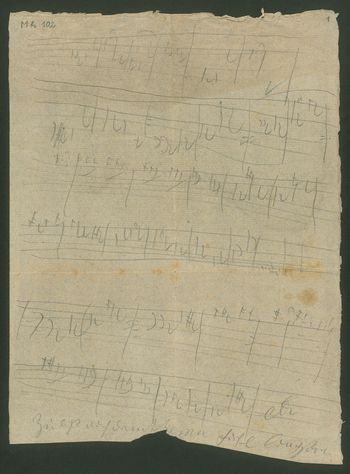
The first and only licensed edition of the conversations in German, Ludwig van Beethovens Konversationsheft (hereafter KH), started to appear in 1968, 150 years after Beethoven started writing them. Edited by Karl-Heinz Köhler, Grita Herre and Dagmar Beck (who joined the East Berlin team in 1971), the conversation books would appear in 11 volumes over the next 33 years. There is one more volume yet to appear in the German series: extant conversation book leaves will be published together as volume 12 in this series; these comprise pages ripped out of the conversation books, which are found in various libraries, archives and private collections. Figure 1 shows an example of such a ‘conversation leaf’, housed today in Beethoven-Haus, Bonn.Footnote 2 Albrecht’s volumes will ostensibly provide a translation of KH; he has, in fact, re-thought the project ‘from the ground up’, taking into account their complex transmission, the story of which he tells in the General Introduction.
Ludwig van Beethoven, sheet with conversation notes from 1826 and autograph sketches for the String Quartet in C-sharp minor, op. 131, second movement. Courtesy of Beethoven House Bonn, Collection H. C. Bodmer, HCB Mh 102.

The conversation books’ transmission and publication history presents intrigue upon intrigue, and alerts us to the political and personal nature of such scholarly undertakings. One crucial person in the transmission process was Anton Schindler. He took the books at the time of Beethoven’s death, probably for his own use in a projected biography. In 1846 he sold his Beethoven documents, including 137 conversation books, to the Prussian Royal Library in Berlin, where several important early biographers used them, including Alexander Wheelock Thayer. In May 1951, the then head of the music department of the Deutsche Staatsbibliothek, Joachim Krüger, stole a number of boxes of rare materials, including all of the conversation books, and took them to the West, establishing himself as an antiquarian book dealer. But in 1956 Karl-Heinz Köhler, Krüger’s successor, learned that the books were in Beethoven-Haus, Bonn, and ordered their return; the Berlin team then started to work on the 11-volume edition.Footnote 3
Thus far only one reputation had been tarnished. But in 1977, Peter Stadlen, a Viennese-born music critic then living in London, created what Albrecht describes as a virtually criminal sensation when he detected that Schindler had falsified many of his own entries in the conversation books and implied that the Berlin team had been negligent in not making such a discovery clear.Footnote 4 Naturally, any biographers who had worked with the conversation books were dependent on what Schindler had passed on, and new biographers would now be dependent on how the conversations were represented in KH. But the Berlin team had already begun to suspect the legitimacy of Schindler’s entries. When volume seven of KH appeared in 1978, it contained an inserted ‘Index of Anton Schindler’s fictitious entries in the previously published conversation booklets’; such entries were then likewise identified in subsequent volumes.
There had been attempts to publish and translate the conversation books, prior to KH. In 1906, Alfred Kalischer published a single conversation book with commentary in four instalments in the journal Die Musik. Footnote 5 In 1924–4, Walther Nohl published what are today deemed to be conversation books two and three.Footnote 6 After that, Georg Schünemann took up the project and had published three volumes through the Prussian Royal Library in Berlin before World War II, and his own death, curtailed a more sustained effort: these publications end with the conversations of July 1823.Footnote 7 As regards translations, selected conversations appeared in a French translation in 1946, while in 1962 an Italian book on the conversations was published.Footnote 8 From the ’70s through to the ’90s various projects were undertaken involving English translations, but none of these resulted in anything like a complete edition.Footnote 9 The tangled history of the conversation books thus far had shown that, for this scholarship to proceed fully and effectively, there was a need for collaboration and international agreement. Thus, in the creation of this first complete English translation, Albrecht has worked between the US and Vienna, and has secured much ‘inside’ and expert help from Germans and Viennese, among others. He also saw a need for a balanced assessment of Schindler’s role in the transmission history.
1. Layout
The KH was intended to bring this fascinating and highly important source to a ‘wide public’.Footnote 10 The Berlin team brought the latest scholarship to their task, which they saw as one of creating a diplomatic transcription. Thus they placed a strong emphasis on reproducing the original, in terms of both layout and content, as far as is possible in a published transcription. In the KH the textual commentary is largely kept to the end of the volume and introductions, so that editorial additions to the main text are minimal. Nonetheless, the editors provide a rich net of commentary regarding authors, events and people. This makes for a large number of footnotes, which are of two different types: one type, which appears at the end of the volume, provides details regarding the content of the entries (biographical information, identification of works mentioned, and so forth); the other, which appears at the foot of the page, gives information regarding the appearance of the text (orthography, crossing out etc.). The authors also provide evidence and discussion of approximate date ranges for each of the books on the basis of certain entries within the conversations.
Albrecht notes that by 1998 it was clear that the KH would need a major revision in conjunction with any translation into English. His re-thinking extended to the kind of transcription that would be needed for a broad readership. While diplomatic transcription preserves the content of the original with little editorial intervention, it is not reader friendly and arguably somewhat redundant in the context of a translation. After all, the original documents are piecemeal enough as they stand, recording mostly only one side of selected conversations with Beethoven, and leaving the novice reader—even the Beethoven scholar—with very few signposts to follow the sense. The translation already ‘loses’ the original German (really Viennese) language, with its orthographic and linguistic quirks; naturally, editorial intervention is required to ‘realise’ this language for a modern, English-speaking readership. So instead of a diplomatic transcription, Albrecht provides what one might term an ‘ambassadorial transcription’: he seeks, with clearly evident editorial presence, to promote and represent the text, and make it intelligible in translation.
The German volumes are especially difficult to follow so far as dating is concerned: most of the conversations have no precise date, meaning the reader needs to refer back to the discussions of dating in the introductions for an estimate. In preparing the English translations Albrecht has done a great deal of research to try to ascertain both the date and place for each entry in the conversation books. He provides this information (including conjectures) in bold in and in square brackets in the main text, after the name of the writer in question, so that the reader immediately has these points of reference. Where the writer of a given entry is unidentifiable, he has also clarified that fact. So, for example, the first entries in the first conversation book appear as follows:
BEETHOVEN [presumably away from his apartment in suburban Landstrasse; possible in a nearby restaurant, the Goldene Birne; ca. Thursday, February 26, 1818]…
UNKNOWN ‘A’ [at an unknown location, possibly the same as above, ca. Thursday February 26]…
NEPHEW KARL [in a restaurant; probably early afternoon of Friday, February 27, 1818]…
The new translations include much other new information to help guide the reader through the often confusing material. Tips on understanding Beethoven’s Vienna, which serve as a valuable point of departure for understanding many of the entries, are given in the opening ‘Reader’s Guide’, which will appear in all volumes. Albrecht outlines Beethoven’s daily routine—essential for understanding the framework of the entries. He also includes directions of the compass vis-à-vis the Danube (writers tended to orient themselves using the river, which was assumed to run west to east but actually runs at a slightly different angle through the city, northwest to southeast); house numbers; maps (virtually all of the addresses mentioned in the edition have been verified); and currency values.
Another thoughtful addition is commentary on external movements during conversations, clarifying what was happening in Beethoven’s immediate environment. So, for instance, Albrecht notes the arrival or departure of correspondent, the continuation of conversations where this is unclear, and the end of long conversations. These notes are also added in bold and within square brackets in the main text. He has done much new research identifying people as well as places and action. Thus, for example, in the following conversation at the beginning of book nine (volume two of the translations), he has worked out from contextual evidence that Joseph Blahetka, father of piano virtuosa Leopoldine Blahetka, was the previously unidentified person who accompanied Matthäus Stein to Beethoven’s house in early 1820, where they arranged a further meeting at Stein’s workshop and Stein offered Beethoven some competitive advice about piano hammers and stringing:
STEIN [at Beethoven’s apartment on the Glacis with Joseph Blahetka; possibly the morning of Sunday, March 12]: You don’t write above the c′′′′. // I would like to know whether you could better hear a piano that wasn’t leathered. // Then come and see me if you get out to the Landstrasse someday soon. [//]
JOSEPH BLAHETKA [continuing; evidently offering to accompany Beethoven to Stein’s shop]: That would be another couple of festive hours for me some time. /
STEIN [continuing]: Therefore in the afternoon. // The heating is to blame. // There is nothing worse than [a piano] with 4 strings. // I have superior strings now. [//] [Blatt 9r] If one has such strings, then one does not need it 4-stringed. // You <must> should not allow Graf to do anything to your [Broadwood] piano. // You can allow him to see everything, but just don’t let him do anything. // …Footnote 11
As Albrecht points out, these introductory notes in bold provide a sense of time, space and action, giving an almost theatrical quality to the reader’s experience that is not possible when using KH. As he puts it: ‘The result is very much like the script of a play, with character designations, dialogue, and stage directions. With this almost three-dimensional quality, it might bring Beethoven’s world to life to an unprecedented degree’.Footnote 12 Footnotes regarding content are greatly extended in these English volumes: he has added to, emended and built on the footnotes of KH, all of which now appear at the foot of the page. This makes for a more cluttered page, in which the editorial voice is very much present; often one third to one half of the page is footnotes and some readers will find the bold type for the date and location of entries visually distracting. But again, all this is highly useful information for orientation and comprehension of the conversations.
In short, while the German volumes have the musicologist/potential biographer in mind, the English translation is made with a wider audience in view. The lay reader can easily navigate the text, and the musicologist and potential biographer will also find the English translations and new contextual knowledge extremely useful. Only matters not relevant to the English translation, pertaining to spelling and German orthography, are omitted in Albrecht’s volumes. The translations even extend to helpful tips for the US reader: Vienna’s ‘1. Stock’ is New York’s ‘second floor’. Perhaps the only aspect that is truly ‘lost in translation’ is a sense of dialect—a phenomenon that is both sonic and social, something that would be achieved, say, by supposing that Vienna were relocated to modern-day Manchester and Beethoven’s nephew Karl remarked (to Beethoven, in a pub): ‘Fish, chips and peas with pea wet? // Give your ’ead a wobble!’. But I already hear the reader asking: ‘why Manchester?’
One can compare the first entry in KH to that in Albrecht’s first volume as an example showing the extent of new research behind the new volumes. One of the first points to notice is that the dating for each conversation is much more precise and easy to see; there is also a new footnote telling us that much of the first book is smudged and illegible, in other words, new descriptions are provided of physical aspects that one could only determine from the original. But matters relating to the physical appearance of the text are now often clarified in the text itself (‘[illegible word]’ etc.), rather than in the footnotes. For example, the above-cited entry by Beethoven’s nephew actually appeared in a footnote in KH; but in Albrecht’s first volume it moved to its rightful place in the main text. In the original conversation book Karl’s comments are covered by Czerny’s subsequent entries, but are nonetheless legible and part of the record. In general, Albrecht’s additions and ‘ambassadorial translations’ make for a smoother reading experience, with less deciphering and flipping between the conversations and the endnotes or introductory comments.
Schindler
Perhaps the most important piece of scholarship behind these new volumes is Albrecht’s own work on Schinder. As noted above, Schindler’s falsified entries became a contentious topic in the transmission history of the conversation books. Albrecht has made a specific study of this point, aiming for a balanced view and concluding: ‘ultimately we agreed that the entries had a certain function in the surviving documents … there is still a great deal to be learned from them about both Schindler and Beethoven’.Footnote 13 So Albrecht is a champion of Schindler in some respects, while still retaining critical distance. In the new translations he proceeds from the basis of his article on Schindler as supposed ‘destroyer and forger’ of Beethoven’s conversation books, in which he makes a case in favour of the accused.Footnote 14 In particular, he goes a long way towards debunking the idea that, as Karl-Heinz Köhler tells it, Schindler had thrown away five-eighths of the conversation books that he had found at the time of Beethoven’s death.Footnote 15 Köhler assumes that Schindler only kept books that represented six dramatic ‘high points’ in Beethoven’s late period: the law suit in connection with his Nephew Karl, 1819–20; conversations of the year of the Ninth Symphony, 1823; the preparation and aftermath of the Konzert-Akademie of 7 May 1824; the main year of his late quartets, 1825; the tragedy in connection with his Nephew in the Summer of 1826; and the three months of his final illness 1826–7.Footnote 16 If this were true, then Schindler’s selective disposal of materials would have biased the views of subsequent biographers using the material.
Albrecht’s ‘case for Schindler’ turns on a possible mis-transcription. He noticed, namely, that in 1842 Schindler reported that he had ‘viel über hundert’ (many more than 100) conversation books, which would make sense if he had around 140. Thayer, on the other hand, who was using the books in Berlin in the 1850s and in 1854, went to Frankfurt to talk to Schindler about them, probably misheard ‘viel über Hundert’ as ‘vier Hundert’ (400). Albrecht concludes: ‘thus began the erroneous perception that there were 400 conversation books present when Beethoven died and that Schindler had destroyed perhaps two-thirds of them. The answer is plain and simple: Schindler didn’t do it, Nobody did!’Footnote 17 But perhaps the matter is not quite so simple: one has to accept Schindler’s words from 1842 and accept that Thayer misheard or wrongly recalled Schindler’s comment. But more compelling evidence, which supports Albrecht’s mis-transcription theory, is provided in a footnote in which he makes calculations that project conversation book numbers by filling in the gaps that occur between March 1819 (when Beethoven seems to have begun continuous use) and March, 1827 (when he died); this projection brings the total number of conversation books, assuming no losses, to ca. 300, well under the traditionally supposed number.Footnote 18
Albrecht’s point is well taken here: later scholars have wanted to see Schindler, who undeniably forged some entries, as ‘the guilty party’, so that the burden of proof has been seen to lie on his shoulders. Albrecht reminds us of the crucial fact that without Schindler, the conversation books we have today might well not have survived. The first volume of Albrecht’s translations is dedicated to ‘Anton Felix Schindler (1795-1864), who saved the conversation books from dispersal and destruction and served as their first “editor”’. Albrecht adopts the necessary balanced view: Schindler was certainly entering ‘dangerous territory’ when he used blank pages to create entries that reflect his own opinions or create conversations that may or may not have taken place; but, knowing that these entries were so added, one can ‘safely regard or disregard them as circumstances warrant’.Footnote 19 Acknowledging that these forged entries are now part of the record, he clearly demarcates them in the text with the cues ‘[falsified entries begin→]’ and ‘[←falsified entries end]’.
In making a case for the ‘decriminalization’ of Schindler, Albrecht further considers the role of Schindler vis-à-vis historiography. He notes that the German historiographer Leopold von Ranke (1795–1886) and his disciple Thayer wanted history written objectively, ‘the way it really was’, based on a range of primary source documents. Schindler, for his part, was preserving the conversation books as primary source documents in the spirit of Ranke, but, with his forgeries, was not following the letter of Ranke’s historiographical law.Footnote 20 Schindler was in fact writing history ‘the way he really wanted it’. The problem with Ranke’s stance is that he presupposes objectivism, which is arguably never possible in the writing of history, and certainly not in biography. Anyone using the conversations as ‘raw material’ for research necessarily adds a layer of interpretation; at least to some degree they must pick and choose, add and embellish, take out of context, and so forth; and, whether intentionally or unintentionally, such an author would ultimately tell the story the way they wanted it told. So Schindler’s forgeries may have given Thayer, Nohl, Schünemann and others leads and emphases, but, regardless, they would make their own stamp on Beethoven biography.
In this connection it is important to note that, even without the forgeries, one thing that we will not get from these conversation books is the truth. One might be led into thinking otherwise from Köhler’s commentary on the aims of the KH, where he makes much of the authenticity of the conversation books as a source: they are direct reports of ‘live’ conversations as opposed to memoirs, which rely heavily on their authors’ memories. Thus, somewhat problematically, he sees the KH as a tool for the scholar in search of the truth: ‘Only a high scientific-philological level—diplomatic fidelity in the transmission of texts and an extensive apparatus for commentary—can fulfil this task [of disseminating the conversations] in the service of finding the truth’.Footnote 21 And yet conversations, much like letters, do not so much represent ‘the truth’ or ‘facts’, but present things in ways determined by the speakers and dependent on different peoples’ agendas. So, for example, when Beethoven’s Nephew Karl sought to visit a friend before breakfast one day in 1826, he wrote the following on a conversation leaf found on the reverse of the sketch leaf in Figure 1:
If you will permit me, I would now like to go quickly to one of my colleagues who has papers of mine which I need very urgently; you must not fear that I will not return; I will be here before breakfast; the air will also do me very good. I need the writings very urgently, and was always with him in the morning, in order to study with him afterwards // I hope that I will not be a prisoner here… I do not demand complete freedom; I would just like to run this little errand, in part because I need the papers very much, and will not meet him later; in part, because the air would really do me good. I’ll be here in an hour, on my word.Footnote 22
Karl made his case for the morning errand carefully, appealing twice to his need for the materials and his health, and even drawing on his moral right for freedom. One will not find ‘the truth’ here, either concerning Karl’s errand or his relationship with Beethoven; but one gains insights into the latter through the manner in which Karl chose to represent himself.
On the other hand, Köhler rightfully notes that the conversation books necessitate a particular manner of reading: using the metaphor of the telephone conversation, he notes that one (mostly) hears only one side of the conversation.Footnote 23 There are of course also many missing conversations, so that the extant conversations need to be read as a very partial record. The first volume, for instance, includes ten conversation books from the period early 1818 to early 1820, which do not show nearly the continuity of conversations that the later ones show. The books from February and March 1818 are only a few pages long, for instance. And of course only on occasion are there entries from Beethoven himself.
The entries by Beethoven fall into several categories, enumerated by Köhler, who suggests that they occurred whenever Beethoven did not care for eavesdroppers.Footnote 24 But there are several other contexts for these entries, which include notes relating to something that he had just read, such as his annotation from Kant in February, 1820 (‘“the moral law within us and the starry heaven above us” … Kant!!!’), and a jotting from a newspaper to note events in Great Britain to commemorate Handel.Footnote 25 Then there are private comments, clearly intended for his interlocutor only, such as the remembrance of Guiliatta Guicardi, or the several instances of crude humour. And there are also extensive lists and reminders about household chores, which were not private but clearly intended for his eyes only. There are several other categories of comments by Beethoven himself, which would repay detailed study: an important and expansive one comprises his notes about what interests him in terms of announcements in the Viennese newspapers, including numerous book titles, taking in declamation, poetry and aesthetics. This highly instructive category of comments in which Beethoven airs his literary interests gives insights into his aesthetics.Footnote 26 Then there are prominent remarks about political events and developments, showing, among other things, that he took a critical view of the Metternich system. Among the comments of Beethoven, it is especially notable that observations on his own compositional process seem to be taboo, as if he wanted no record of them, or did not want to discuss them with anyone.
Over and above such categorization, it proves difficult to generalize about Beethoven’s conversation books. Köhler engages in this to some extent, in the introductions to the KH volumes, whereas Albrecht leaves this matter largely up to the reader. For instance, Köhler notes that the earlier conversation books contain many little compositional sketches, which tend to belong to large-scale works, especially Missa Solemnis, and that the topic of the guardianship of Karl is in the foreground at this time. But in fact Figure 1, the loose leaf conversation sheet, provides examples of both, dating from the time of the last conversation books. On one side of the sheet Beethoven noted down musical ideas that he did not want to forget: on freehand staves he sketched motifs for the second movement of the String Quartet in C sharp minor, op. 131. Beneath the sketch he remarked: ‘First after the theme...’. The other side of the sheet was folded to create a conversation booklet for use by nephew Karl, which, as noted, provides some insights into his relationship with his deaf uncle. The subject of guardianship, and how far it extends, begins to be negotiated between the two here.
Late Beethoven in context
Beethoven’s conversations books make a fascinating study for those seeking to set his works in the wider context of a new era in nineteenth-century concert life. Beethoven was clearly thirsty for knowledge and eager to take part as fully as he could, asking after the popularity and effect on the public of his latest works. So, for example, regarding the 1825 premiere of the String Quartet in A minor, op. 132, the violinist Holz reported to Beethoven:
It was infinitely full, and the trio as well as the quartet in particular were very much applauded; it also went together very well and Linke played better than ever. It was too crowded to hear much; but this much I did hear, that many passages were accompanied by exclamations, and upon leaving many people spoke of the beauty of the new quartet. For this reason Schuppanzigh wants to play it again in 14 days. Footnote 27
Thus one hears about the popularity and effect on the public of late works by Beethoven—here at least Holz’s enthusiastic view of the situation. The modern-day reader might be surprised at the degree to which audiences of the time ‘participated’, with conversation, clapping between movements, calls for repeats and so on.
So although the conversations often only give a one-sided and partial picture of Beethoven’s ‘world’, they provide an ideal corrective to the traditional view that Beethoven became increasingly ‘cut off’ from reality as his deafness progressed. This view of the late Beethoven as ‘cut off’ from his world by the deafness starts in earnest with Wagner, who likens Beethoven to Tiresias, the blind prophet of Greek mythology, famous for clairvoyance:
A musician without hearing! Could a blind painter be imagined?
But we know of a blind Seer. Tiresias, to whom the phenomenal world was closed, but who, with inward vision, saw the basis of all phenomena,—the deaf musician who listens to his inner harmonies undisturbed by the noise of life, who speaks from the depths to a world that has nothing more to say to him—now resembles the seer.Footnote 28
As Kristin M. Knittel points out, these Schopenhauerian ideas would have had great personal resonance with Wagner at that time, who retreated to Switzerland for a tranquil break from the onslaught of industrial revolution noise.Footnote 29 But Beethoven himself was in fact far from oblivious to contemporary listeners and their listening contexts. What he could not hear directly he could perceive in other ways, through observation and in particular through the conversation books for example.
Scholars post-Wagner have tended to build on the idea of the late works as ‘cut off’, emphasizing metaphysical and spiritual meanings, but more often concentrating on purely musical meanings through formal analysis. Like Wagner, Theodor Helm maintained that only in his complete deafness did Beethoven truly begin to ‘listen’, a process that was necessarily inward-looking. The late quartets are ‘stamped with Beethoven’s innermost self-confession, without a backward glance on applause or displeasure of the public, written by the master for himself out of inner need’.Footnote 30 This set the tone for later writers. Many subsequent writers remained focused on the score with regard to these late quartets, and in in such a way that performers, listeners and their contexts are perceived as secondary.
By contrast, the conversation books place these matters in the foreground. In a conversation book from 1825, Holz had observed to Beethoven: ‘we only rehearse your quartets, not those of Haydn and Mozart, [which] work better without rehearsal’.Footnote 31 It is unclear exactly what is meant by ‘rehearse’ here, and Holz may well have been trying to flatter Beethoven with this remark; but the fact is that extensive rehearsal was not yet the norm, even for professional ensembles. Elsewhere, there are hints that the intensive work on the late quartets in general was motivated by financial reasons above all, and not primarily by ‘inner need’. Köhler points to several entries from Beethoven’s brother as well as the publisher Schlesinger to the effect that quartet production would be a lucrative move for Beethoven.Footnote 32 Such were the daily subjects and concerns of Beethoven and his circle.
For those who wish to research this late Beethoven—a culturally conscious, financially interested man of his times—these conversation books are essential reading. The new information found in Albrecht’s translations, and the clear, logical presentation, will provide an essential line of support for such research. The new translations will also support research into any one of the numerous and fascinating personalities represented within them, influential composers, instrument makers and performers like Czerny, Stein and Schuppanzigh. To try to seek ‘the truth’ or to enquire after ‘the way things really were’ is to ask the wrong questions of this source, which might be likened not so much to a phone conversation or theatrical script, but more (in the terms of our time) to a kind of communal iPad on which various people, and sometimes Beethoven himself, could send text messages to Beethoven. Like Beethoven, one can read these private messages more or less sceptically or sympathetically, learning, in any case, much about the opinions, biases and humours of people who made up his world.