Scholars of political institutions debate the level to which different institutions help or hinder the realization of various democratic principles, but in the case of candidate selection methods there is no such discourse. This is probably due to the relative underdevelopment of this field of research.Footnote 2 Nevertheless, candidate selection methods are important for democracy in the same sense that electoral systems are important. Both are links in the chain of the electoral connection that stands at the centre of modern representative democracy.Footnote 3 In order to be elected to parliament, one needs first (in almost all cases) to be selected as a candidate of a specific party. Candidate selection is the ‘process by which a political party decides which of the persons legally eligible to hold an elective office will be designated on the ballot and in election communications as its recommended and supported candidate or list of candidates’.Footnote 4 Candidate selection takes place almost entirely within particular parties. There are very few countries where the legal system specifies criteria for candidate selection and even fewer in which the legal system suggests more than general guidelines.Footnote 5
The aim of this article is quite ambitious: to open the debate on the question, ‘Which candidate selection method is the most democratic?’ It does this by suggesting guidelines for identifying the ramifications of central elements of candidate selection methods for various democratic dimensions – participation, competition, representation and responsiveness – and by analysing their possible role in supplying checks and balances.
It is common to see participation as the major aspect through which democracy in candidate selection methods should be evaluated. For example, the replacement of selection by selected party agencies with selection by party members (party primaries) is defined as democratization.Footnote 6 This article suggests a much broader perspective for evaluating the adherence of candidate selection methods to democratic standards: it relates to additional aspects in the candidate selection methods beyond the inclusiveness of the selectorate. It then looks at possible consequences of these methods beyond participation – representation, competition and responsiveness – and examines the role of candidate selection methods as a part of the (liberal) democratic system of checks and balances. This article views parties as part of a wider political system, and is interested in their contribution, through their candidate selection methods, to the democratic functioning of the system. Adopting this perspective does not suggest an interest in weakening the parties, but rather that strong parties are an inseparable part of a viable democratic system. Thus, as will be elaborated below, the preferable candidate selection method would be the one that grants the party organization a significant role in candidate selection and offers selective incentives to enable its functioning as a voluntary association.
The article starts with a presentation of the general perceptions of democracy that serve to gauge the adherence of each candidate selection method to democratic principles. The following four sections suggest assessments of the democratic ramifications of four major elements that distinguish candidate selection methods.Footnote 7 First, the inclusiveness of the selectorate – the body that selects the party's candidates. Considerably more attention is given to the nature of the selectorate than to the other three elements because it is considered to be the most important in terms of its influence on the democratic qualities of the system. Second, the inclusiveness of candidacy – what criteria does the party set for considering an aspirant as a candidate? Third, the level of centralization/decentralization of selection: does selection take place mainly at the national level or is it largely decentralized along territorial or functional lines? Fourth, the system used for the selection of candidates – are voting systems necessarily democratically superior to appointment systems? And which of the different possible voting methods is the most democratic? The article ends with the same conclusion that many ancient philosophers reached when they addressed the question of the structure of the ‘good’ regime: a candidate selection method that integrates several elements will better serve democracy than one that adheres to one particular value or to a single specific arranging principle.
A point of caution is warranted before turning to answer the question that stands as the theme of this article. The normative claims posited here are based on available empirical evidence. For some of the issues that are dealt with, research supplies a strong empirical basis; other issues are contested, as pointed out in the discussion below (one prominent debate, for example, is on the relationship between inclusiveness and decentralization and party cohesion). For yet other issues, there is little, if any, empirical evidence. This article tries to compensate for this lack of evidence by either using data from similar research (e.g. electoral systems research for understanding the influence of voting methods) or drawing on sound theoretical claims.
Some may argue that it would be preferable to postpone the normative discussion until such time in the future when we (perhaps) have a more solid empirical base. But there are at least two good reasons to open the normative debate at this stage. First, because it might serve as an incentive in itself for empirical studies, especially of the cross-national kind that is needed. Second, this is a real question about the real world and we should thus try to suggest a cautious yet reasonable answer to it in order to serve the goal of promoting democracy.
WHAT IS A ‘MORE DEMOCRATIC’ CANDIDATE SELECTION METHOD?
This study suggests using two general perceptions of democracy for evaluating the level at which each aspect of the candidate selection method adheres to democratic principles. These represent two current commonly shared perceptions of (liberal) democracy.
The first is a positive perception of democracy, that is, democracy as a system that allows all citizens to participate in the selection of competing candidates and groups that claim to better represent their interests and values. Following their election, government officials are expected to remain responsive to the demands and grievances of their voters. From this perspective, a more democratic system is one that optimally balances between four basic democratic elements: participation, competition, representation and responsiveness. Participation and competition fall within even the most minimal definition of democracy.Footnote 8 Representation, meanwhile, is a central element in modern democracy, which is representative democracy. One expects that the representative will resemble the represented, either sociologically (women representing women, for example) or in terms of their opinions and interests (feminists representing women, for example). These two kinds of representation, also known as representation as presence and representation of ideas, are interconnected.Footnote 9 It is argued that the latter enhances the former because it ensures that the representatives share the life experience and interests of those whom they represent.Footnote 10 The theory of representative democracy also expects that the elected representatives will be responsive to the demands and grievances of their respective (s)electorates.
From this viewpoint, the more democratic candidate selection is that which contributes to the fulfilment of these four dimensions of democracy: a high rate of meaningful political participation, representation of relevant societal forces and various opinions, real competition on safe seats or safe positions on the parties' candidate list, and a viable electoral connection that will pressure the elected to be responsive to the needs and grievances of the public.
However, these four dimensions interact with each other, and their relationships are not always linear and positive.Footnote 11 For example, wide participation in candidate selection is likely to impair the ability of the party to ensure proper representation of various social groups. That is, there is a negative relationship between the levels of participation and representation (see discussion below). Thus, what we are looking for is a system that optimally (rather than ideally) balances participation, competition, representation and responsiveness – not a system that thoroughly fulfils all of these goals at the same time.
The second perception offered here can be identified as a more classic liberal (or in the current discourse, neoliberal) notion of democracy. It perceives democracy as essentially a restrained regime of checks and balances, one in which power is intentionally diffused among several actors.Footnote 12 This ‘negative’ notion of democracy presumes that power corrupts, whether it is in the hands of the people or of an oligarchy, and thus emphasizes the restraint of power rather than its proper ‘democratic’ use. From this point of view, the more the power of selecting candidates is diffused among several distinct political actors, the more democratic the system.
WHICH SELECTORATE(S)?
The selectorate is the body that selects the candidates. It may be composed of one person, several or many people, indeed, it could be the entire electorate of a given nation. The selectorate of each single party can be classified according to the extent of its inclusiveness. For the sake of simplicity, three kinds of selectorates that are relevant in most cases will serve here as archetypes: (1) party members, who directly select candidates in party primaries, represent the most inclusive method: the purest type of party primaries is where the voting of party members alone decides the composition and rank of the candidate list or the candidacy in each single-member district (SMD); (2) candidate selection by a selected agency of the party, composed of delegates who were selected by party members: a medium level of inclusiveness; and (3) the highly exclusive kind of selectorate is the nomination committee, a small group that is usually composed of a few leaders or their aficionados.
In order to substantiate the claims regarding the ‘positive perception’ of democracy, we should first explore – on the basis of existing literature on the political consequences of candidate selection – which selectorate better serves which democratic goal. While it is clear that the goal of broad participation is served by using the most inclusive selectorate, we should probe whether other democratic goals – competition, representation and responsiveness – are also better served by such an open selectorate. If they are not, we should determine which selectorate (or possibly a combination of selectorates) would help realize these goals.
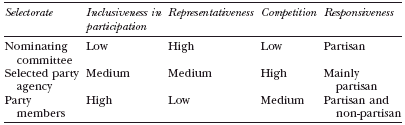
The relationships among the three kinds of selectorates and participation, representation, competition and responsiveness are presented in Table 1. Several scholars identified a negative relationship between inclusiveness in participation and representativeness, especially, but not solely, in regard to women's representation.Footnote 13 Findings about the negative relationship between decentralization and representativeness and liberal democracy and women's representation also substantiate the logic of the claim that smaller and more coordinated selectorates may better ensure representativeness than large uncoordinated selectorates.Footnote 14
The Relationships between Participation, Representativeness, Competition and Responsiveness in Three Kinds of Selectorate

As to the relationship between the inclusiveness in participation and competition, the meagre comparative analysis available points to the relationship that appears in Table 1: a relatively high level of competition when selection is conducted by selected party agencies; an intermediate level when primaries are conducted; and a low level when selection is made by a highly exclusive selectorate.Footnote 15 Evidence for the low level of competition in American (highly inclusive) primaries and research on legislative turnover seem to substantiate the claim that in cases of selection through voting (and not of nominations by small committees) the incumbents' advantage increases parallel to the increase in the size of the selectorate.Footnote 16
The claims about the kind of relationship between the inclusiveness in participation and kinds of responsiveness are based on the notion that the more inclusive candidate selection methods are, the greater both the involvement and the influence of non-party actors – interest groups, donors, campaign professionals and the mass media.Footnote 17 Obviously, these claims may be disputed, and they surely deserve additional systematic empirical re-examination against more extensive data, especially of the cross-national comparative kind.Footnote 18 Nevertheless, they do represent a wide spectrum of available empirical findings from various studies, and they should thus be seen as satisfactory for serving as our guidelines in the discussion below. Moreover, even if we do not accept all the claims that appear in Table 1, the very idea that there is a trade-off – that certain selectorates can serve some goals better while other selectorates more efficiently promote other goals – is sufficient for us to accept the logic of the recommended method that suggests combining several selectorates in the candidate selection process. We can thus turn to look for the optimal selectorate (or rather combination of selectorates) in terms of the four basic democratic elements: participation, representation, competition and responsiveness.
First, by definition, more inclusive selectorates allow for wider participation. Experience teaches us, however, that the price of quantity is often quality. Opening the party to wide participation in candidate selection may result in low-quality participation: turnout may be relatively disappointing; most members are ‘instant’ members, having joined for the sake of the primaries but ready to bunk the party immediately after; many members are not even supporters of the party they joined but rather did so to select a specific candidate; many of those registered are not even aware that they became members of the parties.Footnote 19 Facing these abuses, it would seem reasonable to impose some obstacles on membership participation in order to improve its quality. Conditioning participation in candidate selection on a meaningful minimal term of membership would be an important step towards fulfilling this aim. This would require parties to relinquish the show of power that is related to the success of recruiting large numbers of new members in advance of elections. This short-term payment would better serve the organizational health of the parties and the quality of intra-partisan participation in the long run. Parties, as voluntary associations, have not only the right (which the state lacks) but also the organizational imperative to sustain themselves as voluntary. In order to encourage higher, more genuine, levels of activism beyond the candidate selection event itself, they must have the ability to allocate selective incentives. When the privileges of long-time loyal activists are the same as those of new, temporary and unfaithful registrants, the differential structure of rewards in parties becomes marred.
Second, as claimed in Table 1, in a highly inclusive selectorate it would be difficult to ensure representation of the various groups and ideas that the party might be interested to represent. In contrast, a small nomination committee can craft a highly representative team of candidates. A selected party agency is somewhere in between, as it can coordinate moves to ensure minimal representation of certain groups, but lacks full control over candidacies. This seems to imply that parties should take care to adopt mechanisms for ensuring representation of certain social groups when they open their selectorates, especially when adopting primaries. This is indeed an evident trend: many parties have simultaneously adopted more inclusive selectorates while at the same time imposing some limits on them – using quotas to ensure minimal representation of women, for example.Footnote 20
It should be considered, however, that unwise use of a representation correction mechanism can hurt those who are supposed to be assisted. For example, adopting a low static quota for women's representation may in the short run create a point of entry for women into politics; but in the long run it would become the ‘private’ domain of a few women incumbents, and not of women per se. It is also likely to encourage a separate competition among women, rather than seeing their integration into the general competition, because each would (rationally) call on voters to select her and not other women should too few seats or positions be reserved for women. Such mechanisms would turn from being tools for affirmative action into mechanisms that make under-representation a self-fulfilling prophecy. Thus, wise application of representation correction mechanisms requires limiting their use to newcomers (or, at least, single-term incumbents). It is also recommended to use high quotas or progressively increasing quotas in order to avoid the undesired creation of a separate realm of women's competition. In those systems with a high level of incumbents' re-election (i.e. low legislative turnover) the use of progressively increasing quotas would help to facilitate a process of gradual replacement of male incumbents with women newcomers.
Third, as suggested in Table 1, it is expected that medium-sized selectorates (such as selected party agencies) would be the most competitive, followed by the more inclusive selectorates (party members) and finally the least inclusive selectorates (nomination committees). If a polity gets its fair amount of turnover as a result of general elections, this element might be of lesser significance for its democratic functioning, although the lack of competition within established parties may still be seen as a problem for the parties themselves. If elections do not bring turnover, if parties retain similar seat shares, or even just hold on to their seats in specific constituencies for a long time, then competition within parties becomes valuable for democracy. Here, involving a selected party agency in the selection process is likely to be a remedy. Ensuring satisfactory turnover does not necessarily imply that party agencies should be the sole selectors or that they should have the last word in selection. Rather, in order to serve the purpose of turnover, a party agency (or agencies) should be given the role of approving and rejecting incumbents' candidacies.
Finally, it is expected that legislators who are selected by an inclusive selectorate of party members will be exposed to various pressures (including non-partisan ones), which could be quite different from the party programme, and will have to be responsive to them (Table 1). Giving those activists who populate selected party agencies the exclusive power to choose the party's candidates also comes at a price. They may use their power to promote their own interests and/or may pressure the party in parliament to adhere to orthodox ideology in a way that would harm its electoral or governmental performance. Ensuring that representatives remain exclusively responsive to party leaders by selecting them through a nomination committee may result in a cohesive team, but could also mean that we end up with a bunch of yes-men and yes-women who fail to represent the range of values and interests that the party claims to represent.
It is thus plausible to argue that in order to avoid underscoring the pathologies that may result from the exclusive use of each kind of selectorate, several selectorates should be used in a way that would optimally balance between personal responsiveness on the one hand, and party cohesion on the other. This may enable us to achieve what Shugart called ‘electoral efficiency’: the translation of the will of a majority of voters into policies.Footnote 21 This conclusion also fits the suggested ‘negative’ perception of democracy as it implies the diffusion of power among several actors. This point will be further elaborated below.
The uneasy relationships (non-linear and negative) between the four dimensions – participation, representation, competition and responsiveness – lead to the conclusion that no specific kind of selectorate is necessarily more democratic than another. The evaluation of the role of each selectorate in realizing democracy depends on our expectations: do we want parties to supply an additional wide participatory arena or carefully crafted representative candidacies? Are we aiming for high competition or broad participation?
If we see the relationship between democracy within states and democracy within parties as complementary then parties, instead of investing further in participation – which is the imperative of the democratic state – may enhance other democratic dimensions.Footnote 22 In order to serve democracy, parties may need to structure participation so it will still allow for the creation of a relatively balanced list, the creation of higher levels of competition in order to offset incumbency, or for balancing responsiveness.
In short, because political parties – like other important enclaves in modern democracies (courts are the most prominent examples) – are not subject to the universal participatory prerequisite, they may be used to fine-tune other aspects of the democratic polity. As long as parties act in the framework of a democratic state that abides by the participatory prerequisite, they can contribute to enhancing democracy on other, not insignificant, dimensions, which require compensation for the price extracted at the state level by the prerequisite for universal participation.
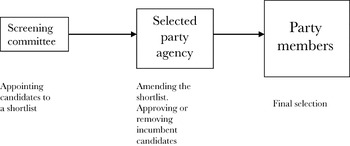
The questions ‘which is the most democratic selectorate?’ in particular and ‘which is the most democratic candidate selection method?’ in general should thus not be met with an either/or answer. Rather, as already claimed in the discussion of the issue of responsiveness, a certain integration of several selectorates in the selection process, as proposed in Figure 1, may produce an optimal balance in the fulfilment of the four different democratic goals.
Proposal for an Optimal Candidate Selection Method: A Tri-Stage Process

There are many possible ways to integrate several different selectorates in candidate selection processes. Figure 1 suggests a tri-stage process that starts with an exclusive selectorate that filters candidates and produces a shortlist; it then continues with selection by a party agency whose role is to approve or reject incumbent candidacies and that may also amend the proposed shortlist of candidates; it ends with selection by those party members who were affiliated with the party for a minimal term.Footnote 23 In terms of participation, this combination allows for meaningful participation for the wider selectorate of party members – they are the ones to conduct the final selection, to decide which candidates are positioned in safe positions/seats and which are not. At the same time, it is sensitive to the need for providing activists with selective incentives, granting them special screening authorities.
It would be hard to ensure representativeness in such a process because it ends with the voting of a large unorganized selectorate of party members that lacks the ability to coordinate the selection of women and minorities. A reasonable level of representation can still be achieved, however. First, the nominating committee should take care to produce a shortlist with more than token representatives, with enough women and minority candidates from whom party members can choose. Second, employing representation correction mechanisms, such as quotas, would ensure a minimal level of representation for such groups.
The level of competition is likely to be modest among party members. The trial for incumbents at the mid-stage – that is, the need for approval of their candidacy by the selected party agency – is likely to allow for some competition of aspirants over safe seats or positions. Furthermore, the screening of candidates in the first stages may ensure that the limited group of aspirants that stay in the contest will put up a fight against the usually victorious incumbents. That is, the lower the number of aspirants, the less diffused are those votes that are intended either to protest against incumbents or simply to refresh party representation.
The proposed tri-stage process may be a particularly optimal solution to the problems of responsiveness. That is, in order to ensure her reselection, the selected member of parliament will have to respond to the party leadership, the party agency and to the party membership, and this might create an optimal web of pressures between the personal and the partisan, between the party programme and other non-partisan interests. Having several principals might cause some confusion to the agents (the MPs), especially when such a system is first used. Yet, confusion is a worthwhile price to pay because the possible pathologies that can develop when the representative responds to a single kind of selectorate – when it is clear who the principal is – are not likely to develop in a multi-stage setting.
Combining several selectorates in the process means a diffusion of power that fits the basic principle of the ‘negative’ perception of democracy. Selection is not in the hands of a single group of actors but requires the wide consent of various possible veto players that hold significantly different views on the characteristics and behaviour of their ideal candidate(s).
CANDIDACY – INCLUSIVE OR EXCLUSIVE?
Who may stand as the candidate of a particular party? That is, what are the criteria for eligibility? A party may allow extremely inclusive candidacy, granting every voter that opportunity. But it may also set highly exclusive terms for candidacy, such as long-term party membership (five years, for example), affiliation with certain organizations, adherence to a given religious sect, and so on. More common requirements are less demanding and include a minimal length of membership prior to the presentation of candidacy and pledges of loyalty to the party. Details on candidacy requirements can be found in research literature, yet no systematic study of the issue has been conducted. Therefore, we would have to base the discussion in this section on sound theoretical considerations.
Democracy means that every citizen is equally eligible to run for office. But this does not imply that each party need allow any citizen who wishes to do so to compete for this role. First, it is the state that should take care of the right to be elected, not a specific party. Second, if everyone were eligible to compete for candidacy in all parties, the parties would lose their ability to represent competing interests, values and policy programmes. However, it should be acknowledged that (incumbent) parties are almost the sole platforms for the implementation of the basic democratic right of being elected. It therefore should not be impossible for citizens to become eligible candidates in parties that represent their values and interests. In other words, it could be argued that candidacy should be moderately conditioned in such a way that a citizen with serious political aspirations would be able to take on the challenge.
Moderate candidacy rules would also serve other purposes. They would not permit the party to become an empty vessel, a mere platform for promoting personal aspirations, but would still allow for candidacies that are beyond the standard middle-class-white-male type. Moderate limitations may also help to reduce the number of competitors in a way that would allow aspirants to challenge incumbents effectively. Such limitations can also be constructive in terms of responsiveness, as they are likely to produce candidates that share interests and values and can thus be expected to work in a cohesive way. At the same time they still allow, within certain boundaries, the existence of a variety of candidates with somewhat different perceptions of interests and values.
How does candidacy relate to the negative notion of democracy? It seems that there is not much of a direct link here. Yet, if moderate candidacy rules were to help increase competition, and at the same time still allow for a variety of meaningful representative candidacies (as argued above), then this would serve – or, at the least, would not impair – the negative notion of democracy in the sense of encouraging, or allowing, a diffusion of power within the party. In other words, real competition within the party and a variety of candidacies may allow for the creation of an intra-party arena in which there are several non-formal and sub-formal centres of power.
CENTRALIZATION VS. DECENTRALIZATION
Candidate selection methods may be seen as decentralized in two senses. Decentralization can be territorial, i.e. when local party selectorates appoint or select party candidates, such as a local leader, a local party agency, all party members or voters in an electoral district. Decentralization of the selection method can also be functional, ensuring representation for delegates of such groups as trade unions, women, minorities, and so on.
Territorial decentralization, while enabling regional and local representation, may impair attempts at securing other, non-territorial kinds of representation. If every region selects a single local representative (either for candidacy in a single-member district or for a regional list), it is hard to ensure the candidacies of women and minorities; if a team is selected, it is easier to take into account several considerations at the same time. Indeed, research demonstrates that the decentralization of candidate selection has a negative impact on women's representation.Footnote 24 As for participation and competition, it is hard to see a direct link to decentralization, although it might be argued that a decentralized system enhances the quality of participation because it brings selection closer to the relevant selectorate. As for responsiveness, once again the interest should be in balancing it, this time, between the different levels, between the national and the local (and possibly, if relevant, also the regional). Decentralization may sometimes enhance the power of local selectorates to the point that it might impair the ability of the party to work cohesively in promoting national party programmes and policies.Footnote 25 If decentralization indeed leads to too much pork-barrel politics, the national centre should be allotted some influence, in order to balance the strength of local interests.
Territorial decentralization means the dispersion of power among many sub-units of the party, and from the standpoint of the ‘negative’ perception of democracy it is surely more democratic. Nevertheless, it should be stressed that it is possible that a decentralized system would be highly oligarchic.Footnote 26 For example, if a small nominating committee were to be the sole selector of the candidates in each single-member constituency, with no say for the party central office, the method would be highly decentralized and highly exclusive at the same time.
Mechanisms such as quotas help to fulfil the democratic goal of functional representation.Footnote 27 At the same time, it can be claimed that they limit competition when they distinguish certain kinds of candidates (women, minorities) from the general crowd of candidates. However, such mechanisms can be democratically justified as long as they are perceived as temporary, intended to ensure that all contestants stand on the same starting line rather than giving any one an advantage. These mechanisms may be implemented in all kinds of selectorates, so they cannot be claimed to either limit or enhance participation. Responsiveness can be influenced by the use of certain representation correction mechanisms. If quotas are in use, then the selected candidate owes his/her selection to the same selectorate as his/her fellow members of parliament. But if certain candidates are selected only by their own kind – women candidates by women selectors, Flemish candidates by Flemish selectors, etc. – then they are expected to be more attentive to the demands of their specific groups. When dealing with issues that are relevant to his/her specific group of selectors, the representative may prefer the interests and views of that group to those of his/her party. Such deviant behaviour may serve the cause of representation, as long as it does not appear frequently and impair the parties' everyday ability to aggregate interests and work cohesively for the promotion of a compromised policy programme.
From the perspective of power dispersion, decentralization for the sake of territorial representation is not unlike decentralization for the sake of functional representation. There may be differences, however, because of the different ways that these kinds of representation are usually ensured. Mechanisms that ensure territorial representation are usually more decentralized because they mean that a selectorate in a specific district selects that district's representatives. In contrast, the mechanism usually used to ensure the representation of women (as an example of the most common group whose representation is ensured through representation correction mechanisms), the quota, is less decentralized. That is, while candidacy is decentralized when using quotas, the selectorate is not, as it is composed of both men and women.Footnote 28
VOTING SYSTEMS OR APPOINTMENT SYSTEMS? AND THEN WHICH VOTING SYSTEM?
A voting procedure is one in which votes determine whether a specific person is to be named the party's candidate in the general elections or in which they decide his or her position on the list. An appointed body of two people or more can use such a voting procedure, yet it is not considered a voting system unless two conditions are met: first, each candidate's votes must be the sole determinant of each candidacy. For example, the case in which an agreed-upon list or an allocation is ratified en bloc by a unanimous or majority vote cannot be considered a ‘voting system’. Second, the voting results must be officially used to justify and legitimize the candidacy. When these conditions are not fulfilled, then we are dealing with an appointment system. The literature almost ignores this issue. There is no systematic study of it beyond the typology of voting and nomination systems suggested by Rahat and Hazan.Footnote 29 Thus, the discussion here would be helped by the findings of the highly developed field of electoral studies.
In itself, voting is surely perceived as a more democratic procedure. Only a voting procedure allows meaningful participation of more than a few people; only voting allows for real competition among contesters for the selectors' votes. At the same time, by its very nature, voting does not allow parties to ensure balanced representation. The use of representation correction mechanisms can help to ensure minimal representation to a certain extent but, as already argued, their use is not without a price for those same groups they aim to empower.
From the perspective of the diffusion of power, voting is surely preferred because it is about dispersing the selection power among the individual selectors. The result of a voting contest is determined by aggregating individual decisions. An appointment itself means that power is concentrated in the hands of a small coordinated group. However, nomination committees are usually not closed oligarchies; rather, they are frequently composed of representatives of the major rival groups within parties and thus allow for compromises rather than for a majoritarian takeover. So it seems that democracy would be optimally served, once again, by the well-crafted use of both systems: the appointment for creating a representative shortlist, and voting for amending it, re-adopting or deselecting incumbents and for the final selection by party members.
The selection of candidates can be made by various voting systems. These can be distinguished according to their levels of proportionality, from proportional representation (for example, the single transferable vote) to semi-proportional systems (such as the limited vote) to various majoritarian methods (alternative vote, plurality vote, exhaustive ballot).Footnote 30 The decision of which of these voting methods is more democratic may be helped along by the claims of both sides in the old debate between supporters of proportional representation electoral systems and of majoritarian electoral systems.Footnote 31 Proportional representation (PR) is taken to be more representative, while majoritarian systems are claimed to lead to better governance – which in terms of parties may be parallel to cohesion. Indeed, more proportional voting systems seem to be more democratic in their treatment of representation, as they give the minority in the party a chance to be represented in parliament. Concerning responsiveness, majoritarianism seems to be a better recipe for party cohesion, inasmuch as every representative is judged by the majority of the party selectorate. PR, on the other hand, allows members to represent a minority within the party and may thus lead him or her to be responsive to a specific group rather than the party as a whole. Finally, PR voting systems may better serve the goal of checking power through its diffusion.Footnote 32
CONCLUSIONS
Using two criteria – the ‘positive’ (subdivided into four distinct elements: participation, representation, competition and responsiveness) and the ‘negative’ perceptions of democracy – led to the suggestion that a three-stage candidate selection method should be employed. In the first stage, a small committee appoints candidates to a shortlist; in the second stage, a selected party agency may add or remove candidates using a special procedure (absolute majority vote, for example) and it also ratifies the re-adoption of incumbent candidates; finally, party members select candidates for safe seats or safe list positions among the proposed candidates. This multi-stage process integrates three kinds of selectorates that make use of appointment and voting systems. The article also recommended using moderate requirements for candidacy, the use of a non-majoritarian voting method and allowing the national centre a real say in candidate selection.
The method suggested can (and should) still be tailored to the particular culture and tradition of the specific party in a given state. The proposed model allows much flexibility regarding all of its elements: the exact characteristics of the selectorates (for example, how would the composition of the nomination committee be determined? Which party agency would take part in the process? What are the specific requirements for becoming a party member?); the weight of the role of the centre vs. the regional and local organizations; the exact requirements for candidacy; and the specific voting system to be employed. The principle that should be adhered to in all cases is that of involving several selectorates in the process of candidate selection. The most democratic selection method would be a multi-stage process.
Cross suggests several contextual factors that relate to the characteristics of the electoral system, the party system, legislative behaviour, the leadership selection method and society, which should be considered when designing a candidate selection method. According to his claim, certain characteristics make a party's internal democracy more important for democracy in general in a given political system, while others reduce its importance. For example, if voters are given a full choice of candidates on the general election day – thanks to the use of an open list system – then party democracy is of less importance than if they were to have no real choice, that is, in a closed list system or single-member plurality systems.Footnote 33
Indeed, the exact design of the candidate selection method adopted by a given party in a specific state must be sensitive to contextual factors. Yet, the claim here is that the three-stage method outlined generally above would contribute to democracy in all cases, thanks to its internal logic. Moreover, this can also be the case if we adopt Cross's logic, that is, their emphasis on exclusiveness in participation. For example, returning to the issue of the nature of the electoral system, a country with a closed list system would surely benefit, in terms of participation, from allowing meaningful membership participation, as the three-stage method allows. However, in a country with an open list system, the benefit would be even larger: party voters would select members of parliament from the team suggested by the party selectorates (the leaders, the delegates and the final decision makers, the party members); power would be dispersed among four, rather than three, selection bodies – three selectorates and one electorate.
Parties should be treated as voluntary associations, and as such should be free to decide which candidate selection method to use.Footnote 34 Nevertheless, because candidate selection is indeed part of the chain of delegation, it is important to be able to judge whether parties use more or less democratic methods and whether they supply the system with additional democratic qualities, or rather create problems. This article provides tools to assess the level by which the candidate selection methods that are in use help to realize democratic principles. It also outlines the main characteristics of the optimal democratic candidate selection method. In any case, an assessment of the quality of democracy must take into account not only easily accessible and highly visible elements, such as electoral systems and government systems, but also the more obscure and less visible aspects of candidate selection methods.