Implications
There is a general trend toward a gradual intensification of ruminant production to meet the increasing demand for livestock products (Bouwman et al., Reference Bouwman, Van der Hoek, Eickhout and Soenario2005), which logically raises major concerns over the environmental consequences involved. Grassland intensification entails higher livestock densities and fertilizer application rates to increase soil productivity, which negatively affects the diversity of resident plant communities. Grasslands are being managed under a variety of agricultural production and conservation objectives; the question of how their biodiversity could be improved by adapting grazing management is a crucial issue, and there is demand from managers interested in interventions and policies for a synthesis of published data.
Introduction
Grassland-based sheep farming is the most common sheep production system worldwide; typical cases include lamb production systems in France and the United Kingdom, New Zealand's dairy and sheep enterprises or Mongolia's steppe system. Native grassland communities are species-rich because of low or inexistent fertilizer input and continuous long-term use as grasslands; however, a major environmental concern is grassland degradation through inappropriate management practices. Over the second half of the 20th century, there has been a substantial decline in the extent of these seminatural grasslands in countries such as the United Kingdom, Germany or France where lowland seminatural grasslands can be converted for arable use, with the remaining resource consisting of fragmented small stands (Stewart and Pullin, Reference Stewart and Pullin2008). At the same time, grazing pressure has decreased radically in Central and Eastern Europe because of competition from the West and uncertainties over land ownership, with the result that large areas have been left unmanaged (Emanuelsson, Reference Emanuelsson2008). Overall, Ostermann (Reference Ostermann1998) estimated that among the European habitats considered important for biodiversity, 65 pasture types are under threat from grazing intensification, whereas 26 are under threat from abandonment.
Plant communities and arthropod populations are highly sensitive to local field management practices and to the impact of grazing herbivores on small-scale vegetation structure (Collinge et al., Reference Collinge, Prudic and Oliver2003; Klimek et al., Reference Klimek, Richter Gen. Kemmermann, Hofmann and Isselstein2007; Marini et al., Reference Marini, Fontana, Scotton and Klimek2008). The use of fertilizers to boost grassland productivity combined with more frequent disturbances favors a relatively small number of competitive plant species at the expense of stress-tolerant species (sensu Grime, Reference Grime1979), with a consequent loss of overall floristic diversity (Tallowin et al., Reference Tallowin, Smith, Goodyear and Vickery2005; Parfitt et al., Reference Parfitt, Yeates, Ross, Schon, Mackay and Wardle2010). Diversity is also assumed to follow a unimodal response along disturbance gradients such as stocking rate or grazing intensity (Grime, Reference Grime1979; Huston, Reference Huston1994). Moderate grazing intensity is assumed to benefit plant diversity by creating a mosaic of short and tall patches with contrasting growth forms and competitive interactions (Milchunas et al., Reference Milchunas, Sala and Lauenroth1988). Spring rest from grazing is another recommendation to preserve plant species richness in grasslands, as it allows flowering, seed production and replenishment of root reserves (Eddy, Reference Eddy2002; Lunt, Reference Lunt2005). Among the mechanisms that explain higher insect diversity in lightly grazed swards, one is that the trophic interactions between plants and herbivorous insects are not disrupted, that is, tall vegetation provides important food resources in the form of nectar for butterflies and live plant biomass for caterpillars and herbivorous insects (Öckinger et al., Reference Öckinger, Eriksson and Smith2006; Dumont et al., Reference Dumont, Farruggia, Garel, Bachelard, Boitier and Frain2009). A second explanation draws on the observation that tall grassland vegetation maintains a higher number of ecological niches, decreases predation risk and increases habitat quality for species that require buffered microclimates (Dennis et al., Reference Dennis, Young and Gordon1998; Morris, Reference Morris2000; WallisDeVries et al., Reference WallisDeVries, Parkinson, Dulphy, Sayer and Diana2007). Exploiting plots during short grazing periods decreases the time grassland arthropods are exposed to disturbance compared with continuous grazing, with late grazing favoring phytophagous species that can benefit from higher food resources throughout most of the grazing season. Late grazing and fertilizer cessation can also favor pollinator abundance and species richness via positive trophic interactions with flowering plants (Carvell, Reference Carvell2002; Sjödin, Reference Sjödin2007).
Sheep differ from large ruminants in terms of their nutrient requirements relative to gut capacity, their ability to feed selectively and their slightly lower ability to digest low-quality forages (Demment and Greenwood, Reference Demment and Greenwood1988). Their behavioral adjustments in response to reduced food availability are therefore chiefly geared to maintaining the nutrient value of the diet (Hodgson et al., Reference Hodgson, Forbes, Armstrong, Beattie and Hunter1991; Dumont et al., Reference Dumont, Petit and D'hour1995; Garcia et al., Reference Garcia, Carrère, Soussana and Baumont2003). Grazing with sheep can thus lead to a dominance of grasses in temperate plant communities because of their high selectivity for legumes and forbs (Krahulec et al., Reference Krahulec, Skálová, Herben, Hadincová, Wildová and Pechácková2001; Warren et al., Reference Warren, Christal and Wilson2002). In the Pyrenees, highly selective sheep grazing also produced a strong homogenization effect but helped maintain specific plant species and communities of high conservation value (Sebastià et al., Reference Sebastià, de Bello, Puig and Taull2008). Stewart and Pullin (Reference Stewart and Pullin2008) recommended maintaining taller sward heights in sheep-grazed pastures than in pastures grazed by cattle and horses in order to maximize forb abundance and plant species richness in the Cynosurus cristatus–Centaurea nigra community. The authors pinpointed sheep selectivity and the lack of sheep-created bare ground niches compared with cattle as detrimental to biodiversity. Consistently, sheep were less likely than cattle to maintain short patches over successive years in lightly grazed mesotrophic grasslands, and could not therefore buffer the negative effects of competition for light on small-sized plants (Dumont et al., Reference Dumont, Carrère, Ginane, Farruggia, Lanore, Tardif, Decuq, Darsonville and Louault2011). Sheep have also been assumed to negatively impact nectar-dependent insect groups as a result of their preferential use of flowering plants; the species richness of bumblebees (Carvell, Reference Carvell2002) and butterflies (Öckinger et al., Reference Öckinger, Eriksson and Smith2006) is lower in sheep-grazed pastures than in similar grasslands used by cattle.
Although sheep grazing is thus rarely considered the best method for delivering conservation objectives on seminatural grasslands, the literature does not provide unequivocal evidence on the impact of sheep grazing on pasture biodiversity (Stewart and Pullin, Reference Stewart and Pullin2008). Our aim was therefore to review evidence of the impact of stocking rate, grazing period and soil fertility on plant communities and arthropod populations in sheep-grazed temperate grasslands. This review is split into two sections because of the quality and number of papers available for each section. A systematic review including a meta-analysis is presented for the effects of stocking rates of sheep on vegetation height, species composition and diversity and for the effects of grazing period and soil fertility on plant species richness. A qualitative review is presented for the effects of management practices on plant functional groups and arthropod populations and diversity.
Material and methods
Literature search and study inclusion criteria
We ran a literature search on articles published up to the end of the year 2010, using the two online databases ISI Web of Knowledge and Science Direct and the Google Scholar search engine. Search queries used the keywords ‘sheep’ and ‘grazing’ together with variables describing grassland management (either ‘stocking rate’, ‘period’, ‘season’, ‘rotational’, ‘soil fertility’ or ‘fertilization’), plant community structure (‘vegetation’, ‘sward heterogeneity’, ‘plant’, ‘plant species’ or ‘plant diversity’) or arthropod populations (‘insect’, ‘insect species’, ‘insect diversity’, ‘arthropods’, ‘Aranae’, ‘Orthoptera’, ‘Coleoptera’, ‘Lepidotera’, ‘Hymenoptera’, ‘Hemiptera’, ‘Collembola’ or ‘pollinators’). Articles were then split into three datasets in order to analyze the impact of sheep grazing on plant and arthropod diversity according to stocking rate (52 articles), grazing period (12 articles) and soil fertility (11 articles). Only studies that were easily available were included in this dataset. To reduce the risk of availability bias, we also reviewed the technical reports and PhD theses cited in the collected papers. This led us to add seven more references to the first dataset, two more to the second dataset and four more to the third dataset. Given the different reactions of plant communities to grazing intensity depending on habitat productivity (Bakker et al., Reference Bakker, Ritchie, Olff, Milchunas and Knops2006; de Bello et al., Reference De Bello, Lepš and Sebastià2006) and salinity levels (Olff and Ritchie, Reference Olff and Ritchie1998), the few data available on semiarid grasslands (Osem et al., Reference Osem, Perevolotsky and Kigel2002; Li et al., Reference Li, Hao, Zhao, Han and Willms2008; Campbell et al., Reference Campbell, Freeman, Emlen and López Ortiz2010) and marshland plant communities (Bouchard et al., Reference Bouchard, Tessier, Digaire, Vivier, Valery, Gloaguen and Lefeuvre2003; Hofmann and Mason, Reference Hofmann and Mason2006; Milotić et al., Reference Milotić, Erfanzadeh, Pétillon, Maelfait and Hoffmann2010) were excluded from this analysis. Assessment of study quality also led us to exclude surveys dealing with mixed grazing, as well as those where stocking rate could not be calculated from plot size and number of grazing days. Some redundant data were further excluded to avoid duplication bias, along with data from surveys in which only 1 year of recordings were reported. This filtering process led to the selection of 48 articles, with 42 included in the stocking rate dataset, 9 in the grazing period dataset and 10 in the soil fertility dataset.
Data extraction
The following information was registered for each reference: country and grassland type (Australia sown-fertilized grassland, United Kingdom Agrostis–Festuca grassland, etc.), grazing management, number of replicates, years since treatment application, and where available, plant species richness, plant evenness, abundance of plant functional groups (grasses, forbs, legumes, stress-tolerant species, etc.) and species richness and abundance of the different arthropod taxa. Stocking rate was estimated by multiplying ‘instantaneous’ stocking density by number of grazing days, and translated into livestock unit days per hectare, while specifying grazing management (continuous, spring grazing, target sward height, etc.). Grazing period was analyzed by factoring in the four following groups: ‘ungrazed’, ‘early grazing’ when there was spring grazing, ‘late grazing’ when the first period of grazing occurred during summer or autumn and ‘continuous grazing’ when pastures were grazed for at least three seasons. Soil fertility was analyzed by selecting articles in which either the same plant community received different levels of mineral fertilization or pastures with plant communities that indicate different levels of fertility (Agrostis-Festuca v. Nardus-Festuca) were directly compared. Each treatment was given a global score and then aggregated into three groups along a soil fertility gradient: poor or moderate soil fertility without any mineral fertilization (poor fertility), rich soil fertility without mineral fertilization or moderately fertilized seminatural grasslands (moderate fertility) and rich soil fertility with high added mineral fertilization (high fertility).
Statistical analysis
A meta-analysis was conducted to analyze the effect of stocking rate on sward surface height, plant species richness, and the Shannon index as an indicator of plant community evenness. Only the mean values were used in the meta-analysis. We chose not to weight the data in terms of a measure of their ‘importance’, as (i) there is no unique criterion for the importance of a study (dispersion of data, number of replicates, duration of the survey, etc.), (ii) data dispersion, when available, was reported in different ways and estimated either from raw data or from statistical models (s.d., s.e.m., s.e.d., etc.) and (iii) using any weighting criterion would have led to the exclusion of further data, thus generating a higher risk of selection bias in this relatively small dataset.
The impact of stocking rate on mean SSH (in cm) was analyzed using the nonlinear mixed model of the SAS software package (1999) with an equation

where a is the asymptote of the curve, b is the mean SSH of ungrazed plots, Si is the effect of experiment i (random effect) and c is the slope coefficient, with stocki expressed in livestock unit days per hectare in experiment i. Integral approximation was performed with the adaptive Gauss–Hermite quadrature method. In a preliminary adjustment step, parameter ‘a’ systematically converged to zero (its lower limit), and was thus removed from subsequent adjustments.
Data on plant species richness and the Shannon index were analyzed using Minitab (v.14) with a GLM, with stocking rate and its quadratic component as classes and experimental treatments in the different articles as factors. Finally, the effects of grazing period and soil fertility on plant species richness were tested using the nonparametric Friedman test. The effect of management practices on the abundance of plant functional groups and on arthropod populations was studied via qualitative analysis, as there was insufficient data for a meta-analysis.
Results
Impact of stocking rate
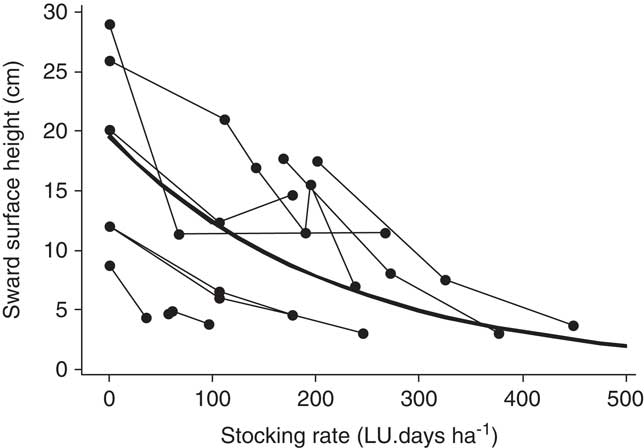
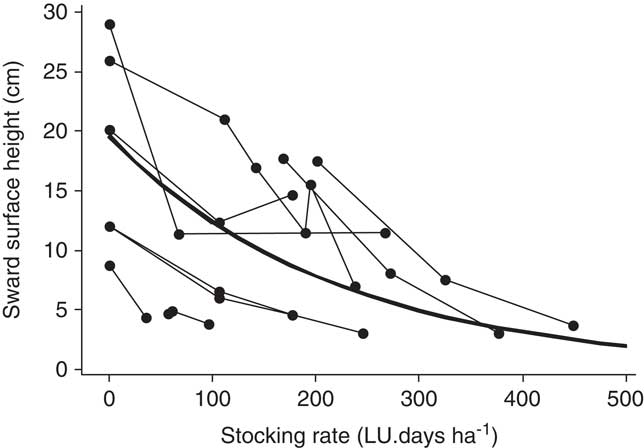
Decreasing stocking rate in our set of seminatural or fertilized temperate pastures led to an increase in the mean SSH (Figure 1):
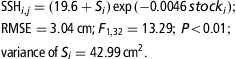
Effect of stocking rate (stocki), expressed in livestock days per hectare (LU days per ha), on mean sward surface height (SSHi ,j) in temperate grasslands. SSHi ,j was expressed in cm, based on a nonlinear regression of the equation: SSHi ,j = (19.6 + Si) exp (−0.0046.stocki); RMSE = 3.04; F 1.32 = 13.29; P < 0.01. Data are from Keiller et al. (Reference Keiller, Buse and Cherrett1995), Treweek et al. (Reference Treweek, Watt and Hambler1997), Dennis et al. (Reference Dennis, Young and Gordon1998), Zhou et al. (Reference Zhou, Tang, Zhao and Zhou2006), Scimone et al. (Reference Scimone, Rook, Garel and Sahin2007) and Mayer et al. (Reference Mayer, Kaufmann, Vorhauser and Erschbamer2009).
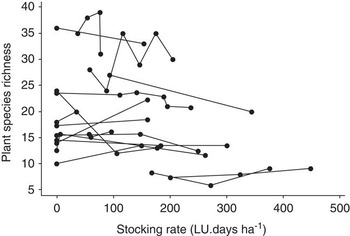
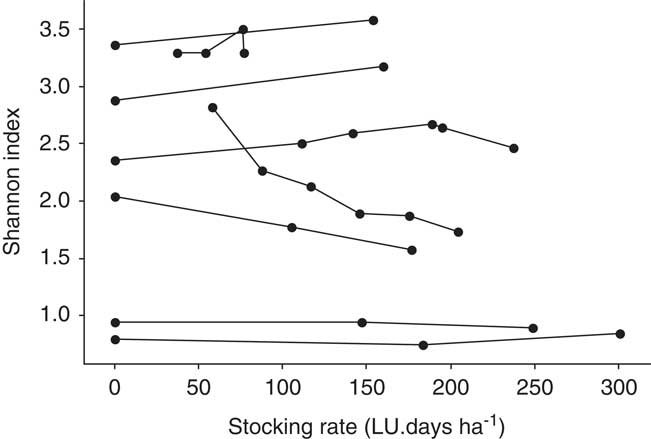
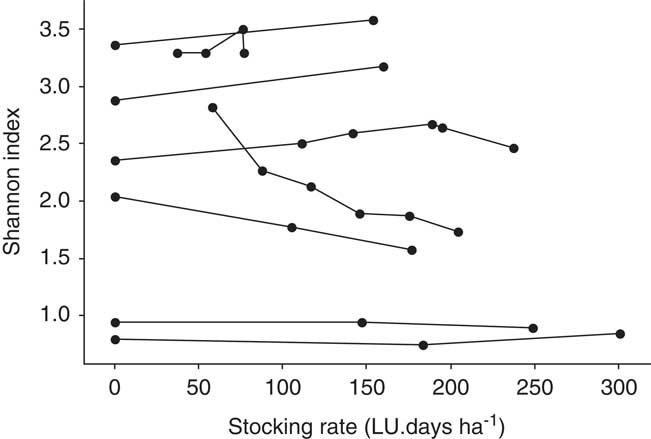
Conversely, we did not find a global effect of stocking rate on plant species richness (F 1.47 = 0.31; P = 0.58; Figure 2), despite significant effects in some experiments showing evidence of a detrimental effect of intensive grazing (Bullock et al., Reference Bullock, Franklin, Stevenson, Silvertown, Coulson, Gregory and Tofts2001; Dorrough et al., Reference Dorrough, Ash and McIntyre2004; Louault et al., Reference Louault, Pillar, Aufrère, Garnier and Soussana2005) or of grassland abandonment (Fothergill et al., Reference Fothergill, Davies, Morgan, Jones and Rees2002; Sebastià et al., Reference Sebastià, de Bello, Puig and Taull2008), as predicted by the unimodal response of diversity along disturbance gradients (Grime, Reference Grime1979). After a change in grazing intensity, species abundance changes more rapidly than plant species richness (Marriott et al., Reference Marriott, Bolton, Barthram, Fisher and Hood2002; Louault et al., Reference Louault, Pillar, Aufrère, Garnier and Soussana2005; Scimone et al., Reference Scimone, Rook, Garel and Sahin2007). However, we could not find any global effect of stocking rate on the Shannon index (F 1.30 = 0.06; P = 0.81; Figure 3) or other indicators of plant community evenness (log normal diversity index: Bullock et al., Reference Bullock, Franklin, Stevenson, Silvertown, Coulson, Gregory and Tofts2001; Simpson dominance index: Scimone et al., Reference Scimone, Rook, Garel and Sahin2007).
Effect of a stocking rate gradient, expressed in livestock days per hectare (LU days per ha), on plant species richness in temperate grasslands. Data are from Dutoit et al. (Reference Dutoit, Alard, Lambert and Frileux1995); Dennis et al. (Reference Dennis, Young, Howard and Gordon1997), Treweek et al. (Reference Treweek, Watt and Hambler1997), Carvell (Reference Carvell2002), Dorrough et al. (Reference Dorrough, Ash and McIntyre2004), Louault et al. (Reference Louault, Pillar, Aufrère, Garnier and Soussana2005), Del Pozo et al. (Reference Del Pozo, Ovalle, Casado, Acosta and de Miguel2006), Zhou et al. (Reference Zhou, Tang, Zhao and Zhou2006), Scimone et al. (Reference Scimone, Rook, Garel and Sahin2007), Gross et al. (Reference Gross, Bloor, Louault, Maire and Soussana2009), Marriott et al. (Reference Marriott, Hood, Fisher and Pakeman2009), Mayer et al. (Reference Mayer, Kaufmann, Vorhauser and Erschbamer2009), Meisser and Chatelain (Reference Meisser and Chatelain2010) and Dumont et al. (Reference Dumont, Carrère, Ginane, Farruggia, Lanore, Tardif, Decuq, Darsonville and Louault2011).

Effect of a stocking rate gradient, expressed in livestock days per hectare (LU days per ha), on plant Shannon index in temperate grasslands. Data are from Dutoit et al. (Reference Dutoit, Alard, Lambert and Frileux1995), Dennis et al. (Reference Dennis, Young, Howard and Gordon1997), Louault et al. (Reference Louault, Pillar, Aufrère, Garnier and Soussana2005), Del Pozo et al. (Reference Del Pozo, Ovalle, Casado, Acosta and de Miguel2006), Zhou et al. (Reference Zhou, Tang, Zhao and Zhou2006), Gross et al. (Reference Gross, Bloor, Louault, Maire and Soussana2009), Marriott et al. (Reference Marriott, Hood, Fisher and Pakeman2009) and Meisser and Chatelain (Reference Meisser and Chatelain2010).
Qualitative review indicated that grazing abandonment rapidly changed plant species composition over a wide range of plant communities, such as ryegrass/white clover sown swards (Marriott et al., Reference Marriott, Bolton, Barthram, Fisher and Hood2002) or Lolium perenne–Agrostis capillaris-dominated pasture (Fothergill et al., Reference Fothergill, Davies, Morgan, Jones and Rees2002). Legumes dropped in abandoned grasslands (Dutoit et al., Reference Dutoit, Alard, Lambert and Frileux1995; Gross et al., Reference Gross, Bloor, Louault, Maire and Soussana2009). A reduction in plant community evenness was also reported in the Arrhenatherum eletius–Bromus erectus community (Moog et al., Reference Moog, Poschlod, Kahmen and Schreiber2002) and in calcareous grasslands (Dutoit et al., Reference Dutoit, Alard, Lambert and Frileux1995). In upper alpine grasslands, stress-tolerant species, plants with low nutritive value and mosses declined after sheep exclusion (Mayer et al., Reference Mayer, Kaufmann, Vorhauser and Erschbamer2009). In contrast to abandonment, reported changes in species composition were much slower when stocking rate was manipulated (Hulme et al., Reference Hulme, Pakeman, Torvell, Fisher and Gordon1999; Marriott et al., Reference Marriott, Fothergill, Jeangros, Scotton and Louault2004; Scimone et al., Reference Scimone, Rook, Garel and Sahin2007). This was, for example, the case over the first 5 years of measurements in extensively used ryegrass/white clover sown swards (Marriott et al., Reference Marriott, Bolton, Barthram, Fisher and Hood2002), although this last survey did find long-term patterns with A. capillaris, Poa trivialis, Festuca rubra and Holcus lanatus being favored by a reduction in stocking rate, whereas more competitive or ruderal species such as T. repens and Poa annua increased with increasing stocking rate (Marriott et al., Reference Marriott, Hood, Fisher and Pakeman2009). In other mesotrophic grasslands typical of agriculturally improved sites, competitive and ruderal species such as L. perenne, Taraxacum officinale and Cerastium fontanum also performed better in heavily grazed plots, whereas Agrostis stolonifera, Dactylis glomerata, F. rubra and Trifolium pratense all benefited from a reduction of grazing intensity (Bullock et al., Reference Bullock, Franklin, Stevenson, Silvertown, Coulson, Gregory and Tofts2001). Many native species declined with grazing in an Australian temperate grassland, even when grazing was restricted to less than 20 days/year. Only a few native species persisted in year-round set-stocked plots (Dorrough et al., Reference Dorrough, Ash and McIntyre2004).
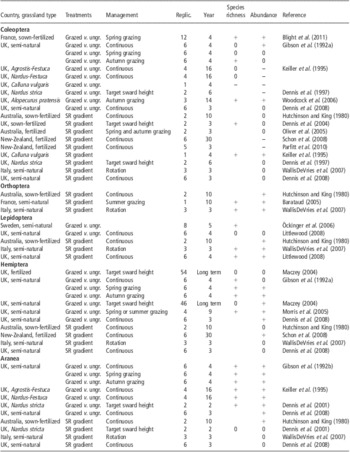
The effect of decreasing stocking rate on arthropod populations was usually consistent across sites, despite broad between-site variation in insect community structure and composition. Phytophagous and epigeal species negatively reacted to the decrease in herbage biomass in heavily grazed plots. Grasshoppers benefited from a decrease in grazing intensity in various types of sheep-grazed pastures (Table 1). Hemiptera, comprising phytophagous Auchenorrhyncha and mixed feeders plus carnivorous true bugs, differ in ecological requirements and may thus have shown inconsistent responses to changes in grazing intensity (Gibson et al., Reference Gibson, Brown, Losito and McGavin1992a). However, we found a general positive trend with abundance and species richness increasing along decreasing stocking rate gradients (Table 1). Spider abundance and species richness were also higher in ungrazed than in grazed pastures (Table 1). This could be related to increased prey availability and to tall and more complex vegetation structures benefiting web-building species. Different grazing intensities did not further affect spider abundance in three seminatural grasslands (Dennis et al., Reference Dennis, Young and Bentley2001; WallisDeVries et al., Reference WallisDeVries, Parkinson, Dulphy, Sayer and Diana2007; Dennis et al., Reference Dennis, Skartveit, McCracken, Pakeman, Beaton, Kunaver and Evans2008), whereas spider abundance progressively declined with each increase in stocking rate in an intensively grazed sown pasture (Hutchinson and King, Reference Hutchinson and King1980), where the reduction of habitat as stocking rate increased up to 30 sheep per ha was an obvious factor.
Effect of decreasing SR on the species richness and abundance of Coleoptera, Orthoptera, Lepidoptera, Hemiptera and Aranea

SR = stocking rate.
+: beneficial; 0: neutral; –: detrimental.
Replic.: number of replicates; Year: number of years since the start of treatment application; ungr.: ungrazed.
Lepidoptera benefited from low or zero grazing intensities (Table 1). In southern Sweden, there were fewer butterfly species in sheep-grazed than in abandoned seminatural grasslands, which was seen as the indirect effect of sheep selectivity for flowering plants (Öckinger et al., Reference Öckinger, Eriksson and Smith2006). High-intensity sheep grazing with 2.7 sheep per ha also produced the lowest moth abundance and species richness in an upland acid grassland; moths peaked in abandoned plots and at a low grazing intensity of 0.9 sheep per ha (Littlewood, Reference Littlewood2008). Conversely, bumblebee species richness and abundance were higher in sheep-grazed than in unmanaged grasslands (Carvell, Reference Carvell2002). This was the consequence of a greater diversity and abundance of flowering plants such as T. pratense, which is considered an important food resource for bumblebees.
The Coleoptera assemblage showed different trends across sites, and Coleoptera abundances were consequently not systematically higher in lightly grazed plots (Table 1). This could be explained by the diverse range of feeding strategies found in the Coleoptera order, ranging from herbivorous to coprophagous and predatory species among the carabid and staphylinid beetles. Coleoptera species richness was, however, favored by a reduction of stocking rate in half of the ten surveys (Table 1) and unaffected by grazing intensity in four more sites. The only detrimental effect was reported in a Calluna vulgaris moorland 4 years after grazing cessation (Keiller et al., Reference Keiller, Buse and Cherrett1995).
Collembola belongs to the hypogeal fauna but can be indirectly affected by biomass accumulation via its effects on litter decomposition. The abundance of Collembola was positively correlated to herbage biomass in a fertilized grassland (Oliver et al., Reference Oliver, Garden, Greenslade, Haller, Rodgers, Seeman and Johnston2005) and consistently shot up in response to a decrease in stocking rate in another sown pasture (King and Hutchinson, Reference King and Hutchinson1976). Collembola abundance was unaffected by stocking rate in the only published survey conducted in a temperate seminatural grassland; however, this may mainly be due to pitfall traps being inadequate for sampling soil mesofauna (WallisDeVries et al., Reference WallisDeVries, Parkinson, Dulphy, Sayer and Diana2007).
Impact of grazing period
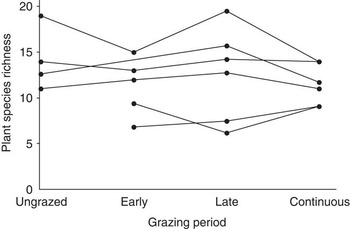
Plant species richness was greater in autumn-grazed pastures compared with ungrazed controls in the meta-analysis (P < 0.05; Figure 4). However, none of the other pair-wise comparisons were significant. This first confirms the lack of a clear effect of stocking rate on plant species richness in sheep-grazed temperate pastures (Figure 2). Second, the fact that the meta-analysis could not reveal any global benefit of late v. early grazing on plant species richness (P = 0.18; Figure 4) suggests complex responses of plant communities to sheep grazing in different seasons. Although a benefit of late grazing was measured in an Australian native pasture, in which native forbs performed better in plots that were not grazed during spring (Turner and Zimmer, Reference Turner and Zimmer2007), spring grazing increased dicot species number in a mesotrophic grassland dominated by fast-growing grasses, probably through the beneficial effects of grazing on interspecific competition (Bullock et al., Reference Bullock, Franklin, Stevenson, Silvertown, Coulson, Gregory and Tofts2001).
Effect of grazing period on plant species richness in temperate grasslands. Grazing period was ‘early’ when there was spring grazing and ‘late’ when the first grazing period occurred during summer or autumn. Data were compared with ungrazed controls and continuously grazed (i.e. grazed for at least three seasons) pastures. Data are from Bullock et al. (Reference Bullock, Franklin, Stevenson, Silvertown, Coulson, Gregory and Tofts2001), Dorrough et al. (Reference Dorrough, Ash and McIntyre2004) and Turner and Zimmer (Reference Turner and Zimmer2007).

Late grazing was assumed to favor phytophagous species such as Orthoptera, Auchenorrhyncha and herbivorous Coleoptera that can benefit from an increase in sward height or herbage biomass throughout most of the grazing season. Autumn grazing slightly increased grasshopper abundance on sown-fertilized grasslands (Branson and Haferkamp, Reference Branson and Haferkamp2003) and cricket abundance on dry grasslands (Morón-Ríos et al., Reference Morón-Ríos, Rodríguez, Pérez-Camacho and Rebollo2010). Hemiptera abundance and species richness were slightly higher in plots grazed by sheep during autumn than in spring (Gibson et al., Reference Gibson, Brown, Losito and McGavin1992a; Morris et al., Reference Morris, Clarke and Rispin2005), with Auchenorrhyncha logically benefiting from greater food resources (Morris et al., Reference Morris, Clarke and Rispin2005). Carnivorous true bugs were also more abundant in autumn-grazed than in spring-grazed plots in seminatural chalk grasslands (Gibson et al., Reference Gibson, Brown, Losito and McGavin1992a). Spider abundance was higher in autumn-grazed plots, although species richness was unaffected by grazing season (Gibson et al., Reference Gibson, Hambler and Brown1992b). Continuous grazing was the most damaging treatment for spider abundance, giving a different species assemblage. In the same experiment, spring grazing increased the abundance and species richness of Coleoptera compared with autumn grazing or spring and autumn grazing (Gibson et al., Reference Gibson, Brown, Losito and McGavin1992a). The majority of beetles recorded were legume feeders, which explains the success of spring grazing that favored small-sized legume species such as T. repens, Medicago lupulina and Lotus spp., which need light to grow (Bullock et al., Reference Bullock, Franklin, Stevenson, Silvertown, Coulson, Gregory and Tofts2001).
Impact of soil fertility
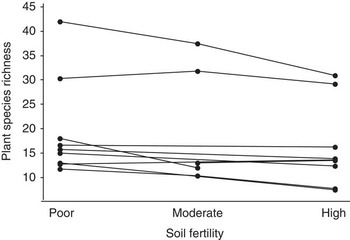
Increasing soil fertility decreased plant species richness in the meta-analysis (Figure 5), although the effect was only significant between the two most extreme treatments (high v. poor: P < 0.05; high v. moderate: P = 0.32; moderate v. poor: P = 0.32). Consistently with this pattern, mineral fertilization led to a significant 12% to 21% reduction in number of plant species in mesotrophic grasslands of northern England (Smith et al., Reference Smith, Buckingham, Bullard, Shiel and Younger1996a). Mineral fertilization reduced the cover of relatively stress-tolerant grasses (Anthoxanthum odoratum, C. cristatus) and small-stature Bellis perennis and Plantago lanceolata, whereas benefiting competitive H. lanatus and P. trivialis. Tall competitive species such as Alopecurus pratensis, D. glomerata and Rumex acetosa also benefited from mineral fertilization (Smith et al., Reference Smith, Corkhill, Shiel and Millward1996b), whereas A. capillaris, H. lanatus and T. repens decreased in fertilized swards (Marriott et al., Reference Marriott, Hood, Fisher and Pakeman2009). Fertilizer input to enhance production, although decreasing Hieracium pilosella dominance, led to a decline in overall native species richness in New Zealand's short tussock grassland (Norton et al., Reference Norton, Espie, Murray and Murray2006); in this particular case, it is hard to distinguish whether fertilizer inputs or increase in stocking densities is the greater cause of decline. Increasing fertility and grazing intensity in a low-productive plant community of southern France consistently reduced the cover of native stress-tolerant species that were gradually replaced by ruderal species (Fayolle, Reference Fayolle2008).
Effect of soil fertility on plant species richness in temperate grasslands. ‘Poor’: poor or moderate soil fertility without any mineral fertilization; ‘Moderate’: rich soil fertility without mineral fertilization or moderately fertilized seminatural grasslands; ‘High’: rich soil fertility with high additional mineral fertilization. Data are from Fothergill et al. (Reference Fothergill, Davies, Morgan, Jones and Rees2002), Maczey (Reference Maczey2004), Norton et al. (Reference Norton, Espie, Murray and Murray2006), Fayolle (Reference Fayolle2008) and Marriott et al. (Reference Marriott, Hood, Fisher and Pakeman2009).

Mineral fertilization increases herbage biomass but usually decreases plant species diversity and sward heterogeneity, which might in turn affect grassland arthropods. Only six surveys published have tackled the effects of soil fertility on arthropod diversity in sheep-grazed temperate pastures. Collembola density was higher in fertilized than in unfertilized grasslands (Oliver et al., Reference Oliver, Garden, Greenslade, Haller, Rodgers, Seeman and Johnston2005; Schon et al., Reference Schon, Mackay, Minor, Yeates and Hedley2008). This increase was positively correlated with the level of superphosphate input, resulting in an increase in vegetation ground cover and soil organic carbon and a lower soil pH in plots where the highest superphosphate levels were applied (Oliver et al., Reference Oliver, Garden, Greenslade, Haller, Rodgers, Seeman and Johnston2005). Amongst epigeal insects, Formicidae decreased in abundance in superphosphate-fertilized swards, but no further effect of the level of mineral fertilization could be detected (Oliver et al., Reference Oliver, Garden, Greenslade, Haller, Rodgers, Seeman and Johnston2005). Mineral fertilization had no effect on Auchenorrhyncha abundance but was detrimental to their species richness (Maczey, Reference Maczey2004). In an Australian native grassland, superphosphate application ranging from 5.5 to 22 kg P/ha per year slightly decreased Coleoptera abundance relative to unfertilized plots (Oliver et al., Reference Oliver, Garden, Greenslade, Haller, Rodgers, Seeman and Johnston2005), whereas an application of 34 kg P/ha per year increased their abundance in another fertilized farmlet (Parfitt et al., Reference Parfitt, Yeates, Ross, Schon, Mackay and Wardle2010). This apparently inconsistent conclusion could result from differences in Coleoptera assemblages and in sampling methods between the two experiments. At a high stocking density of 10 sheep per ha, Dennis et al. (Reference Dennis, Doering, Stockan, Jones, Rees, Vale and Sibbald2004) found no benefit of discontinuing nitrogen fertilizer application on the abundance and species richness of Carabidae and Staphylinidae in an upland sheep pasture. The species richness of different Coleoptera groups was also similar in Agrostis-Festuca v. Nardus-Festuca grasslands, but their assemblage was modified: Carabidae evenness and Elateridae abundance were higher in the less-fertile Nardus–Festuca grasslands, whereas Staphylinidae were unaffected by the plant community (Keiller et al., Reference Keiller, Buse and Cherrett1995).
Discussion
Our literature survey highlights that research on the impact of sheep grazing on biodiversity in temperate grasslands has so far focused much more on the impacts of grazing abandonment or reduced stocking rates than on the impacts of fertilizer cessation or late grazing. The meta-analysis revealed an interesting resistance by different plant community parameters to variations in stocking rate (see Figures 2–4), despite the fact that significant results are more likely to get published than nonsignificant results (i.e. the so-called ‘publication bias’). This absence of any consistent response of plant species richness and plant community evenness along a wide stocking rate gradient suggests that agri-environmental schemes based solely on reducing stocking rate are probably too crude to effectively increase plant diversity. In contrast, we found frequent shifts in functional groups or plant species abundance that could be explained by the functional properties of the plants in the community. Future decision support tools for farmers or end users should therefore take account of dominant functional types in the community in order to propose appropriate management strategies for temperate pastures (Duru et al., Reference Duru, Cruz, Al Haj Khaled, Ducourtieux and Theau2008; Farruggia et al., Reference Farruggia, Theau, Louault and Dumont2008; Cadotte et al., Reference Cadotte, Carscadden and Mirotchnick2011). Given that reducing stocking rate decreases the amount of milk or meat produced per hectare, other options will need to be tested in order to achieve biodiversity outcomes while meeting production objectives in sheep farming systems. Among the options available, choosing an appropriate grazing period appears a promising candidate, as, although the dataset was very limited, it showed that plant species richness was significantly higher in autumn-grazed pastures than in ungrazed controls. However, this overview was founded on a small number of published studies, meaning that the meta-analysis could not reveal any global benefit of late v. early grazing on plant species richness (Figure 4).
The meta-analysis confirmed that increasing soil fertility led to an overall decrease in plant species richness (Figure 5). This contrasts with the conclusions from surveys analyzing the effect of fertilizer cessation as an opportunity for restoring plant community diversity in fertile grasslands. Marriott et al. (Reference Marriott, Fothergill, Jeangros, Scotton and Louault2004) and Tallowin et al. (Reference Tallowin, Smith, Goodyear and Vickery2005) found no great difference in the structure and composition between intensive grasslands and extensive grasslands that had been managed intensively in the past. High nutrient availability is indeed a major factor limiting the restoral of greater plant diversity in temperate grasslands (Janssens et al., Reference Janssens, Peeters, Tallowin, Bakker, Bekker, Fillat and Oomes1998; Bakker and Berendse, Reference Bakker and Berendse1999; Suding et al., Reference Suding, Collins, Gough, Clark, Cleland, Gross, Milchunas and Pennings2005). Reducing nitrogen inputs to below the critical load in order to support natural and seminatural grassland communities will prove slow and costly for most intensively farmed landscapes (Bakker and Berendse, Reference Bakker and Berendse1999). A poor seed bank in intensively managed landscapes also hampers the reestablishment of ecological diversity (Poschlod and Bonn, Reference Poschlod and Bonn1998).
Recommendations for protecting grassland arthropod communities usually favor management systems designed to enable the simultaneous presence of tall and short swards that meet the ecological requirements of different functional groups (Morris, Reference Morris2000). As for plants, arthropod diversity is assumed to follow a unimodal response along grazing intensity gradients (Huston, Reference Huston1994), but the species richness of grassland insects is expected to peak in taller vegetation compared with vascular plants (Pöyry et al., Reference Pöyry, Luoto, Paukkunen, Pykälä, Raatikainen and Kuussaari2006). In line with this weaker disturbance tolerance of insects compared with plants, we highlighted positive effects of decreasing grazing intensity for Orthoptera, Hemiptera (especially phytophagous Auchenorrhyncha) and, despite a diverse range of feeding strategies, for Coleoptera species richness (Table 1). Lepidoptera, which need nectar from flowering plants, and web-building spiders, which face fewer disturbances in tall swards, also benefited from low grazing intensities or grassland abandonment (Table 1). These taxa could act as relevant indicators, as they fulfill the objectives of agri-environmental indicators (Bockstaller et al., Reference Bockstaller, Guichard, Makowski, Aveline, Girardin and Plantureux2008): the environmental impact is directly linkable to agricultural practices (stocking rate in the present case), they simplify a more complex system and are measurable, although the drawback of these direct indicators will be their high measurement costs. Finally, development of agri-environmental schemes for protecting grassland arthropods would benefit from a qualification of the relative position of species populations within their geographic distribution range, as some species have been shown to need different stocking rate regimes to maintain species’ niches in different parts of their range (Bourn and Thomas, Reference Bourn and Thomas2002).
Adding mineral fertilizer inputs has been assumed to decrease the abundance and species richness of epigeal insects, and might not be ecologically sustainable from a grassland fauna conservation standpoint (Fenner and Palmer, Reference Fenner and Palmer1998; Vickery et al., Reference Vickery, Tallowin, Feber, Asteraki, Atkinson, Fuller and Brown2001). However, we were unable to draw any firm conclusions on the benefits of fertilizer cessation or late grazing on arthropod diversity in temperate sheep-grazed pastures, especially given that much of the overview was founded on a very small number of published studies. The literature features a series of specific instances of complex grazing interactions with plant groups and arthropods, but it remains difficult to identify any robust generalizations to inform the development of agri-environment schemes liable to conserve biodiversity.
Acknowledgment
The authors thank Frédéric Glasser for his highly valuable assistance on leading the meta-analysis.