Introduction
Cowpea [Vigna unguiculata (L.) Walp.] is a versatile tropical legume grown throughout the world for pulse, vegetable, fodder and green manure. In 2018, the worldwide production of dry cowpea amounted to 7.23 million tonnes, with Nigeria, Niger, Burkina Faso and Sudan as the leading cowpea-producing countries (FAOSTAT, 2020). The cowpea grain contains about 25% protein and 64% carbohydrate (Bressani, Reference Bressani1985). In the era of climate change, cowpea is referred to as food legume of the 21st century and is recognized as a smart food owing to its superior nutritional traits. But cowpea production is significantly hampered by substantial post-harvest losses. Storage losses are primarily caused by bruchids, Callosobruchus maculatus (Fab.) and C. chinensis (L.) (Coleoptera: Bruchidae). The initial damages caused by bruchids in pulses has been estimated at 30–40%, and subsequently, it can reach up to 100% (Mahendran and Mohan, Reference Mahendran and Mohan2002). Thus, irrespective of the level of initial infestation, the insect has a devastating effect on stored grains, and infested grain lots are rendered unfit for consumption. To curtail this huge loss, the most effective strategy is to develop resistant cultivars that can minimize insect infestation. In legumes, a genotype is designated as resistant if it records low per cent seed weight loss (PSWL) and as susceptible, if the seed weight loss is significantly high. Loss in seed weight is directly correlated with the feeding activity of the insect on the particular genotype, and it is in this context that the screening of germplasm for bruchid resistance has high significance.
Resistance of a host genotype against any insect pest is manifested through non-preference, antibiosis or tolerance and it is strongly correlated with the morphological, physiological and biochemical characteristics of the germplasm (Tripathi et al., Reference Tripathi, Chauhan, Gore, Mehta, Bisht and Bhalla2017). In legumes, physical seed parameters such as seed colour, texture, size and hardness are known to play a significant role in the resistance mechanism and functions synergistically with the biochemical factors, in rendering resistance against bruchids (Appleby and Credland, Reference Appleby and Credland2003). A combination of seed traits in cultivated genotypes has been reported to lower infestation levels and thereby contribute to bruchid resistance (Tripathi et al., Reference Tripathi, Bhalla, Srinivasan, Prasad and Gautam2013). Cowpea germplasm collections are known to exhibit wide variability for seed traits (Lattanzio et al., Reference Lattanzio, Terzano, Cicco, Cardinali, Di Venere and Linsalata2005), and screening of diverse germplasm accessions is essential to identify novel sources of bruchid resistance (Carrillo-Perdomo et al., Reference Carrillo-Perdomo, Raffiot, Ollivier, Deulvot, Magnin-Robert, Tayeh and Marget2019). However, only limited efforts have been made to screen germplasm collections for their trait variability. Consequently, there are very few breeding programmes on use of cowpea germplasm for introgression of bruchid resistance. Therefore, the current study was undertaken to identify bruchid (C. maculatus) resistant/tolerant sources of cowpea from a germplasm collection of 100 diverse accessions, using artificial seed infestation protocol.
Materials and methods
Experimental materials
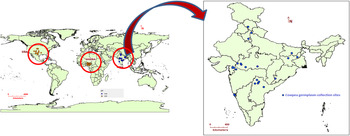
A diverse set of 100 cowpea germplasm accessions comprising landraces (52), elite lines (14), registered genetic stock (1), primitive cultivar (1) and accessions with unknown biological status (32), were obtained from the National Genebank, ICAR-National Bureau of Plant Genetic Resources (NBPGR), New Delhi, India (online Supplementary Table S1). Details of biological status and source of germplasm are available in the PGR portal developed by ICAR-NBPGR (NBPGR, 2020). Collection sites of cowpea accessions evaluated in the current study are depicted in Fig. 1. Along with the 100 accessions of cowpea, three checks viz. V-240, V-578 and Pusa Sukomal were used.
Cowpea germplasm collections sites.

Evaluation of insect parameters
The rearing of test insect, C. maculatus, was carried out on cowpea seeds of local variety at controlled temperature (28 ± 1°C) and relative humidity (65 ± 5%), in a Biological Oxygen Demand incubator, following the procedure of Tripathi et al. (Reference Tripathi, Bhalla, Srinivasan, Prasad and Gautam2013). The cowpea accessions were screened for their reaction to C. maculatus under no-choice artificial infestation conditions using a completely randomized design (Giga, Reference Giga1995). For this purpose, 20 healthy and dried seeds of each accession were weighed and placed in glass bottles covered with perforated lids, to ensure aeration. Two pairs (male and female) of freshly emerged adults from the stock cultures were released in each container, for oviposition. Each accession (20 seeds/container) was replicated five times. The insect adults inoculated in each container were removed after 72 h. Observations were recorded on the number of eggs laid, adult emergence, exit holes and loss in seed weight due to larval feeding. The number of eggs laid by the bruchid females on seeds was counted to determine the level of oviposition on each accession. Adult emergence was initiated after 25 days of infestation. Observations for emergence were recorded at a regular interval of 24 h and continued until zero emergence was recorded. The experimental seeds were weighed (X1) before releasing the insects for egg-laying and were re-weighed after the emergence of adults (X2). The loss in seed weight as a result of feeding activity of the bruchid was calculated (X1 − X2) and expressed in percentage. Other insect-associated parameters viz., mean oviposition value and number of exit holes were also calculated.
Evaluation of physical parameters of seed
Physical parameters of cowpea accessions were recorded using different descriptors such as colour (Mahajan et al., Reference Mahajan, Sapra, Umesh, Singh and Sharma2000), shape and texture (IBPGR, 1983). For assessment of texture, the seeds were examined under a stereo-binocular microscope and classified into six categories, namely (i) smooth, (ii) smooth to rough, (iii) rough-fine reticulation, (iv) rough to wrinkled, (v) wrinkled-coarse folds on the testa and (vi) smooth and shiny. Seed length and width were measured using a Vernier Callipers and expressed in millimetres (mm). Seed hardness was calculated by pressure exertion method using a Texture Analyzer at the Division of Post Harvest Technology, ICAR-Indian Agricultural Research Institute, New Delhi. The pressure was exerted on the individual grain until it cracked, and the reading at the cracking point was expressed in Newton. Seed weight was recorded by weighing 100 uniform seeds in an analytical balance and was measured in gram (g).
Estimation of total soluble sugar and total phenol
Ethanolic extract was prepared for all accessions of cowpea. For this, 100 mg of dried and powdered seeds in each sample was extracted with 5 ml of 80% (v/v) ethanol by continuous shaking for 30 min, at 60°C, in the dark. This was followed by centrifugation at 5000 rpm for 15 min, and the supernatant was collected. The process was repeated twice, using the same residue, and the supernatant was pooled and evaporated to dryness. Total soluble sugar content in the extract was determined using the anthrone reagent, with glucose as the standard (Roe, Reference Roe1955). For this, 100 μl of ethanolic extract was evaporated to dryness in test tubes, on a water bath. Residue was dissolved in 1.0 ml of water, and 4.0 ml of anthrone reagent was added. Absorbance was read at 660 nm and corrected against the blank sample. Total phenols in the ethanolic extract were estimated using the Folin–Ciocalteu (FC) reagent method (Slinkard and Singleton, Reference Slinkard and Singleton1977). For this, the ethanolic extract was re-dissolved in 1000 μl of water. To this, 200 μl of 1 N FC reagent and 2.0 ml of sodium carbonate (7%, w/v) were added. Furthermore, the contents were mixed and allowed to stand for 30 min at room temperature (25 ± 1°C) in the dark. The absorbance was measured at 750 nm using an ultraviolet–visible spectrophotometer (Molecular Devices, USA), using gallic acid (0–100 μg/ml) as the standard. Total phenolic content was expressed as gallic acid equivalent (GAE) per 100 g dry sample.
Data analysis
Statistical analysis was performed using Statistical Analysis software, Version 9.2 (SAS, 2009). Analysis of variance was carried out using PROC GLM to determine significant differences among the cowpea accessions for physical and biochemical parameters and to find out significant differences in infestation among the cowpea accessions. Simple linear correlation analysis was performed using PROC CORR to indicate the measure of correlation and strength of the relationship between physico-biochemical parameters of seed and specific life parameters of bruchids.
Results
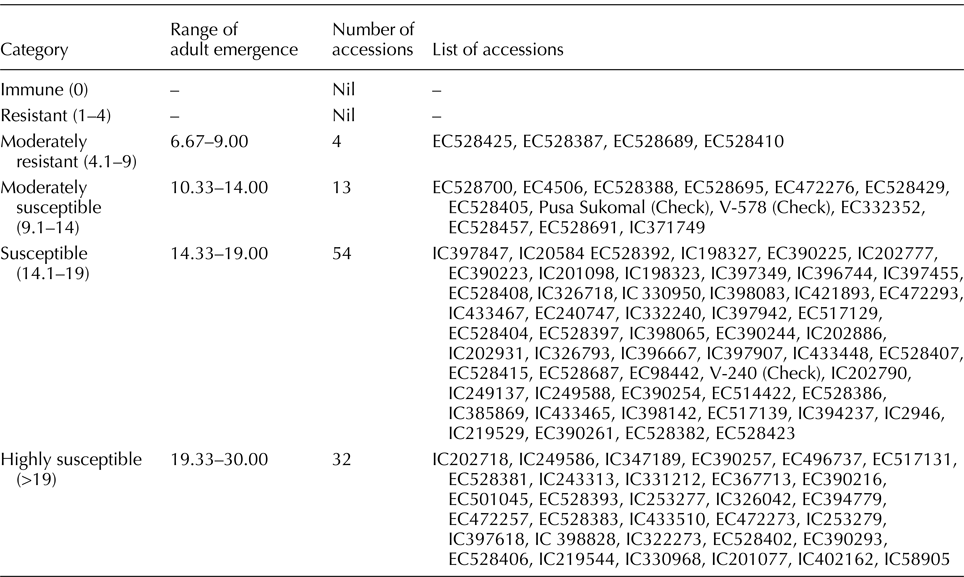
Experimental data revealed considerable variation among genotypes, in their reaction to C. maculatus under no-choice artificial infestation conditions (Table 1). There were significant differences among the accessions in terms of number of eggs laid, adult emergence, exit holes and PSWL. The number of eggs laid by C. maculatus ranged from 52.7 (EC528387) to 437 eggs/20 seeds (IC202931). Minimum number of eggs laid per 20 seeds was recorded in EC528387 (52.7) followed by IC421893(59.3), V-578 (72) and EC332352 (72.7) indicating that these accessions were least preferred for oviposition. Most preferred accession for egg-laying per 20 seeds was IC202931 (437) followed by IC58905 (431). The mean number of exit holes per 20 seeds on cowpea accessions ranged from 4 (EC528425) to 20 (EC390293). The mean adult emergence of C. maculatus ranged from 6.67 (EC528425) to 30 (IC58905). The minimum adult emergence was recorded in EC528425 (6.67) followed by EC528387 (7.67), EC528689 (8.67) and EC528410 (9) (Table 1).
Evaluation of cowpea germplasm for reaction to C. maculatus based on adult emergence (number of adults emerged)

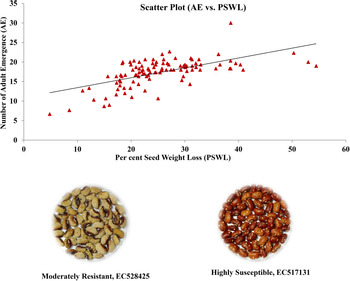
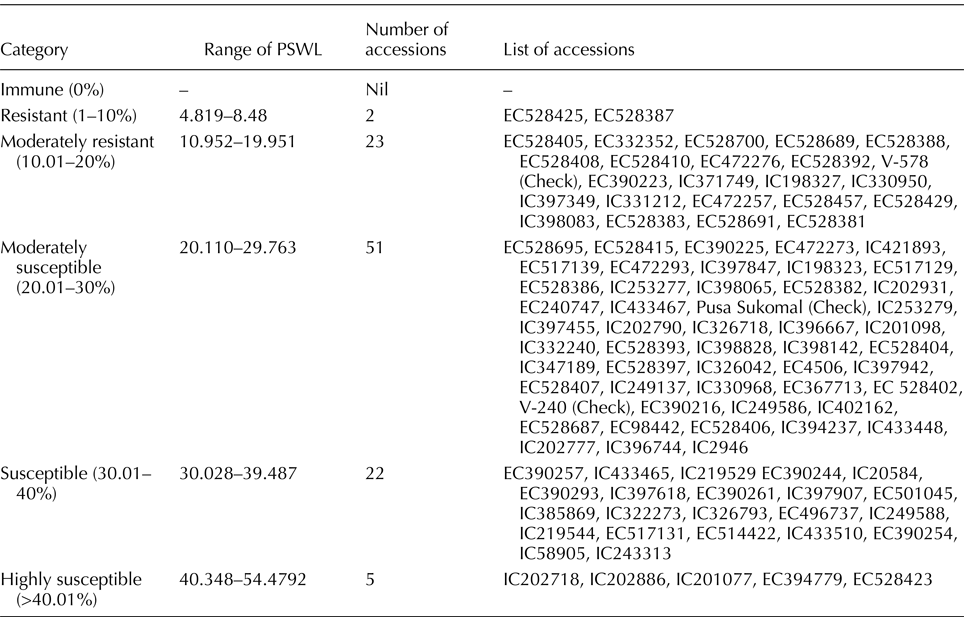
The mean PSWL varied significantly among different accessions (Table 2). It was lowest in EC528425 (4.82%) followed by EC528387 (8.48%). The highest mean PSWL of 54.48% was observed in EC528423. Accessions showing maximum seed weight loss indicated that they were highly preferred (susceptible) for feeding and accessions that recorded minimum seed weight loss were the least preferred (resistant). Cowpea accessions were categorized into resistant, moderately resistant, moderately susceptible, susceptible and highly susceptible groups based on the parameters of PSWL and adult emergence. None of the cowpea accessions were found immune to bruchid attack. However, two accessions viz., EC528425 (Fig. 2) and EC528387 were identified as resistant, based on PSWL and moderately resistant based on the adult emergence. Scatter plot showing a linear trend between two key traits viz. PSWL and adult emergence is depicted in Fig. 2.
Scatter plot showing two key traits viz. adult emergence (AE) and PSWL and representation of cowpea accessions.

Evaluation of cowpea germplasm for reaction to C. maculatus based on PSWL

Seed parameters (physical and biochemical)
Cowpea accessions varied in physical seed parameters viz., colour, shape, testa texture, length, width and hardness. The accessions were grouped into greyed purple, greyed orange, brown, yellow, white and black seed colour categories. Significant variation was observed for seed length, width and hardness. Seed length ranged from 6.67 mm (EC390254) to 15.65 mm (EC501045) and breadth ranged from 4.97 mm (EC390254 and EC528408) to 10.3 mm (EC501045). Seed roundness ranged from 0.4 mm in EC528429 to 0.89 mm (EC528382). Seed hardness ranged from 18.94 Newton (EC528429) to 149.87 Newton (Pusa Sukomal). Germplasm accessions exhibited wide variation in seed shape (kidney, globose, obtuse and round) and testa texture (smooth, smooth to rough, rough with fine reticulations and rough to wrinkled). Results indicated that the largest number of accessions were kidney-shaped (83); followed by globose and round (seven accessions each); six accessions had obtuse shape. Observation on testa texture showed that maximum accessions possessed rough texture with fine reticulations (41) followed by smooth (32), smooth to rough (24) and rough to wrinkled (6). Results of the biochemical parameters of seed indicated that per cent sugar content ranged from 0.322 (IC330950) to 1.493 (IC249137) and per cent phenol content ranged from 0.0326 (EC390261) to 1.081 (EC528423).
Correlation studies
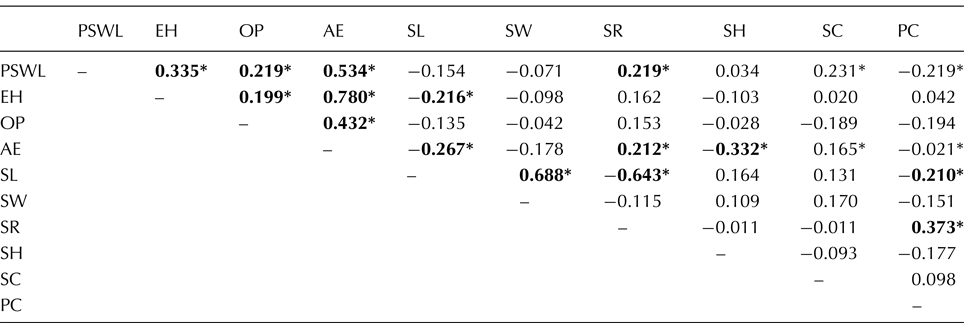
Correlation between PSWL with different growth parameters of bruchids and physico-biochemical parameters of cowpea accessions (Table 3) indicated that PSWL had significant positive correlation with exit holes (r = 0.335), oviposition (r = 0.219), adult emergence (r = 0.534) and seed roundness (r = 0.219). Correlation with biochemical parameters indicated that PSWL had a significant positive correlation (r = 0.231) with sugar content and significant negative correlation with phenol content (r = −0.219). Adult emergence had significant positive correlation (r = 0.135) with sugar content while it was negatively correlated with phenol content (r = −0.021). Adult emergence was negatively correlated with seed hardness (r = −0.332).
Correlation matrix of growth parameters (4) of bruchid and physico-biochemical parameters (6) of cowpea accessions

PSWL, per cent seed weight loss; EH, exit hole; OP, oviposition; AE, adult emergence; SL, seed length; SW, seed width; SR, seed roundness; SH, seed hardness; SC, sugar content; PC, phenol content.
*Significant at 5% level.
Discussion
Genebanks are vital for conserving germplasm and thereby, facilitating plant breeding programmes (Tanksley and McCouch, Reference Tanksley and McCouch1997; Engels, Reference Engels2002; FAO, 2010; Khoury et al., Reference Khoury, Laliberté and Guarino2010; Díez et al., Reference Díez, De la Rosa, Martín, Guasch, Cartea, Mallor, Casals, Simó, Rivera, Anastasio and Prohens2018; Mascher et al., Reference Mascher, Schreiber, Scholz, Graner, Reif and Stein2019). However, one of the major obstacles in the use of Genebank accessions is the lack of adequate characterization and evaluation data associated with the conserved germplasm (Marshall, Reference Marshall, Brown, Frankel, Marshall and Williams1989, Hodgkin et al., Reference Hodgkin, Rao, Cibrian-Jaramillo and Gaiji2003; Kell et al., Reference Kell, Marino and Maxted2017; Kehel et al., Reference Kehel, Sanchez-Garcia, El Baouchi, Aberkane, Tsivelikas, Chen and Amri2020). Hence, it is essential to evaluate accessions for the potential traits (de Carvalho et al., Reference de Carvalho, Bebeli, Bettencourt, Costa, Dias, Dos Santos and Slaski2013; Anglin et al., Reference Anglin, Amri, Kehel and Ellis2018; Byrne et al., Reference Byrne, Volk, Gardner, Gore, Simon and Smith2018). In legumes (including cowpea), information on bruchid resistance is crucial for the utilization of germplasm in crop improvement and screening of diverse germplasm is an important step to identify sources of bruchid resistance (Somta et al., Reference Somta, Somta, Tomooka, Ooi, Vaughan and Srinives2008; Upadhyaya et al., Reference Upadhyaya, Dwivedi, Ambrose, Ellis, Berger, Smýkal and Sharma2011; Carrillo-Perdomo et al., Reference Carrillo-Perdomo, Raffiot, Ollivier, Deulvot, Magnin-Robert, Tayeh and Marget2019). The current study was undertaken to screen a diverse set of cowpea germplasm comprising landraces, elite lines, registered germplasm and primitive cultivars for C. maculatus. The accessions used in this study were diverse in terms of their geographical source of origin, as well as morphological parameters. Landraces represented 52% of the experimental material. Villa et al. (Reference Villa, Maxted, Scholten and Ford-Lloyd2005) defined a landrace as ‘a dynamic population(s) of a cultivated plant that has historical origin, distinct identity and lacks formal crop improvement, as well as often being genetically diverse, locally adapted and associated with traditional farming systems’. Plant breeders often utilize landrace diversity in the development of new cultivars (Frankel et al., Reference Frankel, Brown and Burdon1998; Casañas et al., Reference Casañas, Simó, Casals and Prohens2017). They have been recognized as an important source of genetic diversity for resistance to biotic and abiotic stresses (Allard, Reference Allard1990; Brush, Reference Brush1995; Frankel et al., Reference Frankel, Brown and Burdon1998; Hoisington et al., Reference Hoisington, Khairallah, Reeves, Ribaut, Skovmand, Taba and Warburton1999; Araújo and Nass, Reference Araújo and Nass2002; Scholten et al., Reference Scholten, Green, Campbell, Maxted, Ford-Lloyd, Ambrose, Spoor, Veteläinen, Negri and Maxted2009; Maxted et al., Reference Maxted, Dulloo, Ford-Lloyd, Frese, Iriondo and de Carvalho2012, Reference Maxted, Magos and Kell2013).
In cowpea, global reports indicate the existence of very few landraces having superior bruchid resistance. Screening of more than 15,000 cowpea accessions at the International Institute of Tropical Agriculture (IITA), Nigeria, revealed only three landraces, TVu11952, Tvu11953 and Tvu2027 to be moderately resistant to C. maculatus (Srinives et al., Reference Srinives, Somta and Somta2007). Out of thousands of Vigna accessions screened for bruchid resistance, V2709 and V2802 of green gram were moderately resistant to bruchid and VM2011 of black gram was resistant to bruchid infestation (Talekar and Lin, Reference Talekar and Lin1992; Tripathy, Reference Tripathy2016). Similar results were recorded with regards to cowpea landrace Goa local having moderate resistance to C. maculatus (Nagaraja, Reference Nagaraja2006). In the current study, four landraces viz., IC330950, IC331212, IC371749 and IC397349 were found moderately resistant on the basis of PSWL. Though the number is not significant, these accessions merit utilization in breeding programmes since they would facilitate widening of genetic base in improved cultivars.
Earlier workers have also reported the differential reaction of various pulses to bruchid infestation. Tripathi et al. (Reference Tripathi, Chauhan, Gore, Prasad, Srinivasan and Bhalla2015) screened 52 accessions of cowpea to pulse beetle (C. chinensis) and observed significant differences among the accessions in terms of number of eggs laid, development period, adult emergence, number of emergence holes and seed weight loss. Kananji (Reference Kananji2007) evaluated 42 genotypes of bean for resistance to Mexican bean weevil, Zabrotes subfasciatus (Boheman) and found significant differences in grain weight loss (%) and number of adults emerged.
In the current study, the ovipositional behaviour of C. maculatus varied significantly amongst accessions of cowpea. The differential responses of C. maculatus for oviposition might be due to odour of the seed emanating from its chemical constituents (Howe and Currie, Reference Howe and Currie1964). Certain physical and chemical factors of the host seed play an essential role in regulating these responses (Gokhale and Srivastava, Reference Gokhale and Srivastava1975). Bruchids are reported to be guided in their ovipositional preferences by seed surface, colour, texture, volume, curvature (Gokhale et al., Reference Gokhale, Honda, Yamamoto, Fujii, Gatehouse, Johnson, Mitchel and Yoshida1990) and the nutritional value of seed (Satya, Reference Satya1980). Raina (Reference Raina1970) observed that the number of eggs laid on a single seed depends on the size of the host seed and the bruchid species involved. However, no correlation exists between the preferential oviposition for different seeds and the subsequent larval development.
Larval mortality is of considerable relevance in the host plant suitability, which is assessed on the basis of adult emergence (Wiklund, Reference Wiklund1973; Amusa et al., Reference Amusa, Ogunkanmi, Adetumbi, Akinyosoye and Ogundipe2018), manifested by the round exit holes carrying a ‘flap’ of seed coat formed during the exit of the insect. Manohar and Yadava (Reference Manohar and Yadava1990) studied the extent of damage by C. maculatus on 10 popular cultivars of cowpea. Of these, Udaipur-2 variety suffered the maximum loss of 44.97% in apparent weight, while Co-1 recorded the least loss of 16.25%. Obiadalla et al. (Reference Obiadalla-Ali, Salman and Abd El-Hady2007) screened 21 cultivars of cowpea for resistance to weevil, based on development assessment of various parameters. They classified them into three groups, sensitive, moderately tolerant and highly tolerant. The oviposition response and development of C. chinensis on different cowpea varieties revealed that pulse beetle preferred all the varieties for egg-laying, while differences in adult emergence and PSWL were observed (Singh and Sharma, Reference Singh and Sharma2003; Tripathi et al., Reference Tripathi, Bhalla, Srinivasan, Prasad and Gautam2013).
The seed parameters analysed in this experiment exhibited significant variations. Seed hardness, small seed size, absence of nutritional factors and presence of toxic substances are known to affect bruchid damage in leguminous seeds (Kpoviessi et al., Reference Kpoviessi, Agbahoungba, Agoyi, Chougourou and Assogbadjo2019). Wrinkled seeds are not preferred for the growth and development of beetles. Cowpea weevil prefers smooth-coated seeds to wrinkled seeds for oviposition, and first instar larvae successfully penetrate the seed coat more in smooth seeds than in rough seeds (Nwanze and Horber, Reference Nwanze and Horber1976). Erler et al. (Reference Erler, Ceylan, Erdemir and Toker2009) reported that rough (wrinkled) and thick seed coat of chickpea germplasm might be responsible for resistance to pulse beetle, C. maculatus. In our study, it was found that seed shape and testa texture of the two resistant accessions were kidney shape and rough texture, respectively. However, its contribution in resistance was not predictable as other accessions with kidney shape and with rough testa texture were susceptible/highly susceptible. In most of the cowpea accessions, the colour, texture and shape of seed had no direct influence on the resistance or susceptibility to beetles. Therefore, an absolute relationship between seed parameters and insect resistance could not be established. This might be due to the fact that the process of resistance involves morphological, physiological and biochemical mechanisms which range from simply minimizing the effect of insect attack to adversely affecting the insects' cellular processes, growth and development (Singh, Reference Singh2002). Kapila and Pajni (Reference Kapila and Pajni1989) screened seeds of 17 cultivars of Phaseolus vulgaris for resistance to Z. subfasciatus and concluded that neither size nor colour of the seeds was important for susceptibility. Similarly, Hussain et al. (Reference Hussain, Roy and Husain1997) observed that size, colour and protein content of the seeds have no influence on the susceptibility of green gram seeds to C. chinensis.
In bruchids, larva is the only feeding stage and is the most crucial stage determining the resistance/susceptibility of the cultivars. The intensity of larval feeding, measured through mean per cent loss in seed weight varied significantly among different accessions, as elaborated above, and the result is also in conformation with earlier reports. The analysis of PSWL revealed significant positive correlation (r = 0.335) with exit holes, oviposition (r = 0.219), adult emergence (r = 0.534) and seed roundness (r = 0.219). In a previous study, Tripathi et al. (Reference Tripathi, Shashi, Prasad and Kalyani2012) reported that PSWL had a positive relationship with adult emergence of C. maculatus. Correlation with biochemical parameters indicated that PSWL had a significant positive correlation (r = 0.231) with sugar content and significant negative correlation with phenol content (r = −0.219). Tripathi et al. (Reference Tripathi, Bhalla, Srinivasan, Prasad and Gautam2013) reported that phenol content had a significant negative relationship with a growth index of C. chinensis. It is widely accepted that phenolics play a vital role in protecting plants from both insect and mammalian herbivory (Corcuera, Reference Corcuera1993; Simmonds, Reference Simmonds2003). The size of seeds is also critical in ascertaining the level of resistance. Small-sized grains are known to offer more resistance to pest attack than the larger grains because the latter supply more food and space for larval growth than small-sized grains (Singh et al., Reference Singh, Agrawal and Girish1974). However, this is not universally applicable, as per studies conducted by Lephale et al. (Reference Lephale, Abraham and Victoria2012). Shangane (1.42 g) and Pan 311 (1.45 g) were among the cultivars with small seed size, yet were infested with a high number of bruchids. In contrast, Red Caloona, having relatively larger seed size, recorded minimal insect numbers. Talekar and Lin (Reference Talekar and Lin1992) also investigated characteristics of resistance to C. chinensis in two green gram and one black gram accessions and concluded that smaller seed size of the accessions was not responsible for the resistance. Comparison of seed hardness with adult emergence revealed a significant negative correlation (r = −0.332). Seed coat thickness also could not be concluded as a factor conferring resistance, as the grubs penetrated and reached the cotyledons in all the cases.
On contrary, one of the earliest studies on insect resistance by Southgate (Reference Southgate1979) had demonstrated that size and hardness of the seeds influence the adult emergence and this was further supported by Semple (Reference Semple, Semple, Hicks, Lozare and Casterman1992), wherein the size of insect population on a genotype was reported to be regulated by the reduced oviposition caused due to physical seed barriers. As per their report, the barrier may either limit access into the grain or make it unsuitable for oviposition and difficult for eggs to adhere to the seed or prevent the larva from penetrating the seed when they hatch. But, according to our study, the seed hardness or thickness, apparently do not serve the purpose of a physical barrier that can effectively prevent insect activity. It has also been reported by Pankaj and Singh (Reference Pankaj and Singh2011) that the seed morphological characters were not related to the ovipositional preference and host suitability of the insect pest, in different pulse seeds.
Conclusion
Globally, cowpea serves as an affordable source of food and nutrition. But, storage losses have emerged as major constraints in its production. Control measures such as physical, chemical and cultural methods, may not adequately deal with the problem of bruchid damage. As a result, host plant resistance is one of the most effective and sustainable measures to limit the damage of bruchid. But, the sources of resistance are very few among the commercial varieties and a paradigm shift in breeding programme is needed to ensure greater use of landraces and local germplasm to find a durable source of bruchid resistance. In our study, cowpea accessions were categorized based on the parameters of per cent loss in seed weight and adult emergence. Accessions, EC528425 and EC528387, were identified as resistant and moderately resistant, based on parameters of PSWL and number of adult emergence respectively, and have the potential for use in conventional breeding programmes, to develop resistant cultivars. No strong correlation was observed between the seed parameters and insect infestation. However, the correlation between biochemical parameters and insect infestation indicated that bruchids have the least preference for accessions with less sugar content and high phenol content. The mechanism of resistance may be due to the effect of physico-biochemical characteristics of seeds that prevent females from laying eggs or the larvae from entering into the seeds. Conclusively, the current study indicated that huge variability exists in germplasm collections, with regards to bruchid response. A combination of factors plays a role in imparting resistance or susceptibility to the bruchid. It necessitates a systematic and effective evaluation of a large number of Genebank accessions to find sustainable and durable source of resistance in cowpea.
Supplementary material
The supplementary material for this article can be found at https://doi.org/10.1017/S1479262120000180.
Acknowledgements
The authors gratefully acknowledge the support of Director, ICAR-NBPGR, New Delhi for providing the necessary facilities and Head, Division of Germplasm Evaluation for a keen interest in the study. The authors also acknowledge the role of the farmers who cultivate and manage the landraces as they are custodians of these plant genetic resources.
Conflict of interest
The authors declared that they have no conflict of interest in the content of the manuscript and study undertaken.