An alarming rise in the prevalence of antibiotic resistant gram-negative organisms, including carbapenem-resistant Enterobacteriaceae (CRE), carbapenem-resistant Acinetobacter baumannii, and carbapenem-resistant Pseudomonas aeruginosa, has occurred in the past 20 years. 1 Although recent Food and Drug Administration (FDA) approval of several novel agents active against antibiotic-resistant gram-negative organisms adds to the antibiotic armamentarium, resistance during therapy has already been reported, threatening the future efficacy of even the newest agents from a limited antibiotic pipeline and underscoring the critical need for effective antibiotic stewardship as the backbone for preserving our ability to treat these serious infections.Reference Shields, Potoski and Haidar 2 At the same time, the importance of timely, appropriate antibiotics is increasingly recognized and is particularly important for patients with septic shock.Reference Kumar, Roberts and Wood 3 Recognizing these needs and the role of antibiotic stewardship programs in optimizing antibiotic prescription, implementation of an antibiotic stewardship program (ASP) became a Joint Commission standard for acute-care hospitals in January 2017. 4
The impact of gram-negative resistance is arguably greatest in the intensive care unit (ICU) setting, where prevalence is high and clinical outcomes from these infections are especially poor.Reference Shorr, Zilberberg, Micek and Kollef 5 , Reference Weiner, Webb and Limbago 6 At the same time, ICUs are heavy utilizers of broad-spectrum antibiotics, which, as major drivers of antibiotic resistance, further fuels this dilemma.Reference Vincent, Rello and Marshall 7 Effective antibiotic stewardship is therefore critical in this population. Although the Infectious Diseases Society of America (IDSA) and the Society for Healthcare Epidemiology of America (SHEA) have jointly published guidelines for ASP implementation, recommendations informing interventions specific to the ICU population are limited.Reference Barlam, Cosgrove and Abbo 8 In this review, we discuss opportunities for antibiotic stewardship in the ICU setting, outline existing evidence, and highlight potentially impactful opportunities for future research.
Antibiotic stewardship in the ICU: Unique considerations
Intensive care units are among the heaviest consumers of antibiotics, with an estimated 70% of patients receiving antibiotics during an ICU stay.Reference Vincent, Rello and Marshall 7 This is often for good reason. Approximately one-half of all ICU patients are diagnosed with a bacterial infection, and many others without documented infections present with sepsis or septic shock, for which rapid administration of empiric broad-spectrum antibiotics is indicated.Reference Kumar, Roberts and Wood 3 , Reference Vincent, Rello and Marshall 7 Challenges to optimizing antibiotic use in these scenarios include significant overlap in clinical syndromes resulting from infectious and non-infectious conditions, including bacterial sepsis and the systemic inflammatory response syndrome; imprecision of clinical and microbiologic findings in rapidly and definitively diagnosing some ICU acquired infections; a hesitancy to de-escalate or discontinue antibiotics after initial clinical improvement; and uncertainty defining reasonable durations of therapy when the infectious diagnosis is unclear (for example, for a clinically unstable patient with negative cultures). In part due to these challenges, more than half of overall antibiotic use in the ICU may be inappropriate in indication, choice, or duration, highlighting a potentially impactful opportunity for antibiotic stewardship.Reference Cusini, Rampini and Bansal 9 , Reference Thomas, Bandali, Sankaranarayanan, Reardon and Olsen 10
As with all stewardship interventions, the goal of ICU-based antibiotic stewardship should be to optimize antibiotic use. This includes facilitating prompt administration of antibiotics among patients who need them while limiting unnecessary and potentially toxic exposure among those who do not. Recently, much national attention and debate has focused on the former, with national guidelines calling for antibiotic administration within 1 hour of sepsis or septic shock recognition. More recently, a Centers for Medicare and Medicaid Services (CMS) performance measure mandated antibiotic administration within 3 hours as part of the SEP-1 bundle.Reference Rhodes, Evans and Alhazzani 11 Although the implementation of sepsis care bundles including rapid antibiotic administration can improve sepsis-related outcomes, the benefit of this practice may be greatest among the most severely ill patients, while the benefits (and potential harms) among less severely ill patients remain incompletely understood.Reference Seymour, Gesten and Prescott 12 Given that just over half of patients initiated on antibiotics for suspected bacterial sepsis are ultimately determined to have definite or probable infections, an improved understanding of the risk–benefit ratio of rapid antibiotic administration absent complete diagnostic information and, more importantly, development of tools aiding clinicians in appropriately risk stratifying patients at presentation are needed.Reference Klein Klouwenberg, Cremer and van Vught 13 Given these knowledge gaps and the ongoing regulatory pressure related to the SEP-1 performance metric, antibiotic stewardship strategies focused on antibiotic optimization and de-escalation in the ICU setting may be particularly impactful. The following sections will outline current evidence supporting prospective audit and feedback, microbiologic diagnostic test stewardship, rapid molecular diagnostic tests, and procalcitonin-guided algorithms for antibiotic discontinuation.
Prospective audit and feedback
Prospective audit and feedback, a stewardship strategy in which antibiotic decisions are reviewed with the prescriber by the stewardship team 2–3 days after initiation with recommendations for optimization is of particular importance in the ICU. In the setting of critical illness and diagnostic uncertainty, broad-spectrum antibiotic therapy may be initiated early, but strategies are needed to refine therapeutic decisions after the clinical picture becomes clearer and additional diagnostic information becomes available. Although no studies have directly compared preauthorization and prospective audit and feedback strategies in the ICU, most reports from this setting have evaluated variations on prospective audit and feedback.Reference Elligsen, Walker and Pinto 14 – Reference Lindsay, Rohailla and Taggart 17 Elligsen et al Reference Elligsen, Walker and Pinto 14 used a before-and-after quasi-experimental study to evaluate the effect of a clinical pharmacist–driven intervention on targeted antibiotic use and patient outcomes, including mortality, length of stay, and subsequent Clostridioides difficile infection. Interventions were suggested for 37% of antibiotic orders, and 82% of these interventions were accepted. Antibiotic discontinuation and change to an alternative agent were the most common recommendations. Overall antibiotic use decreased by 22% in the postintervention period in the ICU, with no change in a control group of non-ICU patients. Furthermore, both meropenem resistance and rates of C. difficile infection decreased following the intervention. No difference in mortality or length of stay compared to historical controls was detected.Reference Elligsen, Walker and Pinto 14 Taggart et al Reference Taggart, Leung, Muller, Matukas and Daneman 15 used an interrupted time-series analysis with a control group to evaluate the effect of prospective audit and feedback on total antimicrobial prescribing in the ICU as well as secondary outcomes including pharmacy costs per patient day, C. difficile infection, ICU mortality, length of stay, and readmission. An infectious diseases–trained physician and pharmacist reviewed all antimicrobial orders and met with the ICU team daily in person to provide treatment recommendations. A significant decrease in overall antimicrobial use, which appeared to be driven by reductions in antibacterial use, and corresponding costs was noted in the trauma and neurosurgical ICUs but not the medical–surgical ICU, though this was attributed to differences in case-mix over the course of the study period. Antimicrobial use in control ICUs was unchanged or increased, and there were no significant differences in any of the secondary outcomes.Reference Taggart, Leung, Muller, Matukas and Daneman 15 Rimawi et al Reference Rimawi, Mazer, Siraj, Gooch and Cook 16 studied a similar intervention in which an infectious diseases fellow reviewed charts of all patients receiving antibiotics and discussed recommendations for optimization with the ICU team. Most recommended interventions (84%) were followed, with most interventions related to shortening duration, stopping antibiotics, or narrowing antibiotics based on culture and susceptibility results. In this before-and-after analysis, a significant decrease in total and broad-spectrum antibiotic days of therapy with a corresponding increase in narrow-spectrum penicillin days of therapy was observed, while ICU mortality was unchanged.Reference Rimawi, Mazer, Siraj, Gooch and Cook 16 Finally, and perhaps most notably, a meta-analysis pooling the results of these and other largely quasi-experimental studies demonstrated no difference in ICU mortality with implementation of a prospective audit and feedback program despite reductions in antibiotic use.Reference Lindsay, Rohailla and Taggart 17
Collectively, the available data support prospective audit and feedback as a stewardship strategy in the ICU setting that reduces antimicrobial consumption without a deleterious effect on mortality. Furthermore, the acceptability of this strategy is evidenced by the high uptake of stewardship recommendations in available reports (>80%), as well as survey data suggesting that this strategy is preferred and highly valued among intensivists.Reference Steinberg, Dresser and Daneman 18 Nevertheless, the data evaluating the effectiveness of prospective audit and feedback in this setting have significant limitations. First, the methodologic quality of these largely quasi-experimental studies is relatively low; most are uncontrolled before-and-after studies with infrequent utilization of more robust designs, such as interrupted time-series analysis with an appropriate control group.Reference Schweizer, Braun and Milstone 19 Second, the ASP resources invested across studies were variable, highlighting the need for future studies evaluating the most optimal staffing model to ensure the effectiveness and sustainability of stewardship interventions. Although this factor may vary across centers, ICU types, and patient populations, available data, including the SHEA/IDSA guideline for ASP implementation, support the need for stewardship-trained personnel instead of relying on providers to sustain effective ASP interventions, as has been demonstrated in other settings.Reference Barlam, Cosgrove and Abbo 8 , Reference Gerber, Prasad, Fiks, Localio, Bell, Keren and Zaoutis 20 In the ICU, use of appropriate empiric antibiotic therapy as well as antibiotic de-escalation among patients with ventilator-associated pneumonia (VAP) decreased following removal of a successful ASP audit and feedback intervention combined with mandatory adherence to a VAP clinical protocol, supporting the need for ongoing ASP support in the ICU setting as well.Reference Wilde, Nailor, Nicolau and Kuti 21 Third, because many of the recommendations made by the ASP are related to shortened durations of therapy or antibiotic de-escalation, additional studies are needed to inform optimal antibiotic choice and duration of therapy for common ICU infections, including culture-negative infections. Finally, although available data do not support excess mortality associated with decreased antibiotic utilization, future studies should include other patient-centered outcome measures quantifying both the efficacy and safety of antibiotic stewardship interventions in the ICU setting, including ICU length of stay, adverse drug events and toxicities, and C. difficile infection.
Diagnostic test stewardship
Diagnostic test stewardship, the practice of modifying laboratory-ordering practices such that results can most optimally inform antibiotic treatment decisions, is an emerging strategy for reducing inappropriate antibiotic use. This strategy is predicated on the idea that positive microbiologic cultures sometimes reflect clinically insignificant bacterial colonization and, when obtained absent compelling clinical signs of infection, these “positive” cultures lead to unnecessary antibiotic prescribing in uninfected patients. The potential impact of reducing unnecessary cultures and resultant inappropriate antibiotic prescribing is exemplified by asymptomatic bacteriuria, and several studies have evaluated this strategy.Reference Epstein, Edwards and Halpin 22 , Reference Trautner, Grigoryan and Petersen 23 For example, Trautner et al Reference Trautner, Grigoryan and Petersen 23 evaluated the effectiveness of a urine culture and antibiotic treatment algorithm for hospitalized medical and long-term care patients with indwelling urinary catheters. Their intervention resulted in reduced rates of both urine culture collection and antibiotic treatment for asymptomatic bacteriuria.Reference Epstein, Edwards and Halpin 22 In the ICU setting, Epstein et al Reference Epstein, Edwards and Halpin 22 showed that implementing a “reflex” urine culture protocol, in which urine cultures are performed only if pyuria is present on urinalysis, resulted in a substantial reduction in the number of urine cultures performed and the rate of catheter-associated urinary tract infection (CAUTI), though antibiotic use was not measured in this study.Reference Trautner, Grigoryan and Petersen 23
Although effectiveness data are relatively limited, diagnostic test stewardship may be a particularly impactful antibiotic stewardship strategy in the ICU given the frequency of invasive device utilization (including urinary catheters and endotracheal tubes, both of which are frequently asymptomatically colonized), and the high laboratory utilization in this setting. Future studies should focus on developing pragmatic guidelines informing optimal culturing practices for these conditions as well as evaluating the impact of these guidelines on antibiotic use and patient outcomes.
Molecular diagnostic tests
Traditional culture-based methods for diagnosis of bacteremia have a turnaround time of at least 48 hours from the time the culture is obtained to the time the causative pathogen has been identified and antibiotic susceptibilities are available. Because of the possible harm from a delay in time to adequate antibiotic therapy, empiric broad-spectrum antibiotics are often rapidly administered to critically ill patients while awaiting culture results. Molecular diagnostic tests, including polymerase chain reaction (PCR), microarray technology, fluorescent in situ hybridization (FISH), or matrix-assisted laser desorption/ionization time-of-flight mass spectrometry (MALDI-TOF MS) have the ability to provide organism identification and, in some cases, antibiotic susceptibility testing through identification of known genetic resistance determinants (eg, Klebsiella pneumoniae carbapenemase [KPC]) within hours of a positive blood culture. As a result, the interval between clinician suspicion of infection and definitive diagnosis is significantly shortened, allowing more rapid escalation of antibiotic therapy if a resistant organism is identified, as well as de-escalation when susceptibility to narrower agents is confirmed.
The clinical impact of these various platforms has been evaluated in multiple quasi-experimental before-and-after studies, meta-analyses, and a single randomized controlled trial.Reference Banerjee, Teng and Cunningham 24 – Reference Timbrook, Morton, McConeghy, Caffrey, Mylonakis and LaPlante 29 Banerjee et al Reference Banerjee, Teng and Cunningham 24 performed a randomized trial among inpatients comparing the effect of standard blood-culture processing, a multiplex PCR implemented with templated language to aid the care team in interpreting the results, and the same multiplex PCR implemented with guidance from the antimicrobial stewardship team. The multiplex PCR resulted in more rapid broadening of antibiotics in both intervention groups, but only the multiplex PCR implemented with the antibiotic stewardship intervention resulted in more rapid de-escalation of therapy. The reasons for this are likely multifactorial but driven at least in part by hesitancy of many frontline clinicians to de-escalate antibiotics in medically complex and/or severely ill patients absent expert guidance. No difference was noted in time to effective antibiotic therapy, defined as receipt of at least 1 antibiotic to which the causative pathogen was ultimately susceptible. Finally, while not powered to assess clinical outcomes, no differences were detected in hospital or ICU length of stay, mortality, or microbiologic cure.Reference Banerjee, Teng and Cunningham 24
However, several quasi-experimental before-and-after studies and a recently published meta-analyses have demonstrated reductions in length of stay and mortality as well as antibiotic use following implementation of rapid molecular diagnostic tests. Although the different conclusions reached by these reports may in part be reflective of limitations attendant to the respective study designs (ie, a randomized trial underpowered for assessment of mortality outcomes and before-and-after studies in which estimates of effect size may be biased given comparison to historical controls), the observed differences might also reflect the variable impact of rapid molecular diagnostic tests in different clinical settings.Reference Schweizer, Braun and Milstone 19 Unlike the report by Banerjee et al, in which the baseline prevalence of antibiotic resistance was low and empiric therapy was effective in 70% of patients, other studies have demonstrated significant reductions in time to effective antibiotic therapy in the intervention groups.Reference Perez, Olsen and Musick 25 – Reference MacVane, Hurst, Boger and Gnann 28 To the extent that patient outcomes are driven by receipt of appropriate antibiotics, differences in institution-specific antibiograms, and perhaps institution preferred empiric therapy may contribute to the variable impact of rapid molecular diagnostic tests across settings. Indeed, these tests may be particularly impactful tools for antibiotic escalation among populations with relatively high prevalence of antibiotic-resistant infections. For example, Perez et al Reference Perez, Olsen and Musick 25 implemented MALDI-TOF along with a 24/7 stewardship intervention, resulting in significant reductions in the time to effective antibiotic therapy, ICU length of stay, and mortality among patients with antibiotic resistant gram-negative bacteremia (approximately half of whom were hospitalized in the ICU).Reference Perez, Olsen and Musick 25 Similar studies evaluating the impact of rapid molecular diagnostic tests in patients with vancomycin-resistant Enterococcus (VRE) bacteremia have also demonstrated significant reductions in time to effective therapy, though the impact on mortality in this population has been mixed.Reference Forrest, Roghmann and Toombs 27 , Reference MacVane, Hurst, Boger and Gnann 28
Given the importance of timely, appropriate antibiotics in patients with septic shock and the relatively high prevalence of antibiotic-resistant infections in the ICU population, rapid molecular diagnostic tests may be particularly impactful as tools for antibiotic escalation in this setting. Furthermore, ICU-focused, outcome-driven studies are needed to evaluate this hypothesis. Although a 2017 meta-analysis demonstrated a mortality benefit only when rapid molecular diagnostic tests were implemented along with an ASP intervention, the optimal type and intensity of the stewardship intervention is unknown and may vary substantially depending on the choice of test and clinical setting.Reference Timbrook, Morton, McConeghy, Caffrey, Mylonakis and LaPlante 29 Finally, available studies have demonstrated reductions in broad-spectrum antibiotic use with rapid diagnostic tests, but the generalizability of these findings to the ICU setting is unknown because ICU providers may be less willing to de-escalate antibiotics in unstable patients despite availability of rapid diagnostic tests, especially without concomitant stewardship support. Noting these significant knowledge gaps, further study of the potential impact of existing rapid molecular diagnostic tests in the ICU setting, as well as evaluation of novel molecular diagnostic tests identifying bacterial species directly from blood absent (or prior to) a positive culture, have been recognized as a priority in intensive care medicine and the research campaign to improve survival after sepsis.Reference Coopersmith, De Backer and Deutschman 30 , Reference Kollef, Bassetti and Francois 31
Procalcitonin-guided antibiotic de-escalation
Procalcitonin is a calcitonin precursor synthesized in response to cytokines secreted in the presence of a bacterial infection, and as such, it is considered a relatively specific biomarker distinguishing bacterial infection from other causes of the systemic inflammatory response syndrome. Although available data generally do not support use of procalcitonin as a screening test for antibiotic initiation, procalcitonin may be valuable for antibiotic discontinuation.Reference Layios, Lambermont and Canivet 32 – Reference de Jong, van Oers and Beishuizen 35 The PROcalcitonin to Reduce Antibiotic Treatments in Acutely ill patients (PRORATA) trial, published in 2010, was a randomized controlled trial among adults with suspected bacterial infections evaluating a procalcitonin guided algorithm for both antibiotic initiation and discontinuation. Discontinuation was suggested when the procalcitonin concentration decreased by 80% of its peak value or was <0.5 μg/L. Antibiotic exposure decreased by 23% in the procalcitonin-guided group with no statistical difference in 28-day mortality. Protocol adherence was relatively low, driven in part by hesitancy to withhold or discontinue antibiotics among unstable patients despite low procalcitonin values, though the per-protocol analysis also demonstrated a reduction in antibiotic days without a detectable difference in mortality.Reference Bouadma, Luyt and Tubach 33 However, a second trial, published in 2014, failed to demonstrate a reduction in antibiotic use with a procalcitonin-guided stopping rule among patients with sepsis, though this may have reflected its more conservative recommendation for antibiotic discontinuation at a procalcitonin value of 0.1 μg/L.Reference Shehabi, Sterba and Garrett 34 Most recently, the Stop Antibiotics on Procalcitonin guidance Study (SAPS) trial evaluated a procalcitonin-guided algorithm for antibiotic discontinuation among patients with suspected bacterial infections using the same stopping criteria as the PRORATA trial. Here, a significant reduction in both days of antibiotic therapy and mortality in the procalcitonin-guided group was demonstrated, though again protocol was low.Reference de Jong, van Oers and Beishuizen 35 Although the mechanism for the observed reduction in mortality is unclear, this association is supported by data from a recently published meta-analysis including almost 4,500 patients from 11 clinical trials.Reference Wirz, Meier and Bouadma 36 Potential explanations for the mortality reduction observed with procalcitonin use included more aggressive diagnostic evaluation for and treatment of alternative noninfectious diagnoses in the setting of unexpectedly low procalcitonin values; broadening of antibiotics and/or more aggressive diagnostic evaluation for untreated bacterial infection in the setting of unexpected persistent elevations in procalcitonin value (although the results of at least 1 randomized trial would not support this hypothesis); and incompletely understood direct harms of antibiotic use.Reference Jensen, Hein and Lundgren 37
Overall, these data suggest that procalcitonin may be a safe and effective tool for antibiotic discontinuation in the ICU setting, though notably, most studies have excluded immunocompromised patients. Its use carries a weak recommendation, with moderate quality evidence in the IDSA/SHEA guidelines, which reflects concerns about the generalizability of existing data (derived largely from European centers) to US ICUs, given differences in antibiotic prescribing and stewardship practices. Although the impact of antibiotic stewardship cointervention has not been assessed, the SAPS trial was conducted in a setting with relatively low antibiotic utilization, suggesting that the impact of procalcitonin guidance may persist across settings and supporting the need for further evaluation in US ICUs. Finally, while speculative, the hypothesis that procalcitonin may reduce mortality by serving as a prompt to evaluate alternative diagnoses and discontinue ineffective and potentially toxic antibiotic therapy warrants further study. These opportunities for future study notwithstanding, intensivists should consider measuring procalcitonin at the time of antibiotic initiation and daily thereafter in immunocompetent patients with suspected bacterial infection and should consider antibiotic discontinuation when procalcitonin values that have decreased by 80% of peak value or are <0.5 μg/L.
Future directions
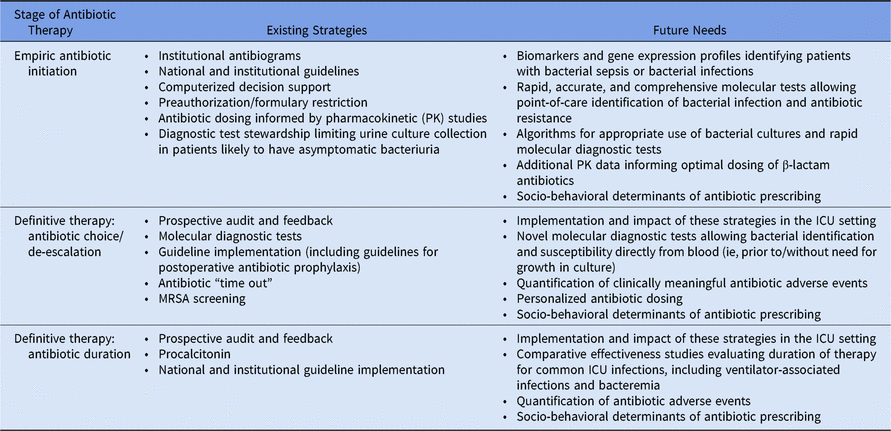
We have summarized the evidence supporting prospective audit and feedback, diagnostic stewardship, molecular diagnostic tests, and procalcitonin-guided antibiotic discontinuation algorithms as potentially efficacious stewardship strategies in the ICU setting. We have also highlighted several opportunities for future research related to each of these approaches (Table 1). Implementation science methodologies and frameworks should be leveraged to inform optimal use of each of these tools, and methodologically rigorous studies should evaluate their impact not only on antibiotic use but on patient-centered outcomes including mortality and length of stay. More broadly, however, future work should focus on an improved understanding of the drivers of unnecessary antibiotic use in the ICU setting, considering patient, provider, and institutional characteristics, the patient and population level risks associated with antibiotic use, and comparative effectiveness studies evaluating optimal antibiotic choice and duration for common infections encountered in the ICU.
Summary of Existing Stewardship Strategies Evaluated in the Intensive Care Unit (ICU) Setting and Future Priorities

Note. MRSA, methicillin-resistant Staphylococcus aureus.
At the patient level, prevalence studies suggest that inappropriately prolonged and overly broad empiric antibiotic use for culture-negative infections and respiratory infections may represent important opportunities for antibiotic optimization. Additional well-designed, multicenter studies are needed, however, to confirm these findings.Reference Cusini, Rampini and Bansal 9 , Reference Thomas, Bandali, Sankaranarayanan, Reardon and Olsen 10 Studies evaluating tools to optimize antibiotic use for these conditions may therefore be particularly impactful. Examples include the use of methicillin-resistant Staphylococcus aureus (MRSA) screening tests to limit unnecessary and potentially nephrotoxic exposure to vancomycin in patients with pneumonia as well as diagnostic stewardship to limit the acquisition of respiratory cultures from mechanically ventilated patients without evidence of VAP.Reference Parente, Cunha, Mylonakis and Timbrook 38 , Reference Willson, Kirby and Kicker 39 Furthermore, the use of novel statistical methods such as the desirability of outcome ranking (DOOR) and response adjusted for duration of antimicrobial risk (RADAR), which incorporate both the benefits and harms of antibiotic exposure into the analysis, may be particularly useful in comparative effectiveness studies evaluating antibiotic choice and duration in the ICU setting, where the prevalence of baseline organ dysfunction, comorbid medical conditions, and polypharmacy may place this population at particularly high risk for antibiotic-associated adverse events.Reference Evans, Rubin and Follmann 40 Finally, although strategies focused on antibiotic de-escalation and optimization may be more immediately acceptable and impactful, a more nuanced approach to the initial diagnosis and management of suspected sepsis, in which likelihood of bacterial infection and illness severity determine the rapidity and breadth of antibiotic administration, is critical. Clinical assessment and laboratory markers of organ dysfunction can undoubtedly aid in this risk stratification, and for non–severely ill patients, allowing time for additional diagnostic evaluation may result in identification of a noninfectious diagnosis or at very least, allow time for microbiologic cultures and other diagnostic tests to be properly conducted, thus increasing the likelihood of a definitive infectious diagnosis upon which antibiotic choice and duration (if any) can be based. For ambiguous cases, future work should focus on the role of rapid molecular diagnostic tests, novel biomarkers, and patient transcriptome analyses, which may allow differentiation of patients with bacterial sepsis from those with nonbacterial inflammatory conditions by measuring differential host gene expression in response to infectious and noninfectious triggers.Reference Timbrook, Morton, McConeghy, Caffrey, Mylonakis and LaPlante 29 , Reference Coopersmith, De Backer and Deutschman 30
On a provider level, future work should seek to understand the socio-behavioral and cultural factors driving antibiotic prescribing in the ICU setting, which may inform optimal implementation of interventions aimed at changing provider behavior.Reference Szymczak, Newland, Barlam, Tamma and Trivedi 41 Furthermore, specific training in antibiotic stewardship for intensivists may not only improve individual antibiotic prescribing but also may result in improved antibiotic stewardship interventions, led jointly with intensivists, that achieve greater sustainability. Finally, on an institutional level, risk-adjusted reporting of antibiotic days of therapy (DOT) in the ICU setting may allow meaningful benchmarking across institutions, improving upon the CDC’s standardized antimicrobial administration ratio (SAAR) by incorporating illness severity and comorbid medical conditions.Reference van Santen, Edwards and Webb 42 Quality indicators for measuring antibiotic appropriateness in the ICU beyond those related to timely antibiotics for sepsis are needed, and these could include therapeutic drug monitoring, guideline adherence, and documentation of antibiotic indication and stop date within antibiotic orders.Reference Kallen, Roos-Blom and Dongelmans 43
Conclusion
The intersection of nearly universal antibiotic use and burgeoning antibiotic resistance in the ICU setting highlight the urgent need for improved ICU-focused antibiotic stewardship with a focus on both facilitating prompt administration of appropriate antimicrobial therapy among patients with known or at high risk of true and potentially antibiotic-resistant infections, while at the same time limiting unnecessary and potentially toxic exposure among those without infections, with infections due to antibiotic susceptible organisms, or in patients who have received adequate durations of therapy. Future work should focus on generating high-quality data informing both empiric and definitive antibiotic use, as well as optimal implementation of these recommendations through well-structured ASPs. This work should be a shared priority for both infectious diseases and critical care medicine professional societies.
Author ORCIDs
Jeffrey S. Gerber, 0000-0002-3076-3186
Acknowledgments
Financial support
This work was supported by the Agency for Healthcare Research and Quality (grant no. 1K12HS026393-01 to K.C.) and the National Institutes of Health (grant no. K23AI127935 to P.D.T.).
Conflict of interest
All authors report no conflicts of interest relevant to this article.