Preferential trade liberalization is a defining feature of the current era of globalization. Debate surrounds the rapid proliferation of preferential trade agreements (PTAs) and their effect on the structure of global production. Powerful firms and industries are thought to support preferential liberalization because it lowers the cost of producing and selling abroad.Footnote 1 Governments appear acquiescent to new agreements because they signal a commitment to growth through global commerce.Footnote 2 Yet little is known about which firms primarily benefit from preferential agreements, or why. This is an important oversight, since such evidence could help explain firms’ preferences and political mobilization over international economic policy.
To gain new insights, our study examines the distributional consequences of PTAs at the firm level. This approach follows a long tradition in the international political economy literature of privileging firms as central political actors. The seminal work of Milner persuasively illustrates how the internationalization of firms reduces their support for protectionism.Footnote 3 Subsequent research incorporates firms’ preferences and economic objectives to explain variation in trade policies across industries,Footnote 4 the proliferation of North-South PTAs,Footnote 5 non-tariff responses to import competition,Footnote 6 and the formation of global supply chains.Footnote 7 In studying the consequences of trade agreements, however, the existing research largely focuses on the redistributive effects across countries and industries, rather than firms.Footnote 8 To better understand the winners and losers from PTAs within countries and industries, we assess the effects of preferential liberalization on the activities of multinational corporations (MNCs), the primary mediators of trade.Footnote 9
We expect the distributional consequences of PTAs to vary substantially across firms, even within the same industry, and for different types of MNC activities. While the establishment of foreign subsidiaries defines MNCs, the economic objectives of their foreign operations differ in systematic ways: some sell primarily to the host country while others focus on production activities for trade.Footnote 10 Our study focuses on the effects of preferential liberalization on the expansion of MNC trade-related activities. We are guided by recent theoretical and empirical contributions in international trade suggesting that firm-level differences explain participation in trade and foreign direct investment (FDI).Footnote 11 For instance, there is strong evidence that exporting firms are significantly larger and more productive than those that serve only the domestic market.Footnote 12 Drawing on these insights, we posit that PTAs will have uneven consequences even among MNCs, with the largest and most productive firms disproportionately expanding their trade with partner countries as a result of preferential tariff cuts.
Our empirical analysis relies on rich data covering the near universe of US multinational affiliates, collected by the Bureau of Economic Analysis (BEA). The BEA data are particularly useful for examining the effects of trade agreements on MNC activities because they enable us to distinguish between the two main types of FDI: trade oriented and market seeking. Specifically, the BEA data measure foreign affiliate sales by destination, including to the United States versus to the host market. Since we can observe MNC affiliate sales to the United States, we can directly test our argument about the unequal effects of US PTA cuts on those sales.
Linking the BEA data with product-level preferential tariff data from all US PTAs, we find strong evidence that preferential tariff cuts expand the trade-related sales of US MNCs. Importantly, tariff cuts disproportionately increase trade among the largest, most competitive firms. Our results are robust to using instrumental variables to account for the potential endogeneity of tariff cuts. To further explore the redistributive effects of preferential liberalization, we examine changes in the concentration of US MNC sales. Consistent with our expectations, we uncover increases in the concentration of MNC economic activity in partner countries after signing a PTA with the United States, particularly in industries with higher preferential tariff reductions. Our findings suggest that the largest, most competitive firms are the principal beneficiaries of one of the central features of PTAs: preferential tariffs.
In revealing the winners of trade agreements, our research note also contributes to studies of trade coalitions. The foundational literature considers divisions over trade policies between factors of production or industries,Footnote 13 and a growing body of work contends that firms’ varied political stances toward international economic policies within industries reflect differences in firm size, product differentiation, and in the location of firms’ global operations.Footnote 14 While we do not explicitly examine firms’ political activities, our results suggest intra-industry political divisions over PTAs. Large and productive firms engaged in offshore production are most likely to rally in their support.
Our research informs an evolving literature on the politics of trade. Traditional accounts of trade policy emphasize the tradeoffs between national welfare and interest group pressures in the implementation or liberalization of tariffs.Footnote 15 A more recent turn in the literature studies variation in the depth of trade agreements, measured as the number of market-friendly provisions such as investor protections, competition policy, or reductions in administrative barriers to trade embedded in the accord.Footnote 16 Tariff reduction and market-friendly provisions have different distributional consequences: tariff cuts disproportionately benefit large firms, whereas greater depth helps smaller companies expand trade. An important implication of this result is that firm-level characteristics (e.g., size and productivity) and differences in trade and production activities should explain variation in support for different aspects of trade liberalization. Specifically, tariff reduction may be a more salient dimension for the largest multinationals with extensive global production networks, whereas smaller companies should value provisions protecting their assets and reducing non-tariff barriers to trade and investment. More generally, debates over the politics of trade policy are best informed using evidence at the micro level. In exploring the design and consequences of trade agreements, it would therefore appear natural to focus analytical inquiry on the political and economic activities of firms.
Distributional Consequences of Preferential Liberalization
Trade agreements are a central feature of globalization and an important area of research in international political economy. Academic interest in the causes and consequences of PTAs has produced two relatively distinct bodies of literature. One group of scholars explores the effect of preferential trade agreements on trade and investment flows among participants. The evidence suggests that PTAs have substantively increased trade flowsFootnote 17 and reduced trade volatilityFootnote 18 among member countries. In addition to their effects on trade, PTAs are also deemed to promote FDI by enabling governments to commit to policies desirable to foreign investors, particularly when the PTA includes strong investment provisions and dispute-settlement mechanisms.Footnote 19 The economic consequences of preferential liberalization underscore the deep and growing linkages between foreign direct investment and trade in the global economy.
A second body of literature investigates the formation of PTAs. Scholars in this tradition focus on the economic interests and political influence of domestic constituencies. This literature extends traditional political economy models predicting factor- or sector-based trade cleavages to examine the evolving global production strategies of multinational firms. A central argument is that PTAs benefit fragmented production networks in which parts and components are produced in multiple countries and cross borders several times prior to final consumption. Barriers to trade restrict producers’ opportunities to exploit country differences in the costs of factors of production, leading firms to lobby for liberalization with countries from which they source.Footnote 20 However, in examining the empirical content of this argument, the literature does not generally account for variation within industries in firms’ capacities to invest and produce abroad, and thus cannot identify which firms most benefit from preferential liberalization.
While industry approaches are informative, greater disaggregation is desirable to the extent that firm-level differences explain firms’ participation in trade and FDI.Footnote 21 Firms integrate to varying degrees into the global economy, even within the same industry. Only the largest and most productive MNCs can afford the fixed costs (e.g., establishing and managing a plant abroad) and the variable costs (e.g., tariffs and inputs) of producing and sourcing abroad.Footnote 22 Thus, the distributional consequences of trade may be most politically relevant at the level of individual firms, rather than industries.Footnote 23
Drawing on these advances in international trade theory, our firm-level analysis seeks to paint a more comprehensive picture of the ways in which international economic institutions integrate global commerce, and to provide new insights into whose interests are most served by the recent proliferation of PTAs. In turn, by demonstrating clear winners and losers from these agreements, our study provides microfoundations for future work on the lobbying activities of MNCs over trade policy. In particular, our analysis unveils which firms are most likely to push for preferential liberalization and why.
PTAs and MNC Activities
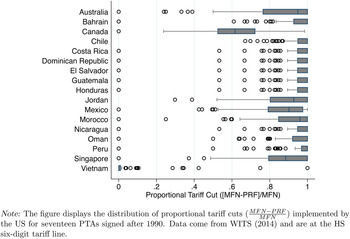
PTAs are increasingly complex arrangements that cover a host of issues, including intellectual property rights (IPRs) and investor dispute settlement.Footnote 24 While the design of the PTA is likely to play an important role in promoting economic integration, the most direct channel through which PTAs may promote trade is through a reduction in trade costs resulting from preferential tariff cuts. To illustrate the magnitude of preferential tariff cuts offered by the United States to its various trading partners, we present a box plot of the proportional tariff reductions implemented in all PTAs signed since 1990.Footnote 25 Figure 1 demonstrates that the United States reduces the large majority of its tariffs to 0 in the first year in which PTAs come into force.
Tariff reductions in US PTAs since 1990

We consider how preferential cuts affect MNC activities. The extant literature identifies two types of FDI: horizontal and vertical.Footnote 26 Horizontal FDI is market seeking: firms establish subsidiaries to serve the host market and to avoid trade barriers and other trade costs. Therefore, preferential concessions—particularly tariff cuts implemented by host markets—may reduce the economic incentives for this type of FDI.Footnote 27 In contrast, vertical (or export-oriented) FDI is resource seeking: the parent company uses its foreign affiliates to add value to goods or services that are generally exported. We expect tariff cuts to directly influence trade-related FDI activities. More specifically, since PTAs lower tariffs among partner countries on a discriminatory basis, we expect PTAs to increase trade-related sales by MNCs present in partner countries.Footnote 28
However, not all firms benefit from preferential tariffs since not all firms export.Footnote 29 Firms’ engagement in trade is explained by firm-level differences in size and productivity.Footnote 30 Productivity differences are relevant because exporters face additional trade costs, including the fixed costs of distribution and servicing, as well as variable costs such as transport, insurance, fees, and tariffs.Footnote 31 More productive firms can charge low prices even in the presence of trade costs, whereas less productive firms must charge higher prices to recoup those costs, resulting in smaller market shares. In other words, there is a self-selection into export markets because of the existence of trade costs, which only productive firms can bear while remaining profitable.Footnote 32
Having identified which firms engage in trade activities, we can now explore how trade liberalization affects these activities. When countries form PTAs, tariff cuts reduce the variable costs of trade. This reduction in costs lowers the productivity threshold that firms must meet to sell to partner countries, motivating more firms to trade with PTA partners and increasing the value of exports for current exporters.Footnote 33 By promoting trade, lower preferential tariffs thus increase competition from new and existing exporters.Footnote 34
Given differences in productivity and size, the intuition of heterogeneous firm models suggests uneven firm-level gains from preferential trade liberalization. These heterogeneous distributional consequences of trade liberalization occur through two channels. First, increasing competition leads to a reduction of prices, which, in turn, lower firms’ profits.Footnote 35 Second, as larger and more productive firms expand their sales, the demand for labor increases in the countries in which they operate; in turn, real wages rise.Footnote 36 The combination of decreasing profits and rising costs forces smaller and less productive firms to either contract or exit the market—a process known as selection or churn.Footnote 37 Since the largest and most productive firms can afford to charge lower prices and can absorb higher wages, they expand sales to liberalizing countries at the expense of smaller less-productive firms.
Thus, PTAs have uneven distributional consequences across firms, even among those within the same industry. In line with recent studies arguing that only a relatively small number of very large productive firms reap benefits from trade liberalization,Footnote 38 we expect a reallocation of sales even among MNCs, the most competitive economic actors in the world economy. To sum up, our core argument is that the largest and most productive firms will increase their trade with partner countries following the formation of PTAs.
Empirical Implications
We consider the role of intra-industry heterogeneity—in terms of affiliate size and productivity—in assessing the impact of PTAs on MNC exports. We focus on the effect of preferential tariff cuts offered by the United States on MNC affiliate sales to the US market, which are directly observable in our data. Using MNC affiliates as our unit of analysis allows us to exploit extensive within-country and within-industry variation in preferential liberalization and differences in the relative size and productivity of subsidiaries. Moreover, by exploiting the most fine-grained unit of analysis available in the data, we are able to mitigate some endogeneity concerns.
The policy mechanism through which PTAs increase trade among the most productive firms is straightforward. Lower preferential tariffs in the United States make shipping products back to the United States cheaper than shipping them to countries that are excluded from the PTA. Indeed, preferential US tariff cuts directly reduce the trade costs for affiliates selling to the home (US) market. Therefore, we should observe increases in sales from affiliates to the United States of products for which the United States implements preferential tariff cuts; these increases should scale with size and productivity.
Implication 1: Reductions in US tariffs for PTA partner countries increase sales to the United States by the largest, most productive affiliates operating in liberalized industries.
Our argument leads to a secondary implication regarding the structure of MNC activities in partner countries. While we primarily focus on the activities of firms, the implications of our argument for the concentration of MNC activity are also potentially interesting—both economically and politically. In particular, given the uneven gains from preferential trade, we should also observe increases in market concentration among US MNC affiliates in the partner country. That is, we expect the reallocation of sales from the least to the most productive firms to trigger an increase in market concentration among MNCs in their host markets. This mechanism operates through tariff reductions, which lower variable costs. In particular, after the United States implements preferential tariff cuts, larger and more productive firms should increase their market share at the expense of smaller and less productive ones.
Implication 2: The formation of PTAs between the United States and partner countries increases market concentration among US affiliates operating in partner countries through preferential tariff cuts implemented by the United States.
Data and Model Specification
We use firm-level panel data from legally mandated BEA surveys of all US multinationals. A US multinational is the combination of a single US firm, called the headquarters or parent firm, and at least one foreign business enterprise, called the foreign affiliate. We use data on nonbank foreign affiliates drawn from the benchmark-period surveys (which have the most extensive coverage) and cover 1989, 1994, 1999, 2004, and 2009. Our analysis includes affiliates in up to 163 countries—the total number of countries in which (1) US FDI was recorded by the BEA and (2) the country-level covariates are available.
Our data record detailed information on the financial and operating activities of US multinational firms and their affiliates abroad. For majority-owned affiliates, the destination of affiliate sales is also recorded, including affiliate sales to the United States and sales to the host country. Following Blanchard and Matschke, we examine affiliate sales to the United States to capture MNC trade-related activities; sales to the host country are considered horizontal FDI.Footnote 39 Our main dependent variable is the logged value of sales to the US, reported at the individual affiliate level. The affiliate-level sales data enable us to directly test our predictions about the effects of preferential tariff cuts on a specific type of activity of US MNCs, namely vertical sales.
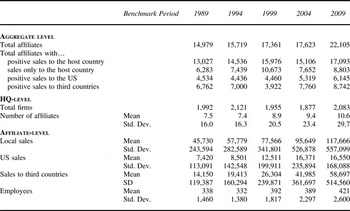
Table 1 provides a summary of US multinational activities across the five benchmark periods included in our analysis. The top panel provides aggregate counts of total affiliates as well as the number of affiliates according to the destination of sales. The table also records, at the headquarters level, the total number of firms in the analysis and the average number of affiliates of each MNC. The bottom panel provides summary statistics of our main affiliate-level variables.
Descriptive statistics of US MNC activities

Note: The sales data are reported in thousands of current US dollars.
Data on Preferential Tariffs and PTA Design
We collected new data on PTAs and PTA tariff cuts to conduct our analysis. Our tariff cuts variable is the difference between MFN and preferential tariffs.Footnote
40
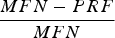
We create a variable, pta tariff cut (us), which captures the proportional tariff reduction implemented by the US with its trading partners, that is,
 $\displaystyle{{MFN - PRF} \over {MFN}}$
. This variable equals 0 for sectors in countries that have no PTA in force with the United States.
To account for differences in the institutional design of PTAs, we rely on a continuous variable (pta depth) that captures the presence of competition-enhancing provisions in PTAs.Footnote 41
Specifically, our indicator is built on forty-eight dummies that capture the presence of market-friendly provisions in a PTA, which remove behind-the-border barriers.Footnote 42 To allow for comparison with earlier work, we create a series of variables indicating membership in PTAs with the United States. The variable pta with us is a dummy coded 1 for the first benchmark period after a country signs an agreement with the United States, and 0 otherwise.Footnote 43 We include additional country-level covariates. We create dummy variables for GATT and WTO membership to account for the potential confounding effects of multilateral (MFN) liberalization. The variable bit with us captures the presence of a bilateral investment treaty. The average score of pta depth across all PTAs that a partner country has joined during the period prior to the benchmark is cumulative pta depth. Finally, we include the (log of) GDP per capita to account for host market development. Descriptive statistics appear in Table C.1 in the appendix.Footnote 44
Empirical Strategy
Our main (baseline) model is:
 $$\eqalign{{\smallcaps{\rm SALES}}_{aji,t} &= \alpha + \beta _1 {\smallcaps{\rm PTA }} \ {\smallcaps{\rm TARIFF}}\ {\smallcaps{\rm CUTS}}\ ({\rm US})_{ij,t - 1} + \beta_2\ {\smallcaps {\rm SIZE}}_{aji,t}\cr &\quad + \beta_3{\smallcaps{\rm PTA}}\ {\smallcaps {\rm TARIFF}}\ {\smallcaps {\rm CUTS}}\ \left( {\rm US} \right)_{\,ji,t - 1}\cr & \quad\times {\smallcaps {\rm SIZE}}_{aji,t} + \beta_4 \; C_{i,t - 1} + \varphi _i + \varsigma _j + \tau _t + {\varepsilon_{ajit}},} $$
where sales aji,t is the amount of sales to the US by affiliate a, in industry j, from host country i in period t. The variable pta tariff cuts (us) refers to the proportional preferential tariff cuts implemented by the United States, and size aji,t indicates the (logged) number of affiliate employees.Footnote 45 The interaction term pta tariff cuts (us) ij,t −1 × size aji,t aims to capture the nonlinear relationship between trade liberalization and sales. To further probe the hypothesis that the effect of preferential liberalization varies across firms, we examine pta tariff cuts (us) ij,t−1 interacted with productivity aji , which captures productivity at the affiliate level.Footnote 46 While productivity and size are closely related theoretically and empirically,Footnote 47 we focus on size because the data on the number of employees are available for all firms. In the models that use productivity, we lose around 6,000 observations since the BEA does not calculate value added for all firms in the sample because of data limitations.
All models include C i,t−1, a matrix including country-level controls, as well as industry ς j , country ϕ i , and period τ t fixed effects. The country-level fixed effects capture all unobserved host country and US-host-country time-invariant factors. The industry fixed effects ς j absorb omitted industry-specific determinants of affiliate activity; industry-specific institutions and policies; and, more importantly, industry-level political influence. Finally, β 1 … , and β 4 are the coefficients of interest, whereas εajit is the error term. We estimate the models using ordinary least squares, with standard errors adjusted for clustering at either the country or industry level, depending on the specification.
Results
We first estimate the influence of PTAs and preferential tariff cuts on US multinational affiliate trade-related activities. We then investigate changes in market concentration following PTAs.
PTAs and MNC Activities
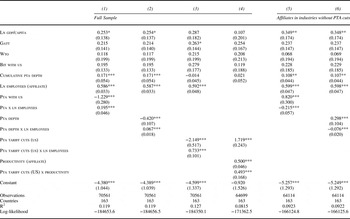
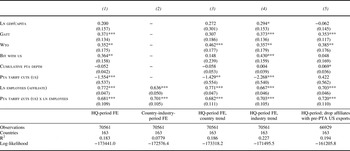
Our estimates of Equation 1 appear in Table 2. The results in column 1 indicate that sales to the United States increase for larger firms and decrease for smaller firms following a PTA with the United States. In column 2, we find a similar effect for the depth of the PTA: the more comprehensive agreements are associated with increased sales for the largest firms. While suggestive, these results using PTA presence and design mask the large observed variance in preferential tariff cuts across sectors within PTAs, which we argued are likely to affect affiliate trade-related activities.
PTAs and US MNC affiliate sales to the US, 1989–2009

Notes: The dependent variable is the log of total affiliate sales to the US based on affiliate-level data from the BEA. Robust standard errors adjusted for clustering. All models include country, period, and industry fixed effects. *p <.10; **p <.05; ***p <.01.
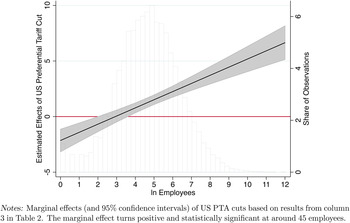
To examine the first empirical implication directly, in columns 3 and 4 we replace the PTA dummy (and PTA depth) with our measure of pta tariff cuts (us). The estimates reported in columns 3 and 4 strongly support our argument. Specifically, the estimated effects of US preferential tariff cuts on affiliate sales to the United States positively scale with affiliate size (column 3) and productivity (column 4). Figure 2 illustrates the marginal effect of a tariff cut along the range of affiliate sizes based on the estimates reported in column 3. US tariff cuts reduce the vertical sales of smaller affiliates, and the marginal effect of preferential cuts on sales turns positive and statistically significant at around forty-five employees, when a 10 percent tariff cut is associated with a 6 percent increase in sales to the United States.Footnote 48 For subsidiaries with 570 employees (around a one standard deviation above the mean of 110 employees), a 10 percent cut is associated with a 25 percent increase in sales; for entities nearing 3,000 employees (i.e., approximately two standard deviations above the mean), the estimated increase in sales is approximately 37 percent.Footnote 49 We find consistent results using a flexible estimation, allowing the interaction coefficients to vary across the employment distribution. Specifically, interactions between tariff cuts and dummy variables corresponding to employment quintiles demonstrate that cuts are associated with statistically significant increases in sales for affiliates in quintiles 2 to 5 (compared to those in the bottom quintile), and with decreases among affiliates in the bottom quintile.Footnote 50
Marginal effect of US preferential tariff cuts on US MNC exports to the US, by affiliate size

To further probe the tariff cuts mechanism, the analysis reported in columns 5 and 6 exploits selectivity in preferential liberalization by constraining our analysis to industries in which there are no tariff cuts. This allows us to shut down the tariff mechanism and examine whether other features of PTAs, such as market-friendly provisions that apply across industries, influence MNC activities after the formation of PTAs. The estimated effects are quite different. Specifically, the interaction terms (pta with us × ln employees, and pta depth × ln employees) enter with negative signs.Footnote 51 This suggests that in industries without cuts, market-friendly provisions that remove behind-the-border barriers appear to reallocate sales from the largest to the smallest affiliates. This is an area for future research.
We perform a number of robustness tests, which we report in Table 3. Our strategy is to employ panel techniques to address additional sources of potential bias. We demonstrate that our main results hold to the inclusion of HQ-period (column 1) and country-industry-period (column 2) fixed effects, which among other things, absorb firm- and industry-level political influence. We also introduce country- (column 3) and industry-specific (column 4) time trends, which test whether the parallel trends assumption holds. In column 5, we drop affiliates with positive sales to the United States prior to the PTA because these affiliates may be most likely to lobby for preferential cuts. Our results are consistent across each of these demanding tests.Footnote 52
PTAs and US MNC affiliate sales to the US, 1989–2009: Robustness tests

Notes: The dependent variable is the log of total affiliate sales to the US based on affiliate-level data from the BEA. Robust standard errors adjusted for clustering. *p <.10; **p <.05; ***p <.01.
We also estimate models at the level of the headquarters' firm by aggregating the activities of individual affiliates in each country in which the firm is present. As the dependent variable we calculate, for each multinational in our sample, the sales to the United States of each of its affiliates, in each country in which it is present. This gives us a unique value of firm sales to the United States for each MNC-country-period observation. We then estimate our main interactive models and report the results in Appendix Table C.4. The results of this analysis are consistent: the largest and most productive MNCs disproportionately increase their exports to the United States following preferential liberalization.Footnote 53
If time-varying affiliate-level characteristics are correlated with affiliate sales and tariff cuts, our models would not be correctly identified and our estimates would be biased. This concern is brought to light by previous studies exploring the political economy of preferential tariffs. In particular, Blanchard and Matschke show that preferential concessions granted by the United States are endogenous to (industry-aggregated) affiliate sales to the United States.Footnote 54
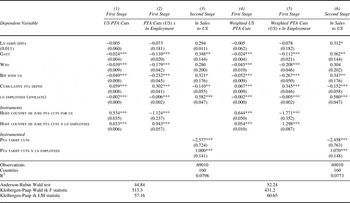
We use an IV approach to address these concerns about endogeneity. Our main strategy, detailed in the appendix, uses tariff concessions granted by partner countries during the PTA negotiations as instruments for US preferential cuts.Footnote 55 We extracted these partner-country tariff commitments from tariff schedules included in the annexes of PTA treaties signed by the United States. Our data are disaggregated at the HS six-digit level and cover more than 5,000 products for each US PTA. Importantly, we have tariff commitments for all the US PTAs. These tariff concessions are de jure. That is, they are not necessarily the same as the applied (de facto) preferential tariffs available in WITS. In line with our main explanatory variables, we operationalize de jure tariff cuts implemented by a partner country as the difference between the MFN tariff (prePTA) and preferential commitment at time zero, that is, the period in which the PTAs come into force, divided by MFN tariffs. We label this instrument host country de jure cuts.
Table 4 reports the results of IV estimations. Instrumenting US PTA tariff cuts using the cuts implemented by the partner countries yields results in line with those presented in Table 2.Footnote 56 In particular, the results of the second stage reported in columns 3 and 6 indicate that reciprocal liberalization through PTAs disproportionately increases the sales of larger and more productive affiliates.Footnote 57 In column 6, host country de jure cuts is weighted by a measure of export product similarity between the United States and the partner countries, based on the assumption that the United States has incentives to level the playing field, especially with trade partners that are close competitors.Footnote 58 In sum, the results from our IV estimations—paired with the other analyses using panel techniques—support our main hypothesis: that preferential trade liberalization increases MNC trade-related activities between PTA partner countries and the United States, but mostly for the largest, most productive firms.
PTAs and US MNC affiliate sales to the US, 1989–2009: Instrumental variables

Notes: Host country de jure preferential cuts instrument for US preferential cuts. In columns 4-6, host country de jure preferential tariff cuts are multiplied by export product similarity with the United States. Robust standard errors adjusted for clustering. All models include country, period, and industry fixed effects. *p < .10; **p < .05; ***p < .01.
PTAs and Market Concentration
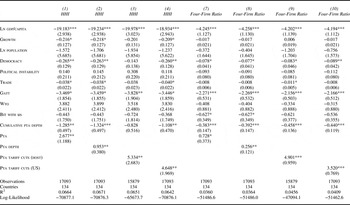
Next we examine the net effects of preferential trade liberalization on market concentration among US MNCs operating in PTA partner countries. Using the BEA affiliate-level data, we compute Herfindahl-Hirschman Indices (HHI) of sales concentration and four-firm sales ratios at the country-industry level for each benchmark period.Footnote 59
Table 5 presents the results from models of sales HHI regressed on our PTA dummy, on pta depth, and on pta tariff cuts. The dependent variable is computed at the four-digit industry level. All of the models include country-industry dummies to control for time-invariant industry-level factors that are specific to each country. We also include a full set of country-level institutional and economic control variables that may be associated with PTAs and with market concentration, including political institutions, trade, and economic performance.
PTAs and market concentration in host countries

Notes: The dependent variables are the Herfindahl-Hirschman Index (columns 1–4) and the four-firm sales share (columns 5–8), based on sales data of affiliates of US MNCs. All models include country-industry and period fixed effects. Robust standard errors adjusted for clustering. *p < .10; **p < .05; ***p < .01.
The evidence presented in Table 5 suggests that PTAs increase market concentration. Column 1 demonstrates that PTAs are associated with an increase in sales concentration among US MNC affiliates. In column 2, we find that market concentration correlates with pta depth. The estimates in columns 3 and 4 demonstrate that preferential tariff cuts by the host country and the United States, respectively, are associated with increased market concentration. For instance, a 10 percent host country preferential tariff reduction is associated with a 0.5-point increase in the HHI index. In columns 7 to 10, we re-estimate the model using the four-firm concentration ratio as the dependent variable, and we obtain very similar results. In terms of controls, we find that democracy and cumulative pta depth are associated with decreasing concentration.
In sum, the results of our analysis of US MNC sales concentration are consistent with our conjecture that tariff cuts principally benefit the largest firms. One caveat is that we are not able to capture overall market concentration since we do not have data on all firms operating in each country. However, to the extent that MNCs are the most productive firms in host countries, we could expect a similar reallocation of sales from less productive domestic firms. If so, the overall concentration effects of PTAs may be larger than our estimates indicate. This is another interesting area for future research.
Conclusion
To better understand the distributional implications of preferential liberalization we analyze how PTAs influence the trade-related activities of MNCs. Drawing on recent insights from international trade theory, we argue that preferential liberalization has redistributive effects across firms within industries. The source of redistribution depends on the type of MNC activity and the competitiveness of the firm. Specifically, preferential tariffs increase trade with partner countries for the largest and most productive affiliates. A further implication of our argument is that PTAs lead to increases in economic concentration in liberalizing markets.
Our analysis of firm-level data covering the near universe of US multinationals strongly supports our argument. The largest and most productive firms disproportionately reap the benefits of liberalization through PTAs. Our results hold when we rely on demanding panel techniques and when we use IV analyses to mitigate concerns about endogeneity. We also find that preferential liberalization has led to sharp increases in the concentration of US MNC sales in PTA partner countries. Our study is the first to demonstrate the uneven distributional effects of PTAs across multinationals.
While previous literature has argued that economic liberalization produces diffuse winners and concentrated losers,Footnote 60 our study finds instead that the beneficiaries of recent trade agreements are highly concentrated. Thus, a paradox of globalization is that the proliferation of PTAs generates handsome rewards, but mainly for the most powerful economic actors. This finding is in line with recent studies in international trade and is consistent with the growing popular and academic concern that globalization has contributed to the concentration of wealth in the hands of an elite group of individuals and firms. Moreover, because economic and political power are closely linked, the undue influence of concentrated interests over policy is another source of increasing consternation around the globe. With regard to firms’ trade policy interests, we demonstrate that microlevel evidence can inform debates about the sources of political mobilization. Our results indicate that support for PTAs should be quite strong among the largest and most productive firms engaged in global production for a simple reason: they win.
Supplementary Material
Supplementary material for this article is available at https://doi.org/10.1017/S002081831700011X