This article looks at the evolution of the British chocolate industry from the 1860s to the 1960s. Specifically, it covers the period after the establishment of the Anti-Slavery Society, often acknowledged to have been a first step toward the fair trade movement, and prior to the 1970s, when that movement is considered to have taken off.Footnote 1 The article has three main aims. The first is to determine whether Quaker business practices of this period should be acknowledged in discussions on the development of the fair trade movement. The second is to distinguish and contrast the different types of endorsement strategies used by firms in the British chocolate industry over time and to highlight their impact on building the reputation of brands. The third is to investigate how indirect endorsement of brands by third parties works. The reputation of a firm can be observed through the multiple ways stakeholders relate to it. By its nature, reputation is a mediated form of information. A reputation helps people deal with issues associated with uncertainty and information asymmetry, because no one can know everything about any particular firm and its brands.Footnote 2 In order to facilitate economic relations and improve performance, firms usually create favorable reputations for their brands. Brand reputation can rely on the tangible characteristics of products, such as performance or design, or on intangible characteristics such as imagery, identity, and core values.Footnote 3 Brand endorsement forms part of these strategies aimed at building brand reputation and also helps to simplify purchase decisions by consumers, based on their knowledge and trust of the endorser, usually someone with particular characteristics with which consumers identify. The reputation of a brand is therefore the outcome of a process of endorsement. It becomes a concept that is socially constructed by a specific group of stakeholders about a particular brand's attractiveness in relation to a group of competitor brands.Footnote 4 A positive brand reputation can be a key source of long-term competitive advantage for a firm, justifying strong investments in advertising as well as in the hiring of celebrities to endorse brands, public relations initiatives, lobbying, and the use of other media communications professionals.Footnote 5
Firms can endorse brands directly or indirectly. In direct firm endorsement, well-known entrepreneurs, the founders of firms, or celebrities often appear in advertising and public relations activities to help build the reputation of a brand.Footnote 6 Indirect firm endorsement occurs when firms hire a celebrity, or another third party with an established public reputation, as part of the process of building a brand's reputation.Footnote 7 But brands can also be endorsed independently of the firms that own them, by third parties. Independent third-party endorsement can also be direct or indirect. Independent direct third-party endorsement is tangible in its nature; it is associated with branded goods that meet certain pre-established standards. In these cases an endorsement or certification logo tends to feature on the label of the product, together with the brand name. An illustration is the Fairtrade label.Footnote 8 By contrast, independent indirect endorsement is intangible by nature. It does not appear on the labels of products associated with particular brands. It acts indirectly, through the knowledge that the public, in particular the consumer, has about the third-party endorser and its association with the brand and its associated firm. One such brand is Duchy Originals that was originally associated both with the British royal family and with organic and sustainable foods of high quality. Through the years there have been changes to the company but still the brand has always benefitted from its indirect royal connection.
This article has five parts. Following the introduction, section two provides an overview of the origins and importance of Quakers in British business and assesses their moral and responsible practices in the chocolate industry. Section three provides evidence of early forms of fair trade practices carried out by these Quaker British chocolate firms in Africa and the Caribbean. Section four provides illustrations and analyzes the alternative endorsement strategies used in the British chocolate industry over time. It also argues that newspapers are important mediators between consumers and the firms in the process of forming brand reputation through third-party endorsement. The last section provides insights on whether discussions on the global morality of business and the origins of the fair trade movement need to be placed in a longer time frame, taking into account the period before the 1970s. It also highlights how indirect endorsement can be an efficient alternative for building brand reputation.
Responsibility, Morality, and Fairness in Chocolate
A growing literature discusses the apparent paradox in the developed world since the eighteenth century between (a) capitalism and (b) responsibility and morality in business. This literature points to a number of key motivations that have historically led firms to follow responsible practices.Footnote 9 Early philanthropy is considered to be not a strategic action related to companies’ business objectives, but rather a voluntary act by corporations and entrepreneurs aiming to give back to societies, especially local communities, through the support of education, the arts, and the general quality of life.Footnote 10
Philanthropy and morality in Quaker business
Quaker businesses were among the early philanthropists concerned with morality, ethics, fairness, human rights, and the long-term maintenance of economic, environmental, and social well-being.Footnote 11 They had an impact on different areas of British society beginning in the late seventeenth century.Footnote 12 Quakerism developed as a puritan Christian sect that dissented from both the Roman Catholic Church and the established Church of England.Footnote 13 Until the repeal of the Sacramental Test Act of 1828, Quakers were prevented from holding civil positions and from attending university, leading them to focus their efforts on business.Footnote 14 Quaker entrepreneurs are considered to be behind the great innovations in iron production that built the Industrial Revolution. Despite Quakers representing just 0.2 percent of the population, their businesses dominated the list of top firms in Britain in the eighteenth century. Further, they also contributed to the development of mass-market consumer goods industries in Britain in the nineteenth century.Footnote 15 Quaker entrepreneurs applied scientific principles to the development of processes and systematically provided staff training through apprenticeships; built housing, villages, health and recreational facilities, and canteens for their workers; and created pension schemes earlier than most of the well-known philanthropists.Footnote 16 Together with philanthropists such as Andrew Carnegie, Quaker entrepreneurs participated in diplomatic actions for peace and against slavery.Footnote 17
The work ethic of British Quaker businessmen was greatly influenced by the ethos and religious principles of the Religious Society of Friends.Footnote 18 The essential tenet of the Society of Friends since its creation was that wealth for its own sake was considered a sin, and work for its own sake a virtue, an end in itself, worth doing for its own sake, and good for the soul, not for the acquisition of personal wealth.Footnote 19 Capitalism was acceptable, but Quaker products had to be beneficial and useful to society and of good quality. British Quaker businessmen were among the first to set fixed and fair prices and to respect delivery dates. They were often called to account before senior members of the Society of Friends for their conduct in business affairs. This internal regulation proved to be extremely helpful, as it allowed Quaker businesses to follow practices that contributed to the creation of a Quaker business identity in the eyes of the public. It also enabled experienced Quakers to provide advice about business to Friends in need. The result was that any failings of individual Friends or their businesses did not affect the collective reputation of honesty, morality, and fairness of the Society of Friends and its members.Footnote 20
British Quaker chocolate firms
By the eighteenth century, cocoa was thought to have medicinal properties and to be a temperance drink, an alternative to alcohol, making it an acceptable and attractive product for Quakers to manufacture.Footnote 21 In Britain, a chocolate industry emerged and big businesses developed, essentially as a result of the activities of a few entrepreneurial Quaker families: Cadbury Brothers (hereafter, Cadbury), Rowntree & Co. (Rowntree), and also their predecessor, J. S. Fry & Son.Footnote 22 Some common patterns can be seen in the way the two leading companies—Cadbury and Rowntree—developed and conducted their business, which helps explain the similar reputations of their brands.
First, both companies originated with Quaker entrepreneurs who had started working as shopkeepers and soon identified market opportunities, which they exploited.Footnote 23 These men did not necessarily develop new inventions, but they were very entrepreneurial in the way they applied innovations to grow their businesses. John Cadbury opened a tea and coffee shop in Birmingham in 1824; in 1831 he began manufacturing cocoa products for drinking.Footnote 24 His sons Richard and George took over the struggling business in 1861. The first major breakthrough took place in 1866, when the business began to use innovative technology imported from Holland that enabled the production and sale of a pure “cocoa essence” drink. Shortly thereafter, and in response to public concerns over adulterated foods (before the 1872 Adulteration of Food Act), another major breakthrough was the development of a cocoa butter by-product for use in the production of various chocolate candies.Footnote 25
In 1919, Cadbury formally merged with Fry to form the British Cocoa & Chocolate Company, but the two firms continued to operate separately.Footnote 26 Fry, which was also owned by a Quaker family, had identified unexploited market opportunities earlier in the mid-eighteenth century. The first large chocolate firm in Britain, Fry began operations in 1751 in Bristol, a city that at the time played a significant role in England's Atlantic trade, and the port to which ships returned from the Caribbean with cocoa destined for local consumption. Fry initially sold cocoa as a medicine, but its consumption for pleasure gradually increased. Early investment in technology enabled the firm to produce fine and clean chocolate to greater purity than any other method in use in Britain at the time.Footnote 27
Rowntree has its origins in William Tuke & Sons of York, a Quaker family business renowned for being very active in the movement against using slave labor in the production of goods, particularly sugar.Footnote 28 The Tuke family's cocoa and chocolate business moved to the hands of Henry Rowntree, also a Quaker, in 1862, two years after he had joined the firm as a manager. In 1869, Joseph Rowntree joined his brother as a partner; Henry died in 1883, leaving Joseph in sole control. Joseph recognized that cocoa was not simply a healthy temperance drink but a palatable and attractive commodity in its own right. He manufactured the first “crystallized pastilles” in 1881 and began in 1887 to develop a new product, Rowntree's Elect Cocoa, known for its purity. In 1897, Rowntree & Co. became a limited company, with Joseph Rowntree as its first chairman.Footnote 29
The second common pattern in the way these Quaker chocolate businesses developed relates to how they progressed steadily over a period of two or three generations yet did not survive independently; they were acquired by leading food multinationals in the second half of the twentieth century. Rowntree was acquired by Nestlé in 1987, while Cadbury first merged with Schweppes in 1969 and then was acquired by Kraft Foods in 2010.Footnote 30 By the time the two Quaker firms were acquired by large multinational enterprises, the businesses had become too large, and the Quaker principles of management had become blurred. From the 1960s, the majority of shares of the two companies stopped being held by the families.Footnote 31
The third common pattern relates to the fact that the main brands of these two firms, Cadbury Dairy Milk and Kit Kat (Rowntree), outlived the firms that created them, remaining leaders in their product categories to the present day. Both are also now directly endorsed by the Fairtrade Foundation.Footnote 32 Cadbury was the first big chocolate manufacturer to make a serious commitment to fair trade, in 2009, and Nestlé, with its Kit Kat brand, followed in 2010.Footnote 33 Cadbury's main chocolate brand, Cadbury Dairy Milk, was introduced in Britain in 1905.Footnote 34 Despite several technological innovations in Britain, the milk chocolate sold there before then had been essentially imported from Switzerland. The new chocolate bar was based on a recipe adapted to suit British tastes, having a higher proportion of milk than previous chocolate bars. Over the years a number of successful extensions were created, such as Cadbury Dairy Fruit and Nut, in 1928, and Cadbury Dairy Whole Nut, in 1933.Footnote 35 Rowntree launched Kit Kat in 1935 amid financial difficulties. The firm overcame these difficulties by hiring new managers, nonfamily members, and bringing in consultants from J. Walter Thompson to find the unique selling point and right marketing mix to sell its product.Footnote 36 The chocolate bar, initially branded as Chocolate Crisp, was renamed Kit Kat in 1937.Footnote 37 Rowntree's aim was to create a line that did not directly compete with Cadbury Dairy Milk, while also satisfying emerging British chocolate tastes. While Cadbury had a broad range of products under the umbrella brand Cadbury, Rowntree had a narrow range of products, such as Kit Kat, Aero, Smarties, and Black Magic, each with its own brand name.Footnote 38
The fourth parallel in the way the two chocolate firms developed is their association with the Society of Friends. This Quaker association translated to a paternalistic management style and transparent and fair relationships with multiple stakeholders, in particular, their employees. Both firms also engaged in a multitude of philanthropic activities. Despite being industry leaders by the end of the nineteenth century, both businesses followed the moral and ethical principles and practices of the Society of Friends by using their wealth in a responsible way.Footnote 39 They reinvested this wealth and used it to build modern large factories outside towns, providing employees and their families with greatly improved working and living conditions.Footnote 40 In developing countries from which they procured raw materials, and as illustrated in the next section, the firms produced important economic, political, and social reforms that contributed to long-term economic development.
Arguments for Proto–Fair Trade in Procurement
The fair trade movement is considered to have developed in the late 1960s in Europe and the United States, with two main aims. In the developing world, the aim was to procure raw materials in a way that helps marginalized supplier producers and workers move from a position of vulnerability to one of security and economic efficiency. In the developed world, the aim was to mobilize consumers to make purchasing decisions based on trust and charity, relying on the direct certification of products by trusted third parties.Footnote 41 Some controversy exists concerning the practices of Quaker businesses against slavery and their use of imperial paternalism in foreign markets.Footnote 42 This section aims to provide evidence that Quaker businesses used their economic powers to carry out key international political, social, economic, and environmental reforms, which, even if not entirely in line with current practices of fair trade and with socially responsible business behavior—can be considered quite radical for their times.
A wide literature acknowledges the role of Quakers in the abolition of slavery in the late seventeenth century.Footnote 43 They were part of the group that formed the Society for the Abolition of Slave Trade in 1787; they were also involved in the establishment of the Anti-Slavery Society in 1839, three decades after Britain had banned its citizens from participating in the transatlantic slave trade, and a year after slavery had ended in Britain's colonies. Through these societies, Quakers publicly expressed their concerns about cruelty and ethical conditions under which labor was being carried out in several colonies in Africa, the West Indies, and other parts of the world.Footnote 44 The most well-known example of this form of the Christian moral critique of consumption is the boycott of slave-produced sugar from 1791, during which the abolitionists encouraged consumers to switch from sugar to honey or to buy sugar from the East Indies, which was free from slavery.Footnote 45 Another example is the “free produce” movement in mid-nineteenth-century Britain, aimed at stopping the production of garments from slave-produced cotton. As part of this movement, Quaker entrepreneurs, such as the Clark family, founders of the leading British shoe multinational, expressed their anti-slavery commitment by wearing clothes with fabrics that were not made of cotton procured from regions that used slave labor.Footnote 46
In a similar way, most of the initiatives carried out by Quaker chocolate firms in developing countries in the late nineteenth century and early twentieth century were associated with their procurement of raw materials. Cocoa and other raw materials, such as sugar, were originally purchased by chocolate manufacturers through intermediaries in Britain, who imported those goods and sold them in major markets, such as London, Liverpool, and Bristol. However, as British chocolate production and consumption expanded, major producers started procuring raw materials directly in their regions of origin, such as Africa and the Caribbean. Cadbury bought two plantations in 1897 in the British West Indian island of Trinidad and, in 1930, another in Montserrat. Rowntree also purchased small cocoa estates in Dominica and Jamaica in 1899. However, their own production never accounted for a significant part of the firms’ requirements for cocoa. The aim with these investments was essentially to do research and get information about the cultivation of cocoa, particularly on matters affecting quality.Footnote 47
Until the beginning of the twentieth century, a significant amount of the cocoa used by British chocolate manufacturers was procured in the Portuguese island of São Tomé e Príncipe. In early 1901, while on a visit to one of Cadbury's plantations in Trinidad, William Cadbury learned that slave labor was being used in the Portuguese colonies of São Tomé e Príncipe and Angola. An investigation was initiated with the collaboration of the Anti-Slavery Society. Beginning with his first visit to Lisbon in 1903, William Cadbury spent substantial financial and physical resources over several years, using diplomacy and trying to intervene, indirectly through the British government, and directly by contacting different Portuguese key parties involved in the cocoa trade with the Portuguese colonies. His aim was to stop slave labor and improve labor conditions on the cocoa estates. In 1904, frustrated with the lack of action by the Portuguese authorities to implement changes associated with new labor regulations, William Cadbury wrote to other chocolate firms in Britain and the United States asking them to take collective action, by hiring a commissioned agent to visit the cocoa estates in São Tomé and Angola. For two years the hired agent, Joseph Burtt, a young Quaker, talked to diplomats, journalists, and European and African businesspeople and traced the slave route through Africa's interior. Upon return, his report prompted Cadbury to travel to West Africa himself, terminate immediately the trade, and recommend that other chocolate firms boycott the purchase of cocoa from the Portuguese colonies also.Footnote 48 Fry and Rowntree from Britain as well as Stollwerck from Germany joined this boycott.Footnote 49
As a consequence of the boycott, Cadbury and other chocolate producers started to invest in the Gold Coast (renamed Ghana in 1957) and Côte d’Ivoire, which became the major suppliers to the world's leading chocolate manufacturers for the rest of the twentieth century.Footnote 50 In 1909, Cadbury set up a permanent buying office in Accra on the Gold Coast and operated it jointly with Fry. These investments allowed the Quaker chocolate firms to avoid purchasing through intermediaries in Britain, where it remained difficult to ensure that the raw materials were not procured from regions that still used slave labor.Footnote 51
The boycott by British chocolate producers led to the flooding of the American market with cheap cocoa from São Tomé e Príncipe. The British chocolate firms sent Burtt to the United States to stop local companies from buying chocolate from the island. The widespread boycott eventually led Portuguese authorities to enforce the new laws and implement the changes promised long ago. As a result, thousands of laborers in Portuguese West Africa were repatriated to their countries, the flow of work to and from the island became voluntary, and the island's mortality rate dropped.Footnote 52
In the Gold Coast, the Ashanti agricultural department made great efforts to improve the standard of cultivation among the native farmers, a task that Cadbury had a major role in helping to achieve. Cadbury sent experts to instruct farmers and employees of the Department of Agriculture on how to plant, cultivate, and prepare good, marketable cocoa; the farmers and workers showed remarkable quickness in absorbing the knowledge and instructions given to them. The firm's buying agencies insisted on the best quality beans and made it worthwhile for growers to properly cultivate and prepare cocoa of high quality. Additionally, Cadbury paid higher prices than the other merchants that monopolized the trade, and substituted payment in cash for the system of barter in which products such as cotton goods and gin were often used as a medium of exchange.Footnote 53
In 1919, Cadbury, Fry, and Rowntree set up a buying agency in Southern Nigeria. This agency, initially named Cocoa Manufacturers Ltd. and later renamed RCF—Rowntree-Cadbury-Fry (Nigeria) Ltd.—became known for its commitment both to developing African enterprise and to encouraging good practices in cocoa farming by paying high prices for better grades of cocoa. The new firm did not own cocoa plantations; crops were grown by peasant farmers and their families, constituting their main source of income.Footnote 54 The buying of cocoa was done by licensed agencies created by RCF. These agencies supervised the purchase of cocoa from producers, arranged for its transportation to the port, and ensured it was shipped safely to its destination. RCF also built working relationships with the producers of cocoa, as the only major firm that bought exclusively through its own depots using salaried African employees dealing directly with producers. Each season, the farmers were guaranteed a fixed and higher price for their cocoa. This helped improve farming techniques for high-grade cocoa. Social services in the producing areas benefited from the proceeds of sales of the cocoa crop, and great progress was made with the building of schools, hospitals, roads, and dwelling houses. Far-reaching and rapid changes took place in the way of life for these West African communities.Footnote 55
It was common practice in the Gold Coast for foreign companies to form “pools” every time international prices of cocoa started to increase and exports developed. Through these pools, firms agreed to buy and sell at the same prices and pay a “pool tax” for overbuying, which was divided among them periodically. Cadbury was the exception. From its entry in that market in 1909, the firm refused to join pooling agreements and usually took the side of the West African governments against British and U.S. merchants in price fixing of West Coast cocoa. The family regarded these practices as incompatible with its Quaker principles.Footnote 56 Cadbury also opposed the attitudes of middlemen who had become tied to individual trading firms and were getting cocoa from farmers at the cheapest possible price.Footnote 57
These proto–fair trade practices were also applied in the procurement of other raw materials by Rowntree, in countries such as Sudan, Somalia, Nigeria, and Senegal from which the firm procured gum arabic.Footnote 58 In their contact with the local people, Rowntree managers worked around the local customs and languages, prioritizing fair dealing and the building of trusting relationships. They also made important charitable donations toward the construction of cathedrals, local schools, and medical missions, among other initiatives.Footnote 59
The behavior of Quaker chocolate businesses in developing countries contrasts with that of other British confectionary manufacturers, such as Terry's. For example, evidence concerning Terry's procurement of cocoa in Venezuela during the first half of the twentieth century indicates that the company's managers placed great emphasis on the maximization of yields per acre of cocoa planted and procured, paid low wages to local planters, and made limited charitable donations.Footnote 60
By the 1960s, Quaker businesses had developed a series of social initiatives in developing countries. Rowntree, for example, was sending Nigerian workers to Britain for training in order to help them become involved in activities within the value chain that added value, such as the trading of cocoa and other raw materials in international markets.Footnote 61 In 1967, when a new act of Parliament enabled, for the first time, trustees to spend some or part of their resources abroad—Joseph Rowntree Trust created three trusts in foreign markets. Among other activities, the trust launched work camps in Ghana, Kenya, and Uganda. These camps were based on principles of international friendship and voluntary work to the community in African countries. Other projects the trust was associated with focused essentially on education in countries such as Malawi and Kenya.Footnote 62
Proto–Fair Trade in Marketing
This section aims to assess the various ways by which consumers in developed countries, in this particular case, in Britain, may form an opinion about a brand's reputation that influences their purchasing decisions. Not only may this opinion rely on the marketing of the brand through advertising campaigns or public relations initiatives, but it can be built through the customer's association of the brand with third parties, with information obtained from the media.
Alternative endorsement strategies
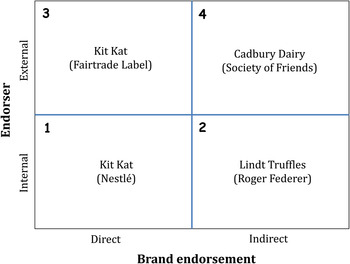
Figure 1 distinguishes a number of endorsement strategies of brands, using the case of chocolate as an illustration and taking into account two types of variables: the nature of the endorser or supporter of the brand, and the type of endorsement. The endorser can be internal to a firm, typically the owner of the firm that owns the brand, or external to the firm, that is, a third party, such as a certification body. Consumers may perceive certification bodies as an important factor in their purchasing decisions. Figure 1 also takes into account the type of brand endorsement, or the way in which the endorsement is linked to the particular brand. This can be a direct brand endorsement, featured explicitly on the label of a product together with the brand name, or an indirect brand endorsement, through an implicit association made by the customer between the brand and a third party with an established reputation.
Types of endorsement strategies in chocolate. (Source: Author's figure.)

Quadrants 1 and 2 in Figure 1 relate to the endorsement strategies followed by most consumer goods firms, which form part of firms’ marketing strategies in the creation of brand reputation. In quadrant 1, the endorsement is provided by the firm and is stated explicitly on the label of the product, together with the brand name. This is very common in firms that follow strategies of umbrella branding, where the firm labels all its products with the company logo. Kit Kat today, which features the logo of Nestlé (the current owner of the brand) on its packaging, is an illustration. Nestlé has historically had a reputation of trustworthiness and quality among the general public worldwide. The association of Kit Kat with Nestlé aims to provide an assurance to the customer about the quality of its ingredients.Footnote 63 Quadrant 2 is also a frequently used endorsement strategy in marketing. Here the endorsement is also internal, in the sense that it is planned and supported by the firm. But it is indirect in the sense that it is not directly stated on the label of the product. Often, firms hire celebrities the public will recognize to endorse their brands, as part of an advertising campaign or public relations initiative. An illustration is the very successful 2010 Lindt Swiss chocolate truffles advertisement that depicts a celebrity—the then world-renowned tennis player Roger Federer, also from Switzerland—at the airport trying to pass through security with a tennis bag full of Lindt truffles.
In quadrants 3 and 4, the endorser is a third party, external to the firm. Quadrant 3 relates to cases where brands are endorsed directly or explicitly by a third party, with an indication of that endorsement stated on the label of a product, jointly with the brand name. This endorsement often relies on the fact that the branded product meets certain standards required by the independent third party in order for it to act as an external endorser. It also includes cases of collective branding, which occur when a specific brand is used by all members of a group or institution. It differs from other cases of direct endorsement primarily in that the collective branding is used by the members of a group, while the latter is used by anyone who meets the specified standards. The Fairtrade logo, which appears on the labels of Kit Kat and Cadbury Dairy Milk chocolate bars, is an example of direct endorsement through external third-party certification. This direct endorsement forms part of a broader social-responsibility statement by the firms whose products and brands meet certain pre-established standards and is associated with their mission of giving back and helping society. It is possible to find early forms of direct product endorsement in various parts of the world. An illustration is the “white label” movement created in 1898 in the United States, which aimed to promote decent working conditions for employees, in particular, women and children.Footnote 64
While the different forms of brand endorsement identified in quadrants 1, 2 and 3 are well discussed in the marketing literature, little research has been done on indirect endorsement through third parties, external to the firm (see quadrant 4).Footnote 65 Indirect third-party endorsement assumes that the consumer has other means of obtaining information that contributes to forming an opinion about the reputation of the firm and its brands and its connections with a trusted third party. The indirect endorser has to have a certain reputation that is recognized by the public. The argument made here is that the almost instant success of the brand Cadbury Dairy Milk when it was launched was connected not only with the intrinsic characteristics of the product and its quality, but also with the brand's indirect endorsement by the Society of Friends, through its association with the firm.Footnote 66 This was particularly true for a firm that did not invest substantially in advertising and marketing. Its few marketing efforts concentrated on associating its products with quality, purity, honesty, and fair trading.
Newspapers as mediators between consumers and indirect endorsers
This article argues that this form of indirect endorsement was very important in establishing the reputation of Quaker businesses in the nineteenth and early twentieth centuries, when the British chocolate market was essentially domestic, regulations and industry standards were weak, and information about the firms and their brands was scarce and mainly available through media such as newspapers. These mediators were very important as they provided information about the businesses and their activities and indirectly helped consumers to form an opinion about the firms’ standing in society, and also about their products and brands, indirectly influencing their reputation.Footnote 67 Drawing on newspaper articles as proxies of public opinion, this study looks at a wide range of newspapers during the period from January 1, 1860, to December 31, 1969, to assess the degree to which the public associated the firms Cadbury and Rowntree and their brands with the Society of Friends and Quaker values and principles, considered here to be external indirect endorsers of their brands.
Britain is a country where the media have historically been an important vehicle for disseminating information and where the newspaper industry was already large and vibrant in the late nineteenth century. Newspapers acted as mediators and agencies of enlightenment, molding the minds and opinions of the public and helping to bridge the gap between firms and their stakeholders. The procedures applied were consistent with those employed by others who have conducted content analyses of press and web media.Footnote 68
The Times was selected as the main newspaper to use in the search. A long-established London-based newspaper, created in 1785, the Times is an important British institution, part of the British political structure, and considered to have been a key innovator in the printing industry.Footnote 69 The search was conducted at the British Newspaper Archive in London. To ensure an appropriate pool of articles for the purposes of this study, criteria for selection and further analysis of articles were developed. First, only articles with the words “Cadbury” or “Rowntree” in the title were selected. The search yielded approximately 774 articles that met the initial search criteria. Each article was reviewed for content, to ensure relevance to the analysis. To allow extensive quantitative examination of the press archive, all articles were rendered into a form that enabled statistical comparison. Second, two mutually exclusive groups of articles were selected: those related to genuine news (249 articles in total: 142 with Cadbury in the title and 107 with Rowntree), and those related to advertisements (525 articles).Footnote 70 Advertisements were analyzed separately from news, as advertisements relate what a firm wants the public to know about it, rather than illustrate what the actual public perception of the firm is.
A series of sequential steps was then carried out to assess the associations made by the public linking the firms Cadbury and Rowntree and their brands with Quakerism and its principles. Within the selected group of news articles—those with Cadbury or Rowntree in the title—and excluding advertisements, a preliminary search was then carried out in the main text of each article for the terms “Quaker” and “Society of Friends.” For each of the firms, only about 12 percent of the articles include at least one of these terms—“Quaker” or “Society of Friends”—in their main text.Footnote 71 This relatively low percentage of articles relating the firms or their owners with Quakerism confirms that these firms did not explicitly associate their philanthropic activities with their owners’ religious beliefs or connections with the Society of Friends. They did not use this as a marketing tool or a form of endorsement of their brands.
Nonetheless, several non-Quaker companies saw the relationship between Quakerism and quality and honesty as a means of enhancing the reputation of their brands. For instance, a leading breakfast cereal brand, Quaker Oats, was first registered in the United States in 1877. Its founder, Henry D. Seymour, had no connection with the Quaker religion or the Society of Friends, but he believed that the use of the trademark “Quaker” would encourage consumers to associate his product with the Quaker values of honesty, integrity, purity, and strength. The Society of Friends objected to the use of the name for a business and petitioned the U.S. Congress to stop its use but was unsuccessful.Footnote 72 In similar cases in the United Kingdom, entrepreneurs applied for the registration of trademarks that contained the word “Quaker” as a means of conveying quality, purity, and honesty. These cases also provoked reactions by the British Society of Friends against the opportunistic use of the Quaker religion and morals. Some of these cases were discussed at Quaker annual meetings and prosecuted in court.Footnote 73
A direct association between the chocolate businesses and Quaker morals and the Society of Friends starts to appear prominently in business newspaper articles from the 1960s, especially in periods of mergers and acquisitions. This association is particularly prominent in the financial press, which highlights the social heritage deeply embedded in the Quaker origin of both Cadbury and Rowntree, the religious background of their top management, their networks developed through the Society of Friends, their financial solvency and transparency, and their deeper relations with consumers beyond their consumption of the firms’ products and brands.Footnote 74
Still using the newspaper articles whose titles include the words “Cadbury” or “Rowntree” (and excluding advertisements) as a way to refine the search for links made between the firms and Quakerism and the Society of Friends, a new search was conducted in the Times using a series of Quaker-related topics: war, peace, and disarmament; slavery and the slave trade; poverty and famine; temperance, liquor, and gambling; and the opium trade. The selection of these topics was based on the words appearing most commonly in the minutes of the annual meetings of the Society of Friends in London during the period of analysis.Footnote 75 Many are anachronistic for the period under scrutiny; also, some of the terminology is different from that used today. Of the articles in the sample, 54 percent of those with Cadbury in the title mention Quakerism or any of the Quaker-related topics mentioned previously, while 55 percent of articles with Rowntree in the title do. Articles in which the words “war,” “peace,” and “disarmament” appear are the most frequent. These articles discuss topics such as the Quakers’ refusal to participate in war in general and commitment to peace and disarmament; their involvement in the restoration of disabled soldiers; services rendered in ambulance units; the Boer War and the investigation of concentration camps for women and children; and hospital work and mine sweeping. Other recurrent topics include the involvement of these Quaker firms in the abolition of slavery and the development of free labor for men, women, and children in developing countries; campaigns against sweated labor and the setting up of so-called sweating exhibitions; the establishment of the National Old Age Pension Society; lobbying against poverty and unemployment; the formation and operation of the Peace Society, with various institutions for the benefit of children and the education of adults; and the creation of villages with adequate sanitary and healthful conditions; among other humanitarian initiatives.Footnote 76
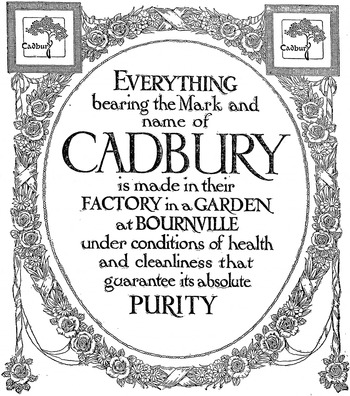
The analysis of advertisements published in the Times during the same period provides a different picture. Until 1910, Cadbury strongly emphasized the purity and quality of its products in its advertisements. Concerns about food standards were very prevalent at this time. George Cadbury, a strong campaigner against food adulteration, had been involved in controversial discussions leading up to the 1872 and 1875 Adulteration of Foods Acts.Footnote 77 The firm's use of the term “purity” aimed to increase consumers’ trust in its brands (see Figure 2).
Cadbury advertisement emphasizing purity, 1910. (Source: London Times, 10 Oct. 1910, 5.)

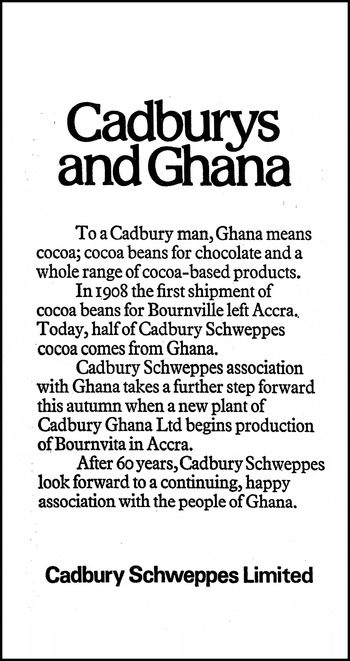
Over time the messages in Cadbury's advertisements change, but this concern with the purity of ingredients remains prevalent even during times of war. Other characteristics frequently emphasized in the ads are the nourishing qualities of Cadbury's chocolate and its good value for money.Footnote 78 Some advertisements also highlight the company's philanthropic activities.Footnote 79 By the end of the 1960s, Cadbury's advertisements also start to show a concern with informing the public about the provenance of its raw materials, emphasizing its long-established, friendly, and happy relationships with developing countries (see Figure 3).
Cadbury advertisement 1969. (Source: London Times, 22 Oct. 1969, I.)

Rowntree was more resistant than Cadbury to advertising in newspapers. Joseph Rowntree was of the opinion that advertisements provided only temporary spurts in output and were a diversion from the traditional reliance on product quality, which he believed safeguarded the company's future.Footnote 80
It is only from around the 1920s, when Joseph Rowntree is no longer central to the management of the firm, that ads start appearing in the Times with some frequency.Footnote 81 Their messages are mainly associated with the nourishing characteristics of the chocolate and its ability to help people deal with stress, anxiety, and digestion, in times of both war and peace.Footnote 82 As part of its philanthropy, Rowntree often bought space in newspapers for other institutions to advertise social and humanitarian causes.Footnote 83
When conducting a search in other newspapers in the British Newspaper Archive and the Library and Archives of the Society of Friends, it is clear that Cadbury and Rowntree seem to use particular media channels for publicizing their philanthropic and humanitarian activities, such as the Quaker newspapers the Friend, the Anti-Slavery Reporter, and the British Friend. These newspapers published information about the various activities of the two firms and provided detailed articles on topics of great relevance to society at the time, not only in the United Kingdom but also abroad. Additionally, both firms acquired newspapers, which they used as vehicles to campaign for humanitarian and political causes. An illustration is George Cadbury's acquisition of the Daily News in 1901, after which the newspaper includes articles about the involvement of the entrepreneur and his firm in certain humanitarian and political causes, such as campaigns against the Boer War, concentration camps, and the burning of Boer farms; the campaign against the Conservative government's policy of allowing indentured Chinese labor to be transported to South Africa; and sponsoring the campaign against sweating and exhibitions on sweated labor around the country between 1906 and 1908.Footnote 84 Another illustration is Rowntree's acquisition of the newspaper Northern Echo in Darlington in 1903. Once again the purpose was to preserve a press free from monopolistic interests and also to advocate against war and in favor of peace and enlightened social reform.Footnote 85
Conclusion
This article argues that the period prior to the 1970s cannot be ignored in research on global business and morality or on the early development of the fair trade movement. Although some researchers suggest that while Quaker businesses were publicly against slavery and in favor of free trade, they were not necessarily caring at a distance; this article shows that wide evidence exists that Quaker-owned British chocolate businesses did indeed care at a distance. They created housing, schools, hospitals, villages, and markets and improved workers’ lives in developing countries earlier than most philanthropists. By using international diplomacy, Cadbury and Rowntree created alliances with competitors and collaborated with local governments and planters. They helped create fairer and more balanced power relations in international value chains between producers and consumers of cocoa and other raw materials used in confectionary, introduced new types of plantations and new farming techniques, and developed whole new industries in some developing countries, contributing to long-term economic development.
Based on historical evidence in the British chocolate industry from the 1860s to the 1960s, this article also illustrates that chocolate firms have relied on different types of endorsement strategies over time. These strategies varied according to the resources of firms, the level of regulation of industries, the size of markets, the level of sophistication of consumers, and the media available. In smaller and unregulated markets, where consumers show a relatively high level of sophistication and education, mediators or intermediaries such as newspapers or other media play an important role in providing information about firms, their entrepreneurs, and their brands, in addition to their associations with reputed third parties, which act as indirect endorsers. This helps explain how Cadbury and Rowntree built long-term reputations for their chocolate brands, despite not having made substantial investments in marketing in their early days. The Quaker Society of Friends and the religious principles it stands for were recognized by the public as a form of indirect endorsement of the chocolate firms and their brands. In large markets characterized by intensive competition, it is difficult and costly for consumers to make informed purchase decisions relying purely on publicly available information. As such, marketing investments by companies can be significant in creating a differentiated image for their brands.
Marketing strategies tend to draw on a combination of both direct and indirect endorsement, such as umbrella branding and the hiring of celebrities. While helping to build a brand reputation, these strategies provide information about the product and help consumers to reduce search costs in their purchase decisions. Third-party direct endorsement or certification is particularly useful when the reputation of products and brands is associated with certain standards, as illustrated by the certification of the Fairtrade Foundation of Kit Kat and Cadbury Dairy Milk chocolate bars. Third-party indirect endorsement can be a cost-effective alternative marketing strategy. Its capacity to create awareness about a brand or influence consumer behavior is harder to control, and it does not tend to be directly associated with managerial decision making. In the present, despite high competition and the globalization of markets, indirect brand endorsement can still be a very useful tool to help build brand reputation, especially in markets where consumers are educated and have good access to media, and also in periods characterized by uncertainty and lack of regulations, such as times of crises in which, among other challenges, firms have to deal with constrained marketing budgets.