Experimental
Crop wild relatives are an increasingly important source of plant genetic resources for plant breeders. This is the result of an increasing demand for traits that are not present in the cultivated gene pool, combined with the availability of facilitating techniques, such as marker-assisted breeding. Additionally, adaptation to climate change requires new traits, which will further increase the demand for promising crop wild relatives (Guarino and Lobell, Reference Guarino and Lobell2011). In situ, these crop wild relatives are threatened by changes in their habitat, such as those resulting from climate change (Jarvis et al., 2010). Several studies have estimated the effects of climate change on the distribution of wild relatives of specific crops (e.g. Jarvis et al., Reference Jarvis, Lane and Hijmans2008; Lira et al., Reference Lira, Tellez and Davila2009; Davis et al., Reference Davis, Gole, Baena and Moat2012; Ureta et al., Reference Ureta, Martinez-Meyer, Perales and Alvarez-Buylla2012). Using species distribution models, they have estimated whether the current habitat area of species will decrease under climate change, and whether climate change will make new habitat areas available. Species for which the total suitable habitat area was expected to decrease with time were labelled as vulnerable. In this approach, several important aspects are not taken into account, for example reproductive system, micro-evolutionary effects and the spatial aspects which will be discussed in this paper:
(1) Dispersal capacity, i.e. whether the species under study is capable of actually reaching the estimated new habitat areas,
(2) Founder effects, i.e. whether this species loses genetic diversity while tracking its suitable climate conditions.
In the following sections, we discuss the potential consequences of these spatial aspects, their impact on the interpretation of the results of studies using species distribution models to assess the effects of climate change on crop wild relatives and how both aspects could be incorporated in future studies.
Dispersal
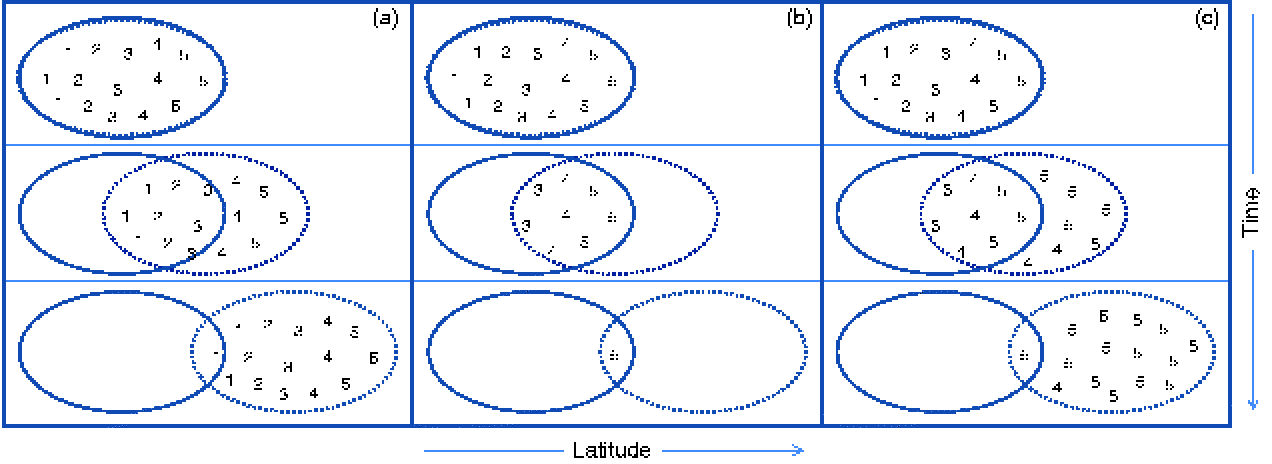
Seed, and subsequently pollen, can disperse to a habitat area different from the location of their natal population. As such, a plant species can colonise new areas. Dispersal is therefore a key aspect in the assessment of the effects of climate change on the distribution of crop wild relatives. The study by Jarvis et al. (Reference Jarvis, Lane and Hijmans2008), assessing the effects of climate change on crop wild relatives, did include a dispersal parameter featuring either unlimited, limited or no dispersal. Although this provides an estimation of the likelihood that species can reach their new habitat areas, the reliability of the prediction can be questioned. First, this is because the assumed limited dispersal speed was 6 km/year, while many mobile species have not been able to reach such speeds in the past decades. For example, Chen et al. (Reference Chen, Hill, Ohlemueller, Roy and Thomas2011) reported an average of 1.76 km/year in a meta-analysis across different taxonomic groups. Second, the maximum annual dispersal distance of a species depends on the means of dispersal and the landscape, but also on population growth, species' interactions and other ecological processes. An overestimation of the dispersal capacity can lead to the false assumption that the species range will not show a substantial decrease under climate change (compare Fig. 1(b) with Fig. 1(a)). The potential consequences are a lack of necessary conservation measures, and the loss of valuable plant genetic resources.
Effect of dispersal capacity and founder effects on species range size and genetic diversity. The area with climate conditions suitable to the species (dotted border) moves away from the original species distribution area (solid border). (a) The situation as currently assumed in most studies using species distribution models, (b) the effect of zero dispersal capacity on the size of the species range and (c) the situation under sufficient dispersal capacity, taking into account founder effects.

Founder effects
Founder populations result from the establishment of a limited number of individual plants, from the expanding range margin of the original distribution area, in an area previously unoccupied by the species. Such populations show limited levels of genetic variation compared with the original source populations, a phenomenon commonly known as ‘founder effect’ (Mayr, Reference Mayr1942). This narrowing of the genetic composition causes the loss of specific, potentially unique traits in the founder populations (Hewitt and Nichols, Reference Hewitt, Nichols, Lovejoy and Hannah2005; Cobben et al., Reference Cobben, Verboom, Opdam, Hoekstra, Jochem and Smulders2012), and has been shown to have important evolutionary consequences (Pujol and Pannell, Reference Pujol and Pannell2008; Pujol et al., Reference Pujol, Zhou, Vilas and Pannell2009). For example, in Capsicum chacoense, the proportion of pungent plants increases with elevation (Tewksbury et al., Reference Tewksbury, Manchego, Haak and Levey2006). Theoretically, it is therefore possible that new populations, established at even higher altitudes under increasing temperatures, lose their polymorphism for the production of capsaicin due to founder effects (in sensu Hewitt and Nichols, Reference Hewitt, Nichols, Lovejoy and Hannah2005). Computer simulations indicated that most genetic diversity in a range-shifting species is (initially) lingering in the original populations (Cobben et al., Reference Cobben, Verboom, Opdam, Hoekstra, Jochem, Arens and Smulders2011), a phenomenon that has been confirmed by several empirical studies of range shifts after the last glacial maximum (Hewitt, Reference Hewitt1996) and under current climate change (Garroway et al., Reference Garroway, Bowman, Holloway, Malcolm and Wilson2011). Under climate change, these original populations, hosting most of the species' genetic variation, increasingly suffer from deteriorating climatic conditions, with the potential loss of genetic variation as a consequence (Cobben et al., Reference Cobben, Verboom, Opdam, Hoekstra, Jochem, Arens and Smulders2011).
Neglecting founder effects when determining new potential habitats for range-shifting plant species implies the false assumption that founder populations harbour the same genetic variation as the source populations (compare Fig. 1(c) with Fig. 1(a)). As a result, the extinction of the source populations can lead to the loss of potentially unique and useful genetic diversity.
Discussion
The introduction of dispersal processes and founder effects in assessments of the resilience of plant genetic resources under climate change requires the integration (Keith et al., Reference Keith, Akçakaya, Thuiller, Midgley, Pearson, Phillips, Regan, Araújo and Rebelo2008) of process-based simulation models (such as used by Schippers et al. (Reference Schippers, Verboom, Vos and Jochem2011) and Cobben et al. (Reference Cobben, Verboom, Opdam, Hoekstra, Jochem and Smulders2012)) and statistical species distribution models (Thuiller et al., Reference Thuiller, Lavorel, Araujo, Sykes and Prentice2005; Phillips et al., Reference Phillips, Anderson and Schapire2006). Through this integrative approach, the future habitat availability of species under changing climatic conditions can be assessed, with additionally a more accurate estimate of dispersal probability to new regions (Graf et al., Reference Graf, Kramer-Schadt, Fernandez and Grimm2007; Vos et al., Reference Vos, Berry, Opdam, Baveco, Nijhof, O'Hanley, Bell and Kuipers2008; Anderson et al., Reference Anderson, Akcakaya, Araujo, Fordham, Martinez-Meyer, Thuiller and Brook2009) and genetic changes resulting from the dispersal process. However, such models are still under development, and require a large amount of data, e.g. species-specific ecological parameters and population-specific genetic data. Pending the availability of these models and the required data, we have two important recommendations for the interpretation of the results of the currently used species distribution models, in studies assessing the effects of climate change on crop wild relatives:
(1) Species, which for their survival largely depend on new suitable habitat areas, should be marked as vulnerable.
(2) Collection priority should be given to threatened populations within the borders of the original species' range.
Acknowledgements
This paper was written in the context of an ongoing project on crop wild relative distributions and climate change, which is part of the Fundamental Research Programme on Sustainable Agriculture (KB-12-005.03-003) funded by the Dutch Ministry of Economic Affairs.