Introduction
Clinicians have long observed that depressed patients are literally imprisoned by their emotions of sadness and misery from which they rarely have respite (e.g. Kraeplin, Reference Kraeplin1921; Beck, Reference Beck1967). Psychiatric diagnostic criteria (e.g. APA, 1994) also highlight that protracted despondent dysphoric mood is a core symptom of depressive disorders, thereby implicating impaired affect regulation as a crucial feature of these conditions. The recent burgeoning of basic research on affect regulation and dysregulation (e.g. Gross, Reference Gross1998), including studies of various self-regulatory responses, therefore has considerable potential to inform both the understanding and clinical management of mood disorders.
Within the domain of affect regulation, some researchers have been particularly interested in ‘mood repair’ (Isen, Reference Isen1985; Josephson et al. Reference Josephson, Singer and Salovey1996). Mood repair refers to the fact that human beings generally seek to attenuate or modulate their own sadness and dysphoria; that is, they tend to respond in ways that result in feeling better (e.g. Morris & Reilly, Reference Morris and Reilly1987; Parkinson & Totterdell, Reference Parkinson and Totterdell1999). As of now, well over a 100 self-regulatory responses have been identified that reportedly can serve to attenuate dysphoric mood, along with quite a number of responses that can worsen it. For example, mood repair attempts in everyday life include a variety of cognitive responses (reinterpreting the cause of sadness, refocusing attention), diverse forms of instrumental behaviors (e.g. exercising, working on a task), turning to others in order to feel better (e.g. seeking emotional support, spending time with others), and ways of being ‘self-indulgent’ or attenuating distress through sensory routes (e.g. eating, alcohol or substance use; Cunningham, Reference Cunningham1988; Thayer et al. Reference Thayer, Newman and McClain1994; Fichman et al. Reference Fichman, Koestner, Zuroff and Gordon1999; Parkinson & Totterdell, Reference Parkinson and Totterdell1999). The multitude of responses can be conceptualized or categorized along various dimensions such as cognitive versus behavioral, adaptive versus maladaptive, functional versus dysfunctional, intentional versus automatic, or self- versus other-focused, among others (e.g. Rippere, Reference Rippere1977; Thayer et al. Reference Thayer, Newman and McClain1994; Parkinson & Totterdell, Reference Parkinson and Totterdell1999; Larsen, Reference Larsen2000; Rusting & DeHart, Reference Rusting and DeHart2000; Joormann et al. Reference Joormann, Siemer and Gotlib2007).
What do we know about the mood repair repertoires of depressed patients? Some conceptualizations of clinical depression have long highlighted that failure to attenuate or contain despondency is a contributor to depression risk. Teasdale (Reference Teasdale1988), for example, has proposed that people who tend to get clinically depressed and those who are able to recover from an episode of sadness do not differ in the initial experience of dysphoria but rather in how they respond to that affect, with depression-prone people likely to respond in ways that impede ‘natural recovery’. Other theorists (Beck, Reference Beck1967; Lewinsohn & Libet, Reference Lewinsohn and Libet1972; Lewinsohn & Graf, Reference Lewinsohn and Graf1973) also have emphasized that depressed and depression-prone people tend to think, behave, and structure their environments in ways that reinforce (or possibly cause) depressed mood and associated depression symptoms. However, only fairly recently have researchers used experimental designs to isolate and characterize specific ways of responding to depressed mood, examined responses theorized to attenuate dysphoria as well as responses that exacerbate it, and included individuals with diagnosable depression in their samples.
Three types of mood repair responses of clinically depressed individuals have been the targets of research efforts. Recalling positive memories and refocusing of attention away from one's distress (or distraction) are two cognitive responses to one's own dysphoria that have been shown to repair mood in normative samples and could be expected to be impaired in depressed or depression-prone people. Experimental manipulation of distraction enabled depressed patients to repair sad affect in one study (Donaldson & Lam, Reference Donaldson and Lam2004). In a replication and extension, currently and formerly clinically depressed individuals also used a distraction strategy to successfully attenuate sad affect, but were unable to repair their sad mood via the recall of positive personal memories (Joormann et al. Reference Joormann, Siemer and Gotlib2007). However, when self-reported distraction in depressed patients has been studied as a trait, findings have been inconsistent concerning the relations between the use of this strategy and improvement in depression symptoms or better treatment response (Bagby et al. Reference Bagby, Rector, Segal, Joffe, Levitt, Kennedy and Levitan1999; Kuehner & Weber, Reference Kuehner and Weber1999; Bagby & Parker, Reference Bagby and Parker2001; Lam et al. Reference Lam, Smith, Checkley, Rijsdijk and Sham2003; Arnow et al. Reference Arnow, Spangler, Klein and Burns2004).
Findings have been somewhat more consistent about a cognitive response to depressed affect that exacerbates rather than repairs it, namely, rumination, which refers to repetitively thinking about one's own sadness or dysphoria and its correlates (for reviews, see Thomsen, Reference Thomsen2006; Nolen-Hoeksema et al. Reference Nolen-Hoeksema, Wisco and Lyubomirsky2008; Watkins, Reference Watkins2008). One experimental and several non-experimental studies of depressed in-patients and/or out-patients (Kuehner & Weber, Reference Kuehner and Weber1999; Lam et al. Reference Lam, Smith, Checkley, Rijsdijk and Sham2003; Riso et al. Reference Riso, du Toit, Blandino, Penna, Dacey, Duin, Pacoe, Grant and Ulmer2003; Donaldson & Lam, Reference Donaldson and Lam2004) have found that the tendency to ruminate (by self-report) correlates with heightened depression and distinguishes patients from healthy controls (Riso et al. Reference Riso, du Toit, Blandino, Penna, Dacey, Duin, Pacoe, Grant and Ulmer2003). Rumination also has been shown to prospectively predict depression symptom severity in patients with seasonal affective disorder (Young & Azam, Reference Young and Azam2003) and subsequent depression diagnosis in previously hospitalized depressed individuals (Kuehner & Weber, Reference Kuehner and Weber1999), although such relations have not been verified in other clinical samples (Bagby et al. Reference Bagby, Rector, Segal, Joffe, Levitt, Kennedy and Levitan1999; Bagby & Parker, Reference Bagby and Parker2001; Arnow et al. Reference Arnow, Spangler, Klein and Burns2004).
There is no question that clinical depression is associated with suboptimal mood repair. And while the psychosocial literature clearly suggests that this impairment partly reflects the use of cognitive responses to depressed affect that exacerbate or maintain it, relatively little is known about the wider mood repair repertoires of depressed patients compared with that of never-depressed individuals. For example, are there non-cognitive mood repair responses that are likely to worsen depressed affect, and which are particularly characteristic of individuals at risk for depression? Or, in addition to deploying responses that exacerbate sadness, do depression-prone individuals suffer from a deficiency of regulatory responses that can attenuate dysphoria? Further, to the extent that depressed persons exhibit impaired mood repair, are these impairments trait-like and observable during periods of remission? And how much do suboptimal mood repair repertoires contribute to the risk of subsequent depressive episodes? Empirical exploration of these issues would help to better conceptualize the interface of poorly regulated dysphoric mood and depressive disorder. Additionally, while successful mood repair clearly reflects the confluence of good mood repair skills and an array of (information processing, behavioral, physiological and contextual) factors, clinicians would benefit from more extensive data on the range of common maladaptive responses to sadness and the variety of adaptive responses that can serve mood repair. Such information may help clinicians to successfully alter depressed patients' affect-regulatory skills (e.g. Lam et al. Reference Lam, Smith, Checkley, Rijsdijk and Sham2003).
Therefore, capitalizing on a large, carefully diagnosed clinical sample, and a longitudinal design, we examined the mood repair repertoires of a group of young adults with histories of depressive disorders and a group of healthy controls. Our primary self-report measure of mood repair focused on the use of a variety of responses that can either attenuate or exacerbate sad affect, which we label as ‘adaptive’ or ‘maladaptive’ responses respectively, and which were so classified by a panel of expert clinician-researcher judges. We posed three questions:
(1) How do the mood repair repertoires of adult probands with histories of very early-onset depression differ from that of non-psychiatric controls?
(2) Do remitted and currently depressed probands report similar mood repair repertoires?
(3) Do mood repair repertoires predict subsequent depression symptom severity and time to a recurrent depressive episode?
Given the considerable emphasis in the literature on the role of cognitive mood-regulatory processes in depression, we conducted several post-hoc analyses to examine whether maladaptive cognitive and non-cognitive mood repair responses were similarly able to predict depression outcomes (we thank two anonymous reviewers for this suggestion).
Method
Subjects
Subjects were participants in a large, multidisciplinary Program Project on childhood-onset depression (e.g. Miller et al. Reference Miller, Fox, Cohn, Forbes, Sherrill and Kovacs2002) and include young adults with juvenile-onset mood disorders (n=215) and controls (n=122) with no history of major psychiatric illness. The majority of both the proband and control samples were women [n=154 (72%) and n=91 (75%), respectively]. With a mean age of 25.4 (s.d.=4.3) years at assessment, probands were about 3 years younger on average than were the controls (p<0.001). Probands and controls did not significantly differ in ethnic/racial backgrounds: the distributions were, respectively, 82% and 71% Caucasian, 13% and 25% African-American, and 4% and 4% biracial or ‘other’ (e.g. Asian, Hispanic or Native American). However, probands had lower levels of educational achievement (p<0.001) than did controls (e.g. 13% v. 21%, respectively, had college or higher degrees).
Probands were recruited by: (1) re-contacting individuals who had participated in past research studies as mood-disordered children; (2) advertising in out-patient psychiatric clinics and related medical settings; and (3) advertising in the community. Control participants were recruited by re-contacting individuals who had participated in past research studies as psychologically well children, using a geographically suitable Cole directory, and also by advertising in a special community program for Women and Infants. For the purposes of the larger Program Project, childhood-onset of mood disorder was operationally defined as major depressive or dysthymic disorder with first onset by the age of 14 years, and childhood-onset bipolar disorder was defined as first bipolar (manic or hypomanic) episode by the age of 17 years.
Procedures
Subjects received a comprehensive psychiatric evaluation (involving multiple informants) and then separately completed a battery of questionnaires and self-rated scales. Clinical interviewers and diagnosticians were blind to the results of subjects' self-ratings. Depending on the Program Project study in which they were enrolled, probands also received one or more follow-up psychiatric evaluations (including self-rated scales) at approximately 12- to 14-month intervals, which covered the time period since the prior evaluation.
Psychiatric evaluation and diagnosis
Psychiatric diagnoses were determined via a modified version of the Structured Clinical Interview for DSM-IV (SCID; First et al. Reference First, Spitzer, Gibbon and Williams1995). The SCID was administered to subjects by trained and highly experienced professional clinicians, and then separately to second informants, who provided data about the subjects. Pairs of psychiatrists then independently reviewed these data (including the clinician's initial diagnoses) and childhood psychiatric and medical records, to reach ‘best-estimate’ consensus diagnoses (Maziade et al. Reference Maziade, Roy, Fournier, Cliché, Merette, Caron, Garneau, Montgrain, Shriqui, Dion, Nicole, Potvin, Lavallee, Pires and Raymond1992). A subset of subjects had participated in a prior longitudinal study involving multiple psychiatric assessments and consensus diagnoses over the course of up to 20 years (e.g. Kovacs et al. Reference Kovacs, Obrosky, Gatsonis and Richards1997, Reference Kovacs, Obrosky and Sherrill2003). This subsample was evaluated originally via the Interview Schedule for Children and Adolescents and later via its Young Adult version (Sherrill & Kovacs, Reference Sherrill and Kovacs2000), and eventually by the SCID as well. Psychiatric evaluations included determination of the number of lifetime depressive episodes and level of functioning in the year prior to the assessment. We conducted a reliability trial using the clinical interviewers' initial SCID-based diagnoses for 50 cases. For the diagnoses of interest, levels of agreement (κ) were as follows: major depression (κ=0.92); dysthymia (κ=0.63); and mania/hypomania (κ=1.00).
The proband group includes cases with histories of unipolar depressive disorder (n=159) and cases with histories of bipolar disorder (n=56). Both of these subgroups started their mood disorder histories with a childhood episode of depressive disorder and did not significantly differ in demographic characteristics at study entry, including age, last grade completed, ethnic background, and sex distribution (p between 0.26 and 0.90). As is typical of samples with very-early-onset mood disorder, co-morbid psychiatric disorders were common, with some type of anxiety disorder being the most frequent (69%). At the time of the initial data collection, 60% (n=96) of the unipolar cases and 79% (n=44) of the bipolar cases were in remission from their mood episodes, while the rest were in acute depressive episodes.
Self-rated questionnaires
Participants completed the Beck Depression Inventory (BDI), an extensively validated measure of depression symptoms (Beck et al. Reference Beck, Steer and Carbin1988), and questionnaires related to emotion/affect regulation (described below). At the initial assessment, probands had a mean BDI score of 16.6 (s.d.=11.7), with those in acute depressive episodes being significantly more symptomatic [mean=24.2 (s.d.=10.8)] than remitted probands [mean=11.2 (s.d.=9.1)]. The control group had a mean BDI score of 2.0 (s.d.=2.7).
Subjects' self-regulatory responses to sadness were assessed via the recently developed version A of the ‘Feelings and Me’ (FAM-A) questionnaire for adults (M. Kovacs, unpublished results), which lists a wide range of responses that can be deployed when feeling sad. Items were derived from the broader literature on emotion regulation, coping and depression, informal surveys with colleagues and patients, and clinical experience, and were pre-tested with various samples of convenience. The items sample four types of responses through which changes in dysphoric affect are eventuated, namely: behavioral or instrumental strategies (e.g. planned action), cognitive strategies (e.g. re-evaluation), interpersonal strategies (engaging other people in order to relieve one's distress) and somatic-sensory responses focusing on the physical self (self-soothing, eating). Adaptive or functional responses were operationally defined as those likely to attenuate dysphoric affect in appropriate ways and prevent it from ‘getting out of hand’ (e.g. ‘I try to find something constructive to do’); maladaptive or dysfunctional responses were defined as those likely to exacerbate sadness in the short or the long run (e.g. ‘I think about how badly I feel; I use drugs’). Items were submitted to a panel of judges consisting of seven clinical psychologist researchers (four males and three females; post-degree clinical experience ranging from 1 to 20+ years). Each was asked independently to indicate for each item whether: (a) the strategy reflected an adaptive or maladaptive way to regulate sadness and (b) designate the primary and secondary regulatory response category it exemplified. Final classification required agreement by at least five out of the seven clinician-judges.
The final FAM-A includes 54 items with the stem: ‘When I feel sad or down, I …’, followed by statements rated on a scale from ‘0=not true of me’ to ‘2=many times true of me’. It yields three global scores: ‘adaptive regulatory responses’ score (30 items, potential score range 0–60); ‘maladaptive regulatory responses’ score (24 items, potential score range 0–48); and the ‘adaptive/maladaptive balance of emotion-regulatory responses’ score (AMBERR), a ratio score based on all 54 items. AMBERR is computed as the percentage adaptive responses score divided by the sum of the percentage adaptive responses score and the percentage maladaptive responses score, multiplied by 100.
The FAM-A has sufficiently good initial psychometric properties to serve as a research tool. Internal consistency (Cronbach's α) among controls (n=122) was 0.89 for the adaptive and 0.80 for the maladaptive scores; among probands (n=215), it was 0.88 for the adaptive and 0.91 for the maladaptive scores; the split-half reliability (Spearman–Brown formula) for the AMBERR score was 0.89 for probands and 0.76 for controls. Test–retest reliability, approximately 12 months (±3 months) apart (computed as the intra-class correlation coefficient) for controls (n=40) was 0.71 for the adaptive score and 0.71 for the maladaptive score; for probands (n=61), it was 0.64 for the adaptive and 0.73 for the maladaptive score. The test–retest coefficients for the AMBERR score were 0.75 for controls and 0.76 for probands. Concurrent and construct validity were estimated using the Response Style Questionnaire (RSQ; Morrow & Nolen-Hoeksema, Reference Morrow and Nolen-Hoeksema1990) and the revised Life Orientation Test (LOT-R; Scheier & Carver, Reference Scheier and Carver1985; Scheier et al. Reference Scheier, Carver and Bridges1994). The rumination subscale of the RSQ, which quantifies maladaptive cognitive responses to dysphoria, significantly correlated with the FAM-A maladaptive response score both in probands (r=0.80, p<0.0001) and controls (r=0.74, p<0.0001). The distraction subscale of the RSQ, which quantifies adaptive ways of re-focusing attention away from one's dysphoria, significantly correlated with the FAM-A adaptive response score in probands (r=0.67, p<0.001) and controls (r=0.65, p<0.001). The LOT-R, which assesses dispositional optimism, a temperament believed to be related to adaptive affect regulation, positively correlated with the adaptive responses score in probands (r=0.30, p<0.001) and controls (r=0.31, p<0.001).
Statistical analyses
We used traditional approaches (e.g. t test, χ2) to compare the FAM scores and item endorsement rates of probands and controls. Owing to the large number of contrasts, we applied the conservative Bonferroni correction to those analyses and required p<0.05 for a family of contrasts. To examine other central questions, we used multivariate modeling procedures (e.g. general linear models, multinomial logistic regression) that allowed us to control for the effects of selected variables on target outcomes. Finally, we used Cox proportional hazards regression to model the risk of recurrence of a depressive episode in probands (Cox, Reference Cox1972).
Results
Descriptive analyses: do probands and controls differ in their mood repair repertoires?
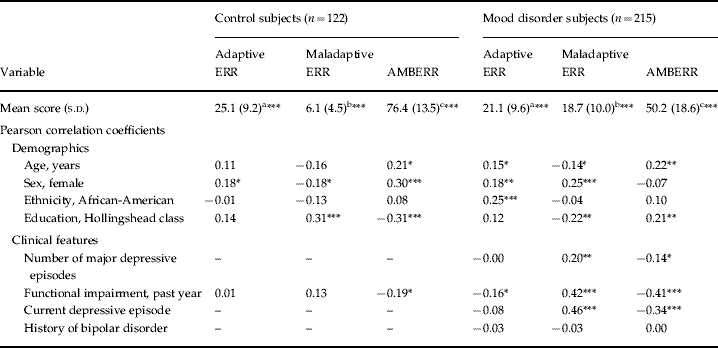
Probands differed markedly from controls across all three scores that reflect their responses to sadness (Table 1). Compared with controls, probands reported more responses that are likely to exacerbate dysphoria (higher maladaptive responses score), somewhat fewer responses that can attenuate sadness (lower adaptive responses score), and their overall mood repair repertoires were characterized by a higher ratio of maladaptive to adaptive responses (lower AMBERR scores). Probands' relatively high adaptive score suggests that they do not suffer from a deficiency of strategies that can modulate sadness. Instead, compared with controls, these young adults with histories of juvenile-onset depression report an excess of regulatory responses that are likely to worsen depressed mood. This is clearly reflected in the robust across-group difference in the AMBERR score: whereas the response repertoires of controls were characterized, on average, by a 3:1 ratio of adaptive to maladaptive strategies, this ratio was 1:1 among probands.
FAM-A score characteristics and correlations with demographic and clinical variables

FAM-A, Version A of the ‘Feelings and Me’ questionnaire; ERR, emotion-regulatory response; AMBERR, adaptive/maladaptive balance of emotion-regulatory responses; s.d., standard deviation.
a, b, c Compared by t tests.
* p<0.05, ** p<0.01, *** p<0.001.
Table 1 also summarizes associations between FAM-A scores and demographic as well as clinical variables. Controlling for the number of demographic contrasts (24 contrasts with a family-wise p<0.05), significant findings remained with regard to sex, education level and ethnic background. Namely, control women had higher AMBERR scores than did control men and mood-disordered woman had higher maladaptive emotion-regulatory response scores than did mood-disordered men; controls with higher educational levels had higher maladaptive and less favorable AMBERR scores; and African-American probands had higher adaptive scores. Five of the correlations between FAM scores and clinical variables survived the control for multiple contrasts. Higher maladaptive emotion-regulatory response scores were associated with more depressive episodes, greater functional impairment, and being in a depressive episode at the time of completing the FAM-A; lower AMBERR scores were also associated with greater impairment and currently being in a depressive episode. Notably, however, history of bipolar (versus unipolar) mood disorder was unrelated to any of the FAM-A scores. Further analyses on the proband sample (not shown in Table 1) revealed that FAM-A scores also were unrelated to age at onset of first depressive episode (all p>0.10).
We also conducted an exploratory analysis comparing probands in a depressive episode who had concurrent anxiety disorder (n=40) and currently depressed probands without anxiety disorder (n=35). These two groups did not significantly differ on any of the FAM-A scores [adaptive score, 21.6 (s.d.=9.8) v. 18.7 (s.d. 7.7); maladaptive score, 24.1 (s.d.=8.7) v. 25.8 (s.d.=7.8); AMBERR score, 43.3 (s.d.=16.5) v. 39.9 (s.d.=11.2); all p>0.10].
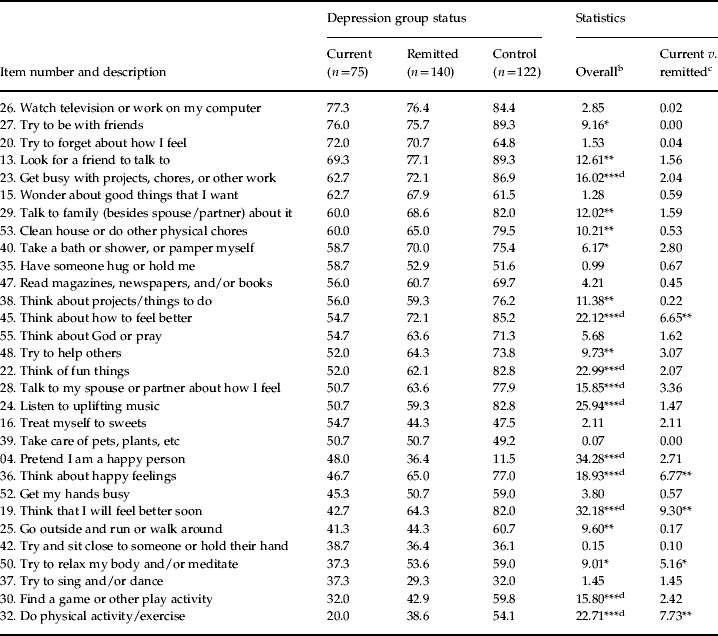
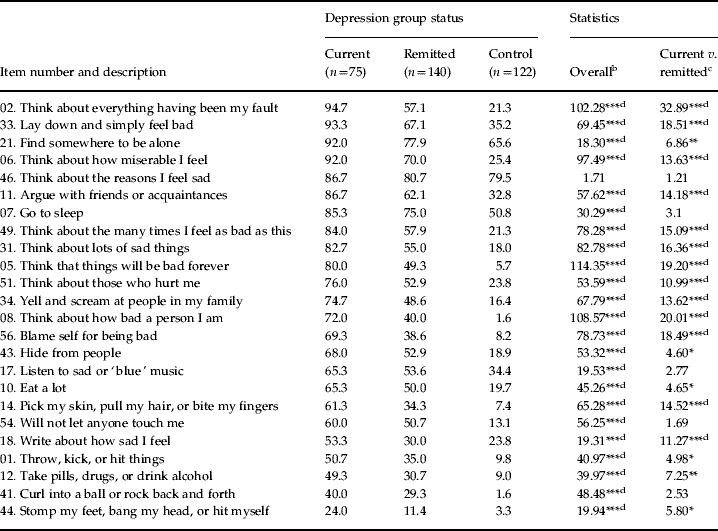
To elucidate the sources of group differences in FAM-A scores, we examined the item endorsement rates. Of the 30 adaptive regulatory responses that were queried (see Table 2), 18 were significantly more characteristic of controls, of which nine remained significant after Bonferroni correction. These nine items (more typical of controls) reflect mood repair via cognitive responses that focus on self-inducing positive emotion or responses involving active behavioral engagement. None of the differences between remitted and actively depressed probands in endorsements of adaptive responses survived Bonferroni correction. Of the 24 maladaptive responses that were queried (see Table 3), all but one were endorsed significantly more often by probands than controls and 23 out of 24 comparisons remained significant after Bonferroni correction. Of note is probands' endorsement of somatic-sensory or ‘body-oriented’ responses (e.g. pull my hair; rock myself), which are reminiscent of developmentally early distress-regulation patterns (Kovacs et al. Reference Kovacs, Joormann and Gotlib2008). Although as a group, probands therefore reported more dysfunctional mood repair repertoires, those who were currently depressed reported the most pronounced dysfunction, having endorsed 13 maladaptive responses (after Bonferroni correction) at higher rates than did their remitted peers.
Endorsement rates (%) of adaptive mood repair responsesFootnote a

a Endorsement was defined as selecting ‘sometimes’ or ‘often’ as an answer. Responses are listed in decreasing order of frequency of endorsement among subjects in current episode of depressive disorder.
b χ2(2).
c χ2(1).
d Significant (p<0.05) after Bonferroni correction for type I error.
* p<0.05, ** p<0.01, *** p<0.001.
Endorsement rates (%) of maladaptive mood repair responsesFootnote a

a Endorsement was defined as selecting ‘sometimes’ or ‘often’ as an answer. Responses are listed in decreasing order of frequency of endorsement among subjects in current episode of depressive disorder.
b χ2(2).
c χ2(1).
d Significant (p<0.05) after Bonferroni correction for type I error.
* p<0.05, ** p<0.01, *** p<0.001.
Multivariate modeling: do currently depressed and remitted probands differ in their mood repair repertoires (compared with controls)?
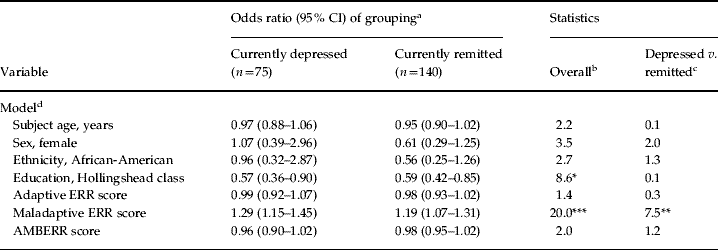
We then used multinomial logistic regression analyses to compare probands who were in a depressive episode at the time of assessment (n=75) and those in remission (n=140) versus controls (n=122), while incorporating sociodemographic variables that have been found to affect FAM-A scores (see Table 1). As the results in Table 4 indicate, in addition to lower education level increasing the odds of being a depressed proband, the maladaptive emotion-regulatory response score was a significant independent predictor of both currently depressed and remitted depressed status. Although the maladaptive score was slightly more likely to discriminate currently depressed than remitted depressed probands from controls, the findings in Table 4 show that the maladaptive regulatory response repertoires of probands differed from that of controls regardless of probands' current depression status.
Multinomial logistic regression of remitted and currently depressed proband groups versus controls

ERR, Emotion-regulatory response; AMBERR, adaptive/maladaptive balance of emotion-regulatory responses; AIC, Akaike Information Criterion fit statistic (lower is better).
a Odds ratio of group assignment versus control (n=122).
b χ2(2).
c χ2(1).
d Model fit (AIC)=514.9. Fit statistics for models with demographics and only one ER score were 678.9, 513.9 and 539.0 for adaptive ERR, maladaptive ERR and AMBERR scores respectively.
* p<0.05, ** p<0.01, *** p<0.001 for type III tests of significant effect.
Do mood repair repertoires predict future depression symptoms?
To test the hypothesis that maladaptive regulatory responses to sadness represent a risk factor for increased depression symptoms, we examined subjects who had two psychiatric assessments at least 1 year apart and had completed both the FAM-A and BDI questionnaires: this group included 73 probands and 44 controls. Because time 1 and time 2 depression symptoms (BDI scores) were highly correlated (r=0.81, p<0.001), we controlled for time 1 BDI in the analysis using a general linear model. The adaptive and AMBERR scores did not predict future (time 2) depression symptoms (adjusted F=0.01 and 0.69, respectively). However, the maladaptive score significantly predicted future depression symptoms [adjusted F(1, 114)=4.99, p=0.027] above and beyond the strong prediction offered by initial depression symptom levels.
Do mood repair repertoires predict recurrent depressive episodes?
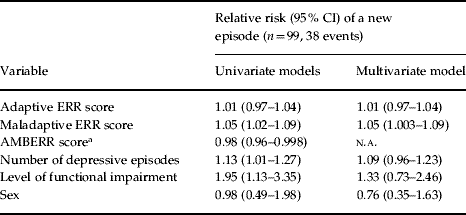
We used longitudinal analytic methods (Cox proportional hazards models) to examine if FAM-A scores predict recurrence of depressive episodes. Of the 140 probands who were not in an episode of depressive (or any other mood) disorder when they completed their FAM-A scales, 99 had follow-up clinical evaluations. Subjects without follow-up were older [27.3 (s.d.=3.3) v. 24.8 (s.d.=4.4) years, t=3.72, p<0.001], had less functional impairment [1.8 (s.d.=0.7) v. 2.2 (s.d.=0.7), t=−2.58, p=0.011], and lower maladaptive scores [12.3 (s.d.=9.9) v. 16.6 (s.d.=8.9), t=−2.52, p=0.013]. On average, time from the index assessment to last evaluation was 3.0 (range 1.0–6.6) years, with 44.4% of the probands having been followed for more than 3 years. During the follow-up period, 38 probands had a recurrent depressive episode.
In a series of univariate models of recurrent depressive episodes, we assessed the predictive value of the three global FAM-A scores, along with number of previous depressive episodes, level of functional impairment coincident with the FAM-A assessment, and sex. The maladaptive score predicted a recurrent depressive episode (i.e. relative risk per point change 1.05 [95% confidence interval (CI) 1.02–1.09], p=0.004) as did the AMBERR score in the expected direction, as well as number of previous episodes, and level of functional impairment (see Table 5). To test whether FAM-A scores can provide incremental value in prediction, we next ran a model including all the variables and found that the clinical variables were no longer significant (right-hand column in Table 5). In fact, a backward elimination procedure identified the maladaptive emotion-regulatory response score as the only independently significant predictor of depressive episode recurrence.
Longitudinal models of the risk of a recurrent depressive episode in previously remitted probands

CI, Confidence interval; ERR, emotion-regulatory response; AMBERR, adaptive/maladaptive balance of emotion-regulatory responses; n.a., not applicable.
a The AMBERR score was not included in the full multivariate model due to its collinearity with the adaptive and maladaptive scores.
Post-hoc analyses: do maladaptive cognitive and non-cognitive mood repair responses predict depression outcomes equally well?
Given the importance of cognition in affect self-regulation and the emphasis on rumination in past studies of depression (Nolen-Hoeksema et al. Reference Nolen-Hoeksema, Wisco and Lyubomirsky2008), we conducted post-hoc analyses to examine if the cognitive item set in our questionnaire was the source of the effects we found. First (using the clinician-judges' original categorizations), we computed a maladaptive cognitive score (nine items; α=0.90 and 0.70 in probands and controls, respectively; item nos. 2, 5, 6, 8, 31, 46, 49, 51, 56 in Table 3) and a maladaptive non-cognitive score (remaining 15 items in Table 3; α=0.82 and 0.71 in probands and controls, respectively). Control subjects had a significantly lower maladaptive cognitive score [2.32 (s.d.=2.02)] than did remitted [6.34 (s.d.=4.61), t=9.34, p<0.001] and currently depressed [11.08 (s.d.=4.28), t=16.61, p<0.001] probands. Likewise, the maladaptive non-cognitive score of controls [3.83 (s.d.=3.04)] was lower than that of remitted [9.04 (s.d.=5.29), t=9.92, p<0.001] and currently depressed [13.88 (s.d.=4.80), t=16.25, p<0.001] probands. Second, we used each of the new scores singly and then together in place of the FAM-A maladaptive global score in the three final models summarized above [namely: (a) logistic regression of cross-sectional depression status adjusted for age, race, sex and education; (b) general linear model of prospective depression symptoms adjusted for prior depression symptoms, and (c) Cox regression of recurrence of a depressive episode adjusted for clinical variables]. We compared nested models of the new scores using changes in −2 log-likelihood (Δ−2LL) for models with discrete outcomes and changes in variance explained (ΔR 2) for models with continuous outcomes.
We found that the newly derived maladaptive non-cognitive and cognitive scores each predicted depression status cross-sectionally (logistic regression models). Separate models for each score were statistically significant [Δ−2LL=154.75 and 150.27 for cognitive and non-cognitive scores respectively, all χ2(2), p<0.001]. Additionally, starting with the maladaptive cognitive score and adding the non-cognitive score (Δ−2LL=18.26, p<0.001) or starting with non-cognitive and then adding cognitive score (Δ−2LL=22.74, p<0.001) significantly improved the model. Thus both scores independently discriminated remitted, depressed and control groups.
When predicting future BDI after adjusting for prior BDI, the maladaptive non-cognitive score was significant [F(1, 114)=8.27, p=0.005] but the cognitive score was not significant [F(1, 114)=0.88, p=0.35]. It should be noted, however, that several items that comprise the cognitive scale refer to sad mood and, thus, that scale may share more variance with the BDI than the maladaptive non-cognitive scale. A model with both scores (still adjusting for prior BDI) was not significantly different from the model that included the maladaptive non-cognitive score [ΔR 2 <0.01, F(1, 113)=0.79, p=0.37], but was significantly better than the model with the maladaptive cognitive score [ΔR 2=0.02, F(1, 113)=8.11, p=0.005]. Thus it appears that, independent of prior depression symptoms, the association between FAM-A maladaptive total score and future depression symptoms was driven by non-cognitive mood repair items.
Finally, in proportional hazards models, each of the newly derived scores significantly predicted a recurrent depressive episode as indicated by change in Δ−2LL [5.5 and 8.7 for the maladaptive cognitive and non-cognitive scores, respectively; each χ2(1), p<0.05] with correspondingly significant parameter estimates [relative risk 1.09 (95% CI 1.02–1.16) and 1.10 (95% CI 1.03–1.18)]. A model with both scores together significantly predicted episode recurrence as well [Δ−2LL=8.7, χ2(2), p=0.01]. Comparing the model that includes both the maladaptive cognitive and non-cognitive scores with models with individual scores revealed that adding the cognitive score did not improve a model with just the non-cognitive score [Δ−2LL=0.01, χ2(1), p=0.92]. However, adding the non-cognitive score to the cognitive-score-only model showed improvement at trend level [Δ−2LL=3.2, χ2(1), p=0.07].
We also subdivided the maladaptive non-cognitive score into a five-item maladaptive interpersonal responses score and a 10-item behavioral/other responses score (based on clinicians' original judgments) and essentially replicated the above-noted results. Specifically, each maladaptive score individually predicted depression symptoms and recurrence, but no single maladaptive score consistently and significantly improved a model containing the other scores.
Discussion
Unremitting sadness is a central feature of depressive disorders, implicating impaired mood repair as a key component of these conditions. However, comparatively little is known about depressed patients' mood repair response repertories, the inventory of which would help to better characterize potential sources of mood repair failure. For example, while it has been well documented that depressed people typically ruminate about their own dysphoria, which prolongs (rather than repairs) sadness (Nolen-Hoeksema et al. Reference Nolen-Hoeksema, Wisco and Lyubomirsky2008), far less is known about non-cognitive mood repair responses that may exacerbate this negative affect state. Less successful mood repair among depression-prone than among never-depressed people also may reflect a deficiency of responses that can attenuate dysphoric affect.
To investigate these issues, we queried young adult probands with a history of childhood-onset depression and non-psychiatric controls about their mood repair responses, using a new self-report inventory that was constructed with the aid of a clinician-judge panel. We found that the mood repair response repertoires of probands systematically differed from that of non-psychiatric controls and that the dysfunctional component of these repertories also prospectively predicted depression symptoms and recurrent depressive episodes. More specifically, irrespective of whether they were euthymic or depressed at the time of assessment, probands reported typically reacting to their own sad affect with a far greater number of maladaptive responses and with somewhat fewer adaptive responses than did controls. In other words, a history of depressive episodes – rather than current depression – accounted for the proband–control group differences in mood repair response repertories. Further, probands' reports of how they managed their own sadness did not differ as a function of having experienced unipolar versus bipolar depressive episodes. Our finding of notable maladaptive affect-regulatory responses both in remitted and acutely depressed probands suggests that mood repair difficulties in the context of depression have trait-like features, consistent with a report by Joormann et al. (Reference Joormann, Siemer and Gotlib2007).
Surprisingly, however, probands also reported quite a number of regulatory responses that are believed (or have been shown) to attenuate dysphoria, suggesting that a history of depression does not necessarily imply an absolute deficiency of adaptive mood repair skills. Indeed, the lack of more dramatic across-group differences in rates of adaptive mood repair responses was unexpected particularly because probands had childhood-onset depression (having been about 10 or 11 years old, on average, at the onset of their first depressive episode). This suggests that depression may have to onset earlier than the school-age years in order for it to substantially derail the normative developmental unfolding of adaptive affect-regulatory responses.
Given that probands appear to have access to a variety of adaptive mood repair responses, one question for future research is why that repertoire is not more protective against increased risk of future depression. One possible explanation is that some responses that can attenuate dysphoria may not have the desired consequences when deployed by depression-prone individuals. The possibility of reduced efficacy of mood repair in depression-prone people is indirectly supported by a growing literature on individual differences in mood repair success (e.g. Hemenover et al. Reference Hemenover, Augustine, Shulman, Tran and Barlett2008). More direct support for this argument derives from a recent experiment, which demonstrated that although diagnosed depressed individuals were able to implement each of two cognitive mood repair responses (recall of positive autobiographical memories, experimental distraction) only one (distraction) was successful in attenuating their dysphoria (Joormann et al. Reference Joormann, Siemer and Gotlib2007).
Our findings have various implications for the clinical management and treatment of depressed patients. First, controls in the present study (compared with probands) were significantly more likely to report mood repair attempts involving the self-induction of positive affect (e.g. thinking of fun things, listening to uplifting music). While being able to draw on positive affect appears to help individuals cope with negative emotions (e.g. Tugade & Fredrickson, Reference Tugade and Fredrickson2004), there may be physiological constraints on the ability of depression-prone people to experience pleasure and related positive emotions (Nestler & Carlezon, Reference Nestler and Carlezon2006), possibly explaining why experimental mood repair via positive affect was ineffective with depressed participants (Joormann et al. Reference Joormann, Siemer and Gotlib2007). Thus, one question for future research is whether teaching depressed patients regulatory responses involving the induction of positive affect would actually help them to attenuate dysphoria.
Second, control cases also were more likely than were probands to report mood repair responses involving behavioral engagement as well as physical activity/exercise. Along with our finding that maladaptive non-cognitive (e.g. behavioral) mood repair responses predicted depression outcomes, the implications are that action may be just as important as cognition in regulating negative affect states. Notably, therefore, these findings are in harmony with the recent emphasis on interventions emphasizing behavioral activation for clinically depressed individuals (e.g. Dimidjian et al. Reference Dimidjian, Hollon, Dobson, Schmaling, Kohlenberg, Addis, Gallop, McGlinchey, Markley, Gollan, Atkins, Dunner and Jacobson2006).
Third, the fact that probands reported significantly higher use of all the maladaptive regulatory responses to dysphoria that were queried (except one), particularly when they were currently depressed, underscores the value of a broad assessment of mood repair responses rather than an exclusive focus on cognitive ones. This conclusion is supported by our post-hoc analyses, which revealed that maladaptive non-cognitive and cognitive responses to sadness represent complementary but not identical constructs, each of which predicts depression-related outcomes. In that regard, the different routes by which depression-prone individuals can maintain or exacerbate their dysphoria raise questions about the optimal approach to improving mood repair skills: should it strengthen adaptive regulatory skills and responses; should it target neutralizing or dismantling dysfunctional responses (Lam et al. Reference Lam, Smith, Checkley, Rijsdijk and Sham2003); should it focus on behavioral or cognitive domains, among others? These issues also need to be investigated.
Results of our study generally validate the perspective of clinician-judges in classifying which mood repair responses exacerbate sadness and which responses appropriately attenuate it. Grouping of affect-regulatory responses according to whether they presumably upregulate or downregulate (i.e. exacerbate or attenuate) sadness also accords with recent experimental work in affective neuroscience (e.g. Davidson et al. Reference Davidson, Lewis, Alloy, Amaral, Bush, Cohen, Drevets, Farah, Kagan, McClelland, Nolen-Hoeksema and Peterson2002; Lévesque et al. Reference Lévesque, Eugène, Joanette, Paquette, Mensour, Beaudoin, Leroux, Bourgouin and Beauregard2003). It must be granted, however, that the ‘maladaptive’ and ‘adaptive’ labels we have used to refer to responses that worsen, and those that improve sadness, may not be uniformly accepted. We nonetheless believe that these labels are clinically useful and capture the fact that depressive illness is first and foremost a disorder of functionally appropriate mood regulation. Naturally, the functional significance of any one particular mood repair response may vary depending on the context in which it is deployed and the criteria that are used to evaluate mood repair success. However, our finding that the mood repair repertoires of control subjects entailed predominantly responses that attenuate sadness, but that depression outcomes were predicted by responses that exacerbate sadness, lend some credence to the distinction between adaptive and maladaptive responses.
Our results also have implications for research on the self-regulation of dysphoria. The finding that responses to sadness that presumably worsen it can be detected in a normative group is consistent with the child development literature, indicating that both functional and dysfunctional affect-regulatory responses are learned in the course of development. However, closer study is needed of why and how maladaptive regulatory responses come to have different consequences in normative versus at-risk groups. Further, although maladaptive responses had generally low endorsement rates among controls (as could be expected), there were some exceptions, which suggest that research perspectives on mood regulation do not uniformly mirror everyday life. It is also worth noting that our results regarding age and AMBERR scores are in line with findings that affect regulation becomes increasingly adaptive as people get older (e.g. Gross et al. Reference Gross, Carstensen, Pasupathi, Tsai, Skorpen and Hsu1997; Carstensen et al. Reference Carstensen, Pasupathi, Mayr and Nesselroade2000).
Overall, this study confirms prior reports that self-rated maladaptive cognitive mood repair responses predict future depression symptom severity and that among those with histories of clinical depression, such self-reports can predict future depressive episodes (e.g. Nolen-Hoeksema et al. Reference Nolen-Hoeksema, Wisco and Lyubomirsky2008). Notably, our results also extend previous work on cognitive affect-regulatory processes and depression: we have shown that the short- and long-term clinical predictive utility of non-cognitive maladaptive responses to sadness is equivalent to (or possibly even better than) the predictive utility of maladaptive cognitive mood repair responses. Thus, future research also should encompass the study of mood repair attempts which include, for example, the use of interpersonal/social interactions or instrumental behaviors that are not primarily cognitive in nature. Greater attention to primarily non-cognitive mood repair responses may be particularly fruitful in research on pediatric depression owing to developmental constraints on the maturation of cognitive functions (e.g. Casey et al. Reference Casey, Tottenham, Liston and Durston2005).
Our results need to be considered in light of several caveats. Although the FAM-A was designed for depression research, various responses included therein presumably could regulate anxiety because depressed affect and anxious affect have in common some dynamic and temporal features. While in this study, depressed probands with and those without co-morbid anxiety had similar response profiles, additional research is needed on the relations of specific regulatory responses and distinct psychopathological states. Further, our finding that probands with unipolar and those with bipolar depression histories reported similar mood repair repertoires may be regarded as contrary to the nosologic distinction between these two forms of mood disorder, and thus needs to be replicated on a larger sample. Our study is also constrained by the fact that the FAM questionnaire is a new tool that requires further psychometric work and that because we focused on self-report, we only could address those types of responses that are accessible to conscious processing (Westen et al. Reference Westen, Muderrisoglu, Fowler, Shedler and Koren1997). The self-regulation of dysphoric affect also involves automatic responses, representing ‘over-learned habits’ that are acquired starting early in childhood (Mauss et al. Reference Mauss, Bunge and Gross2007). While research on the automaticity of perceptual processes and goal pursuit in daily life (Bargh & Chartrand, Reference Bargh and Chartrand1999) suggests that people have the capacity to report on many responses that occur automatically (e.g. rumination; Gross, Reference Gross2007), self-report cannot possibly capture the full array of processes that serve mood repair. Additionally, because our study has focused on descriptive aspects of mood repair responses, it did not address the mechanisms which may account for the relations of maladaptive responding and prospective depression outcomes. All in all, notwithstanding these constraints, our findings add to a growing clinical literature on mood repair in depressed patients (Kuehner & Weber, Reference Kuehner and Weber1999; Lam et al. Reference Lam, Smith, Checkley, Rijsdijk and Sham2003; Riso et al. Reference Riso, du Toit, Blandino, Penna, Dacey, Duin, Pacoe, Grant and Ulmer2003) indicating that vulnerability to depressive disorder is associated with problematic self-regulatory responses to sadness and that such responses can provide useful information about the course of this debilitating condition.
Acknowledgements
This work and preparation of the manuscript were partially supported by National Institute of Mental Health (NIMH) Program Project no. 5PO1 MH056193 to M.K. and no. 1R21MH077669 to J.R.
Declaration of Interest
None.